
How to Choose an Electronic Recycling Center You Can Trust
An electronic recycling center is a specialized facility built to manage the end-of-life process for your company's old technology—securely and responsibly. It’s far more than a simple disposal site. Think of it as a crucial partner for any business looking to avoid data security risks, stay compliant with environmental laws, and even recover value from retired IT assets.
Beyond the Landfill: Why Your Business Needs a Recycling Partner
When a company server, laptop, or fleet of smartphones gets old, just tossing it in a dumpster isn’t an option. Doing so opens your business up to huge liabilities, from data breaches caused by improperly wiped hard drives to hefty environmental fines for illegal dumping.
This is exactly where an electronic recycling center comes in. It transforms a complex operational headache into a structured, secure, and fully auditable process.
Imagine it’s a specialized clinic for your retired tech. Instead of being thrown out, each device is carefully triaged. Some might be healthy enough for a second life through refurbishment. Others require secure "surgery" to permanently destroy sensitive data before being broken down into their core materials. This careful, methodical approach is what separates a professional e-recycler from a general scrap metal yard.
The Escalating E-Waste Crisis
The need for these specialized centers has never been more urgent. The sheer volume of discarded electronics, known as e-waste, has ballooned into a global problem with massive security and environmental consequences. This isn't some far-off issue; it's a direct result of rapid technology cycles and the constant pressure for businesses to upgrade their infrastructure.
The numbers are pretty stark.
In 2022, the world generated an incredible 62 million tonnes of electronic waste, which is an 82% jump from 2010. Projections show this figure climbing another 32% to 82 million tonnes by 2030—a growth rate that’s five times faster than documented recycling efforts. Even more concerning, only 22.3% of this e-waste was properly collected and recycled, leaving billions in valuable resources sitting in landfills.
Transforming Risk into a Strategic Advantage
For any IT or operations leader, retired electronics represent a minefield of potential risks. Every old hard drive could hold sensitive customer data, financial records, or your company's intellectual property. Every discarded monitor or circuit board contains materials like lead and mercury that can poison the environment if not handled correctly.
To help visualize the stakes, let's compare the two paths your old equipment can take.
Risks of Improper Disposal vs Benefits of Professional Recycling
| Risk Area | Improper Disposal (Landfill/Uncertified) | Professional Electronic Recycling Center |
|---|---|---|
| Data Security | High risk of data breaches from abandoned hard drives. | Certified data destruction with documented proof of erasure. |
| Compliance | Potential for fines and legal action for violating environmental laws. | Guarantees compliance with EPA, state, and local regulations. |
| Brand Reputation | Your branded equipment could end up in a landfill, damaging your image. | Protects brand integrity with responsible, auditable processes. |
| Environmental Impact | Hazardous materials like lead and mercury contaminate soil and water. | Prevents pollution by properly recycling and managing materials. |
| Financial Value | Zero value recovery; you pay to throw away potentially valuable assets. | Identifies assets for resale, creating a potential revenue stream. |
| Chain of Custody | No documentation or tracking; you have no idea where your assets end up. | Provides a secure, documented trail from pickup to final disposition. |
As the table shows, the choice directly impacts your company's security, reputation, and bottom line.
A professional electronic recycling center tackles these challenges head-on. They provide:
- Data Security Assurance: Using certified data destruction methods to permanently erase all information and providing a Certificate of Destruction as proof.
- Regulatory Compliance: Ensuring every asset is managed according to local, state, and federal regulations, including environmental laws like the Resource Conservation and Recovery Act (RCRA).
- Brand Protection: Preventing your company's equipment from being dumped in landfills or illegally exported, which can cause serious reputational harm.
- Value Recovery: Identifying components and devices that can be refurbished and resold, which often creates revenue to offset recycling costs.
By partnering with a certified e-recycling provider, you aren't just getting rid of old equipment. You are executing a smart risk management strategy that protects your data, upholds your environmental commitments, and preserves your brand's integrity. To understand the options available, consider the key differences between various ewaste recycling centers.
Key Services of an Enterprise-Focused Recycling Partner
While the idea of an electronic recycling center might sound simple, the reality for a business is far more complex than a drop-off bin. A true enterprise partner provides a whole suite of secure, compliant, and fully auditable services. This is about managing the entire end-of-life journey for your technology, not just getting rid of it.
These specialized processes protect your company from significant risks and can even turn old equipment into a source of revenue. From a single laptop to an entire server farm, every asset is handled with precision from the moment it leaves your control.
Secure IT Asset Disposition (ITAD)
At its heart, IT Asset Disposition (ITAD) is the complete, strategic management of your retired technology. Think of it as a carefully planned exit strategy for every piece of hardware. Instead of just "disposing" of old gear, ITAD is laser-focused on maximizing its value, guaranteeing data security, and ensuring you stay compliant with environmental laws.
The process kicks off with a detailed inventory and audit of every asset. Any devices that still have market value are flagged for refurbishment and resale, which can turn a disposal cost into a check that helps offset the service fees. For equipment that has truly reached its end, the focus shifts to secure data destruction and responsible recycling. A solid ITAD program is a smart financial move, not just an operational chore.
Certified Data Destruction
This is arguably the most critical service an electronic recycling center can offer. Simply hitting "delete" or reformatting a hard drive does absolutely nothing to permanently remove sensitive information. That lingering data is a massive liability waiting to happen, making professional destruction a non-negotiable security step.
Certified partners use methods that meet strict standards like those in NIST 800-88 to guarantee data is completely sanitized. This can involve a few different approaches:
- Physical Shredding: This is the gold standard for end-of-life devices. Hard drives and other storage media are fed into a shredder that mechanically grinds them into tiny, unrecoverable pieces.
- Cryptographic Erasure: For newer drives that support it, this technique erases the media's encryption key. Without the key, the data on the drive becomes permanently scrambled and unreadable.
- Secure Wiping: Specialized software overwrites the entire drive multiple times with random data, essentially burying the original information so deep it can never be recovered.
Once a device is sanitized, a reputable recycler issues a Certificate of Destruction. This legal document is your proof that you fulfilled your compliance duties and the data is gone for good.
This flowchart shows the stark difference between improper e-waste disposal and a responsible recycling process.
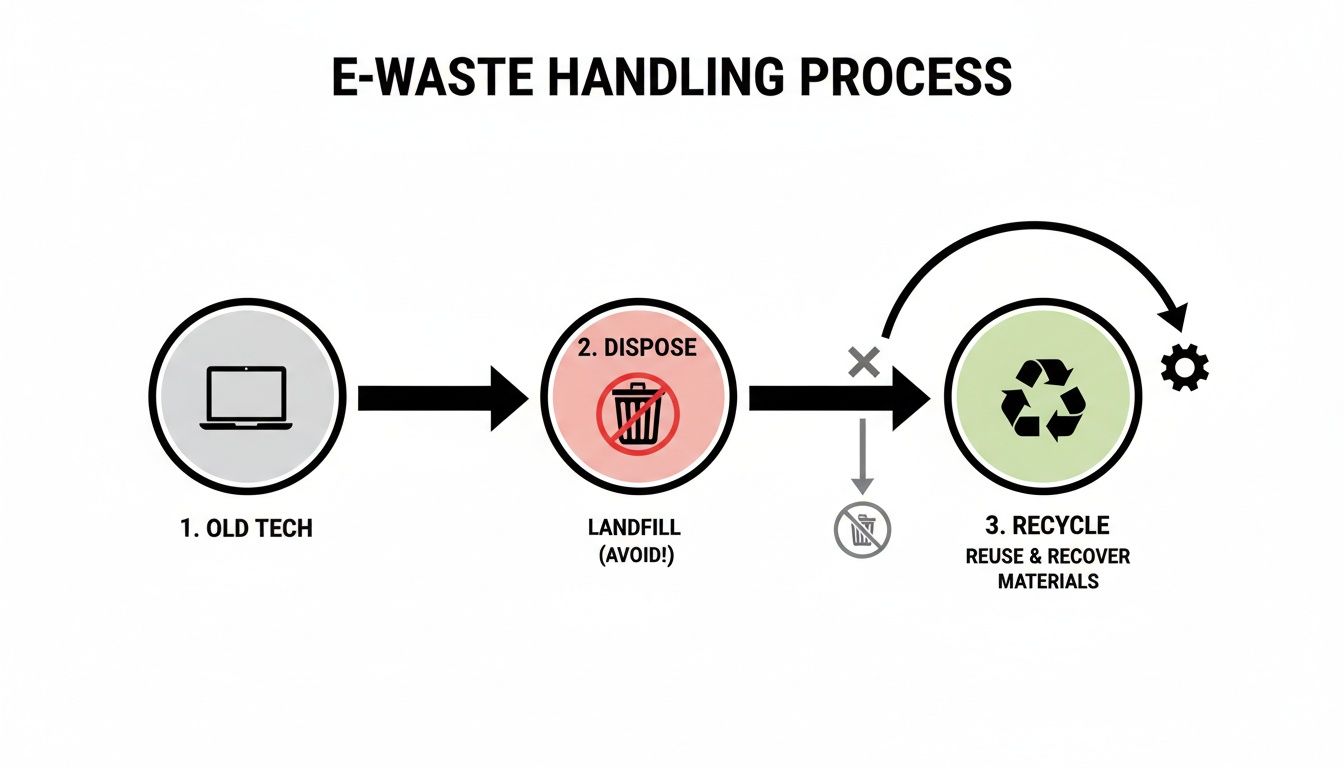
As you can see, a certified process keeps hazardous materials out of landfills and directs old technology into a secure, circular path of material recovery and reuse.
Data Center Decommissioning
Taking apart a data center is a huge logistical puzzle that demands specialized expertise. It’s a lot more involved than just unplugging servers. A professional partner manages the entire project—from cataloging assets and wiping data on-site to physically removing servers, racks, networking gear, and all the supporting power infrastructure.
This service is essential for companies moving to the cloud, consolidating facilities, or upgrading their hardware. The whole process is designed to cause minimal disruption to your daily operations, all while maintaining a secure chain of custody for every single asset that leaves the building.
Specialized Equipment Recycling
Not all electronics are the same. Industries like healthcare and scientific research use highly specialized equipment that has its own unique set of disposal rules. For instance, a hospital replacing MRI machines or a lab retiring analytical tools must follow strict regulations covering sensitive patient data (HIPAA) and hazardous materials.
A top-tier electronic recycling center has the expertise to handle this specialized equipment. They understand the unique compliance requirements and have the processes in place to safely decontaminate, dismantle, and recycle medical and laboratory devices, providing the necessary documentation to satisfy regulatory audits.
By providing these core services, a recycling partner delivers more than just disposal—they offer a comprehensive risk management solution. You can see a full list of professional computer recycling services to get a better idea of how they can support your organization's IT strategy.
Understanding E-Waste Compliance and Certifications
When it comes to getting rid of old electronics, it’s not as simple as just having someone haul the equipment away. Your company is legally on the hook for those assets long after they’ve left your building, making compliance a huge piece of your risk management puzzle. Using a non-certified vendor is like handing your company’s financial records to a total stranger—the potential for a costly disaster is massive.
This responsibility is tied to a complex web of regulations. At the federal level, the Environmental Protection Agency (EPA) has strict rules for handling the hazardous materials inside electronics. State and local laws often add even more requirements. And for industries like healthcare or finance, mandates like HIPAA demand absolute, verifiable proof that all data was destroyed to protect sensitive information.
Why Certifications Are Non-Negotiable
This is exactly why industry certifications are so vital. They aren't just logos to make a website look good; they are proof that an electronic recycling center has passed rigorous, independent audits of its processes for data security, environmental safety, and worker health. Think of them as a seal of approval that guarantees the recycler operates at the highest industry standard.
The two most recognized and respected standards in our industry are R2v3 and e-Stewards. While they have their differences, both are designed to give your organization complete peace of mind.
- R2v3 (Responsible Recycling): This certification covers the entire lifecycle of an electronic device. It sets strict requirements for environmental protection, data security, and the health and safety of employees. An R2v3 certified facility has to prove it tracks all materials, ensures its downstream partners are also certified, and has rock-solid systems to prevent data breaches.
- e-Stewards: Developed by the Basel Action Network, this standard is especially known for its tough rules against exporting hazardous e-waste to developing nations. It also places a heavy emphasis on data security and environmental responsibility, making it another gold standard for business clients.
Choosing a partner with these credentials fundamentally changes your risk profile. It transforms the burden of compliance from a source of anxiety into a managed, documented process you can fully trust.
The Importance of a Secure Chain of Custody
Beyond the certifications themselves, the concept of a secure chain of custody is what truly shields your organization from liability. This is the unbroken, documented audit trail that follows every single asset from the moment we pick it up to its final disposition. It’s the official story of your old equipment, written with serial numbers, dates, and signatures.
A secure chain of custody provides a verifiable, legally defensible record that proves your company acted responsibly. It answers the critical questions an auditor might ask: Where did this server go? How was its data destroyed? Can you prove it?
This detailed documentation is your ultimate safeguard. A professional electronic recycling center will provide serialized reporting and a final Certificate of Destruction. This certificate is more than just a piece of paper; it’s your legal proof that every hard drive was wiped or shredded according to standards like NIST 800-88, officially transferring liability away from your company.
Without this documented trail, you have no way to prove you met your legal and ethical obligations. You can learn more about how a top-tier partner becomes a R2 certified electronics recycler by reviewing the rigorous standards they must meet.
The Strategic Value of Responsible E-Waste Management
Choosing an electronic recycling partner is more than just an operational task—it’s a strategic business decision. Too often, companies see e-waste management as a simple cost center, a box to check off. But that mindset misses a huge opportunity. It’s better to view it as a powerful tool for improving your bottom line, boosting your environmental credentials, and strengthening your brand.
This changes the entire conversation. Instead of asking, "How do we get rid of this stuff?" the question becomes, "How can this process create value for our business?" The answer is found in a professional, certified approach that turns retired assets from a liability into a real advantage.
Turning Costs into Revenue Streams
The most direct benefit is financial. A well-run ITAD (IT Asset Disposition) program, managed by a certified expert, is built to squeeze every last drop of value from your old equipment. Not every device is destined for the shredder; many components and even whole units can be securely refurbished and sold on the secondary market.
This process creates a new revenue stream that can easily offset—or even exceed—the costs of recycling and data destruction. By reselling usable assets, you’re participating in the circular economy, giving technology a second life and capturing value that would otherwise be buried in a landfill.
The numbers here are staggering. The global electronic waste recycling market was valued at $70.1 billion in 2024 and is projected to hit $251.9 billion by 2034. A huge part of that is driven by material recovery—in 2022 alone, the e-waste generated contained an estimated $62 billion worth of valuable metals.
This data makes the financial case crystal clear: responsible recycling isn’t just an expense; it’s an investment in recovering valuable resources.
Bolstering Your Environmental and Social Governance Profile
These days, a company’s commitment to Environmental, Social, and Governance (ESG) principles is under a microscope. Investors, customers, and even your own employees are paying close attention. How your organization handles its e-waste is a very visible, very real part of your environmental story.
Dumping old electronics in a landfill sends a terrible message. When hazardous materials like lead, mercury, and cadmium leach into the soil and groundwater, they cause lasting ecological harm.
Partnering with a certified e-recycling center directly tackles these issues:
- Prevents Pollution: It ensures that toxic materials are handled safely and kept out of our environment.
- Conserves Resources: It recovers valuable materials like gold, silver, copper, and aluminum, which reduces the need for destructive new mining.
- Reduces Carbon Footprint: Reusing and recycling electronics takes far less energy than manufacturing new products from scratch.
When you adopt a responsible recycling policy, you create a powerful, positive story for your ESG reports and marketing. It’s a tangible demonstration of your commitment to sustainability, which builds brand trust and connects with modern consumers. To learn more about this positive impact, check out our guide on the primary benefits of e-waste recycling. This isn't just about compliance; it's about turning a responsibility into a compelling brand asset.
How to Vet and Select the Right Recycling Partner
Choosing the right electronic recycling partner is one of the most important decisions an IT leader can make. This isn't just about hauling away old equipment; it's about entrusting a vendor with your company's data security, environmental compliance, and brand reputation.
A thorough vetting process ensures you select a partner that acts as a true extension of your team, mitigating risk at every step of the way.

This decision demands a structured approach. You need to move beyond a simple price comparison and dig into the operational details that separate a premier provider from a potential liability. By asking the right questions, you can confidently identify a partner that safeguards your assets from pickup to final disposition.
Start with Verifying Certifications
First things first: verify their industry certifications. These aren't just optional badges; they are proof that an electronic recycling center adheres to the highest standards for security and environmental stewardship.
Look for two key credentials: R2v3 and e-Stewards. A certified partner has undergone rigorous, third-party audits of their entire operation, confirming they have:
- A secure process for handling and tracking all equipment.
- Protocols for complete and verifiable data destruction.
- Safe and responsible management of hazardous materials.
- A commitment to not illegally export toxic e-waste.
Never take a vendor's claim of certification at face value. Always ask for their certificate number and verify it directly on the official R2 or e-Stewards websites. This simple check is your first line of defense against non-compliant operators.
This initial step filters out unqualified vendors immediately, allowing you to focus your attention on partners who have already proven their commitment to industry best practices. Without these foundational credentials, you are exposing your organization to unnecessary risks.
Scrutinize Data Security Protocols
Once certifications are confirmed, your next focus must be on data security. A data breach from a retired asset is just as damaging as one from your live network. Your potential partner must demonstrate an unshakeable commitment to protecting your sensitive information.
Ask for explicit details on their data destruction methods. Do they follow NIST 800-88 guidelines? A top-tier provider should offer multiple secure options, including physical shredding and cryptographic erasure, and be able to explain which method is best for different types of media.
Their security measures should also extend beyond the machinery. Investigate their facility's physical security, including access controls, surveillance, and employee background checks. Every link in the chain of custody must be secure. For a deeper understanding, it's helpful to compare various IT asset disposition companies and their security frameworks.
Assess Logistics and Reporting Transparency
For businesses with multiple locations, logistics are a major factor. A capable partner should offer nationwide pickup capabilities with secure, GPS-tracked transportation. They need to demonstrate experience in handling complex projects, like multi-site office cleanouts or complete data center decommissioning.
Transparency is just as important as logistics. A reliable partner will provide detailed, serialized reporting for every single asset they handle. This isn't just a summary; it's a granular audit trail that tracks each device by serial number from pickup to its final state—whether it was resold, recycled, or destroyed.
You should expect and demand a Certificate of Destruction for all data-bearing devices. This document is your official, legally defensible proof that your data was permanently eliminated, closing the loop on your compliance responsibilities. A vendor who can’t provide this is a significant red flag.
Vendor Vetting Checklist for Electronic Recycling Partners
To make this process easier, we've put together a checklist to guide your conversations with potential partners. Use these questions to systematically evaluate each vendor and ensure you cover all critical areas.
| Evaluation Criteria | Key Questions to Ask | Ideal Partner Response / Red Flags to Watch For |
|---|---|---|
| Certifications & Compliance | Are you R2v3 or e-Stewards certified? Can you provide your certificate number for verification? How do you ensure compliance with environmental regulations like EPA and state laws? | Ideal: Provides certificate numbers immediately. Explains their internal compliance and audit processes clearly. Red Flag: Vague answers, claims "certification is pending," or can't produce a valid certificate. |
| Data Security & Destruction | What are your data destruction methods? Do you follow NIST 800-88 guidelines? Can you describe your facility's physical security measures (access control, surveillance)? | Ideal: Details multiple destruction methods (shredding, wiping). Confirms NIST adherence and describes layered physical security. Red Flag: Only offers one method, seems unfamiliar with NIST, or has weak facility security. |
| Logistics & Chain of Custody | What is your process for secure transportation? Do you use your own fleet or a third party? How do you maintain chain of custody from pickup to final disposition? | Ideal: Describes secure, GPS-tracked transport, vetted employees, and a documented chain-of-custody process for every asset. Red Flag: Uses unvetted third-party couriers, lacks tracking, or cannot clearly explain their custody process. |
| Reporting & Documentation | What level of detail is included in your asset reports? Do you provide serialized reporting? Can we get a sample Certificate of Destruction? | Ideal: Offers detailed, serialized reports and provides a sample certificate that includes serial numbers, destruction method, and date. Red Flag: Provides only summary-level reports, charges extra for detailed documentation, or offers a generic certificate. |
| Environmental Responsibility | What happens to non-reusable materials? Can you trace materials to their final downstream destination? Do you have a "no landfill" policy? | Ideal: Has a clear policy for responsible recycling, a vetted downstream partner network, and a firm no-landfill commitment. Red Flag: Unsure about downstream partners or admits that some non-hazardous materials may be landfilled. |
By walking through this checklist, you'll be able to compare vendors apples-to-apples and make a decision based on risk management and operational excellence, not just price.
Common Questions About Electronic Recycling Services
When it comes to IT asset disposition, business leaders have a lot of questions. And for good reason. You're dealing with sensitive data, valuable equipment, and environmental regulations. Before you hand over your retired assets, you need clear, straightforward answers.
Here’s a look at the most common concerns we hear from businesses just like yours.
How Can I Be Certain Our Sensitive Data Is Destroyed?
This is, without a doubt, the number one question on every IT manager's mind. A professional electronic recycling center doesn't just promise data destruction; they prove it. For every single drive or device with a serial number, you should receive a formal Certificate of Destruction. This isn't just a piece of paper—it's your legal proof of compliance.
Make sure your partner uses auditable destruction methods that meet federal standards like NIST 800-88. The gold standard is physical shredding, which leaves no room for error. For an extra layer of security, many top-tier providers offer on-site destruction services, allowing you to watch them physically shred your hard drives before the equipment ever leaves your building.
What Actually Happens to Our Equipment?
Once your assets are picked up, they’re taken to a secure facility for a full audit and triage. The first goal is always to see what can be reused. Devices with life left in them are securely data-wiped, tested, refurbished, and prepared for resale. This is the most environmentally friendly option, and it helps you recover value from your initial investment.
Equipment that's truly at its end of life is carefully taken apart, or "de-manufactured," right down to its basic materials. The commodities inside—metals, plastics, circuit boards, and glass—are then sent to certified downstream partners who specialize in refining them. These raw materials can then be used to make new products. A transparent partner will provide a complete chain-of-custody report showing you exactly where everything went.
Is Using a Professional E-Recycling Service Expensive?
It’s better to think of professional e-recycling not as a cost, but as an investment in protecting your business. The potential price tag of a data breach or a fine for improper disposal can be catastrophic, easily dwarfing the service fees. You're paying for peace of mind and risk mitigation.
Better yet, the process can often pay for itself. When you have newer equipment that can be remarketed, the value recovered can frequently offset or even exceed the cost of recycling. This can turn what seems like an expense into a budget-neutral or even revenue-generating project. It’s also about contributing to a more sustainable system. For example, Europe manages to recycle 42.8% of its e-waste, showing how effective infrastructure can turn old tech back into valuable resources. You can discover more insights about global recycling rates to see how different regions are tackling the challenge.
At Dallas Fortworth Computer Recycling, we provide the secure, compliant, and transparent electronic recycling services your organization needs. Our certified processes ensure your data is destroyed, your brand is protected, and your environmental obligations are met. Learn more about our nationwide IT asset disposition solutions at https://dallasfortworthcomputerrecycling.com.