
10 Critical Benefits of E-Waste Recycling for Modern Organizations in 2026
In 2026, the global volume of electronic waste is projected to exceed 75 million metric tons, creating unprecedented challenges for organizations responsible for retiring technology. While many IT leaders view e-waste disposal as a simple operational task, it represents a critical intersection of risk, cost, and opportunity. Improperly handled, retired IT assets become significant liabilities, exposing sensitive data, violating environmental regulations, and damaging public trust.
However, a strategic approach transforms this challenge into a powerful advantage. This article explores the 10 essential benefits of e-waste recycling, moving beyond surface-level environmentalism to reveal how a certified IT Asset Disposition (ITAD) partner like Dallas Fortworth Computer Recycling converts retired technology into a source of measurable value. We will detail how a professionally managed program delivers tangible results across multiple business functions.
From mitigating multi-million dollar data breach fines to generating revenue and strengthening your brand's commitment to sustainability, these insights provide a comprehensive framework for turning your e-waste from a liability into a strategic asset. You will learn how to:
- Secure sensitive data through certified destruction methods.
- Comply with complex environmental and data privacy regulations.
- Recover value from retired equipment through responsible remarketing.
- Strengthen your organization's environmental, social, and governance (ESG) profile.
Each point is designed to equip IT directors, procurement managers, and sustainability officers with the data and actionable steps needed to build a secure, compliant, and value-driven disposition program. Let's examine the specific advantages that make professional e-waste recycling a critical component of modern IT management.
1. Material Recovery and Reduced Mining Impact
One of the most significant environmental benefits of e-waste recycling is the direct recovery of valuable materials from discarded electronics. IT assets are rich sources of precious metals like gold, silver, and copper, as well as aluminum and rare earth elements. Recycling these devices converts what would be waste into a valuable stream of raw materials, dramatically reducing the need for destructive and resource-intensive mining operations.
Producing electronics from recycled materials consumes significantly less energy and water compared to extracting virgin ore. For instance, processing one ton of electronic waste can yield the same amount of gold as processing over 29 tons of raw ore. This direct substitution preserves natural ecosystems, cuts the massive carbon emissions associated with mining, and transforms IT asset disposition from a cost center into a source of measurable value.
Real-World Impact and Implementation
Major corporations are already demonstrating the immense value of this practice. Apple’s 2022 sustainability report highlighted that its recycling efforts eliminated the need to mine over 31,000 tons of minerals. Similarly, Dell's commitment to using recycled materials has reduced its reliance on virgin mining by more than 100,000 tons annually. This approach proves that sustainable IT management is not just an environmental goal but a sound economic strategy.
Actionable Strategies for Your Organization
To leverage these benefits, organizations can take several concrete steps:
- Partner with Certified Experts: Work with an R2v3 or e-Stewards certified recycler that provides detailed material recovery reports. This ensures transparency and provides auditable data for your sustainability reporting.
- Track Asset Value: Document the precious metal content of your IT assets before disposition to get an accurate valuation and maximize your return on retired equipment.
- Calculate Embodied Carbon: Use the data from recovery reports to calculate the embodied carbon reduction your organization achieves through recycling, strengthening your ESG (Environmental, Social, and Governance) metrics.
By implementing a strategic recycling program, your organization directly contributes to a circular economy. Dallas Fortworth Computer Recycling offers comprehensive services that maximize material recovery, helping you meet sustainability goals and secure your data. Explore our shred and recycle services to learn how we turn your e-waste into a valuable resource.
2. Reduction of Toxic Substances in Landfills and Groundwater
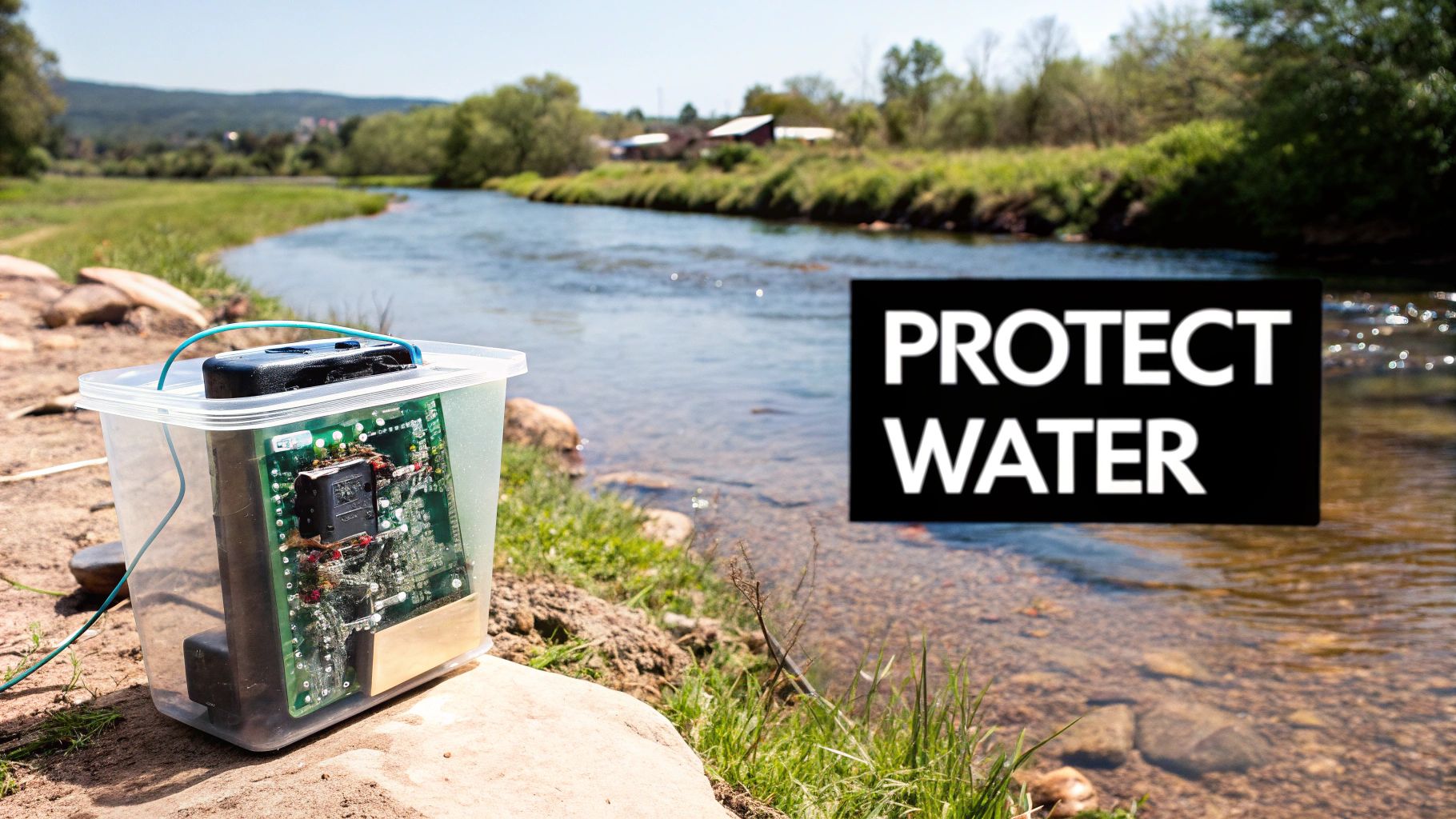
Beyond recovering valuable materials, a critical benefit of e-waste recycling is preventing hazardous substances from contaminating our environment. Discarded electronics often contain toxic materials like lead, mercury, cadmium, and brominated flame retardants. When sent to a landfill, these toxins can leach into the soil and seep into groundwater, posing a severe threat to public health and delicate ecosystems.
Responsible recycling intercepts these devices, ensuring hazardous components are safely managed and disposed of according to strict environmental protocols. This process neutralizes the environmental risk posed by old IT assets, transforming a potential liability into a proactive step toward corporate environmental stewardship. Proper handling of these substances is not just a best practice; it is essential for safeguarding community water supplies and meeting environmental protection regulations.
Real-World Impact and Implementation
The impact of proper e-waste management is well-documented. For instance, California’s Electronic Waste Recycling Act of 2003 has successfully prevented hundreds of thousands of tons of hazardous materials from entering landfills. Globally, the Basel Convention works to stop the export of toxic e-waste to developing nations that lack the infrastructure for safe disposal. Healthcare systems also demonstrate leadership by partnering with certified recyclers to ensure that medical equipment containing mercury and lead is handled properly, preventing local water contamination.
Actionable Strategies for Your Organization
Your organization can actively prevent environmental contamination by implementing robust IT asset disposition policies:
- Choose Certified Recyclers: Partner exclusively with R2v3 or e-Stewards certified recyclers. These certifications guarantee that hazardous materials are managed and disposed of in compliance with the highest environmental and safety standards.
- Conduct Environmental Audits: Regularly review your current IT disposal practices to identify any risks of improper hazardous waste handling and ensure full compliance with environmental laws.
- Demand Chain-of-Custody Documentation: Require your recycling partner to provide detailed chain-of-custody reports. This documentation serves as auditable proof that your e-waste was managed responsibly from pickup to final disposition.
- Incorporate Metrics into ESG Reporting: Use data from your recycling program to report on the volume of hazardous materials diverted from landfills, strengthening your organization's ESG profile.
By taking these steps, you protect the environment and mitigate significant compliance risks. Dallas Fortworth Computer Recycling adheres to rigorous standards for hazardous material management, ensuring your retired assets never become an environmental liability. You can learn more about the environmental impact of electronic waste and how our certified processes provide a secure and compliant solution.
3. Cost Reduction Through Certified Data Destruction and Risk Mitigation
Beyond material recovery, one of the core financial benefits of e-waste recycling is the significant cost reduction achieved through certified data destruction and risk mitigation. Mishandling IT assets containing sensitive data exposes organizations to catastrophic financial liabilities, including regulatory fines, litigation costs, and severe reputational damage. A certified recycling process transforms this risk into a managed, documented, and secure procedure that protects the bottom line.
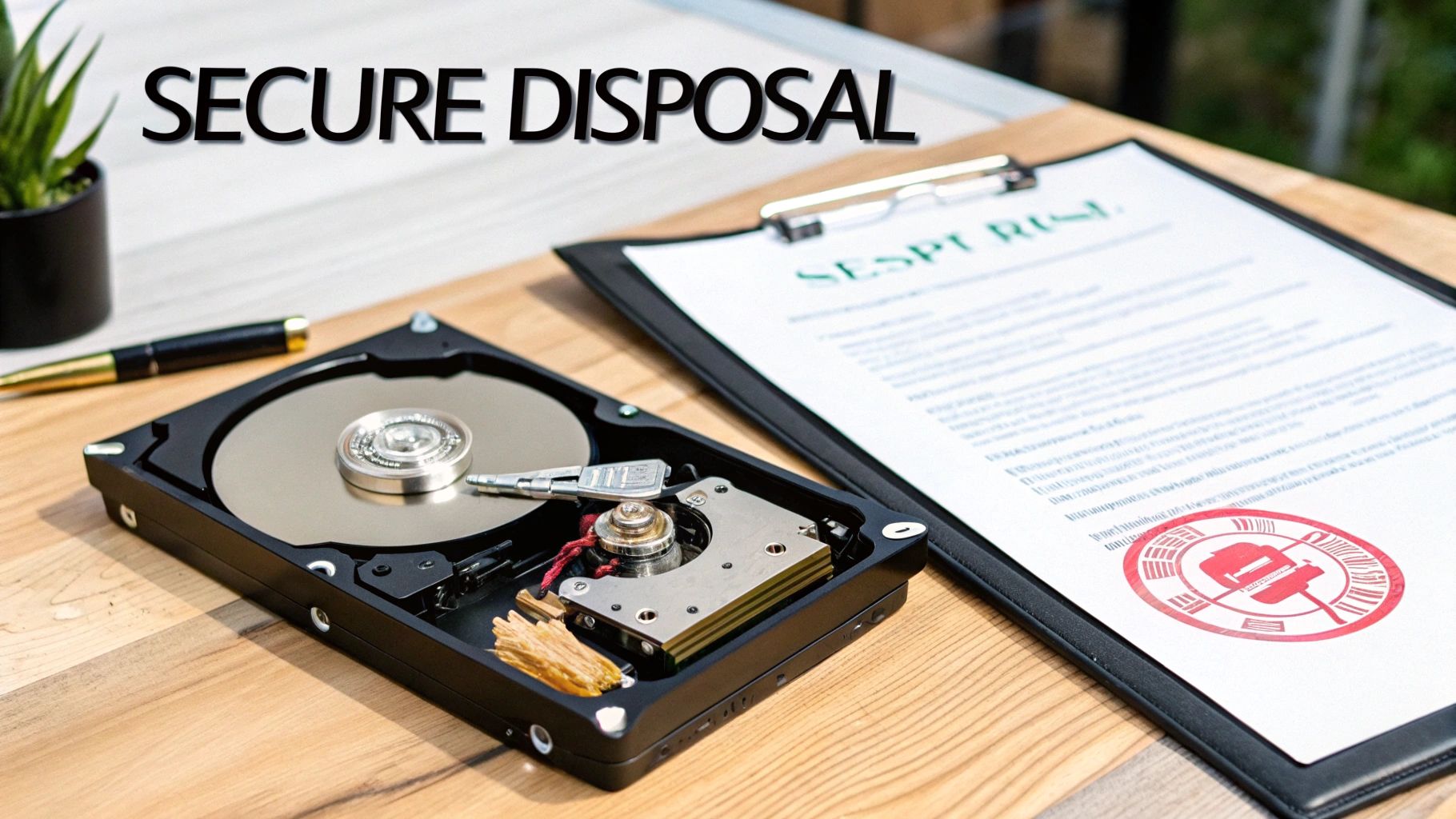
Securely destroying data isn't an operational expense; it's a crucial investment in preventing high-cost failures. For example, the average cost of a healthcare data breach reached $10.93 million in 2022, an expense often preventable with proper device disposal protocols. Following standards set by NIST and using certified partners provides a verifiable defense against such incidents, turning asset disposition into a shield against financial and legal threats.
Real-World Impact and Implementation
The financial consequences of inadequate data handling are well-documented. In 2013, the Target data breach, which led to an $18.5 million settlement, was initiated through an insecure vendor with network access, highlighting the importance of third-party risk management. Similarly, a £20 million GDPR fine was levied against UK Airways partly due to insufficient data security measures. These cases underscore that certified data destruction is a non-negotiable component of modern risk management, safeguarding a company's financial stability.
Actionable Strategies for Your Organization
To mitigate risks and reduce costs associated with data-bearing assets, organizations should implement the following:
- Require a Certificate of Data Destruction: For every IT asset disposition engagement, demand a serialized Certificate of Data Destruction. This document serves as legal proof that your organization met its data security obligations.
- Establish Asset Tagging: Implement an IT asset tagging system that links specific devices to their corresponding data destruction records, creating a clear and auditable chain of custody.
- Update Vendor Agreements: Include specific, certified data destruction requirements that meet NIST 800-88 standards in all vendor service level agreements (SLAs) for IT services.
- Schedule Compliance Audits: Make the review of data destruction documentation a standard part of your internal and external compliance audit cycles to ensure ongoing adherence.
By integrating these practices, your organization can avoid costly breaches and demonstrate due diligence. Dallas Fortworth Computer Recycling provides certified data destruction services that meet the highest industry standards. Discover how our process provides the documentation you need with our detailed explanation of a certificate of destruction for hard drives.
4. Revenue Generation from IT Asset Recovery and Resale
Beyond simple disposal, a strategic IT Asset Disposition (ITAD) program transforms e-waste from a liability into a direct revenue stream. Many retired assets, such as servers, networking equipment, and computers, retain significant market value. By partnering with a certified specialist, organizations can tap into refurbishment and resale channels, recovering a portion of their initial investment and offsetting the costs of a technology refresh.
This process involves remarketing functional equipment to secondary markets where it can serve new purposes. The financial return depends on factors like the asset's age, condition, and current market demand. This approach not only generates revenue but also extends the useful life of electronics, creating a clear win for both an organization's budget and the principles of a circular economy. It’s a key financial advantage among the many benefits of e-waste recycling.
Real-World Impact and Implementation
The financial returns from IT asset recovery can be substantial. Major corporations often see annual returns of $2-5 million from large-scale IT refreshes. Similarly, data center decommissioning projects can successfully recover 20-30% of the original equipment investment through certified resale. These funds can be reinvested into new technology, support other departmental budgets, or even be channeled into community initiatives, turning end-of-life hardware into a tangible asset.
Actionable Strategies for Your Organization
To maximize the financial return from your retired IT assets, implement the following strategies:
- Maintain a Detailed Inventory: Keep a comprehensive record of your IT assets, including acquisition dates, specifications, and current functional status, to facilitate accurate and swift valuation.
- Batch Assets Strategically: Coordinate your IT refresh schedules to consolidate retired equipment into larger batches, which often yields a higher total recovery value and streamlines logistics.
- Demand Transparent Valuation: Partner with an ITAD provider that offers a clear and transparent valuation methodology, ensuring you understand how your assets are priced and get a fair market return.
- Prioritize Value for Donations: For lower-value equipment, consider donating it to nonprofits. This can provide valuable tax deductions while directly supporting community and educational programs.
By treating retired IT equipment as a potential asset, your organization can create a self-funding mechanism for its disposition program. Dallas Fortworth Computer Recycling provides expert valuation and remarketing services that ensure you receive the maximum possible return on your retired hardware. Discover how our asset recovery services can turn your e-waste into a financial gain.
5. Compliance with Environmental and Data Protection Regulations
Navigating the complex web of environmental and data privacy laws is a critical challenge for any organization. One of the most important benefits of e-waste recycling is its role in ensuring compliance with these regulations. Disposing of IT assets improperly can lead to severe penalties for violating laws like the EPA's Resource Conservation and Recovery Act (RCRA), state-specific e-waste rules, and stringent data protection mandates such as HIPAA, GDPR, and PCI-DSS.
A certified recycling partner provides a documented, auditable process for asset disposition, transforming a significant compliance risk into a managed and verifiable activity. This process ensures that hazardous materials are handled according to environmental laws and that all data-bearing devices are sanitized or destroyed in line with privacy standards. This documented proof of compliance is essential for avoiding fines, legal action, and reputational damage associated with regulatory violations.
Real-World Impact and Implementation
The financial and legal stakes are incredibly high. For instance, in 2023, GDPR fines for data handling violations, including improper data destruction, totaled over €1.4 billion. Similarly, HIPAA audits frequently target the IT asset disposition practices of healthcare entities, with violations leading to multi-million dollar penalties. Government contractors must also adhere to strict FedRAMP requirements for data center decommissioning, where non-compliance can result in loss of federal contracts. Partnering with a certified recycler provides a shield against these significant liabilities.
Actionable Strategies for Your Organization
To ensure your ITAD program meets all regulatory requirements, consider these steps:
- Conduct a Compliance Gap Analysis: Review your current IT asset disposition processes against relevant regulations (e.g., state laws, HIPAA, GDPR) to identify potential vulnerabilities.
- Verify Recycler Certifications: Before selecting a vendor, confirm they hold active R2v3 or e-Stewards certifications, which are the gold standard for compliant and secure processing.
- Integrate Compliance into Contracts: Include specific compliance requirements, such as documented data destruction and adherence to environmental laws, directly into your service level agreements (SLAs) with your recycling partner.
- Request Compliance Documentation: Require your vendor to provide certificates of destruction and recycling for every batch of assets, and integrate this documentation into your annual audit preparation.
By embedding regulatory compliance into your e-waste strategy, you protect your organization from legal and financial risks. Dallas Fortworth Computer Recycling is an R2v3 certified recycler committed to upholding the highest standards of regulatory adherence. Understand how our R2 Certified Electronics Recycler processes can safeguard your organization.
6. Support for Circular Economy and Sustainable Supply Chain Models
E-waste recycling is a cornerstone of the circular economy, an economic model that replaces the linear "take-make-dispose" system with one based on reuse, refurbishment, and material recovery. Instead of becoming waste, retired electronics are transformed into valuable resources for new products. This approach creates a more resilient and sustainable supply chain by reducing dependence on volatile global markets for virgin raw materials.
By integrating recycled materials back into manufacturing, companies can lower production costs, mitigate supply chain risks, and meet growing consumer and investor demand for sustainable practices. This model not only conserves natural resources but also strengthens brand reputation. Embracing this benefit of e-waste recycling allows an organization to actively participate in building a closed-loop system where assets retain their value long after their initial use.
Real-World Impact and Implementation
Leading technology companies have successfully pioneered circular supply chains. Dell’s closed-loop recycling program, for instance, uses plastic from old electronics to manufacture new computer chassis, demonstrating a scalable model for material reuse. Similarly, HP’s Planet Partners program facilitates the circular recycling of ink and toner cartridges, significantly cutting down its reliance on virgin plastic. These initiatives, along with broader frameworks like the EU’s Circular Economy Action Plan, highlight the shift toward sustainable production as a global standard.
Actionable Strategies for Your Organization
To embed circular principles into your operations, consider these targeted strategies:
- Establish Circular Procurement Policies: Update your procurement guidelines to prioritize suppliers who use recycled content and offer robust take-back or recycling programs for their products.
- Integrate Lifecycle Management: Coordinate IT refresh cycles with refurbishment and remarketing timelines to maximize the secondary-use value of devices before they enter the recycling stream.
- Track Material End-Use: Partner with a certified recycler that can provide detailed documentation on where recovered materials are sent, ensuring they re-enter the manufacturing supply chain and support your sustainability reporting.
- Include Circular Metrics in Contracts: Add clauses to vendor and service level agreements that require reporting on recycling rates, material recovery, and adherence to circular economy principles.
A strategic approach to IT asset disposition is crucial for building a circular supply chain. Dallas Fortworth Computer Recycling ensures that your retired assets are processed responsibly, maximizing material recovery and providing the transparent reporting needed to support your ESG goals. Discover our certified electronics recycling services to see how we help close the loop.
7. Job Creation in Green Technology and Skilled Recycling Services
Beyond environmental and data security advantages, a significant community benefit of e-waste recycling is its role as a powerful engine for local economic development. The process of collecting, sorting, refurbishing, and recycling electronic assets is labor-intensive and requires a skilled workforce. By choosing responsible recycling, organizations directly support the creation of stable, well-paying jobs in the growing green technology sector.

These roles range from logistics specialists and collection drivers to skilled technicians who repair and remarket devices, and plant workers who operate sophisticated machinery to recover valuable materials. This industry provides crucial employment opportunities and fosters workforce advancement through specialized training programs, transforming IT asset disposition into a direct investment in community prosperity and skilled labor.
Real-World Impact and Implementation
The economic impact of the e-waste recycling industry is substantial and growing. Projections from the U.S. Environmental Protection Agency (EPA) suggest the sector could support over 75,000 jobs by 2030. Globally, the industry already employs more than 1.7 million workers. In regions like Japan, the recycling industry not only provides over 150,000 jobs but also offers wages that are, on average, 15% higher than the national average. This demonstrates that a commitment to recycling is also a commitment to building a resilient and skilled local workforce.
Actionable Strategies for Your Organization
To ensure your ITAD program contributes to local economic growth, consider these steps:
- Prioritize Local Partners: Select a certified recycler, like Dallas Fortworth Computer Recycling, that is committed to hiring and training within the local community, keeping economic benefits in your region.
- Request Employment Metrics: Ask potential recycling partners for data on their job creation, employee training programs, and local economic impact to inform your selection process.
- Highlight Community Impact: Incorporate the job creation aspect of your recycling program into your corporate social responsibility (CSR) and ESG reports to showcase your commitment to community well-being.
- Support Workforce Development: Participate in or promote local workforce development initiatives that provide training for green technology jobs, further strengthening the skilled labor pool.
By intentionally partnering with recyclers who invest in their local workforce, your organization can extend the positive impact of its sustainability efforts far beyond environmental metrics. Dallas Fortworth Computer Recycling is proud to contribute to the Texas economy by creating skilled jobs. Connect with us to learn how your IT asset disposition can support both environmental and community goals.
8. Reduced Carbon Footprint and Climate Change Mitigation
One of the most powerful benefits of e-waste recycling is its direct impact on reducing an organization's carbon footprint. The lifecycle of an electronic device, from raw material extraction to manufacturing and disposal, is incredibly carbon-intensive. Recycling and refurbishment programs break this linear, high-emission cycle by creating a circular flow of resources, significantly mitigating climate change impact.
By extending the life of devices through reuse or recovering materials through recycling, companies can dramatically cut the greenhouse gas emissions associated with producing new electronics. Furthermore, proper disposal avoids the release of methane, a potent greenhouse gas generated when e-waste decomposes in landfills. This makes responsible IT asset disposition a critical component of any corporate net-zero or climate action strategy.
Real-World Impact and Implementation
Leading technology companies are proving that IT asset lifecycle management is central to their climate commitments. Microsoft has made IT asset reuse and recycling a critical pillar of its ambitious net-zero strategy. Similarly, Google’s sustainability reports show that its data center decommissioning and equipment refurbishment programs have reduced the carbon footprint of its infrastructure by over 40%. These examples demonstrate that managing e-waste isn't just a compliance task; it is a measurable climate solution.
Actionable Strategies for Your Organization
To translate these benefits into tangible results, your organization can implement several targeted strategies:
- Establish a Carbon Baseline: Calculate the current carbon footprint of your IT asset disposition, especially if it involves landfilling, to create a benchmark for improvement.
- Integrate into Scope 3 Goals: Incorporate the carbon reductions from e-waste recycling into your Scope 3 emission reduction strategies and Science Based Targets initiative (SBTi) commitments.
- Request Impact Reports: Partner with a certified recycler that provides detailed carbon impact calculations for all recycling and refurbishment activities, giving you auditable data for sustainability reports.
- Document and Communicate: Showcase your carbon reduction metrics in annual sustainability reports, ESG disclosures, and stakeholder communications to highlight your climate leadership.
A strategic e-waste program turns your end-of-life IT assets into a tool for climate change mitigation. Dallas Fortworth Computer Recycling provides detailed reporting on the environmental benefits of our services, helping you track and achieve your carbon reduction goals. Discover our comprehensive shred and recycle services to see how we can support your sustainability initiatives.
9. Prevention of E-Waste Dumping in Developing Nations and Health Equity
A critical, yet often overlooked, benefit of e-waste recycling is its role in preventing the illegal export of hazardous electronic waste to developing nations. Without certified domestic processing, a significant portion of e-waste is shipped overseas, where it is dismantled in informal, unregulated settings. This practice exposes workers, including children, and their communities to toxic substances like lead, mercury, and cadmium, creating severe public health crises and environmental devastation.
Choosing a responsible, certified recycler ensures that your retired IT assets are processed domestically under strict environmental and safety regulations. This commitment to a secure chain of custody is a powerful act of corporate social responsibility. It directly addresses global health equity and environmental justice by preventing your organization's e-waste from contributing to hazardous conditions in vulnerable communities abroad, such as the infamous e-waste dumpsite in Agbogbloshie, Ghana.
Real-World Impact and Implementation
The scale of this issue is immense. According to the United Nations Environment Programme, the illicit trade of e-waste is a multi-billion dollar industry, with estimates suggesting that up to 80% of e-waste is illegally exported. Research from sites in India and Ghana reveals devastating consequences, with children in these communities exhibiting lead levels more than six times above safe thresholds. By partnering with certified domestic processors, corporations can actively sever their connection to this harmful global trade, ensuring their end-of-life electronics do not become a health burden for others.
Actionable Strategies for Your Organization
To ensure your e-waste disposition practices uphold global health equity, implement these clear strategies:
- Mandate No-Export Policies: Work exclusively with recyclers like those holding R2v3 or e-Stewards certifications, which strictly prohibit the export of hazardous e-waste to developing nations.
- Include Clauses in Vendor Contracts: Add specific language to your vendor agreements that explicitly forbids the overseas dumping of your electronic assets and requires all processing to be done domestically.
- Request a Documented Chain of Custody: Demand auditable proof that your equipment is handled and processed entirely within a certified, domestic facility, from pickup to final destruction.
By prioritizing domestic, certified recycling, you take a firm stance against environmental injustice. Dallas Fortworth Computer Recycling guarantees that 100% of your assets are processed in our secure, local facilities. Explore our shred and recycle services to ensure your IT disposition strategy is both secure and ethically sound.
10. Simplified IT Asset Management and Logistics Coordination
One of the often-overlooked benefits of e-waste recycling is the immense logistical simplification it brings to IT asset disposition (ITAD). Managing the end-of-life process for thousands of devices, especially across multiple locations, creates a significant administrative burden. Professional recycling services consolidate this entire workflow, offering coordinated pickup scheduling, centralized documentation, and streamlined logistics that free up internal resources.
This consolidation transforms a complex, time-consuming task into a predictable and efficient process. Instead of your IT team juggling multiple vendors, tracking assets in spreadsheets, and coordinating individual shipments, a single certified partner manages the entire chain of custody. This is particularly valuable for large-scale projects like data center decommissioning or enterprise-wide hardware refreshes, where logistical precision is critical.
Real-World Impact and Implementation
The efficiency gains from professional logistics coordination are substantial. Enterprise IT teams have reported reducing the staff time dedicated to disposition by over 60% after partnering with a specialized service provider. In the high-stakes environment of data center decommissioning, coordinated logistics can help projects finish up to 30% faster, minimizing downtime and operational disruption. Fortune 500 companies successfully manage the retirement of 10,000+ assets annually by leveraging a streamlined recycler partnership, ensuring consistency and compliance across all locations.
Actionable Strategies for Your Organization
To streamline your ITAD logistics, your organization can implement several key strategies:
- Establish Standardized Processes: Create uniform ITAD request forms and documentation templates for all departments to use. This consistency simplifies tracking and ensures all necessary information is captured upfront.
- Coordinate Multi-Location Pickups: Work with a provider that can manage pickups from all your sites in a single, coordinated effort. This eliminates the complexity of dealing with regional vendors and standardizes your disposition protocol.
- Integrate Scheduling with Refresh Cycles: Align your bulk disposition activities with planned hardware refresh cycles. Scheduling regular, predictable pickups reduces one-off requests and allows your team to focus on deployment.
By outsourcing the logistical complexities of e-waste, your organization can focus on its core operations. Dallas Fortworth Computer Recycling provides nationwide coordination and robust ITAD services that simplify asset management from start to finish. To understand the full scope of this process, learn more about our comprehensive approach to what is IT asset disposition and how we can tailor a solution for your enterprise.
10-Point Benefits Comparison: E-Waste Recycling
| Item | 🔄 Implementation Complexity | ⚡ Resource Requirements | 📊 Expected Outcomes | 💡 Ideal Use Cases | ⭐ Key Advantages |
|---|---|---|---|---|---|
| Material Recovery and Reduced Mining Impact | High — specialized equipment & scale-dependent processes | Capital investment, skilled operators, energy/water (lower than mining) | High material recovery; reduced virgin mining; measurable energy/water savings | Large-scale decommissions, data centers, sustainability programs | Recovers precious metals; revenue offsets; supports circular supply chains |
| Reduction of Toxic Substances in Landfills and Groundwater | Moderate — certified hazardous handling and compliant workflows | Certified facilities, testing, chain-of-custody documentation | Reduced toxin leaching; protected water and public health; regulatory compliance | Healthcare, government, sites near sensitive ecosystems | Mitigates health risks; avoids fines; lowers long-term liability |
| Cost Reduction Through Certified Data Destruction and Risk Mitigation | Moderate — secure workflows, verification, and coordination with IT | Certified destruction tools (degauss/physical), audit docs, security staff | Eliminated breach liabilities; audit-ready records; enables safe reuse | Regulated industries, data centers, GDPR/HIPAA environments | Lowers breach/regulatory costs; preserves reputation; legal proof |
| Revenue Generation from IT Asset Recovery and Resale | Low–Moderate — asset assessment, refurbishment logistics | Inventory systems, refurbishment capacity, resale channels | Recovered revenue (15–40% offset); extended asset lifecycles | IT refresh cycles, nonprofit donations, secondary-market sales | Offsets refresh costs; frees budget; reduces landfill volume |
| Compliance with Environmental and Data Protection Regulations | Moderate–High — multi-framework adherence and documentation | Certified vendors, administrative overhead, ongoing audit records | Audit-ready compliance; reduced fines; streamlined regulatory processes | Enterprises, government contractors, healthcare providers | Demonstrates due diligence; protects licenses; insurer confidence |
| Support for Circular Economy and Sustainable Supply Chain Models | High — reverse logistics, standards adoption, cross-industry coordination | Investment in material tracking, procurement policy changes, partner networks | Lower virgin material use; supply resilience; improved ESG metrics | Organizations pursuing long-term sustainability and circular procurement | Reduces supply risk; attracts ESG investors; measurable sustainability gains |
| Job Creation in Green Technology and Skilled Recycling Services | Moderate — training programs and facility setup required | Workforce development funds, certification courses, local facilities | Job growth; community economic impact; skilled labor pipeline | Local governments, CSR initiatives, regions with underemployment | Builds local jobs; reduces informal hazardous work; social impact metrics |
| Reduced Carbon Footprint and Climate Change Mitigation | Moderate — requires carbon accounting and lifecycle analysis | Baseline data, carbon calculators, recycler impact reporting | Significant CO2 reductions; supports net-zero and Scope 3 targets | Corporations with net-zero goals; SBTi-reporting organizations | Large emissions savings; procurement advantage; reportable metrics |
| Prevention of E-Waste Dumping in Developing Nations and Health Equity | Moderate — verification of processing location and chain-of-custody | Certified domestic processors, contractual export prohibitions, audits | Reduced exports to informal sites; protected vulnerable communities | Multinationals, ethical supply chains, CSR-focused organizations | Prevents exploitation; aligns with Basel Convention; strengthens brand ethics |
| Simplified IT Asset Management and Logistics Coordination | Low–Moderate — integration with ITAM and logistical planning | Centralized scheduling, tracking systems, vendor coordination | Reduced administrative burden; faster decommissions; standardized reporting | Multi-location enterprises, data center projects, busy IT teams | Streamlines processes; saves staff time; single point of contact |
From Cost Center to Strategic Advantage: Activating Your E-Waste Recycling Plan
The journey through the extensive benefits of e-waste recycling reveals a powerful truth for modern organizations: IT asset disposition is no longer a logistical footnote or a mere compliance task. It has evolved into a strategic imperative that directly influences your financial health, operational security, and corporate reputation. Moving beyond the surface-level understanding of "doing good for the environment," we've seen how a structured e-waste program becomes a multi-faceted value driver.
This is a fundamental shift in perspective. Instead of viewing retiring electronics as a cost center, forward-thinking leaders now see it as an opportunity. It is a chance to mitigate catastrophic data breach risks, to comply with an increasingly complex web of regulations like GDPR and HIPAA, and to inject unexpected revenue back into the budget through asset recovery. The benefits are not isolated; they are interconnected, creating a powerful ripple effect across your entire organization.
Weaving the Benefits into a Cohesive Strategy
Recapping the critical takeaways, we see a clear path from reactive disposal to proactive asset management. The environmental arguments are compelling on their own. Reducing the need for virgin material mining, preventing toxic heavy metals from contaminating our soil and water, and mitigating the global carbon footprint are all significant outcomes of responsible recycling.
However, the operational and financial arguments are just as potent.
- Risk Mitigation: Certified data destruction is not just about wiping a hard drive; it's about creating an auditable, legally defensible process that protects your company, its customers, and its partners from devastating security incidents.
- Value Recovery: Deprecated assets sitting in a storage closet are liabilities. Through a certified ITAD partner, they are transformed into financial assets, offsetting the cost of new equipment and improving your balance sheet.
- Operational Efficiency: A streamlined logistics and asset management program, like the one offered by Dallas Fortworth Computer Recycling, removes the burden from your internal IT teams, freeing them to focus on core business objectives instead of coordinating pickups and tracking inventories.
Key Insight: The most successful e-waste programs are those that stop treating asset disposition as an end-of-life problem and start integrating it as a strategic component of the entire IT lifecycle. This approach turns a potential liability into a demonstrable strategic advantage.
Your Actionable Next Steps Toward a Better ITAD Program
Mastering these concepts is no longer optional in today's business landscape. The reputational damage from an environmental misstep or a data breach can be irreversible. Conversely, showcasing a commitment to the circular economy and data security can become a powerful differentiator, attracting top talent and building trust with discerning customers.
To activate your own strategic e-waste recycling plan, consider these immediate actions:
- Conduct an Internal Audit: Identify all retired, stored, and end-of-life IT assets currently within your organization. Understanding the scope of what you have is the first step toward managing it effectively.
- Evaluate Your Current Provider: If you have a recycling partner, are they R2 or e-Stewards certified? Do they provide detailed certificates of data destruction and asset tracking reports? If not, you are exposed to unnecessary risks.
- Engage Stakeholders: Bring leaders from IT, finance, legal, and facilities into the conversation. Frame the discussion around the comprehensive benefits we've covered, from risk reduction and regulatory compliance to revenue generation and brand enhancement.
- Define Your Goals: What is your primary objective? Is it maximizing value recovery? Ensuring ironclad data security? Or simplifying multi-site logistics? A clear goal will help you select the right partner and services.
Ultimately, the benefits of e-waste recycling crystallize when you move from theory to implementation. By partnering with a certified expert, you transform a complex operational challenge into a seamless process that delivers tangible returns. You protect your data, your brand, and our shared planet, proving that sound business strategy and corporate responsibility can, and should, go hand in hand.
Ready to transform your IT asset disposition from a logistical burden into a strategic asset? Partner with Dallas Fortworth Computer Recycling to leverage our certified, secure, and nationwide services. We specialize in making the benefits of e-waste recycling a reality for your organization, ensuring maximum value recovery and absolute data security. Contact us today for a complimentary consultation and discover a smarter way to manage your technology lifecycle.