
Expert Environmentally Friendly Telecom Disposal Near Me

You're probably dealing with a familiar mess right now. A phone system refresh is done, the network closet is crowded with retired switches and routers, and someone has stacked old VoIP handsets, PBX components, and cabling in a back room because nobody wants to be the person who disposes of it incorrectly.
That hesitation is justified. Telecom disposal looks simple until you remember what's inside those assets. Some devices still hold configuration data or embedded storage. Others have resale value if they're tested and routed into reuse. Some belong in regulated e-waste streams, not in a general junk haul. A search for environmentally friendly telecom disposal near me often returns consumer drop-off pages, not the kind of documented, secure process an IT director needs.
Beyond the Storage Closet: The Real Risks of Retired Telecom Gear
A pile of retired telecom gear is rarely just clutter. It's a mix of security exposure, environmental responsibility, and unrealized value.
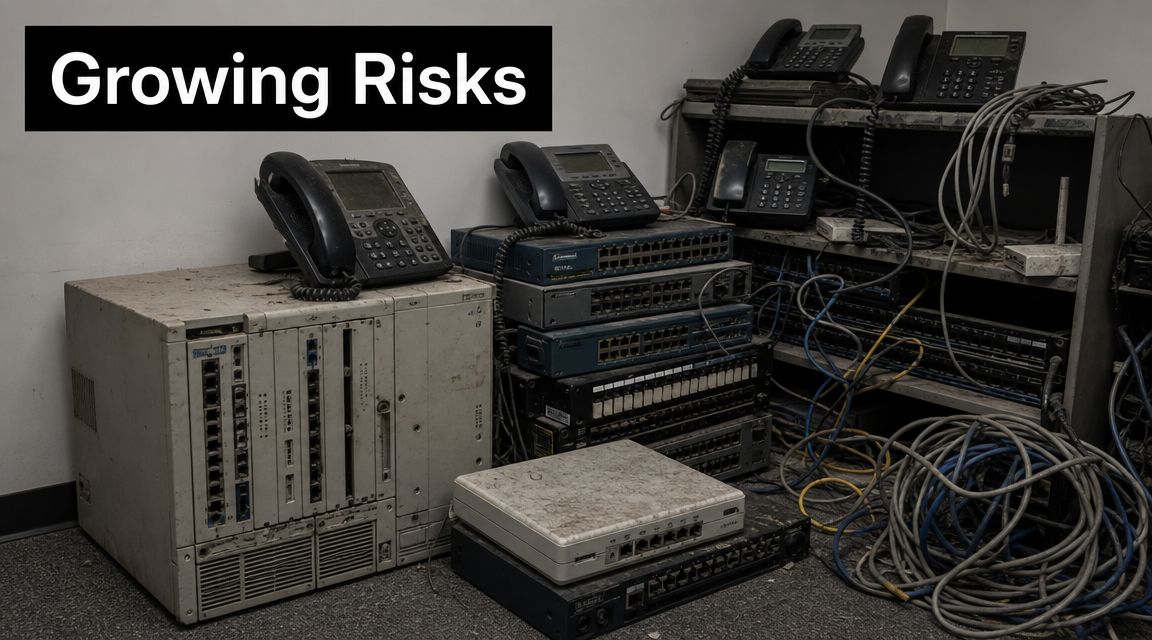
The first mistake many organizations make is treating decommissioned telecom hardware like office cleanout material. That works for broken chairs. It does not work for switches, routers, PBX shelves, conference phones, firewalls, rack appliances, and carrier gear that may still contain business data, firmware configurations, asset tags, or components that require controlled downstream handling.
The broader context matters. The United Nations' Global E-waste Monitor reports that the world generated 62 million metric tons of electronic waste in 2022, and that volume is projected to reach 82 million metric tons by 2030 according to the Global E-waste Monitor. That's why telecom disposal has moved out of the facilities bucket and into IT governance, sustainability, and compliance.
What usually goes wrong
In practice, the failures are predictable:
- Assets disappear into informal channels. A local hauler picks everything up, but there's no serialized record of what left the building.
- Data handling gets assumed, not verified. A vendor says they “destroy everything,” but can't produce destruction certificates tied to individual assets.
- Reusable equipment gets shredded too early. Good hardware that could be redeployed, refurbished, or sold is reduced to scrap value.
- Environmental claims stay vague. “Eco-friendly” sounds nice until you ask where the material goes.
Practical rule: If a vendor can't show you how each asset moves from pickup to final disposition, you don't have a disposal program. You have a liability transfer with poor documentation.
Why IT directors need a different lens
The right question isn't “Who can take this stuff away this week?” It's “Who can retire these assets in a way that protects data, preserves value, and stands up in an audit?”
That shift changes how you evaluate local options. Consumer drop-off programs have their place, but enterprise telecom disposal needs documented intake, screening for reuse, secure data handling, and controlled recycling. If your organization is building a broader sustainability policy, the environmental impact of electronic waste is part of the same operational picture.
Decoding "Environmentally Friendly" Telecom Disposal
“Environmentally friendly” gets used so loosely in this market that it often hides more than it explains. For telecom equipment, the term only means something when the vendor can prove a hierarchy of disposition decisions and a controlled process behind them.
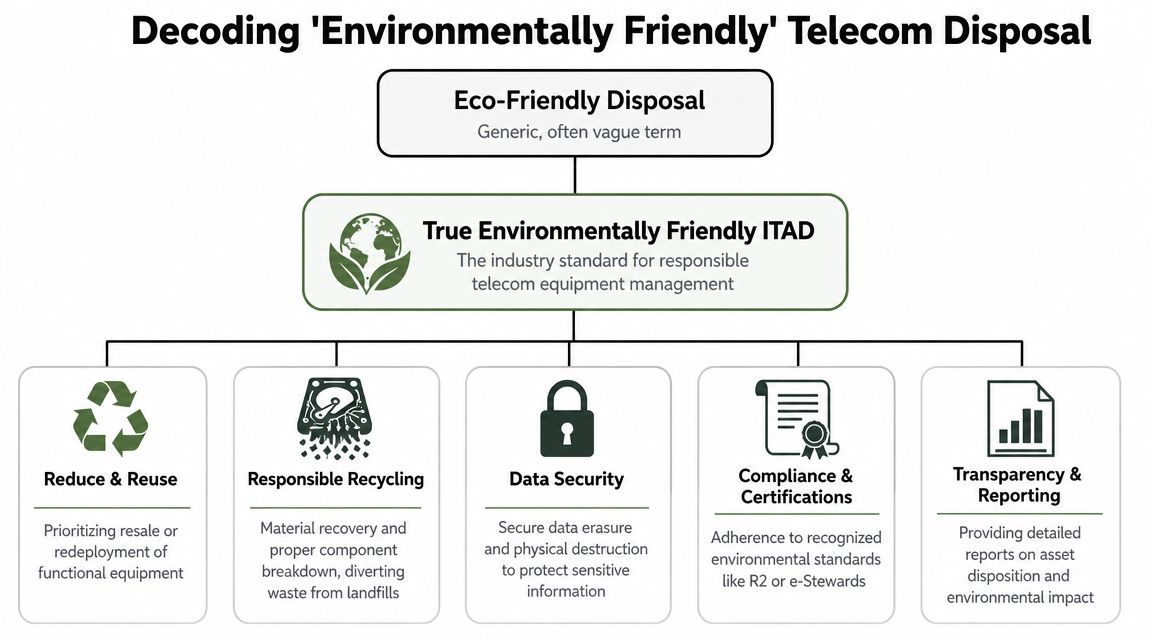
A real environmentally friendly telecom disposal near me search should lead you toward IT asset disposition, not just generic recycling. That distinction matters because shredding everything isn't the greenest outcome. It's just the simplest operationally for the vendor.
The stronger model follows a value hierarchy.
The real hierarchy of telecom disposition
Reuse
If a switch, router, VoIP phone, or PBX component is still functional, the first question should be whether it can stay in service. That may mean internal redeployment to a secondary site, lab use, disaster recovery stock, or resale into a secondary market.
Refurbishment
Some assets need cleaning, testing, minor repair, firmware work, or accessory matching before they can be remarketed. That still keeps the product in circulation and avoids premature destruction.
Parts harvesting
Sometimes the full unit isn't viable, but power supplies, interface cards, transceivers, handsets, mounts, and other components still are. Good ITAD partners know how to evaluate that.
Material recovery
Once the asset no longer has practical reuse value, dismantling and separation come next. Metals and plastics can be recovered if the processor has a real downstream path.
Controlled disposal
Residuals that can't be reused or recovered should move into properly documented end processing, not informal dumping.
What best practice looks like on the ground
The most effective environmental programs maximize reuse and material recovery. The best practice sequence is triage, secure transport, data destruction, dismantling, and then separation of metals and plastics, with proof that recovered materials re-enter manufacturing, as described in this telecom equipment recycling process overview.
That sequence matters because every early decision affects the final environmental result. If equipment is mixed carelessly, batteries and other sensitive components may not get isolated correctly. If data destruction is skipped or delayed, reusable gear may be destroyed unnecessarily just to remove risk. If downstream vendors aren't transparent, “recycling” may just mean transfer to another handler.
How greenwashing shows up
A vendor doesn't need to lie outright to mislead you. Most greenwashing in this space sounds polished and harmless.
| Vendor claim | What to ask next |
|---|---|
| We recycle everything responsibly | How do you screen for reuse before recycling? |
| We offer secure destruction | Do you provide serialized Certificates of Destruction and chain-of-custody records? |
| We're zero landfill | What happens to residual fractions and who handles downstream recovery? |
| We're certified | Which certifications apply to this facility and this service scope? |
Ask for process detail, not slogans. A serious recycler can walk you through intake, testing, data handling, dismantling, and downstream channels without getting vague.
What to look for instead
A better vendor conversation includes practical questions:
- How do you decide reuse versus shred?
- Do you test telecom gear by model and condition?
- Can you document downstream material handling?
- How are hazardous components isolated before processing?
- What reports do you issue at project close?
For buyers comparing providers, certification also matters. A recycler that aligns with documented standards gives you a more reliable baseline than a simple hauling service. If you're screening partners, this overview of an R2 certified electronics recycler is the kind of benchmark worth understanding before you sign anything.
A Practical Guide to Vetting Telecom Disposal Partners
A generic local search can bury you in the wrong results. You'll see municipal drop-off pages, scrap buyers, office junk removal, and consumer electronics recyclers that may be perfectly fine for households but not built for enterprise telecom retirement.
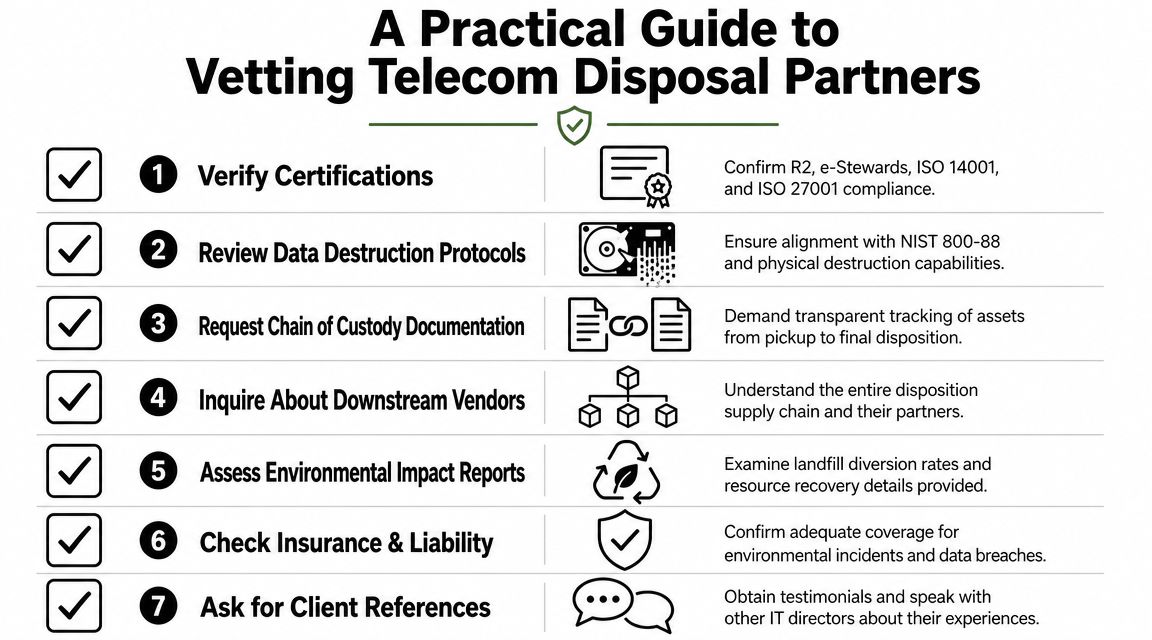
The first pass should narrow the field quickly. You're not looking for “who recycles electronics.” You're looking for a provider that can manage enterprise telecom assets with documentation, security controls, and reuse capability.
Start with the right search intent
Refine your search terms beyond environmentally friendly telecom disposal near me. Add language like:
- B2B ITAD
- telecom equipment recycling
- secure data destruction
- chain of custody
- network equipment disposition
- enterprise electronics recycling
That usually filters out consumer-only results and surfaces firms that understand serialized inventory, pickups, and business compliance requirements.
The question most buyers skip
The most environmentally friendly outcome is often reuse or parts harvesting, not shredding. With global e-waste formal collection and recycling at 22.3% in 2022, buyers should ask vendors exactly how they assess reuse potential, as noted in this e-waste recycling discussion.
That single question tells you a lot. If the answer is vague, or if the vendor defaults every conversation to poundage and destruction, they may be running a recycling-first model rather than a value recovery model.
A practical shortlist framework
Use the first call or email exchange to qualify vendors against operational criteria, not marketing language.
- Service fit. Ask whether they handle enterprise telecom categories such as PBX systems, rack gear, VoIP phones, routers, switches, UPS-related electronics, and structured cabling accessories.
- Pickup model. Confirm whether they support on-site packing, palletization, dock scheduling, and multi-site collections.
- Data risk awareness. See if they immediately ask about embedded storage, flash media, or regulated data environments.
- Documentation. Ask what records they issue as standard, not as an add-on.
- Disposition logic. Listen for reuse, refurbishment, remarketing, and parts harvesting before recycling gets discussed.
Certifications matter, but context matters more
Many IT directors use certifications as a shortcut. That's reasonable, but only if you ask how the certification applies to the actual workflow.
Here's a practical way to interpret common credentials:
| Certification or control | What it helps you evaluate |
|---|---|
| R2 or e-Stewards | Whether electronics processing follows a recognized environmental and operational standard |
| ISO 14001 | Whether environmental management is formalized |
| ISO 27001 | Whether information security controls are part of the organization's management system |
| NAID-style destruction controls or equivalent documented processes | Whether data destruction practices are structured and auditable |
A logo on a website isn't enough. Ask which facility is certified, whether subcontractors are involved, and what scope the certification covers.
If a vendor talks a lot about recycling volume but very little about audit trails, asset grading, or downstream accountability, keep looking.
What to ask during a serious vetting call
Don't run the call like a sales demo. Run it like a risk review.
Some questions should be direct:
- How do you inventory telecom assets at pickup?
- Do you capture serial numbers or asset tags on-site?
- What happens when a device can't be wiped but still contains storage?
- How do you separate reuse candidates from end-of-life scrap?
- What certificates and final reports do you issue?
- Can you identify your downstream recycling partners or categories?
- How do you handle exceptions, missing serials, or damaged units?
A strong provider will answer clearly. A weak one will drift into generalities.
What a facility visit should confirm
If you tour a facility, pay attention to operational discipline, not presentation. Look for staged receiving, quarantine areas, testing benches, data destruction areas, and segregation of different material streams. Ask how inbound inventory is reconciled against pickup records.
Also look for signs that the site was designed for business assets, not just public drop-offs. Labeled process zones, controlled storage, and formal receiving procedures usually indicate a more mature operation.
For teams building a shortlist, this page on IT asset disposition companies is useful as a reference point for the kind of service category you should be evaluating.
Ensuring Ironclad Security and Chain of Custody
Environmental handling matters. Security is still the issue that can hurt you fastest.
Telecom gear gets underestimated because it doesn't always look like traditional data-bearing equipment. But routers can store configs and credentials. Firewalls and unified communications appliances may contain logs, certificates, and account details. Phone systems can hold call records, voicemail data, directory information, and user settings. Once that hardware leaves your control without documentation, your risk posture changes immediately.
The financial exposure is not theoretical. The average cost of a data breach reached USD 4.88 million in 2024, according to this security-focused recycling guidance. That's why treating telecom disposal like a scrap job is a bad decision for any serious IT organization.
What secure handling actually requires
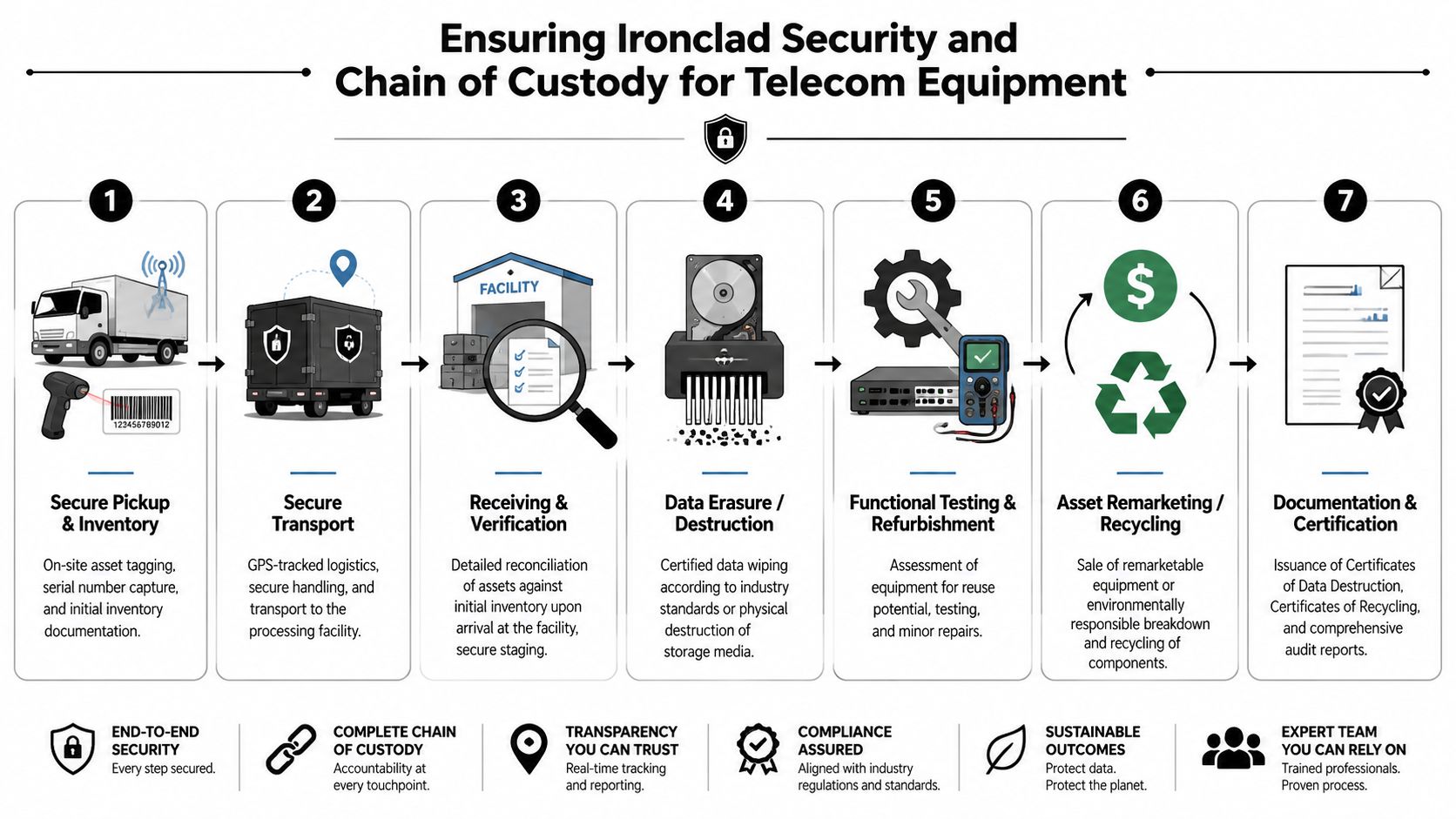
Security in disposition is a chain, not a single event. The controls should begin before pickup and continue through final disposition.
At minimum, you want:
- Serialized tracking from collection through processing
- Controlled transport with documented handoffs
- Receiving reconciliation at the processing facility
- Documented data destruction tied to the asset record
- Exception handling for damaged, unknown, or unmatched units
- Final reporting that closes the loop
If the vendor can only prove destruction in bulk, that's not the same as proving what happened to your specific assets.
When wiping works and when it doesn't
Not every telecom asset should follow the same destruction path. That's where experienced ITAD providers separate themselves from generic recyclers.
Use software-based sanitization when the device supports it, the media is healthy, and reuse is still viable. Use physical destruction when storage media is damaged, inaccessible, unsupported, or the risk profile requires complete media elimination. Some organizations also separate treatment by business function. Lab hardware, regulated healthcare communications gear, and critical infrastructure appliances often justify a stricter destruction posture than ordinary office phones.
Here's the practical framework:
| Asset condition | Typical secure path |
|---|---|
| Functional device with supported media | Verified sanitization, then reuse evaluation |
| Damaged device with inaccessible storage | Physical media destruction |
| High-risk regulated asset | Destruction-first approach with documentation |
| Unknown telecom appliance | Quarantine, inspect, then decide based on confirmed media type |
The documents that matter most
A vendor can say all the right things and still leave you exposed if the paperwork is weak.
The documents worth insisting on are:
- Chain-of-custody report showing each transfer point
- Serialized inventory report that ties asset identity to outcome
- Certificate of Destruction for data-bearing items that were destroyed
- Certificate of Recycling or equivalent end-processing record for non-reusable assets
- Project summary report that reconciles total received, processed, reused, and recycled categories
The safest telecom disposal program is the one you can defend after the fact, without relying on memory or vendor assurances.
Common blind spots in telecom environments
Telecom projects create special problems because asset ownership can be messy. Some equipment is owned by IT, some by facilities, some by a telecom manager, and some may have come from a carrier, integrator, or prior project. That makes it easy for equipment to get removed without proper intake.
Other blind spots include wall-mounted phones that never make it into inventory, branch hardware shipped back informally, and edge devices that sit in remote cabinets for months after decommissioning.
For any project with mixed equipment types, destruction services should be integrated into the broader retirement plan. Teams that need physical destruction as part of that plan can benchmark requirements against services like shred and recycle, where secure destruction is part of the documented chain rather than a disconnected last step.
Managing Project Logistics and Calculating ROI
Most telecom disposal projects go sideways in the logistics phase, not in the policy phase. The plan looks solid on paper, but then assets get moved before they're logged, equipment from multiple rooms gets mixed together, or someone schedules pickup before data-bearing devices have been properly flagged.
A low-risk workflow is straightforward: inventory assets, separate them by reuse and recycling potential, perform certified data destruction first, route functional gear for reuse, and send only residuals to a certified recycler, as outlined in this telecom disposal workflow guide. The key control is chain-of-custody documentation that proves each step happened.
A field-tested execution sequence
For most enterprise projects, the cleanest approach looks like this:
Build the asset list early
Pull from CMDB records, network inventories, telecom records, and physical walkthroughs. Expect gaps. The walkthrough is where you catch shelf spares, abandoned branch gear, and untracked phones.Sort by disposition path
Don't palletize everything together. Separate likely reuse candidates from obvious scrap, and isolate anything with embedded storage or unclear data risk.Decide where data destruction occurs
Some organizations need on-site handling for sensitive equipment. Others can send devices to a secure facility if serialized custody starts at pickup. The decision should be made before the truck arrives.Coordinate pickup around site operations
Confirm dock access, freight elevator constraints, pallet requirements, labeling rules, and who signs release paperwork. Facilities teams and IT teams often assume the other side has covered this.Reconcile on receipt
Once the vendor receives the load, you want a comparison against the outbound manifest. During this comparison, missing units, swapped counts, or packaging issues surface.
What improves project outcomes
The organizations that get this right usually do a few things consistently:
- They assign one owner for asset retirement decisions.
- They tag exceptions instead of letting odd items ride with the general load.
- They treat remote offices as part of the same control framework, not as informal side projects.
- They insist on final reporting that matches internal records.
A surprising amount of value comes from discipline before pickup. Cleaner inventory means faster testing, better reuse decisions, and fewer disputes about what was processed.
How to think about ROI without guessing
You don't need a complex financial model to evaluate telecom disposition. Use practical categories.
Recovery value comes from equipment that can be redeployed, refurbished, harvested for parts, or remarketed. The exact amount varies by age, model, and condition, so the right approach is to ask vendors how they grade telecom assets and how they return value when applicable.
Avoided cost is just as important. A documented process can reduce the chance of paying for emergency cleanouts, repeated pickups, internal labor spent reconciling missing equipment, or crisis response after poor data handling.
Compliance value shows up in defensibility. When audit, legal, procurement, or ESG stakeholders ask what happened to retired assets, documentation saves time and protects the organization.
A telecom disposal project creates ROI in three places: what you recover, what you avoid, and what you can prove.
A simple decision table for internal planning
| ROI category | What to evaluate |
|---|---|
| Asset recovery | Which gear still has resale, redeployment, or parts value |
| Operational savings | Reduced internal handling time and fewer cleanup cycles |
| Risk reduction | Better control over data-bearing devices and exceptions |
| Audit readiness | Quality of chain-of-custody, destruction, and recycling records |
If your current process can't produce that picture, the issue usually isn't volume. It's workflow design.
How Dallas Fortworth Computer Recycling Delivers Compliant Disposal
For organizations that need a B2B disposition partner, the useful question is whether a provider's operating model matches the requirements discussed above. That means secure retirement, environmental accountability, and documentation that procurement, compliance, and IT can all rely on.
Dallas Fortworth Computer Recycling provides nationwide IT asset disposition and electronics recycling services for commercial and public-sector organizations. According to the company information provided, its scope includes IT equipment disposal, certified data destruction, data center decommissioning, computer and laptop disposal, and responsible handling of specialized equipment. That service profile aligns with the kind of multi-step retirement process telecom projects usually require.
Where that fit matters most
Telecom disposal is rarely just a recycling event. It's usually a mixed project involving network hardware, voice equipment, storage risk, pickup coordination, and final reporting. A provider built around business workflows is better positioned to handle serialized intake, controlled logistics, and documentation than a public drop-off model.
That's where a formal ITAD service becomes relevant. Teams evaluating options can review the company's IT asset disposition services in Dallas Fort Worth Texas to see the service category and operating approach.
How the model maps to enterprise needs
A strong telecom disposal partner should support five outcomes:
- Secure handoff for decommissioned assets
- Data destruction that's documented, not implied
- Reuse-first evaluation where equipment still has life
- Responsible recycling for residual materials
- Audit-ready reporting for internal and external stakeholders
Based on the publisher background, Dallas Fortworth Computer Recycling emphasizes environmental stewardship, maximizing reuse and recycling to reduce landfill impact, while also supporting regulated and enterprise-oriented workflows. It also offers nationwide pickup logistics, which matters when telecom assets are spread across headquarters, branches, clinics, labs, or remote sites.
What this means for a buyer
If you're comparing local vendors, the main point isn't brand preference. It's operational fit. You need a partner that can manage the asset retirement chain from pickup through documentation, with enough process maturity to handle mixed telecom inventories and enough security discipline to protect the organization if questions come later.
That's the threshold to use in your evaluation, whether you choose this provider or another qualified ITAD firm.
From Liability to Asset: A Strategic Approach to Telecom Disposal
Retired telecom equipment shouldn't be managed as junk removal. It belongs in a controlled ITAD process with clear decisions about reuse, data destruction, recycling, and reporting.
The local search matters, but it's only the starting point. The real work is qualifying whether a provider can protect your data, document chain of custody, screen assets for value recovery, and handle residual material responsibly. That's what turns environmentally friendly telecom disposal near me from a convenience search into a business decision.
For IT directors, infrastructure teams, healthcare environments, public agencies, and distributed enterprises, this is now a standard part of risk management. The organizations that handle it well protect more than storage space. They protect compliance posture, audit readiness, and the chance to recover value from assets that still have a useful second life.
If your retired telecom gear is piling up, now is the time to build a process that's secure, documented, and environmentally responsible.
If your organization needs a documented plan for retiring telecom hardware, contact Dallas Fortworth Computer Recycling to discuss secure pickup, certified data destruction, reuse-first disposition, and audit-ready reporting for enterprise equipment.