
Sustainable Telecom Recycling Los Angeles: IT Leader’s Guide
Your telecom refresh may already be complete on paper. The new switches are live, the voice migration is done, and the old gear is still sitting in a cage, staging room, or half-empty MDF waiting for someone to decide what happens next.
That moment looks operational, but it's really strategic. A retired firewall can still hold configuration data. A pallet of phones can still have reuse value. A mixed load of routers, batteries, rack gear, and cabling can still create compliance problems if it leaves your site without inventory, sanitization, and documentation.
For Los Angeles IT leaders, sustainable telecom recycling Los Angeles isn't about finding the fastest pickup. It's about building a disposition process that security can defend, finance can understand, sustainability can report, and audit can verify later.
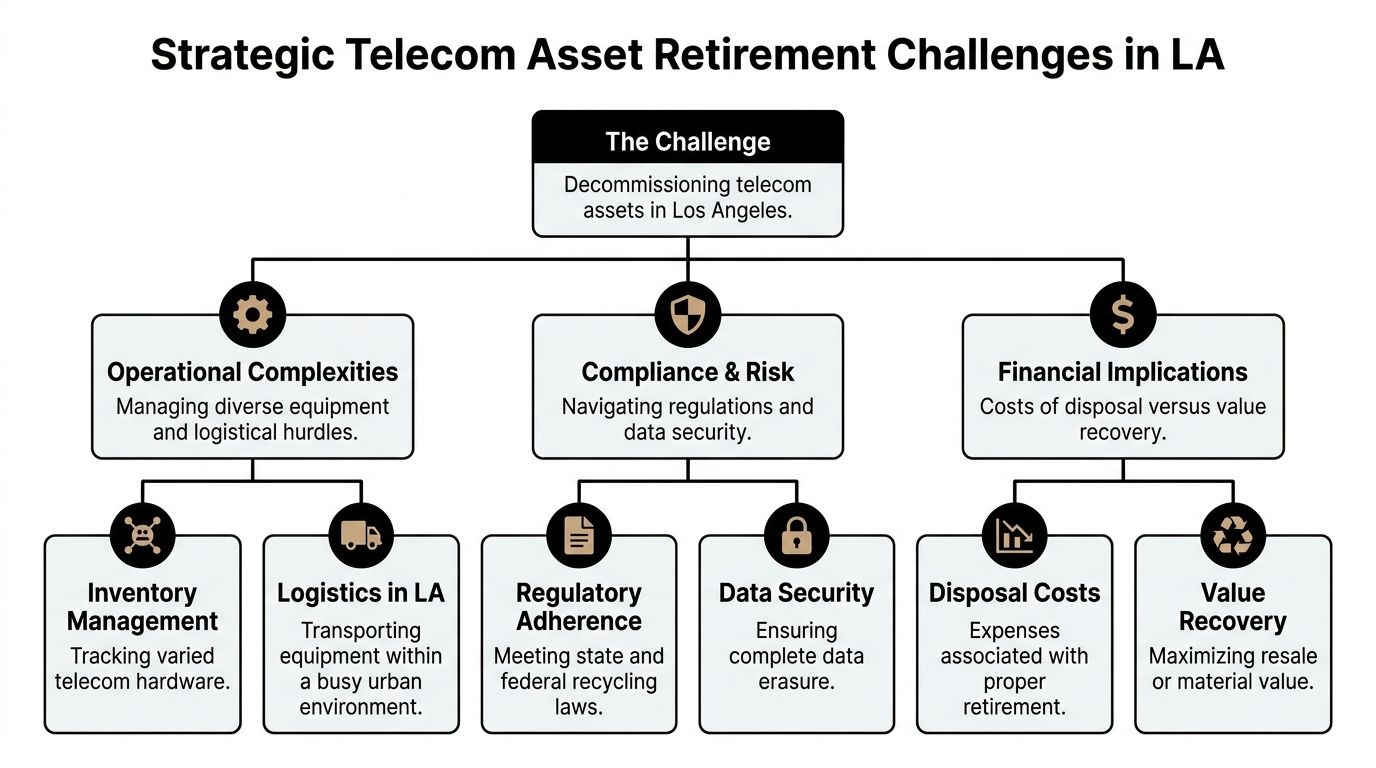
The Strategic Challenge of Telecom Asset Retirement in LA
An LA-based IT director usually runs into the same collision of priorities. Facilities wants the room back. Security wants proof that data-bearing devices won't leave untracked. Finance wants to know whether any retired equipment still has value. Sustainability wants a defensible story for where everything went.
Those pressures get sharper during network upgrades, UC migrations, branch consolidations, and data center changes. Telecom retirement isn't one asset class. It's switches, routers, appliances, handsets, access points, racks, power supplies, batteries, optics, and cabling, all moving through different risk paths.
Why telecom disposal becomes a board-level issue
The business case starts with the scale of the waste stream itself. The Global E-waste Monitor 2024 reported that 62 million tonnes of e-waste were generated worldwide in 2022, with only 22.3% properly collected and recycled. For Los Angeles organizations, that matters because retired telecom equipment enters a system where certified handling is still the exception.
If your process is loose, your assets don't disappear into a neat recycling outcome. They move into a fragmented chain where value can be lost, hazardous components can be mishandled, and documentation can vanish.
Practical rule: If a device ever touched your network, treat it as a controlled asset until inventory, sanitization, and final disposition records prove otherwise.
What works and what fails
What works is planning before the first rack is touched. That means identifying data-bearing gear, separating batteries early, tagging reuse candidates before they get mixed into scrap, and choosing an ITAD workflow instead of a general cleanup vendor. A broad IT equipment recycling process is useful as a baseline, but telecom environments need tighter controls because network gear often carries both security exposure and residual value.
What fails is the common shortcut. Teams decommission quickly, pile mixed hardware onto pallets, and ask a vendor to “take everything.” That approach usually creates three problems at once:
- Weak inventory control because installed gear, shelf spares, and loose accessories get mixed together
- Poor value recovery because reusable routers, handsets, or modules are treated like commodity scrap
- Thin audit evidence because custody and sanitization records start after the load has already left the site
In Los Angeles, logistics add another layer. Tight loading windows, shared docks, freight elevator rules, parking limits, and multi-site portfolios all turn a simple pickup into a process issue. That's why the retirement decision belongs with IT leadership, not just facilities or surplus removal.
Navigating the Los Angeles Regulatory Landscape
In Los Angeles, telecom disposal breaks down when teams treat a network refresh like a facilities cleanout. A pallet leaves the site, but no one can reconcile serials, confirm data destruction, or show where batteries and mixed electronics went downstream. That gap creates audit exposure long before anyone asks about recycling rates.
California and Los Angeles require more discipline than a general e-waste pickup. For an IT director, the practical task is to convert broad regulatory obligations into site-level controls. Who accepted the equipment, how it was classified, whether any item held data, and what records exist after pickup matter more than a stack of generic recycling promises.
Public drop-off options do not meet enterprise requirements
Los Angeles offers public disposal programs, and the city's S.A.F.E. Centers serve residents well. They are not designed for commercial telecom retirement projects.
Enterprise telecom disposition needs documented intake, asset-level reconciliation, secure transport, and records that hold up under procurement review, internal audit, or a customer security questionnaire. A resident-focused program does not replace that. If your project includes routers, switches, PBX equipment, firewalls, UPS units, or network appliances, your organization remains responsible until custody transfers under documented business procedures.
The vendor standard matters here. If a recycler cannot explain its certifications, downstream controls, and audit documentation, treat that as a risk signal. A qualified R2 certified electronics recycler should be able to show how assets move from pickup to final processing, not just say that material is recycled.
Access to recycling is different from controlled disposition
General recycling access solves a public waste problem. It does not solve an enterprise governance problem.
The Recycling Partnership reported in January 2024 that residential recycling capture remains limited in the U.S. For Los Angeles businesses, the takeaway is straightforward. Putting equipment into a recycling stream is not the same as proving compliant disposition.
Telecom equipment often contains a mix of metals, boards, plastics, batteries, and storage or configuration data. Some devices still hold credentials, call detail records, network maps, or customer information. If those assets enter an undocumented stream, the business absorbs both environmental risk and security risk.
A business cannot defend a disposal decision it failed to document.
Operating rules Los Angeles IT leaders should apply
Use these rules when setting policy and reviewing vendors:
Keep commercial telecom assets out of residential channels
Public programs are not built for serial tracking, business pickup coordination, or enterprise audit records.Classify equipment before it leaves the site
Separate data-bearing devices, batteries, reuse candidates, and scrap streams before loading. Mixed pallets create avoidable compliance problems.Treat sanitization as part of disposition, not a separate task
A powered-down device can still carry data, credentials, and configuration risk.Require documented custody transfers
Signatures, manifests, pickup logs, and post-receipt reconciliation should match. If they do not, your audit trail weakens at the first handoff.Keep records in a system that outlasts the project team
Legal, finance, procurement, and security reviews often happen months later. Disposition files need to survive staff changes and vendor turnover.
In practice, Los Angeles compliance comes down to execution at the dock, in transit, and at the processor. Companies that get this right do not just avoid violations. They preserve resale value, shorten audit response time, and give sustainability teams records they can use.
The Pillars of Compliant Telecom Recycling
A compliant telecom recycling program in Los Angeles stands on two controls that have to work together. Environmental handling and data protection. If either side is weak, the project creates exposure for IT, legal, procurement, and sustainability teams at the same time.
For an IT director, the practical question is simple. Can the vendor prove what happened to each asset class, and can that proof survive an audit months later?
Environmental stewardship starts with asset-level decisions
Telecom recycling succeeds or fails at sorting. Network switches, VoIP phones, UPS units, batteries, cabling, optics, and rack gear should not move through one generic process because they do not carry the same material risk, handling requirements, or resale potential.
A disciplined program usually includes four operating steps:
- Inventory before release so the outbound list matches what the recycler receives
- Segregation by material and asset type so batteries, reusable equipment, scrap metal, and data-bearing hardware follow the right path
- Functional testing and grading so reusable assets are identified before they are dismantled
- Documented downstream processing so your team knows where commodity recovery, refurbishment, and final recycling occur
Certification helps, but only if your team understands what the certification controls. A vendor that follows the practices of an R2 certified electronics recycler should be able to show how it manages intake, testing, downstream vendors, exception handling, and final reporting. That matters in Los Angeles, where sustainability goals often sit next to strict internal audit requirements.
Data security must match the actual telecom device
Telecom hardware often falls into a blind spot between endpoint security and facilities disposal. Firewalls, PBX systems, routers, session border controllers, wireless controllers, and some handsets can retain credentials, call records, configuration files, certificates, and admin history.
The disposition method has to fit the media and the business risk. Software wiping can preserve remarketing value when the device and storage type support it. Physical destruction makes more sense when media is damaged, inaccessible, encrypted under retired key control, or restricted by policy. A factory reset alone is rarely enough evidence for enterprise disposition.
That trade-off matters. Destroy too broadly and the company gives up recoverable value. Reuse too aggressively without proper sanitization and the company carries avoidable security risk.
Operational test: Ask the vendor which telecom assets qualify for wiping, which require shredding or drive destruction, and how exceptions are recorded on the final report.
Where programs usually break down
Most compliance failures do not start at the processor. They start with an imprecise disposition model inside the business. One blanket instruction, usually “recycle everything” or “destroy everything,” gets applied to equipment with very different risk profiles.
| Failure mode | What it looks like | Business consequence |
|---|---|---|
| Over-destruction | Working telecom gear is destroyed before testing | Lower recovery value and weaker sustainability results |
| Under-securing | Equipment is cleared in bulk without asset-specific sanitization records | Residual data risk and poor audit defensibility |
| Mixed-stream handling | Batteries, data-bearing devices, and scrap are palletized together | Processing delays, exception fees, and avoidable compliance gaps |
The stronger approach is selective and documented. Reuse candidates get tested, sanitized, and graded. Non-recoverable or policy-restricted assets go to controlled destruction and material recovery. That is what turns sustainable telecom recycling Los Angeles from a disposal task into a defensible operating process with measurable financial and compliance value.
Mastering Chain of Custody and Auditability
A Los Angeles IT director usually does not lose sleep over the truck pickup. The main exposure starts after the equipment leaves the cage and before final disposition is documented. That gap is where audits get messy, data destruction claims get hard to defend, and sustainability reporting turns into guesswork.
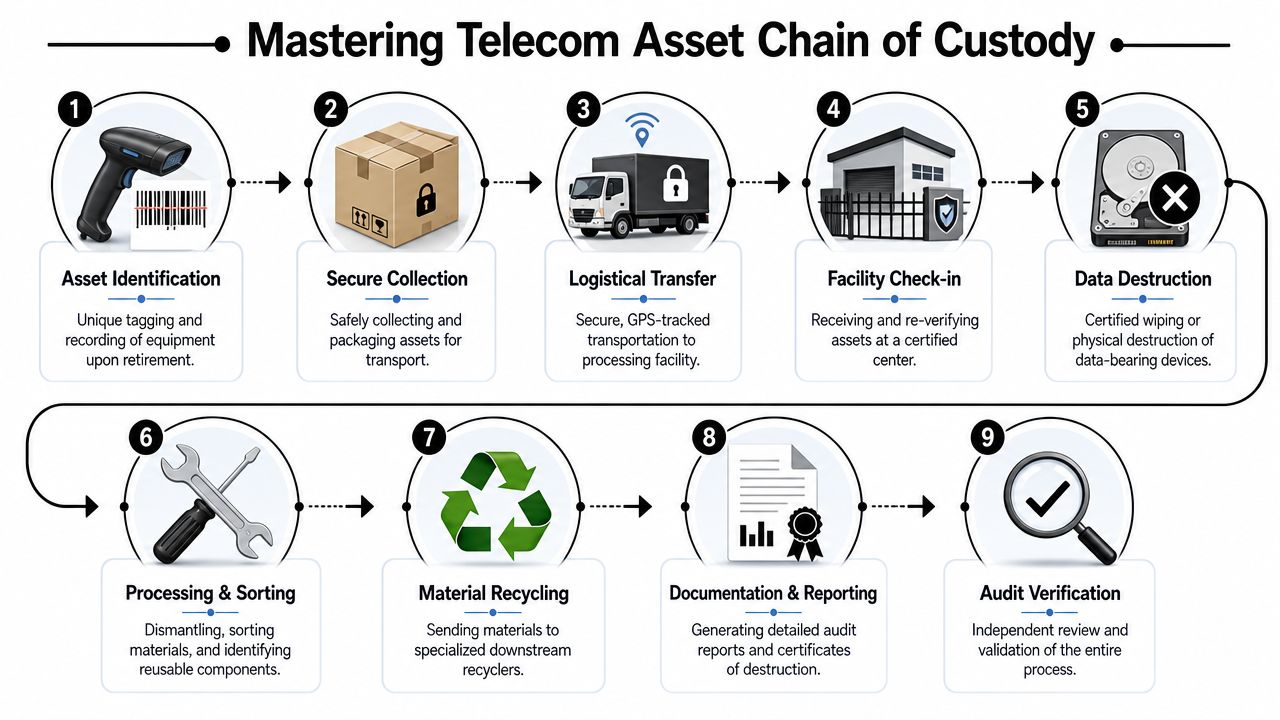
Chain of custody is the control framework for that gap. It records who had each asset, when custody changed, where the asset moved, what happened to it, and which records support each step. For telecom equipment, that level of detail matters because one project can include data-bearing devices, batteries, resale candidates, scrap, and regulated components in the same outbound stream.
What an auditable process looks like
An auditable process starts before pickup with a defined scope, an internal release point, and a naming convention your security, procurement, and ESG teams can all follow later. It continues through transport, intake, sanitization, testing, downstream processing, and final reporting. If any one of those stages is undocumented, the file is incomplete.
That matters in Los Angeles because local disposal projects often involve multiple sites, building access restrictions, third-party movers, and mixed telecom inventories. Generic recycling paperwork does not hold up well under internal review when a legal team asks for asset-level history or when finance wants to reconcile recovery value to the original shipment.
The practical standard is simple. You should be able to trace a device or asset group from your inventory record to its final outcome without relying on verbal confirmation from the vendor.
The records you should require
For an enterprise telecom project, the custody file should include these records:
Pre-pickup asset scope
A serial-based list is best. If that is not possible for every item, use asset type, quantity, site, room, and any known identifiers, then document where serial capture begins.Release authorization
Someone inside your organization should approve the transfer. This closes a common audit gap where equipment leaves a site without a clear business owner.Pickup manifest with signatures
Your team releases the assets. The vendor accepts them. The record should include date, location, quantities, and any sealed container or pallet identifiers.Transport log or handoff record
This should show how material moved from site to processing facility, including custody changes if a separate carrier is involved.Facility intake reconciliation
The processor should confirm what arrived, flag variances, and document exceptions instead of burying them in a summary report.Sanitization or destruction records
These records should identify the method used and connect it to the specific asset or media category. A detailed certificate of destruction for hard drives is a good reference point for the level of detail to expect.Final disposition report
This should show what was reused, resold, dismantled, recycled, or destroyed, with enough detail to support both audit review and sustainability reporting.
Missing records create more than administrative cleanup. They weaken legal defensibility and make downstream claims harder to verify.
The difference between a manifest and proof
This distinction causes regular problems in ITAD reviews. A pickup manifest shows that equipment left your site under vendor custody. It does not show that the equipment was sanitized, destroyed, refurbished, or recycled in the manner your policy requires.
Each record answers a different question:
| Document | What it proves | What it does not prove |
|---|---|---|
| Pickup manifest | Assets left your location under vendor custody | Final destruction or recycling outcome |
| Intake reconciliation | Assets arrived at the processing facility | That sanitization or recycling happened |
| Certificate of destruction | Data-bearing media was destroyed under the documented method | Full material recovery path for all non-data assets |
| Certificate of recycling | Equipment or materials entered the stated recycling path | That all data risks were handled correctly |
A vendor that merges these into one vague summary creates avoidable risk. For auditability, keep the chain intact. Release, receipt, processing, and final disposition should each have their own evidence.
How to build for audit, not convenience
Audit-ready programs are usually less convenient at the loading dock. They are far easier to defend six months later.
Start by freezing scope before pickup unless a named approver authorizes additions. Last-minute changes are one of the fastest ways to create reconciliation errors. Separate data-bearing gear, batteries, and commodity scrap before the vendor arrives. Mixed streams increase exception handling and make asset-level reporting harder to trust.
Assign one internal owner for manifest review and post-project reconciliation. In practice, shared ownership often means no ownership. Store the final file in a system that security, procurement, legal, and sustainability teams can access without chasing email attachments.
The companies that do sustainable telecom recycling Los Angeles well treat chain of custody as an operating control, not a paperwork exercise. That discipline connects corporate sustainability commitments to what happened on the ground, asset by asset, site by site.
Your Vendor Selection Checklist for Los Angeles
A Los Angeles IT director usually experiences a recycler's full quality after the trucks leave. The quote looked fine. The pickup happened on time. Then legal asks for destruction proof by asset class, procurement wants itemized reconciliation against the original scope, and sustainability needs defensible disposition reporting for an internal review. If the vendor cannot produce clean records, the project cost just went up.
Vendor selection should be treated as an audit and control decision with cost implications, not just a hauling decision. In telecom environments, a vendor has to protect three things at once. Data, chain of custody, and residual value.
What separates a qualified telecom recycler from a generic hauler
In Los Angeles, the gap between a basic pickup service and a defensible enterprise process is wide. A qualified telecom recycler should be able to show serial-level or asset-tag-level tracking, documented destruction methods by device type, and a clear path for reuse candidates that still have value. Generic haulers usually default to weight-based receipts and broad recycling statements. That is not enough for internal audit, security review, or disposition analysis.
The screening questions should test how the operation works under pressure. Ask what happens when the pickup scope changes on site, how exceptions are documented, who approves a switch from reuse to recycling, and how batteries and power components are segregated before transport. Ask to see sample paperwork before you sign. A vendor with mature processes will provide it without hesitation.
A provider with real telecom depth should also be able to discuss decommissioning flow, site access constraints, rack removal coordination, and triage logic for mixed generations of gear. Buyers who want that consultative approach should expect the level of planning reflected in telecom consulting services in Los Angeles, especially for multi-site or high-sensitivity projects.
Telecom Recycling Vendor Vetting Checklist
| Criteria | What to Ask | Why It Matters |
|---|---|---|
| Certifications | Which current certifications govern your recycling and data-destruction workflows? | Certifications show whether the vendor operates inside documented controls and audited processes |
| Asset tracking | Can you track by serial number, asset tag, site, or pallet? | Tracking quality determines whether finance, IT, and audit can reconcile the project later |
| Data destruction | Which devices are wiped, which are physically destroyed, and how do you prove each result? | Telecom assets do not all follow the same sanitization path |
| Chain of custody | What records are created at pickup, transport, intake, testing, and final processing? | Missing handoff records create audit gaps and weaken incident response |
| Battery handling | How do you isolate, package, and process batteries and power components? | Mixed battery handling creates safety exposure and avoidable compliance issues |
| Reuse triage | Do you test assets for remarketing before recycling them? Who approves the final path? | Reuse-first triage protects residual value and supports sustainability goals |
| Reporting depth | Can you show sample manifests, destruction certificates, and final disposition reports? | Sample paperwork reveals whether the workflow is disciplined or improvised |
| Insurance and liability | What coverage do you carry for environmental and data-related incidents? | Legal and procurement teams will want to know where liability sits if something fails |
| LA logistics | How do you handle dense sites, loading restrictions, freight elevator limits, parking access, and multi-site pickups? | Los Angeles projects often fail at the building and transport level, not during the sales process |
| Downstream transparency | Which downstream processors receive materials, and how do you verify their controls? | First-mile control is only part of the risk picture |
Red flags worth treating as disqualifiers
Some answers should end the evaluation quickly.
- Vague destruction language such as broad claims without the actual method, device scope, or proof format
- No sample reports because the vendor says documentation is created only after processing
- One-path disposition where everything is destroyed or everything is recycled without asset-level triage
- Loose intake practices where mixed pallets are accepted without exception handling or reconciliation rules
- Aggressive value estimates before anyone has reviewed condition, completeness, model mix, or data sensitivity
Pickup speed matters, but reporting depth matters more. A fast vendor with weak controls creates downstream work for IT, security, legal, and finance.
The strongest vendor is usually the one that answers detailed questions plainly, documents trade-offs, and shows how its process will hold up after the project is closed. In Los Angeles, that level of discipline is what turns telecom recycling from a disposal task into a controlled asset disposition program.
Making the Call Reuse versus Recycling
The hardest disposition decision usually isn't whether to remove old telecom gear. It's whether each asset should be reused, remarketed, or recycled.
That decision affects three things at once. Financial return, security exposure, and sustainability performance. If you send everything to destruction, you may eliminate risk but destroy recoverable value. If you push too much into remarketing, you may create unnecessary brand or data concerns.
Why triage matters more now
The broader e-waste direction makes this decision more important, not less. The Global E-waste Monitor 2024 projects that the documented collection and recycling rate could fall to 20% by 2030 if capacity does not expand fast enough, a projection cited in this discussion of telecom equipment recycling solutions for 2025. For telecom operators and enterprise IT teams, that makes intelligent reuse and refurbishment triage a practical necessity.
If a device can be safely sanitized and returned to use, that is often the strongest sustainability outcome. If it cannot, certified dismantling and recycling become the correct path.
A practical decision matrix
Use these questions to sort assets:
| Decision factor | Reuse or remarket leans stronger when | Recycling leans stronger when |
|---|---|---|
| Asset condition | Equipment is complete, functional, and commercially relevant | Equipment is damaged, incomplete, or heavily worn |
| Data sensitivity | Sanitization is feasible and well documented | Residual risk remains high or policy requires destruction |
| Marketability | There is realistic secondary demand for the model | The asset has little practical resale appeal |
| Compliance burden | Documentation can follow the asset cleanly through remarketing | Downstream reuse would create too much review or control overhead |
| Brand risk | The organization is comfortable with controlled secondary-market release | The organization wants final disposition certainty |
A mature buyer or remarketing partner should help validate this triage. If you're weighing resale potential, a specialized market view from telecom equipment buyers in Los Angeles is more useful than a generic scrap estimate.
What usually belongs in each path
In many environments, these patterns hold:
- Reuse candidates often include newer switches, tested handsets, spare modules, access points, and supportable routers
- Recycle-first assets usually include broken chassis, obsolete systems, damaged power gear, mixed cable, and nonfunctional peripherals
- Destroy-before-anything assets are devices where policy, storage type, or sensitivity makes preservation of hardware less important than certainty of sanitization
There's also a timing issue. Once good equipment gets thrown into mixed gaylords with scrap metal, cable, and broken plastics, the option to preserve value usually disappears. Triage has to happen before rough handling starts.
Security should decide whether reuse is allowed. Condition and market demand should decide whether reuse is worthwhile.
The strongest sustainable telecom recycling Los Angeles programs don't force a false choice between environmental responsibility and business discipline. They sort assets intentionally so reuse happens where it's defensible, and recycling happens where it's necessary.
Beyond Compliance Community and Zero-Landfill Initiatives
A telecom recycling program can do more than close a compliance ticket. Handled well, it can support zero-landfill goals, improve internal sustainability reporting, and create community value through reuse pathways that would never emerge from a simple haul-away transaction.
That shift matters because IT leaders are increasingly asked to contribute to corporate sustainability goals without compromising security. Telecom disposition is one of the few places where those goals can line up cleanly if the process is disciplined.

Zero-landfill is a documentation problem as much as a recycling problem
Many organizations say they want zero-landfill outcomes for electronics, but the challenge lies in proof. It's not enough for a vendor to say that materials were handled responsibly. You need documented pathways showing whether equipment was reused, dismantled, recycled, or destroyed.
For telecom gear, that's especially important because the stream is mixed. A single retirement project can include reusable network modules, recyclable metal housings, hazardous batteries, and devices that require secure destruction. A zero-landfill claim only means something when each of those streams is separated and documented correctly.
Where community impact becomes real
Some retired assets shouldn't be remarketed broadly but can still support structured reuse. Others may be suitable for donation after sanitization, testing, and approval under company policy. That can turn a line-item disposal event into a local impact story, especially when organizations want to support schools, nonprofits, workforce programs, or digital access initiatives.
The best version of that model is selective. Sensitive or policy-restricted devices stay out of donation channels. Reuse-eligible equipment goes through the same inventory and sanitization controls you'd require for any other disposition path.
Here's where companies often find the most value:
- Refurbished non-sensitive equipment can support community organizations that need functional technology
- Documented reuse programs give sustainability teams stronger narratives than commodity recycling alone
- Clear separation of sensitive assets protects the organization while still allowing broader CSR participation
A donation pathway only adds value when the same control standards apply. Community impact doesn't excuse weak chain of custody.
Why this changes IT's role
When telecom retirement is handled strategically, IT stops being the department that “gets rid of old gear” and becomes the group that enables measurable reuse, controlled recycling, and responsible downstream handling.
That changes internal perception. Procurement sees cleaner asset recovery decisions. Sustainability sees verifiable diversion and reuse. Leadership sees risk managed without wasting recoverable equipment. Community teams may even gain a local story with operational substance behind it.
In Los Angeles, where sustainability expectations are high and logistics are rarely simple, that broader framing matters. It turns disposition from a tactical cleanup into a documented contribution to both operational discipline and corporate responsibility.
From Tactical Disposal to Strategic Asset Management
The organizations that handle telecom retirement well don't treat it as a junk-removal task. They treat it as an asset management event with security, financial, environmental, and audit consequences.
That mindset changes every decision. Regulations become operating rules, not legal trivia. Certifications become evidence of process, not marketing badges. Chain of custody becomes a control framework, not paperwork. Reuse versus recycling becomes a triage decision, not a guess made at the loading dock.
For Los Angeles IT leaders, that's a core opportunity in sustainable telecom recycling Los Angeles. A disciplined process reduces compliance exposure, protects data, preserves recoverable value where appropriate, and gives the business documentation it can effectively use.
The practical standard is straightforward. Inventory before pickup. Separate sensitive and hazardous items early. Demand traceable handoffs. Match sanitization methods to the device. Vet vendors on documentation, not claims. Keep the final file somewhere your organization can find years later.
When you do that consistently, telecom disposition stops being a recurring headache. It becomes one more controlled part of infrastructure lifecycle management. That's what mature IT leadership looks like. Not just keeping the new environment running, but retiring the old one in a way the business can defend.
If your team needs a partner for secure, compliant telecom and IT asset disposition, Dallas Fortworth Computer Recycling supports organizations nationwide with certified data destruction, electronics recycling, decommissioning, and audit-ready chain-of-custody workflows. For IT leaders managing complex retirements, they can help turn end-of-life equipment from an operational burden into a controlled, documented process.