
IT Equipment Recycling Telecom Houston: Secure Telecom IT
A Houston telecom refresh usually ends the same way. The new gear is installed, the cutover is done, and the old equipment gets pushed into a closet, a cage, or the corner of a server room while everyone moves on to the next priority.
That backlog creates risk fast. Retired switches, routers, firewalls, PBX components, VoIP phones, servers, UPS units, and rack gear aren't just taking up space. Some still hold configurations, call logs, credentials, or other operational data. Some still have resale value. Some require controlled recycling and documented handling. Once that equipment leaves your control without a clean process, the problem stops being facilities-related and becomes a compliance issue.
This is why IT equipment recycling telecom Houston needs to be handled as an IT asset disposition function, not as junk removal. The global context makes that clear. The category of small IT and telecommunication equipment totaled about 4.6 million tonnes globally, yet only 22% had documented collection and recycling, and 5.1 million tonnes of e-waste were shipped across borders in 2022 through uncontrolled or undocumented channels according to the Global E-waste Monitor summary. If your equipment leaves the building with poor documentation, you lose visibility right where risk starts.
For Houston IT leaders, the practical question isn't whether a recycler will take the gear. It's whether the provider can document every handoff, sanitize every data-bearing asset appropriately, and reconcile the final outcome against the original asset list. That's the standard that separates a simple pickup from a defensible project, especially when you're also reviewing options like telecom equipment liquidation in Houston.
Introduction Navigating the Telecom Equipment Lifecycle in Houston
Most decommissioning projects don't begin with a neat spreadsheet. They begin with scattered equipment across MDFs, IDFs, branch closets, storage shelves, and overflow pallets that nobody has touched since the last upgrade cycle.
In Houston, that creates a specific operational challenge. You're not dealing with one stream of old electronics. You're dealing with a mix of network hardware, data-center-adjacent gear, batteries, racks, and telecom endpoints that often passed through multiple owners inside the organization before anyone was asked to retire them properly.
Why telecom gear creates outsized disposal risk
Telecom equipment looks harmless once it's powered down. It isn't. A decommissioned router may still contain startup configurations. A firewall can retain credentials and logs. A call system or handset may hold contact records and call history. Even when a device seems too old to matter, the data on it can still matter a lot.
The mistake I see most often is treating retirement as a hauling problem. That approach misses three things:
- Security exposure: Data-bearing devices need sanitization before removal, not after they arrive somewhere else.
- Audit exposure: If assets leave the site without a manifest, your team can't prove what was removed.
- Environmental exposure: Electronics need a documented downstream path, especially when equipment isn't suitable for reuse.
Practical rule: If a telecom device ever touched your production environment, handle it as sensitive until documented sanitization proves otherwise.
Why Houston organizations need process, not convenience
Houston already has the conditions for responsible electronics recovery. The challenge is choosing the right lane. Public programs are useful for residents and small loads, but enterprise telecom retirement needs controls that stand up to internal review, procurement scrutiny, and compliance questions.
That's why mature teams build the project around chain of custody from the start. They don't ask only what a recycler accepts. They ask how the provider inventories, sanitizes, transports, reconciles, and reports on the equipment.
When that discipline is missing, old hardware turns into uncertainty. When it's present, retirement becomes just another governed part of infrastructure lifecycle management.
Building Your Disposition Blueprint The Initial Audit and Inventory
The inventory phase determines whether the rest of the project runs cleanly or turns into a scramble. If your team skips this step or does it loosely, every later control gets weaker. Pickup crews work from assumptions, finance can't assess value recovery, and compliance has nothing solid to reconcile against.
Start with one principle. Your asset list is not an administrative formality. It is the first control document in the chain.

Build the inventory by location, not by memory
Don't rely on what people think is being retired. Walk the sites. That means telecom closets, IDFs, MDFs, data center rows, branch offices, storage rooms, cages, and any overflow area where retired gear may have landed.
A room-by-room approach catches the assets that email threads miss. It also forces your team to verify access conditions, packaging needs, rack status, and any equipment that still appears live.
Use a simple location structure such as:
- Primary network rooms: Core switches, routers, firewalls, servers, UPS systems.
- Branch and floor closets: Access switches, patch hardware, handsets, wireless gear.
- Storage and overflow areas: Boxed phones, spare components, legacy appliances, loose cables.
- Shared facilities space: Server racks, deinstalled hardware, batteries, retired peripherals.
Capture the fields that matter later
A weak list says “old Cisco switches.” A defensible manifest records enough detail to support pickup, sanitization, reconciliation, and final reporting.
At minimum, capture:
- Asset identity: Manufacturer, model, serial number, and internal tag if one exists.
- Asset type: Router, switch, firewall, PBX component, VoIP phone, server, UPS, rack, battery.
- Condition: Working pull, untested, damaged, incomplete, or scrap.
- Data-bearing status: Confirmed yes, likely yes, or no.
- Physical details: Rack-mounted, loose, palletized, boxed, oversized, or battery-attached.
- Location: Building, floor, room, closet, cage, or branch identifier.
Teams that need a stronger process framework often align this work with broader IT asset management best practices, especially when the retirement event spans multiple departments.
Don't wait until pickup day to decide what's sensitive, what's reusable, and what's scrap. The manifest should make those decisions visible before anyone touches the equipment.
Triage before removal
Not every item needs the same treatment. That's where many projects lose time. The inventory should sort assets into practical handling groups.
| Category | What belongs there | Why it matters |
|---|---|---|
| Immediate control | Firewalls, servers, storage, phones with stored data, network appliances | These assets need sanitization planning first |
| Value review | Newer switches, routers, servers, complete handsets, clean rack gear | These may qualify for resale or reuse |
| Recycle only | Damaged, obsolete, incomplete, nonfunctional electronics | These need downstream recycling controls |
| Logistics-sensitive | Heavy UPS units, batteries, server racks, hard-to-access closet gear | These affect labor, timing, and safety |
What works and what fails
What works is boring on purpose. A tagged inventory. Clear room locations. Serials where available. Defined handling instructions. Internal signoff before release.
What fails is familiar. One spreadsheet built from memory. Gear staged without serial capture. Data-bearing assets mixed with general scrap. A vendor being asked to “figure it out on site.”
That approach saves time only until something goes missing.
Understanding Houston's Recycling Rules and Regulations
Houston organizations sit inside a recycling environment that is more developed than many buyers realize. That's good news, but it also creates confusion because the public-facing side of that ecosystem doesn't always match what enterprise telecom decommissioning requires.
The basic distinction is simple. Public electronics recycling programs answer one question: where can certain items be collected? Enterprise ITAD answers a different one: how do you prove secure, compliant, documented disposition from release to final outcome?
What Houston's local ecosystem tells you
Houston's market didn't appear overnight. The City of Houston has run free electronics recycling collection events that explicitly accept items such as servers, server racks, mainframe equipment, UPS systems and batteries, and network equipment, and the City of Houston electronics recycling page also reflects the broader point that public-sector programs and state manufacturer obligations have helped create a mature local ecosystem for retiring enterprise telecom hardware.
That matters because it shows Houston already has infrastructure for electronics recovery. But local collection access is not the same thing as enterprise governance. An IT director has to think beyond accepted items and ask whether the chain of custody, sanitization, and reporting fit a business environment.
The consumer and business distinction matters
The Houston-Galveston Area Council makes an important distinction in the regional market. Its electronics recycling program is limited to individual consumers, not organizations, and its contract structure supports one-day collection events and permanent facilities for consumer electronics.
That separation pushed commercial users toward specialized B2B providers. Once you're decommissioning gear from data centers, NOCs, branch networks, or regulated environments, the job stops looking like community recycling and starts looking like controlled asset disposition.
Here's the practical difference:
- Consumer collection models: Designed around convenience and item acceptance.
- Commercial ITAD models: Designed around accountability, asset tracking, sanitization, and reporting.
- Hybrid situations: Small business loads may be physically similar to consumer loads, but the documentation requirements are completely different.
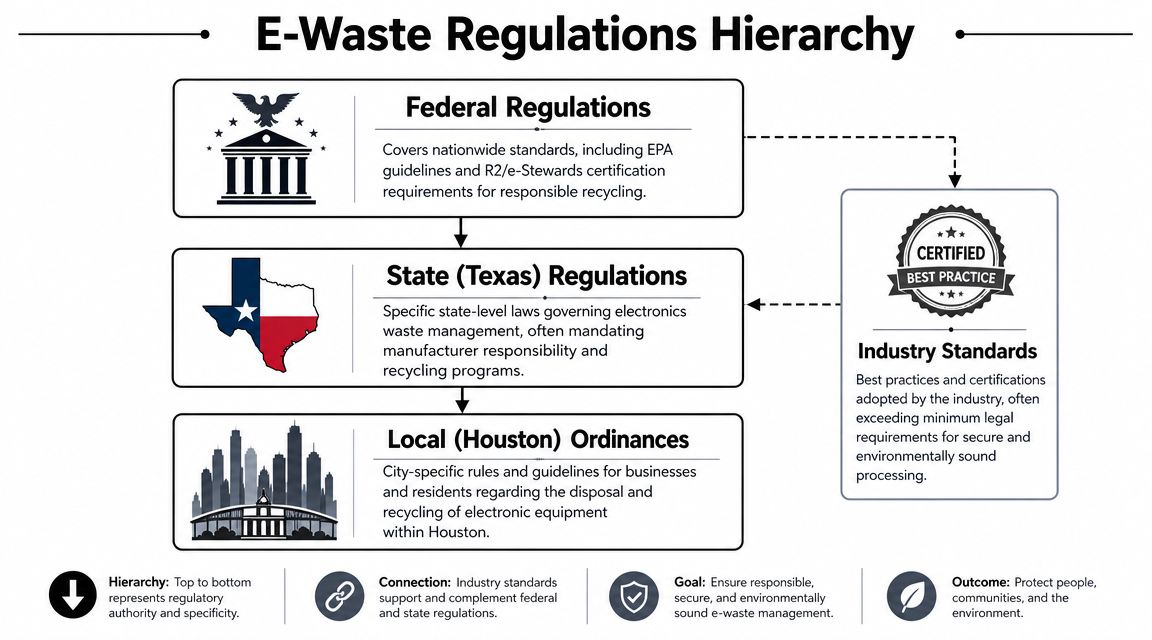
How to think about the rule stack
You don't need a legal memo for every project, but you do need a working framework for how these obligations layer together. Houston teams usually benefit from a simple hierarchy.
| Level | What it affects | What you should care about |
|---|---|---|
| Federal expectations | Environmental handling and controlled processing | Whether the downstream path is responsible and documented |
| Texas requirements | Manufacturer take-back and electronics recycling structure | Why the state already supports organized electronics recovery |
| Houston and regional programs | Collection options and local infrastructure | What exists locally, and where public programs stop being enough |
| Industry certifications | Operational discipline and auditability | Whether the provider's process is strong enough for enterprise use |
A Texas-based organization usually wants a partner that understands both the logistics and the policy environment. For teams comparing service areas or disposition options, a Texas IT recycling and ITAD provider overview can help frame what statewide support should look like.
Public recycling answers “Can this item be taken?” Enterprise ITAD answers “Can we prove exactly what happened to this asset?”
What doesn't work in Houston enterprise projects
The weakest approach is assuming that because Houston has established recycling outlets, any recycler is acceptable for telecom gear. That's where organizations blend two very different needs.
A basic drop-off or generic electronics pickup may be enough for non-sensitive, low-risk consumer devices. It is not enough when the project involves serialized network equipment, data-bearing hardware, internal audit review, or formal destruction records.
What works is matching the disposition model to the business risk. If the gear came from enterprise infrastructure, the project needs enterprise controls.
The Secure ITAD Workflow From Your Door to Final Disposition
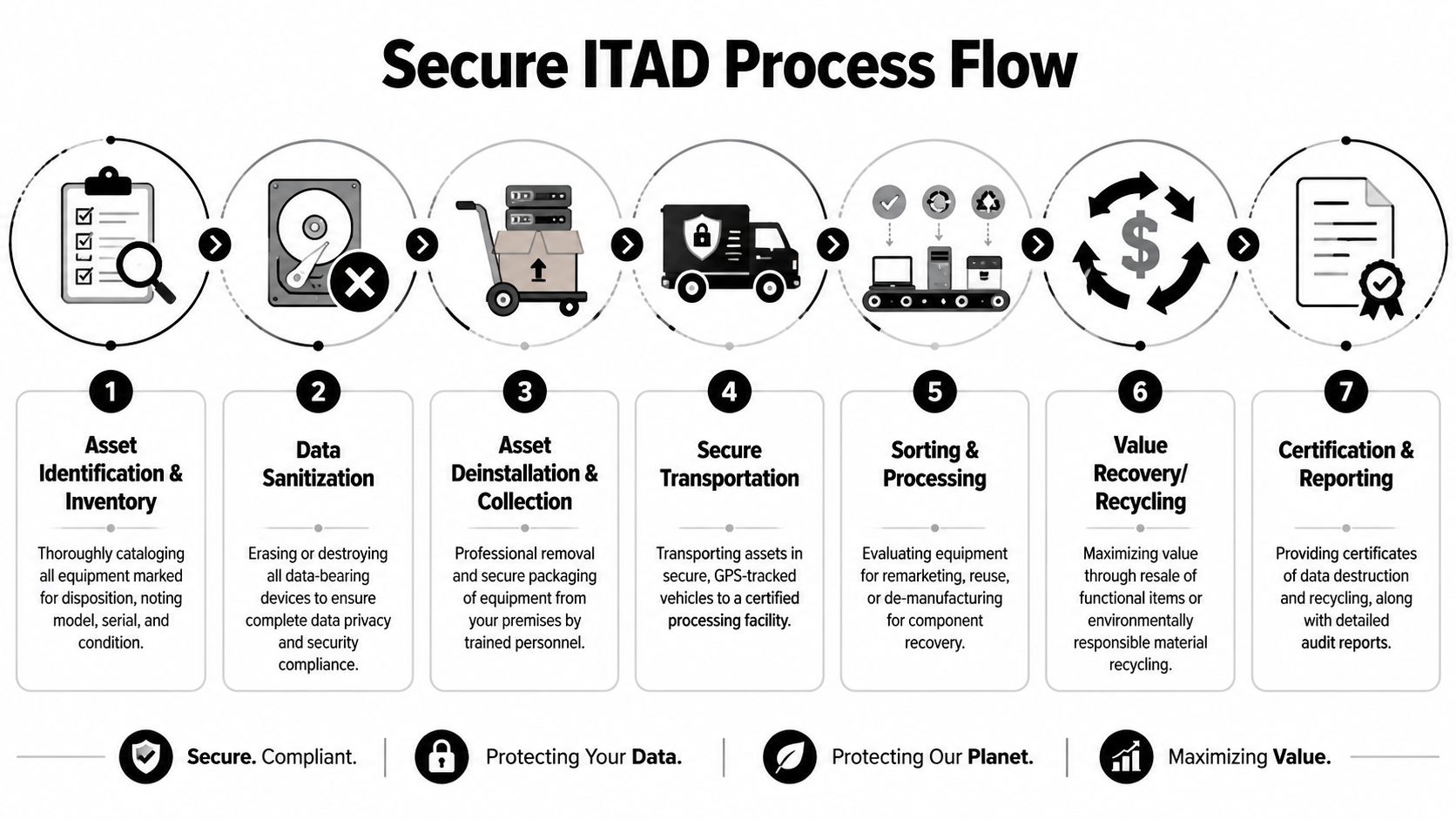
A proper telecom retirement follows a chain. If one link is weak, the whole record becomes questionable. That's why I advise Houston teams to treat the project as a controlled workflow from the moment an asset is identified for removal.
The most useful framework is straightforward. Build the inventory, sanitize by device type before removal, separate reuse candidates from recycle-only material, and finish with a disposition report. That stepwise approach creates a defensible audit trail, as outlined in this telecom equipment recycling workflow reference.
Step one and step two control the rest of the project
If the asset list is incomplete, every later document is incomplete too. The inventory has to be settled first, including location, type, condition, and whether the device is likely data-bearing.
Then comes sanitization planning. Many organizations make an expensive mistake at this point. They assume only servers or laptops need formal data destruction. In telecom environments, that's too narrow. Routers, switches, firewalls, call systems, and other appliances can retain sensitive operational data. The sanitization decision has to happen before those assets leave the site.
A useful internal decision table looks like this:
| Asset type | Common risk | Typical handling question |
|---|---|---|
| Servers and storage | Drives and retained data | Wipe for reuse or physically destroy |
| Firewalls and appliances | Credentials, logs, configs | Require verified sanitization |
| Switches and routers | Startup configs, cached settings, possible removable media | Don't rely on a basic reset alone |
| VoIP and telecom endpoints | Call logs, contact data, user data | Decide whether wiping or destruction fits policy |
On-site removal needs documented handoffs
Once sanitization requirements are set, the removal process has to preserve accountability. That means no loose loading, no informal “take the whole pile” instructions, and no truck leaving without a signed release tied back to the manifest.
For Houston organizations with multiple sites, this matters even more. A combined pickup may seem efficient, but if each location doesn't have its own controlled handoff record, discrepancies get harder to resolve.
What good pickup discipline includes:
- Pre-release check: Verify that staged assets match the approved manifest.
- Controlled loading: Separate data-bearing devices, reuse candidates, and scrap streams.
- Handoff record: Record who released the equipment, when it left, and under what count or serial list.
- Site reconciliation: Keep site-level records before combining loads.
If your team needs physical collection support for mixed electronics loads, scheduled electronic recycling pickup services are one option to compare against local providers, but the key criterion is whether the pickup process preserves chain of custody and final auditability.
A truck ticket isn't enough. If the paperwork can't trace the equipment back to a room, a site, and an approved asset list, the chain is already weak.
Transportation and intake are control points, not just logistics
Transportation gets treated as a middle step, but it's a major exposure point. Assets have left your premises and haven't yet reached final processing. At this stage, trust-based workflows often fail.
At intake, the provider should reconcile what arrived against what was released. If there's a mismatch, the exception should be documented immediately. Mature operators don't hide discrepancies inside a later summary report.
This is also where segregation matters in practice. The person loading gear shouldn't be the only person validating what was received. Independent confirmation turns a movement event into an auditable control.
Sorting decides value recovery versus final recycling
After intake, the provider should sort assets into disposition paths. Some equipment still has value. Some is only suitable for material recovery. Some may require destruction because policy rules out reuse.
Telecom projects differ from scrap hauling. A switch with market value should not be shredded out of convenience. A data-bearing appliance should not be routed toward resale unless sanitization has been completed and recorded. A rack or UPS unit may require separate processing and handling altogether.
Three common streams usually appear:
- Reuse or remarketing: Functional and supportable assets with residual value.
- Component or material recovery: Obsolete or damaged equipment suitable for compliant dismantling and recycling.
- Physical destruction path: Assets subject to policy-driven destruction or non-reusable data-bearing components.
Final reporting is the proof, not an afterthought
The project isn't complete when the truck leaves, and it isn't complete when the equipment is dismantled. It's complete when your team receives documentation that reconciles the original inventory to the final outcome.
A solid reporting package usually includes:
- Asset disposition report: What happened to each listed asset or category.
- Certificate of data destruction: For assets sanitized or physically destroyed under the agreed method.
- Certificate of recycling: For material sent through compliant recycling channels.
- Exception log: Any variance, unresolved serial issue, or processing note that affects the audit trail.
The report should let IT, security, compliance, and finance answer the same question with the same document: what left, how it was handled, and where it ended up.
What works is an integrated workflow. What doesn't is splitting inventory, wiping, transport, resale, and recycling across disconnected vendors who each issue partial paperwork. That model creates blind spots exactly where Houston IT teams need certainty.
Unlocking Hidden Value in Retired Telecom Gear
Too many organizations classify retired telecom hardware as scrap before anyone checks whether it still has recoverable value. That decision is convenient, but it's often costly.
Houston's electronics recycling market has shifted away from simple scrap handling and toward value recovery and secure enterprise services. Regional market positioning reflects that change, including B2B recyclers that advertise telecom and network equipment pickup for data centers, as noted on the Houston-Galveston Area Council used electronics page. The practical takeaway is that commercial telecom gear now gets evaluated differently than mixed household electronics.
Where value usually hides
Value recovery isn't limited to pristine equipment. The strongest candidates are complete, newer, supportable assets, but partial value can also exist in components, bulk lots, and equipment families with active secondary demand.
Common value buckets include:
- Network hardware with resale potential: Switches, routers, firewalls, wireless controllers, and certain telecom appliances.
- Data-center-adjacent equipment: Servers, rails, rack components, and accessory kits that still have demand.
- Bulk endpoint lots: VoIP phones and conference units when they're complete and in usable condition.
- Commodity-bearing scrap: Equipment that no longer has resale value but still contains recoverable material.
What determines whether gear should be reused or recycled
The right question isn't “Can someone take this?” The better question is “What path preserves the most value without creating security or compliance problems?”
Use this decision lens:
| Question | If yes | If no |
|---|---|---|
| Is the asset complete and identifiable? | Send for value review | Route toward recycling review |
| Can it be sanitized to policy? | Reuse or remarketing stays possible | Destruction may be required |
| Is there likely secondary demand? | Test and evaluate for resale | Focus on material recovery |
| Would handling costs exceed recovery? | Be selective | Recycle efficiently |
The mistake is forcing every asset into one stream. If you scrap everything, you erase possible return. If you try to remarket everything, you add processing time and cost to gear that should have gone straight to recycling.
What works in practice
Strong telecom disposition projects sort for value early. They don't throw marketable switches onto the same pallet as broken rack scrap. They also don't assume older gear is worthless without checking whether complete lots or reusable components still matter in the secondary market.
There's also a governance angle. Value recovery works best when finance, IT, and the disposition provider agree in advance on what qualifies for resale, what must be destroyed, and what should go directly to recycling. That keeps policy from getting rewritten in the warehouse.
Retired equipment isn't automatically low-value equipment. The difference usually comes down to inventory quality, sanitization discipline, and whether someone reviewed the assets before treating them as scrap.
How to Choose a Certified ITAD Partner in Houston
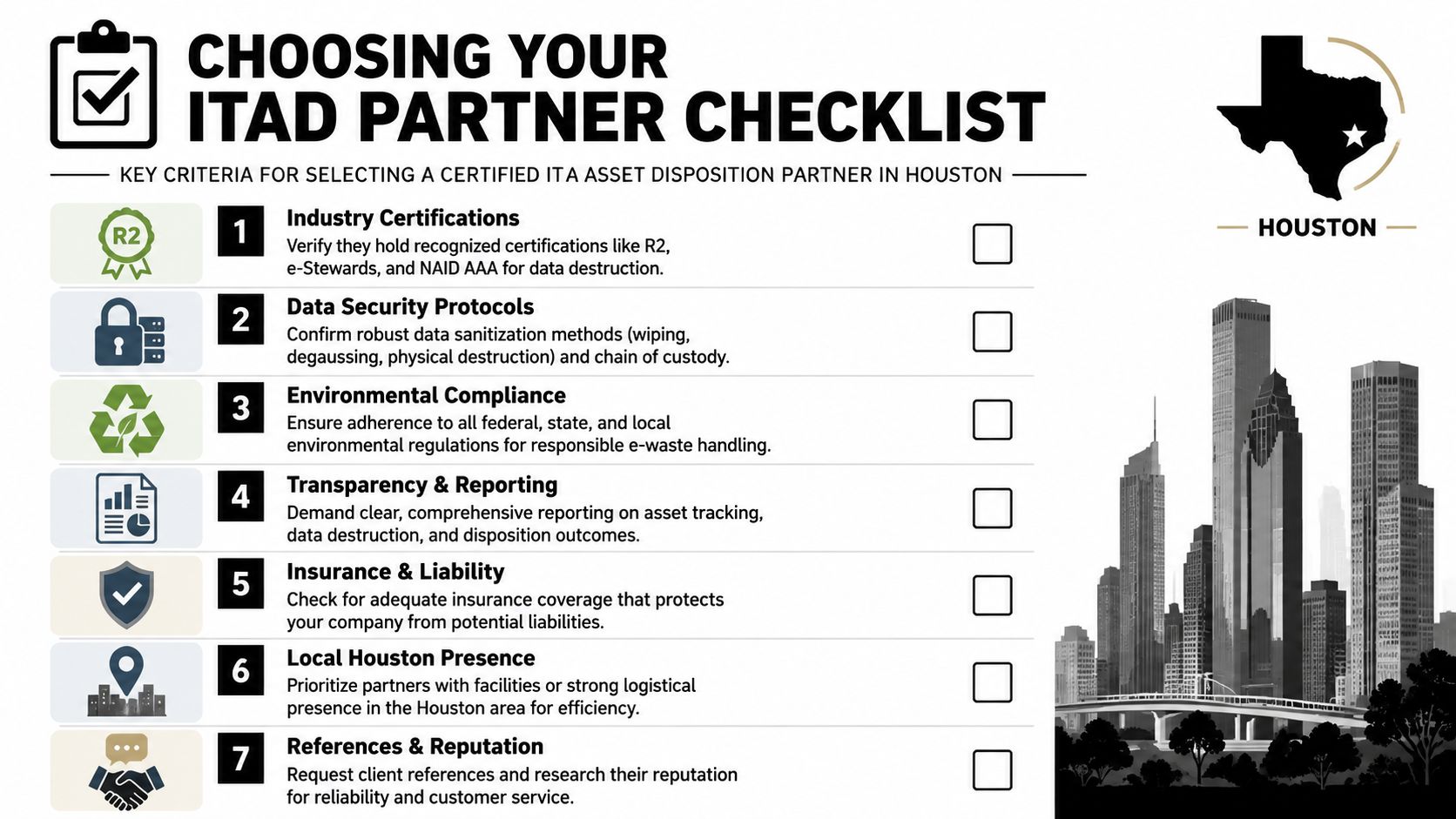
The biggest mistake in Houston telecom recycling is choosing a vendor based on acceptance lists, speed, or pickup convenience alone. Those factors matter, but they don't answer the risk question.
The more useful comparison is between a basic recycler and a true ITAD partner. One takes electronics. The other can prove what happened to every asset.
The compliance gap most buyers miss
Many Houston recycling pages still focus on accepted items and basic service claims. That leaves out the details enterprise buyers require. The EverTrade telecom and network equipment page is useful here because it highlights the compliance gap between simple drop-off recycling and enterprise ITAD, including the need for chain-of-custody documentation, NIST 800-88 sanitization, serialization, and end-to-end disposition controls.
That's the right lens for vendor selection. If a provider can't explain those controls clearly, the service may still remove equipment, but it won't remove your exposure.
Compare vendors by controls, not by marketing
Use a side-by-side review that looks at operational proof.
| Evaluation point | Basic recycler | Certified ITAD provider |
|---|---|---|
| Asset tracking | General counts or broad item categories | Serialized or asset-level reporting where applicable |
| Data sanitization | Vague or optional | Defined methods tied to policy and asset type |
| Chain of custody | Limited visibility after pickup | Documented handoffs and reconciliation |
| Downstream controls | Often unclear | Expected to be disclosed and managed |
| Final documentation | Basic receipt or generic certificate | Destruction and recycling records that support audit review |
For organizations that want a certification-focused benchmark, an R2 certified electronics recycler overview shows the type of standards-based positioning you should expect from any serious provider, whether local to Houston or serving the area through scheduled logistics.
Questions worth asking before assets move
A vendor conversation should get specific quickly. If the answers stay general, that's a warning sign.
Ask questions like these:
- How do you document chain of custody from our site through final disposition?
- What sanitization methods do you use for routers, switches, firewalls, servers, and telecom endpoints?
- Can you provide sample certificates for destruction and recycling?
- How do you handle asset discrepancies between pickup and intake?
- Who manages downstream recycling, and how is that documented?
- What level of serialized reporting do you provide?
One practical example in the market is Dallas Fortworth Computer Recycling, which provides B2B ITAD, electronics recycling, pickup logistics, and certified data destruction services for organizations managing business technology retirement. The important point isn't the brand name. It's whether the provider can document controls in writing before your first pallet leaves the building.
Red flags that should stop the process
Some issues should end the discussion early.
- Vague data destruction language: “We wipe everything” isn't enough.
- No sample paperwork: If they won't show documentation during sales, expect weaker reporting later.
- Unclear downstream handling: If they can't explain where material goes, your audit trail will stay incomplete.
- Loose manifest standards: “Just give us an estimate” usually means reconciliation will be weak.
- No distinction between reuse and destruction policy: That creates both value loss and security risk.
If the provider can't show you how the paperwork works before pickup, assume the paperwork won't get stronger after pickup.
Common Questions on Telecom Equipment Recycling
Does every telecom recycling project need on-site service
No. Some projects can be staged internally and released through scheduled pickup. Others need on-site deinstallation, packing, palletizing, or supervised removal from active telecom rooms. The deciding factors are sensitivity, site access, equipment volume, and whether your staff can prepare the load without weakening chain of custody.
What should happen to UPS units, batteries, and server racks
These items need to be identified early in the inventory. They affect labor, transport, and downstream processing. Houston's public collection environment shows that telecom-adjacent assets can be accepted in some programs, but business projects should still separate them operationally so the provider can plan handling, safety, and reporting correctly.
Can we just factory reset switches and routers before recycling
You can perform internal prep steps, but a factory reset is not the same as documented sanitization. For enterprise disposition, the important question is whether the final process creates evidence that the device was handled under your security policy.
Should we mix phones, switches, servers, and scrap in one bulk load
That usually creates confusion. Mixed loads make value recovery harder and can weaken your audit trail. Keep data-bearing gear, reuse candidates, and recycle-only material separated as early as possible.
What paperwork should IT ask for at the end
At minimum, ask for a disposition report plus any applicable destruction and recycling certificates. Those records should align with the manifest you approved before release. If the paperwork can't reconcile back to the original inventory, it won't help much during an internal review.
Conclusion Your Final Checkpoint for Responsible Recycling
Telecom equipment retirement in Houston works best when it's managed like a governed ITAD event, not a cleanup job. The equipment may be old, but the risks are current. Data exposure, weak chain of custody, poor downstream visibility, and lost asset value usually trace back to one issue. The process was too loose at the start.
A controlled inventory, device-specific sanitization, documented transport, clear separation of reuse and recycling paths, and final reconciliation give your team something better than a cleared-out room. They give you proof.
If your team needs a documented path for retiring servers, network gear, telecom hardware, or mixed business electronics, Dallas Fortworth Computer Recycling offers B2B IT asset disposition, electronics recycling, pickup logistics, and certified data destruction services for organizations that need secure handling and audit-ready reporting.