
Guide to Community Impact Programs in IT Disposal
The backlog usually looks harmless at first. A few retired laptops in a storage room. Some monitors from a floor refresh. A batch of desktops waiting on approval because nobody wants to be the person who signs off on the wrong disposal path.
Then the pile grows. IT owns the risk, finance wants the assets cleared, legal wants documentation, sustainability wants reuse, and someone in leadership asks whether any of it can support community goals.
That's where most organizations split the issue in two. They treat IT asset disposition as a security and logistics problem, and community impact programs as a separate CSR initiative. In practice, that separation leaves value on the table. The stronger approach is to design one process that handles data destruction, chain of custody, compliance, reuse, and community outcomes together.
Rethinking Your Retired IT Assets
Most IT leaders inherit a retirement process, not a strategy. Equipment reaches end of use, gets pulled from service, and sits until someone schedules pickup. That works well enough if your only objective is clearing space.
It falls short if you're trying to reduce risk and create measurable value from the same workflow.
Retired devices still carry business obligations. Drives may contain regulated information. Asset records may be incomplete. Equipment condition may vary. Some items can be refurbished and reused. Others should be dismantled and recycled immediately. A strong community program starts by accepting that these decisions belong inside the ITAD process, not after it.
A lot of organizations still think of donation as the soft option. It isn't. Donation done casually creates audit gaps. Donation done professionally can become one of the most disciplined parts of your retirement program.
What changes when IT treats disposal as strategy
Instead of asking, “How do we get rid of this equipment?”, ask two tighter questions:
- What must be destroyed or recycled with no exception because of data sensitivity, age, or condition?
- What can be securely prepared for reuse in a way that serves schools, nonprofits, workforce programs, or digital access initiatives?
That shift matters because it changes who gets involved and what gets tracked. Security defines wipe or destruction standards. Compliance defines documentation requirements. Sustainability defines reuse priorities. Community partners define where functioning equipment can create real utility.
Practical rule: If a device can't pass your security and documentation requirements, it doesn't belong in a donation stream.
The result is a cleaner operating model. Reusable assets don't get mixed with scrap. Non-reusable assets don't linger while teams debate donation possibilities. Leadership gets one coherent story instead of separate reports for disposal, recycling, and outreach.
The hidden cost center that can do more
Stored equipment creates friction. It consumes space, invites confusion about ownership, and increases the chance that chain of custody becomes fuzzy over time. A formal computer equipment disposal process reduces that friction, but the bigger gain comes from building a destination strategy into the workflow itself.
That's where community impact programs become practical for IT, not abstract. A working laptop is no longer just an item to remove from inventory. It can become a documented asset that moves through secure sanitization, refurbishment, allocation, and verified transfer to an organization that can use it.
This isn't philanthropy replacing discipline. It's discipline making philanthropy possible.
The Strategic Value of IT Community Impact Programs
A strategic program is different from occasional giving. It uses policy, partner standards, measurable outcomes, and documented handoffs. In the ITAD context, that means your retired technology becomes part of a repeatable operating system, not a feel-good side project.

The nonprofit sector already offers a useful precedent. United Way of Northeast Georgia describes the United Way community impact model as an approach used by a majority of United Ways worldwide, organizing resources around priority community needs and requiring reported data on program success. That's important for IT leaders because it shows what separates a community impact program from simple charity. The model is structured, outcome-oriented, and built around shared accountability.
Why IT should care
If you manage infrastructure, endpoint fleets, or data center transitions, you already run programs that require controls, vendor governance, and reporting. Community impact programs fit that operating style better than many teams expect.
The business case usually lands in four places:
| Priority | What it means in ITAD |
|---|---|
| Risk management | You reduce ad hoc handling and define clear paths for reuse, destruction, and recycling. |
| Executive reporting | Leadership gets evidence that retired assets supported both compliance and community goals. |
| Employee engagement | Staff can support a program that has visible purpose without bypassing IT controls. |
| Brand and ESG alignment | The organization can connect secure reuse and responsible recycling to broader public commitments. |
The key point is that none of those benefits require lowering your standards. In fact, the opposite is true. The more regulated your environment, the more valuable a well-run program becomes because loose donation practices are off the table.
What works and what usually fails
The strongest programs share a few traits:
- They start with asset policy, not enthusiasm. Teams define eligibility, data handling, documentation, and approved recipients before any device leaves custody.
- They tie community goals to specific equipment categories. Laptops may fit student access programs. Networking gear usually won't.
- They use recurring partners. Repeating the same controlled process is safer than reinventing every donation cycle.
- They report outcomes, not just activity. “We donated devices” is weaker than “we placed devices into a program designed to improve digital access and track use over time.”
What tends to fail is the informal middle ground. Devices are set aside “for donation someday.” Managers make one-off approvals. Recipient vetting is light. Documentation arrives late, if at all. That model creates the work of community outreach without the protection of a real ITAD program.
Community impact is most credible when the same operational rigor used for security also governs donation, refurbishment, and reporting.
Done right, retired assets behave less like waste and more like a managed portfolio. Some units are harvested for value recovery. Some are redeployed internally. Some are securely refurbished for outside use. Others are recycled because reuse would create more risk than benefit.
That portfolio mindset is what turns community impact from a side benefit into a strategic output of IT operations.
Key Models for IT Donation and Partnership
Most organizations don't need more ideas. They need a model that fits their governance, staffing, and risk tolerance. In practice, there are three common approaches.
A formal electronics donation program should support whichever model you choose, but the right answer depends on how much control you want, how much internal effort you can sustain, and how tightly you need to govern data risk.
Direct donation and refurbishment
This is the most visible model. The company retires eligible devices, sanitizes or destroys data-bearing media, refurbishes the hardware if needed, and transfers equipment to approved schools, libraries, or nonprofits.
It works well when you have a predictable flow of standard endpoints such as laptops and desktops. It also gives IT the clearest line of sight into what equipment moved where.
Best fit
- Organizations with steady refresh cycles
- Teams that want high control over recipient standards
- Programs focused on digital access or device scarcity
Trade-offs
- Internal review can become time-consuming if every batch requires separate approval
- Device quality varies, so not every refresh generates useful donation inventory
- The recipient may need support for setup, software, or logistics that IT doesn't want to provide
This model breaks down when companies confuse usable equipment with merely powered-on equipment. If the battery is failing, the device won't support current workloads, or replacement parts are hard to source, donation may shift cost downstream to the recipient.
Strategic nonprofit partnerships
This model is less transactional. Instead of donating devices whenever surplus appears, the company partners with a mission-aligned organization and builds an ongoing technology support channel around it. The relationship may include periodic equipment transfers, volunteer setup help, digital skills training, or coordination with a workforce development program.
The advantage is relevance. Equipment goes into a defined use case rather than a generic donation pool.
The best partnerships don't start with surplus inventory. They start with a real operating need on the recipient side.
A strategic partnership often produces stronger stories for internal stakeholders because the company can connect assets, staff involvement, and community goals in one narrative. It also creates more room to learn what recipients can absorb. Some nonprofits need reliable mid-range laptops. Others need peripherals, imaging help, or multilingual onboarding materials more than hardware volume.
The downside is complexity. Partnerships need governance. Someone has to own recipient vetting, program cadence, issue escalation, and boundaries around support.
Employee purchase and giving programs
This model sits between internal asset monetization and community benefit. Employees can acquire retired devices under a controlled process, and the organization directs proceeds toward a charitable purpose or designated community program.
For some companies, this is easier to scale than direct external donation because the receiving population is known, distribution is simpler, and support expectations are clearer. It can also reduce the chance that useful devices sit in storage while teams debate recipient matching.
Here's a practical comparison:
| Model | Control | Internal effort | Security complexity | Community visibility |
|---|---|---|---|---|
| Direct donation | High | Moderate | Moderate to high | High |
| Strategic partnership | High | High | Moderate to high | High |
| Employee purchase and giving | Moderate | Moderate | Moderate | Moderate |
This model isn't ideal if your main objective is direct digital equity in external communities. It can still support a broader impact strategy, but the link is less immediate than placing devices directly with schools or nonprofits.
How to choose without overengineering it
Use simple criteria first:
Asset mix
If your retirement stream is mostly standardized user devices, direct donation is easier. If it's specialized or mixed-condition equipment, a partnership or resale-based giving model may be cleaner.Governance capacity
If your team can't manage recurring partner oversight, avoid building a complicated external network.Support expectations
If your organization won't provide post-transfer help, choose recipients and models that don't depend on it.Executive intent
Some leaders want visible community placement. Others want a lower-lift model that still ties asset retirement to social good.
The common mistake is picking the most inspiring model instead of the most sustainable one. A smaller program that stays compliant and repeatable will outperform an ambitious program that stalls after the first shipment.
Navigating Data Security and Regulatory Compliance
Security is where good intentions usually get tested. If your donation workflow creates uncertainty about data destruction, custody, or recipient handling, it isn't a community program. It's a breach scenario waiting for the wrong day.
That's why secure IT community impact programs have to be designed from the same control framework as any other ITAD activity.
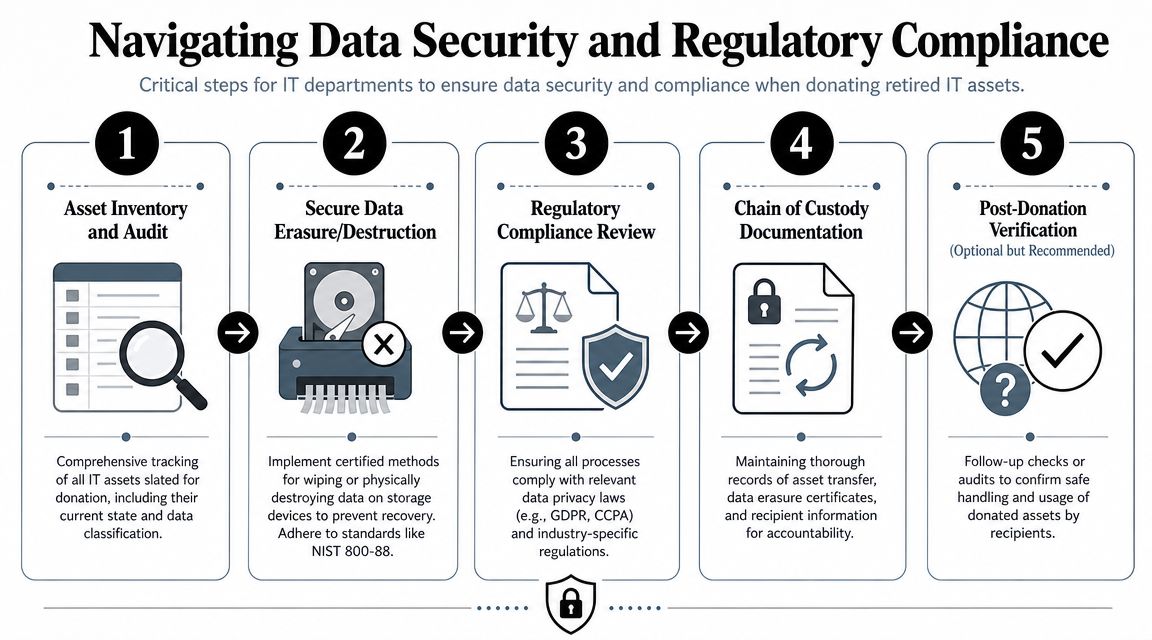
The non-negotiables
Start with asset inventory and classification. Before equipment moves anywhere, the organization needs a documented record of what it is, where it came from, who approved retirement, and what kind of data exposure it may carry.
Then move to data sanitization or destruction. Some devices can be wiped and verified for reuse. Others should have storage media physically destroyed because the risk profile, device age, or regulatory context makes reuse impractical. Your standard should be written, consistent, and auditable.
A useful reference point is guidance on data security best practices for retired equipment, especially when internal teams need to align legal, security, and operations around one process instead of separate assumptions.
Where compliance teams usually push back
Compliance concerns are usually legitimate. They tend to cluster around a few questions:
- Can we prove data was removed or destroyed?
- Can we show uninterrupted chain of custody from pickup to final disposition?
- Do recipient transfers create obligations under privacy, sector, or contractual requirements?
- Do we have a defensible path for equipment that isn't suitable for reuse?
If you can't answer those questions quickly, the program isn't ready.
That's also why certified partners matter. A competent ITAD provider should support documented pickup, serialized tracking where appropriate, sanitization records, downstream handling controls, and environmental disposition for equipment that can't reenter service.
Equity belongs in compliance conversations too
A lot of teams treat equity as a communications issue. Instead, it is a design issue. The harder question isn't only who received devices. It's who didn't.
REA Analytics notes that proving equity means measuring who is not being reached and identifying barriers such as internet access, language gaps, or transportation. That matters in IT programs because a device placed with the wrong assumptions may not create meaningful access at all.
A laptop donation program can look successful on paper and still miss the people with the highest barriers. If recipients need multilingual instructions, local support, power accessories, or transportation-friendly pickup windows, those details affect whether the program produces equitable benefit.
Security protects the organization. Equity protects the purpose of the program. You need both.
A safer operating pattern
The safest pattern is straightforward:
- Define eligibility rules for donation versus recycling.
- Apply approved wipe or destruction methods before any transfer decision.
- Document custody at every handoff.
- Vet recipient organizations for capacity, legitimacy, and intended use.
- Route non-reusable equipment into certified recycling, not storage limbo.
That framework keeps community impact inside the control boundary rather than outside it. For IT leaders, that's the difference between a program you can defend in an audit and one you can only describe optimistically.
Measuring and Reporting Your Program's Success
If leadership only sees a donation count, the program will eventually be treated like a nice gesture instead of an operational asset. The job is to show what changed for the business and for the community, and to show it in a way that survives scrutiny.
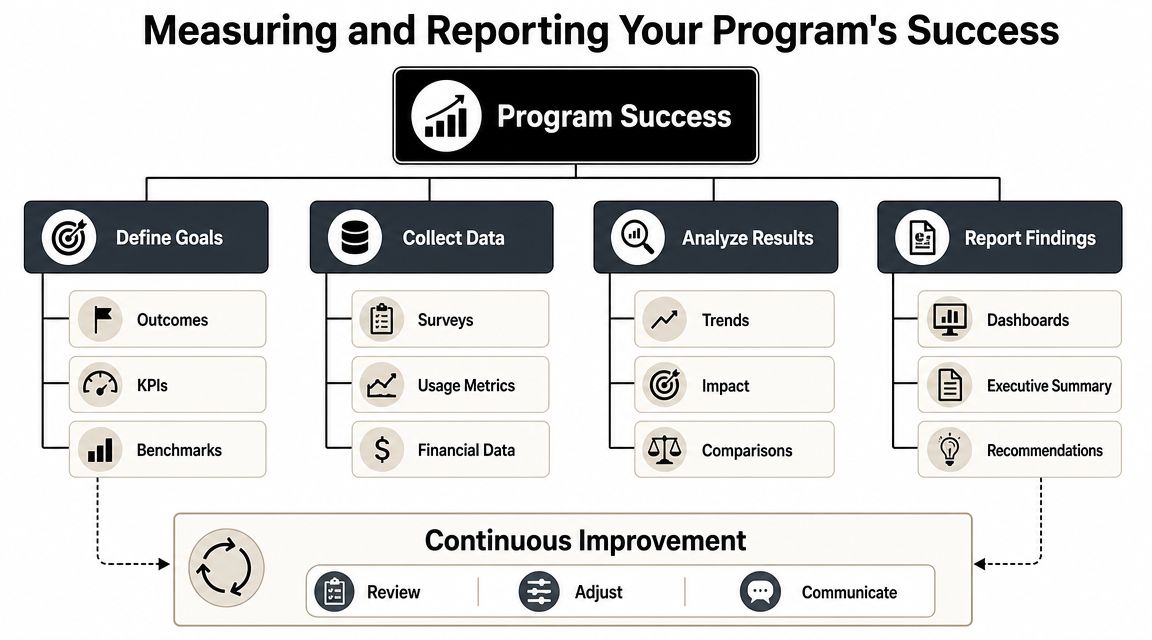
The measurement model I trust most in this space starts before the first device leaves your facility. Sopact describes a rigorous approach as baseline plus intervention tracking plus outcome measurement, using persistent IDs so participants can be followed over time. That matters because year-end totals alone can't separate program effects from background change.
Stop reporting only outputs
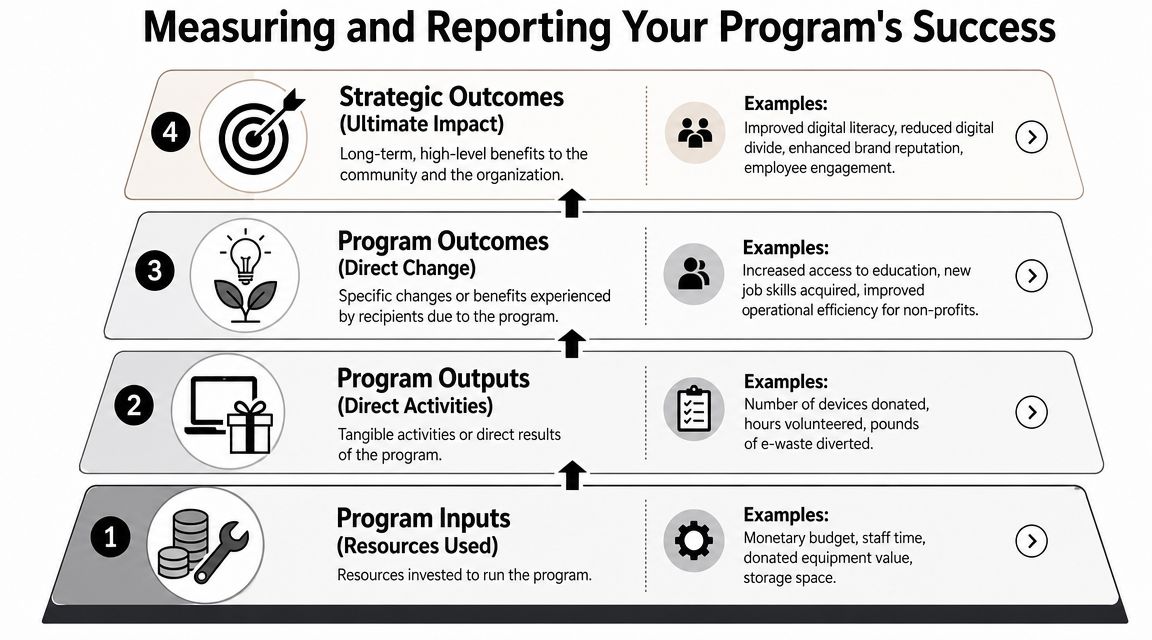
Outputs are still useful. You should know how many devices were processed, how many were reused, how many were recycled, how much staff time the program consumed, and how many partners participated.
But outputs aren't enough. They show activity, not effect.
A better reporting stack looks like this:
| Layer | What to measure in an IT community program |
|---|---|
| Inputs | Staff time, vendor costs, device pool, storage and logistics effort |
| Outputs | Devices prepared, devices transferred, volunteer sessions, partner organizations served |
| Outcomes | Recipient access to working technology, nonprofit operational support, training completion, service usability |
| Strategic impact | Whether the program advanced business goals and community priorities in a durable way |
Many internal reports often lack depth. They stop at the easy line items. The stronger report follows the asset beyond shipment and asks what changed after placement.
Combine numbers with signal
Benevity's guidance on impact measurement is useful here because it argues for quantitative outputs plus qualitative signal, meaning scale data should sit alongside participant sentiment and coded feedback that reveals barriers and mechanisms (Benevity on measuring social impact data collection).
For IT leaders, that's practical. Device counts tell you throughput. Recipient feedback tells you whether the hardware was usable, whether onboarding was clear, whether replacement cycles fit actual need, and where the process created friction.
Use both.
- Business KPIs might include audit readiness, policy compliance, reduction in idle asset storage, executive visibility into reuse outcomes, and employee participation in approved program activities.
- Community KPIs might include access gained, service continuity for nonprofit partners, training participation tied to donated equipment, or feedback about setup and usability barriers.
Build attribution into the workflow
A vague impact story won't hold up in front of finance, procurement, or a board committee. You need matched records.
That usually means tracking:
- device ID or asset batch
- retirement date
- wipe or destruction status
- transfer destination
- recipient program
- follow-up outcome notes
- exception handling
A documented chain of custody process helps because it gives the business side of the report the same evidentiary backbone as the security side.
If you can't trace a device from retirement decision to final outcome, you can't credibly claim impact from that device.
One more point matters. Community outcomes fluctuate. Programs operate inside broader economic and local conditions. Urban Institute observations summarized in the verified material note that community-level initiatives can create spillover effects across a community, but those effects can be difficult to detect because outcomes change year to year for many reasons. That's exactly why baseline discipline matters. It keeps the report honest.
What a strong report sounds like
A weak report says the company donated equipment and supported the community.
A stronger report says the company retired eligible assets through a documented ITAD process, securely prepared a defined subset for reuse, transferred them through vetted partners, captured follow-up feedback, and used that data to refine recipient fit, service design, and future refresh allocation.
That kind of reporting does two things at once. It protects credibility with internal stakeholders, and it gives community partners evidence they can use.
Launching Your Program with a Certified Partner
Most organizations can design the policy. Fewer can execute the full chain consistently at scale without help. That's why partner selection matters so much. The right ITAD partner doesn't just pick up equipment. The partner supports secure retirement, documentation, downstream handling, and a realistic path for reuse or recycling.
If a provider can't handle both security and community program requirements, you'll end up stitching together separate vendors and carrying the coordination burden yourself.
What to ask before you sign
Use a practical checklist in vendor review:
What certifications and documented controls do you maintain?
Ask for the standards, the process documents, and the reporting artifacts you'll receive.How do you determine whether equipment is reused, resold, donated, or recycled?
The answer should be rule-based, not improvised.What does your chain of custody look like from pickup through final disposition?
If this answer is vague, stop there.How do you support data sanitization and destruction evidence?
You need documentation that legal and audit teams can work with.Can you support recipient or program-level reporting for community initiatives?
A partner who only handles scrap processing won't help much if leadership wants measured outcomes.How do you handle assets that shouldn't enter a donation stream?
This matters as much as the reuse path.
One example in this category is an R2-certified electronics recycler, which can help organizations structure secure, documented handling for retired equipment while keeping reuse and recycling inside a compliant process. For companies evaluating options, Dallas Fortworth Computer Recycling is one such provider focused on B2B and public-sector IT disposition workflows.
Why outcome reporting should be part of partner selection
A lot of providers can move boxes. Far fewer can support impact reporting that means anything.
That standard has already been set in the broader community impact field. In one United Way example, a local initiative reported both 5,294 people receiving basic-needs assistance and 168 people finding and starting jobs in the same reporting period, showing scale and outcome together in one framework (United Way community impact reporting example). That's the mindset IT leaders should bring into asset-based community programs as well. Activity alone is incomplete. Outcomes are what justify continued investment.
A certified partner should make that easier, not harder. The right one helps you narrow which assets are suitable for impact programs, preserve the evidence trail, and avoid building a donation process that creates more governance problems than community value.
The end goal is simple. Retired technology leaves your environment securely. Reusable assets reach vetted recipients through a documented process. Non-reusable assets are handled responsibly. Leadership gets proof, not aspiration.
Dallas Fortworth Computer Recycling helps organizations retire technology through secure, documented ITAD workflows that can also support community-oriented reuse where appropriate. If you're building or tightening a program, explore Dallas Fortworth Computer Recycling to review its services for data destruction, electronics recycling, chain of custody, and reuse-focused disposition planning.