
Your Guide to a Certificate of Destruction for Hard Drives

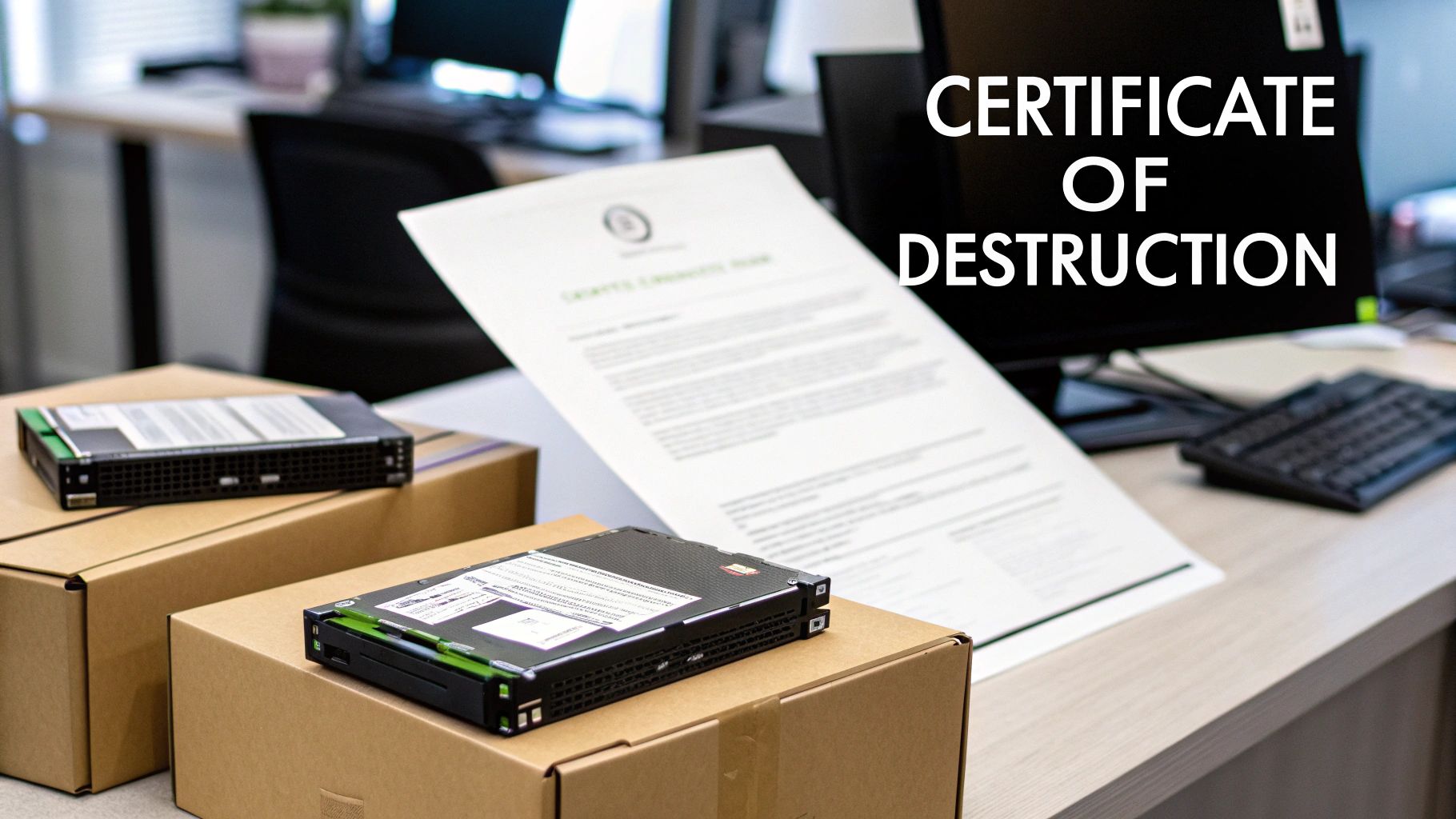
A certificate of destruction for hard drives is much more than a simple receipt. It’s the official, legally binding document that proves your company’s sensitive data has been permanently and irretrievably destroyed.
Think of it as a death certificate for your data. It confirms that old hard drives were physically eliminated according to industry standards, not just wiped, reformatted, or worse, misplaced. This single piece of paper is often your most important defense in a data security audit or a breach investigation.
Why This Document Is Your Ultimate Data Security Shield
Imagine your business retires a few old servers. Weeks later, you get a call—one of the hard drives, loaded with thousands of customer records, was found in a dumpster behind an electronics shop. The legal fallout, regulatory fines, and damage to your reputation could be catastrophic.
This scenario isn't far-fetched, and it highlights a crucial truth: when your data leaves your control, so does your liability. That is, unless you have definitive, documented proof of its destruction.
A certificate of destruction for hard drives is that proof. It's a formal document issued by a certified IT Asset Disposition (ITAD) vendor like us, confirming your media has been physically destroyed beyond any possibility of recovery. It’s not just paperwork; it’s a cornerstone of any serious risk management and compliance strategy.
The Critical Role of a CoD in Compliance
Simply deleting files or formatting a drive is dangerously insufficient. Specialized software can often recover data from wiped drives, leaving your organization completely exposed. Physical destruction—shredding, crushing, or pulverizing the drive into tiny pieces—is the only method that guarantees the data is gone for good. The CoD serves as the official record of this final, irreversible act.
For any organization handling sensitive information, this isn't optional. Several major regulations mandate strict data disposal protocols, and a CoD is the key to proving you've met your obligations.
- HIPAA (Health Insurance Portability and Accountability Act): Demands that healthcare providers protect patient health information (PHI) throughout its entire lifecycle, including secure disposal.
- GDPR (General Data Protection Regulation): Grants individuals the "right to be forgotten," which requires provable, permanent data erasure.
- GLBA (Gramm-Leach-Bliley Act): Mandates that financial institutions have a comprehensive security plan to protect consumer financial information, with secure disposal being a core requirement.
Failing to comply can lead to staggering fines and legal trouble. A properly executed CoD provides auditors with the clear, third-party verification they need to see that you've done your part.
Establishing an Unbreakable Chain of Custody
The value of a certificate of destruction for hard drives goes beyond a simple confirmation stamp. It formalizes and completes the chain of custody—the chronological paper trail documenting the seizure, control, transfer, and final disposition of your assets.
A proper Certificate of Destruction acts as the final link in your chain of custody. It officially transfers liability from your organization to the certified destruction partner, providing a clear, auditable trail that proves you fulfilled your due diligence in protecting sensitive data.
This transfer of liability is absolutely vital. Once a certified vendor takes possession of your assets and issues the CoD, they are now responsible for ensuring the destruction process meets all agreed-upon and regulatory standards. Without this document, your organization remains on the hook indefinitely for any data that might surface from improperly handled media. It’s your definitive proof that you acted responsibly.
The Anatomy of a Compliant Destruction Certificate

Let's be clear: a simple receipt from a recycling company is not a certificate of destruction for hard drives. One is just a flimsy acknowledgment of a transaction. The other is a legally defensible document designed to hold up under the harsh lights of an audit or legal challenge. Knowing the difference is absolutely critical to protecting your business.
A proper certificate is meticulously detailed, leaving zero room for doubt. It’s built with specific, verifiable information that creates an unbreakable record of your data’s final moments. Think of it less like a store receipt and more like a detailed forensic report—every key fact is captured, signed, and dated.
This isn't optional. A generic document stating that "IT assets were received and processed" is a massive red flag. It offers no real proof and would likely be dismissed by auditors, leaving your company completely exposed.
Core Components of a Legally Sound Certificate
To be considered valid proof of destruction, a CoD must contain several non-negotiable fields. These elements are the bedrock of its legal and audit-ready status. If even one is missing, the whole document becomes questionable, seriously weakening your compliance standing.
A truly compliant certificate will always include:
- Unique Certificate ID: A serialized number that makes this specific destruction event uniquely traceable within the vendor’s system.
- Client Information: Your company’s full, official name and address, clearly identifying you as the owner of the assets.
- Vendor Information: The complete legal name, address, and contact details of the certified ITAD partner who performed the destruction.
- Date of Destruction: The exact date the hard drives were physically destroyed.
- Location of Destruction: The physical address of the facility where the destruction happened, which is crucial for verifying a secure process.
- Authorized Signatures: Signatures from representatives of both your company (transferring custody) and the destruction vendor (accepting custody and confirming destruction).
These fields create an official, unambiguous record connecting your organization to a specific destruction event performed by a recognized vendor. They answer the fundamental questions an auditor will ask: who, what, where, and when.
Elevating Your Certificate from Compliant to Bulletproof
Meeting the bare minimum is one thing; having a document that is truly unassailable is another. Top-tier ITAD vendors provide extra details that create an even stronger, more granular audit trail, demonstrating a higher commitment to security and transparency.
Look for these elements to identify a superior certificate:
- Detailed Asset List: This is the most important differentiator. The certificate should list the unique serial number of every single hard drive destroyed. This directly links the CoD to your internal inventory records, providing item-level proof.
- Method of Destruction: The document must state how the drives were destroyed. Vague terms like “processed” are not enough. It should specify the method, such as “physical shredding to 2mm particles” or “crushing via hydraulic press.”
- Chain of Custody Reference: The certificate should reference the chain of custody documentation, including dates and signatures for every time the assets were transferred, from your facility to the final destruction point.
- Statement of Compliance: A formal declaration that the destruction was performed according to specific standards, such as those set by NAID AAA or other relevant regulations.
A Certificate of Destruction that itemizes each asset by serial number and specifies the exact destruction method transforms the document from a simple attestation into a powerful, irrefutable piece of evidence. This level of detail is the gold standard for audit defense.
This granular information is especially important for organizations with large-scale disposal needs, like those found in enterprise environments. For more insights on managing this process, our guide on secure data center equipment disposal services provides valuable context.
The table below breaks down what you should consider essential versus what signifies a higher standard of service.
Mandatory vs. Recommended Fields on a Certificate of Destruction
At a minimum, every Certificate of Destruction must contain certain fields to be considered valid for compliance and legal purposes. However, the best ITAD partners go a step further, including additional information that provides a more robust and detailed audit trail. Here’s a look at what separates a basic certificate from a bulletproof one.
| Field | Description | Status (Mandatory/Recommended) |
|---|---|---|
| Unique Asset Serial Numbers | A complete list of serial numbers for every individual hard drive that was destroyed. | Mandatory |
| Specific Destruction Method | A clear description of the technique used (e.g., shredding, crushing) and the resulting particle size. | Mandatory |
| Date and Location of Destruction | The precise date and physical address where the assets were destroyed. | Mandatory |
| Authorized Signatures | Signatures from both the client and the vendor, confirming the transfer and destruction. | Mandatory |
| Custody Transfer Log | A record of every time the assets changed hands, with dates, times, and signatures. | Recommended |
| Reference to Regulatory Standards | A statement confirming adherence to standards like NIST 800-88, HIPAA, or NAID AAA Certification. | Recommended |
| Witness Information | Names of individuals who witnessed the destruction process, if applicable. | Recommended |
Ultimately, the more detailed your certificate is, the stronger your legal and compliance position will be. When you review a CoD, don’t just check for its existence—dissect its contents. A truly compliant document tells a complete story, one that leaves no doubt about the secure and permanent end of your data’s lifecycle.
Why Secure Hard Drive Destruction Is a Business Imperative
A certificate of destruction for hard drives might look like just another piece of paperwork, but it’s actually proof that you’ve prevented a potential corporate disaster. When old IT assets are mishandled, they aren’t just an oversight—they’re ticking time bombs loaded with financial and reputational risk, waiting to go off.
Failing to properly destroy even a single hard drive can demolish years of customer trust and brand loyalty in an instant. The consequences aren’t abstract fears; they’re catastrophic, real-world damages that can cripple a business.
The Tangible Costs of a Data Breach
When an old company hard drive shows up on the secondary market with sensitive data still on it, the fallout is swift and severe. The costs go far beyond a simple financial hit, creating a ripple effect that touches every part of your business, from customer relationships to regulatory standing.
A data breach from improper hardware disposal can set off a chain reaction of negative outcomes:
- Massive Regulatory Fines: Authorities enforcing regulations like HIPAA or GDPR don't hesitate to levy fines that can run into millions of dollars, especially when negligence is a factor.
- Irreversible Brand Damage: Bad news travels fast. A 2021 report revealed that 86% of consumers said they would be less likely to do business with a company after it suffered a data breach.
- Costly Legal Battles: Affected customers and partners often file class-action lawsuits, dragging your organization through years of expensive and distracting litigation.
- Loss of Competitive Advantage: If your intellectual property, trade secrets, or proprietary research gets out, the long-term strategic damage can be impossible to calculate.
This isn’t just about protecting data—it’s about protecting your entire business. A professional destruction process, verified by a CoD, isn't an expense. It's a critical investment in risk management.
Real-World Consequences of Improper Disposal
We’ve seen it happen time and again in high-profile data breaches: retired IT assets become the source of a major crisis. In one notorious case, a financial institution sold off old computer equipment without making sure the hard drives were destroyed first. Those drives, full of thousands of unencrypted customer financial records, were eventually resold online. The result was massive fines and a public relations nightmare.
This entire disaster could have been avoided with a certified destruction process documented by a detailed certificate of destruction for hard drives. That CoD would have provided auditable proof that the data was gone forever, closing a major security gap and shielding the institution from liability.
The question is no longer if a data breach will happen because of mishandled assets, but when. Secure, certified destruction is the only way to permanently remove old hardware from the risk equation.
The threats are only getting worse. Data breaches from insecure computing devices have reached crisis levels around the world. Recent reports show a shocking increase in these incidents, with the number of people affected jumping from 310 million to over 1.3 billion worldwide in just four years. You can find more details on these alarming trends in this comprehensive data breach report.
Building a Strong Business Case for Certified Destruction
Thinking of professional ITAD services as just another cost center is a dangerous mistake. It’s far more accurate to view it as a key part of your company’s insurance and cybersecurity strategy. The price of a certified destruction service is a tiny fraction of the potential cost of a single data breach.
When you partner with a certified vendor, you aren’t just getting rid of old equipment. You are actively defending your organization against very real threats. The process gives you a clear, defensible position that demonstrates due diligence to auditors, regulators, and your own stakeholders.
Making secure disposal a priority is easier than ever with programs designed for compliance and efficiency. Our guide to business computer recycling services shows how companies can implement a secure and auditable workflow. In the end, a certificate of destruction is the final, documented proof that your company takes its data security obligations seriously—turning a potential liability into a verified asset of trust.
A Practical Guide to Requesting and Verifying Your CoD
Getting a certificate of destruction for hard drives isn’t a passive process where you just wait for a document to show up in your inbox. To do it right, you need a proactive, step-by-step approach to make sure the final paperwork is accurate, auditable, and legally sound. This guide will turn a potentially complex task into a manageable workflow that protects your organization from start to finish.
The whole process actually starts long before your assets ever leave your building. Your first, most critical step is to create a detailed inventory. This isn't just a simple count of devices; it's a granular log that includes the make, model, and—most importantly—the unique serial number of every single hard drive headed for destruction. This internal record is your single source of truth.
Without this master list, verifying the final certificate is impossible. It’s the baseline you’ll use to measure your vendor’s performance and the accuracy of their documentation.
The Pre-Destruction Checklist
Before you even schedule a pickup, you need to arm yourself with the right questions and set clear expectations with your ITAD partner. A reputable vendor will welcome this diligence because it shows a shared commitment to security and transparency. If a vendor is evasive or dismissive of these details, that's a huge red flag.
Your pre-destruction due diligence should include these key steps:
- Requesting a Sample CoD: Ask the vendor for a sample certificate before you commit. Scrutinize it to ensure it includes all the mandatory fields we discussed earlier, especially the itemized list of serial numbers.
- Clarifying the Chain of Custody: Ask them to walk you through how they document custody transfers. Will they use sealed and locked bins? Are their vehicles tracked with GPS? Who signs off at each stage of the journey?
- Confirming the Destruction Method: Get a specific, no-nonsense answer on how the drives will be destroyed. Will they be shredded? If so, what will the final particle size be? This exact detail must be what appears on the final certificate.
The diagram below shows the severe risks that come with skipping these crucial steps. It illustrates how a single mishandled drive can quickly spiral into a full-blown business crisis.
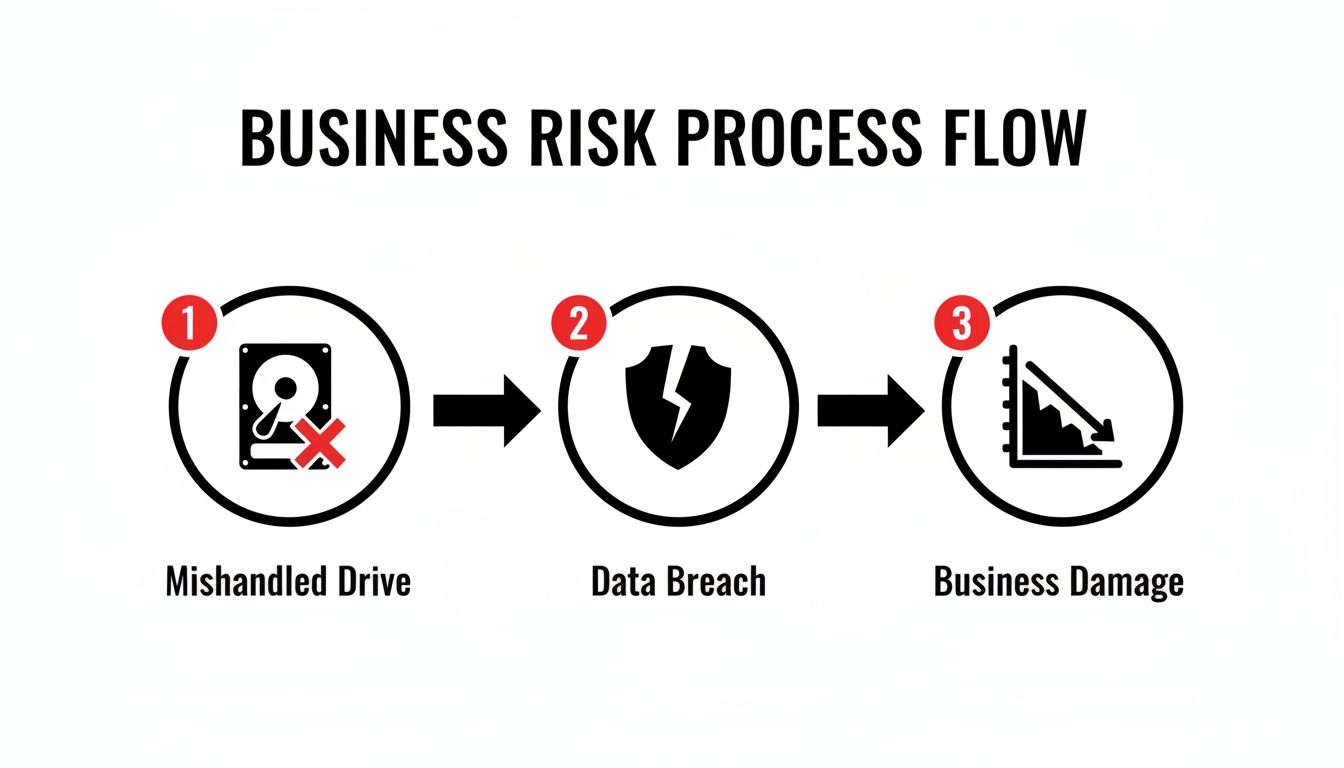
This flow highlights a sobering reality: the journey from a simple operational oversight to significant financial and reputational damage is dangerously short. This is exactly why a verified destruction process is non-negotiable.
Verifying Your Certificate of Destruction
Once the destruction is complete, your vendor will issue the CoD. This is where your initial diligence pays off. The verification process is a straightforward but essential cross-referencing task that officially closes the loop on your asset disposition project.
Think of verification as the final audit of the entire process. It’s your last chance to catch discrepancies and confirm that every single sensitive asset was destroyed as promised. Do not skip this step.
Here’s your action plan for verification:
- Match Serial Numbers: This is the most important step. Meticulously compare the serial numbers listed on the certificate of destruction for hard drives against the original inventory list you created. Every single number must match perfectly.
- Check Key Details: Confirm that all other information is correct—your company name, the date of destruction, the destruction method, and the authorized signatures.
- Investigate Discrepancies Immediately: What if a serial number is missing or incorrect? Contact your vendor right away. A professional partner will have detailed internal records and should be able to quickly resolve the issue or provide a clear explanation.
For businesses managing a wide range of devices, partnering with a vendor who understands these complexities is key. You can explore comprehensive e-recycling and electronics recycling services for businesses to see how a structured program supports this entire workflow. Ultimately, this rigorous request-and-verify system ensures your CoD is not just a piece of paper, but undeniable proof of your commitment to data security.
How We Deliver Auditable Compliance You Can Trust
Knowing what a certificate of destruction for hard drives is supposed to do is one thing. Seeing it backed by a secure, transparent process provides the real peace of mind your business needs. At Dallas Fortworth Computer Recycling, we’ve built our entire process around delivering auditable, risk-free compliance you can count on. Our system isn't just designed to meet industry standards—it’s built to exceed them.
Our secure chain of custody begins the moment you schedule a pickup with us. We don't just show up with a truck; your assets are collected in locked, tamper-evident bins and transported in GPS-tracked vehicles. This creates a verifiable digital trail from your facility right to ours.
For businesses in healthcare, finance, or any other regulated industry, this meticulous approach isn't optional. It's an absolute necessity. We understand that a single gap in the process can create massive liability.
A Foundation of Certification and Security
Once your assets arrive at our secure facility, they are handled under constant surveillance within a controlled-access environment. As a NAID AAA Certified partner, our facility, staff, and procedures have undergone rigorous, unannounced audits from the industry’s top security certification body. This isn't a one-time approval; it's an ongoing commitment to upholding the highest standards of data destruction.
This certification is your guarantee that we follow strict protocols for everything from employee background checks to physical security and process controls. It’s the framework that supports every action we take.
Meticulous Serial Number Tracking
The heart of our auditable process is our detailed serial number tracking system. Before any destruction takes place, every single hard drive is scanned. Its unique serial number is recorded and logged against your specific work order, creating a direct, one-to-one link between your inventory and the final destruction event.
This single step is what elevates a generic service into a defensible compliance action. It’s the granular detail that ensures our Certificate of Destruction can stand up to the toughest audits, proving not just that some drives were destroyed, but that your specific drives were.
A verifiable audit trail is built on specifics, not generalities. By capturing every serial number, we provide irrefutable, item-level proof that your data-bearing assets were permanently eliminated, leaving no room for ambiguity.
This detailed documentation is the bedrock of a truly secure partnership and how we ensure our IT asset disposition services deliver complete accountability.
The Final, Unbreakable Proof
After the physical destruction—typically shredding drives into tiny, irrecoverable fragments—we issue your comprehensive Certificate of Destruction. This document brings all the critical data points from our secure workflow together into a single, legally sound record. It includes:
- A complete, itemized list of every hard drive serial number.
- The exact date and location of destruction.
- The specific method used, such as “physical shredding to 2mm.”
- An authorized signature from our team, attesting to the completed work.
This isn't just a piece of paper; it’s the final word on your assets’ lifecycle, formally closing the loop and permanently transferring liability away from your organization. The growing reliance on such robust processes is clear. The global market for hard drive destruction was recently valued at $1.65 billion and is projected to reach $5.05 billion within the next decade. By partnering with us, you gain more than a service—you gain a risk-free partnership built on trust and irrefutable proof.
Common Questions About Hard Drive Destruction Certificates
Even with a solid plan, questions always come up when you're managing the final disposal of old hard drives. A certificate of destruction for hard drives is a non-negotiable document, so it’s natural to want to get the details right. This section answers the most common questions we hear from IT professionals, helping you handle the process with confidence and keep your organization secure and compliant.
We'll cover everything from how long you should keep these records to the major differences between data destruction methods. Each answer is designed to reinforce the core principles of security, compliance, and why partnering with a proven ITAD expert is so important.
How Long Should We Keep a Certificate of Destruction?
This is one of the most frequent and important questions we get. While specific industry rules can vary, the widely accepted best practice is to keep a Certificate of Destruction for a minimum of seven years. This timeline lines up with many general business record retention standards.
However, for businesses in highly regulated industries, longer is always better.
- Healthcare (HIPAA): With sensitive Protected Health Information (PHI) involved, it's smart to keep these certificates indefinitely. Think of them as a permanent part of your compliance and risk management history.
- Finance (GLBA): Just like healthcare, financial institutions should plan on indefinite retention to maintain a complete audit trail of how they've protected customer data over the years.
Treat the CoD as your permanent legal proof that you did the right thing. A data breach investigation or a compliance audit can happen years after the equipment is long gone. Having that certificate instantly accessible in a secure, backed-up digital archive is your best defense for long-term audit readiness.
Is Data Wiping the Same as Physical Destruction?
No, they are completely different processes with very different security outcomes. Confusing the two can leave your business wide open to risk. Data wiping, often called sanitization, uses software to overwrite the data on a hard drive, leaving the physical drive intact and ready for reuse.
Physical destruction, on the other hand, means shredding, crushing, or pulverizing the drive itself. This process renders the hardware totally useless, making it physically impossible for anyone to recover the data.
While software-based wiping is a good option for hard drives that will be reused inside your company, it's not the most secure choice for end-of-life equipment. Physical destruction provides the ultimate guarantee that the data is gone for good, which is why a Certificate of Destruction is almost always tied to this method.
It's also crucial to know that some data removal methods, like degaussing (using a powerful magnet), only work on older magnetic hard disk drives (HDDs). They do absolutely nothing to modern Solid-State Drives (SSDs), which don't use magnetic storage. Physical destruction works on every type of drive, every time.
What Are Red Flags on a Vendor's Certificate?
A weak or incomplete certificate of destruction for hard drives can be just as bad as not having one at all. Knowing how to spot the warning signs is a key skill for any IT manager in charge of asset disposal. A good certificate is transparent, detailed, and ties directly back to your physical inventory.
Be on the lookout for these common red flags:
- Generic Descriptions: The certificate just says a "batch of IT assets" or "computer equipment" instead of listing each hard drive by its unique serial number.
- Vague Destruction Methods: The document uses fuzzy terms like "processed" or "recycled" instead of specifying the exact method, like “shredded to 2mm particles.”
- Missing Core Information: Key details are left out, like the exact date of destruction, the physical location where it happened, or the required signatures from both your company and the vendor.
- No Reference to Compliance Standards: A reputable partner will state that the destruction was performed according to standards like NAID AAA or NIST 800-88.
If a vendor hesitates to show you a sample certificate or won't answer detailed questions about their documentation, that's a major warning sign. A true professional partner will be completely transparent because their documents are built to prove their secure and compliant process.
Can Our Company Issue Its Own Destruction Certificate?
While you can and should document your internal data destruction activities, a self-issued certificate holds very little authority in a formal audit or legal situation. The real power of a CoD comes from being an unbiased, third-party validation.
A certificate from a certified, independent ITAD vendor provides the impartial proof that regulators and auditors are looking for. It shows that a secure, industry-standard process was followed by a qualified partner, which removes any hint of a conflict of interest or questions about whether the destruction was done correctly.
This third-party verification is what demonstrates true due diligence. It confirms that you not only had a policy in place but that you also brought in a certified expert to execute it properly. That external validation is what turns a simple internal record into a powerful piece of legal and compliance evidence.
At Dallas Fortworth Computer Recycling, we provide the auditable, NAID AAA Certified destruction processes that your organization can rely on. Our detailed Certificates of Destruction are designed to meet the strictest compliance standards, giving you the irrefutable proof you need to operate with confidence. Contact us today to learn how we can secure your end-of-life data. Find out more at https://dallasfortworthcomputerrecycling.com.