
Your Guide to Corporate E-Waste Solutions
When a business needs to get rid of old technology, it's not as simple as just throwing it out. Corporate e-waste solutions are professional services designed to help companies manage retired IT equipment securely and in full compliance with the law. It’s a structured approach that turns outdated assets from a liability into a managed resource, taking care of everything from data security and environmental rules to recovering any leftover value.
The Hidden Risks in Your Retired IT Assets
Every server, laptop, and company phone your organization takes out of service is more than just obsolete hardware—it’s a ticking time bomb of potential risks. Think of your old IT gear as a hidden balance sheet. If you just let it pile up in a storage closet, each device represents a growing debt of data security threats, steep regulatory fines, and missed financial opportunities. This isn't some far-off problem; it's an immediate business challenge sitting in your back room.
The constant cycle of tech upgrades and the massive shift to cloud infrastructure are only making this issue worse. Companies are refreshing their technology faster than ever, which means the pile of retired assets is growing exponentially. Suddenly, responsible disposal has become a top priority for IT, finance, and compliance leaders alike.
The Scale of the E-Waste Challenge
The numbers here are genuinely staggering. Globally, we generated a massive 62 million tonnes of e-waste in 2022, and that number is expected to hit 82 million tonnes by 2030. For businesses, this translates directly into mountains of old servers, computers, and networking gear that demand careful handling. What’s really alarming is that only 22.3% of this waste was properly recycled, leaving billions of dollars in recoverable materials on the table and creating a huge compliance headache. You can dig into more of this data in the UN's recent e-waste monitor report.
This is where having a formal strategy becomes non-negotiable.
A proactive e-waste plan isn't just about disposal. It's a strategic framework for turning risk into a secure, compliant, and often profitable process. It’s about making sure every retired asset is handled in a way that protects your data, your brand, and your bottom line.
Reframing the E-Waste Problem
Instead of seeing e-waste as just another task for the facilities team, it’s critical to view it as a core business function with real risks and opportunities. Without a proper plan, your organization is wide open to:
- Data Security Breaches: A single hard drive that wasn't wiped correctly can lead to a catastrophic data leak, costing millions in fines and destroying your company's reputation.
- Regulatory Penalties: Failing to comply with environmental laws like the WEEE Directive or various state-level regulations can result in severe financial penalties.
- Lost Financial Value: A lot of retired equipment still has significant resale value. Just tossing it out is literally throwing money away that could have been recovered through remarketing.
Effective corporate e-waste solutions provide a clear, structured path to neutralize these risks. They ensure every device is securely sanitized, responsibly recycled, or remarketed to capture its remaining value.
Decoding Your E-Waste Management Options
An effective e-waste strategy isn't a single action—it's a set of specific, connected services designed to protect your organization and even recover value. Think of it less like simple disposal and more like a specialized toolkit, where each tool solves a different piece of the asset retirement puzzle.
Understanding what these individual services do is the first step toward building a program that moves beyond just checking a compliance box and starts actively benefiting your bottom line.
When technology is retired, it creates a cascade of potential issues that demand careful management. The diagram below shows the three main risks every business faces when decommissioning old hardware.
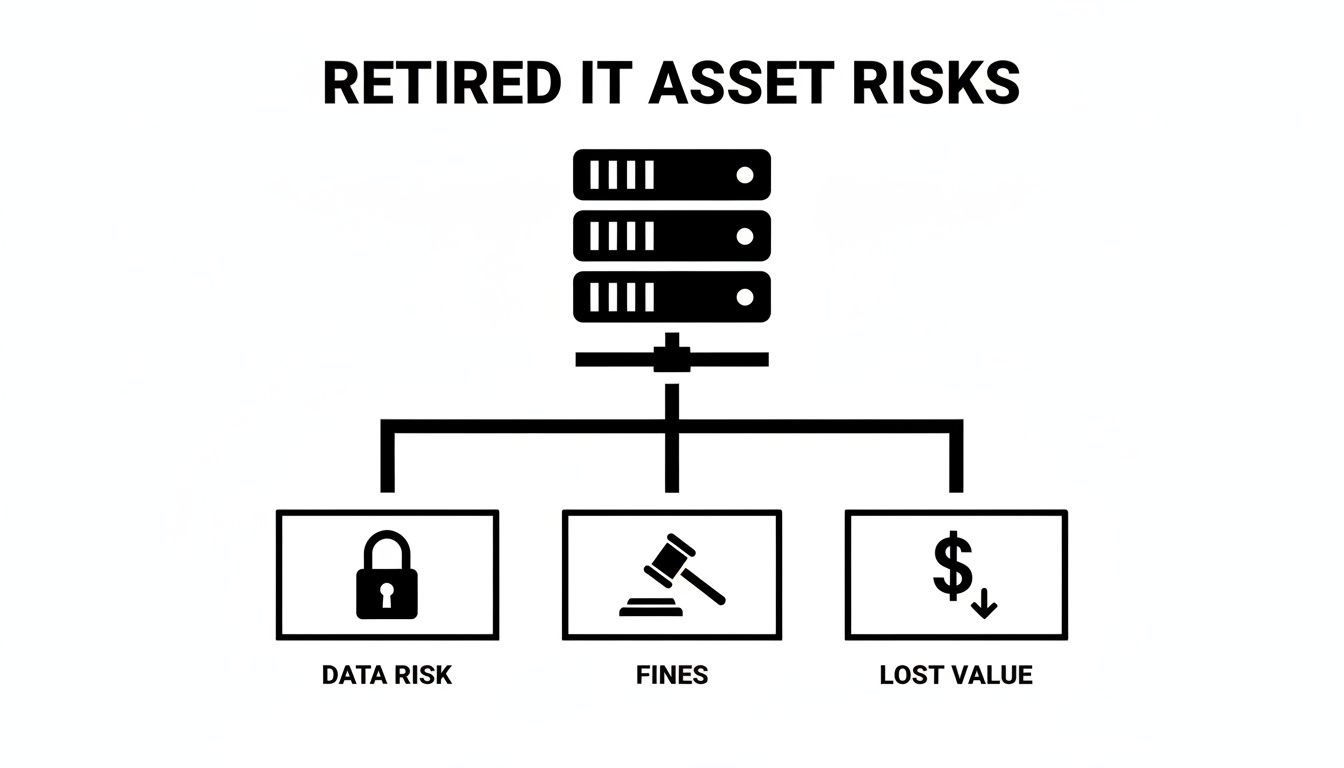
As you can see, failing to properly manage old servers and devices exposes your business to serious data security threats, regulatory penalties, and the direct financial loss of recoverable value.
Corporate E-Waste Service Offerings at a Glance
To help you quickly identify which services align with your needs, this table breaks down the core offerings.
| Service Type | Primary Function | Key Business Benefit | Common Assets Covered |
|---|---|---|---|
| IT Asset Disposition (ITAD) | Manages the entire lifecycle of retired IT assets to maximize value and ensure compliance. | Turns a cost center into a revenue stream through resale and responsible recycling. | Laptops, desktops, servers, monitors, networking gear |
| Certified Data Destruction | Guarantees the permanent and verifiable destruction of sensitive data on storage media. | Protects against data breaches and provides auditable proof of compliance. | Hard drives (HDDs), solid-state drives (SSDs), backup tapes |
| Data Center Decommissioning | Manages the systematic shutdown, removal, and disposal of entire data center environments. | Minimizes operational disruption during facility consolidations or cloud migrations. | Servers, storage arrays, racks, networking equipment, power systems |
| Asset Reuse & Resale | Identifies and refurbishes viable equipment to sell on the secondary market. | Maximizes financial return on investment (ROI) and supports the circular economy. | Enterprise servers, networking switches, corporate laptops |
| Certified Electronics Recycling | Responsibly dismantles and processes end-of-life electronics to recover raw materials. | Ensures environmental compliance and prevents hazardous materials from entering landfills. | Obsolete PCs, broken printers, old peripherals, any non-resalable electronics |
Each service plays a distinct role, but they often work together to create a comprehensive, secure, and financially sound asset retirement program.
IT Asset Disposition: The Value Recovery Engine
IT Asset Disposition (ITAD) is the most comprehensive service, acting as your primary engine for value recovery. It’s much more than just disposal; ITAD is a formal process for managing retired IT equipment to maximize its financial return while ensuring data security and environmental compliance.
A skilled ITAD partner assesses each asset to determine its best possible outcome. This involves meticulously tracking, testing, and grading every piece of equipment. Devices with remaining market value are refurbished and prepared for resale, turning what was once a cost center into a potential revenue stream.
Certified Data Destruction: The Digital Fortress
Your company’s data is its most valuable asset. Certified Data Destruction is the digital fortress that guarantees sensitive information on old hard drives, SSDs, and other media is permanently and irretrievably destroyed. For protecting your brand, customers, and intellectual property, this is a non-negotiable step.
Vendors accomplish this using two primary methods that meet strict government and industry standards like NIST 800-88:
- Physical Shredding: Hard drives are fed into industrial shredders that pulverize them into tiny, unrecognizable fragments, making data recovery physically impossible.
- Data Wiping/Sanitization: Specialized software overwrites the entire drive with random data, effectively erasing the original information.
Upon completion, you receive a serialized Certificate of Destruction. This document is your auditable proof that you’ve met your legal and ethical obligations for data privacy.
Data Center Decommissioning: A High-Stakes Operation
For any organization retiring large-scale infrastructure, Data Center Decommissioning is a high-stakes logistical operation that requires immense precision. This specialized service involves the systematic shutdown and removal of servers, racks, networking gear, and power systems from a live or retired facility.
The process is incredibly complex, demanding expert project management to de-install equipment without disrupting ongoing operations. It includes asset tracking, on-site data destruction, and secure transportation, all performed under a strict chain of custody to ensure a smooth transition during cloud migrations or facility consolidations.
A well-executed decommissioning project is invisible. It happens securely, efficiently, and on schedule, minimizing operational disruption while ensuring every asset and byte of data is accounted for.
Remarketing and Certified Recycling: Your Dual Backstops
Finally, two pillars of a robust program address both your financial and environmental duties.
Asset Remarketing and Resale is your ROI and sustainability champion. It’s the part of ITAD focused purely on finding a new life for viable technology. By selling refurbished laptops, servers, and components on secondary markets, your organization not only recoups a portion of its initial investment but also contributes to the circular economy.
On the other hand, Certified Electronics Recycling serves as your environmental compliance backstop. For assets with no resale value, this process ensures they are responsibly dismantled. Materials like precious metals, plastics, and glass are recovered and reintroduced into the manufacturing supply chain, keeping hazardous materials out of landfills. Businesses can see how these programs work by exploring the range of electronics recycling services for businesses in Dallas Fort Worth.
Navigating Data Security and Regulatory Compliance
When it's time to retire old IT assets, two things keep CIOs and compliance officers up at night: data security and regulatory compliance. Getting either one wrong can lead to catastrophic financial blows and a tarnished reputation. A solid corporate e-waste solutions strategy is built on a foundation of airtight security protocols and a deep understanding of the legal landscape.
It helps to think of your old hardware not just as equipment, but as a collection of locked safes. Every server hard drive, employee laptop, and company smartphone is packed with sensitive data—customer records, financial statements, proprietary intellectual property, you name it. Just deleting files isn't enough. That’s like leaving the key in the lock.

Real data security demands permanent, irreversible data destruction. This is why a documented chain of custody is so critical. Think of it like evidence in a legal case; every step, from pickup at your facility to final destruction, has to be documented without any gaps. This is what protects your organization from liability if an audit or data breach investigation ever comes your way.
Demystifying the Regulatory Alphabet Soup
The world of compliance is swimming in acronyms, and each one represents a set of rules with serious teeth. Failure to comply isn't just a minor mistake; it can lead to crippling penalties.
- NIST 800-88: This is the gold standard for data sanitization from the National Institute of Standards and Technology. It outlines specific procedures for purging, clearing, or physically destroying data so it can never be recovered.
- HIPAA: The Health Insurance Portability and Accountability Act sets strict rules for protecting patient health information. Healthcare providers must ensure all data on retired medical devices and servers is destroyed in a fully compliant way.
- FACTA: The Fair and Accurate Credit Transactions Act requires businesses to properly destroy consumer information to guard against identity theft.
Following these standards isn't optional. They're legal mandates designed to protect sensitive information, and any reputable e-waste partner will provide certification that their processes meet or exceed these requirements. The global pressure for better e-waste management is only growing, especially since just 22.3% of e-waste was formally recycled in 2022, while an estimated 60-90% is illegally traded or dumped.
Why Vendor Certifications Are Your Assurance
So, how can you be sure a vendor will handle your assets securely and ethically? The answer is in third-party certifications. These aren't just logos slapped on a website; they are proof that a provider has passed rigorous, independent audits of their processes.
Two of the most important certifications in the industry are:
- R2 (Responsible Recycling): This certification focuses on environmentally sound practices, worker health and safety, and data security. An R2-certified vendor is committed to a transparent and accountable recycling process.
- e-Stewards: Often considered one of the most stringent standards, e-Stewards certification guarantees that no hazardous e-waste is exported to developing countries and that all data is handled with the highest level of security.
Choosing a certified partner is your single best defense against downstream liability. It ensures your e-waste doesn't end up in a landfill or on an overseas black market, and it confirms your data is destroyed according to the highest industry standards.
Finally, a Certificate of Destruction is the last crucial piece of the compliance puzzle. This legal document is your official record, detailing what was destroyed, how it was done, and when. It is your auditable proof of due diligence. You can explore more about what makes a valid certificate of destruction for hard drives in our detailed guide. Without this paperwork, you have no verifiable proof that you fulfilled your legal and ethical obligations.
Choosing the Right E-Waste Solutions Partner
Picking a vendor to handle your company's e-waste is one of the most important decisions you'll make in your entire asset management program. This isn't just about finding someone to haul away old equipment. It’s about trusting a partner with your sensitive data, your legal compliance, and ultimately, your brand's reputation.
Making the wrong choice can lead to staggering data breach fines and compliance nightmares. The right partner, however, becomes a seamless extension of your IT and security teams. You need to move past the glossy brochures and website promises to find them. This requires a battle-tested framework for vetting potential partners—one that digs into the specific criteria that truly matter.
Evaluating Core Capabilities
Before you even think about contracts, start with the fundamentals. A vendor’s operational strength is what determines their ability to meet your needs securely and consistently, especially if your organization is spread across multiple locations.
First, look at their logistics. Can they service all your office locations with a national reach, or are they a single-region player? A partner with a robust, nationwide network can standardize your e-waste process, ensuring every site follows the same high standards. This makes audits a breeze and gives you a single point of contact. For complex jobs like facility shutdowns, it’s critical to understand their process. You can see what’s involved by reviewing a guide on data center equipment disposal services in Dallas Fort Worth.
Next, zoom in on their data destruction methods. A top-tier provider should offer both on-site and off-site solutions. This gives you the flexibility to choose the right security level for different assets. On-site shredding, where a mobile destruction truck comes right to your facility, offers the ultimate peace of mind for highly sensitive data because you can watch it happen.
Scrutinizing Security and Compliance
Certifications are your first line of defense. They are independent, third-party proof that a vendor's processes meet strict industry standards. Keep an eye out for these key credentials:
- R2v3 (Responsible Recycling): This certification ensures the vendor follows best practices for environmental safety, worker health, and data security all the way down the recycling chain.
- e-Stewards: Often considered the gold standard, e-Stewards guarantees that no hazardous e-waste is illegally exported and that all data is handled with maximum security.
But don't stop at the certificates. You need to dig deeper into their security protocols. How do they maintain a rock-solid chain of custody from the moment an asset leaves your building? Ask to see sample documentation, like serialized asset reports and certificates of destruction.
A vendor’s willingness to provide transparent, detailed reporting is a direct reflection of their confidence in their own processes. If they hesitate to share sample reports or audit trails, consider it a major red flag.
This level of detail isn't optional. A complete, auditable trail is your primary defense if a regulator comes knocking or a data breach investigation ever occurs.
Asking the Tough RFP Questions
Your Request for Proposal (RFP) is your chance to formally vet potential partners and compare them on an apples-to-apples basis. This is where you separate an adequate vendor from a true risk-mitigation partner. Go beyond the basics and ask the tough questions about liability coverage and downstream accountability.
Here are a few essential questions to build into your RFP:
- Downstream Vendor Audits: "Describe your process for auditing and vetting downstream recycling and resale partners. How often are these audits conducted?" This shows you how seriously they take responsibility for your assets even after they leave their facility.
- Pollution Liability Insurance: "Can you provide a certificate of insurance that includes specific coverage for pollution liability and errors and omissions?" A standard general liability policy often won't cover environmental incidents.
- Data Breach Coverage: "Does your insurance policy include specific coverage for data breaches resulting from the handling of our assets? Please provide the coverage limits." This confirms they have a financial safety net for a worst-case scenario.
- Employee Screening: "What are your procedures for background checks and security training for employees who will handle our assets?" People are often the weakest link in the security chain.
Asking these questions transforms the selection process from a simple procurement task into a strategic security decision. It empowers you to choose a partner who truly minimizes your risk, protects your data, and maximizes the value of your retired IT assets.
Turning E-Waste Costs Into Financial Wins
Viewing your e-waste program as just another line item in the expense column is an outdated—and expensive—mistake. A smart approach to corporate e-waste solutions isn’t about spending money. It’s a powerful value generator that actively improves your financial health. When you reframe asset retirement as a business opportunity, you can unlock significant returns built on three core pillars: cost avoidance, value recovery, and enhanced brand equity.
This shift in perspective completely changes the financial equation of a technology refresh cycle. The process moves from a necessary evil to a predictable and often profitable part of your IT operations.
The First Pillar: Cost Avoidance
The most immediate financial win comes from the money you don't have to spend. Preventing a single data breach is the perfect example. The price of certified data destruction is a tiny fraction of the potential multi-million-dollar fallout from a breach, which can include regulatory fines, legal fees, customer notifications, and catastrophic brand damage.
On top of that, professional e-waste management helps you sidestep steep fines for non-compliance with environmental regulations. It’s always cheaper to be proactive with compliance than to react to penalty notices.
The Second Pillar: Value Recovery
This is where your e-waste program starts putting money back into your budget. Many of your retired IT assets—especially enterprise-grade servers, laptops, and networking gear—still hold significant value on the secondary market. A skilled IT Asset Disposition (ITAD) partner will refurbish and remarket these devices, turning depreciated assets into a steady cash flow.
This isn't just about recovering value from the obvious high-ticket items. It taps into a massive, underutilized resource pool. To put it in perspective, the world’s e-waste in 2022 contained metals worth billions, yet only $28 billion was salvaged. This mismanagement led to a staggering $37 billion net global loss, a figure you can read more about in the Global E-waste Monitor 2024. By recovering and reselling viable equipment, your company directly captures a piece of that lost value.
A well-managed asset resale program can transform your tech refresh from a financial drain into a predictable revenue stream, often offsetting the entire cost of the disposition service.
The Third Pillar: Brand Equity
Finally, a real commitment to sustainability is no longer just a talking point—it's a tangible business asset. Today's customers, investors, and top talent are increasingly drawn to companies with strong, demonstrable environmental, social, and governance (ESG) credentials. A transparent, certified e-waste program is a powerful way to prove you’re serious about your impact.
This positive public image builds brand loyalty and can even influence purchasing decisions, creating long-term financial benefits that go far beyond direct revenue from asset sales. By implementing a formal program, which you can learn more about through various business computer recycling services in Dallas Fort Worth, you invest in your company's reputation as a responsible corporate citizen. It's a smart, forward-thinking approach that delivers a clear ROI while protecting your data, your budget, and your brand.
Building Your Corporate E-Waste Program
Great intentions don't make a great e-waste program. The real work is turning your strategy into a clear, repeatable process that anyone in your organization can follow. A solid roadmap is what transforms policy into practice, giving you a secure, compliant, and financially smart system you can actually rely on.
This journey starts with knowing what you have. From there, you can set the rules for retiring old tech and then bring your chosen partner into the fold seamlessly.
Phase 1: Perform an Internal Asset Audit
You can't manage what you don't measure. The first step is a thorough internal audit of all IT assets you’re planning to retire. This inventory needs to capture the basics: device type, age, condition, and where it’s located.
This initial count creates your baseline. It helps you predict disposal volumes and, just as importantly, spot which assets might still have some resale value. All effective corporate e-waste solutions are built on this foundational data.
Phase 2: Develop a Clear Asset Retirement Policy
With a complete inventory in hand, it’s time to formalize the process. An asset retirement policy is your company's official rulebook for decommissioning technology. It needs to spell out your data sanitization standards, chain-of-custody protocols, and the specific criteria that determine if a device gets resold or recycled.
This policy takes all the guesswork out of the equation. It guarantees every employee and department follows the exact same secure, compliant steps for every retired device—whether it's one laptop or an entire server rack.
Phase 3: Onboard and Integrate Your Vendor
Once you’ve selected a certified partner, the focus shifts to making them part of your team. This means setting up clear communication channels, locking in pickup schedules, and connecting their reporting system with your own asset management tools. When done right, their services should feel like a natural extension of your IT department.
For companies looking for a partner to handle everything from start to finish, exploring professional IT asset disposition services in Dallas Fort Worth can show what this kind of end-to-end management looks like in practice.
Phase 4: Establish Ongoing Reporting and KPIs
Finally, a successful program isn't "set it and forget it." It requires constant oversight. Work with your partner to set up a regular reporting schedule and track key performance indicators (KPIs) that prove the program is working, both for security and your bottom line.
Here are the essential KPIs you should be watching:
- Asset Remarketing Rate: The percentage of retired equipment that was successfully resold.
- Average Value Recovery: The average cash you get back for each resold device.
- Cost Per Disposed Unit: Your total service cost divided by the number of assets handled.
- Compliance Adherence: A non-negotiable 100% rate of receiving serialized Certificates of Destruction for every single data-bearing device.
Keeping an eye on these numbers lets you fine-tune the program over time, demonstrate its value to leadership, and ensure it’s always hitting its targets.
Frequently Asked Questions
When it comes time to retire old technology, IT and procurement leaders always have a few key questions about security, cost, and logistics. Here are some straightforward answers to the most common concerns we hear about corporate e-waste solutions.
How Do We Handle Assets With Sensitive Data That Cannot Leave Our Facility?
This is a non-negotiable for any organization dealing with confidential information. The best corporate e-waste solution providers bring certified data destruction right to your doorstep. They’ll arrive with mobile shredding equipment, allowing your team to physically witness the destruction of hard drives and other media.
This process guarantees that sensitive data never leaves your secure environment. It provides a rock-solid chain of custody and immediate peace of mind. Right away, you get a serialized certificate of destruction, confirming everything was handled according to standards like NIST 800-88.
What Is the Real Financial Return on IT Asset Resale?
The value you can recover from reselling old IT assets really depends on their age, condition, and current market demand. As a general rule, enterprise-grade equipment that is 3-5 years old—think servers, laptops, and networking gear—will bring back the highest return.
A trustworthy ITAD partner will give you a detailed audit report and a transparent revenue-sharing model. For many businesses, the money generated from remarketed assets is enough to offset—or even completely cover—the service costs for the entire batch of equipment. This turns what was once a disposal cost into a revenue stream.
Key Takeaway: A well-managed resale program is designed to turn depreciated hardware into positive cash flow. It effectively funds your secure and compliant disposal process while maximizing the return on your original technology investment.
How Can We Manage E-Waste Consistently Across Multiple Locations?
Managing e-waste for a national or global company requires a partner with serious logistics muscle. A single-source provider can coordinate secure, scheduled pickups from all your sites, from small remote offices to massive data centers.
This centralizes the entire process, ensuring every single location adheres to the same strict protocols for data security and environmental compliance. You get the benefit of consolidated reporting and one simple invoice, which makes audits a breeze and provides a complete, documented trail for every asset across the organization. A unified strategy gets rid of inconsistencies and ensures every site meets corporate security standards without fail.
Ready to implement a secure and compliant e-waste strategy for your organization? Dallas Fort Worth Computer Recycling offers nationwide ITAD and certified data destruction services tailored to your needs. Schedule a consultation with our experts today!