
Green Business Practices: Sustainable IT Assets 2026
Old laptops are stacked in a storage room. A row of retired servers is still sitting in a cage because nobody wants to move them without a wipe plan. Networking gear from the last refresh is tagged “hold for now,” which usually means nobody has decided whether it's scrap, resale, or a security problem.
That situation is common, and it rarely stays simple for long. End-of-life hardware takes up space, but the bigger issue is what it represents: unmanaged data risk, weak documentation, uncertain environmental handling, and lost recovery value. If your team can't say exactly what happened to each device after it left production, you don't have a green program. You have a backlog.
For IT leaders, green business practices only matter when they survive contact with reality. That means secure data destruction, documented chain of custody, practical logistics, and a disposition plan that fits budget and compliance requirements. In ITAD, sustainability is not a branding exercise. It's an operating discipline.
The Growing Challenge of End-of-Life IT Assets
An IT director usually notices the problem in stages. First, the storage area gets tight. Then finance asks whether any retired hardware still has value. Then security asks why old drives are still on site. After that, legal or compliance wants to know how the organization documents final disposition.
The trouble is that end-of-life IT assets don't behave like ordinary surplus. A decommissioned monitor is one thing. A storage array, desktop fleet, or medical workstation with sensitive data is another. Once equipment leaves active service, the organization still owns the risk until it can prove otherwise.
What gets missed in the backlog
Teams often underestimate how many separate issues are tied to one pile of obsolete hardware:
- Data exposure risk: Drives, SSDs, copiers, firewalls, and embedded devices may still contain regulated or confidential information.
- Environmental handling risk: Electronics can't be treated like ordinary trash if you want a defensible sustainability program.
- Financial leakage: Reusable assets lose value while they sit idle, and reusable components may never be harvested.
- Operational drag: Facilities, IT, security, and procurement all end up dealing with the same unresolved inventory.
A lot of organizations start searching for guidance only when the pile becomes impossible to ignore. That's usually when they realize that end-of-life IT equipment isn't just a cleanup project. It's a control issue.
Old hardware becomes expensive the moment nobody can answer three questions: what data was on it, where it went, and who handled it.
Why informal disposal fails
Informal processes break down fast. One site wipes laptops one way, another site stores them for months, and a third sends mixed loads out with little documentation. That inconsistency creates the exact kind of gap auditors and security teams look for.
The organizations that handle this well treat ITAD as part of infrastructure management, not as an afterthought. They know which assets are eligible for redeployment, which should be remarketed, which need physical destruction, and which require special downstream handling. That's where green business practices stop being abstract and start reducing risk.
Defining Strategic Green Practices for Modern IT
Most advice about green business practices is too broad to help an IT director. “Recycle more” isn't a strategy. It doesn't tell you how to buy equipment, how to extend useful life, how to classify retired assets, or how to document what happened after pickup.
The practical definition starts with lifecycle thinking. The World Commission on Environment and Development formally defined sustainable development in 1987 as meeting present needs “without compromising the ability of future generations to meet their own needs,” a principle that established the full-lifecycle approach from sourcing to disposal that now underpins strategic IT asset disposition programs, as summarized in the Library of Congress green business guide.
What green means in IT operations
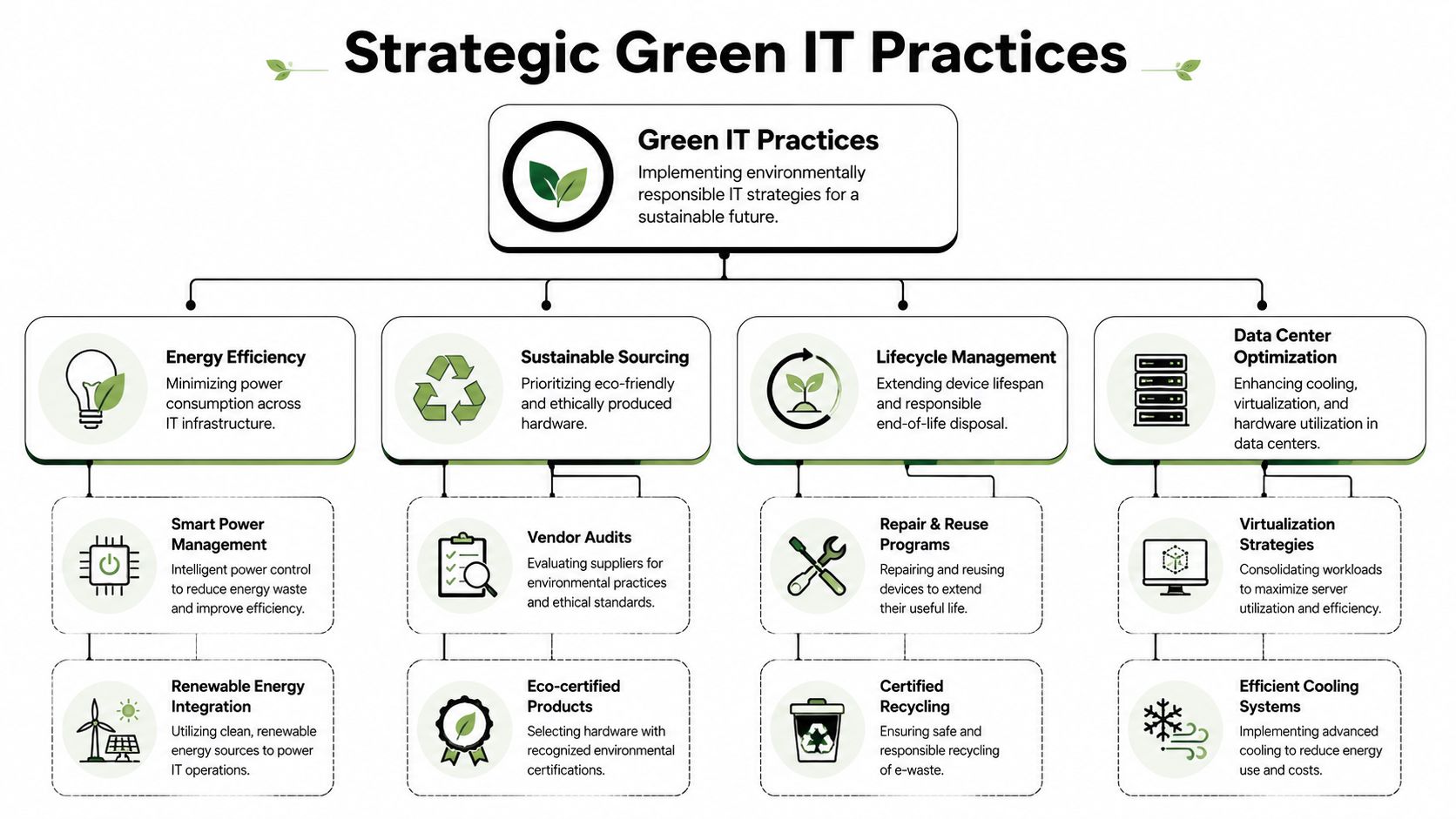
For a technical team, green business practices should translate into decisions you can operationalize:
- Buy with end-of-life in mind: Favor equipment that can be repaired, upgraded, or disassembled without excessive effort.
- Extend service life where appropriate: Redeployment and refurbishment often produce better outcomes than premature replacement.
- Separate reuse from waste: A working laptop, a parts-harvest candidate, and a non-functional battery-swollen device should never enter the same process.
- Make final disposition verifiable: If recycling happens, it should happen through a controlled, documented workflow.
That's the difference between generic sustainability and strategic ITAD. Strategic ITAD starts before disposal. Procurement standards, refresh timing, imaging policy, lease returns, data-bearing media controls, and warehouse procedures all affect the final environmental outcome.
Recycling is one lane, not the whole road
A mature program uses a hierarchy. First look at reuse inside the organization. If that's not viable, assess refurbishment or remarketing. After that, recover usable parts where policy allows. Recycling is essential, but it should usually be the later-stage option after higher-value recovery paths are considered.
That's especially important in electronics, where the environmental impact of electronic waste is tied not only to disposal, but also to whether products are reused, dismantled responsibly, or pushed into landfill streams.
Practical rule: If your “green” plan begins when equipment is already on a pallet, you started too late.
A strategic program also recognizes a hard truth. Security can override recovery value. If an asset class presents unacceptable data risk, physical destruction may be the right choice even when some resale value remains. Good green practices in IT don't ignore that trade-off. They document it and manage it.
The Tangible ROI of Green IT Asset Disposition
The fastest way to lose executive support is to frame ITAD as a moral project instead of a business function. Budget owners respond to avoided cost, recovered value, lower operational waste, and reduced risk exposure. A green ITAD program can support all four.
The broader business case for sustainability is stronger than many skeptics assume. A systematic review of 58 studies found that approximately 79% reported improved economic performance after adopting green practices, and 33% observed higher return on assets, linking sustainability to measurable financial results through waste and energy management, according to the systematic review on green practices and business performance.
Where the return shows up
In ITAD, ROI usually appears in three places.
First, there's value recovery. Equipment that is still serviceable may be redeployed, refurbished, or remarketed instead of being treated as scrap. Waiting too long usually reduces that option.
Second, there's cost avoidance. Securely moving assets out of closets, labs, branch offices, and data centers reduces storage burden and lowers the chance that unmanaged equipment creates a security incident or compliance headache.
Third, there's process efficiency. Standardized retirement workflows keep infrastructure teams from repeatedly solving the same problem site by site.
Here's the practical distinction that matters in budget meetings:
| ITAD approach | Typical outcome |
|---|---|
| Ad hoc pickup and bulk disposal | Fast removal, weak documentation, low value capture |
| Security-only destruction mindset | Stronger risk control, but may leave reuse value on the table |
| Strategic green ITAD | Balances data destruction, reuse, remarketing, recycling, and reporting |
What leadership usually needs to hear
A CFO doesn't need a lecture on e-waste. They need to know whether the process is controlled. A CISO wants proof that data-bearing assets won't drift into an informal channel. Procurement wants consistent vendors and predictable records. Sustainability teams want reporting that doesn't collapse under audit.
That's why benefits of e-waste recycling should be discussed in financial and operational terms, not just environmental ones. Reuse can preserve asset value. Certified recycling can reduce disposal risk. Structured disposition can keep refresh cycles from creating a hidden liability pile.
If the program only measures how much equipment left the building, it's missing the business case. The real question is how much risk was retired and how much value was preserved.
The organizations that get this right don't ask whether green ITAD costs money. They ask which disposal choices create unnecessary loss.
Your Implementation Framework for Sustainable ITAD
A server refresh gets approved on Friday. By Monday, operations wants the racks cleared, security wants every drive accounted for, finance wants resale value recovered, and facilities wants the floor space back. Programs break down at that point, not because the goals are unclear, but because nobody has built a process that can survive real operational pressure.
That gap is common. A peer-reviewed study on barriers to green practice adoption found that cost pressure and limited technical support often slow adoption of more advanced green programs. In ITAD, the practical answer is a phased framework with defined decisions, named owners, and records that hold up under review.
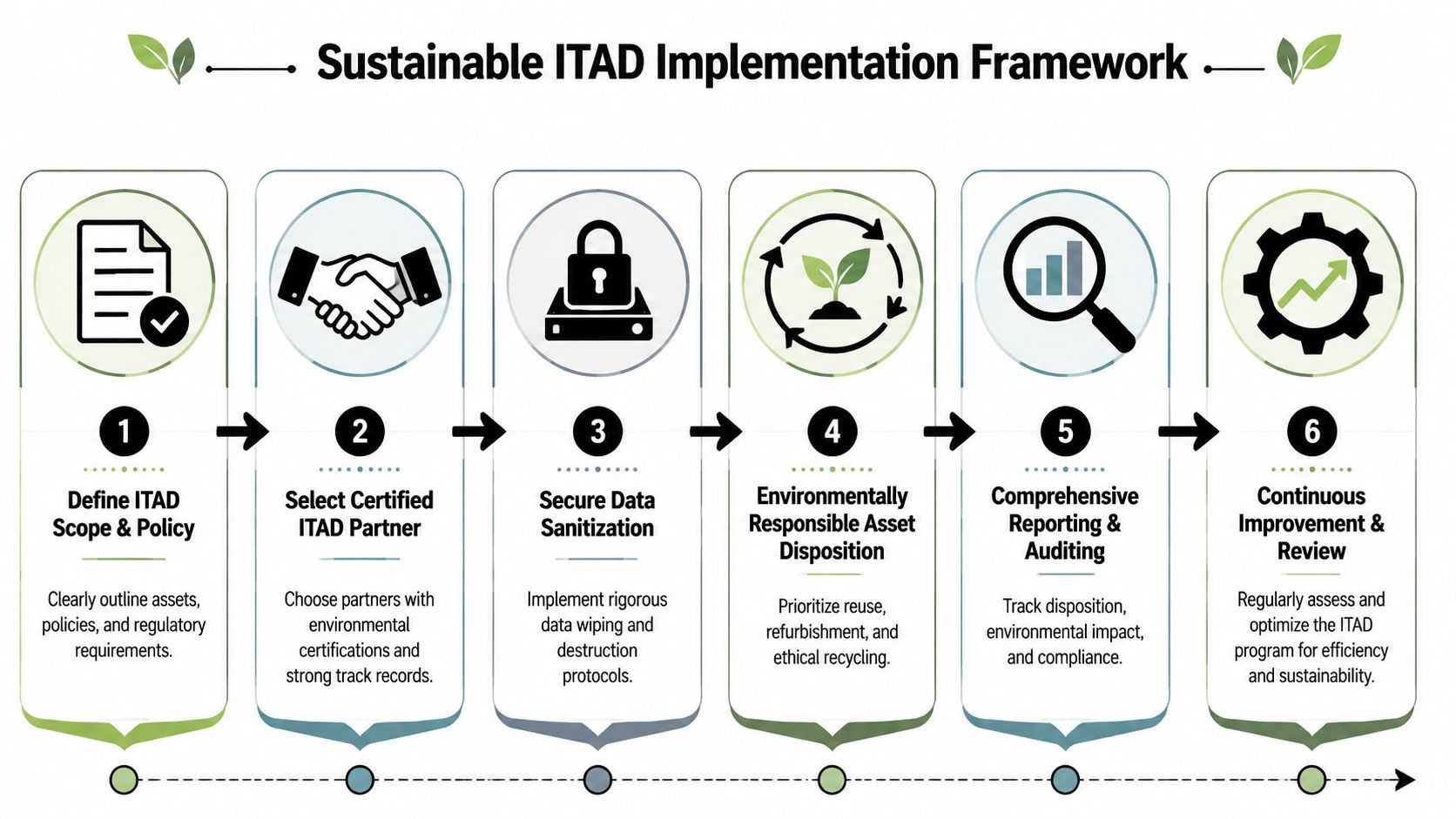
A sustainable ITAD program does not start with a truck. It starts with rules.
Start with scope and ownership
Set the boundary first. Identify which assets are covered, which sites follow the program, and which business units can approve release. Include endpoints, servers, storage, networking gear, mobile devices, peripherals, and any specialized equipment that creates handling or compliance issues.
Then assign accountability by function. IT can inventory and classify. Security can define sanitization requirements. Procurement or vendor management can control processor selection. Compliance can set retention rules. If those roles stay informal, exceptions become the default.
Your written policy should answer five points:
- Which asset classes are in scope?
- Who can authorize disposition by asset type?
- Which media can be sanitized for reuse, and which must be physically destroyed?
- Under what conditions is remarketing allowed?
- Which records must be retained, by whom, and for how long?
For multi-site organizations, one enterprise standard usually works better than separate local programs. Local teams can have work instructions, but the decision logic should stay consistent.
Build the workflow in decision order
The order matters because each step affects value recovery, security exposure, and reporting quality.
Start by inventorying assets at the level you need to defend later. Record make, model, serial number, asset tag, location, assigned user or department, and whether the item contains data-bearing media. Then classify each asset into a specific path: redeploy, refurbish, resell, parts harvest, recycle, or destroy.
After classification, apply the security control that matches the asset and the data risk. Only then should logistics be scheduled.
Teams that reverse this sequence usually create avoidable problems. Mixed pallets arrive with reuse candidates and destruction-only assets combined. Pickup records fail to match final reports. Resale value drops because equipment was handled as scrap before anyone checked condition or marketability.
Set data destruction rules by asset class
One sanitization standard across all devices looks simple on paper and fails quickly in practice. A user laptop, an enterprise storage array, a mobile phone, and a multifunction printer do not carry the same data risk or require the same handling method.
Use internal categories that drive a preset decision:
| Asset category | Typical disposition control |
|---|---|
| Employee endpoints | Wipe if approved for reuse, destroy media if not |
| Servers and storage | Serialized tracking, stronger custody controls, documented sanitization |
| Mobile devices | Account removal, carrier considerations, data wipe verification |
| Specialized regulated equipment | Coordination with compliance, asset-specific handling instructions |
IT leaders usually face the trade-off. Broad destruction policies reduce judgment calls, but they can erase recoverable value. Broad reuse policies preserve value, but only if the organization can prove sanitization was performed correctly and consistently. The right choice depends on data sensitivity, downstream market value, and the level of documentation your team can maintain.
Make logistics and paperwork part of the operating model
Logistics should follow the disposition plan, not define it. Prepare packing lists, serialized manifests, site sign-off procedures, transport requirements, and exception handling before the first collection event. If a site cannot produce accurate release records, delay the pickup until it can.
Documentation also needs to be usable by people under time pressure. I usually advise clients to standardize one intake form, one manifest format, and one exception process across sites. That reduces training time and makes reconciliation easier after a pickup.
Organizations that need stricter documentation standards should build their process around chain of custody documentation requirements for ITAD. The point is not paperwork for its own sake. The point is being able to show, asset by asset, what left the site, who handled it, how data was addressed, and what final disposition occurred.
Dallas Fortworth Computer Recycling is one example of a B2B processor that handles IT asset disposition, data destruction, electronics recycling, and data center decommissioning. Whether you use that provider or another, the operating rule stays the same. The vendor must fit your controls, reporting standards, and escalation process.
A pilot is often the best starting point. Choose one asset stream with enough volume to test the workflow, such as laptops from one office or retired network gear from one region. Fix the gaps there first. Then expand to higher-risk and higher-volume categories once the process produces consistent records, predictable turnaround times, and defensible disposition outcomes.
Ensuring Compliance and Auditable Chain of Custody
Compliance problems in ITAD usually begin with missing proof, not bad intentions. An organization may believe equipment was wiped, transported securely, and recycled responsibly. If it can't produce documentation for each step, that belief won't help much during an audit, a breach review, or a legal inquiry.
That's why chain of custody matters more than sustainability slogans. For regulated sectors, the standard isn't “we sent it to a recycler.” The standard is “we can show who handled each asset, when they handled it, what happened to the data, and what happened to the material after that.”

What an auditable chain should include
A defensible chain of custody usually covers more than pickup receipts. It should show continuity from identification to final disposition.
Look for these elements:
- Asset-level traceability: Serial numbers, asset tags, quantities, and condition notes tied to collection records.
- Transfer accountability: Named handoffs between internal staff, transport teams, and processors.
- Data destruction evidence: Certificates, logs, or destruction records aligned to the actual assets handled.
- Downstream visibility: Confirmation that materials went through approved channels rather than disappearing into opaque resale or scrap markets.
- Exception handling: A record of damaged, unscannable, missing, or policy-restricted items.
If your current process can't support that, review what strong chain of custody documentation should look like and compare it to your actual paperwork.
Why design decisions affect compliance later
Compliance starts earlier than commonly perceived. Circular-economy guidance notes that end-of-life recovery options depend on design choices, including whether products can be disassembled, remanufactured, recycled, or upcycled. In ITAD terms, choosing equipment with modular components and standardized fasteners can improve reuse, remanufacture, and recycling outcomes, as outlined in the circular business model guidance on product design and recovery.
That matters because hard-to-disassemble gear often creates ugly trade-offs. If it's expensive to separate components or safely remove media, the organization may end up with fewer recovery options and more disposal complexity.
Compliance gets easier when procurement, operations, and disposition standards agree with each other.
Certifications help, but they don't replace oversight
Certifications such as R2 or e-Stewards can be useful screening tools, especially when you need evidence that a vendor follows documented environmental and operational controls. But a certificate alone doesn't answer every question that matters to your organization.
You still need to review actual service scope, serialized reporting, site procedures, downstream management, insurance, and data destruction capabilities. The certification may open the door. Your due diligence determines whether the vendor belongs inside your control framework.
Selecting an ITAD Partner and Measuring Program Success
Vendor selection is where many sustainability programs become either durable or fragile. A polished website doesn't tell you whether a provider can handle server decommissioning, document serialized assets correctly, or separate resale candidates from destruction-only material without creating confusion.
The better approach is to evaluate a partner the same way you'd evaluate any other high-risk service provider. Look at controls, evidence, exceptions, and reporting quality.
What to ask before you sign anything
A capable ITAD vendor should be able to explain the entire path of an asset without hand-waving. That includes intake, storage, sanitization, resale decisioning, recycling, and reporting.
Use this checklist during procurement.
| Criteria | What to Look For | Why It Matters |
|---|---|---|
| Certifications | Relevant environmental and process certifications, current and verifiable | Helps screen for documented operational controls |
| Data destruction capability | Clear wiping and destruction options for different media types | Protects sensitive information and supports policy enforcement |
| Chain of custody | Serialized tracking, manifests, signed transfer records | Supports auditability and internal accountability |
| Reporting quality | Asset-level records, final disposition detail, exception logs | Gives IT, compliance, and finance usable evidence |
| Logistics | Secure pickup procedures, site coordination, packing guidance | Reduces handling errors during removal |
| Downstream transparency | Clear explanation of reuse, recycling, and material handling paths | Lowers environmental and reputational risk |
| Insurance and contractual terms | Coverage details, responsibility boundaries, documented SLAs | Clarifies risk transfer and service expectations |
| Experience with your asset mix | Ability to handle servers, medical devices, lab equipment, or network gear as applicable | Prevents process breakdowns on specialized hardware |
If certification is part of your screening criteria, it helps to understand what an R2 certified electronics recycler is supposed to demonstrate, then verify whether the vendor's actual process matches your needs.
How to measure whether the program is working
Good reporting should answer operational questions, not just produce a certificate at the end. GRESB notes that high-quality sustainability data depends on accuracy, coverage, completeness, access, and governance, and that completeness should span relevant time periods while governance protects integrity, privacy, and compliance. For ITAD, that means every asset's journey must be traceable and audit-ready, as described in the GRESB guidance on data quality in sustainable business practices.
That principle is more useful than a vanity dashboard. Your measures should reflect control.
Track program success with questions like these:
- Was every in-scope asset accounted for?
- Did the disposition method match policy?
- Were data-bearing devices processed with the required sanitization method?
- How many assets were reused or remarketed versus recycled?
- How quickly were retired assets removed from sites after approval?
- Were there any custody gaps, reporting exceptions, or unresolved serial mismatches?
What weak reporting looks like
Weak reporting tends to sound clean but say very little. “Processed responsibly” is not enough. “Recycled per standards” is not enough. “No issues reported” is not enough.
You want records that let an auditor, security lead, or procurement manager trace the asset history without guesswork. If the vendor relies heavily on estimates, aggregated loads, or vague summaries, the sustainability story won't hold up when someone asks for proof.
A usable ITAD report should let you reconstruct the transaction after the people involved have moved on.
Green Business Practices in Action
A hospital retires a mixed batch of clinical workstations, printers, tablets, and storage devices after a systems upgrade. The sustainability goal is real, but it comes second to patient data protection. The IT team separates data-bearing assets from low-risk peripherals before pickup, uses stricter custody rules for anything tied to clinical workflows, and requires destruction evidence that maps back to the original inventory. The green result comes from disciplined reuse and recycling after the data risk is closed, not before.
A data center team decommissions a full row of aging servers during a consolidation project. The temptation is to clear the floor fast and call the job done. That usually creates value loss and documentation gaps. The better move is to stage the assets by configuration, identify reusable systems and parts, isolate failed units, and apply serialized sanitization controls before anything leaves the site. In practice, these steps make green business practices operational. The team reduces waste, preserves recoverable value where policy allows, and keeps a clean record for infrastructure, security, and finance.
A government department has a different problem. Its issue isn't just disposal. It's evidence. The agency needs to show that regulated electronics moved through an approved chain from office or field location to final disposition with no unexplained handoff. That changes the entire process. Pickup windows are coordinated around documentation readiness. Manifests matter as much as trucks. Exceptions are logged immediately because “we'll reconcile that later” is exactly how public-sector reviews get painful.
These scenarios differ by industry, but the pattern is the same:
- Classify assets before removal
- Match sanitization to risk
- Use documented custody at each handoff
- Prioritize reuse where defensible
- Demand final reporting that stands up to review
That's what separates a real ITAD program from a warehouse cleanup. Green business practices in IT only work when they account for security, compliance, and economics at the same time.
If your team needs a more controlled way to retire technology, Dallas Fortworth Computer Recycling provides B2B IT asset disposition, data destruction, electronics recycling, and data center decommissioning services for organizations that need secure handling, documented chain of custody, and environmentally responsible processing.