
Electronic Disposal Austin: A Practical Guide to electronic disposal austin
For IT leaders in Austin, dealing with old electronics isn't just about clearing out a storage closet. It’s a critical function that protects sensitive company data, keeps you compliant with a web of regulations, and demonstrates your commitment to the environment. A solid IT Asset Disposition (ITAD) program turns what could be a massive headache into a strategic, audit-proof process.
Your Framework For Smart Electronic Disposal In Austin
The life of a company server, laptop, or network switch doesn’t end when you unplug it. That’s actually where some of the biggest risks begin. A haphazard approach to retiring old gear is a direct path to liability, whether it's a data breach from a forgotten hard drive or a fine for improper disposal.
This is exactly why having a clear, repeatable framework is non-negotiable. A well-defined ITAD strategy gives you a defensible process for every single piece of equipment that leaves your building. It’s not just about tossing things in a recycling bin; it's a security-first approach that covers an asset from the moment it’s marked for retirement until you have a certificate in hand proving it was handled correctly.
The Core Stages Of An ITAD Program
A strong framework breaks the whole complex job down into logical, manageable stages. This ensures nothing slips through the cracks.
First up is Asset Inventory and Segregation. You have to know what you’re getting rid of. This means creating a detailed manifest by recording serial numbers, asset tags, and device types before anything moves.
Next, and most importantly, is Secure Data Sanitization. Before any device leaves your sight, every bit of sensitive data on it must be permanently destroyed. This isn’t optional—it’s a requirement for complying with regulations like HIPAA or SOX, and it demands certified, verifiable methods.
Then comes Logistics and Chain of Custody. Getting the assets from your office to a processing facility has to be secure. An unbroken, documented chain of custody is your proof that the equipment was handled securely at every single step of its journey.
Finally, you have Final Disposition and Reporting. This is where hardware is either responsibly recycled or, if it still has value, remarketed. The process wraps up when you receive official documents, like a Certificate of Destruction, which is your proof of compliance for any future audits.
To give you a better feel for what happens to the raw materials, you can learn more about the recycling of computer components in our detailed article.
The flowchart below shows how these steps connect to form a cohesive, secure workflow.
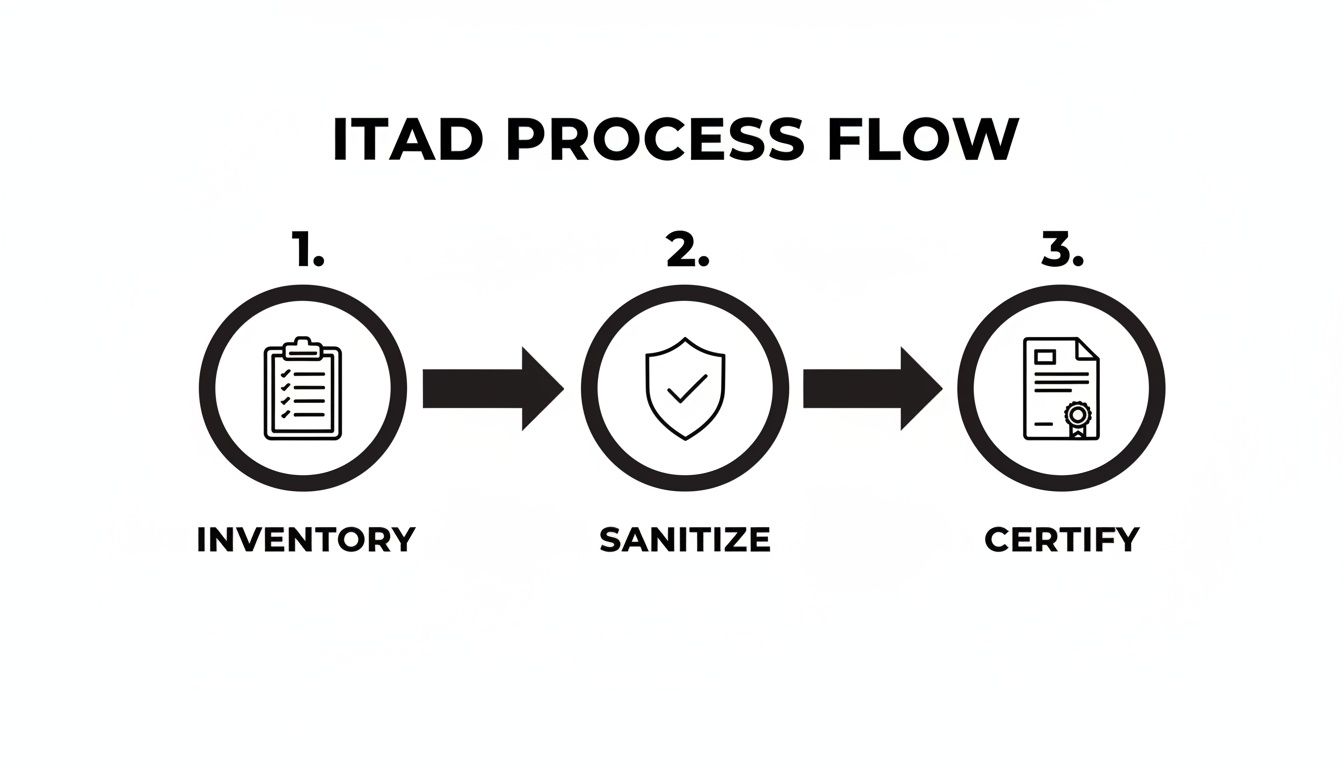
This visual makes it clear: a successful electronic disposal Austin strategy is a documented, step-by-step journey, not a one-time task. Each phase builds on the last to create a secure, accountable result.
To help you put this framework into action, the table below breaks down the key stages, objectives, and critical action items for your team.
Key Stages of a Compliant ITAD Process for Austin Businesses
| Stage | Key Objective | Critical Action Items |
|---|---|---|
| 1. Asset Identification & Inventory | Create a complete and accurate record of all assets designated for disposal. | • Record serial numbers, asset tags, and device specifications. • Segregate assets based on data sensitivity and potential for reuse. |
| 2. Data Sanitization & Verification | Ensure 100% of data is irreversibly destroyed on all data-bearing devices. | • Select a destruction method (wipe, degauss, shred) based on policy. • Perform verification to confirm successful data erasure. |
| 3. Secure Logistics & Chain of Custody | Maintain end-to-end security and accountability during transport. | • Use sealed, locked transport containers. • Ensure all handlers are vetted and trained. • Document every transfer of custody. |
| 4. Processing & Final Disposition | Responsibly recycle, remarket, or destroy assets in a compliant manner. | • Dismantle equipment for commodity separation. • Test and refurbish viable assets for resale. • Ensure all e-waste is handled by certified downstream partners. |
| 5. Documentation & Reporting | Provide auditable proof of secure and compliant disposition. | • Obtain a Certificate of Destruction/Recycling. • Generate detailed asset reports matching the initial inventory. • Retain all documentation for compliance records. |
Following these stages methodically transforms your disposal process from a potential risk into a well-managed and defensible corporate program. In the rest of this guide, we’ll dive deeper into each of these critical phases, giving you the practical advice you need to protect your organization.
Navigating E-Waste Compliance in Texas
When it comes to IT asset management, compliance isn't just another box to check—it's the bedrock of your entire risk strategy. For any Austin organization, a single misstep in electronic disposal can trigger severe financial penalties and cause irreparable harm to your reputation. The legal framework is a complex mix of federal, state, and industry-specific rules that you simply can't afford to ignore.
This is about more than just being environmentally responsible. It’s about ironclad data security and legal liability. A single hard drive tossed in the wrong bin can set off a chain reaction of consequences, from massive fines to damaging customer lawsuits.
Understanding the Regulatory Landscape
Several key regulations dictate how businesses must handle data on their end-of-life electronics. These aren't just abstract legal concepts; they carry real-world weight and apply directly to your IT assets.
- Health Insurance Portability and Accountability Act (HIPAA): If your organization handles protected health information (ePHI), the HIPAA Security Rule mandates strict procedures for the final disposition of that data and the media it’s stored on. A failure here can lead to fines running into the millions for a single breach.
- Sarbanes-Oxley Act (SOX): For any publicly traded company, SOX requires tight controls over financial records. That responsibility extends all the way to the secure disposal of any electronic device containing financial data, all to prevent fraud and maintain data integrity.
- NIST Special Publication 800-88: This is the gold standard for data sanitization. The National Institute of Standards and Technology provides meticulous guidelines for clearing, purging, and physically destroying data on all types of media. Following these standards isn't just a best practice; it's often a requirement for government contracts.
The global scale of this problem is hard to comprehend. By 2025, experts project that over 347 million metric tonnes of e-waste will sit unrecycled worldwide, even as we generate more than 65 million tonnes each year. With formal recycling rates at a dismal 22.3%, the gap is massive. This reality makes it absolutely critical to partner with a vendor who lives and breathes these compliance standards.
The Real-World Consequences of Non-Compliance
Let's walk through a scenario we've seen play out before. A mid-sized Austin healthcare provider was decommissioning a rack of old servers and dozens of workstations. To cut costs, they hired a local scrap hauler who quoted a rock-bottom price for pickup. The hauler promised to "recycle" everything but offered no documentation, no data destruction certificates, and no chain-of-custody records.
Months later, a local news station reported that several of the provider’s old computers were discovered at a public auction—with hard drives still full of thousands of patient records.
The fallout was immediate and catastrophic. The provider was hit with a multi-million dollar HIPAA fine, a class-action lawsuit from patients, and a public relations nightmare that destroyed decades of community trust. All of it was completely avoidable.
Now, imagine that same scenario, but with a certified vendor. The provider would have received a serialized inventory list before the equipment ever left their building. A secure, locked truck would have handled the transport. Most importantly, they would have received a Certificate of Data Destruction afterward, proving with serial-number-level detail that every single hard drive was destroyed according to NIST standards. If an auditor came knocking, they'd have an irrefutable paper trail showing due diligence and full compliance.
Choosing a certified partner for your electronic disposal in Austin isn't a cost center; it's a fundamental security investment. It’s the difference between a defensible, auditable process and a massive, unforeseen liability. You can learn more about why working with an R-2 certified electronics recycler is a crucial step in protecting your organization. This certification is your assurance that a vendor adheres to the highest industry standards for both data security and environmental responsibility, giving you true peace of mind.
Preparing Your Assets for Secure Disposal
The security of your electronic disposal Austin program is locked in long before a vendor’s truck ever shows up. It's the groundwork you lay internally—the careful preparation of your assets—that builds the foundation for a secure, auditable, and compliant process. This phase really boils down to two critical pillars: a meticulous inventory and certified data sanitization.
Skipping these steps is like building a house without a foundation. You’re leaving the door wide open for lost assets, data breaches, and a broken chain of custody that could turn into a nightmare during an audit. This is where you establish control from the very beginning.
Creating an Ironclad Asset Inventory
Let's be blunt: you can't protect what you don't track. The first move is to build a detailed, accurate inventory of every single asset you plan to dispose of. This isn’t just about counting computers; it’s about creating a unique record for each device that will follow it through the entire disposition journey.
A strong inventory needs to capture a few key data points for each item:
- Serial Number: The unique identifier right from the manufacturer.
- Asset Tag: Your own internal tracking number for the device.
- Device Type: Get specific (e.g., "Dell Latitude 7420 Laptop," "HPE ProLiant DL380 Server").
- Physical Location: The room or data center aisle where the asset currently sits.
- Intended Disposition: A preliminary tag for its next step. Is it a good candidate for remarketing, or is it headed straight for secure recycling?
Think about a financial services firm in Austin doing a major tech refresh. Their IT team methodically goes through their server room and offices, scanning both the serial number and their company asset tag for each of the 200 devices being retired. This data gets compiled into a master spreadsheet, which now serves as the official record and the starting point for their chain of custody.
Demystifying Data Destruction Methods
With a complete inventory in hand, the next non-negotiable step is ensuring every byte of sensitive data is gone for good. Simply deleting files or formatting a drive is nowhere near enough; that data can often be recovered with surprising ease. Real data sanitization requires proven methods that meet industry standards, most notably NIST 800-88.
There are three primary methods for certified data destruction, and the right one depends on the media type and your security needs.
- Software Wiping (Purging): This uses specialized software to overwrite the entire hard drive with random data, often in multiple passes. It's a great way to sanitize data while keeping the physical drive intact for reuse or resale.
- Degaussing (Purging): This process uses a powerful magnetic field to completely scramble the magnetic data on traditional hard disk drives (HDDs) and magnetic tapes. Degaussing renders the drives useless, so it’s only for hardware with no resale value.
- Physical Shredding (Destroying): This is the final answer for data destruction. The hard drive or solid-state drive (SSD) is fed into an industrial shredder that pulverizes it into tiny, unrecognizable pieces. For damaged or certain types of non-functional media, this is the only NIST-approved method.
It's crucial to know that SSDs, unlike traditional spinning hard drives, cannot be securely wiped with degaussing. Because of their flash memory design, physical shredding is the most reliable method for ensuring total data destruction on SSDs.
Back to our Austin financial firm. Their inventory shows a mix of assets. Newer laptops with SSDs are slated for remarketing, so their drives will be sanitized using certified software. But the older servers with HDDs that held sensitive financial data? Those are getting physically shredded to eliminate any possible risk.
This careful, documented approach to data destruction is what separates a compliant program from a major liability. If you want to get more technical, our guide on how to wipe a hard drive completely offers a deeper dive. By meticulously tracking your assets and applying the correct data sanitization technique for each one, you create an unbreakable, auditable trail that protects your organization from start to finish.
How to Choose the Right E-Waste Partner in Austin

Once your assets are prepped, you’ll face the single most important decision in this whole process: choosing who will handle them. This isn't just about a pickup; it's a choice that directly impacts your data security, legal standing, and public reputation. In Austin, you've got options, but they are far from equal.
Picking the right partner for electronic disposal Austin services means finding a vendor that functions as an extension of your own security team. This is no time to hunt for the cheapest bid from a general scrap hauler. A genuine IT Asset Disposition (ITAD) partner brings a documented, secure, and compliant process that shields you from downstream liability.
Look for Non-Negotiable Certifications
The very first filter to apply when looking at vendors is their certifications. These aren't just fancy logos for a website; they are hard-earned proof of rigorous, third-party audits. They verify a company’s commitment to the highest industry standards for both security and environmental stewardship. Without them, you have no real assurance of what happens to your gear after it leaves your sight.
Two certifications are considered the gold standard in the ITAD world:
- R2 (Responsible Recycling): The R2 standard ensures a facility has locked-down processes for data security, environmental protection, and worker safety. It mandates a documented chain of custody and ensures hazardous materials are managed correctly.
- e-Stewards: This is another highly respected certification, particularly known for its strict ban on exporting hazardous e-waste to developing nations. It also demands stringent data security protocols and responsible recycling practices.
A partner holding these certifications has invested serious time and capital into building a trustworthy operation. It’s your first and best signal that they take compliance as seriously as you do.
Evaluate Their Security and Chain of Custody
With certifications confirmed, it’s time to dig into the nitty-gritty of their process. This is where you separate the true security professionals from the rest. Your goal is to confirm they can maintain an unbroken, documented chain of custody from your door to final disposition.
Don't be shy—ask pointed questions about their operational security:
- What are your on-site security measures at your processing facility? (Think secure access, 24/7 surveillance, and employee background checks.)
- How do you keep assets secure during transit? (You want to hear about sealed, locked trucks and vetted drivers.)
- Can you provide a serialized report that perfectly matches the inventory list I give you? (The only acceptable answer is "yes.")
Any hesitation to answer these questions is a massive red flag. A reputable partner will be completely transparent and proud of the security protocols they've built. Our guide to selecting IT asset disposition companies offers a more detailed checklist for vetting potential vendors.
Compare Asset Remarketing vs. Straight Recycling
Not everything you retire is junk. Some of your equipment might still have significant residual value, and a skilled ITAD partner can help you recover it through asset remarketing. This process involves testing, refurbishing, and reselling functional devices like newer laptops, servers, or networking gear.
The revenue generated from remarketing can often be shared, which helps offset—or even cover—the costs of the entire disposal project. It can turn a necessary expense into a source of ROI.
Of course, remarketing isn’t always the right move. For older, obsolete, or damaged equipment—or for any device that held extremely sensitive data—direct and immediate destruction is the safer play. A good partner will help you analyze your inventory and decide which path makes the most sense for each asset class, balancing financial return with your risk tolerance.
The challenge here is only getting bigger. In 2022, the world generated a staggering 62 million tonnes of e-waste, an 82% increase from 2010. That number is projected to hit 82 million tonnes by 2030, all thanks to our constant demand for new tech. The UN's Global E-waste Monitor 2024 lays out these trends, highlighting why choosing a partner committed to responsible reuse and recycling is so critical.
The table below makes the difference between a certified ITAD partner and a standard recycler crystal clear.
Certified ITAD Partner vs. Standard Recycler Comparison
| Feature | Certified ITAD Partner (e.g., Dallas Fortworth Computer Recycling) | Standard Recycler / Scrap Hauler |
|---|---|---|
| Data Security | Offers certified, auditable data destruction (NIST 800-88 compliant). | No guaranteed or certified data destruction; high risk of data exposure. |
| Chain of Custody | Provides a documented, serialized chain of custody from pickup to final report. | Minimal to no tracking; assets can be lost or resold without your knowledge. |
| Compliance | Guarantees compliance with regulations like HIPAA, SOX, and environmental laws. | Offers no compliance guarantees, placing all liability back on your company. |
| Reporting | Delivers Certificates of Destruction and detailed, serialized asset reports. | Provides a simple weight ticket or basic invoice, if anything. |
| Value Recovery | Offers secure asset remarketing to generate a financial return on viable gear. | Typically no value recovery; assets are treated as scrap metal. |
| Environmental | Adheres to strict R2 or e-Stewards standards, preventing illegal exporting. | May export hazardous materials, creating environmental and legal risks. |
Ultimately, choosing a vendor for your electronic disposal in Austin is a strategic business decision. By prioritizing certifications, scrutinizing security protocols, and understanding your options, you can select a partner who doesn't just recycle your hardware—they protect your entire organization.
Finalizing Your Disposal with Secure Logistics and Documentation

You’ve done all the internal prep work, but the final stage of your electronics disposal is where accountability is truly proven. It all comes down to moving your assets off-site without a single security gap and, critically, getting the ironclad documentation to prove you did everything by the book.
This is the last mile, and it’s where your entire compliance strategy gets validated.
A sloppy pickup or incomplete paperwork can unravel all of your hard work. This is precisely why a professional ITAD partner is so essential—they understand the job isn't done until you have a complete, auditable record in hand. That documentation is your ultimate defense in any audit.
Coordinating a Seamless and Secure Pickup
The physical removal of your assets needs to be a well-orchestrated event, not a chaotic free-for-all. The goal here is to minimize disruption to your operations while maintaining strict security from the moment the equipment starts moving.
Before your partner arrives, make sure your assets are consolidated in a secure, designated staging area. Each pallet or container should be clearly labeled and match your master inventory list. This one simple step prevents confusion and guarantees a smooth, efficient handover.
When you're scheduling the pickup, communicate any specific logistical needs your Austin facility might have:
- Are there specific loading dock hours or security check-in procedures?
- Will the team need specialized equipment like a pallet jack or a lift-gate truck?
- Does your building management require advance notice or a certificate of insurance from the vendor?
A true professional will ask these questions proactively, but having the answers ready ensures the process is quick and seamless. This kind of attention to logistical detail is the hallmark of a vendor who respects your business.
The Three Documents You Must Obtain
The paperwork you receive after the job is done is much more than a simple receipt. It's your legal proof of compliance and the final link in the chain of custody. Without these documents, your process is incomplete and, frankly, indefensible.
Think of this documentation as your organization's insurance policy against future compliance inquiries or data breach allegations. A complete, serialized paper trail is non-negotiable.
Your partner for electronic disposal Austin services must provide a reporting package with three critical components. Let’s break down exactly what to look for.
1. A Serialized Asset Report
This report is the bookend to the inventory you created at the very beginning. It should list every single asset received by the vendor, identified by the same serial numbers and asset tags from your initial list. This one-to-one match confirms nothing was lost in transit and that every device is accounted for.
2. The Certificate of Data Destruction
This is arguably the most critical document you'll receive. It's a legally binding statement certifying that all data on your devices has been destroyed according to specific standards, like NIST 800-88. A generic statement won't cut it. You can learn more about what a proper certificate of destruction for hard drives must include, but crucially, it must detail the destruction method (e.g., shredding, wiping) and list the serial numbers of the specific drives that were sanitized.
3. The Certificate of Recycling
This document confirms that all non-reusable materials were processed in an environmentally responsible manner, adhering to all federal, state, and local regulations. It’s your proof of environmental due diligence, showing your e-waste didn’t end up in a landfill. This is more important than ever; the metals in global e-waste from 2022 alone were valued at $91 billion, yet only 22.3% was formally recycled. Your certificate proves you’re part of the solution.
By insisting on this trio of documents, you close every loop, ensuring your disposal process is secure, compliant, and fully documented from start to finish.
Common Questions About Electronic Disposal in Austin
When it comes to getting rid of old IT equipment, Austin organizations often run into the same handful of questions. The answers usually highlight the massive gap between a simple drop-off recycling program and a secure, compliant IT asset disposition (ITAD) strategy built for business.
Let's clear up the confusion. Here are the practical answers to the questions we hear most often.
Recycling Versus IT Asset Disposition
One of the biggest misunderstandings is the difference between electronics recycling and ITAD. They both handle old tech, but they are fundamentally different processes with completely different goals.
Standard e-recycling is all about material recovery. Its main job is to break down devices into basic commodities—plastic, metal, glass—that can be used again. It's a purely environmental service.
IT Asset Disposition (ITAD), on the other hand, is a security and compliance service first. It's a complete management process for your retired assets that always includes:
- Certified Data Destruction: Verifiable data sanitization that meets strict standards like NIST 800-88.
- Serialized Asset Tracking: A documented chain of custody from the moment we pick it up to its final destination.
- Value Recovery: Assessing, refurbishing, and reselling equipment that still has market value to generate a financial return.
- Compliant Recycling: The final, responsible step for any assets that can't be reused.
For any business, school, or healthcare provider handling sensitive data, a real ITAD service for electronic disposal Austin is the only safe option. Standard recycling leaves you wide open to data breaches.
Can We Get Paid for Old IT Equipment
Absolutely. This is often a pleasant surprise for many organizations. It's a core part of a professional ITAD program called value recovery or asset remarketing.
If your retired hardware—like newer servers, laptops, or networking gear—is still functional and in demand, an ITAD partner can securely refurbish it and sell it. Your organization gets a share of the revenue, which can significantly cut the cost of the disposal project or even turn it into a net positive. It’s a smart way to turn a line-item expense into an ROI opportunity.
Handling Specialized Medical or Lab Equipment
Disposing of medical and lab equipment is a whole different ballgame. These devices don't just hold sensitive electronic protected health information (ePHI) governed by HIPAA; they can also be biohazard risks if not decontaminated properly.
You absolutely must work with a vendor who has proven experience in the healthcare space. They need to provide HIPAA-compliant data destruction and show you their decontamination protocols. Don't just take their word for it—ask for references from other clinics or hospitals to be sure they can handle the job.
Do Austin City Recycling Programs Work for Businesses
The City of Austin offers great e-waste programs for residents, like the Recycle & Reuse Drop-off Center. But these programs are not designed for businesses, and using them is a huge mistake.
They simply don't have the security and compliance features that are legally required for commercial assets, such as:
- Certified and documented data destruction.
- Auditable, serialized asset tracking.
- Chain-of-custody documentation.
- Liability protection.
Using a residential service for your business's old computers is a direct path to a data breach and potential regulatory fines. To do it right, you have to use a professional ITAD partner.
At Dallas Fortworth Computer Recycling, we provide nationwide, secure, and compliant ITAD solutions tailored for Austin organizations. We turn complex disposal challenges into a streamlined, risk-free process. Learn more and schedule your secure electronics disposal by visiting us at https://dallasfortworthcomputerrecycling.com.