
Top Telecom Equipment Buyers Dallas: 2026 Selling Guide

You're probably staring at a row of retired routers, PBX shelves, edge appliances, or carrier-grade switches that used to be business-critical and now just eat floor space. The surface problem looks simple. Clear the room, get a quote, move on.
That's rarely the actual job.
For IT leaders dealing with telecom equipment buyers Dallas, the bigger risk sits inside the gear and around the paperwork. Configuration files, call records, customer data, stored credentials, licensing issues, and audit requirements all survive long after the hardware stops earning its keep. A sloppy disposition can create a security incident, a compliance problem, or a dispute over what was picked up and what wasn't.
Dallas makes this more relevant, not less. The North American telecom equipment market held 35.35% of the global market share in 2025, and the global market is projected to expand by USD 222.84 billion from 2026-2030, according to Cognitive Market Research's telecom equipment market analysis. More buying means more refresh cycles. More refresh cycles mean more surplus gear. If your team handles network upgrades, UC migrations, data center consolidation, or site closures, you're already in the asset disposition business whether you planned for it or not.
A clean telecom retirement process protects three things at once. It protects your data, your audit trail, and the value still left in the equipment.
That's why experienced teams don't start with “Who pays the most?” They start with inventory discipline, secure handling, documentation, and only then price. If you need a baseline for what a telecom retirement workflow should cover, this overview of telecommunications disposition services in Dallas is a useful reference point.
The Challenge of Retiring Telecom Equipment
Telecom equipment creates a different kind of disposal problem than general office IT. A laptop fleet is usually straightforward. A room full of Cisco voice gateways, Juniper gear, rack-mounted routers, legacy Avaya systems, antennas, power shelves, and spares from multiple acquisition cycles is not.
The first complication is mixed asset value. Some units still have active secondary-market demand. Others are only worth their material recovery value. Many lots contain both, and buyers price them very differently depending on how well you've identified and separated the assets.
The second complication is hidden data risk. Teams often remember hard drives and forget that telecom gear can retain call detail records, saved credentials, VLAN settings, site maps, IP telephony configurations, or customer network information. That oversight creates exposure long after the hardware leaves your dock.
Why telecom gear becomes risky fast
A rushed cleanup usually leads to avoidable mistakes:
- Incomplete inventories: Staff label equipment as “misc. network gear,” which creates valuation disputes and weak chain-of-custody records.
- Poor segregation: Reusable switches get stacked with scrap boards and damaged chassis, which lowers recovery.
- Unclear ownership: Multi-site organizations often can't confirm whether a lot belongs to corporate IT, a local facility, or a business unit.
- Weak internal sign-off: Operations wants the room cleared, security wants verified erasure, finance wants recovery, and nobody owns the whole process.
Practical rule: If an asset list wouldn't survive an internal audit, it isn't ready for sale.
Dallas adds a market-specific wrinkle. The local telecom ecosystem is active enough that buyers know the difference between organized enterprise lots and distressed cleanouts. They price accordingly.
What works and what doesn't
What works is boring, disciplined process. Build the inventory. Match devices to locations. Pull accessories and line cards into identifiable groups. Record missing parts before a buyer does. Decide early which assets are remarketable, which need destruction, and which will go straight to certified recycling.
What doesn't work is treating decommissioned telecom equipment like surplus office furniture. That approach tends to produce lower offers, longer pickup windows, and weak documentation. It also invites arguments after the truck leaves.
Preparing Your Telecom Assets for Disposition
Preparation determines almost everything that follows. It affects the quote, the pickup plan, the audit trail, and your eventual payout. Most underperforming lots aren't bad lots. They're just poorly prepared.

Build an inventory that buyers can trust
Start with the facts a serious buyer or ITAD partner needs:
Manufacturer and model
Cisco ISR, Catalyst, Nexus, Juniper MX, Avaya IP Office, Adtran, Poly, and similar product families should be recorded exactly, not approximately.Serial number
This is the backbone of chain-of-custody and destruction records.Asset type and role
Router, switch, PBX, VoIP phone, firewall, antenna controller, optical transport gear, gateway, or power unit.Physical condition
Note bent rack ears, missing faceplates, cracked plastics, corrosion, or visible board damage.Functional status
Pulled working, powers on, untested, failed, or parts only.Included accessories
Power supplies, optics, transceivers, cards, rails, handsets, antennas, cables, and mounting kits all affect resale.
The difference between “20 Cisco switches” and “20 Cisco Catalyst switches with exact model and serial records” is substantial in practice. One gets a rough quote. The other gets a serious bid.
Sort for value, not convenience
Teams often stage assets by where they were removed from. Buyers care more about equipment category, condition, and resale path.
Use practical buckets such as:
- Enterprise routing and switching
- Voice and UC equipment
- Wireless and RF hardware
- Optics, modules, and transceivers
- Damaged or incomplete units
- Items designated for destruction only
That sorting step matters because buyers and processors don't evaluate all telecom gear the same way. Reusable rack gear may go to remarketing. Specialty modules may be priced separately. Damaged boards may move on a commodity path. If you mix those streams together, you usually lose value.
According to Future Market Insights' telecom equipment market report, top telecom equipment buyers benchmark wireless capex intensity at 12-13% by 2029, and IT managers who audit retired gear against procurement cycles can recover 20-30% more resale value during decommissioning by identifying higher-value equipment such as open RAN-related assets. The operational lesson is simple. Don't assume an older lot is uniform. Audit it carefully before it leaves.
Stage the lot like a controlled handoff
Physical organization affects speed and trust.
- Palletize by category: Keep routers with routers, phones with phones, loose modules in labeled containers.
- Use visible asset labels: If your internal tags still exist, keep them readable until reconciliation is complete.
- Separate no-resale items: Don't make a buyer sort broken scrap from clean reusable gear on your floor.
- Photograph rows and pallets: Those photos help resolve disputes later.
If your team needs a model for the operational side, a server decommissioning checklist for structured retirement projects can help standardize handoff prep.
Well-documented lots move faster because the buyer doesn't have to discover the story of the equipment after arrival.
Involve the right internal stakeholders early
Telecom disposition breaks when IT works alone. Pull in security, facilities, procurement, and finance before outreach begins.
A short internal checklist helps:
| Internal owner | What they should confirm |
|---|---|
| IT operations | Equipment is truly out of service and dependencies are removed |
| Security | Sanitization or destruction requirements are defined |
| Facilities | Dock access, freight elevator, and pickup windows are approved |
| Finance or procurement | Asset ownership and any disposition approvals are cleared |
That upfront coordination prevents the common last-minute problem where a buyer is scheduled, but the organization hasn't approved release, access, or destruction standards.
Finding and Vetting Reputable Telecom Equipment Buyers in Dallas
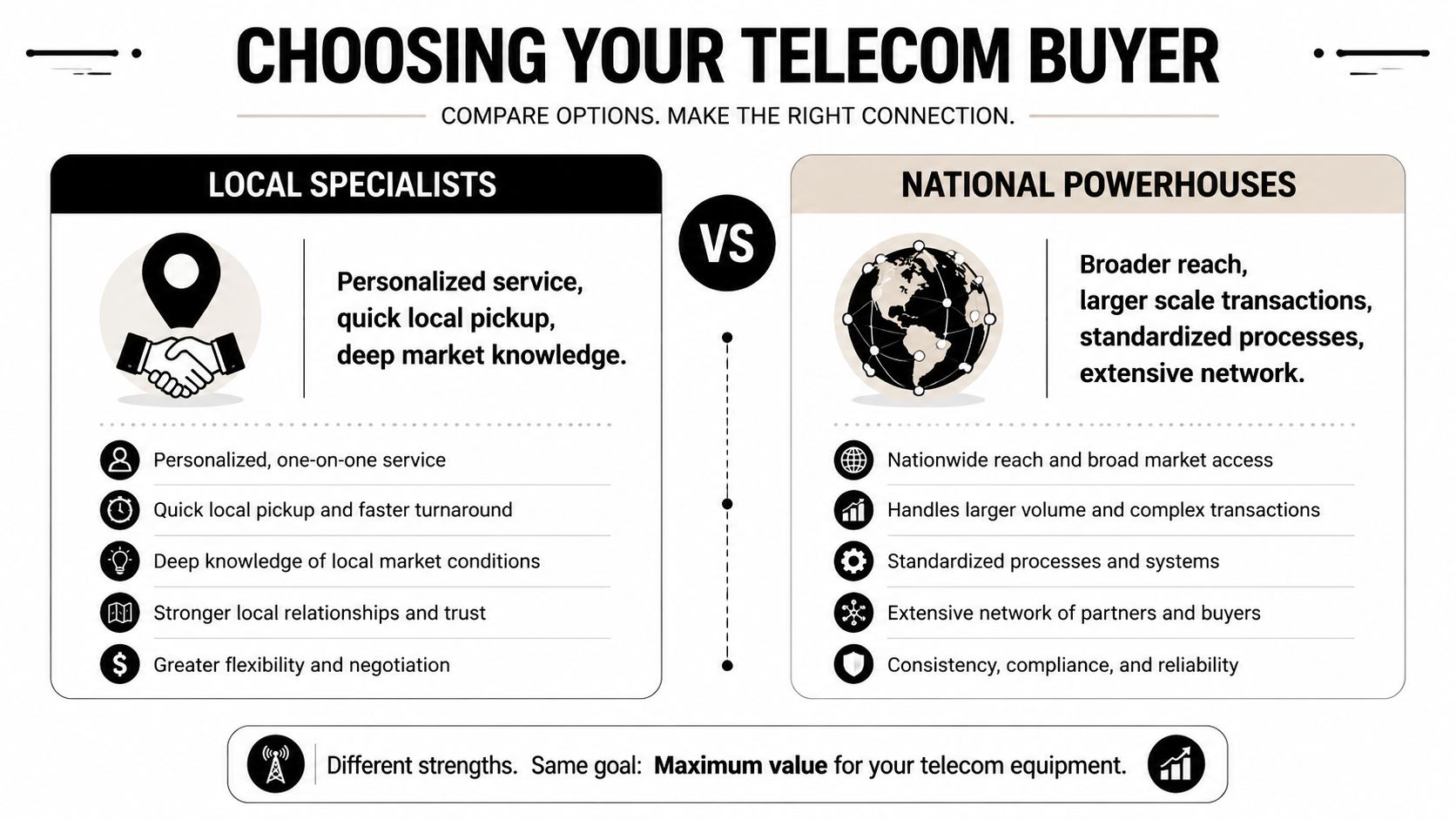
Dallas gives you options. That's useful, but it also creates noise. Some buyers are local specialists with hands-on market knowledge. Others are national ITAD firms with broad logistics and formalized workflows. Neither category is automatically better. The right fit depends on your equipment mix, your compliance burden, and how much operational support you need.
The Dallas market is active enough to reward discipline
Local demand isn't abstract. In Dallas, telecom revenue is concentrated among mid-sized firms. Long Range Systems reports $13 million in annual revenue and Ahoy Systems reports $12.1 million, according to ZoomInfo's Dallas telecommunications company rankings. That doesn't tell you who should buy your retired equipment, but it does confirm a real market with active telecom participants and competing disposition outlets.
A competitive market helps only if you run a disciplined selection process. If you ask five buyers for a quote using a vague spreadsheet, you don't have five real bids. You have five guesses.
Local specialist or national firm
Some organizations need responsive local pickup and direct communication with the evaluator. Others need a larger company that can handle multi-site projects under one master process.
Here's the practical comparison.
| Criteria | Local Dallas Buyer | National ITAD Firm |
|---|---|---|
| Response speed | Often faster for on-site review and short-notice pickups | Usually process-driven, sometimes slower to customize |
| Market familiarity | Strong understanding of local demand and site logistics | Broad remarketing channels across many markets |
| Project scale | Good for focused local lots and recurring regional work | Better for multi-site or enterprise-wide programs |
| Process consistency | Can vary widely by operator | Usually more standardized |
| Compliance depth | Must be verified carefully | Often stronger on formal documentation, but not always |
| Specialization | May know certain telecom categories very well | May handle wider asset mixes beyond telecom |
Use that table as a starting point, not a shortcut.
A Dallas buyer with deep telecom experience can outperform a national provider on speed and equipment knowledge. A national ITAD firm can outperform a local reseller when you need unified reporting, chain-of-custody across several facilities, or formal destruction workflows. The error is assuming category alone tells you the answer.
Questions that expose weak buyers quickly
When evaluating telecom equipment buyers Dallas, ask questions that force operational specifics.
What happens after pickup?
If they can't explain testing, resale, recycling, and downstream handling in plain terms, keep digging.How do you document custody?
You want a clear record from your site to final disposition, not a verbal assurance.What do you issue after data destruction?
A serious provider should describe certificate content, not just say “we wipe everything.”How do you handle regulated-industry clients?
Healthcare, finance, and government buyers should hear an answer that references documentation and auditability.Can you manage incomplete lots?
Many telecom rooms contain mixed-condition gear. A buyer should be able to explain how they price that reality.
Ask for process details, not marketing claims. Good vendors answer operational questions without hesitation.
Red flags you shouldn't ignore
Weak buyers often reveal themselves early.
One red flag is a fixation on pickup speed with little discussion of recordkeeping. Another is vague language around data sanitization. A third is refusal to reconcile serial numbers at pickup. If the company can tell you what it pays but not what it documents, your risk is going up.
Watch for these signs:
- No clear facility information
- No explanation of downstream recycling or remarketing
- No documentation sample
- No experience described for healthcare, finance, or public sector
- No distinction between reusable assets and destruction-only assets
A buyer doesn't need fancy language. They do need crisp answers.
What a strong vetting process looks like
A useful approach is to shortlist three categories of provider: a local telecom-oriented buyer, a regional ITAD firm, and a national operator with Texas coverage. Send each the same inventory package. Require the same assumptions. Ask for the same documentation list.
Then compare total capability, not just the top line offer.
If you're benchmarking the broader provider sector, reviewing IT asset disposition companies serving Dallas organizations can help frame what mature service coverage should include.
The best buyer for your project is usually the one who can do three things well at the same time: evaluate the gear accurately, document the chain of custody, and execute pickup without creating new work for your staff.
The Critical Path to Compliance and Data Security Documentation
The quote matters. The truck schedule matters. Genuine protection sits in the paperwork.
A review of Dallas telecom equipment buyers' websites found a clear market gap. They tend to focus on valuation while providing minimal detail on data destruction certifications, chain-of-custody, and R2 or e-Stewards compliance expectations, according to this review of Dallas telecom equipment buyer positioning. That gap should get your attention if you manage telecom gear that touched customer data, internal call records, or network credentials.

The documents that matter
A professional disposition isn't complete when the equipment leaves. It's complete when your organization receives defensible records.
The minimum set should include:
Serialized inventory reconciliation This confirms what transferred, not what everyone assumed transferred.
Chain-of-custody record
This shows where the assets went, when they moved, and who accepted them.Certificate of data destruction
This should describe the method used and connect the certificate to specific assets or media where applicable.Final disposition reporting
Reuse, resale, destruction, or recycling should be documented clearly enough for audit purposes.
If a vendor treats those documents as optional extras, that's a warning sign.
What makes a certificate usable in an audit
Not all certificates carry the same weight. A one-line statement that “all data was destroyed” may satisfy nobody except the seller who issued it.
A stronger certificate includes identifiable details such as asset references, serial number mapping where relevant, destruction or sanitization method, dates, and authorized sign-off. Your compliance team may also want consistency with internal retention practices and policy language.
For teams that need an example of what strong proof should look like, review how a certificate of destruction is used in secure hard drive disposal workflows. The same standard of specificity matters in telecom projects, especially when devices contain storage, logs, or saved system data.
If you can't hand the document to an auditor without explanation, the document is too weak.
Telecom gear often holds more data than teams expect
Many organizations are exposed by this oversight. Telecom hardware doesn't always look like a data-bearing asset, but practical field experience says otherwise.
Consider what may remain in retired equipment:
| Equipment type | Common retained information |
|---|---|
| VoIP systems and PBX gear | Call records, user extensions, voicemail references, admin credentials |
| Routers and firewalls | Running configs, site topology, VPN details, user accounts |
| Wireless controllers | SSIDs, keys, deployment maps, device associations |
| UC appliances | Contact data, integration settings, service accounts |
That's why “we removed the hard drives” isn't always enough. Some devices use onboard flash, removable modules, or internal storage that gets overlooked during a rushed decommission.
Industry-specific expectations in Dallas environments
Healthcare organizations need disposition records that stand up to internal privacy review. Financial institutions need evidence that retired communications hardware didn't leave with stored configuration or customer-related data intact. Government and public-sector departments often need a stricter chain of accountability from pickup through final processing.
The documentation burden changes by organization, but the discipline doesn't. Define the standard before pickup. Put it in writing. Require the buyer to meet it.
A few essentials help:
- Document before release: Don't let assets leave under a vague promise that paperwork will follow.
- Tie records to serials: Batch-level statements are weaker than asset-linked records.
- Confirm method language: “Destroyed” and “sanitized” aren't interchangeable. Your internal policy should dictate which is acceptable.
- Keep copies centrally: Don't let certificates live only in one project manager's mailbox.
What weak compliance handling looks like
Weak handling usually sounds polished at first. “Secure process.” “Responsible recycling.” “Certified destruction available.” Those phrases are too broad on their own.
Ask for samples. Ask what fields appear on the certificate. Ask who signs chain-of-custody records. Ask when exceptions are reported. Buyers that handle enterprise telecom retirements well won't struggle with those questions.
Good documentation protects more than compliance. It protects your staff when leadership asks what happened to the assets six months later.
Pricing Negotiation and Maximizing Your Asset Return
Most teams focus too hard on the first number. That's understandable, but it's not how you maximize value.
The best financial outcome comes from evaluating total return, not just purchase price. A slightly lower offer can be the better deal if it includes pickup, accurate reconciliation, proper packaging, and documented destruction. A higher number can become worse quickly if the buyer later downgrades the lot, charges unexpected logistics costs, or provides weak records that create extra internal work.

What drives telecom valuation
Telecom equipment buyers usually look at the same practical factors:
Model demand
Popular Cisco, Juniper, Avaya, Poly, and similar enterprise lines often have clearer resale paths than obscure or highly customized gear.Age and lifecycle position
Equipment that's too far past active deployment demand may still move, but usually on weaker terms.Condition and completeness
Missing power supplies, handsets, optics, rails, or faceplates reduce confidence and price.Testability
If the buyer can verify the unit more easily, you're in a stronger position.Lot quality
Clean, organized, model-specific batches usually outperform mixed gaylords of unknown equipment.
Documentation improves price
This point matters more than many sellers realize. In a study of 35 telecom buyers, buyers ranked support quality first, product feature and performance second, and price fifth, according to the ACG Research study published by Cisco. In disposition terms, that translates into a practical advantage for sellers who present organized, well-documented, testable equipment. Buyers pay better when uncertainty is lower.
That doesn't mean every spreadsheet creates a premium. It means credible information reduces the discount buyers build in to protect themselves.
Buyers negotiate hardest when they think your lot will surprise them after pickup.
Three deal structures to compare
Not every telecom disposition should be sold the same way.
Outright purchase
Fastest and simplest. Best when you want immediate clearance and predictable closure.Consignment or revenue-share style arrangement
Sometimes useful for higher-value specialty gear, but only if reporting terms are clear and you trust the remarketing process.Recycling with possible offsets
Common for obsolete, damaged, or incomplete telecom equipment where compliance and cleanup matter more than resale.
The right structure depends on your priorities. If audit certainty and quick site turnover matter most, a straight purchase or managed recycling path is usually easier to govern than a long-tail resale arrangement.
How to negotiate without creating friction
Good negotiation is specific.
- Ask for assumptions in writing: Are prices based on working pull, visual inspection, or full testing?
- Clarify deductions early: Missing parts, damage, and freight handling should be discussed before pickup day.
- Bundle low-value with high-value carefully: Don't let a buyer use the weak part of the lot to blur pricing on the strong part.
- Request service detail, not just price: Packing, palletizing, onsite labor, and documentation all have real value.
A disciplined seller doesn't chase the highest headline number. A disciplined seller looks for the offer that survives scrutiny.
Coordinating Logistics Pickup and Finalizing the Disposition
Pickup day is where good planning either pays off or falls apart. The goal is simple: transfer the right equipment, in the right condition, with the right paperwork, without disrupting operations or losing control of the chain of custody.
What your team should do before the truck arrives
Make the site easy to work and hard to misunderstand.
- Clear access routes: Open loading paths, freight elevators, dock access, and cage areas before the crew arrives.
- Stage assets by pickup group: Keep approved items together and keep excluded items clearly separate.
- Print the final inventory: Don't rely only on a spreadsheet open on one person's laptop.
- Assign one owner on site: One IT or facilities lead should reconcile questions in real time.
If you need operational guidance for scheduling and handoff, a Dallas electronics pickup process for business equipment removal offers a useful model for coordinating collection windows and site readiness.
Reconcile before anything leaves
This is the control point many teams rush through. Don't.
Match the assets being loaded against the approved inventory or pickup manifest. If items are missing, added, or swapped, note it immediately. If pallets are wrapped, label them before they leave your custody. If loose modules or handsets are included, confirm where they're counted.
A short sign-off sheet should capture:
| Final handoff item | Why it matters |
|---|---|
| Pickup date and time | Establishes transfer point |
| Onsite contact and receiving contact | Confirms responsible parties |
| Asset count or serialized list | Prevents later disputes |
| Exceptions noted at pickup | Preserves accuracy |
| Signatures from both sides | Closes the loop |
Keep the handoff professional
Professional crews usually show up prepared, communicate clearly, and move equipment without forcing your staff to improvise the process. If the team on site seems unaware of what's being collected, stop and verify before loading continues.
Slow down at the dock. Ten extra minutes of reconciliation can prevent weeks of cleanup later.
Once the truck departs, set a follow-up date for the promised destruction and final disposition documents. Don't let that request drift into the background.
Beyond the Sale A Strategic Approach to IT Asset Disposition
The strongest IT teams don't treat retired telecom hardware as a one-off cleanup project. They treat it as part of IT governance.
That shift matters because telecom disposition sits at the intersection of security, infrastructure, finance, facilities, and compliance. When the process is mature, your organization doesn't scramble every time a PBX migration finishes or a network refresh leaves old hardware behind. The inventory method already exists. The release approvals are clear. The documentation standard is defined. The business knows when to remarket, when to destroy, and when to recycle.
That's also how you reduce internal friction. Facilities gets space back. Security gets evidence. Finance gets recovery visibility. IT gets closure instead of a lingering pile of unlabeled gear.
Some assets will still have resale value. Some won't. For low-value or non-remarketable units, certified recycling and documented destruction are still successful outcomes if they reduce risk and close the audit trail properly.
The practical standard is straightforward. Prepare the assets carefully. Vet buyers beyond the quote. Demand documentation that can stand up to scrutiny. Negotiate on total value. Control the pickup day. Teams that do those five things usually avoid the hidden failures that make telecom disposition expensive.
If your organization needs a partner for secure, compliant telecom and IT equipment retirement, Dallas Fortworth Computer Recycling supports businesses, healthcare providers, government agencies, and other regulated organizations with ITAD, certified data destruction, data center decommissioning, and nationwide pickup services. If you want a process that prioritizes chain of custody, audit-ready documentation, and responsible reuse or recycling, they're worth contacting for a project review.