
Top Telecom Installation Company Dallas: IT Director’s

Your Dallas office has outgrown the network that got you through the last few years. New staff need drops, voice paths are inconsistent across floors, a carrier handoff is being reconsidered, and someone finally asked what happens to the old racks, copper runs, UPS units, and telecom gear after cutover. That's usually the moment a routine install stops looking routine.
Searching for a telecom installation company in Dallas sounds simple until the project starts touching facilities, security, procurement, networking, compliance, and asset disposition at the same time. In DFW, that complexity gets amplified by the market itself. Dallas sits in a major South Central U.S. connectivity corridor, and Equinix notes the area has a “high concentration of telecommunications” users with strong data-center leasing and construction activity in the market, which helps explain why demand for installation services remains steady in the region according to Equinix's Dallas data center market overview.
The practical consequence is this. You are not hiring a crew to pull cable and mount hardware. You are managing an infrastructure lifecycle event in a dense telecom market where schedules tighten quickly, access windows matter, and old equipment can create as much risk as the new environment is meant to solve.
Setting the Stage for Your Dallas Telecom Upgrade
A Dallas telecom project usually starts with a business trigger. A lease expansion. A floor restack. A carrier change. A data center migration. A voice modernization effort. The mistake is treating that trigger as a narrow installation problem.

Why Dallas changes the planning standard
In a smaller market, you can sometimes recover from loose planning. In Dallas, poor coordination tends to show up faster. Building access, riser constraints, carrier timing, municipal requirements, and utility dependencies can turn a seemingly direct install into a multi-party project.
That's why the stronger approach is to think in terms of service continuity, not just installation completion. If your chosen partner can wire a closet but can't coordinate with facilities, align with the cutover plan, or address retired hardware, they're solving only part of the problem.
A useful way to frame the job is to split it into three layers:
- Delivery layer. Cabling, hardware placement, labeling, testing, and activation.
- Control layer. Scheduling, permitting, change control, access management, and rollback planning.
- Disposition layer. Removal of replaced infrastructure, chain of custody, and compliant downstream handling.
The old stack matters before the new stack goes live
Many buyers often lose time, as they assume decommissioning can wait until after the install. It usually can't, at least not without consequences. Legacy cabinets block access. Abandoned patching creates confusion during troubleshooting. Data-bearing devices linger in closets because nobody owned removal.
Practical rule: If the cutover plan doesn't identify who disconnects, inventories, removes, and documents the retired telecom environment, the project is incomplete.
When teams are evaluating options for field work and removal support, it helps to understand the broader range of telecommunications services in Dallas that may need to be coordinated under one timeline.
The IT director who gets through a Dallas upgrade cleanly usually does one thing differently. They stop asking, “Who can install this?” and start asking, “Who can carry this from survey to closeout without creating a second problem on the way out?”
Building Your Vendor Shortlist in the DFW Market
A search engine results page won't give you a real shortlist. It will give you firms that rank well, buy ads, or describe themselves broadly enough to appear relevant. That isn't the same as finding a contractor who can manage your building type, your cutover constraints, and your internal approval chain.
Start with project fit, not logos
Before contacting anyone, define the kind of installer you need. Dallas buyers usually end up sorting vendors into a few practical groups:
- National firms with a local operating footprint. These can be useful when your standards are set across multiple sites and procurement wants one contract structure.
- Regional infrastructure contractors. Often stronger when the work includes field coordination, right-of-way issues, or multi-discipline execution.
- Specialized local installers. Good fit for contained projects, refreshes, and work where local building familiarity matters more than broad geographic coverage.
A vendor can look qualified on paper and still be wrong for your environment. A contractor built for quick tenant-office deployments may struggle in a hospital, campus, municipal site, or active data hall.
Build the list from people who see projects fail
The best referrals usually come from stakeholders who watched another telecom job go well or go badly. Ask non-competing peers which installers handled change windows cleanly, who delivered closeout documentation without chasing, and who became difficult once the statement of work got tested in the field.
Commercial real estate contacts can also be useful, especially if they focus on tech-enabled facilities. They often know which firms handle access restrictions, risers, and building management requirements without drama.
Use a short pre-qualification screen before you schedule calls:
- Relevant environment. Have they worked in occupied enterprise space, not just greenfield or low-complexity commercial sites?
- Scope match. Can they handle structured cabling, fiber, equipment staging, and cutover support under one lead?
- Removal readiness. Do they acknowledge legacy equipment removal as part of the project reality?
- Documentation discipline. Can they produce test results, labels, as-builts, and turnover records that your team can use later?
Don't confuse provider directories with true vetting
Lists of telecom providers near you can help you identify local market participants, but they shouldn't be the basis for award decisions. The shortlist should be built on project fit, not availability alone.
The strongest Dallas vendors usually sound less promotional and more operational. They answer with sequence, dependencies, and assumptions.
That's a good sign. It means they've spent time in live environments where the hard part wasn't selling the install. It was keeping the site stable while the work happened.
The Non-Negotiable Vendor Vetting Checklist
Once you have a shortlist, standardize the evaluation. If each vendor gets asked different questions, procurement ends up comparing personalities instead of risk.
The cleanest approach is to score every bidder against the same operational criteria. Price still matters, but price without execution controls is how low bids become expensive projects.
What separates a credible installer from a risky one
The first pass should focus on whether the firm can safely operate in your environment. That includes insurance, site procedures, technician qualifications, data-handling discipline, and evidence that they can document work to enterprise standards.
The second pass should focus on field performance. Telecom projects are won or lost on repeatability. A crew that installs quickly but generates punch-list churn, rework, and return visits is not efficient.
Industry KPI guidance is useful here. The most actionable field measures for installers include first-pass acceptance rate, punch-list closure time, and the percentage of installs completed on the first site visit, because these metrics align with transparent communication and continuous project monitoring as outlined in this telecom KPI overview.
Telecom Installer Vetting Checklist
| Criteria | What to Verify | Red Flag |
|---|---|---|
| Licensing and legal readiness | Current authority to perform the stated scope in your project geography and building type | Vague answers about who actually holds responsibility |
| Insurance and COI | General liability, workers' comp, and any project-required endorsements listed correctly before site entry | COI arrives late, names are wrong, or exclusions are brushed off |
| Site safety process | Written safety procedures, utility awareness, escalation path, and supervisor accountability | “Our guys know what to do” without documentation |
| Technical capability | Experience with structured cabling, fiber, staging, testing, labeling, and closeout | Broad marketing language but no workflow detail |
| Security handling | Procedure for access badges, restricted rooms, and data-bearing equipment handling | No chain-of-custody language or unclear device controls |
| Project management | Named PM, communication cadence, issue log, and change-order process | Sales lead disappears after award |
| Documentation quality | Sample labels, test reports, as-builts, punch-list format, and turnover package | Documentation treated as optional or post-project cleanup |
| Field KPIs | How they track first-pass acceptance, return visits, and punch-list closure | No performance measurement beyond “project completed” |
| Decommissioning coordination | Inventory, removal sequencing, and disposition handoff for retired telecom assets | Removal pushed to “later” or excluded without discussion |
| References | References from projects similar to yours in complexity, not just size | References are outdated or unrelated to your environment |
Questions worth asking in the interview
Don't ask whether they can “handle” the project. Ask how they would control failure points.
- On access control. Who signs equipment in and out of restricted spaces?
- On test failure. What happens if staged gear fails acceptance before cutover?
- On punch items. How are unresolved items logged, assigned, and closed?
- On asset removal. Who owns inventory reconciliation for retired devices?
- On field changes. Who can approve a scope change when site conditions differ from drawings?
A good vendor will answer directly. A weak one will generalize.
For teams that need upstream planning support before issuing an RFP, outside telecom consulting services in Dallas can help convert a rough requirement into a scope that installers can price and execute.
Vetting should feel a little uncomfortable for the vendor. If the conversation never gets into risk ownership, you're still in the marketing phase.
Mapping Your Project Timeline and Dallas Logistics
Dallas telecom work moves best when the project sequence is fixed early and defended throughout execution. The field methodology that works most reliably is a stage-gated workflow consisting of pre-construction survey and permits, design freeze, site safety and utility verification, equipment staging, cutover with a rollback plan, and closeout with as-builts as described in this telecom project management guide.
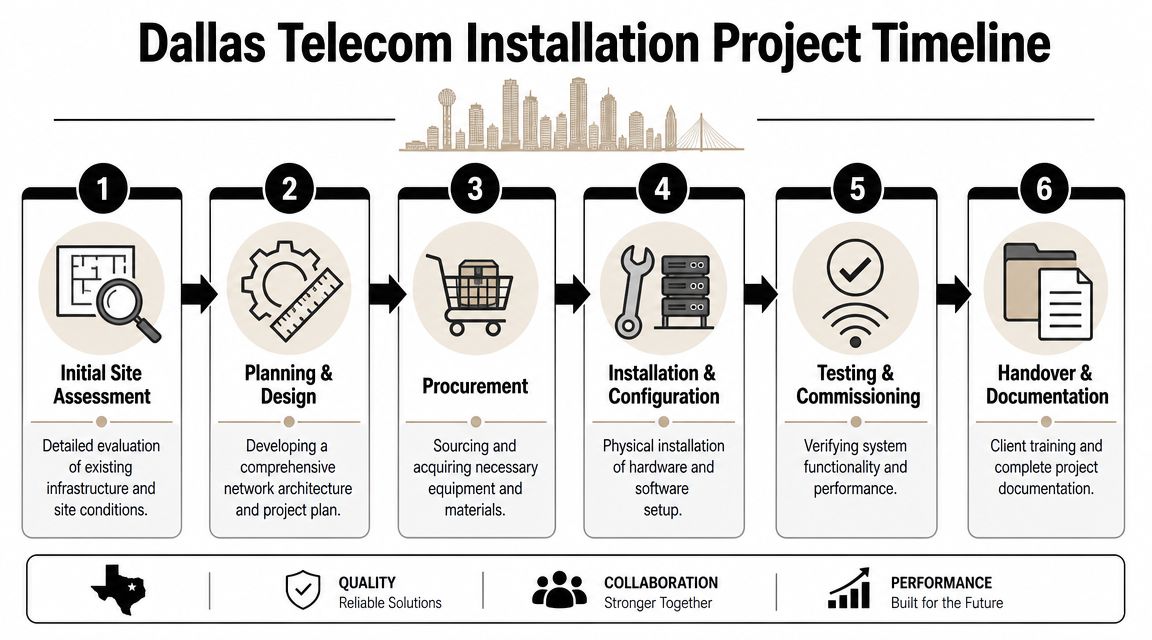
The sequence that reduces rework
A lot of installation trouble comes from starting physical work before design assumptions are stable. Crews arrive, discover conflicts, and then the site becomes a workshop for decisions that should have been made earlier.
A stage-gated plan avoids that by forcing agreement at each step:
- Survey and permits. Validate actual conditions, pathways, room readiness, and required approvals.
- Design freeze. Lock down rack elevations, cable paths, handoff locations, and cross-discipline coordination.
- Safety and utility verification. Confirm site access, utility-locate requirements, and restrictions around the work area.
- Equipment staging. Receive, inspect, label, and acceptance-test material before it enters the production window.
- Cutover and rollback. Define who does what, in what order, and what triggers a reversal.
- Closeout. Deliver as-builts, test results, asset records, and unresolved issue tracking if anything remains.
Dallas-specific delays that buyers underestimate
In DFW, “fast install” often has less to do with crew size and more to do with entitlement complexity. If the work touches underground paths, public right-of-way, utility coordination, or constrained building access, the schedule depends on approvals and access windows as much as labor.
Directional boring can be the right approach when surface disruption has to be minimized, but trenchless work still depends on proper planning and corridor access. The same goes for aerial routes or building-to-building fiber. The method doesn't remove the need for pre-work discipline.
Use these questions early:
- Permitting path. Does the route require municipal review, private property approvals, or both?
- Power coordination. Are there dependencies with facility electrical work or utility timing?
- Access windows. Can the site support daytime work, or will cutover require after-hours execution?
- Downtime tolerance. Which spaces can absorb interruption, and which need live-environment controls?
- Civil method. Is aerial, trench, or directional boring the least disruptive path for this site?
If you're evaluating underground or campus connectivity work, local fiber optic installation options near you can help clarify whether the likely bottleneck is field labor or route complexity.
The timeline should show where decisions must be final, not just where crews are expected to appear.
That's the difference between a schedule and a real execution plan.
Decoding Contracts and Controlling Installation Costs
The lowest bid usually reflects one of three things. Missing scope, optimistic assumptions, or a contractor willing to recover margin through change orders later. None of those help an IT director who has to defend spend after the project starts slipping.
Why low bids turn expensive
Telecom work crosses multiple disciplines. Cabling interacts with power, pathways, hardware staging, and cutover sequencing. If the statement of work is loose, every gray area becomes a billing event or a delay.
That's why value-based contracting beats low-bid contracting in Dallas enterprise environments. You want the contract to make the work predictable, not just cheap on award day.
A solid statement of work should define:
- Exact deliverables. Cable counts, rack work, labeling standard, testing output, closeout documents.
- Site assumptions. Access hours, room readiness, pathway availability, escort requirements, disposal exclusions or inclusions.
- Acceptance criteria. What constitutes completion for each phase.
- Change control. Who can approve changes, how they're priced, and what documentation is required.
- Payment triggers. Milestone-based billing tied to verified progress, not vague percentage-complete language.
Contract structures that fit telecom work
Fixed-price can work when the scope is mature and site conditions are well understood. Time and materials can work for exploratory or variable work, but it needs discipline. A not-to-exceed cap often provides a useful middle ground when there's uncertainty but the buyer still wants budget protection.
The contract should also cover warranties, issue-response expectations, punch-list obligations, and ownership of documentation. If decommissioning is in scope, it should state inventory responsibility, removal boundaries, and chain-of-custody expectations.
McKinsey notes that because 5G buildouts are capital intensive, contractors should reduce waste by bundling civil works, power, and fiber tasks to minimize truck rolls and by enforcing real-time change control to avoid overruns caused by scope creep and poor stakeholder alignment in McKinsey's telecom strategy analysis.
That principle applies directly to enterprise installs. If one contractor handles civil prep, another does power, and a third performs fiber termination with no integrated sequencing, you pay in delays even before you pay in invoices.
What good contracts do in practice
A good contract assigns risk to the party best able to manage it. A bad one leaves major assumptions unstated. When that happens, every site walk uncovers “new” work.
The cheapest proposal often becomes the most expensive one to supervise.
Integrating Decommissioning with Your New Installation
Most telecom install plans still treat removal as cleanup. That's a mistake. Decommissioning is part of the project scope the moment a new environment replaces an old one.
When teams delay that conversation, they create avoidable risk. Legacy gear stays powered longer than necessary. Data-bearing devices remain in circulation without a clear owner. Old racks and patching consume space needed for closeout. The result is a project that technically installed new infrastructure but never fully retired the old one.
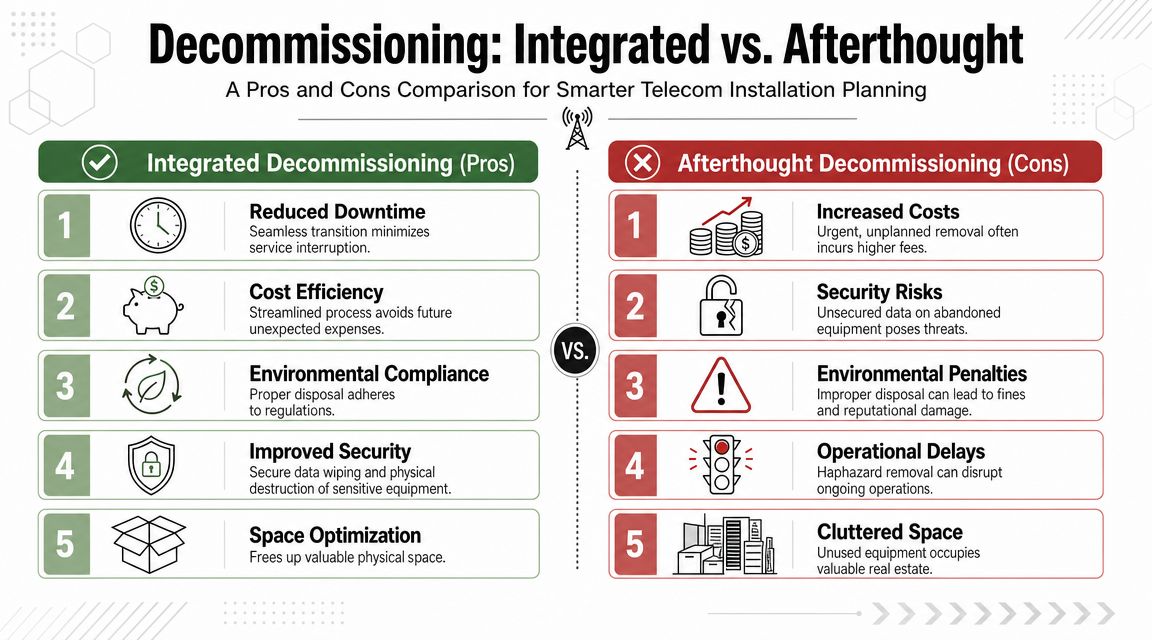
Why removal belongs in the cutover plan
Enterprise and public-sector upgrades often create a parallel workload that includes removing cabinets, obsolete copper or fiber runs, retired network electronics, UPS units, and related hardware. The security and environmental side of that workload is substantial. The United States generated about 6.9 million tons of e-waste in 2022, and only 22.3% was documented as formally collected and recycled, which is why proper decommissioning should include material recovery and data sanitization according to this Dallas dark fiber market discussion.
That data matters because telecom gear often includes more than passive components. It can include data-bearing appliances, management modules, storage, and integrated systems that should not leave the site without documented handling.
What integrated decommissioning looks like
The stronger model ties removal to the same timeline as staging and cutover. That doesn't mean every old asset leaves the building on the same night. It means the project defines exactly what gets disconnected, when it gets inventoried, who signs custody, and where it goes next.
Use a decommissioning workstream with these controls:
- Inventory before touch. Record what is being retired before technicians start disconnecting.
- Chain of custody. Assign custody for any data-bearing hardware from removal through final disposition.
- Data sanitization decision. Identify what requires wiping, shredding, or other approved destruction handling.
- Material segregation. Separate reusable hardware, regulated streams, scrap metal, batteries, and mixed electronics.
- Space release plan. Link rack and room clearance to the new installation milestones so the site isn't left half-transitioned.
Secure cutovers don't end when the new link comes up. They end when the old environment is disconnected, accounted for, and processed correctly.
The operational payoff
Integrated decommissioning reduces confusion after go-live. Your team knows what was removed, what remains temporarily, and what has entered the disposition process. Facilities gets space back. Security gets a documented handoff. Procurement avoids the lingering question of what happened to retired assets.
For larger removals, especially in data halls and telecom rooms, buyers often need specialized data center equipment disposal services in Dallas-Fort Worth to support chain-of-custody and compliant downstream handling.
This is one of the clearest differences between a contractor who performs tasks and a partner who understands infrastructure lifecycle management. The first one installs. The second one closes the loop.
Finalizing Your Partnership for a Successful Rollout
By the time you're ready to sign, the decision should be narrower than “Who gave us a workable quote?” The better question is whether the vendor can carry operational responsibility across the full project lifecycle.
Three factors matter most.
First, technical credibility. The installer should understand your environment well enough to identify hidden dependencies before the field team discovers them. Second, process discipline. You want a partner with a defined workflow, documented controls, and a PM structure that keeps issues visible. Third, decommissioning maturity. The firm doesn't need to process retired assets themselves in every case, but they do need to plan removal, custody, and handoff as part of project execution.
That shift in mindset changes outcomes. You're no longer hiring a telecom installer as a standalone trade. You're selecting a project partner who can support business continuity, documentation, and clean asset exit under one operating plan.
If a telecom installation company in Dallas can't explain how the project starts, changes, cuts over, closes out, and retires the old stack, keep looking.
If your Dallas organization is upgrading telecom infrastructure and needs a secure plan for the equipment left behind, Dallas Fortworth Computer Recycling supports IT leaders with IT asset disposition, data destruction, data center decommissioning, and compliant electronics recycling workflows. That's especially useful when a network build, voice refresh, or site consolidation also requires documented chain of custody, removal coordination, and responsible downstream handling of retired technology.