
7 Telecom Providers Near Me: 2026 Dallas-Fort Worth Guide

Your Dallas-Fort Worth business is expanding, and the strain on your network is obvious. Cloud apps hesitate when teams pull large files, video meetings stutter at the worst moment, and remote users start blaming “the internet” for every delay. At that point, searching telecom providers near me stops being a basic shopping exercise and turns into an infrastructure decision with real operational risk.
Most provider roundups don't help much. They mix consumer plans with enterprise circuits, gloss over SLAs, and skip the practical question that matters most in procurement: what happens after install day if the line fails, the site grows, or the hardware you replaced is still sitting in a rack with live configs on it?
This guide is built for IT leaders who need a shortlist fast and need that shortlist framed around business consequences, not marketing copy. The U.S. market is concentrated enough that your realistic options usually come from a small number of major carriers and a few meaningful regional challengers. The larger pattern is the same in other major markets too. Enterprise buyers typically end up evaluating a handful of providers, not dozens, because national networks hold most of the footprint and subscriptions in practice, including the dominant share held by the Big Three in the U.S. according to the Florida Public Service Commission telecom industry report.
Key Comparison Criteria for Your Shortlist
- Network Technology & Performance: Is dedicated fiber with symmetrical speeds essential, or can your business run well on coax or fixed wireless? Last-mile design affects latency, uptime, and how the connection behaves under load.
- Service Level Agreements (SLAs): Business service starts with accountability. Check uptime guarantees, latency commitments, packet loss terms, and repair windows.
- Customer Support & Local Presence: When service drops, you need a business support path that reaches people who can act, not a residential call queue.
- Scalability & Future-Proofing: Your current bandwidth need isn't the hard part. The hard part is whether the provider can grow with cloud adoption, branch expansion, and tighter security architecture.
- Total Cost of Ownership (TCO): Monthly recurring cost is only one line item. Build in install charges, managed equipment, static IPs, contract terms, and downtime risk.
1. AT&T Business
A common DFW scenario goes like this. The headquarters needs fiber with firm uptime commitments, three branch offices need business internet that can be ordered quickly, and the field team wants wireless service under the same contract. AT&T makes the shortlist early because it can cover all three without forcing IT to stitch together multiple carriers.
Its business internet catalog also helps during early procurement. The published options on the AT&T Business Fiber page give IT and finance a fast way to pressure-test budget assumptions before the formal quote process starts. That matters when you are screening providers for a new site, a relocation, or a broader network refresh.
Where AT&T is usually the right fit
AT&T is strongest when the business wants standardization across locations and services, not just the lowest monthly rate.
- Primary connectivity for core offices: Symmetrical fiber works well for cloud applications, VoIP, video meetings, and heavy file synchronization.
- Regional or multi-state footprints: One carrier across multiple sites can reduce contract sprawl, billing complexity, and support handoffs.
- Internet plus wireless resilience: Some business fiber offers support wireless backup on eligible setups, which can simplify branch continuity planning.
- Organizations planning beyond installation: Provider selection is only the front half of the lifecycle. Teams that also need a plan for retired routers, handsets, and telecom gear should map that work early with a telecommunications company near me in Dallas-Fort Worth that handles secure downstream disposition.
The buying motion changes once you move upmarket. Posted fiber plans are useful for small and mid-size offices. DIA, Ethernet, SD-WAN, SASE, voice, and larger mobility bundles usually require account-team engagement, site review, and a longer approval cycle. Buyers who miss that distinction often underestimate install intervals and overestimate pricing transparency.
AT&T is practical for companies that want room to grow without changing providers a year later. It can support a branch today and a more controlled enterprise design later. That said, procurement teams should separate broadband pricing from true enterprise service economics. Monthly rate, construction exposure, managed equipment, contract term, and SLA language all need review before the quote goes to signature.
A simple rule works here. Use AT&T's published business fiber offers for early budget screening, then validate enterprise circuits as a separate purchase decision.
If you're comparing local options and want to stack AT&T against other regional and national carriers serving North Texas, this roundup of local telecom companies in Dallas-Fort Worth is a useful companion reference.
2. Spectrum Enterprise / Spectrum Business

Spectrum is two different conversations depending on what you're buying. Spectrum Business serves the price-sensitive SMB side. Spectrum Enterprise is where serious SLA-backed fiber, managed networking, and integrated security discussions happen. If you blur those together, you'll misjudge the provider.
For Dallas-Fort Worth enterprises that need dedicated fiber with accountability, Spectrum Enterprise deserves attention. Its Dallas enterprise internet services page positions the company around Dedicated Fiber Internet, managed networking, voice, and security services, which is the bundle many IT teams want when they don't want to orchestrate five vendors.
Why enterprises buy Spectrum
Spectrum Enterprise is strong when uptime terms and operational support matter as much as raw bandwidth. It's often a better fit than a commodity broadband buy if the site supports revenue operations, patient scheduling, transactional systems, or always-on voice.
A few practical advantages stand out:
- SLA-backed dedicated service: This is the main draw. You buy accountability, not just bandwidth.
- Managed service stack: Internet, networking, security, and voice can sit under one provider relationship.
- Wireless failover options: That gives branch sites a cleaner continuity plan when wired service drops.
The downside is familiar. Enterprise pricing is custom quoted, and that's normal, but it slows early comparison work. You won't get much “street price” clarity until the account team qualifies the site and service design.
The real trade-off
Spectrum Enterprise is often easiest to justify when downtime has a measurable business cost. If the internet outage means your office works slower, lower-cost options may be enough. If an outage means calls fail, transactions stop, or a clinic loses operational continuity, dedicated service becomes easier to defend.
Buy Spectrum Enterprise for business continuity and escalation structure. Don't buy it if your actual need is basic office internet and your budget won't support enterprise support expectations.
On the smaller-business side, some Spectrum offerings can be perfectly fine, but remember that cable-based plans may behave differently than dedicated fiber under sustained upload load. That matters for cloud backup, large sync jobs, and camera-heavy environments.
If you're still sorting broad categories before narrowing providers, this local guide to telecom services near me in DFW helps frame the difference between simple business internet and enterprise-grade telecom services.
3. Frontier
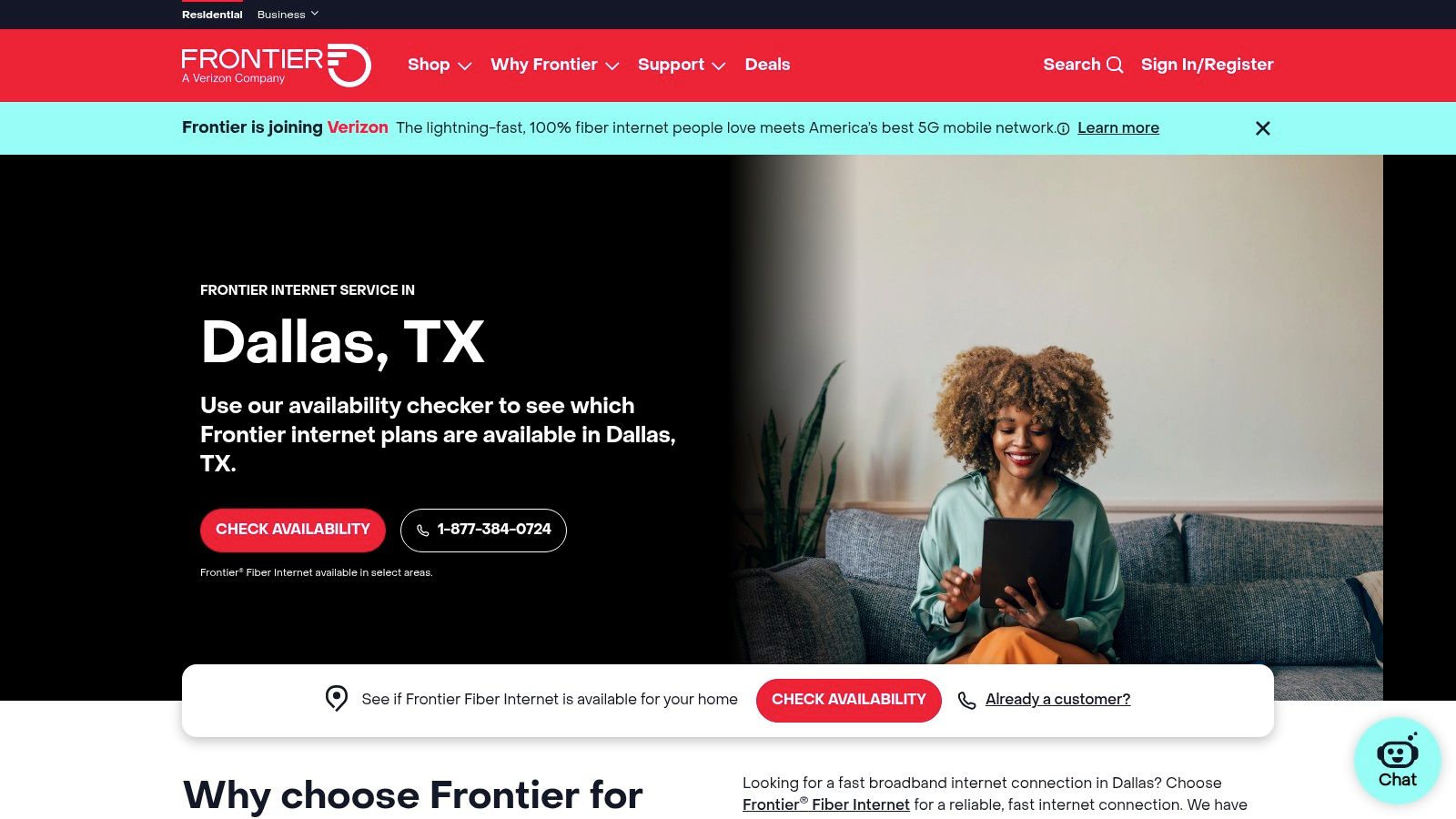
Frontier has become a serious contender in North Texas where its fiber is available. That's the key qualifier. Availability is highly address-specific, but when Frontier is on-net, it often gets attention quickly because the posted multi-gig fiber options are easy to understand and compare.
The Frontier Dallas service page makes that side of the offer visible. For IT buyers, transparency matters because it lets you pressure-test the market before committing time to full enterprise quoting. Frontier is often strongest in that middle ground where you want better upstream performance than cable can usually deliver, but you're not yet in a carrier-heavy custom WAN design.
Best use case for Frontier
Frontier tends to make the most sense in these situations:
- Small and mid-size offices with cloud-heavy workflows: Symmetrical service helps more than many buyers expect.
- Creative, legal, and backup-heavy environments: Large uploads stop being a daily complaint.
- Sites in expanding suburban footprints: Frontier can be compelling in newer or recently upgraded service areas.
The limitation is that posted fiber plans don't automatically equal a full business telecom stack. If you need static IPs, hardened support expectations, or enterprise DIA and Ethernet, the buying process changes.
What procurement teams should verify early
With Frontier, the first screening step isn't speed. It's address qualification and service class. Ask whether the exact location supports the business-grade service you need, not just whether “Frontier fiber” appears on the page.
That distinction matters because broadband-style promos can create false confidence. A site may qualify for an attractive internet plan but still require a separate quote path for more formal business requirements.
Frontier is strongest when you can use its fiber as purchased, not when you're trying to force a broadband-first offer into an enterprise WAN role.
If your team is comparing Frontier against other area carriers and wants a broader local benchmark, this DFW roundup of a telecommunications company near me is useful for cross-checking fit by business type.
One caution applies beyond Frontier and affects a lot of “telecom providers near me” searches in general. Local search results rarely show you how much real provider redundancy exists at a site. More than a third of Americans have access to only one broadband provider or none, and only about 29 percent of households had access to three or more options for 100/20 Mbps service as of late 2023, according to the Benton Institute analysis on broadband provider scarcity. For secondary offices and disaster recovery planning, that hidden scarcity matters more than marketing maps.
4. Lumen Technologies

Lumen isn't the provider most Dallas businesses call first for a basic office internet circuit, and that's fine. It isn't trying to win that conversation. Lumen is a stronger fit for data center operators, multi-cloud environments, large enterprise WANs, and teams that care about interconnection options as much as office access.
Its Ethernet services portfolio makes that clear. The company leans into Ethernet On-Demand, higher-capacity transport, and cloud connectivity rather than small-business simplicity. If your environment includes colocated infrastructure, cross-connect planning, or traffic patterns that spike around projects and migrations, Lumen is worth serious review.
Where Lumen earns its keep
Lumen is compelling when the network itself is part of the business operation, not just a utility bill. Dallas has enough carrier hotel and data center activity that a provider with deep metro and backbone relevance can materially change your architecture options.
The strongest use cases tend to be:
- Data center and colocation connectivity
- High-capacity Ethernet and wavelength needs
- Multi-cloud access where path design matters
- Project-based or bursty bandwidth demand
One of Lumen's practical advantages is commercial flexibility around on-demand services in eligible environments. That isn't universal across all addresses, but where it applies, it can be more useful than a static contract built around peak assumptions.
Where buyers get tripped up
The mistake is treating Lumen like a simple local ISP comparison. For an ordinary branch office with modest needs, Lumen can be overkill. The value appears when your team knows why it needs carrier-grade transport, cloud adjacency, or metro ring resilience.
If the site is a rack, cage, core node, or cloud on-ramp problem, Lumen moves up the list fast. If it's a 25-person office trying to leave cable, it probably doesn't.
This becomes even more relevant during facility moves and infrastructure transitions. If you're planning relocation or consolidation work, pair carrier selection with a realistic physical transition plan. This guide to data center migration services in Dallas-Fort Worth is helpful for coordinating network changes with equipment moves and retirement workflows.
5. Optimum Business
Optimum Business is the kind of provider many teams overlook until they need a quick budgeting baseline. That's where it can be useful. Optimum's business services rate card gives buyers something many providers don't: a visible starting point for package and fee review.
That transparency doesn't make Optimum the right answer for every DFW site. It does make the provider easier to assess in the first pass. If you're trying to compare likely spend before opening a custom quote process, Optimum gives you more to work with than many competitors.
When Optimum makes sense
Optimum can be a practical option for businesses that want a serviceable local provider where available, especially if the address is already in a supported footprint and speed-to-install matters. Static IP add-ons, LTE backup options, and business Wi-Fi support make it useful for conventional office deployments.
Still, the service mix matters. In HFC service areas, many plans are asymmetrical. That's not disqualifying, but it changes the conversation if your users push large uploads all day.
The budgeting advantage and the architectural limit
Procurement teams like visible pricing because it speeds internal approvals. Finance likes it too. You can build a rough model quickly and identify whether the site belongs in a commodity broadband bucket or needs to be escalated to DIA.
The architectural limit is simple: don't buy an asymmetrical cable-style service for a workload that behaves like an enterprise fiber requirement. That mismatch creates the “cheap circuit, expensive complaints” problem.
- Use Optimum for budget screening: The rate card helps you compare service categories quickly.
- Verify access method by address: Fiber and cable service zones are not the same thing operationally.
- Check add-on costs early: Static IPs, managed Wi-Fi, and backup connectivity can change the actual monthly figure.
If your organization is standardizing telecom gear refreshes at the same time, align provider procurement with asset control. These IT asset management best practices help avoid the common problem where old gateways and edge devices stay untracked after a carrier change.
6. Astound Business Solutions

Astound is one of the more credible local alternatives in the DFW conversation. For teams tired of defaulting to the largest incumbent every time, that's important. A regional provider with a real footprint can offer advantages in pricing, contract negotiation, and install planning, especially for Dallas and North Dallas area sites.
Its Dallas business internet page shows a service set that spans business internet, voice, Ethernet, dark fiber, and access to broader cloud and data center resources. That mix gives Astound more relevance than a simple “local ISP” label suggests.
Why Astound gets shortlisted
Astound tends to appeal to buyers who want a provider that feels more focused on the region and less standardized in approach than the largest national carriers. That's not always better, but it can be.
What usually stands out:
- A meaningful local footprint: Better than gambling on a provider with only theoretical availability.
- Competitive alternative positioning: Useful when incumbent quotes come in high or inflexible.
- Room to grow into larger services: DIA, Ethernet, and dark fiber keep the provider relevant beyond the first install.
The limitation is coverage consistency. With Astound, you need to check the exact served city and address. Some locations fit cleanly. Others may need build-out or won't qualify at all.
Good challenger, not universal answer
Astound is often strongest as a second or third quote in a disciplined procurement process. It gives you a serious challenger option without dropping into a tiny local operator that can't support future scale.
A good regional carrier can lower cost and improve responsiveness, but only if the site is genuinely inside its operational sweet spot.
One issue provider searches still miss applies here too. Availability alone doesn't guarantee adoption. In underserved areas, communities often need support such as digital software and hardware training at convenient locations, low-cost computers, and technical support for broadband expansion to translate into meaningful use, as described by the County Health Rankings broadband initiatives guidance. That matters for public sector, nonprofit, and distributed workforce planning where connectivity isn't the only deployment barrier.
7. T-Mobile for Business
A DFW branch lease gets signed, the staff arrives next week, and the fiber install date slips another 45 days. That is the situation where T-Mobile for Business earns a spot in the plan.
T-Mobile solves a deployment problem, not a carrier-grade transport problem. Its Business Internet offering makes sense when a business needs service fast, needs a backup path, or needs connectivity at a site that may not justify a full wired build.
I usually recommend it for four specific use cases:
- New sites waiting on fiber, DIA, or cable turn-up
- Temporary offices, trailers, and project locations
- Small branches with predictable, moderate usage
- Secondary connectivity for outage protection
The appeal is operational. Procurement is simpler than a traditional circuit order. Installation is faster. Monthly costs are easier to forecast. For multi-site teams trying to keep openings on schedule, those advantages matter.
The trade-off is consistency.
Fixed wireless performance can vary by address, building construction, indoor placement, and cell congestion at peak times. A location can test well at noon and feel different during the business rush. That gap is why I treat T-Mobile as a tactical service unless the site has been validated under real working conditions.
Dallas-Fort Worth buyers should also pressure-test the site, not the coverage map. Marketing coverage across the metro does not answer the questions that matter in procurement. Can the gateway sit where signal is strong enough? Will the branch policy allow the right window or rooftop placement? Does the application mix tolerate occasional variability? Voice, cloud apps, and light office traffic may be fine. Large file transfers, constant video use, or latency-sensitive workloads may not be.
T-Mobile works well as an interim access method and as a failover circuit. It is harder to justify as the default primary connection for every office profile.
That distinction matters across the full telecom lifecycle. T-Mobile can get a site live quickly while a wired primary is still in provisioning, and it can stay in place later as backup. Then, when the network design changes or a location closes, the retirement process needs the same discipline as the initial buy. Routers, gateways, handsets, and other telecom hardware still need secure, documented decommissioning through a trusted local partner. That last step gets ignored too often in DFW telecom planning, and it creates avoidable compliance and asset-disposal risk.
Top 7 Local Telecom Providers Comparison
| Provider | Implementation complexity 🔄 | Resource requirements ⚡ | Expected outcomes 📊 | Ideal use cases 💡 | Key advantages ⭐ |
|---|---|---|---|---|---|
| AT&T Business | Moderate 🔄, posted fiber quick; DIA/enterprise quote-based longer lead times | Fiber footprint across DFW; eligible gateway for built‑in 5G failover | Reliable symmetrical speeds (300 Mbps–5 Gbps) and enterprise bundles | HQ/campus, branches, data‑center links; multi‑site rollouts | Broad DFW fiber, transparent posted pricing on many plans, 5G failover |
| Spectrum Enterprise / Spectrum Business | High 🔄, custom quoting and SLA negotiation common for enterprise services | Dedicated metro fiber, managed services and 24/7 monitoring | SLA‑backed high availability and scalable symmetric bandwidth (up to 100 Gbps cited) | Large enterprises needing SLA‑backed dedicated fiber and managed security | Strong SLA posture, dense metro coverage, single‑vendor managed portfolio |
| Frontier | Low–Moderate 🔄, posted multi‑gig fiber tiers; enterprise DIA often quote‑based | Symmetrical multi‑gig fiber where available; equipment bundles (Wi‑Fi 6/7) | Competitive multi‑gig pricing and strong upload performance | Cost‑sensitive businesses seeking multi‑gig fiber in served areas | Attractive entry pricing on 500 Mbps–1 Gbps, strong upload speeds |
| Lumen Technologies | High 🔄, carrier‑grade provisioning; On‑Demand available where eligible | Carrier‑hotel ports, high‑capacity transport and cloud‑connect options | Very high capacity, low latency, strong SLAs (up to 400 Gbps options) | Data‑center connectivity, multi‑cloud, wholesale and high‑capacity networks | Deep interconnects, flexible hourly/monthly NaaS models, MEF‑certified offerings |
| Optimum Business (Altice USA) | Low–Moderate 🔄, published rate card simplifies procurement; availability varies | Mix of HFC (cable) and fiber; LTE failover and static IP options | Predictable budgeting; performance may be asymmetrical unless on fiber | On‑net buildings needing quick turn‑up and straightforward pricing | Transparent regional rate card, potentially fast installs in covered buildings |
| Astound Business Solutions | Moderate 🔄, posted business tiers; DIA/enterprise usually quoted | Local fiber footprint with 24/7 support; voice and data‑center options | Competitive local performance and symmetrical business tiers | Local businesses seeking an alternative to incumbents in DFW | Competitive regional pricing, clear served‑city availability, local focus |
| T‑Mobile for Business | Low 🔄, fast self‑install or optional professional install | Fixed wireless (5G/LTE) with gateway included; site signal‑dependent | Rapid deployment and portability; variable performance with congestion | Temporary sites, branch failover, locations lacking wired options | Quick turn‑up, simple pricing, portability and easy failover setup |
From Selection to Decommissioning Your Strategic Plan
Selecting a provider is only the first half of the job. The more expensive mistakes usually happen after the contract is signed. Teams rush installation, leave old gear in place longer than planned, forget to document demarc changes, and discover too late that a provider swap created new security and asset management problems.
The right approach is to tie provider selection to the operating model of the site. If the location supports core applications, voice, patient service, manufacturing systems, or customer transactions, buy around failure impact first and price second. If it's a small office with limited operational exposure, a simpler service tier may be the right financial decision.
Matching the provider to the business
For data-intensive enterprises and data center operations, Lumen and Spectrum Enterprise make the most sense when you need strong SLAs, higher-capacity transport options, and a support model built for critical infrastructure. They aren't the cheapest names on the page, but that's usually not the point. Their value appears when outage exposure, cloud adjacency, or backbone design affects the business directly.
For multi-site DFW organizations such as retail groups, healthcare clinics, and distributed professional services firms, AT&T Business and Astound are practical candidates. AT&T brings broad reach and service breadth. Astound can be the sharper local alternative where coverage aligns and the account team can move quickly.
For startups, new developments, and locations that need connectivity now, T-Mobile for Business fills an important role. It can bridge the period before wired circuits arrive, support a temporary buildout, or act as a durable backup path. Frontier also deserves a hard look where its fiber is available because symmetrical service can solve real workflow issues without pushing every site into an enterprise-grade custom network buy.
Don't ignore the retired hardware
Every telecom upgrade leaves hardware behind. Routers, switches, SD-WAN appliances, firewalls, cable modems, optical gear, access points, and provider gateways often hold saved credentials, configuration files, VPN details, IP schemes, and service records. Leaving that equipment in a storage room is a security issue, not just a housekeeping issue.
Many otherwise disciplined projects fall apart here. The network cutover gets all the attention, but no one owns the end-of-life process. Devices sit on shelves for months. Asset records go stale. Chain of custody gets fuzzy.
A telecom migration isn't complete until the replaced equipment is removed from service, documented, sanitized, and dispositioned through a controlled process.
For Dallas-Fort Worth organizations and nationwide operations, Dallas Fortworth Computer Recycling is built for that last step. The company focuses on secure, compliant retirement of technology assets, including network and telecom hardware. For IT managers, that matters because retired edge devices often contain enough residual data to create audit and breach risk if they aren't handled correctly.
A strong decommissioning partner should give you more than pickup. You want certified data destruction, audit-ready reporting, and a documented chain of custody. You also want environmentally responsible handling so obsolete telecom equipment doesn't become unmanaged e-waste.
Procurement questions that matter in practice
Contract term is the first one. Longer terms can improve monthly economics, but they reduce flexibility. If you're in a growth cycle, negotiating relocation language and upgrade paths matters as much as headline price.
SLA negotiation is the second. On broadband-style service, you usually take the SLA as offered. On enterprise DIA or Ethernet, you often have more room to negotiate service credits, escalation language, and accountability around chronic performance issues.
The third is building status. If you're in a lit building, the project usually moves faster and with less friction. If you're not, construction lead times can reshape the whole procurement schedule, so ask that question early before you commit internally to a go-live date.
The strongest telecom procurement programs in DFW handle the full lifecycle as one workflow. Select the provider. Validate installation assumptions. Stage and document the cutover. Then retire the replaced hardware with the same level of discipline you used to buy the new service.
If you're replacing routers, switches, firewalls, gateways, or other telecom hardware during a provider change, Dallas Fortworth Computer Recycling can help close the project properly with secure, compliant IT asset disposition, certified data destruction, and responsible electronics recycling for DFW organizations and nationwide operations.