
Choosing an R2 Certified Electronics Recycler
When it's time to retire old technology, an R2 certified electronics recycler isn't just a vendor—they're a critical partner. Choosing one is a strategic move that shields your business from the costly risks of data breaches, compliance violations, and environmental fines.
Why Your Old Tech Demands an R2 Certified Partner
That storage closet full of old servers, laptops, and hard drives is more than just clutter. For any IT director or procurement manager handling a tech refresh, it's a minefield of hidden liabilities. Every single device represents a potential point of failure—not in its performance, but in its retirement.
This scenario puts enormous pressure on your team. The job isn't just about making space; it's about protecting sensitive company data, navigating a maze of environmental regulations, and safeguarding your organization's hard-earned reputation.
The Problem with Uncertified Disposal
Hiring a non-certified vendor to handle your old electronics is like giving a stranger the keys to your office. The consequences can be devastating and ripple throughout your entire organization:
- Data Breaches: Retired hard drives are often still loaded with sensitive customer information, employee files, or trade secrets. If they aren't professionally destroyed, that data can easily end up in the wrong hands.
- Compliance Violations: Strict regulations like HIPAA, GDPR, and FACTA govern how data must be handled. One misstep in the disposal process can trigger steep fines and serious legal trouble.
- Environmental Liabilities: Old electronics are full of hazardous materials like lead and mercury. If your vendor illegally dumps your e-waste, your company can be held legally responsible for the cleanup costs and penalties.
- Reputational Damage: A data leak or an environmental scandal tied to your equipment can shatter customer trust and tarnish your brand almost overnight.
An uncertified recycler might offer a lower price, but that's usually because they're cutting corners on security and compliance. What looks like a cost-saving measure quickly becomes a massive organizational risk.
The Strategic Advantage of an R2 Partner
This is exactly where an R2 certified electronics recycler makes all the difference. They transform a high-stakes task into a secure, predictable, and fully documented process.
Think of an R2 partner less like a waste hauler and more like a specialized asset manager for your end-of-life technology. They operate under a strict set of standards, confirmed by third-party auditors, that dictate every single step of the disposal process.
Choosing an R2 certified partner is a proactive, strategic decision that ensures your retired assets are managed with the highest level of security and environmental care. It's a choice that protects your bottom line and proves your commitment to responsible business practices. If you need a reliable local provider, a certified electronics recycling center can deliver the secure solutions you need. This guide will walk you through exactly what to look for.
Understanding What R2 Certification Guarantees
When you see that R2 logo, it’s not just a sticker. It’s a promise—a strict commitment to a set of rules that governs every single step of the electronics disposal process.
Think of R2 certification as a comprehensive “building code” for managing e-waste. A building code ensures a structure is safe, stable, and built correctly. In the same way, the R2 standard ensures your retired assets are handled securely, transparently, and with environmental integrity from the moment they leave your facility.
This isn't a simple checklist you can breeze through. It’s an entire operational philosophy, backed by rigorous third-party audits. An R2 certified electronics recycler is contractually obligated to follow these guidelines, turning what could be a massive liability into a verifiable part of your company’s risk management strategy.
The Core Pillars of the R2 Standard
The R2 standard is built on a clear hierarchy of responsible management. It’s a framework that dictates not just what recyclers do, but how they do it, locking in accountability at every stage.
- Prioritizing Reuse Over Recycling: The greenest and most responsible action is always to extend an electronic device's life. R2 mandates that certified recyclers first test and assess all incoming equipment for refurbishment and resale potential.
- Ensuring Downstream Accountability: An R2 recycler’s job doesn't end when materials leave their facility. They are required to vet and track all downstream partners—the specialized companies that handle materials like plastics or circuit boards—to guarantee they also operate safely and responsibly.
- Mandating Secure Data Sanitization: The standard demands strict adherence to leading data destruction protocols, like those from the National Institute of Standards and Technology (NIST). This ensures all your sensitive information is verifiably destroyed before a device is ever resold or recycled.
- Protecting Worker Health and Safety: R2 certified facilities must have robust safety programs in place to protect their employees from the hazards that come with handling electronic components, such as heavy metals and sharp materials.
R2 certification provides a documented chain of custody for your assets. It’s the difference between hoping your data is destroyed and having a certificate that proves it was.
Translating Standards into Business Benefits
For IT leaders and procurement teams, these standards deliver tangible business advantages. Working with an R2 certified electronics recycler isn't just about checking a compliance box; it’s about building resilience and protecting your brand’s reputation.
This commitment has driven incredible global adoption. In the world of electronics recycling, R2 has become a beacon of responsibility. As of late 2025, there are nearly 720 facilities worldwide certified to the R2 standard—a massive jump from just 27 facilities a few years ago. This growth shows a clear, worldwide demand for a higher standard in electronics management.
Partnering with a certified vendor aligns your IT operations with your company’s broader sustainability goals. It gives you clear, auditable proof of your commitment to responsible practices—something that customers, investors, and employees care about more than ever. You can learn more about how to select from the top IT asset disposition companies that hold these critical certifications.
Ultimately, the R2 guarantee is one of peace of mind—knowing your assets are in professional, accountable hands.
How R2 Certification Protects Your Sensitive Data
For any IT leader, data security is non-negotiable. That pile of retired laptops, servers, and hard drives isn't just old hardware; it's a vault of sensitive corporate information, customer records, and proprietary secrets. Just hitting "delete" or reformatting a drive gives you a false sense of security, leaving recoverable data wide open for the taking.
This is where an R2 certified electronics recycler becomes a critical extension of your cybersecurity team. R2 certification isn't just a label—it's a mandate for a strict, legally compliant, and auditable process for data destruction. It turns the abstract idea of "data security" into a concrete, verifiable set of actions that protect your organization from staggering financial and reputational damage.
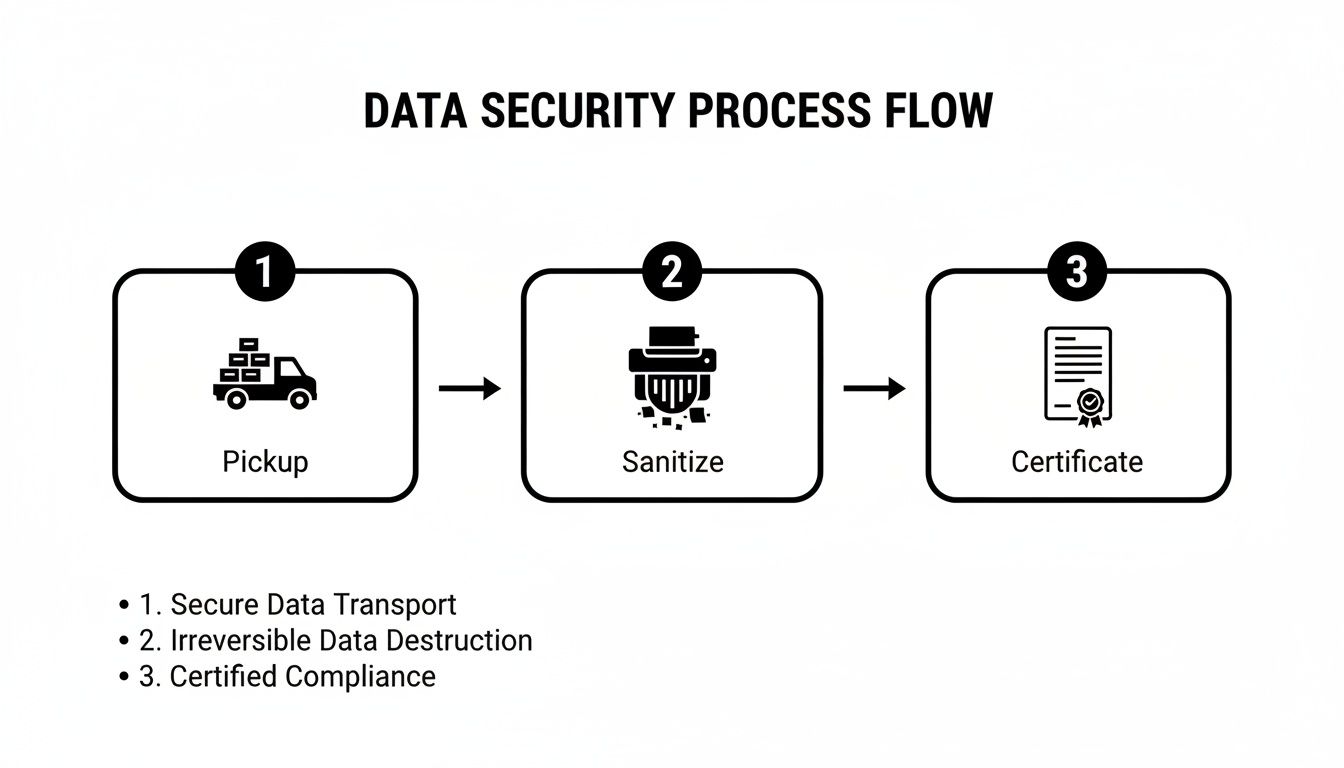
Think of the R2 process as a digital vault with an ironclad paper trail. From the moment your assets leave your facility, a secure chain of custody begins. Every device is tracked and every step is recorded, ensuring nothing gets lost or mishandled. This documented journey is your proof of compliance and the evidence you need to show your organization acted responsibly.
Moving Beyond Simple Deletion
A standard delete command on a computer doesn't actually erase anything. It just removes the signpost telling the operating system where the files are located. With basic, easily accessible software, that "deleted" information can often be fully recovered.
An R2 certified electronics recycler is required to use methods that render data completely and permanently unrecoverable, following rigorous standards like those set by the National Institute of Standards and Technology (NIST).
This involves several proven techniques:
- Physical Shredding: Hard drives and solid-state drives are fed into industrial shredders that pulverize them into tiny, unrecognizable fragments. There is simply no way to reassemble the platters or chips to get the data back.
- Cryptographic Erasure: For devices that might be reused, this software-based method overwrites the entire drive with random, meaningless data. The process is so thorough that it completely sanitizes the drive, making the original information impossible to retrieve. You can explore our guide to learn more about how to wipe a hard drive using these professional methods.
- Degaussing: High-powered magnets are used to scramble the magnetic fields on traditional hard drives, instantly and permanently destroying all stored data.
The R2 standard requires recyclers to provide a Certificate of Data Destruction upon completion. This document is your official record, proving that your data was destroyed in a compliant manner—a critical piece of evidence for any audit.
The High Cost of a Data Breach
Failing to properly manage the data on retired assets can be catastrophic. A single data breach from a discarded hard drive can trigger millions of dollars in fines, legal fees, and customer notification costs. The damage to your brand's reputation can be even worse, destroying customer trust that took years to build.
Data security is the cornerstone of R2 certification, making it indispensable for IT managers navigating the risks of end-of-life electronics. R2 recyclers must implement these ironclad protocols, a non-negotiable for regulated sectors like healthcare and government. This is why major corporations like HP, Samsung, and Dell partner exclusively with R2-certified firms to protect their data, highlighting enterprise trust in these standards. You can discover more insights about why businesses need R2 certification on securis.com.
Your First Line of Defense in Asset Retirement
Ultimately, partnering with an R2 certified electronics recycler is an essential layer of defense for your organization. It's a proactive step that minimizes risk, ensures compliance with data privacy laws like HIPAA and GDPR, and protects your company from the severe fallout of a preventable data breach.
By entrusting your retired assets to a certified partner, you aren't just disposing of old equipment; you are actively safeguarding your most valuable asset: your data.
How to Properly Vet Your R2 Recycling Partner
Picking a partner to handle your retired IT assets is a high-stakes decision. A logo on a website is just marketing—it’s not proof of compliance. Trust has to be earned through verification. Properly vetting an R2 certified electronics recycler is a critical due diligence step that shields your organization from the fallout of data breaches and environmental liabilities.
This process isn't complicated, but it does mean you have to look past the sales pitch. The key is to treat it like a mini-audit. You'll use official sources to confirm their credentials and ask targeted questions that reveal how they really operate. A legitimate R2 partner will welcome the scrutiny and have all the necessary documentation ready to go.
Verify Certification Status Directly
First things first: confirm that the vendor’s R2 certification is both legitimate and current. Never, ever just take a company’s word for it.
The official directory managed by Sustainable Electronics Recycling International (SERI) is the only place to get the real story. Think of it as the single source of truth for all things R2.
- Go to the Source: Head straight to the official SERI "Find an R2 Recycler" directory. This is the only way to get real-time, accurate information.
- Search for the Vendor: You can look them up by company name or location. If they don’t appear in the search, they are not R2 certified. End of story.
- Check the Details: Once you find them, click to see the specifics. Pay close attention to the R2 version (like R2v3), since newer versions have much stricter requirements for data security and tracking downstream partners.
This simple check takes just a few minutes, but it instantly cuts through any misleading claims and empowers your team to validate a potential partner independently.
Look for Red Flags and Ask Tough Questions
Once you've confirmed their certification, it’s time to dig deeper. A truly professional R2 certified electronics recycler will be an open book about their processes. If you get any pushback or vague answers, consider it a major red flag.
Be on the lookout for these warning signs when you're talking to potential partners:
- Resistance to Facility Audits: A certified facility should have nothing to hide. If they balk at the idea of a site visit or a physical audit, it’s a good sign they aren't following protocol behind the scenes.
- Vague Downstream Partner Information: R2 demands full accountability for the entire recycling chain. If a vendor can’t tell you exactly where your old equipment is going, they aren’t compliant.
- No Sample Documentation: Ask to see examples of their Certificate of Data Destruction or their asset tracking reports. If they can't produce clear, professional samples, what you get for your actual assets will likely be inadequate.
A partner’s willingness to provide transparent, detailed answers is a direct reflection of their commitment to the R2 standard. Vague responses often signal operational weaknesses.
The process should be straightforward and documented at every step, creating a secure and auditable chain of custody for every single asset you hand over.
By following these steps, you can confidently select one of the top computer recycling companies and turn your vetting process into a reliable, repeatable workflow that protects your business.
Your Vendor Selection Checklist for ITAD Partners
Choosing the right IT Asset Disposition (ITAD) partner is about more than just checking a box. Sure, an R2 certification is the bare minimum, but a truly great partner acts as an extension of your own risk management and compliance teams. They're the ones you trust with your old hardware, your sensitive data, and your reputation.
To find that kind of partner, you need to dig deeper. This checklist will give you a practical framework for evaluating potential vendors, helping you ask the right questions to find an R2 certified electronics recycler that actually fits your company's security and sustainability goals.
Logistics and Operational Capacity
How a vendor physically handles your assets says a lot about their professionalism. Their logistics, security during transit, and overall responsiveness are huge indicators of whether they can protect your equipment from the moment it leaves your building.
- Pickup and Transportation: Do they show up in a marked truck with uniformed staff and secure, locked containers? Or is it just some guy in a van? You need to see a secure, documented process, including GPS-tracked vehicles.
- Facility Security: A certified facility isn't just a warehouse. It should have serious physical security, like controlled access, 24/7 camera surveillance, and background-checked employees.
- Geographic Reach: Can they handle all your locations with their own trucks and staff? Or will they subcontract the job in certain areas, potentially creating a gap in your chain of custody?
Key Questions to Ask:
- "Walk me through your security measures for our assets from the moment they leave our dock to the moment they arrive at your facility."
- "Can you provide details on your facility's access control, alarm systems, and video surveillance?"
- "We have offices nationwide. How do you manage logistics for a company with a footprint like ours?"
Asset Tracking and Reporting
One of the biggest reasons to hire an R2 certified electronics recycler is for the airtight, auditable trail they provide. Their ability to track every single asset and give you clear, detailed reports is non-negotiable. If their reporting is sloppy, it's a massive red flag.
A vendor's reports are a direct reflection of their internal process. If the paperwork is confusing or incomplete, you can bet their asset management is, too.
You need serialized reporting that documents the entire journey of each device, from your door to its final destination. This paperwork is your proof of compliance when the auditors come knocking.
What to Look For in Reporting:
- Serialized Asset Tracking: Every single item—each laptop, server, and hard drive—needs its own unique tag and tracking number. No batch processing.
- Detailed Disposition Status: The final report should spell out what happened to every asset. Was it resold? Were parts harvested? Or was it shredded into tiny pieces?
- Certificates of Data Destruction: This is critical. You must get a formal certificate that lists the serial numbers of every data-bearing device that was wiped or destroyed, proving you complied with standards like NIST 800-88.
To help you organize your evaluation, we've put together a simple checklist. Use this to compare potential partners side-by-side and make sure you're not missing any crucial details.
Vendor Evaluation Checklist for R2 Certified Recyclers
| Evaluation Criteria | What to Look For | Questions to Ask |
|---|---|---|
| R2 Certification | A current, valid R2v3 certificate. Verify it on the SERI website. | "Can you provide a copy of your current R2v3 certificate? What is your downstream vetting process?" |
| Data Destruction | Clear processes for data wiping, degaussing, and physical destruction. Adherence to standards like NIST 800-88. | "Describe your data destruction methods. Can destruction be performed on-site? How do you verify successful data erasure?" |
| Asset Tracking | Serialized, end-to-end tracking from collection to final disposition. | "Can we see a sample of your asset disposition report? How do you ensure every asset is accounted for?" |
| Logistics & Security | Secure, company-owned vehicles, uniformed & background-checked staff, secure containers, and robust facility security. | "What security protocols are in place during transport? Who has access to our assets at your facility?" |
| Reporting | Detailed, timely, and accurate reports, including Certificates of Data Destruction. | "How soon after pickup can we expect a full reconciliation report and certificate of destruction?" |
| Environmental Compliance | A clear policy on hazardous waste handling and downstream accountability. | "How do you manage focus materials like batteries and mercury-containing lamps?" |
| Value Recovery | Transparent process for testing, grading, and remarketing assets to maximize your return. | "What is your revenue-sharing model for remarketed equipment? How do you determine asset value?" |
| Insurance | Adequate liability insurance, including data breach and pollution liability coverage. | "Can you provide a certificate of insurance listing your coverage types and limits?" |
By systematically working through these points, you can move beyond a vendor’s sales pitch and get a real sense of their operational maturity.
R2 vs. e-Stewards: A Quick Comparison
While R2 is the most widely adopted standard, you'll also hear about e-Stewards. They are both excellent, top-tier certifications, but they have different philosophies, especially when it comes to exporting used electronics. Knowing the difference helps you pick a partner that aligns with your corporate social responsibility policies.
| Standard | Key Differentiator | Best For Organizations That… |
|---|---|---|
| R2 | Focuses on a "reuse first" hierarchy and permits the legal export of tested, working electronics to vetted global markets. | Prioritize a flexible global reuse model to extend equipment life and support circular economy principles. |
| e-Stewards | Enforces a strict ban on exporting hazardous e-waste to developing nations to prevent environmental dumping. | Have a rigid "no-export" policy for hazardous materials as a core part of their CSR strategy. |
Ultimately, this checklist is about empowering you to look past the certification logo and scrutinize the operational details that truly matter. By asking tough questions and demanding clear proof, you can confidently choose a partner who will be a trusted guardian of your assets, your data, and your brand.
The Broader Impact of Choosing a Certified Recycler
Your decision to work with an R2 certified electronics recycler is about more than just checking a box for compliance. It’s a public declaration of your company’s values and a powerful move that strengthens your brand.
This choice sends a clear signal to customers, investors, and even your own employees. It demonstrates a genuine commitment to ethical operations and becomes a tangible part of your Corporate Social Responsibility (CSR) and Environmental, Social, and Governance (ESG) initiatives. In an era where accountability matters, your IT asset disposition strategy is a visible reflection of your company's integrity.
Championing the Circular Economy
The old way of doing business was simple and linear: take, make, dispose. It was also incredibly wasteful, burning through finite resources and creating mountains of trash. An R2 certified electronics recycler helps your business break that cycle by embracing a circular economy.
The entire R2 standard is built on one simple, powerful idea: reuse first. Before any device is shredded for raw materials, it must be evaluated for refurbishment and resale. This priority changes everything:
- Extends Product Lifecycles: Giving working equipment a second or third life is the single most sustainable thing you can do. It drastically cuts the need for new manufacturing.
- Conserves Natural Resources: Keeping devices in circulation means less demand for mining the precious metals and minerals required to build new ones.
- Minimizes Waste Generation: Reuse prevents functional tech from being discarded prematurely, helping your company meet its zero-waste goals.
This isn’t just good for the planet—it’s smart business. It transforms potential liabilities into valuable assets and closes the loop on your technology’s lifecycle.
Preventing Environmental and Social Harm
The alternative to certified recycling is grim. When electronics are disposed of improperly, they often end up poisoning communities and ecosystems. Uncertified handlers frequently dump e-waste in landfills or ship it illegally overseas, where toxic materials like lead, mercury, and cadmium leach into the soil and water.
Choosing an R2 certified recycler is a deliberate act to prevent this harm. The standard’s strict controls on downstream vendors and its prohibition on illegal exports ensure your retired assets never contribute to an environmental disaster.
The scale of this problem is staggering. In 2019, the world generated 53.6 million metric tons of e-waste, but only a tiny 17.4% was properly recycled. An R2 certified electronics recycler directly fights this trend by following strict rules that protect our air and water. You can find more insights on the benefits of using a certified e-waste recycler at ibeci.com.
Ultimately, your choice is a vote for a better system. It proves your company understands its global responsibility and is committed to being part of the solution. Our guide on corporate e-waste solutions can help you build a program that aligns with these critical goals.
Answering Your R2 Certification Questions
When it comes to electronics disposition, it's natural to have questions about the details. This section provides direct answers to some of the most common things we're asked about working with an R2 certified electronics recycler.
R2 Versus e-Stewards Certification
People often ask us to compare the R2 and e-Stewards standards. Both are top-tier certifications that guarantee responsible recycling, but they're built on different philosophies.
R2, a standard developed by a broad group of industry stakeholders, allows for the export of tested, functional electronics to vetted facilities around the globe. This approach supports a healthy international market for reuse. In contrast, e-Stewards enforces a strict “no-export” policy on any hazardous e-waste to developing nations to prevent improper disposal. Your choice really depends on what your organization values most: R2's flexible global reuse model or e-Stewards' more rigid export restrictions.
Does R2 Mean 100 Percent Recycling?
Not exactly, and that's actually a good thing. The R2 standard operates on a strict "reuse, recover, dispose" hierarchy. This framework requires a certified recycler to first prioritize refurbishing and reselling any devices that still work, because that's the most sustainable path.
This "reuse-first" approach ensures the maximum value is extracted from your old assets and that a minimal amount of waste ever sees a landfill, which is a core principle of the circular economy.
Only after reuse has been ruled out are materials processed for commodity recovery—the part most people think of as recycling. This ensures a far more responsible and environmentally friendly outcome than simply scrapping everything.
The Cost of Using an R2 Partner
The cost can vary depending on the amount of equipment you have, the logistics involved, and what level of data destruction you need. You might see some uncertified vendors offering free pickups, but that's often a red flag that they're cutting corners on either data security or environmental compliance.
Working with an R2 certified electronics recycler is really an investment in managing your risk. The fee you pay covers auditable data destruction, compliant processing, and protection from the massive potential fines that come with a data breach or environmental violation. When you factor in the value you can get back from resold assets and the risk you avoid, the service often provides a strong return on investment.
At Dallas Fortworth Computer Recycling, we provide the secure, auditable, and certified electronics disposition services your organization needs to stay compliant and protected. Learn more about our nationwide ITAD solutions and schedule your pickup today.