
10 Data Center Migration Best Practices for a Flawless Transition in 2026
A data center migration is one of the most complex and critical initiatives an IT organization can undertake. The process is far more intricate than simply moving servers from one location to another; it's a high-stakes operation where the integrity of your entire digital infrastructure hangs in the balance. Whether you are consolidating facilities, moving to a colocation provider, or executing a hybrid cloud strategy, the potential for catastrophic failure is immense. A poorly planned migration can trigger extended downtime, severe data loss, compliance violations, and crippling financial losses.
Success requires a meticulous, strategic approach grounded in proven methodologies. A robust plan addresses not just the physical move but also the complex interdependencies between applications, networks, and storage systems. It mandates rigorous protocols for secure data destruction, compliant IT asset disposition, and thorough post-move validation to ensure performance and security are not compromised. This is where a definitive checklist of data center migration best practices becomes essential.
This guide provides a comprehensive framework to navigate this challenging process. We will detail 10 essential best practices that cover every critical phase, from initial assessment and risk mitigation to post-migration optimization and audit readiness. By following these actionable steps, IT leaders can de-risk their projects, minimize business disruption, and ensure the new environment is resilient, secure, and perfectly aligned with long-term strategic goals. This list is your blueprint for transforming a high-risk technical project into a resounding business success.
1. Comprehensive Planning and Assessment Phase
A successful data center migration is built on the bedrock of a meticulous planning and assessment phase. This foundational step involves creating a complete, detailed inventory of the existing IT environment before a single server is moved. It goes far beyond a simple hardware count; it’s a deep dive into every asset, application, dependency, and regulatory constraint that defines your current operations. This process is one of the most critical data center migration best practices because it uncovers potential roadblocks, hidden costs, and complex interdependencies that could otherwise derail the project, leading to extended downtime and budget overruns.

The primary goal is to create a master blueprint of your infrastructure. This includes documenting all hardware assets, software licenses, data flows, and specific compliance requirements like HIPAA or FedRAMP. For instance, a large financial institution embarking on a multi-year cloud migration must first conduct an exhaustive assessment to map every customer data touchpoint and ensure regulatory compliance at every stage. Similarly, a healthcare system must map all electronic health record (EHR) dependencies to prevent critical service interruptions. This phase ultimately informs the entire migration strategy, timeline, and resource allocation.
Key Insight: The time invested in comprehensive assessment pays dividends by transforming unknowns into manageable, planned tasks, significantly reducing the risk of unexpected failures during the live migration.
How to Implement a Comprehensive Assessment
To ensure nothing is missed, approach this phase systematically.
- Engage Stakeholders Early: Involve security, compliance, and application owners from day one to validate documentation and identify regulatory or operational requirements.
- Utilize Discovery Tools: Employ automated tools to accelerate the asset inventory process, which helps capture everything, including undocumented or "shadow IT" systems.
- Create a Dependency Map: Develop a detailed spreadsheet or use specialized software to map all systems, their interdependencies, and their business criticality. This visual map is invaluable for sequencing migration events.
- Plan for Decommissioning: As you inventory assets, identify which hardware will be decommissioned rather than moved. Planning for the secure disposal and data destruction of these assets is a key component of the overall project, and professional data center decommissioning services can ensure this is handled compliantly.
2. Secure Data Destruction and Sanitization Protocol
A critical, yet often overlooked, component of a migration project is the secure disposal of data on decommissioned assets. Implementing a rigorous data destruction and sanitization protocol ensures that sensitive information does not leave the secure environment when old hardware is retired. This process involves identifying all data-bearing devices, selecting the appropriate destruction method based on data sensitivity, and verifying the process with a complete audit trail. This is one of the most vital data center migration best practices because failing to properly sanitize media can lead to catastrophic data breaches, severe regulatory penalties, and irreparable brand damage.
The core objective is to make data recovery impossible, adhering to standards like NIST 800-88, DOD 5220.22-M, or specific industry regulations like HIPAA and PCI-DSS. For example, a financial institution must use a certified wiping process compliant with GLBA for its old banking infrastructure before assets are recycled. Similarly, a government agency handling classified information must follow NSA-approved physical destruction methods. The protocol defines not just the how but also the who and when, creating a documented chain-of-custody from asset identification to final disposition.
Key Insight: Secure data destruction isn't an afterthought; it's an integral security control that protects your organization's most valuable asset-its data-long after the physical hardware has been powered down.
How to Implement a Secure Data Destruction Protocol
A successful sanitization strategy requires clear procedures and certified execution.
- Classify Data and Select Methods: Categorize data based on sensitivity levels (e.g., public, internal, confidential) and assign a corresponding destruction method, such as secure wiping, degaussing, or physical shredding. You can learn how to wipe a hard drive using software-based methods for lower-risk assets.
- Partner with Certified Vendors: Engage vendors with recognized certifications like NAID AAA, e-Stewards, or R2. These certifications validate that the partner follows strict security protocols, chain-of-custody procedures, and environmentally compliant recycling practices.
- Document Everything: Maintain a detailed log for every asset being sanitized. This documentation should include the asset's serial number, the destruction method used, the date and time of destruction, and the technician responsible. This creates an auditable record for compliance.
- Issue Certificates of Destruction: Require your vendor to provide a formal Certificate of Data Destruction for every batch of media processed. This legal document serves as proof of compliance and formally transfers liability.
3. Phased Migration Strategy with Pilot Testing
A "big bang" or all-at-once migration is one of the riskiest approaches to a data center move, as a single unforeseen issue can cause a catastrophic, company-wide outage. Instead, one of the most effective data center migration best practices is to adopt a phased strategy that incorporates pilot testing. This methodical approach involves moving systems in smaller, manageable waves, starting with non-critical applications to identify and resolve issues on a smaller scale before impacting core business operations. It systematically de-risks the entire project by allowing for process refinement and staff training in a controlled environment.
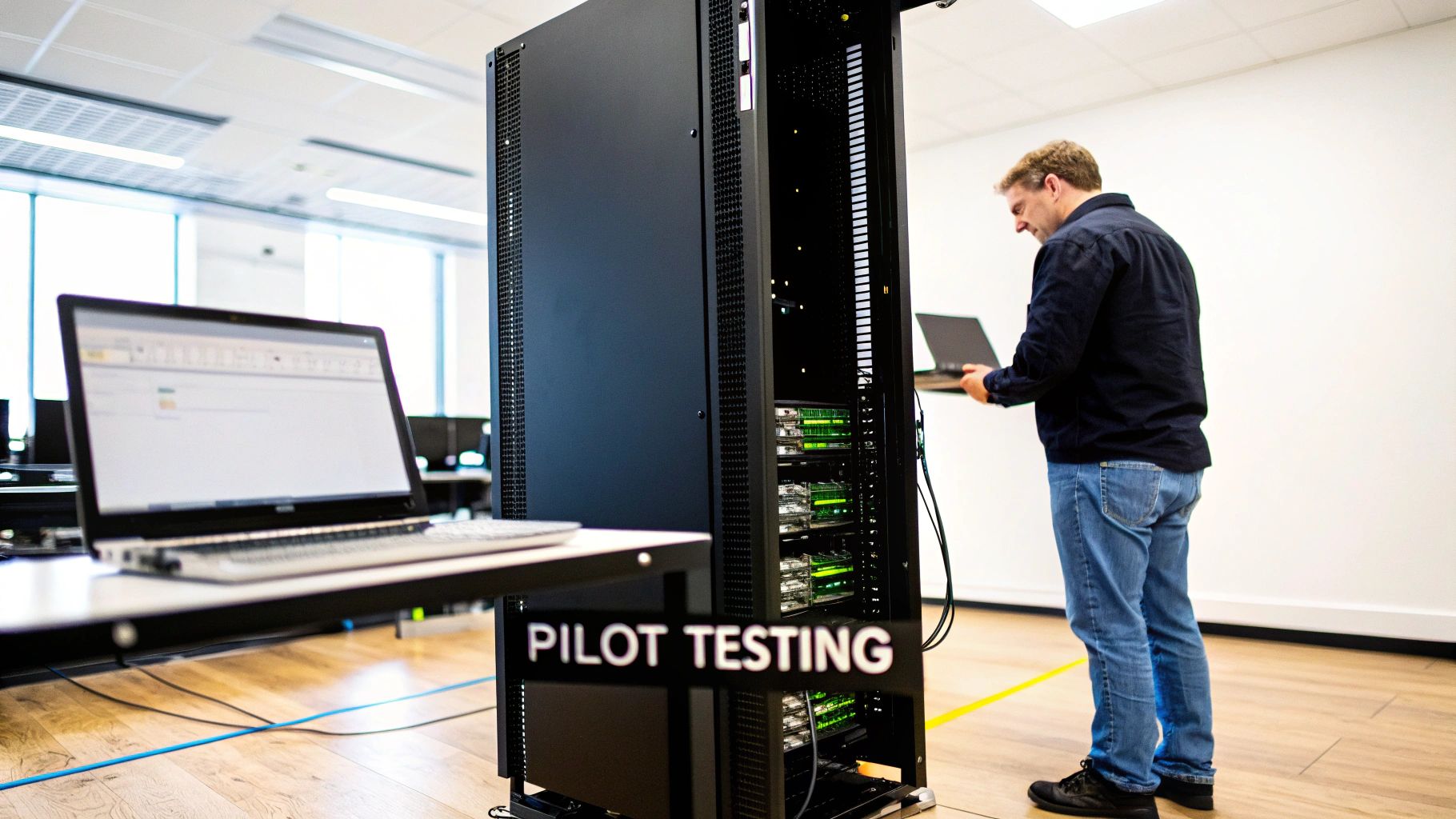
This strategy allows teams to learn and adapt with each phase, turning the migration into an iterative, predictable process rather than a single, high-stakes event. For example, a financial services firm might first migrate non-customer-facing development and testing environments to a new cloud platform. This pilot phase validates the network connectivity, security protocols, and migration tools without putting sensitive customer data or trading systems at risk. Similarly, a healthcare system can pilot a new electronic health record (EHR) system with a single outpatient clinic before rolling it out to the entire hospital, ensuring clinical workflows are not disrupted.
Key Insight: A phased migration with pilot testing transforms the project from a leap of faith into a series of calculated steps, enabling you to build momentum and confidence while containing the blast radius of any potential failures.
How to Implement a Phased Migration
To execute this strategy successfully, organize the migration into logical, self-contained phases.
- Select a Representative Pilot: Choose an application or system for the pilot phase that is representative of your broader environment but not mission-critical. This ensures the lessons learned are relevant to more complex systems down the line.
- Establish Clear Success Criteria: Before starting any phase, define specific Key Performance Indicators (KPIs) for success, such as application response time, data integrity checks, and user acceptance.
- Document and Iterate: Treat each phase as a learning opportunity. Meticulously document any issues encountered, the resolutions applied, and any process improvements. Apply these lessons to refine the plan for the subsequent, more critical phases.
- Build in Buffer Time: Schedule buffer time between each migration phase. This provides a necessary window to address unexpected issues, conduct thorough validation, and ensure the team is fully prepared before proceeding to the next wave.
4. Robust Change Management and Communication Plan
A data center migration is as much a people project as it is a technology project. A robust change management and communication plan is the framework that ensures organizational alignment, manages stakeholder expectations, and minimizes resistance. This plan goes beyond simple status updates; it’s a strategic effort to guide every affected team, from IT operations to application owners and end-users, through the transition. This approach is one of the most vital data center migration best practices because it directly mitigates human-centric risks, which can be just as disruptive as technical failures.

The core objective is to ensure everyone understands their role, the project's progress, and the rationale behind key decisions. For example, large enterprise migrations often establish a physical or virtual command center with representatives from all stakeholder teams to facilitate real-time decision-making during critical cutover windows. Similarly, cloud providers like Google Cloud often assign dedicated migration managers who facilitate weekly status meetings and maintain constant communication, ensuring alignment between the client and the technical teams. Without this structured communication, teams operate in silos, leading to misunderstandings, missed dependencies, and costly delays.
Key Insight: Proactive and transparent communication transforms stakeholders from passive observers into active participants, fostering a collaborative environment that is essential for overcoming unforeseen challenges.
How to Implement a Robust Communication Plan
To build an effective change management and communication strategy, focus on clarity, consistency, and accessibility.
- Establish a Migration Command Center: Create a central hub, or "war room," with representatives from all key functions (networking, security, applications, business units) to serve as the single source of truth during the migration.
- Develop a Communication Matrix: Define who needs to be informed, about what, how often, and through which channel. This includes creating templated messages for different audiences, from executive summaries to detailed technical updates.
- Define Clear Escalation Paths: Document and communicate a clear process for escalating issues. When a problem arises, teams should know exactly who to contact and what the response protocol is, preventing chaotic troubleshooting.
- Maintain an Accessible Knowledge Base: Use a shared platform like a wiki or SharePoint site to host all project documentation, including FAQs, decision logs, and status reports. This ensures everyone has access to the latest information.
5. Network Architecture Redesign and Optimization
A data center migration offers a rare and powerful opportunity to modernize the foundational network that underpins your entire IT operation. Instead of a simple "lift-and-shift," treating the migration as a chance to redesign the network architecture transforms a logistical necessity into a strategic upgrade. This approach involves a critical evaluation of the current network's limitations and implementing a modern design that boosts performance, resilience, and security. It is one of the most impactful data center migration best practices because it addresses legacy bottlenecks and future-proofs the infrastructure for cloud-native applications and increased data volumes.
The primary goal is to build a network that is more agile, secure, and scalable than the one being left behind. For example, a global enterprise can use its migration to deploy a software-defined wide area network (SD-WAN), optimizing connectivity between the new data center and multiple cloud environments. Similarly, a financial institution can implement microsegmentation to isolate workloads and meet stringent PCI-DSS compliance requirements, a task much simpler to achieve in a greenfield network environment than by retrofitting a legacy one. This strategic redesign ensures the new data center can support next-generation technologies from day one.
Key Insight: Viewing the migration as a network refresh rather than just a physical move allows you to eliminate technical debt and build an infrastructure aligned with future business goals, not past constraints.
How to Implement Network Redesign and Optimization
A successful network transformation requires a methodical and forward-looking approach.
- Conduct a Baseline Analysis: Before designing the new network, thoroughly analyze the performance, traffic patterns, and bottlenecks of your current architecture to inform design decisions.
- Embrace Zero-Trust Principles: Use the migration as a catalyst to implement a zero-trust security model, where access is never trusted by default and must be explicitly verified, dramatically improving your security posture.
- Test Extensively in a Lab: Build a proof-of-concept of the new network architecture in a lab environment. Rigorously test failover scenarios, performance, and application compatibility before any production cutover.
- Plan for a Transition Period: Design a migration plan that allows for dual-network operation during the transition. This provides a rollback path and minimizes disruption by allowing for a phased cutover of services.
6. Comprehensive Performance Testing and Validation
A migration is not successful until the new environment performs as well as or better than the old one. This is why comprehensive performance testing and validation is a non-negotiable step. This phase involves rigorous testing of applications, infrastructure, and workflows in the target environment before the final cutover. It goes far beyond simple connectivity checks; it’s about simulating real-world operational stress to ensure systems can handle peak demand without degradation. This rigorous validation is one of the most vital data center migration best practices as it directly prevents post-migration performance issues that can cripple business operations and damage user trust.
The core objective is to validate that business-critical applications meet or exceed established performance baselines under realistic load conditions. For example, an e-commerce platform must run "Black Friday" simulation tests to guarantee its new infrastructure can handle massive, sudden traffic spikes. Similarly, a financial trading firm must conduct microsecond-level latency testing to ensure that trade execution speeds are not compromised. Without this validation, a company risks launching a new environment that is slower, less stable, and incapable of supporting its core business functions, leading to immediate revenue loss and frustrated customers.
Key Insight: Proactive and aggressive performance testing transforms the go-live event from a high-risk gamble into a well-rehearsed, predictable outcome, ensuring business continuity and user satisfaction.
How to Implement Comprehensive Testing and Validation
A structured testing approach is essential for identifying and resolving performance bottlenecks before they impact end-users.
- Establish Pre-Migration Baselines: Before the migration begins, thoroughly benchmark the performance of critical applications in the current production environment. This data serves as the objective measure of success.
- Create Realistic Test Scripts: Develop test scripts that mirror actual user transaction patterns and business workflows. Generic tests often miss application-specific performance issues.
- Test Under Peak Load and Beyond: Use load testing tools to simulate peak user traffic, and then push the system an additional 30-40% beyond that to understand its breaking point and capacity limits.
- Validate Failover and Resiliency: Intentionally trigger failures in the new environment to test redundant systems, failover processes, and disaster recovery capabilities. This confirms that the new setup is as resilient as promised.
7. Compliance Verification and Audit Readiness
Ensuring regulatory compliance cannot be an afterthought; it must be a core component of the migration strategy from the very beginning. This best practice involves implementing a comprehensive verification program to confirm that the new data center environment meets all security controls, data residency laws, and industry-specific regulations like HIPAA, PCI-DSS, or GDPR. This proactive approach is one of the most vital data center migration best practices because failing to address compliance early can lead to severe penalties, failed audits, and the need for costly post-migration remediation that could have been avoided.
The objective is to build audit readiness directly into the migration process, not just validate it at the end. For instance, a financial institution migrating its payment processing systems must meticulously map and verify PCI-DSS controls at each phase of the project to prevent compliance gaps. Similarly, a government agency moving to a new facility must validate FedRAMP controls to ensure the new environment is authorized to operate. This involves creating a clear audit trail that documents every compliance-related decision and validation step, providing undeniable proof of due diligence.
Key Insight: Treating compliance as a parallel workstream, rather than a final checkbox, ensures the migrated environment is secure, compliant, and audit-ready from day one, protecting the organization from significant regulatory and financial risk.
How to Implement Compliance Verification
To integrate compliance seamlessly into your migration, adopt a structured and well-documented approach.
- Map Controls to Requirements: Create a compliance matrix that explicitly maps every regulatory requirement (e.g., HIPAA Security Rule, GDPR data residency) to the specific technical and administrative controls being implemented in the new environment.
- Integrate Compliance into Go/No-Go Criteria: Make successful compliance testing a mandatory gate for proceeding with each migration wave. This prevents non-compliant systems from ever going live.
- Maintain a Comprehensive Audit Trail: Document all compliance verification activities, including test results, configuration changes, and sign-offs from legal and compliance teams. This documentation is critical for future audits.
- Verify Compliant Data Destruction: Ensure that as legacy systems are decommissioned, all data is destroyed in accordance with regulations. Obtaining a certificate of destruction for hard drives provides essential evidence for your audit trail.
8. Vendor Selection and Relationship Management
No data center migration is a solo effort; it’s a complex orchestration requiring specialized expertise that often lies outside an organization's core competencies. This is where strategic vendor selection and diligent relationship management become paramount. This best practice involves carefully vetting, selecting, and managing third-party partners who will handle critical aspects of the migration, from cloud infrastructure and implementation services to the final decommissioning of old assets. Effective vendor management is one of the most crucial data center migration best practices as it directly impacts project timelines, budget adherence, security, and the overall success of the initiative.
The primary goal is to build a high-performing ecosystem of trusted partners. For example, a global enterprise migrating to a hybrid cloud model must rigorously evaluate AWS, Azure, and Google Cloud not just on price but also on their security certifications, compliance capabilities, and long-term roadmap. Similarly, a healthcare system must select a HIPAA-certified implementation partner like Deloitte or Accenture to manage the migration of its electronic health record (EHR) systems, ensuring patient data is protected. This careful selection process ensures that each component of the migration is handled by experts, mitigating risk and freeing up internal teams to focus on business-critical functions.
Key Insight: Strong vendor partnerships are not just transactional; they are strategic alliances. Clearly defined SLAs, transparent communication channels, and shared goals are the foundation of a successful collaboration.
How to Implement Effective Vendor Management
A structured approach to vendor selection and management is essential for a smooth migration.
- Develop a Detailed Request for Proposal (RFP): Create a comprehensive RFP that clearly outlines your technical requirements, security and compliance needs, project scope, and success criteria. This forces vendors to provide specific, comparable responses.
- Conduct Thorough Due Diligence: Go beyond the sales pitch. Request references from organizations of a similar size and industry, conduct reference checks, and evaluate each vendor's financial stability and relevant certifications (e.g., SOC 2, ISO 27001).
- Negotiate Robust Service Level Agreements (SLAs): Define clear, measurable SLAs with specific uptime guarantees, performance metrics, and penalty clauses for non-performance. Also, establish clear escalation procedures with committed response times.
- Partner with Certified ITAD Providers: For assets being retired, it's vital to choose the right partner. Engaging with reputable IT asset disposition companies ensures that data is destroyed compliantly and hardware is recycled or disposed of responsibly.
9. Disaster Recovery and Business Continuity Planning
A data center migration is the perfect opportunity to re-evaluate and enhance your organization's resilience. Integrating disaster recovery (DR) and business continuity (BC) planning into the migration process is a critical best practice that transforms a necessary relocation into a strategic improvement. This involves creating robust plans aligned with the new infrastructure, ensuring that your organization can withstand and quickly recover from unexpected disruptions. This is one of the most vital data center migration best practices because it directly addresses business risk, protecting revenue, reputation, and customer trust by building a more fault-tolerant operational environment from the ground up.
The core objective is to define and implement recovery strategies that meet or exceed business requirements in the new environment. For example, a financial institution might use the migration to establish multi-region active-active failover for its trading systems, reducing recovery time from hours to mere seconds. Similarly, a healthcare provider can implement redundant EHR systems across geographically diverse data centers to guarantee patient data availability during a regional outage. This proactive approach ensures that business continuity is not an afterthought but a foundational component of the new IT landscape.
Key Insight: Treat the migration as a "greenfield" opportunity to architect a superior disaster recovery solution, rather than simply lifting and shifting outdated and often ineffective legacy plans.
How to Implement Disaster Recovery and Business Continuity Planning
To build a resilient post-migration environment, a structured approach is essential.
- Define RTO and RPO: Conduct a fresh business impact analysis to define modern Recovery Time Objectives (RTO) and Recovery Point Objectives (RPO) for each critical application in its new home.
- Automate Failover Processes: Implement automated failover and failback procedures wherever possible to minimize human error and reduce recovery times during a high-stress event.
- Conduct Regular Drills: Schedule and execute regular DR tests, such as quarterly full-system failover exercises, to validate procedures and ensure the entire team is prepared.
- Test Diverse Scenarios: Don't just test for a full site failure. Validate your plans against various scenarios, including application-level corruption, network isolation, and ransomware attacks, to identify specific weaknesses in your recovery strategy.
10. Post-Migration Monitoring, Optimization, and Knowledge Transfer
The completion of the physical move is not the end of the project; it is the beginning of a new operational state. A critical data center migration best practice is to immediately implement a robust post-migration monitoring, optimization, and knowledge transfer plan. This phase ensures the new environment performs as expected, identifies opportunities for improvement, and equips your operations teams with the knowledge to manage it effectively. Treating the migration cutover as a finish line often leads to performance degradation, cost overruns, and operational instability.
The primary goal is to validate the success of the migration and transition into a state of continuous improvement. This involves deploying application performance monitoring (APM) tools like Datadog or New Relic to establish new performance baselines and proactively detect issues. For example, a financial services firm might conduct monthly cost reviews and optimization sessions after moving to a cloud environment to ensure they are leveraging the most cost-effective instance types. This proactive management transforms the post-migration period from a reactive firefighting mode into a strategic optimization cycle, solidifying the project's long-term value and ROI.
Key Insight: The post-migration phase is where the projected benefits of the move are either realized or lost. Continuous monitoring and optimization are essential for achieving the desired cost savings, performance gains, and operational efficiencies.
How to Implement Post-Migration Excellence
A structured approach ensures a smooth transition and captures maximum value from your new infrastructure.
- Deploy APM Tools at Cutover: Install and configure monitoring tools immediately upon cutover to begin collecting baseline performance data. This allows you to quickly identify any post-migration performance anomalies compared to pre-migration benchmarks.
- Conduct Regular Optimization Reviews: Schedule monthly or quarterly meetings with infrastructure, application, and finance teams to review performance metrics and cost reports. Use these sessions to identify and implement optimization opportunities.
- Document and Transfer Knowledge: Within 30 days of migration, document all lessons learned, create comprehensive runbooks for the new environment, and hold knowledge transfer sessions with the permanent operations team.
- Finalize Asset Disposition: Ensure all decommissioned assets are accounted for and processed correctly. A comprehensive server decommissioning checklist can help guarantee that no steps are missed, from data destruction to final asset recycling or resale.
Comparison of 10 Data Center Migration Best Practices
| Practice | 🔄 Implementation Complexity | ⚡ Resource / Time Requirements | 📊 Expected Outcomes | 💡 Ideal Use Cases | ⭐ Key Advantages |
|---|---|---|---|---|---|
| Comprehensive Planning and Assessment Phase | High — cross-team inventory, dependency mapping | Significant — senior IT, discovery tools, time | Clear migration plan, risk reduction, accurate budgeting | Large enterprises, regulated environments, multi-site moves | Reduces surprises; ensures compliance visibility; budgeting accuracy ⭐⭐⭐⭐ |
| Secure Data Destruction and Sanitization Protocol | Medium-High — policy + certified processes | Moderate — certified vendors, specialized tools | Eliminates data breach risk; auditable destruction records | Healthcare, finance, government, hardware retirement | Certified chain-of-custody; legal protection; reputational safety ⭐⭐⭐⭐⭐ |
| Phased Migration Strategy with Pilot Testing | Medium — wave planning, rollback procedures | High — parallel systems, testing resources | Minimized downtime; early issue detection; iterative validation | Large workloads, complex apps, staged rollouts | Risk reduction; staff training; staged ROI realization ⭐⭐⭐⭐ |
| Robust Change Management and Communication Plan | Medium — stakeholder mapping, CABs, comms cadence | Moderate — communications, leadership time | Improved adoption; fewer incidents; clearer roles | Distributed teams, organizations with many stakeholders | Aligns teams; reduces resistance; faster escalation resolution ⭐⭐⭐⭐ |
| Network Architecture Redesign and Optimization | High — topology redesign, SDN, segmentation | High — new infrastructure, specialist expertise | Improved performance, security, scalability | Cloud-native apps, high-performance or multi-cloud environments | Performance gains; stronger security posture; automation potential ⭐⭐⭐⭐ |
| Comprehensive Performance Testing and Validation | Medium-High — test design, environment parity | High — test environments, tools, specialist time | Prevents regressions; validates SLAs and failover | Latency-sensitive systems, peak-load scenarios | Ensures performance; identifies bottlenecks before cutover ⭐⭐⭐⭐ |
| Compliance Verification and Audit Readiness | High — regulatory mapping, control validation | Moderate-High — compliance staff, evidence collection | Audit-ready environment; reduced regulatory risk | Regulated industries, cross-border data migrations | Avoids fines; provides documented evidence; continuous compliance ⭐⭐⭐⭐⭐ |
| Vendor Selection and Relationship Management | Medium — RFPs, SLA negotiation, due diligence | Moderate — procurement, legal, vendor audits | Reliable partner ecosystem; clear accountability | Multi-vendor projects, outsourced migrations | Access to expertise; contractual protections; vendor accountability ⭐⭐⭐⭐ |
| Disaster Recovery and Business Continuity Planning | Medium-High — RTO/RPO design, failover planning | High — DR infrastructure, replication, testing | Improved resilience; shorter recovery times | Mission-critical systems, compliance-driven orgs | Faster recovery; validated runbooks; reduced downtime risk ⭐⭐⭐⭐ |
| Post-Migration Monitoring, Optimization, and Knowledge Transfer | Medium — monitoring, tuning, documentation | Ongoing — APM tools, ops resources | Continuous improvement; cost optimization; stabilized ops | Organizations seeking long-term efficiency and cost control | Ongoing optimization; institutional knowledge capture; cost savings over time ⭐⭐⭐⭐ |
From Blueprint to Reality: Partnering for a Secure Migration Outcome
Executing a data center migration is far more than a logistical exercise of moving hardware from point A to point B. It is a strategic transformation that, when done correctly, repositions an organization's entire technology foundation for future growth, agility, and security. The journey from initial blueprint to a fully operational new environment is intricate, demanding meticulous planning, unwavering attention to detail, and a deep understanding of the interconnected dependencies within your IT ecosystem. Following the data center migration best practices outlined in this guide transforms what could be a high-risk venture into a powerful business enabler.
The common thread weaving through every successful migration is a proactive, holistic approach. It’s not just about the move itself, but about the comprehensive lifecycle of the project. This includes everything from the initial discovery and assessment phase, where you build your foundational understanding, to the final post-migration optimization, where you fine-tune performance and capture long-term value. Each practice, from phased rollouts with pilot testing to robust change management, acts as a critical building block, reinforcing the overall stability and success of the project.
The Last Mile: Securing Your Legacy Assets
A critical, yet often dangerously overlooked, phase of any data center migration is the final chapter: the secure and compliant decommissioning of retired assets. The migration project is not truly complete until the old environment is fully dismantled, all sensitive data has been irretrievably destroyed, and every piece of hardware has been accounted for and processed in an environmentally responsible manner. Failing at this final hurdle can undermine the entire project, exposing the organization to significant data breach risks, regulatory penalties, and reputational damage.
This is where the concept of partnership becomes paramount. The specialized expertise required for certified IT Asset Disposition (ITAD) is often beyond the scope of internal IT teams who are focused on bringing the new environment online. A certified ITAD partner provides the necessary rigor and auditable processes to ensure this final step is executed flawlessly.
Key Takeaway: The success of your data center migration isn't just measured by the uptime of your new facility. It is also measured by the verifiable security and compliance of how you retired the old one. This final step is non-negotiable for protecting your organization's data and reputation.
Actionable Next Steps for a Successful Migration
As you move forward, focus on translating these best practices into a tangible action plan. The most important takeaway is that success is not accidental; it is the direct result of a structured, disciplined, and well-communicated strategy.
- Revisit Your Plan: Use the ten best practices as a checklist to audit your current migration plan. Identify any gaps in your strategy, particularly around risk mitigation, performance validation, and secure asset disposition.
- Prioritize Communication: Solidify your change management and communication plan. Ensure all stakeholders, from the C-suite to the end-users, understand the timeline, the "why" behind the move, and what to expect.
- Engage Experts Early: Do not wait until the end of the project to consider your ITAD strategy. Engaging a certified partner like Dallas Fortworth Computer Recycling early in the planning process ensures that secure data destruction, logistics, and compliance requirements are integrated into your project from the start, not treated as an afterthought.
Ultimately, a meticulously planned and executed data center migration is a landmark achievement. It represents a significant investment in your organization's future, enabling innovation and providing a scalable platform for years to come. By embracing these data center migration best practices, you are not just moving servers; you are building a more resilient, secure, and efficient technological future for your business.
Ensure your migration's final phase is as secure as its first by partnering with a certified expert. Dallas Fortworth Computer Recycling provides auditable, compliant, and secure IT asset disposition services, guaranteeing your legacy data is destroyed and your old hardware is handled responsibly. Visit Dallas Fortworth Computer Recycling to learn how they can provide the peace of mind that completes your successful migration project.