
A Guide to Ewaste Recycling Centers for Modern IT Leaders
When your company retires old technology, where does it go? An e-waste recycling center is more than just a destination for old equipment—it’s a specialized facility designed to securely manage the disposal, data destruction, and recycling of corporate IT assets.
Think of them as high-security vaults for your end-of-life electronics, ensuring every byte of sensitive data is permanently destroyed and valuable materials are recovered in a fully compliant, environmentally sound way.
What Are E-Waste Recycling Centers and Why They Matter
Picture your company’s server room, but in reverse. Instead of deploying new technology, e-waste recycling centers are built to strategically and securely dismantle it. Their job goes far beyond simple junk hauling; they are the final, critical step in the IT asset lifecycle, shielding your organization from potentially massive financial, legal, and reputational damage.
Every server, laptop, and hard drive your business retires is a potential liability. If you don't handle them correctly, these devices can become ticking time bombs of confidential corporate data or hazardous environmental waste. This is exactly why a professional recycling partner is no longer a luxury—it’s a necessity.
The Escalating Risk of Improper Disposal
The sheer volume of electronic waste is staggering. The world generated 62 million tonnes of e-waste in 2022 alone, a shocking 82% increase from 2010. What's worse is that only 22.3% of it was properly collected and recycled, leaving a staggering US$62 billion in recoverable materials on the table. As this mountain of old tech grows, so does the risk for any business that fails to manage its retired equipment properly.
Without a certified partner, your old assets could easily end up in a landfill, exposing your brand to negative press and steep environmental fines. Or, they could fall into the wrong hands, leading to a data breach with crippling financial and legal consequences.
For IT leaders, the conversation has shifted. E-waste management is no longer a footnote in an operations manual; it is a core component of modern risk management, data security, and corporate social responsibility.
Turning Liability into an Opportunity
A certified e-waste recycling center transforms this potential liability into a structured, secure, and documented process. They provide an unbroken and defensible chain of custody, tracking an asset from the moment it leaves your facility to its final destruction or recycling. This meticulous paper trail isn't just nice to have; it's non-negotiable for proving compliance with regulations like HIPAA or GDPR.
Working with a specialist gives you several key advantages:
- Data Security: They guarantee complete, certified destruction of all data on retired hard drives and media, protecting you from breaches.
- Regulatory Compliance: You get all the documentation needed to prove you’ve met your legal and environmental obligations.
- Value Recovery: They can identify assets with remaining life that can be refurbished and resold, often turning a disposal cost into a revenue stream.
- Environmental Stewardship: You have peace of mind knowing that hazardous materials are handled safely and valuable resources are put back into the supply chain.
By choosing the right partner, you're doing more than just getting rid of old hardware. You’re reinforcing your security posture, upholding your company's commitment to sustainability, and protecting your bottom line. To see how this works with different types of devices, you can learn more about the specifics of responsible IT equipment recycling.
The Core Services Your Business Needs to Understand
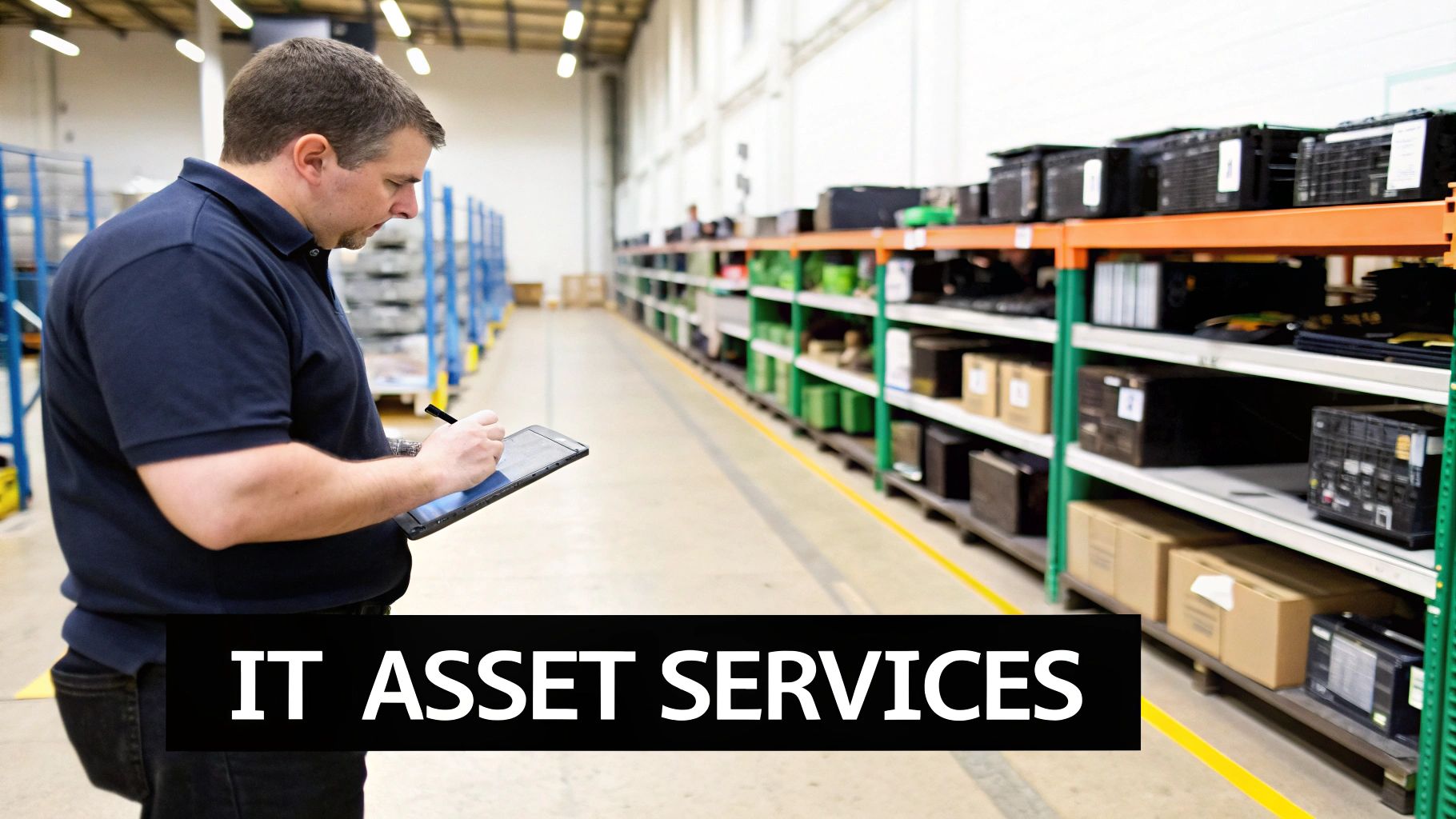
When you partner with a professional e-waste recycling center, you’re doing much more than just hiring a disposal company. You're bringing in a specialist to manage risk, recover value, and protect your business. Understanding their core functions helps you see just how critical a role they play in your overall IT strategy.
Let's break down the three main services that form the backbone of any reputable electronics recycling partner. These services are all about protecting your company, ensuring you stay compliant, and even finding hidden value in equipment you thought was worthless.
IT Asset Disposition (ITAD)
IT Asset Disposition, or ITAD, is the official term for a smart, strategic approach to managing old IT hardware. Think of it as the profitable, secure alternative to just tossing out old equipment. The whole point of ITAD is to get the maximum financial return from your used assets while guaranteeing data security and environmental compliance every step of the way.
It’s not just about recycling; it’s about recovering value. When your retired laptops, servers, or networking gear get to an ITAD facility, they're first sorted and audited. Any devices that still have market value are professionally wiped, refurbished, and then resold through established channels.
ITAD transforms the end of an asset’s life from a disposal cost into a revenue-generating opportunity. A skilled partner can often recover enough value from resold equipment to offset or even eliminate the costs associated with recycling and data destruction.
This approach gives technology a second life, which is a huge part of building a more sustainable, circular economy. For any IT leader, a solid ITAD program is a clear win—it shows you’re being financially savvy and environmentally responsible at the same time.
Certified Data Destruction
In this day and age, the data on your retired devices is far more valuable—and dangerous—than the hardware itself. Certified data destruction is the one service you can't skip. It’s your absolute guarantee that sensitive corporate, customer, and employee information is gone for good, with no chance of recovery.
This isn’t something you can do by simply hitting "delete." Professional ewaste recycling centers use methods that meet strict standards set by organizations like the National Institute of Standards and Technology (NIST).
A few common methods include:
- Physical Shredding: This is the gold standard. Hard drives and other media are fed into industrial shredders that chew them up into tiny metal fragments. It's the most secure method because you can literally see the proof.
- Cryptographic Erasure: For newer drives, this process erases the media's encryption key. Without the key, the encrypted data on the drive is rendered permanently unreadable.
- Degaussing: A powerful magnetic field is used to scramble the magnetic signature on traditional hard disk drives (HDDs), completely destroying the data.
Once the job is done, you'll get a Certificate of Data Destruction. This isn't just a piece of paper; it's a critical legal document that provides a serialized, auditable trail for every single device that was destroyed. It’s your proof of due diligence, protecting your organization from liability down the road. You can learn more about how to securely shred and recycle your devices to stay compliant.
Data Center Decommissioning
Data center decommissioning is a massive, project-based service for companies making big infrastructure changes, like moving to the cloud, consolidating facilities, or doing a complete hardware refresh. It's a whole different ballgame from getting rid of a few dozen laptops.
Think of it as a meticulously planned operation for your IT infrastructure. A full-service decommissioning partner handles the entire process, including:
- Project Management: A dedicated team plans and coordinates all the logistics to make sure there's minimal disruption to your daily operations.
- On-Site Services: Technicians come to your facility to safely de-install servers from racks, manage the mess of cabling, and securely pack everything for transport.
- Secure Logistics: All equipment travels in sealed, GPS-tracked vehicles, maintaining a secure chain of custody from your door to theirs.
- On-Site Data Destruction: For ultimate peace of mind, many partners offer mobile shredding services. You can actually watch your hard drives get destroyed before they even leave your property.
This end-to-end service is absolutely essential for any business retiring a large volume of high-value or data-heavy equipment. It ensures a complex, high-risk project gets done securely, efficiently, and with all the documentation you need to prove it.
Navigating Certifications and Regulatory Compliance
Choosing an e-waste partner without checking their certifications is a lot like hiring a new sysadmin without a background check. You're handing them the keys to your kingdom and just hoping for the best. Certifications aren't just fancy logos for a website; they are hard-earned, independently audited guarantees that a recycler’s processes meet strict standards for data security, environmental safety, and legal compliance.
These standards create a baseline of trust in an industry where the stakes are sky-high. As an IT leader, understanding these certifications is your single best tool for managing risk. They give you a clear framework for vetting partners, ensuring the facility you choose operates ethically and securely from the moment your assets leave your building. Flying blind is simply not an option when a data breach or environmental fine is on the line.
The Gold Standards of E-waste Recycling
When you start looking at ewaste recycling centers, you'll see a lot of acronyms. While there are many out there, three really matter when you're looking for a trustworthy, high-quality partner. The best recyclers often hold more than one, as each focuses on a slightly different piece of the puzzle.
R2 (Responsible Recycling): Think of R2 as the comprehensive operational playbook for a recycler. It covers everything from worker health and safety to data security and the responsible management of the entire downstream recycling chain. An R2 certification gives you peace of mind that your partner has a secure, documented process for tracking your assets and destroying your data. You can learn more about what it takes to become an R2 Certified electronics recycler and why it should be non-negotiable for your business.
e-Stewards: This standard was created by the Basel Action Network, an environmental watchdog group, and it's widely considered the toughest certification from an environmental standpoint. Its main principle is a flat-out ban on exporting hazardous e-waste to developing nations, where it’s often processed in unsafe conditions. Choosing an e-Stewards certified recycler is a powerful statement that aligns with strong corporate social responsibility and ESG goals.
ISO (International Organization for Standardization): While not exclusive to e-waste, ISO certifications are a huge indicator of a well-run business. ISO 14001 is the standard for environmental management, proving a company is actively working to reduce its environmental impact. ISO 45001 covers occupational health and safety, ensuring a safe workplace for employees. A partner with ISO certifications has a mature, process-driven operation you can count on.
To make it easier to see how these stack up, here’s a quick comparison:
Comparing Top Ewaste Recycling Certifications
This table is a quick-reference guide to help you understand what each major certification guarantees for your organization.
| Certification | Primary Focus | Key Guarantee for Your Business |
|---|---|---|
| R2 (Responsible Recycling) | Comprehensive operational standards for data security, environmental management, and worker safety throughout the entire recycling chain. | Your assets are tracked and your data is securely destroyed according to a documented, auditable process. |
| e-Stewards | Strict environmental protection, with a zero-tolerance policy against exporting hazardous e-waste to developing countries. | Your brand is protected from association with unethical and environmentally damaging disposal practices. |
| ISO (14001 & 45001) | Process-driven management systems for environmental impact (14001) and occupational health and safety (45001). | You're partnering with a mature, professional organization committed to operational excellence and safety. |
Having a partner with these certifications isn't just about finding a good vendor; it's about building a defensible compliance strategy.
Connecting Certifications to Real-World Compliance
These certifications are your direct line to satisfying complex legal and regulatory demands. In today’s business climate, compliance isn't optional, and the right partner acts as your shield.
A certified recycler doesn’t just get rid of your old equipment. They provide an auditable, defensible paper trail that proves your organization acted with due diligence, protecting you from fines and legal action in the event of an audit or incident.
This is especially critical when dealing with industry-specific rules. For example:
- Healthcare (HIPAA): A hospital retiring old computers must prove all patient data (ePHI) was completely destroyed. A certified recycler provides a serialized Certificate of Data Destruction that stands up to HIPAA audits.
- Finance (GLBA): A bank has to protect sensitive customer financial data under the Gramm-Leach-Bliley Act. Certified data destruction processes ensure you meet these requirements without fail.
On top of federal rules, a wave of state-level regulations is coming. Europe, with its WEEE Directive, has long led the way, achieving a formal e-waste collection rate of 42.8%. The US, in contrast, generates 6.92 Mt of e-waste annually but recycles just 15% of it. This massive gap is prompting more and more states to pass their own laws, making certified partners essential for navigating this evolving legal patchwork. Find out more about these global e-waste statistics and trends.
Working with a certified recycler ensures your organization stays ahead of these requirements, turning a compliance headache into a genuine business advantage.
Understanding Logistics and Cost Structures
The operational side of e-waste management is a complex dance of security, tracking, and financial calculation. For any IT decision-maker, understanding how certified e-waste recycling centers handle the journey of your assets—and how they figure out the costs and value—is key to minimizing risk and maximizing your return.
Think of the logistics process as a sealed, armored transport for your technology. From the moment a pallet of servers leaves your loading dock, every single step has to be secure, transparent, and meticulously documented to maintain an unbroken chain of custody. This isn’t just about moving boxes; it's about protecting your organization's most sensitive information until it's gone for good.
The Journey of an Asset: A Secure Chain of Custody
A secure chain of custody is the absolute backbone of any reliable ITAD process. It’s a chronological paper trail that documents the control, transfer, and disposition of your assets, giving you an auditable record that will stand up to any scrutiny. A certified partner ensures this chain is never, ever broken.
The process typically unfolds in a few key stages:
- Secure Pickup and Transport: It all starts with a scheduled pickup by trained, background-checked technicians. Your assets are inventoried on-site, serialized, and loaded into locked, GPS-tracked vehicles, ensuring they are monitored from your door straight to the recycling facility.
- Secured Receiving and Auditing: Once at the facility, the shipment's seals are broken in a secure, monitored area. Each asset is checked against the initial inventory, and its serial number is scanned into a tracking system. This step confirms that everything that left your site has arrived safely.
- Processing and Final Disposition: From there, assets are triaged. Items ticketed for resale undergo data sanitization and refurbishment, while end-of-life devices are sent for responsible recycling and commodity recovery. Every step is logged.
- Issuing Final Documentation: Once all processes are complete, you receive legally binding documentation. This includes a serialized inventory list, a Certificate of Data Destruction, and a Certificate of Recycling, officially closing the loop on the chain of custody.
The image below breaks down the simple but crucial steps for ensuring compliance from start to finish.
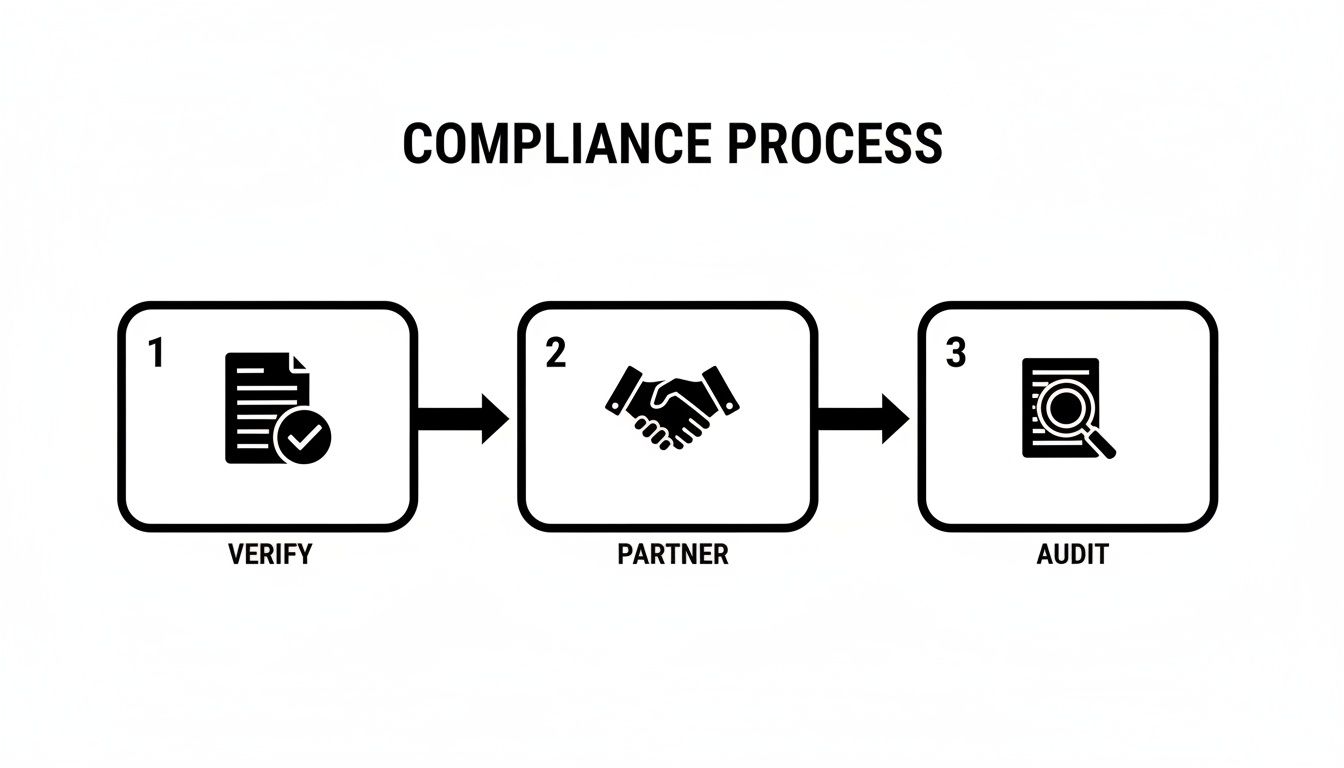
This process really drives home that compliance is built on verification, partnership, and ongoing auditing—the core tenets of a secure logistics framework. For large-scale projects, understanding the specialized handling required is paramount. You might be interested in our detailed guide on the data center decommissioning process.
Breaking Down the Financial Models
How do e-waste recycling centers actually determine their costs? It's a fair question, and the answer depends entirely on the makeup of your retired assets. The financial model is a balance between the costs of processing the equipment and the potential revenue from remarketing it. A transparent partner will give you a detailed breakdown so you know exactly where you stand.
A few key factors will influence your costs or potential revenue:
- Asset Type and Condition: Newer assets like servers, laptops, and networking gear often have significant resale value, which can offset—or even exceed—recycling costs.
- Data Destruction Requirements: The method of data destruction can affect the price tag. For example, on-site shredding might cost more than in-facility shredding but offers maximum peace of mind.
- Recycling Costs: Older or obsolete items, like CRT monitors or broken printers, have no resale value and contain hazardous materials that are expensive to process safely. These will always come with a recycling fee.
- Logistics: The location, volume, and accessibility of your equipment will influence transportation costs.
The ultimate goal is to transform what could be a significant cost center into a value-generating part of your IT strategy. A top-tier partner can often create a positive return by skillfully remarketing your viable assets.
At the end of the day, a detailed settlement report will show a transparent accounting of the value recovered from resold equipment minus the costs for logistics and recycling. This kind of clarity is the hallmark of a true ITAD partner.
How To Choose The Right Ewaste Recycling Partner
Picking a partner to handle your retired IT assets is one of the most important decisions an IT leader can make. This isn't just about hauling away old equipment; it's about trusting a vendor with your company's data, its reputation, and its legal standing. The right partner is a shield. The wrong one can open the door to catastrophic risk.
Making the right call means looking past the glossy brochures and asking the tough questions that separate a true security partner from a simple scrap hauler. You need to vet their processes, security, and compliance with the same intensity you'd apply to any other critical vendor.
Building Your Vendor Vetting Checklist
To properly evaluate ewaste recycling centers, you need a repeatable, systematic approach. A solid checklist lets you compare vendors apples-to-apples, ensuring no critical detail gets missed. The questions you ask should cut straight to their core operations, forcing them to show you their capabilities, not just tell you about them.
Zero in on the areas that carry the most risk for your organization: data security, chain of custody, and downstream accountability. A top-tier partner won't just welcome these questions—they'll have clear, documented answers ready to go.
Any hesitation or inability from a vendor to provide detailed, verifiable proof of their processes is a massive red flag. Real professionals are proud of their security and compliance frameworks and are eager to show them off.
Your vetting process is all about gathering evidence. This means asking for sample reports, understanding their security protocols, and verifying that their certifications are current and valid.
Critical Questions Every IT Leader Should Ask
Before you sign anything, you need a set of pointed questions designed to reveal the true quality of a potential partner. For a more comprehensive list, check out our guide on selecting from the top IT asset disposition companies.
Here are the essentials to get you started:
Can you provide a complete, serialized, and auditable chain-of-custody report? This is non-negotiable. You need an unbroken, documented trail for every single asset from your door to its final disposition.
What are your specific procedures for auditing downstream vendors? Your liability doesn't stop when your assets leave their building. A responsible partner must prove they rigorously vet every single company that handles your materials downstream.
What data destruction methods do you offer, and do they meet NIST 800-88 standards? Get specifics on shredding, degaussing, and cryptographic erasure. They must provide a serialized Certificate of Data Destruction as proof.
Are your employees who handle our assets background-checked and properly trained? People are often the weakest link in the security chain. You need to know their team is trustworthy and professional.
To help you organize your vetting process, we've put together a simple checklist with the essential questions to ask any potential partner.
Vendor Vetting Checklist
| Category | Essential Question | Why It Matters |
|---|---|---|
| Data Security | Can you provide a serialized Certificate of Data Destruction compliant with NIST 800-88? | This is your legal and auditable proof that sensitive data was permanently destroyed. Without it, you're exposed. |
| Chain of Custody | What does your serialized, asset-level tracking report look like? Can we see a sample? | A complete, unbroken chain of custody is your defense against asset loss, theft, and compliance violations. |
| Downstream Vetting | How do you audit and verify the compliance of your downstream recycling partners? | Your environmental and data liability extends to where your e-waste ultimately ends up. You need proof of responsible recycling. |
| Certifications | Are you R2v3 or e-Stewards certified? Can you provide your certificate number for verification? | These certifications are the industry gold standard, proving a vendor adheres to strict environmental and security protocols. |
| Logistics & Security | What security measures are in place during transport and at your facility? | Assets are vulnerable in transit. Look for GPS-tracked trucks, sealed pallets, and secure, monitored facilities. |
Using a structured checklist like this ensures you're making a decision based on facts and capabilities, not just a sales pitch.
What To Look For During A Facility Tour
While asking questions is crucial, nothing tells the whole story like an in-person visit. A facility tour is your chance to see if their promises match reality. It gives you a gut feeling about their professionalism and security posture that you can't get from a phone call.
Pay close attention to the environment. A secure, well-organized facility is a strong sign of a process-driven operation. On the other hand, a chaotic or unsecured site suggests a lack of discipline that could put your assets—and your company—at risk.
Here’s a quick checklist for your on-site evaluation:
Physical Security Measures: Look for controlled access points, 24/7 video surveillance, and secure, segregated areas for receiving, auditing, and destroying assets. Is the facility clean and organized?
Process Observation: Ask to see their receiving and inventory process in action. How do they track assets from the moment they arrive? Is every device scanned and logged meticulously?
Destruction Equipment: Take a look at their shredders and other data destruction equipment. Does it look well-maintained and capable of handling the media you use, like SSDs versus traditional hard drives?
Employee Protocols: Watch the staff. Are they following clear security procedures? Does the environment feel professional and buttoned-up?
Choosing the right e-waste recycling partner is a strategic decision that directly impacts your organization's security, compliance, and sustainability goals. By using this framework, you can move beyond simple cost comparisons and select a partner that truly has your back.
Common Questions About Ewaste Recycling Centers
Even for experienced IT leaders, the details of electronics recycling can bring up some serious questions. With data security, environmental compliance, and your budget on the line, getting straight answers is the only way to make a smart decision and protect your company from risk.
This section covers the most common questions we hear from IT and procurement professionals, giving you the clarity needed to handle your end-of-life IT assets with confidence.
What Happens to Our Equipment After It Leaves Our Facility?
This is always the first and most important question, because it cuts right to the heart of the chain of custody. Once your assets are securely picked up and transported to a certified facility, they go through a careful triage process. Think of it as an expert evaluation to find the best possible outcome for every single device.
First, anything with reuse potential—like newer laptops, servers, or networking gear—is tested and has its data wiped clean to NIST 800-88 standards. These devices are then refurbished and prepped for resale on secondary markets, which is the key to getting the most value back from your old equipment.
At the same time, devices that are truly at the end of their life are ticketed for de-manufacturing. They’re methodically broken down into clean commodities like steel, aluminum, copper, and plastics. Throughout this entire journey, a strict, serialized audit trail is kept, so you have a complete record of where every asset ended up.
The ultimate outcome is documented proof. You receive a serialized Certificate of Data Destruction and a Certificate of Recycling, which provide a legally defensible audit trail confirming that every device was handled securely and responsibly.
This transparent process means nothing is left to chance, giving you full visibility and peace of mind.
How Can We Be Sure Our Sensitive Data Is Completely Destroyed?
Data security is non-negotiable, and just hitting "delete" or formatting a drive is not enough. Reputable ewaste recycling centers guarantee total data destruction using certified, military-grade methods that meet tough standards like NIST 800-88.
There are two primary methods you can count on:
- Physical Shredding: This is the most final form of destruction. Hard drives, SSDs, and other storage media are fed into industrial shredders that grind them into tiny, unrecoverable pieces.
- Cryptographic Erasure: For modern, encrypted drives, this software-based method erases the drive's encryption key. Without the key, the data is permanently locked away and impossible to access.
The proof is in the paperwork. You’ll get a serialized certificate that lists every single hard drive or storage device by its unique serial number, confirming it was destroyed according to certified standards. For companies that need the highest level of assurance, many partners also offer on-site shredding, letting you watch your media get destroyed before it even leaves your building.
Is Electronics Recycling Expensive or Can We Make Money From It?
Honestly, it can be both. The final cost—or payout—all comes down to the mix of equipment you’re getting rid of. It’s a balancing act between the value you can get back from newer gear and the cost to process older, worthless items. This is where a strategic IT Asset Disposition (ITAD) program makes all the difference.
Here’s a simple breakdown of how the finances work:
- Revenue Generation: Newer or in-demand equipment like servers, enterprise networking gear, and recent-model laptops often have real resale value. A good ITAD partner can find buyers for these assets, and the revenue can offset or even exceed the project costs, putting money back in your budget.
- Disposal Costs: On the flip side, old items like CRT monitors, broken printers, or obsolete accessories have no resale value. They contain hazardous materials (like lead and mercury) that cost money to handle and process safely and legally. These items will always have a recycling fee.
A transparent partner will give you a detailed settlement report when the job is done. This statement clearly lists the value recovered from resold assets against the costs for logistics, data destruction, and recycling, so you see the complete financial picture.
What Is the Real Difference Between R2 and E-Stewards Certification?
Both R2 (Responsible Recycling) and e-Stewards are the top-tier, third-party audited certifications in the electronics recycling industry. They both aim to ensure safe and responsible practices, but they come at it from slightly different angles.
Think of R2 as a comprehensive, market-friendly standard. It sets a wide range of rules for data security, environmental protection, worker safety, and how downstream recycling partners are vetted. It’s the most common certification you’ll find in North America.
E-Stewards, which was started by the environmental group Basel Action Network, is known for being stricter on one key point: it has a zero-tolerance ban on exporting any hazardous electronic waste to developing countries. This makes it a popular choice for organizations with very strong ESG (Environmental, Social, and Governance) goals.
Your choice often boils down to your company’s specific risk tolerance and corporate responsibility policies. However, most leading ewaste recycling centers hold both certifications to meet the needs of all their clients.
At Dallas Fortworth Computer Recycling, we provide nationwide, certified ITAD and electronics recycling services designed to protect your data, ensure compliance, and maximize value recovery. Learn more about our secure and responsible solutions for your business.