
Vetting ITAD Vendors with Third Party Audits
Your storage room is full of retired laptops, failed SSDs, network gear pulled from a refresh, and a few servers that still hold regulated data somewhere in old snapshots and logs. Procurement already found an ITAD vendor. Sales says they're certified. Their website shows badges. Operations wants the room cleared this month.
That's usually the moment risk gets underestimated.
In practice, most IT leaders don't get burned because they ignored disposal altogether. They get burned because they accepted evidence that looked official without asking whether it proved anything. A vendor can be certified and still leave gaps in scope, chain of custody, downstream handling, or data destruction verification. When that happens, the audit report doesn't protect you. It becomes one more document in the incident file.
The Hidden Risk in Your Retired IT Assets
The failure pattern is familiar. An IT director approves pickup of end-of-life assets after reviewing a vendor packet that includes a few certificates, a generic statement about secure destruction, and a reassuring promise that everything is handled according to industry standards. Months later, legal asks for proof that a specific batch of devices was tracked from pickup through destruction or resale. The vendor can produce a summary certificate, but not a clean record trail tied to serial numbers, custody transfers, and final disposition.
That's where “certified” stops being a comfort word.
Retired assets create a strange blind spot in otherwise mature security programs. Teams lock down identity systems, monitor endpoints, and segment production networks, then hand the last stage of the asset lifecycle to an outside party with lighter scrutiny than they'd apply to a cloud provider. If you're comparing IT asset disposition companies, that's the core mistake to avoid. You aren't buying hauling. You're transferring custody of equipment that may still contain sensitive data, licensed software, configuration history, and regulated records.
Why the vendor boundary matters
The larger problem is broader than ITAD. In 2024, 30% of breaches involved a third-party vendor, and that was twice as much as the previous year, according to Recorded Future's analysis of the Verizon DBIR. That should change how you read every vendor claim, especially in disposal and recycling, where assets physically leave your control.
A third-party issue in ITAD doesn't always start with dramatic misconduct. Sometimes it starts with ordinary sloppiness:
- Loose intake controls that break the handoff record between your dock and the processor
- Incomplete serial capture that makes later verification impossible
- Unclear downstream routing for assets that aren't shredded immediately
- Certificates without operational detail that satisfy procurement but not an auditor, regulator, or insurer
The dangerous assumption is that a logo on a website equals verified control performance.
The practical risk isn't just a breach. It's being unable to prove what happened to a device after it left your possession. In ITAD, that proof matters as much as the destruction itself.
What Are Third-Party Audits and Why Do They Matter
A useful way to explain third party audits is to compare them to a home inspection. The seller can tell you the roof is sound. You can walk through the house yourself. But an independent inspector checks what is there, documents the condition, and identifies issues you might miss.
That's the role of an audit in vendor risk.

The three ways vendors get assessed
Not every assessment carries the same weight.
| Assessment type | Who performs it | Main weakness |
|---|---|---|
| First-party | The vendor assesses itself | Self-interest shapes the result |
| Second-party | You assess the vendor | Scope and technical depth vary by customer |
| Third-party | An external auditor evaluates the vendor | Quality depends on independence and scope |
A self-assessment can still be useful. So can a customer questionnaire. But neither should be mistaken for independent validation. If a vendor says its controls are strong, ask what evidence supports that claim beyond internal policy statements and marketing language.
For ITAD, this matters because the details are operational. You need more than “we destroy drives securely.” You need to know whether a third-party auditor examined custody records, interviewed staff, tested process execution, and checked whether the documented workflow matches what happens on the floor.
Independence is the point
The most important attribute in third party audits is independence. A University of Chicago analysis found that when auditors were structurally independent, false reporting of pollution compliance dropped by 80%, with auditors 23 percentage points less likely to falsely report compliance. The baseline problem in that study was severe. For particulate matter, auditors reported only 7% of plants as violating the standard when the true violation rate was 59%, and the reform also led plants to reduce pollution by 0.21 standard deviations on average, as described in the University of Chicago analysis of truth-telling in third-party audits.
That research wasn't about ITAD. The lesson still applies directly. If the audit structure rewards smooth approvals instead of uncomfortable findings, you'll get cleaner paperwork, not better oversight.
Practical rule: Treat auditor independence as a control requirement, not an administrative detail.
A strong audit should help you answer concrete questions. Was the scope broad enough? Did the auditor inspect the relevant facilities? Were exceptions documented? Did the report test actual performance or just review policies? If you need destruction evidence for drives, hard drive certificate of destruction practices only matter when they're backed by process controls that an outside reviewer has examined.
Key Audit Standards for IT Asset Disposition
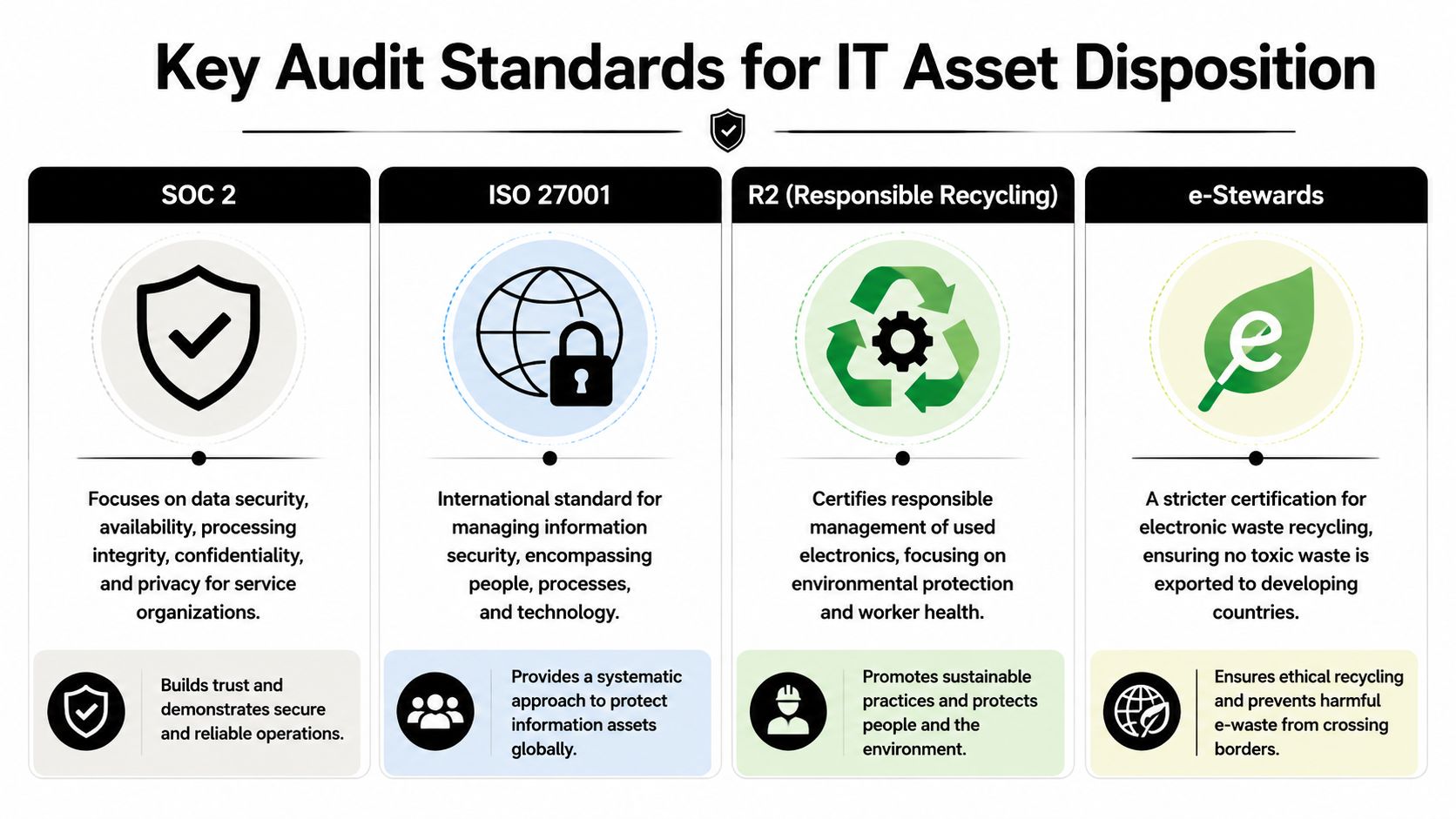
ITAD vendors often present a stack of certifications as if each badge answers the same question. They don't. Some standards focus on information security management. Others focus on service controls over time. Others are centered on recycling practices, environmental handling, and downstream accountability.
If you don't separate those functions, you can approve a vendor with an impressive compliance page and still miss the risk that matters most to your organization.
What each standard is good for
Here's the practical way to read the common ITAD standards.
| Standard | Best used to evaluate | What it won't tell you by itself |
|---|---|---|
| SOC 2 | Whether service controls related to security and handling are designed and operating over time | Environmental downstream practices |
| ISO 27001 | Whether the vendor has a formal information security management system | Asset-by-asset destruction proof |
| R2 | Whether electronics are handled through a structured responsible recycling framework | Full security posture outside the certified scope |
| e-Stewards | Whether the recycler follows stricter electronics recycling and downstream handling expectations | Whether all internal security controls are effective in practice |
SOC 2 and ISO 27001 answer different questions
A lot of IT teams lump these together as “security certs.” That's too shallow.
SOC 2 is useful when you want to understand whether controls are operating in a service environment. For an ITAD provider, that may help you examine how data-bearing assets are received, tracked, processed, restricted, and documented over time. It can help surface whether the control environment is active or merely documented.
ISO 27001 is different. It focuses on the management system behind information security. That makes it valuable for judging whether the vendor has governance, risk treatment, policy control, access discipline, and continuous management attention. It tells you the vendor has built an information security structure. It does not replace transaction-level evidence for individual assets.
R2 and e-Stewards focus on downstream consequences
For ITAD, data security is only half the issue. The other half is where equipment goes after pickup.
R2 is often the standard buyers use to assess whether used electronics are managed responsibly, with attention to environmental protection and worker health. It matters if your organization needs confidence that reusable equipment, components, and scrap streams are handled under a defined process.
e-Stewards is often read as a stricter environmental and downstream handling signal. If your concern includes export risk, toxic material handling, and final recycling integrity, this is one of the labels buyers often examine closely.
A vendor's certification stack should map to your risks. Security controls, data destruction evidence, and downstream material handling are related, but they are not the same control.
That's why mature teams maintain a crosswalk. They identify which standard covers which exposure, then ask where the uncovered areas are. A vendor with good discipline around certification maintenance is generally easier to assess because the evidence set is organized instead of scattered across departments.
How to Evaluate Your ITAD Vendor's Compliance Claims
A certificate is a starting point. It isn't proof that your exact services, locations, and asset flows were examined. Many reviews fail at this stage. The team confirms that a vendor “has SOC 2” or “is R2 certified” and never asks what the report covered, when it was issued, whether there were exceptions, or whether the audited environment matches the work you're outsourcing.
That's how paper compliance slips through.
What to request before you approve the vendor
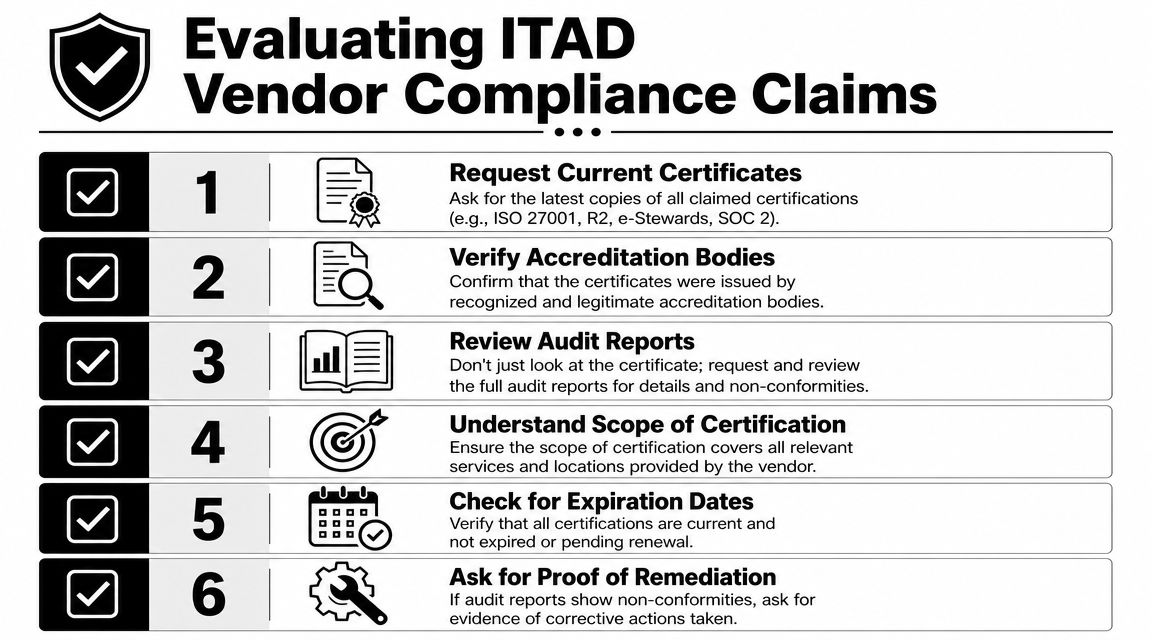
Start with documents, but don't stop at the certificate itself.
- Current certificates. Ask for the latest versions of every certification and report the vendor claims.
- Defined scope. Confirm the audited scope covers the exact facilities, services, and business units that will handle your assets.
- Full reports where available. A summary page tells you very little. You need the opinion, scope, testing notes, and findings.
- Corrective action evidence. If there were nonconformities or observations, ask how they were remediated and what proof exists.
- Downstream controls. For material that isn't refurbished for direct return or immediately destroyed, ask how downstream processors are managed and evidenced.
The strongest vendors answer these requests without defensiveness. Weak vendors redirect you to marketing pages or insist that “we've never had an issue” should settle the question.
How to tell whether the audit itself is trustworthy
Stanford's analysis of third-party audits for AI makes a point that applies well beyond AI. A passed audit can be misleading. Its value depends on the design of the audit, specifically the auditor's independence, access to data and systems, clear standards, and public reporting, as discussed in Stanford's analysis of outsider oversight.
That gives you a better review framework than badge collecting.
Ask questions like these:
- Who selected the auditor, and how independent was that arrangement?
- What systems, records, facilities, and staff did the auditor have access to?
- Was the standard applied narrowly or across the service lifecycle?
- Were findings disclosed clearly, or was the output limited to a pass signal?
- Did the audit test operations, or mainly validate policy existence?
If the vendor can't explain how its audit was scoped and executed, you shouldn't assume the audit reduced your risk.
For ITAD specifically, dig into the certification that speaks most directly to recycling operations. If a provider emphasizes R2 certified electronics recycling, verify what parts of intake, data-bearing material handling, reuse decisions, and downstream transfer are within that certified boundary.
Verifying Audit Reports and Chain of Custody
Reading an audit report well is a practical skill. You're not trying to become an auditor. You're trying to determine whether the documents in front of you support the vendor's promises and your internal control requirements.
That means reading for gaps, not just for reassuring language.
What strong evidence looks like
A rigorous third-party audit is test-based. Auditors may use documentation review, interviews, technical assessments, and sometimes on-site work or limited scanning by agreement to verify whether controls operate as claimed, as outlined in ThreatNG Security's explanation of third-party audits.
For ITAD, that should translate into evidence you can follow.
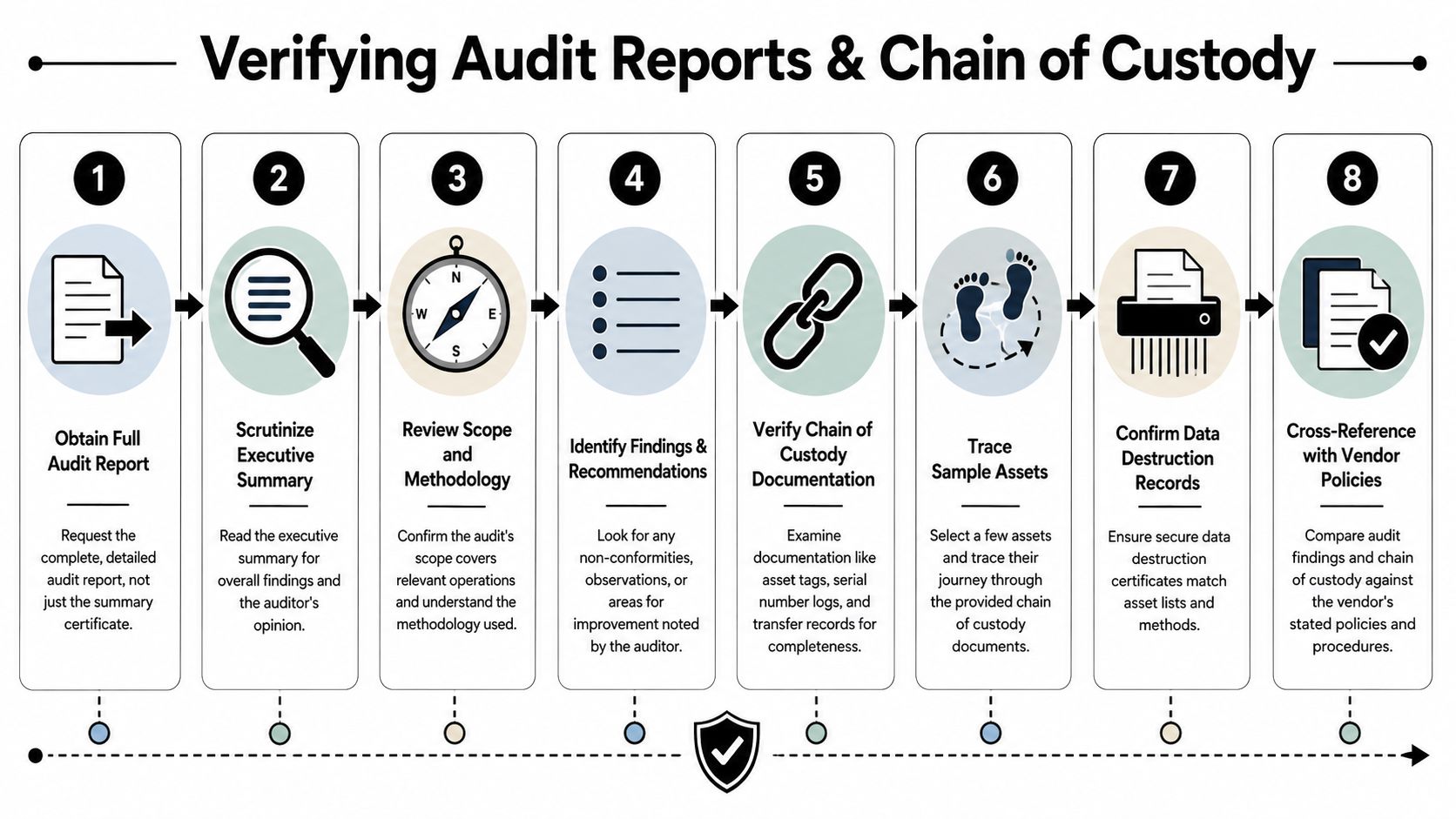
Look for these elements:
- Named scope that clearly identifies the facility or service environment
- Methodology detail showing the auditor did more than review a policy binder
- Findings section that includes exceptions, observations, or areas needing correction
- Date alignment so the report period matches the services you're relying on
- Operational records that support pickup, receipt, processing, destruction, and downstream transfer
How to test chain of custody instead of trusting it
The fastest way to cut through vague claims is to trace sample assets. Take a few serial numbers from your shipment and ask the vendor to walk you through the full record set.
A useful review sequence looks like this:
- Start with your outbound list. Confirm the serial numbers, asset tags, and quantities from your side.
- Match the pickup event. Review who took custody, when, and under what documented transfer.
- Check intake records. Confirm the vendor logged those same assets upon receipt.
- Verify processing status. Determine whether the devices were destroyed, sanitized, remarketed, or broken down for parts.
- Cross-check the destruction evidence. If destruction is claimed, the record should map back to the same assets and method used.
Ask for enough documentation that you can reconstruct the lifecycle of a single device without relying on verbal explanations.
This is where chain of custody documentation matters more than any broad assurance statement. If the paperwork can't support spot-tracing, your internal audit team, regulator, or privacy counsel won't treat the process as controlled.
How Dallas Fortworth Computer Recycling Delivers Auditable Compliance
A disposal project looks controlled until counsel asks for proof on a device that left your site six months ago. At that point, an audit report by itself does not solve the problem. You need records that show what happened, who handled the asset, and whether the vendor's controls covered the service you bought.
That is the standard Dallas Fortworth Computer Recycling should be held to, and it is the standard any serious ITAD provider should expect to meet.
The pressure on that evidence chain is increasing. Guidance for internal audit teams notes that the new IIA third-party topical requirement was issued in September 2025 and will become effective in September 2026. It pushes organizations to treat third-party oversight as a governed process rather than a one-time vendor screening exercise, including contract inventory, onboarding and offboarding controls, access removal, and performance monitoring, as discussed in M&N Advisors' review of the new third-party topical requirement.
For IT directors, the practical question is simple. Can the vendor produce evidence that stands up when procurement, privacy, security, and internal audit all ask different questions about the same shipment?
Why auditability matters more than badges
Certifications still matter. They signal that an outside party reviewed part of the operation. But a certificate can also create false comfort if the scope is narrow, the report period does not match your service dates, or the audited controls stop short of the handoff points that create the most risk.
That is why a trustworthy ITAD partner makes the evidence usable, not just available on request. Buyers should expect clear scope language, documented procedures, consistent service records, and support from staff who understand how those records map to customer audit and legal review requirements.
In practice, that separates a controlled operation from paper compliance.
What good looks like in practice
A vendor that delivers auditable compliance usually shows the same traits over time.
- Customer-facing evidence is organized and reviewable, rather than spread across sales, operations, and accounting.
- Service records tie back to the actual work performed, including pickup, intake, processing, destruction, and downstream disposition.
- Audit materials support customer due diligence instead of forcing each department to reconstruct the process from scratch.
- Staff can answer scope questions directly, including what was audited, what was excluded, and how exceptions are handled.
I look for one more sign. The vendor does not treat the audit report as the end of the conversation. A strong provider treats it as one piece of evidence inside a larger control set that customers can test.
That matters because retired assets create delayed risk. If Dallas Fortworth Computer Recycling can make the record trail easier to verify and defend, it is reducing your exposure. If it cannot, the audit language may look clean while the operational risk remains with your team.
Partnering for Peace of Mind
Third party audits matter because disposal risk is rarely visible until something goes wrong. By then, the equipment is gone, the vendor has changed hands internally, and your team is left proving decisions made months earlier. The difference between a manageable review and a painful escalation usually comes down to evidence quality.
The key discipline is simple. Don't ask only whether the vendor passed an audit. Ask whether the audit was independent, whether the scope matched the services you use, whether the findings were transparent, and whether chain-of-custody records can support asset-level verification. That's how you separate a credible control environment from paper compliance.
For IT directors, this is now core vendor governance. It sits beside access reviews, cloud due diligence, and incident response planning. Retired assets still carry business risk. They can expose data, licensing history, customer information, internal configurations, and regulatory obligations long after users stop touching them.
A strong ITAD program should give you three forms of confidence:
- Security confidence that data-bearing assets were handled under controlled processes
- Documentation confidence that you can prove custody and destruction with defensible records
- Downstream confidence that equipment and materials were managed responsibly after leaving your site
If your current vendor can't support that level of scrutiny, the problem isn't just incomplete paperwork. It's incomplete control.
If you're reviewing your ITAD process and need a partner that can support secure disposition, documented chain of custody, and audit-ready compliance evidence, contact Dallas Fortworth Computer Recycling. Their team works with organizations that need defensible data destruction, responsible electronics recycling, and a cleaner path through vendor due diligence.