
Arlington Electronic Waste Disposal Your Ultimate Guide
Facing a mountain of outdated tech in your office? For businesses in Arlington, getting rid of old electronics is a critical job that goes way beyond just calling a junk hauler. Properly managing old hardware is essential for protecting your data and staying on the right side of regulations, and Dallas Fortworth Computer Recycling offers a direct, professional solution.
Your Quick Guide To Arlington E-Waste Disposal
For any IT leader or business owner, that growing pile of old computers, servers, and monitors is more than just clutter—it's a liability. Simply throwing out this e-waste is like leaving your company's most sensitive files in an unlocked cabinet in a public park. It’s a huge risk for data breaches and expensive non-compliance fines.
A professional disposal strategy isn't just "nice to have"; it's a core part of modern risk management. Every single retired device, from a laptop to a server, can hold a wealth of confidential information. This might be customer data, financial records, or your own trade secrets that could cause devastating financial and reputational damage if they fell into the wrong hands.
The Problem With DIY Disposal
It’s tempting for organizations to try and handle e-waste internally or use general waste services, but these shortcuts are full of holes. Just deleting files or reformatting hard drives doesn't permanently erase data. On top of that, state and federal laws have strict rules for how electronic waste must be handled, and ignoring them can lead to serious legal trouble.
The real challenge for any Arlington business is turning a complex legal and security headache into a smooth, secure process. This is where a dedicated IT Asset Disposition (ITAD) partner becomes so valuable, giving you peace of mind and the auditable proof of compliance you need.
To make the right choice, it's important to understand the key factors involved.
Key Considerations For Business E-Waste Disposal
This table breaks down the most important aspects of a professional e-waste program.
| Factor | Why It Matters | Best Practice |
|---|---|---|
| Data Security | Your biggest risk. A single data breach can cost millions and destroy your reputation. | Use a vendor that provides certified data destruction, including wiping, degaussing, or physical shredding. |
| Regulatory Compliance | Federal (EPA) and state laws dictate how e-waste must be managed to prevent environmental harm. | Partner with a recycler who understands laws like RCRA and provides documentation for your records. |
| Chain of Custody | You need to know where your assets are at all times, from pickup to final destruction. | Insist on serialized tracking and a documented chain of custody from a professional logistics team. |
| Environmental Impact | Electronics contain hazardous materials that can pollute landfills and groundwater. | Choose a recycler committed to R2 or e-Stewards standards who prioritizes reuse and responsible materials recovery. |
Considering these points helps ensure you're not just getting rid of old equipment, but truly protecting your business from every angle.
Finding A Reliable Solution
The key is to partner with a specialist who gets the end-to-end requirements of corporate e-waste management. A qualified vendor should provide a seamless experience covering every critical step. You can learn more about compliant Arlington technology recycling and see exactly how a professional service operates.
This process should always include:
- Secure Logistics: Professional, documented pickup and transport of your assets.
- Certified Data Destruction: Verifiable methods that meet or exceed government and industry standards.
- Responsible Recycling: Environmentally sound processing of all materials, preventing landfill dumping.
- Complete Documentation: Certificates of Destruction and serialized reports for your compliance and audit records.
By working with a partner like Dallas Fortworth Computer Recycling, Arlington businesses can turn a daunting task into a manageable and secure operation. We are the local, end-to-end partner built to solve this exact problem, ensuring your organization stays protected, compliant, and focused on what it does best.
Why Standard Recycling Is Not Enough For Your Business
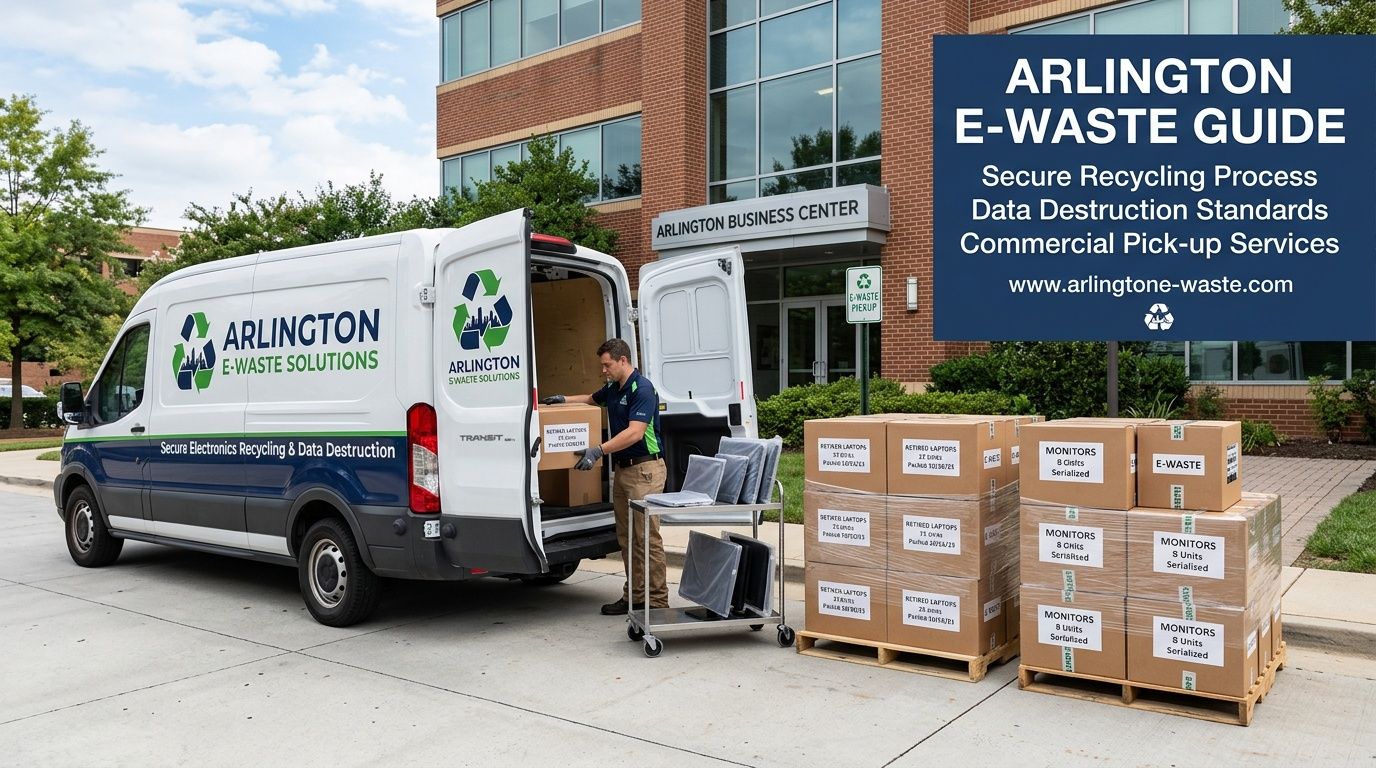
When your company is ready for a technology refresh, it's easy to see a community e-waste drop-off event in Arlington and think it’s a simple solution. But for a business, there's a massive gap between residential recycling programs and the secure, documented process your organization actually needs.
Those community drives are built for household electronics, not business assets. Using them for your company’s retired hardware is like using a personal email account for sensitive corporate files—the tools are simply not designed for the necessary level of security, liability protection, and legal proof.
The Hidden Risks Of Inadequate Disposal
Choosing the wrong disposal method opens your organization to serious, often underestimated risks. The biggest danger is data security. Your old computers, servers, and hard drives are filled with sensitive information—customer data, intellectual property, financial records, and employee details.
Without certified data destruction, this information can be easily recovered, leading to data breaches. The consequences go beyond fines; they include significant reputational damage and a loss of customer trust that can be incredibly difficult to win back.
Beyond data security, there are major legal and environmental liabilities. Many industries are governed by strict data privacy laws that dictate how you must handle asset disposal.
- HIPAA (Health Insurance Portability and Accountability Act): Requires healthcare organizations to ensure all patient health information is completely unrecoverable.
- FACTA (Fair and Accurate Credit Transactions Act): Mandates that any business handling consumer credit information must properly destroy it before disposal.
- GLBA (Gramm-Leach-Bliley Act): Imposes strict requirements on financial institutions for protecting consumer financial data.
Failing to comply can lead to crippling fines and legal battles. Improper disposal can also result in environmental penalties if your electronics end up in a landfill, leaking hazardous materials like lead and mercury. You can learn more about these consequences in our guide on the environmental impact of electronic waste.
The Problem With Patchwork Programs
The regulatory landscape for e-waste is inconsistent. Without a single federal law mandating electronics recycling, areas like Arlington rely on a patchwork of local programs. These often come with logistical problems, such as limits on the number of items you can drop off, which is completely impractical for businesses managing bulk IT assets.
This gap is exactly why B2B specialists who understand commercial compliance and security are so essential.
For an Arlington business, relying on residential services is not a viable risk management strategy. A professional IT Asset Disposition (ITAD) partner isn't just a convenient choice; it's a fundamental requirement for protecting your data, ensuring compliance, and safeguarding your brand.
This is precisely why a dedicated partner like Dallas Fortworth Computer Recycling exists. We provide the certified data destruction, auditable chain-of-custody, and regulatory compliance that standard programs lack. Since 2012, we have focused exclusively on serving the complex needs of data centers, healthcare providers, and government clients who cannot afford to take chances.
Working with a professional partner transforms e-waste from a liability into a managed, secure, and documented part of your technology lifecycle.
Securing Your Data: The Most Critical Step in Compliant Disposal
When it comes to Arlington electronic waste disposal, the top priority isn’t the recycling itself—it’s the permanent, verifiable destruction of the sensitive data living on every device you retire. Simply hitting ‘delete’ or reformatting a hard drive isn't enough. It’s like tearing a page out of a book and leaving it in the trash; the information is still there for anyone determined enough to find it.
For any business, the data on retired assets represents a significant liability. We’re talking about customer records, financial reports, employee files, and proprietary secrets. A single data breach from an improperly disposed computer can lead to staggering fines, legal battles, and a permanent loss of the trust you've worked so hard to build.
This is why secure data destruction isn't just a best practice; it's the non-negotiable foundation of any compliant IT asset disposal plan. It’s the only way to ensure your company’s information is gone for good, protecting you from risk long after the equipment has left your building.
Digital Erasure That Meets Government Standards
One of the most common methods for data destruction is software-based wiping. This is far more advanced than a simple 'delete' command. We use specialized software to overwrite the entire hard drive with random data, a process that is often repeated multiple times. This makes the original information completely unrecoverable.
To be effective, this process must adhere to strict government and military standards.
- NIST 800-88: The National Institute of Standards and Technology provides the gold standard for media sanitization. Its framework details methods for clearing, purging, and destroying data based on the sensitivity of the information.
- DoD 5220.22-M: This Department of Defense standard specifies a three-pass overwriting method that has long been a trusted benchmark for securely wiping sensitive data.
Partnering with a vendor who can certify their process to these standards is your first line of defense in data security.
A vendor's ability to provide proof is just as important as the destruction itself. This is why a formal Certificate of Data Destruction is essential—it’s your auditable evidence that you have fulfilled your legal and ethical obligations to protect sensitive information.
This document serves as your official record, proving that your data was handled and destroyed according to established security protocols.
When Physical Destruction Is the Only Answer
While software wiping is highly effective, some situations demand a more final solution: physical destruction. This is the only way to be 100% certain that data can never be recovered. It's the right choice for drives that are damaged, non-functional, or contained your most highly classified information.
We use two primary methods for physical destruction:
- Degaussing: This process uses an incredibly powerful magnetic field to instantly scramble the magnetic coating on a hard drive's platters, permanently erasing all data and rendering the drive completely useless.
- Shredding: Exactly as it sounds. Industrial-grade shredders grind hard drives, solid-state drives, and other media into small, unrecognizable fragments. This is the ultimate security measure, ensuring no part of the drive can ever be reassembled or read.
Physical destruction provides an undeniable and final end to the data-bearing asset, offering the highest level of assurance for businesses in Arlington concerned with risk. You can explore more about these techniques in our detailed guide on Arlington secure data destruction.
The Importance Of R2v3 Certification
How can you be sure a vendor's security claims are legitimate? The answer lies in third-party certifications. The R2v3 (Responsible Recycling) standard is the premier certification for the electronics recycling industry, and it places a heavy emphasis on data security.
An R2v3-certified recycler has undergone rigorous, independent audits to verify its data destruction processes, security protocols, and chain-of-custody procedures. This certification is your assurance that a vendor meets the highest industry benchmarks—not just for environmental practices, but for protecting your sensitive information from the moment it leaves your facility. When you work with an R2v3-certified partner, you're choosing a team whose security processes have been put to the test, giving you the confidence to manage your IT assets responsibly.
The E-Waste Disposal Process From Pickup To Final Report
It’s easy to think of e-waste disposal as just getting old equipment out of your office, but for Arlington businesses, it’s a detailed process built on security and accountability. A professional IT asset disposition (ITAD) plan isn’t an abstract compliance task; it’s a clear, manageable workflow that protects your organization from start to finish.
Let’s walk through exactly what that looks like. It all starts with a simple call or online request. Our team will work with you to understand the scale of your project, whether you're clearing out a few old workstations or decommissioning an entire data center. From there, we'll give you a straightforward proposal with no surprises. Once you give the green light, we schedule the pickup at a time that works for you, ensuring minimal disruption to your operations.
Step 1: On-Site Logistics and Secure Pickup
When our logistics team arrives at your Arlington facility, their first job is to handle your IT assets securely and efficiently. For larger projects, we palletize, shrink-wrap, and prepare everything for transport right on-site. This contains and protects your equipment before it even leaves your building.
From the moment we touch your assets, we establish a secure chain of custody. This is the critical paper trail that tracks every single piece of equipment from your door to our facility. Think of it as a registered mail receipt for your most sensitive hardware; it provides an unbroken line of accountability, confirming who has possession at every step. This is the foundation of a reliable Arlington electronic waste disposal service.
Step 2: Secure Transit and Facility Reception
With your equipment securely loaded into our locked, GPS-tracked vehicles, it’s transported directly to our controlled-access processing facility. As soon as it arrives, we verify the entire shipment against the initial pickup records. Each device is checked in, and every item containing data—from hard drives to servers—is immediately identified and segregated for secure data destruction.
This is where the detailed audit trail really takes shape. Our inventory system assigns a unique identifier to each asset, linking it directly to your organization. This serialized tracking is essential for the itemized reporting you’ll receive later on.
Step 3: Asset Processing and Data Destruction
Once inside our facility, all equipment is sorted. Items that have potential for reuse are tested and refurbished—the best outcome from an environmental standpoint. But before anything else happens, data security is our absolute priority.
Every single data-bearing device undergoes our certified data destruction process. We follow a strict workflow to ensure your information is permanently and irretrievably eliminated.
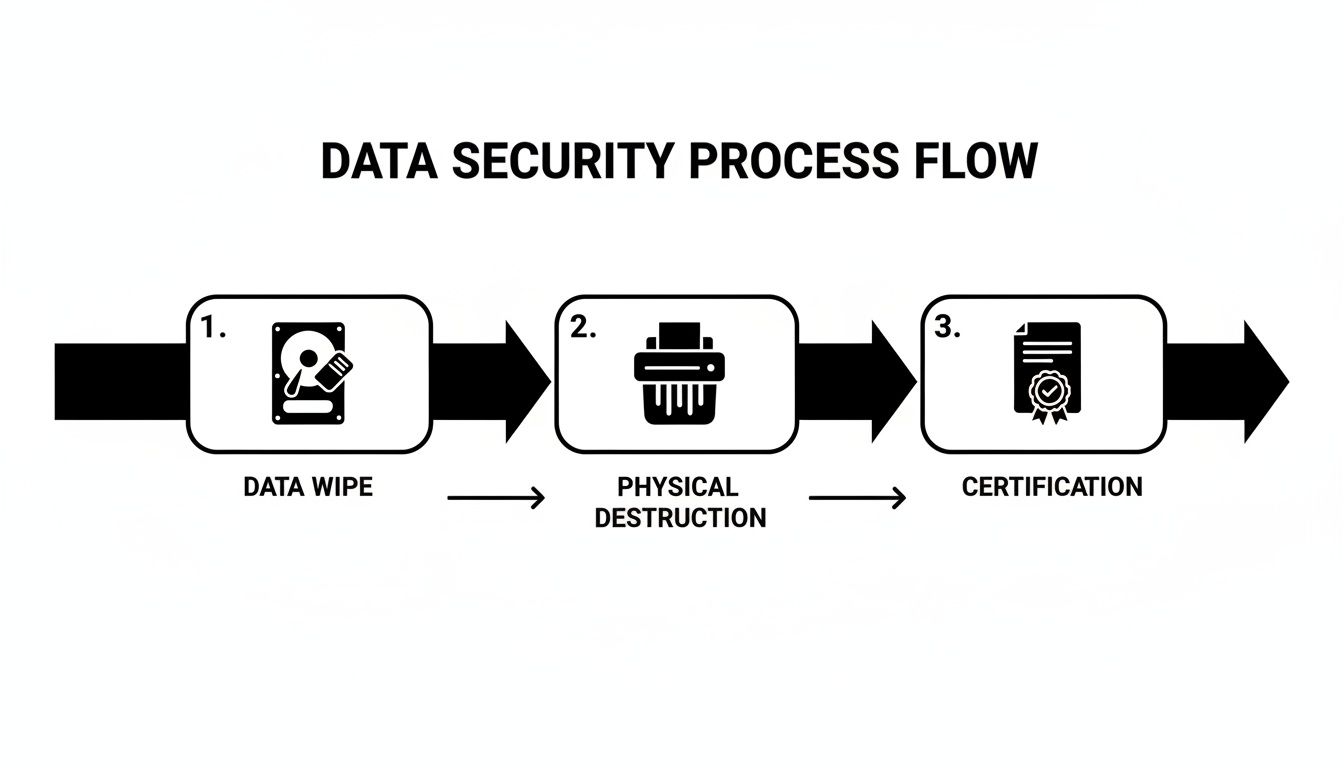
Whether through multi-pass software wiping or physical shredding, we make sure your data is gone for good before any asset moves to the final recycling stage. This is a non-negotiable step. The sheer volume of electronics being retired makes this rigor essential. For example, the Consumer Technology Association (CTA) reported that 700 million pounds of consumer electronics were recycled in the U.S. in a single recent year. For IT directors in Arlington, especially in government and healthcare, that number underscores why you need certified partners who provide the strict documentation you require.
Step 4: Responsible Recycling and Final Reporting
After data destruction is complete and certified, the real recycling begins. We de-manufacture the equipment, breaking it down into its core commodities like metals, plastics, and glass. These materials are then sent to our vetted downstream partners to be processed back into raw materials.
The final step is delivering your complete reporting package. This is your proof of compliant disposal.
This package provides the auditable documentation your organization needs and typically includes:
- A Certificate of Data Destruction: This document legally certifies that all data on your specified assets was destroyed according to NIST 800-88 and other industry standards.
- A Serialized Asset Report: An itemized list of every device we processed, including make, model, and serial number, all tied back to its final disposition (e.g., destroyed, recycled).
- A Certificate of Recycling: Confirms that your non-data-bearing assets were handled in an environmentally responsible manner, in full compliance with regulations.
This transparent process provides the peace of mind that comes from a fully auditable and secure solution. If you're ready to get started, you can get more details about an e-waste pickup in Arlington.
Handling Specialized And Restricted Electronic Waste
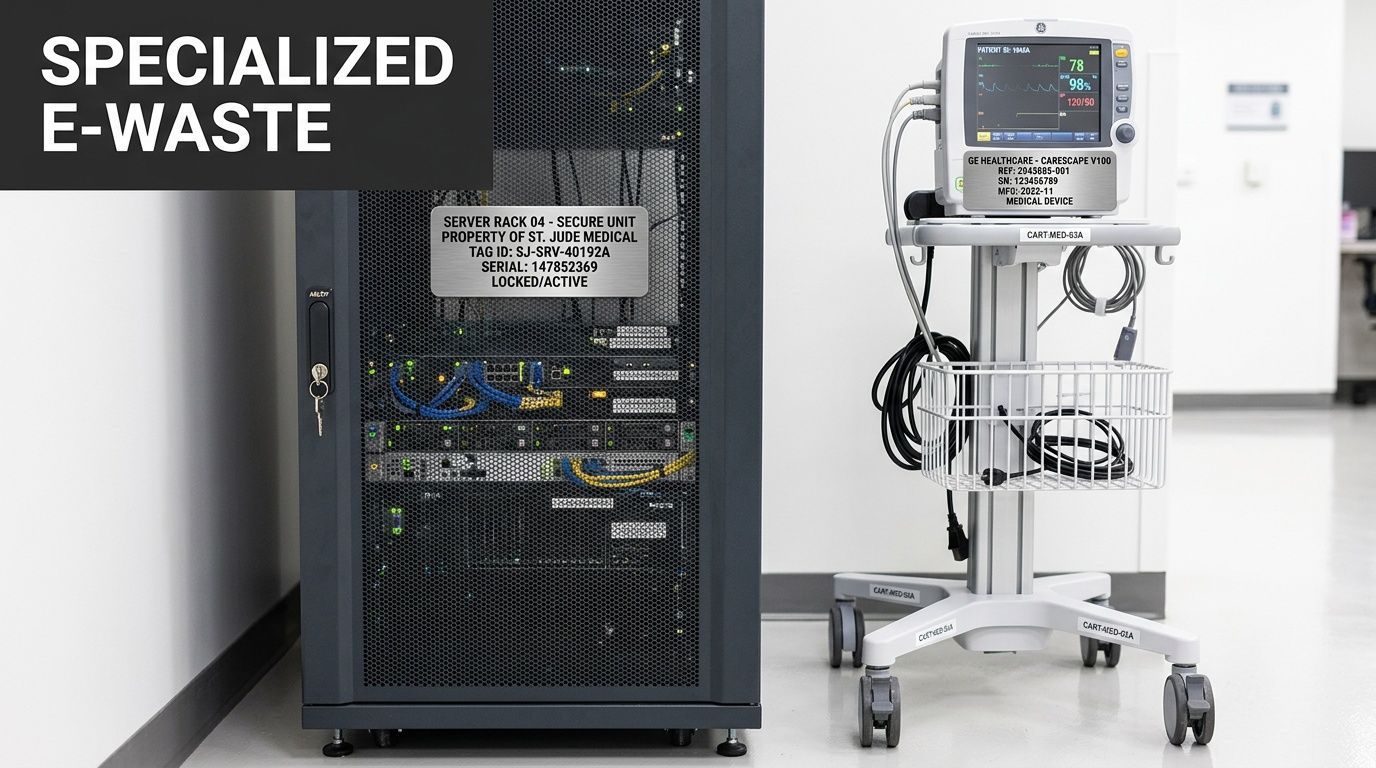
Not all e-waste is created equal. While office equipment like computers and printers makes up the bulk of retired IT assets, many Arlington organizations—especially those in healthcare, research, and data services—face a much more complex challenge. These fields rely on unique equipment that requires special handling for disposal.
Think of it this way: retiring a standard desktop is like recycling a cardboard box. Decommissioning a medical imaging machine, however, is like decommissioning a small power plant. It’s packed with sensitive components, proprietary software, and even hazardous materials that standard recycling processes just aren't built for. A one-size-fits-all approach to Arlington electronic waste disposal simply doesn’t work for these assets.
Accepted Vs. Restricted Items
For most businesses in Arlington, the list of accepted items is straightforward. A certified IT Asset Disposition (ITAD) partner can easily process common technology and ensure it’s managed responsibly.
Typically Accepted Items:
- Computers and Laptops: Desktops, workstations, and notebooks of all makes.
- Servers and Networking Gear: Rack-mounted servers, switches, routers, and hubs.
- Monitors and Displays: LCD and LED monitors (though some restrictions may apply to older CRT models).
- Printers and Peripherals: Standard office printers, scanners, keyboards, and mice.
Certain items, however, come with restrictions or demand a specialized disposal plan. This is often because of hazardous materials, extreme size and weight, or embedded protected data that needs meticulous handling. Understanding these restrictions from the start helps avoid compliance issues and logistical surprises down the road.
The real challenge with specialized e-waste isn't just its physical nature—it's the strict regulatory frameworks that govern its disposal. Failure to follow these rules, particularly in healthcare, can lead to significant legal and financial penalties.
Medical And Lab Equipment Disposal
For healthcare clinics and research labs across Arlington, electronic waste disposal has an added layer of complexity. Medical devices often contain Protected Health Information (PHI), making them subject to the stringent rules of the Health Insurance Portability and Accountability Act (HIPAA).
Disposing of an ultrasound machine, a patient monitor, or lab diagnostic equipment requires a partner who understands and complies with these healthcare regulations. The entire process must guarantee that all patient data is irretrievably destroyed, supported by a clear and auditable chain of custody from pickup to final disposition. This is non-negotiable for maintaining full HIPAA compliance.
This is where a specialized partner like Dallas Fortworth Computer Recycling becomes essential. We have the expertise to manage sensitive medical and laboratory equipment, ensuring all data is securely destroyed and all materials are recycled according to environmental laws. This covers everything from large diagnostic machines to smaller, data-heavy lab tools.
The need for professional handling is underscored by local recycling trends. While Arlington County's recycling rate hit 52.4% in 2023, e-waste accounted for a mere 1.4% of that stream. This tiny fraction highlights how much specialized equipment isn't entering proper channels—a significant risk, especially with the county aiming to divert 90% of waste by 2038. For IT managers overseeing complex assets, this statistic makes it clear: you need certified partners who can manage the entire decommissioning process securely.
Whether you're decommissioning a server room or retiring specialized medical gear, choosing a vendor with proven experience is critical. Our team provides tailored solutions for even the most complex assets, ensuring your organization’s disposal process is secure, compliant, and responsible. If your project involves large-scale server removal, you might be interested in our dedicated data center equipment disposal services.
Your Partner In Compliant IT Asset Disposition
Choosing the right IT asset disposition (ITAD) partner is one of the most critical decisions your Arlington organization will make. It’s not just about getting rid of old equipment; it’s about protecting your business from serious data, financial, and environmental risks.
At Dallas Fortworth Computer Recycling, we are more than just a pickup service. We are your dedicated partner for compliant Arlington electronic waste disposal. Since 2012, we have served businesses across the DFW metroplex with an unwavering commitment to security, compliance, and reliability.
Why Businesses Across Arlington Partner With Us
Our entire process is built to provide documented, verifiable security and peace of mind. We deliver expert local service for Arlington businesses while having the logistical strength to manage projects of any size, anywhere in the country.
Our core commitments are straightforward:
- Proven Experience: Since 2012, we have been the trusted ITAD partner for corporations, healthcare providers, and government agencies that require professional, secure solutions.
- Unyielding Security: We operate under strict R2v3 certification guidelines, ensuring your data is verifiably destroyed and every asset is handled with documented security from start to finish.
- Environmental Responsibility: Our zero-landfill policy guarantees your retired electronics are recycled responsibly. This minimizes your environmental footprint and helps meet corporate sustainability goals.
- Community Focus: We believe in giving back to the community by helping local nonprofits and other organizations manage their electronics responsibly through strategic partnerships and donation programs.
Choosing a partner isn’t just about a transaction. It's about finding a specialist you can trust to handle every step—from pickup to final reporting—with meticulous care and full accountability. This protects your organization from liability and reinforces your commitment to responsible corporate citizenship.
Take The Next Simple Step
Getting started is easy. To receive a transparent quote for your project, simply reach out to our team.
To help us provide the most accurate estimate, it’s helpful to have a general inventory of the equipment you need to dispose of. This can be a rough count of items like desktops, laptops, servers, and monitors. From there, our experts will guide you through the rest of the process and schedule a pickup that fits your timeline.
Your Questions About Arlington E-Waste Disposal, Answered
When it's time to retire your company's IT assets, you're bound to have questions. Here are some straightforward answers to the most common inquiries we receive from Arlington businesses about professional electronics recycling.
What Types Of Electronic Waste Do You Accept?
We handle a comprehensive range of business and commercial IT equipment. This includes everything from desktops, laptops, and servers to networking gear like switches and routers. We also take monitors, printers, mobile devices, and peripherals.
Our services extend to specialized electronics from medical and laboratory settings, ensuring full regulatory compliance. However, we do have restrictions on certain items with hazardous materials or oversized industrial machinery. The best way to be sure is to contact our team with an equipment list for a clear assessment.
Is My Company's Data Really Secure During The Disposal Process?
Absolutely. For us, data security isn't just a feature—it's the foundation of our entire process. We know that until your data is verifiably destroyed, the liability rests with you. That's why we've built a multi-layered security protocol to eliminate that risk completely.
It starts the moment we arrive, with a secure chain-of-custody protocol for transport from your Arlington office to our facility. Once there, we perform data erasure that meets or exceeds the rigorous NIST 800-88 standard. For hardware that requires the highest level of security, we also provide physical destruction services like degaussing and shredding.
Once the process is complete, you receive a formal Certificate of Data Destruction. This legally-binding document is your auditable proof that every piece of media has been properly sanitized, protecting your business and satisfying compliance requirements.
Do You Offer Services For Small Businesses In Arlington?
Yes, we proudly work with businesses of all sizes across Arlington and the greater DFW metroplex. Our services are designed to be just as accessible and effective for a small office retiring a few computers as they are for a large enterprise decommissioning an entire data center.
Every client receives the same high-level security, detailed documentation, and professional service. We ensure that small and mid-sized businesses have access to the same enterprise-grade compliance and peace of mind that larger corporations demand.
Why Can't I Just Use The Arlington City Recycling Program?
This is a critical point. City-run recycling events are excellent resources for residents, but they are fundamentally not built for business e-waste. They simply lack the security, tracking, and documentation that are legally required when disposing of corporate IT assets.
Your business equipment contains sensitive data, and you are responsible for it until it is proven to be destroyed. Using a certified ITAD partner like Dallas Fortworth Computer Recycling is the only way to ensure you meet federal and state data privacy laws (like HIPAA, FACTA, or GLBA) and receive the auditable proof needed to protect your company from significant financial and reputational risk.
Ready to secure your company’s retired IT assets and ensure full compliance? Contact Dallas Fortworth Computer Recycling today to schedule your Arlington pickup and get the peace of mind that comes with professional, certified service. Learn more about our business-exclusive services.