
Arlington Secure Data Destruction A Complete Business Guide
For any business in Arlington, secure data destruction isn't just another IT task to check off a list. It's a fundamental part of your risk management strategy. Failing to permanently destroy data on retired hardware is like leaving your company’s most sensitive files on a park bench for anyone to find. This guide breaks down why a formal, documented process is absolutely essential for protecting your organization.
Why Secure Data Destruction in Arlington Is A Business Imperative
When an old server, company laptop, or hard drive is taken out of service, its journey is far from over. That device is a ghost, still holding a complete history of sensitive information—from private employee records and financial data to your most valuable trade secrets. Without a certified process to permanently erase this digital footprint, your company stays vulnerable long after the equipment is unplugged.
And make no mistake, the fallout from getting this wrong can be devastating. A single data breach can trigger crippling fines, drag you into legal battles, and shatter the customer trust you've spent years building. For Arlington's key industries, the stakes are even higher.
- Healthcare Providers: You're bound by strict HIPAA regulations. Improperly disposing of patient health information (PHI) can lead to penalties that are nothing short of massive.
- Government Contractors: You must follow stringent NIST guidelines for handling sensitive government data. Documented destruction isn't just a good idea—it's a requirement for compliance.
- Tech Companies: Your intellectual property and client data are your lifeblood. Protecting them is non-negotiable for maintaining your competitive edge and honoring your contracts.
The Strategic Value of a Formal Process
It's time to stop thinking of IT asset disposition (ITAD) as a cost and start seeing it as an investment. A documented Arlington secure data destruction program gives you a verifiable audit trail, proving your organization took every necessary step to protect its information. That paper trail is your best defense if a regulator comes knocking or you face a legal challenge.
The focus on data privacy isn't going away. Data breaches cost companies an average of $4.45 million in 2023, a sobering number that has pushed 70% of enterprises to make secure IT asset disposition a top priority.
The global market for these services is exploding as a result. With regulations that can impose fines of up to 4% of a company's global annual revenue, projections show the data destruction market is on track to hit $14 billion by 2026.
For IT directors and procurement teams in Arlington, the choice is clear. The modest cost of professional data destruction pales in comparison to the catastrophic expense of a breach. You can learn more about how a structured approach provides peace of mind in our guide to secure computer disposal in Arlington.
The table below summarizes the core reasons why this needs to be on your radar.
Why Arlington Businesses Must Prioritize Secure Data Destruction
| Key Driver | Impact on Your Arlington Business |
|---|---|
| Regulatory Compliance | Avoids heavy fines from laws like HIPAA, FACTA, and NIST standards. |
| Risk Mitigation | Prevents data breaches that cause financial loss and reputational damage. |
| Brand Protection | Demonstrates a commitment to data privacy, building trust with clients and partners. |
| Legal Defense | Provides a documented audit trail (Chain of Custody) for legal protection. |
At the end of the day, these drivers all point to the same conclusion: a proactive, professional approach to data destruction is smart business.
Understanding the Methods of Secure Data Destruction
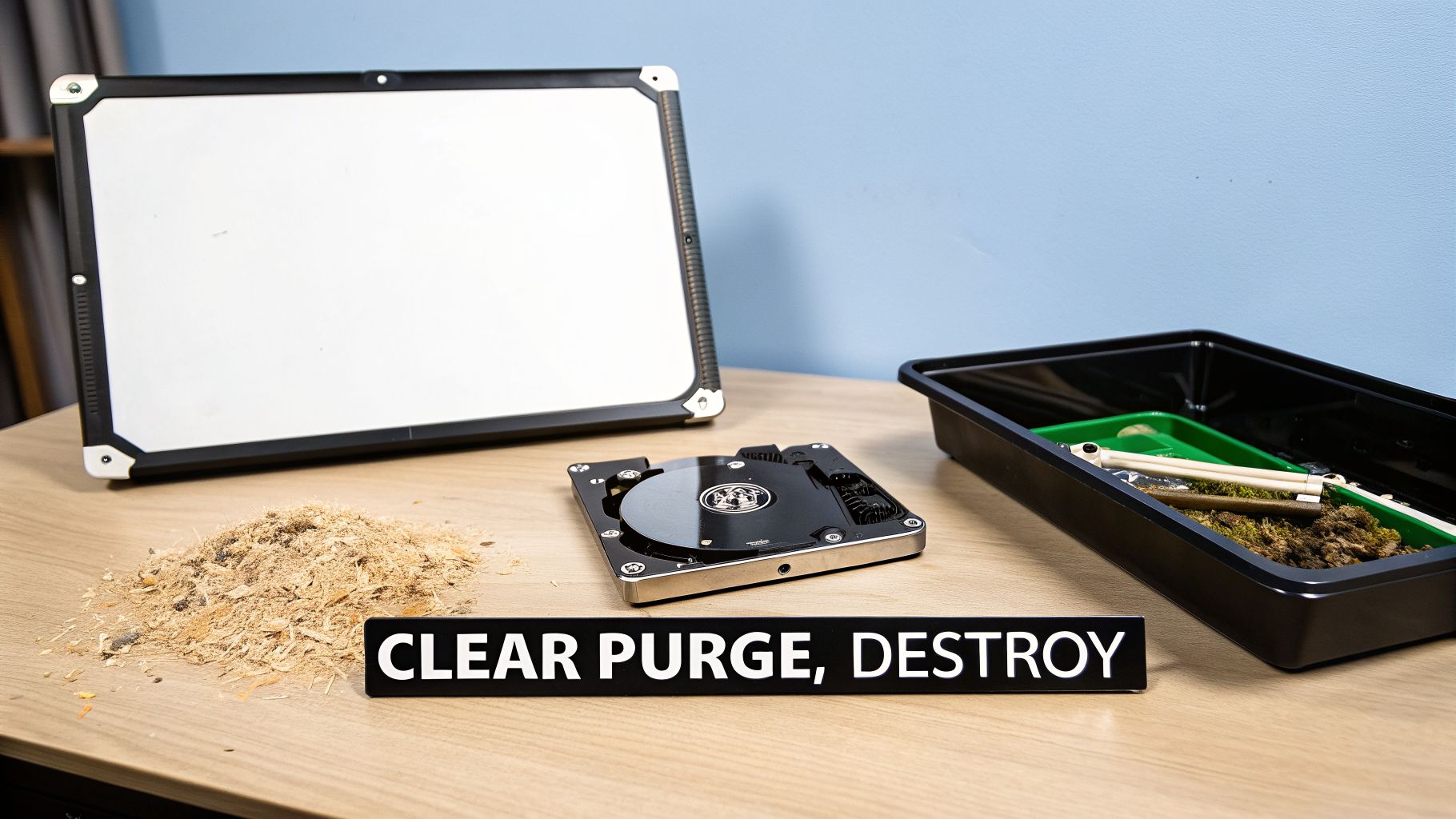
When your Arlington business decides to retire a piece of hardware, the data on it doesn't just vanish. It sticks around on hard drives and solid-state drives (SSDs), and simply hitting "delete" is like giving a whiteboard a quick wipe with a dry eraser. The faint outlines are still there, easily recovered by anyone with basic tools.
True Arlington secure data destruction requires a permanent solution. To make the right call for your business, you need to understand the three primary methods recognized by the National Institute of Standards and Technology (NIST): software wiping (Clear), degaussing (Purge), and physical destruction (Destroy). Each one offers a different level of security, and your choice will hinge on your data's sensitivity and your compliance mandates.
Method 1: Software Wiping (The "Clear" Standard)
Software wiping, also known as data sanitization, uses specialized software to write random 1s and 0s over every sector of a drive. Think of it as meticulously scrubbing that whiteboard clean, then writing over the entire surface with new, meaningless patterns—not just once, but multiple times. This process buries the original information, making it extremely difficult to recover.
This is the perfect method for devices you plan to reuse, resell, or donate because it leaves the hardware completely functional. Industry benchmarks like the Department of Defense (DoD) 5220.22-M and NIST 800-88 Clear standards define what makes a software wipe effective.
- Best For: Laptops, desktops, and servers you intend to repurpose.
- Pros: Allows for asset reuse, is highly cost-effective, and can be performed right at your facility.
- Cons: It can be slow when dealing with a large number of drives and isn't always reliable for damaged drives or modern SSDs with advanced wear-leveling technology.
Method 2: Degaussing (The "Purge" Standard)
Degaussing is a much more forceful approach. The process involves exposing magnetic storage media—like traditional hard disk drives (HDDs) and backup tapes—to an incredibly powerful magnetic field. This instantly scrambles the magnetic domains where data lives, rendering the media permanently unreadable and unusable.
Let’s go back to that whiteboard. Degaussing is like hitting it with a super-powered magnet that irreversibly liquefies the ink into a meaningless smear. The slate is wiped clean, but the drive itself is toast. It can never be used again.
Degaussing is a powerful tool for magnetic media, but it's important to note its limitation: it has no effect on non-magnetic media like solid-state drives (SSDs). This makes physical destruction a more universal solution for modern IT environments.
Method 3: Physical Destruction (The "Destroy" Standard)
When you need the absolute highest level of security, nothing beats physical destruction. This is the final, most definitive method. It involves shredding, crushing, or completely disintegrating the storage device into tiny, unrecognizable pieces. If wiping is erasing the whiteboard and degaussing is scrambling the ink, physical destruction is putting the entire whiteboard through an industrial woodchipper.
For Arlington businesses handling highly sensitive information—like patient records under HIPAA or controlled government data—physical destruction is often the only acceptable path. It provides a verifiable end to the data's lifecycle, leaving zero chance of recovery. If you want to dive deeper, check out our guide on hard drive shredding in Arlington.
This process guarantees compliance with the NIST 800-88 Destroy standard. When a certified vendor completes the job, you receive a Certificate of Destruction. For any IT director, that document is more than just a piece of paper—it’s your auditable proof of compliance and your ultimate peace of mind.
Navigating Data Privacy Laws in Texas and Beyond
For any organization in Arlington, handling data privacy laws isn't an academic exercise—it’s about managing real-world risk. Getting rid of old hardware without a compliant data destruction plan is a serious gamble. Regulations from HIPAA, FACTA, and Texas state law aren't just suggestions; they carry significant financial penalties.
These laws all point to one non-negotiable standard: stored data must be made completely irrecoverable. Just deleting files or reformatting a drive doesn't cut it, as that data can often be pulled back with basic software. This is precisely why a documented process for Arlington secure data destruction is so essential.
The NIST Framework: Your Guide to Compliance
The National Institute of Standards and Technology (NIST) Special Publication 800-88 is the gold standard for media sanitization. Think of it as the playbook that federal and Texas state regulations refer to. It outlines three methods for data sanitization: Clear, Purge, and Destroy.
Your legal and security requirements will dictate which method you need. For everyday, non-sensitive data, a "Clear" (software wipe) might be enough. But when you're dealing with protected information, the rules get much stricter, often requiring the complete finality of the "Destroy" standard.
The pressure to comply is only growing. As data breaches continue to expose the weakness of simple software wiping, the need for definitive destruction has become undeniable. In fact, the global market for data destruction is projected to hit $11.38 billion by 2025, driven by regulations that demand absolute, verifiable proof of data elimination. You can read more in the data destruction services market research.
Key Regulations Affecting Arlington Businesses
While dozens of laws touch on data, a few are especially critical for businesses operating in the Arlington area. Understanding their core demands is the first step in building a defensible IT asset disposition (ITAD) program.
- HIPAA (Health Insurance Portability and Accountability Act): This is the law of the land for any healthcare provider, insurer, or business associate handling protected health information (PHI). HIPAA requires that all PHI on old computers, servers, or medical devices be rendered unreadable and indecipherable. Fines for non-compliance can average $1.5 million per violation.
- FACTA (Fair and Accurate Credit Transactions Act): This federal law impacts nearly every business that handles consumer information like credit reports, employment applications, or background checks. The FACTA Disposal Rule mandates that you take "reasonable measures" to protect this data, which often makes physical destruction the most reliable path to compliance.
- Texas Identity Theft Enforcement and Protection Act: This state-level law requires businesses to implement and maintain sound procedures for protecting sensitive personal information. A key part of that is ensuring that when you dispose of records containing this data, they are properly destroyed.
The common thread in all these regulations is the need for proof. True compliance isn’t just about destroying the data; it’s about having a verifiable, third-party record—like a Certificate of Destruction—that proves you did it right. This document is your best defense against legal and financial risk.
For healthcare organizations, in particular, every step of the disposal process must meet strict regulatory standards. You can get a detailed breakdown of these rules in our guide to HIPAA-compliant electronics recycling in Texas. The most effective way to manage risk is to partner with a certified vendor who understands these complex legal demands and can help keep your business protected.
Choosing Between On-Site and Off-Site Destruction
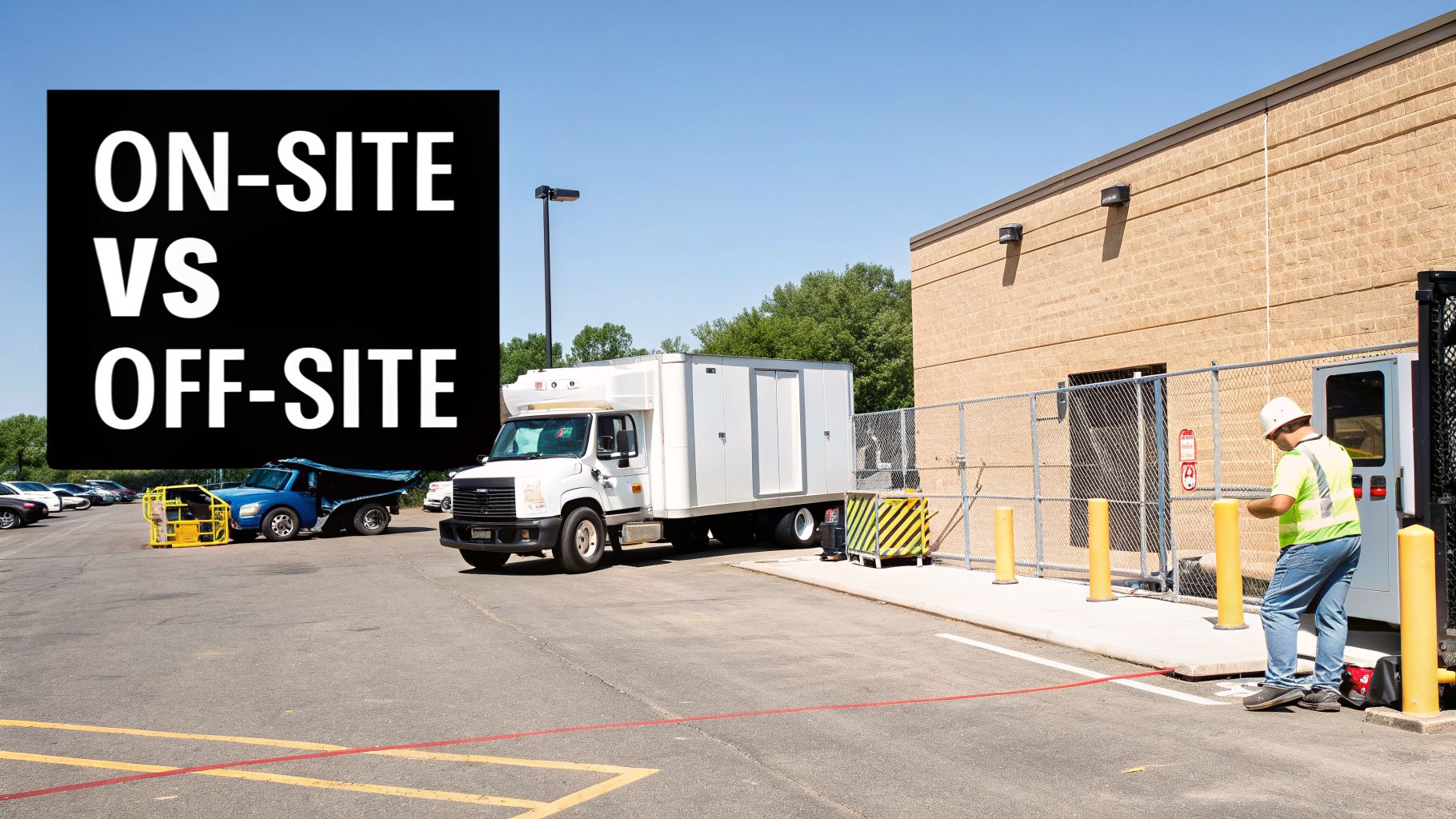
Once you’ve settled on the best way to destroy your data, the next big question is where it will happen. For any Arlington organization, this decision comes down to a practical balance of security, convenience, and cost. You have two main choices: on-site destruction at your facility or off-site destruction at a secure, specialized plant.
Each service model has its own distinct advantages. The right choice for your Arlington secure data destruction plan will depend entirely on your company’s risk tolerance, compliance needs, and day-to-day operations. This decision directly shapes your chain of custody and how much direct oversight you have.
On-Site Destruction: The Ultimate in Security Oversight
On-site destruction, often called mobile shredding, brings the entire process right to your curb. A specialized, self-contained truck equipped with industrial-grade shredders pulls up to your Arlington facility. Your staff can witness everything firsthand, from the moment your IT assets are scanned to the second they’re fed into the shredder.
It’s the equivalent of having a mobile vault with a viewing window. Your sensitive assets never leave your sight, which completely eliminates any risk during transport. For organizations managing highly regulated data under HIPAA or handling government contracts, this unbroken chain of custody delivers absolute peace of mind.
This is the gold standard for maximum security. It's ideal for businesses that demand direct verification and need to close the compliance loop on the spot. If you want to see how this works, you can learn more about on-site shredding services and their benefits.
Off-Site Destruction: A Balance of Security and Efficiency
With off-site destruction, a certified team collects your assets from your location in secure, locked containers. The devices are then transported in a GPS-tracked vehicle to a highly secure, access-controlled facility where the destruction takes place. The entire process is governed by a strict, documented chain of custody from start to finish.
Think of it like using a bonded armored car service to move assets to a central bank vault for processing. While you don’t personally watch the destruction, you trust a documented, audited process managed by a professional partner.
Off-site services are often more cost-effective and can be far more efficient for large-volume projects like data center cleanouts, as the vendor handles all the heavy lifting and processing at scale without disrupting your business.
For many Arlington businesses, this model strikes the perfect balance between high security and operational convenience, all backed by a formal Certificate of Destruction upon completion.
On-Site vs Off-Site Data Destruction: A Comparison
So, which model is right for you? It really depends on your specific priorities. To help you decide, we've put together a head-to-head comparison of the key factors for each approach.
| Factor | On-Site Destruction | Off-Site Destruction |
|---|---|---|
| Security | Highest level; you witness the destruction in real-time. | High level; relies on a documented chain of custody and secure facility. |
| Verification | Immediate and direct visual confirmation of destruction. | Verified through a Certificate of Destruction and audit trail. |
| Cost | Typically higher due to specialized equipment and on-location service. | Generally more cost-effective, especially for larger volumes. |
| Convenience | Minimal disruption, as the entire process is self-contained on-site. | Requires scheduling pickup and handoff; less disruptive for large-scale jobs. |
| Best For | Highly regulated industries, top-secret data, or maximum peace of mind. | Businesses seeking a balance of security, cost, and logistical efficiency. |
Ultimately, whether you choose the absolute oversight of on-site destruction or the streamlined efficiency of an off-site process, the key is partnering with a certified vendor who can deliver the security and documentation your Arlington business requires.
How to Vet Your Arlington Data Destruction Vendor
Choosing a partner for Arlington secure data destruction goes far beyond just comparing price quotes. The right vendor is a critical part of your risk management strategy, while the wrong one can leave your business facing serious legal and financial trouble. You have to know the difference between a basic electronics recycler and a true, compliance-focused IT Asset Disposition (ITAD) partner.
To sort the experts from the amateurs, you need to lead the conversation. This means asking sharp, specific questions to understand their process, confirm their credentials, and make sure they have the right safeguards in place. Think of it as a background check—your company’s data security is on the line.
Verifying Industry Certifications
Certifications are your first and most important checkpoint. They aren't just logos for a website; they are hard proof that a vendor has passed rigorous, third-party audits of its security, environmental practices, and daily operations. For any business in Arlington, there are two certifications that are non-negotiable.
- NAID AAA Certification: This is the gold standard specifically for data destruction. A NAID AAA certified company has proven its processes are secure, covering everything from employee screening and facility access to the integrity of its shredding equipment.
- R2v3 (Responsible Recycling): While its main focus is on environmental responsibility, the R2v3 standard also has strict rules for data sanitization and security. It ensures a vendor is not only recycling electronics correctly but also managing the data on them according to a tight, auditable protocol.
A vendor without these certifications might offer a lower price, but they can't give you the auditable proof you need to protect your business. Always insist on seeing their current certificates for both.
Scrutinizing Insurance and Liability Coverage
Next, you need to dig into their insurance. A standard general liability policy just won't cut it. The amount of data being handled is staggering; global data volumes hit 120 zettabytes in 2023 and are on track to reach 181 zettabytes by 2025. With companies retiring about 25% of their servers every year, the risk tied to old storage is massive. You can learn more about these trends in this data destruction industry report.
With this much at stake, you must see proof of specific insurance that protects you if something goes wrong.
Your vendor must carry downstream data liability insurance, often called professional liability or errors and omissions (E&O) insurance. This specific policy covers financial losses if a data breach happens because the vendor failed to properly destroy data. Without it, you’re completely exposed.
Ask for their Certificate of Insurance and look closely at the coverage limits. Make sure the policy is active and covers the entire scope of their work, from pickup and transport to the final destruction.
Demanding a Documented Chain of Custody
The chain of custody is the unbroken, chronological paper trail documenting every touchpoint your assets go through, from the second they leave your office to their final destruction. This isn't an optional nice-to-have; it's the foundation of any defensible Arlington secure data destruction program.
Your vendor must be able to show you a detailed process for this, including:
- Serialized Asset Tracking: Every single device—server, laptop, HDD—should be scanned and inventoried by serial number at the time of collection.
- Secure Logistics: Assets must be moved in locked, sealed containers by uniformed, background-checked employees driving GPS-tracked vehicles.
- Formal Documentation: A transfer of custody form should be signed at pickup, which formally passes liability from you to the vendor.
This documented trail is your proof that no device was lost or mishandled. After the job is done, the vendor must provide a formal Certificate of Destruction. This is a legally binding document that should list the serial numbers of all destroyed devices, state the destruction method used, and confirm the date and location. It's the final piece of evidence you need to close the loop on your compliance responsibilities.
Your Step-by-Step IT Asset Disposition Plan
Moving from theory to action is what truly protects your business. For an Arlington organization, building a formal IT Asset Disposition (ITAD) plan doesn't have to be a monumental task. It's about creating a clear, structured process that establishes a defensible and compliant program for every retired piece of technology.
This plan becomes your internal playbook, ensuring every data-bearing device is handled with the same high security standards from the moment it’s retired to its final, documented destruction. Here’s a step-by-step guide to implement a solid plan for Arlington secure data destruction.
Step 1: Inventory All Data-Bearing Assets
You can't secure what you don't track. The starting point is a detailed inventory of every single device that stores or processes data. And you have to think beyond just the obvious computers and servers.
Your inventory list needs to be thorough. Make sure you include:
- Workstations: Every desktop and laptop used by your employees.
- Servers and Data Center Equipment: This includes blade servers, rackmount units, and storage area networks (SANs).
- Individual Drives: Any loose hard disk drives (HDDs) and solid-state drives (SSDs) from past upgrades or repairs.
- Mobile Devices: All company-owned smartphones and tablets.
- Network Hardware: Routers and switches that can hold sensitive configuration data.
For each asset, log its serial number, your company asset tag, its physical location, and the current user or department. This master list is the foundation of your entire disposition process.
Step 2: Classify Data and Define Policies
Not all data carries the same risk. The next step is to classify the information on these assets based on its sensitivity and the regulations that apply to it. This classification directly determines the required method of destruction.
Group your assets by the type of data they hold—is it public information, internal business data, intellectual property, protected health information (PHI), or financial records? For any asset containing data governed by HIPAA, FACTA, or specific government contracts, physical destruction is almost always the mandated standard.
With this classification done, create a clear, written internal security policy for asset retirement. This document should state precisely which destruction method (e.g., NIST Purge or Destroy) is required for each data type. It leaves no room for guesswork.
A well-defined policy is your first line of defense. It ensures consistent, compliant actions across your entire organization and provides a clear standard to hold your chosen vendor accountable to.
Step 3: Vet Vendors and Schedule Service
Once your inventory and policies are in place, you can find the right partner. Use the vetting criteria we've discussed to evaluate potential vendors. Remember, you aren't just hiring a disposal service; you're bringing on a security partner to manage your risk.
This outlines the essential pillars for vetting any potential data destruction provider.
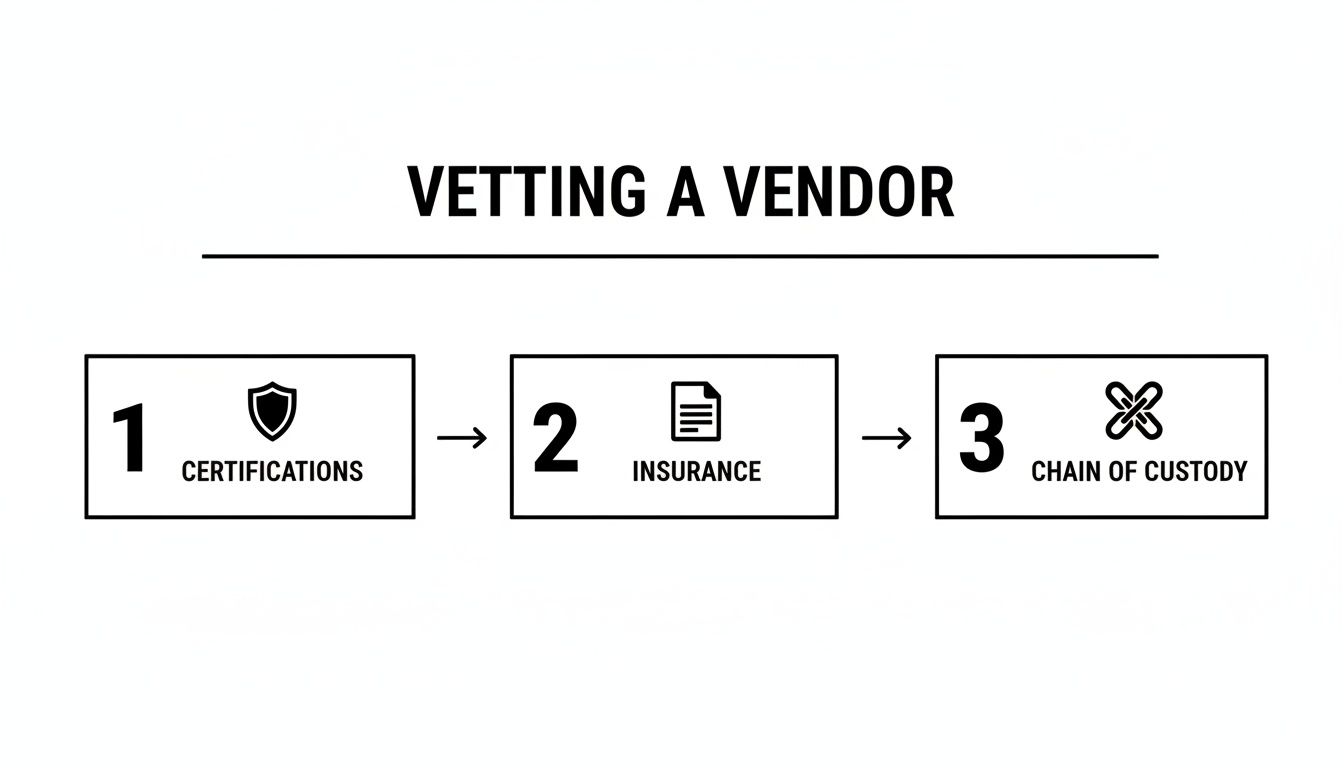
These three elements—verifiable certifications, downstream liability insurance, and a documented chain of custody—are the bedrock of a secure partnership.
After selecting a certified vendor, it's time to schedule the service. Whether you opt for on-site or off-site destruction, confirm every step aligns with your internal policy. When the vendor's team arrives, they should scan each asset from your inventory list and have you sign a transfer of custody form, formally documenting the handover and shifting liability. For a deeper look at what a complete plan includes, see our guide to IT asset disposition in Arlington.
Step 4: Review Your Certificate of Destruction
This is the final, crucial step that closes the loop on liability. After the destruction work is done, your vendor must provide a formal Certificate of Destruction. This is the single most important piece of documentation you will receive from the process.
Review it carefully to ensure it includes:
- A unique serial number for the certificate itself.
- The exact date and method of destruction.
- A serialized list of all destroyed assets that matches your original inventory.
- A statement transferring custody and confirming destruction was performed according to industry standards.
File this certificate securely. It is your official, auditable proof that your organization met its legal and ethical duty to protect its sensitive data. By following these steps, you transform Arlington secure data destruction from a potential liability into a documented, strategic process.
Frequently Asked Questions About Secure Data Destruction
Even with a solid plan in place, a few practical questions always come up. Here are some of the most common ones we hear from Arlington businesses, with direct answers to help you finalize your IT asset disposition strategy.
What Is The Difference Between Recycling and Secure Data Destruction?
This is one of the most important questions we get, and the distinction is critical for compliance. Standard electronics recycling is focused on recovering materials like plastic and metal to keep e-waste out of landfills. It’s an environmental process, not a security one.
Secure data destruction is a dedicated security service designed to make data completely unrecoverable. While a certified ITAD partner like us performs both, you must ensure your vendor provides a Certificate of Destruction. A simple recycling certificate won't satisfy compliance requirements for Arlington secure data destruction.
How Long Should My Business Keep A Certificate Of Destruction?
Think of your Certificate of Destruction as permanent proof of due diligence. It’s the official legal document showing you complied with data privacy regulations like HIPAA and FACTA when you disposed of an asset.
We recommend retaining all Certificates of Destruction for a minimum of seven years, but permanently is the gold standard. If an audit or legal question arises years from now, this document is your first and best line of defense.
Can My Internal IT Team Just Wipe Our Drives?
Your IT team can definitely perform basic software-based wiping (what NIST calls the "Clear" method), but this approach has significant limitations. It’s often insufficient for hardware regulated by HIPAA, and it leaves you with no independent, third-party proof that the data is truly gone. Software wipes also don't work on damaged drives or non-magnetic media.
Using a certified third-party vendor provides an objective, auditable trail that proves destruction was completed to industry standards. This is essential for minimizing your company's liability and ensuring the process is documented, compliant, and defensible.
Do I Need To Remove The Hard Drives Before You Arrive?
No, you don't. In fact, it's more secure to leave the drives inside the computers, servers, or laptops. Our professional ITAD services are set up to manage the entire device from start to finish.
Our team will inventory the asset by its serial number and then destroy the drive—either by removing it for on-site shredding or by processing the entire unit at our secure facility. This maintains an unbroken and secure chain of custody for every single asset.
For a partner that guarantees a secure, compliant, and documented process for every asset you retire, trust Dallas Fortworth Computer Recycling. Learn how we can protect your Arlington business by visiting https://dallasfortworthcomputerrecycling.com.