
Enterprise Telecom Solutions Chicago: Buyer’s Guide

If you're evaluating enterprise telecom solutions Chicago right now, you're probably dealing with three problems at once. The business wants better performance for cloud apps, your finance team wants cleaner telecom spend, and your security or compliance team wants assurances that old voice and network gear won't disappear into an undocumented closet cleanout.
Most telecom buying processes still treat those as separate issues. That's a mistake. In practice, your carrier contract, migration plan, and retirement process for legacy routers, switches, firewalls, PBX hardware, and handsets all affect each other. If you buy well but decommission poorly, you create risk at the exact moment your environment is changing fastest.
Your Guide to Modernizing Chicago Enterprise Telecom
Too many telecom projects start with a narrow question: how do we get more bandwidth? That usually produces the wrong outcome. You renew oversized circuits, add overlapping services, and inherit another contract cycle without fixing utilization, resiliency, support accountability, or equipment retirement.
Chicago infrastructure teams need a broader view. The global enterprise telecom services market was valued at USD 848.2 billion in 2022 and is projected to reach USD 1.2 trillion by 2032, with growth tied to 5G investment, according to Global Market Insights coverage of the enterprise telecom services market. For a Chicago IT director, that matters because telecom is no longer just transport. It underpins hybrid work, branch connectivity, IoT traffic, cloud access, and the timing of when legacy equipment leaves service.
A practical modernization plan starts with an internal operating view, not a provider quote. Before you talk to carriers, document what the business depends on:
- Critical applications: Identify which systems fail visibly when latency, packet loss, or voice quality slips. ERP, EHR, trading, call center, and plant-floor systems don't tolerate the same risk.
- Site roles: Separate headquarters, branch, clinic, warehouse, lab, and data center requirements. One telecom design rarely fits every site.
- Security dependencies: Map where firewalls, SBCs, UC platforms, and legacy voice systems still hold sensitive data or credentials.
- Exit requirements: Define how old telecom hardware will be removed, sanitized, documented, and recycled before contracts are signed.
Practical rule: If your telecom strategy ends at installation, it isn't a full infrastructure strategy.
That full-lifecycle perspective is what makes enterprise telecom buying more resilient. A Chicago team replacing PRI, MPLS, or legacy voice platforms also needs to know which devices will be stranded, who owns data destruction, and how chain-of-custody will be documented. That's why I advise clients to treat telecom procurement and asset retirement as one governance workflow, not two separate projects.
If you're comparing local options, this Chicago telecommunications services overview is useful context for thinking beyond carrier features and toward lifecycle management.
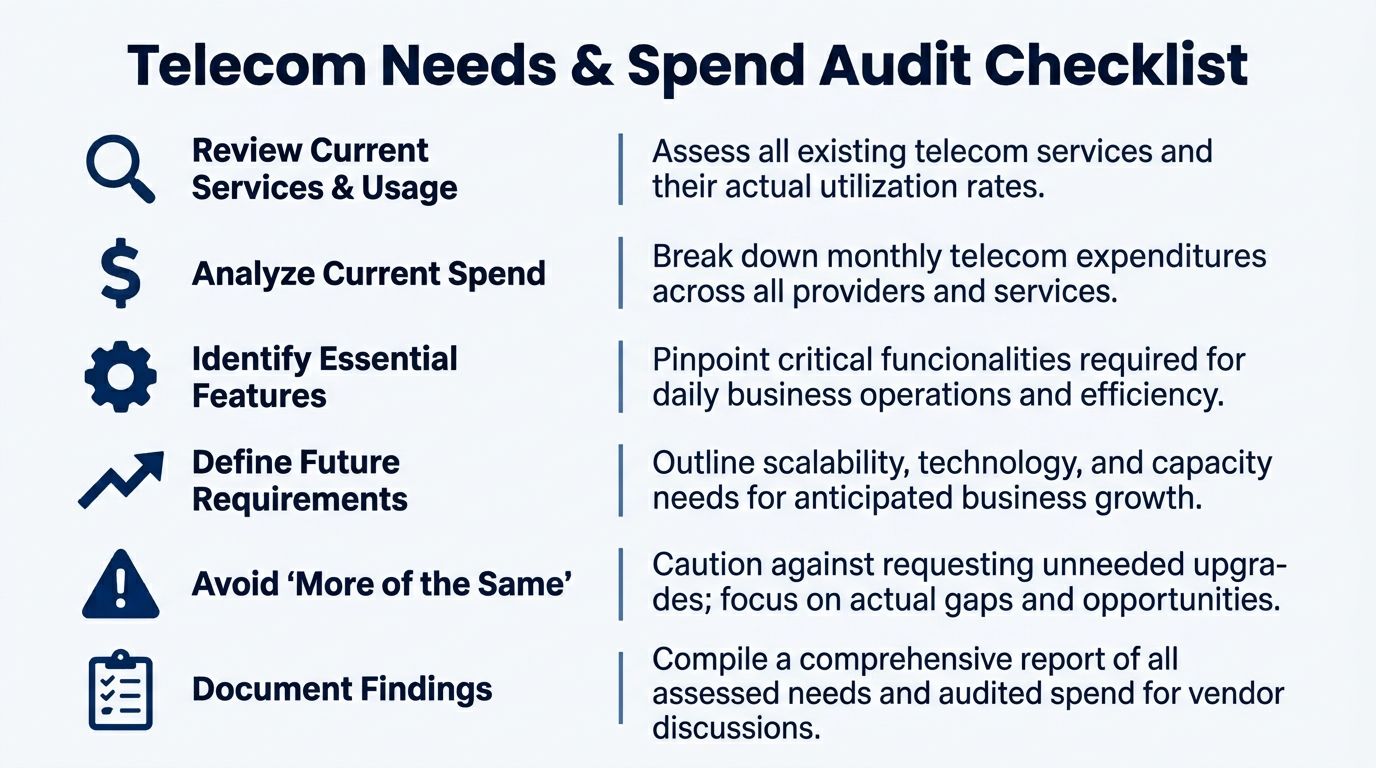
Assess Your True Telecom Needs and Audit Current Spend
The fastest way to overspend is to ask vendors for "an upgrade" before you've audited what you already have. In large environments, the current state is usually messier than anyone expects. Billing inventories don't match network diagrams. Old circuits remain active after migrations. Mobile plans stay assigned to departed staff. Voice services linger because no one wants to risk disconnecting the wrong number.
A disciplined audit fixes that. One proven methodology shows that 70-80% of large enterprises have inactive services they're still billing for, and that a 5-step process of discovery, validation, benchmarking, dispute, and optimization can lead to a 15-25% average spend reduction in the first year, based on Tellennium's telecom audit methodology.
Start with inventory truth
You need one reconciled record of every service, vendor, contract, circuit, phone number block, internet connection, mobility account, and on-prem telecom asset. That means pulling from invoices, carrier portals, CMDB records, procurement files, and what your network team sees in production.
Look for mismatches such as:
- Active billing with no business owner: These services are prime candidates for disconnect review.
- Installed but undocumented hardware: Old edge devices and voice gateways often remain in racks after cutovers.
- Multiple labels for the same service: Carrier naming conventions create confusion and hide duplicates.
- Branch exceptions: Small sites often carry legacy analog or copper dependencies that headquarters teams miss.
Disciplined IT asset management best practices matter. If your telecom inventory and hardware inventory live in separate silos, you'll miss both cost and risk.
Validate usage instead of trusting provisioned capacity
A provisioned circuit doesn't prove a business need. Pull usage records, traffic logs, call patterns, and site-specific demand trends. Then compare them to billed capacity and service tiers.
A common example is a site that was upgraded for a one-time project and never resized after the project ended. Another is a branch that moved major workloads to SaaS but still carries connectivity designed for local server traffic. In voice environments, you may find call paths or trunks retained only because no one documented the dependency.
The right question isn't "What are we paying for?" It's "What is still necessary, and what business event justifies keeping it?"
Translate findings into future-state requirements
Once the current state is clean, define what the next contract needs to support. Don't write a generic wishlist. Tie requirements to operational conditions.
Use a working RFP input list like this:
| Requirement area | What to document internally | Why it matters |
|---|---|---|
| Network services | Internet, WAN, voice, wireless, cloud connectivity, diversity needs | Prevents incomplete quotes |
| Site profile | Address, business function, hours, criticality, onsite support constraints | Shapes SLA and escalation needs |
| Security controls | Segmentation, logging, access rules, retention, device handling | Avoids surprises during migration |
| Hardware transition | Legacy gear to remove, sanitize, store, or recycle | Brings ITAD into procurement early |
| Compliance needs | Healthcare, public sector, finance, internal audit expectations | Filters out weak vendors quickly |
A good audit doesn't just cut spend. It gives you an advantage. When vendors know you've already reconciled inventory and usage, they can't hide behind vague bundles or generic upgrade language.
Build a Winning RFP and Evaluate Chicago Telecom Vendors
Chicago isn't a market where you can afford a lazy RFP. The U.S. enterprise telecom services segment was valued at USD 187.01 billion in 2022, and Chicago hosts over 100 data centers, which makes local network performance and peering relationships especially important, according to Research and Markets reporting on the U.S. enterprise telecom market. In a dense carrier environment, weak vendor selection doesn't fail because options are limited. It fails because there are too many plausible options.
Write an RFP that forces specificity
Most bad RFPs produce polished but unusable responses. Vendors answer with template language, broad promises, and pricing that can't be compared line by line. Your RFP should force operational clarity.
Include these components:
- Site-level scope: Require vendors to price by location and service type, not only in aggregate.
- Migration assumptions: Ask them to state cutover sequencing, customer responsibilities, blackout windows, and rollback criteria.
- Support model: Require named escalation paths, support hours, implementation governance, and fault ownership boundaries.
- Security and data handling: Ask how they manage credentials, config backups, retired CPE, and access revocation during transition.
- Legacy equipment retirement: Require a written approach for identifying provider-owned gear versus customer-owned gear, and for coordinating deinstallation with secure disposition.
That last point screens out more weak vendors than many anticipate. Many providers are strong at installation and shaky at removal. They can turn up circuits and ship replacement gear, but they don't have a disciplined process for what happens to old firewalls, voice gateways, session border controllers, or handsets after cutover.
Run migration and disposition as parallel workstreams
Telecom leaders often think of migration as a network event. It's also a physical asset event. If you don't manage both together, assets get stranded, chain-of-custody breaks down, and the post-cutover environment becomes harder to audit.
Here's the practical model:
| Workstream | Primary owner | Key deliverables | Common failure |
|---|---|---|---|
| Service migration | Network and telecom team | Turn-up schedule, test plans, rollback steps, acceptance criteria | Services cut over without business validation |
| Contract alignment | Procurement and legal | SLAs, billing structure, termination language, equipment ownership terms | Ambiguous responsibility after go-live |
| Asset disposition | Infrastructure, security, facilities | inventory, pickup schedule, sanitization records, disposition certificates | Legacy gear left onsite with no documented status |
Treat every decommissioned telecom device as a security object first and a recycling object second.
Score vendors on total operational fit
A vendor that offers attractive pricing but weak Chicago-area performance, inconsistent support, or no credible decommissioning process is not the low-risk choice. Build a scorecard before proposals arrive so internal stakeholders don't drift toward whichever sales team presents best.
Chicago Telecom Vendor Evaluation Scorecard
| Evaluation Criterion | Weighting | Vendor A Score (1-5) | Vendor B Score (1-5) | Notes |
|---|---|---|---|---|
| Chicago network performance and peering | High | Validate local service reliability and fit for your sites | ||
| SLA quality and service credits | High | Look beyond uptime headline language | ||
| Migration governance | High | Review project management depth and rollback discipline | ||
| Security and access controls | High | Check how they handle configs, credentials, and support access | ||
| Legacy asset retirement support | Medium | Confirm provider role in deinstall and equipment ownership | ||
| Billing transparency | Medium | Demand readable invoices and service-level mapping | ||
| Support responsiveness | Medium | Evaluate escalation quality, not just help desk promises | ||
| Fit for regulated operations | High | Essential for healthcare, finance, and government environments |
For teams comparing providers and service models, this managed telecom services reference helps frame what ongoing operational support should look like after the contract is signed.
Plan a Seamless Migration and Secure Asset Disposition
Vendor selection is only the midpoint. The highest-risk window starts after signature, when old and new services overlap, temporary workarounds multiply, and retired hardware begins piling up in IDF rooms, branch closets, and staging areas.
A major gap in the Chicago market is that many telecom providers focus on installation and not on end-of-life asset disposition. The local gap matters more because Illinois's 2025 e-waste mandates raise the compliance stakes, and organizations often lack clear guidance on chain-of-custody for sensitive telecom gear during decommissioning, as noted in this Chicago telecom market gap analysis focused on decommissioning and ITAD.
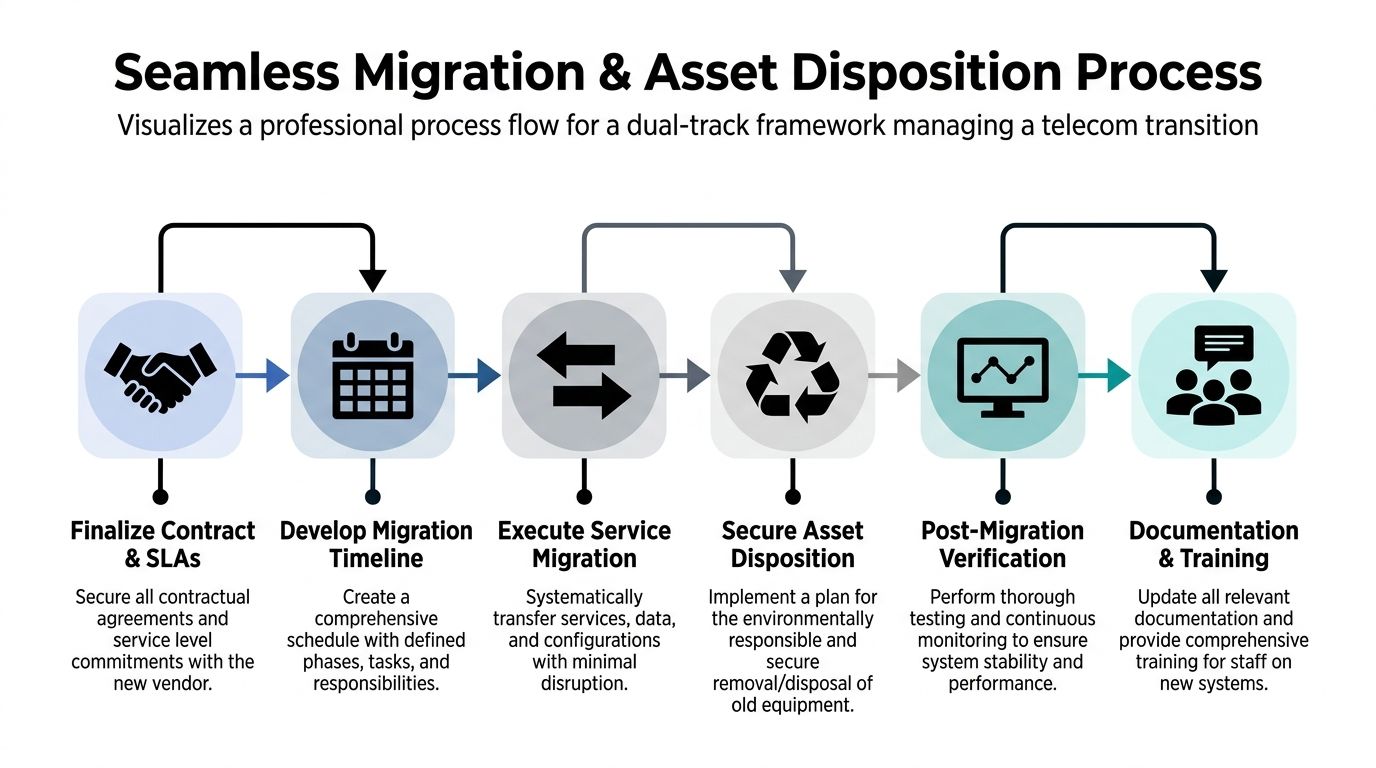
Build one timeline, not two separate projects
The migration plan should include both service activation and physical retirement milestones. If the telecom team cuts over on Friday and the infrastructure team figures out hardware cleanup three weeks later, control breaks immediately.
Your project plan should define:
- Acceptance trigger. State exactly what conditions mark a successful cutover for each site or service.
- Ownership transfer. Clarify when provider-managed or customer-owned equipment becomes your disposition responsibility.
- Asset hold period. Decide whether hardware sits in quarantine for rollback protection before final retirement.
- Pickup and packaging process. Assign who labels, stores, and releases equipment.
- Final records. Require inventory reconciliation against what was physically removed.
What secure telecom retirement actually requires
Telecom hardware is often overlooked because it doesn't look like "data center equipment" in the traditional sense. But routers, firewalls, voice gateways, call managers, voicemail systems, session border controllers, UC appliances, and even some handsets can contain sensitive data, credentials, call records, or configuration details.
A sound ITAD process includes:
- Asset identification: Match serial numbers and site locations to your migration inventory.
- Segregation by risk: Separate devices that may store sensitive data from passive accessories and cabling.
- Sanitization controls: Make sure devices with storage or recoverable configurations go through documented data destruction.
- Chain-of-custody evidence: Record who handled each asset from rack removal through final disposition.
- Environmental handling: Route reusable and recyclable items through a compliant downstream process instead of informal disposal.
Old telecom gear shouldn't leave a site based on verbal approval or a spreadsheet attachment. It needs documented release control.
For infrastructure teams managing major refreshes, this data center ITAD resource is a practical reference for treating decommissioned telecom and data center equipment with the same rigor.
Avoid the migration mistakes that create cleanup risk
The technical side of migration has its own failure modes, and many of them spill directly into asset disposition.
Watch for these patterns:
- Premature disconnects: Teams remove old circuits or hardware before proving application, voice, and failover behavior in production.
- No rollback inventory: Staff de-rack legacy equipment without labeling it for temporary retention, making rollback chaotic.
- Unclear carrier demarcation: Customer teams dispose of equipment they do not own, or leave provider gear behind.
- Orphaned branch assets: Central teams complete cutovers but never verify what remains in closets at remote sites.
- Missing final documentation: Finance stops paying for a service, but audit records never show where the supporting hardware went.
A smooth migration is less about speed than control. The best projects move with enough discipline that procurement, network engineering, security, facilities, and disposition vendors are all working from the same final asset list.
Negotiate Your Contract and Ensure Ongoing Compliance
A telecom contract can look competitive and still become expensive. The losses usually come from weak timing, loose language, and poor post-signature control. If you're buying enterprise telecom solutions Chicago, negotiation is not just a procurement step. It's where you decide how much operational friction you'll be living with for the next term.
A proven telecom negotiation playbook can produce 20-35% cost savings, especially when teams start with a pre-negotiation audit 9-12 months before expiration, use competitive RFPs to benchmark rates, and continue with invoice validation after signature. That same playbook warns that 80% of billing errors erode margins, according to this telecom contract negotiation playbook from Socium IT.

Negotiate the terms that actually drive risk
Price matters, but several clauses matter more over time.
Focus your review on:
- Renewal language: Evergreen terms and short notice windows trap teams that discover problems too late.
- Service credits: Many contracts offer credits that sound useful but are capped so tightly they don't offset real business impact.
- Termination rights: You need clear language for chronic underperformance, delayed installations, site closures, and technology changes.
- Equipment ownership: Spell out who owns installed hardware, replacement hardware, and removed hardware at every stage.
- Billing detail: Require invoice formats that map back to services, locations, and contract terms without manual detective work.
Build governance after signature
A signed contract doesn't enforce itself. Someone has to validate invoices, compare charges to contracted terms, and verify that disconnected services cease billing. Many savings often leak away here.
I recommend a simple operating cadence:
| Review area | Monthly check | Quarterly check |
|---|---|---|
| Billing | Validate charges, taxes, credits, and disconnected services | Review trends, disputes, and recurring exceptions |
| Service performance | Inspect outage records and chronic ticket patterns | Compare experience against SLA commitments |
| Inventory alignment | Reconcile billed services with active sites and devices | Confirm moved, closed, or migrated locations are cleaned up |
| Contract posture | Track notice periods and change requests | Prepare early for renegotiation or consolidation |
If your team only looks at telecom invoices when finance flags a spike, you've already given away leverage.
For organizations that want outside expertise during renewals or vendor disputes, this telecom consulting services resource is a useful model for how structured advisory support can tighten contract management.
Compliance isn't just carrier compliance
Ongoing compliance includes more than service levels and billing accuracy. It also includes documentation around retired equipment, access revocation for old systems, and confirmation that decommissioned assets did not leave your control without records.
That matters most in regulated sectors. A healthcare network, local government department, or financial services firm can't treat retired telecom infrastructure as miscellaneous surplus. Once a device falls out of support, the risk shifts from uptime to evidence. Can you prove what it was, where it came from, who touched it, and how it was disposed of?
Those questions should stay in your telecom governance process long after the cutover weekend is over.
Building a Resilient and Future-Ready Telecom Strategy
The strongest telecom environments in Chicago aren't built by chasing the lowest circuit price. They're built by teams that know their inventory, write precise requirements, evaluate vendors on operational fit, and control what happens to every device when the service lifecycle ends.
That full-lifecycle approach changes the quality of the decision. Procurement gets cleaner comparisons. Infrastructure teams get better cutover planning. Security gets documented chain-of-custody. Compliance teams get records they can use. Finance gets fewer billing surprises.
Enterprise telecom solutions Chicago should be evaluated as an infrastructure lifecycle, not a one-time purchase. When you plan procurement, migration, and secure retirement together, you reduce risk at the exact points where most organizations lose visibility.
Dallas Fortworth Computer Recycling helps organizations retire telecom and IT equipment with documented chain-of-custody, certified data destruction, and compliant nationwide logistics. If your Chicago telecom refresh includes old network gear, voice infrastructure, data center hardware, or specialized regulated equipment, Dallas Fortworth Computer Recycling can support the secure end-of-life side of the project so your team doesn't leave compliance and disposal to chance.