
Telecom Consulting Services Los Angeles: A Hiring Guide

Your carrier renewal is sitting in your inbox. The branch office still has random jitter on voice calls. Finance wants a cleaner telecom budget. Security wants old gear removed the right way. Meanwhile, every vendor says they can “optimize the environment” without telling you exactly how they'll audit circuits, benchmark rates, or handle the hardware that comes out when the upgrade is finished.
That's where most Los Angeles telecom projects go sideways. The problem usually isn't a lack of options. LA has plenty of carriers, consultants, integrators, and broker-style advisors. The problem is that companies hire for the go-live and ignore the full lifecycle. They focus on pricing, implementation, and vendor selection, then treat decommissioning as someone else's problem.
A good hiring process for telecom consulting services Los Angeles has to be more disciplined than that. You need a consultant who can audit what you have, challenge what you're paying for, design what comes next, and account for what gets retired along the way.
Why Your LA Business Needs a Telecom Consulting Partner Now
Los Angeles IT teams are under pressure from both sides. Users expect stable connectivity from headquarters, branch sites, data centers, and home offices. At the same time, carriers keep changing product mixes, contract structures, and delivery assumptions. If you're managing MPLS transitions, DIA refreshes, UCaaS decisions, cloud on-ramps, or a fiber build into a new facility, the margin for error is small.
That complexity is one reason the consulting market keeps expanding. The global telecommunications consulting market was valued at $8.5 billion in 2024 and is projected to reach $20.7 billion by 2033, with North America holding a 37% market share, according to telecommunications consulting market projections from Market Intelo. That growth is tied to digital transformation and next-generation network rollouts, which tracks with what many LA infrastructure teams are dealing with on the ground.

What changes in Los Angeles
LA adds its own operational friction. You're often dealing with multi-site footprints spread across dense urban corridors, suburban office parks, industrial facilities, healthcare sites, and creative production environments. The network design that works for a downtown office won't necessarily fit a warehouse operation near the port or a post-production firm that moves large media files all day.
Consultants who've worked this market know the questions to ask early:
- Carrier diversity: Which buildings are effectively single-carrier even when sales reps claim there are alternatives?
- Construction realities: Is the timeline dependent on building access, riser work, landlord approvals, or municipal permits?
- Application sensitivity: Are you solving for voice stability, cloud access, file movement, guest traffic isolation, or all of it at once?
- Lifecycle discipline: Who owns circuit disconnects, inventory cleanup, and retirement of the hardware that gets replaced?
A lot of internal teams know these issues exist. What they often lack is the time to run a clean audit, create a comparable bid package, and manage the carrier process without getting pulled into outage response and daily operations.
Practical rule: If your team can't produce a current circuit inventory, contract summary, and business owner for each major service, you need outside structure before you need outside recommendations.
Why waiting gets expensive
The cost of delay isn't always obvious on month one. It shows up in paying for services no one uses, renewing contracts with weak terms, and leaving old routers, PBX gear, firewalls, or handoff equipment in closets because nobody planned their exit. That's why a hiring process should start with lifecycle thinking, not just carrier negotiation.
If you're comparing service models, it also helps to understand how broader telecom solutions for businesses near me are typically framed. The useful distinction is between firms that source circuits and firms that can govern a transformation from assessment through retirement.
First Steps Before You Hire a Telecom Consultant
Before you talk to any consultant, get your own house in order. Not perfectly. Just enough that you can separate actual needs from vendor storytelling.
The best engagements start with an internal fact pattern. If you skip that step, you'll get proposals that look polished but don't line up with your network, your contracts, or your operational constraints.
Start with inventory, not aspirations
Teams often want to jump straight to “Should we move to SD-WAN?” or “Which carrier should we use for the new site?” Those are valid questions, but they come second.
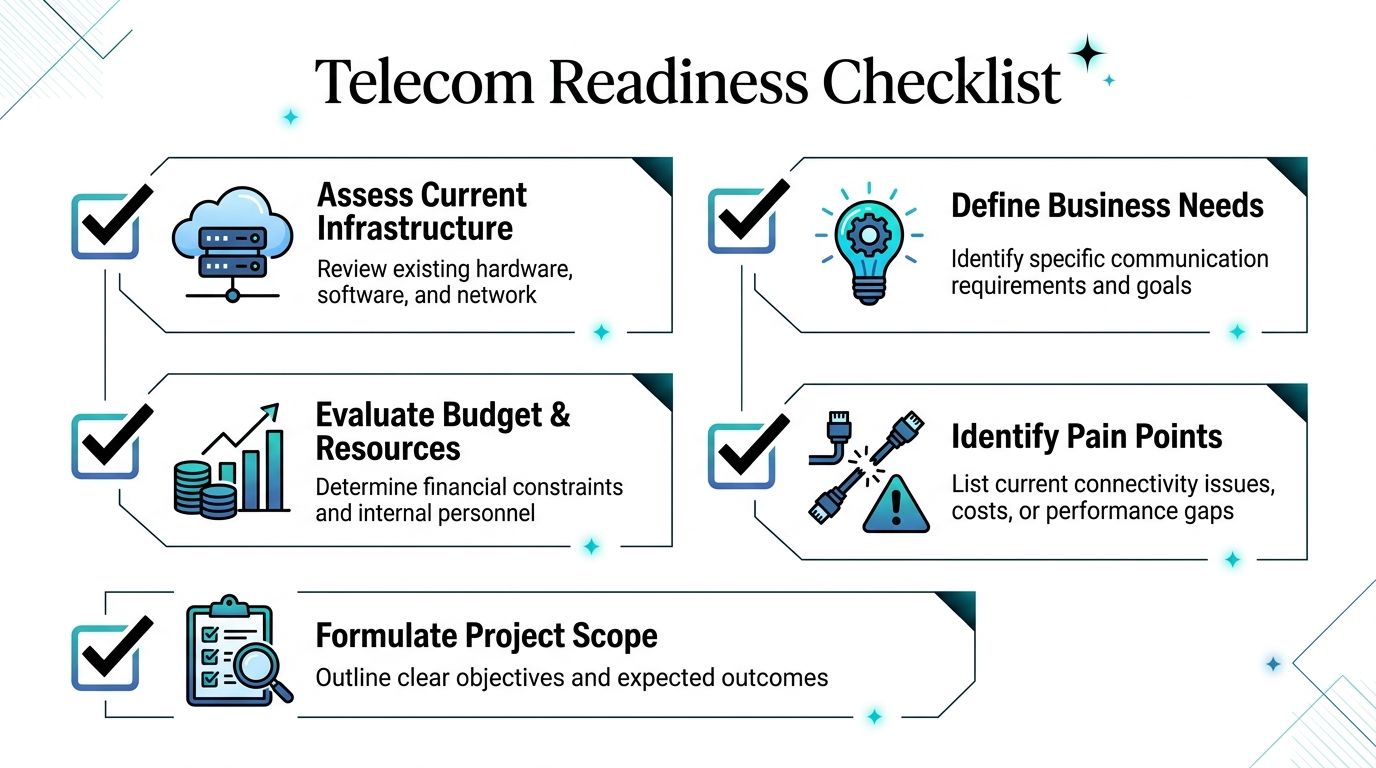
Start by collecting:
Contracts and amendments
Pull carrier master agreements, order forms, renewals, and any side letters. Look for notice windows, auto-renewal language, early termination terms, and pricing protections.Circuit and service inventory
Build a list of every internet circuit, WAN link, voice service, SIP trunk, wireless backup, cloud connect, and managed service. Include location, account number, bandwidth, contract end date, and business owner.Invoices and billing variance
Review several months of bills. Don't just total spend. Look for disconnected sites still billing, bandwidth that no longer matches demand, and product bundles that hide line-item cost.Topology and dependencies
Document what connects where, which applications depend on each path, and which failovers are real versus theoretical.Site-specific constraints
Add landlord rules, security access limits, construction blackout windows, and any site with known delivery headaches.
Define what “success” actually means
A consultant can't solve a vague objective like “improve telecom.” You need measurable outcomes, but that doesn't always mean you need a spreadsheet full of invented precision. It means you need clear operating priorities.
A strong internal brief usually answers questions like these:
- Cost question: Are you trying to reduce recurring spend, prevent a bad renewal, or clean up invoice waste?
- Performance question: Is the pain point latency, packet loss, voice quality, outage frequency, or unstable failover?
- Transformation question: Are you replacing legacy WAN, consolidating vendors, opening new sites, or migrating communications platforms?
- Risk question: Are you trying to improve redundancy, contract control, auditability, or security around retired hardware?
A bad scope asks for “network optimization.” A usable scope asks for an audit, carrier benchmark, target-state design, migration roadmap, and ownership of disconnect tracking.
Build a one-page internal charter
This doesn't need to be fancy. It does need to exist.
Use a short charter with these fields:
| Item | What to document |
|---|---|
| Business drivers | Why the project matters now |
| In-scope locations | Headquarters, branches, data centers, remote hubs |
| Current pain points | Billing, performance, vendor sprawl, contract risk |
| Desired outcomes | Cost control, resiliency, modernization, simplification |
| Internal owners | IT, security, finance, procurement, facilities |
| Hard constraints | Budget rules, timing, compliance, construction limits |
That one page improves every vendor conversation because it forces specificity.
Decide what work stays internal
Not every task should go to the consultant. Some organizations want the consultant to own sourcing, rate benchmarking, and migration planning, while IT retains architecture decisions and carrier escalations. Others want a heavier managed relationship. Both can work.
If you need examples of how providers package managed telecom services near me, compare where they draw the line between advisory work and operational ownership. That distinction matters more than branding.
Key Criteria for Selecting Your LA Telecom Partner
A polished pitch deck doesn't tell you much. The true measure is whether the consultant can bring structure to a messy environment, hold carrier claims to evidence, and stay useful after contract signature.
The strongest firms tend to evaluate your environment the same way every time. According to TM Forum guidance on telco transformation pitfalls, expert telecom consulting follows a five-phase methodology that starts with a current-state audit and often uncovers 20 to 30% of spend tied to unused services. The same methodology relies on standardized vendor RFP templates and SLA scorecards so carriers can be compared on equal terms.

Technical depth beats broad promises
You don't need a consultant who can say “fiber,” “cloud,” and “voice” in the same sentence. You need one who can explain design trade-offs in plain English.
Ask how they approach:
- Primary and secondary path design across office, industrial, and remote locations
- Voice survivability when circuits fail or sites lose local infrastructure
- Cloud connectivity choices when application performance matters more than raw bandwidth
- Carrier handoff planning so migrations don't leave you with overlap billing and orphaned services
- Legacy environment coexistence when the old platform must stay alive during cutover
A technically weak consultant will hide behind generic best practices. A strong one will talk about dependencies, order of operations, and where migration risk sits.
LA market knowledge matters more than logos
Some national firms know telecom well but don't know Los Angeles well. That becomes obvious when they underestimate building access delays, overstate carrier availability, or assume every site can be solved with the same procurement motion.
A consultant with real local experience should be able to discuss:
- Downtown high-density buildings versus lower-density suburban sites
- Carrier-lit buildings versus locations that need construction
- Why one site may need a fast tactical fix while another justifies a cleaner long-term build
- Which stakeholder usually slows delivery, such as landlord management, facilities, construction, or procurement
If a firm talks about “nationwide advantage” but can't describe local delivery friction, keep looking.
SLA discipline separates advisors from brokers
A lot of consultants can get quotes. Fewer can evaluate them properly.
You want a team that can score providers on service-level terms, not just monthly recurring cost. That means asking them to show the scorecard categories they use. Uptime, latency, packet loss, restoration targets, escalation path, and implementation accountability should all be visible.
Here's a simple screening lens:
| Evaluation area | Weak answer | Strong answer |
|---|---|---|
| SLA review | “We compare carrier proposals” | “We score uptime, latency, packet loss, restoration terms, and support commitments” |
| Carrier neutrality | “We work with many providers” | “We document recommendation logic and conflicts” |
| Inventory audit | “We review your environment” | “We reconcile contracts, invoices, and live services line by line” |
| Migration planning | “We support implementation” | “We map dependencies, disconnect timing, and rollback points” |
What works: forcing every bidder into the same response template.
What fails: letting each firm define the evaluation criteria for you.
Pricing model should match the problem
There isn't one right fee model. There is a wrong one for your situation.
Fixed-fee project work fits best when scope is clear. A contract audit, sourcing event, or defined migration plan usually belongs here. The upside is predictability. The risk is change-order games if your internal data is messy.
Retainer-based support works when the environment changes constantly, or when you need recurring telecom expense management, vendor governance, and ongoing optimization. The risk is drift if deliverables aren't explicit.
Gain-share or savings-based pricing can align incentives on cost reduction, but it can also distort behavior. If the consultant only gets paid from savings, they may prioritize short-term spend cuts over architecture quality or operational resilience.
If you're surveying local telecom companies, ask less about who has the broadest partner roster and more about how they structure accountability when invoices, contracts, and implementations don't line up neatly.
Navigating the Unique LA Telecom Carrier Ecosystem
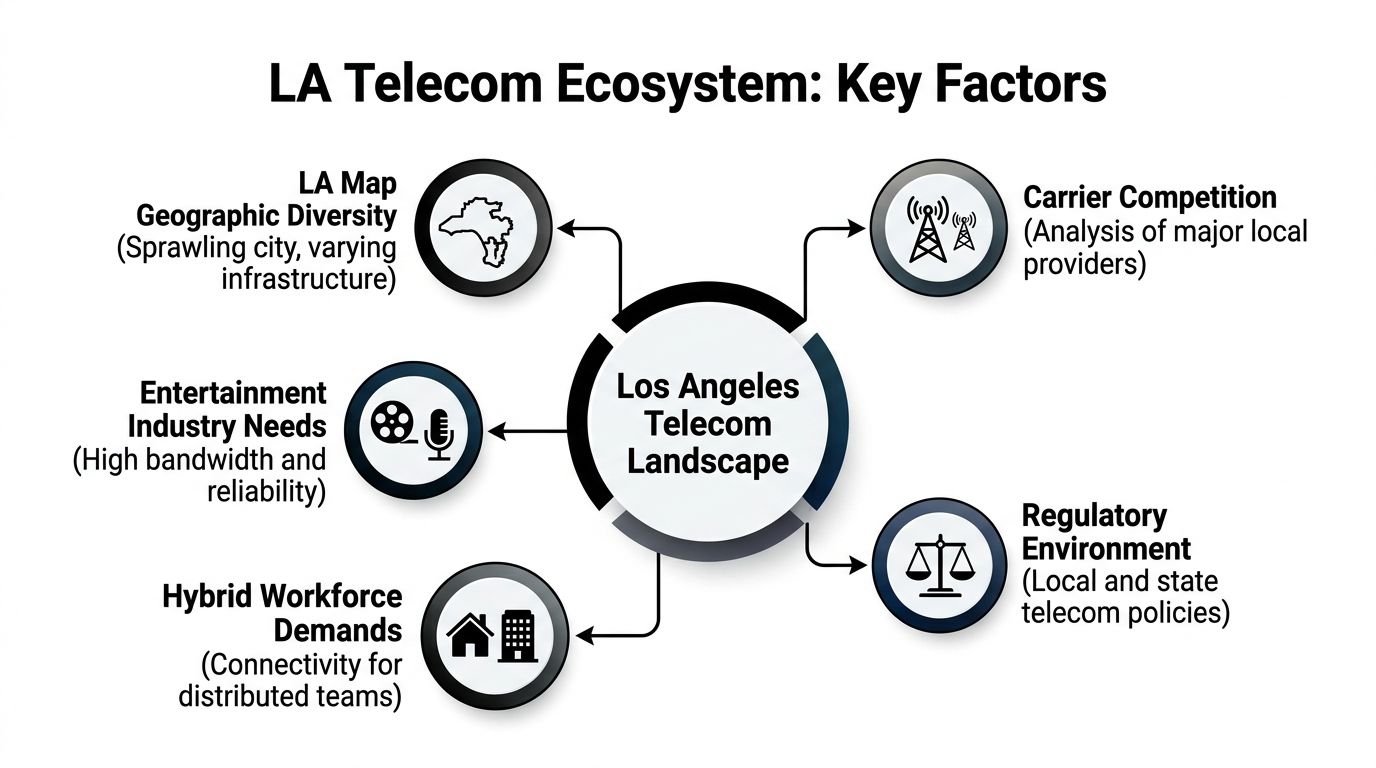
Los Angeles isn't one telecom market. It's a patchwork of micro-markets stitched together by carrier footprints, building conditions, municipal processes, and business use cases.
One project might involve a straightforward carrier refresh in a lit office building. Another might involve a distribution site where the advertised options don't match what's serviceable. A third may look simple until the landlord controls riser access and the implementation schedule slips before the order is even accepted.
The carrier map is only the first draft
In practice, LA consultant interviews should include real questions about providers like AT&T, Lumen, and Spectrum, because those names show up often in enterprise conversations. But the useful question isn't “Do you work with them?” Almost everyone does.
The better questions are:
- Which providers have delivered reliably in buildings similar to ours?
- Which options are strong for diversity versus reselling the same local loop?
- Where do provider maps overstate practical availability?
- Which downtown paths make sense if we need connectivity into hubs like One Wilshire or nearby interconnection-heavy buildings?
A consultant who knows the city will usually answer with caveats. That's a good sign. The LA market punishes certainty that isn't backed by field experience.
Permitting and construction are where plans meet reality
Many selection processes often falter. On paper, multiple providers may appear equivalent. In reality, trenching, conduit access, landlord coordination, and local approvals can turn a “best price” decision into a schedule problem.
The gap between Beverly Hills, downtown LA, and industrial corridors is not academic. It affects lead time, access, and practical install sequencing. A consultant who treats all construction risk as generic project management overhead usually hasn't lived through enough difficult turns.
Local expertise shows up in boring details. Which entrance facility has room. Which riser needs coordination. Which site needs a temporary path because the permanent one won't land cleanly.
Resilience in LA means more than dual circuits
This city has too many variables for checkbox redundancy. Carrier diversity only helps if the paths are diverse, the failover is tested, and the application behavior under impairment is understood.
For many businesses, especially those with production, healthcare, logistics, or customer-facing operations, a resilient design in LA should account for:
- Building-level single points of failure
- Power and cooling dependencies in network closets and intermediate rooms
- Seismically aware infrastructure choices where facility standards require more scrutiny
- Operational fallback plans when the backup path works but key applications still degrade
If you want a sense of how broader firms frame telecom services in Los Angeles, use that only as a starting point. Your consultant should be able to translate market coverage into building-level reality.
From RFP to Shortlist Qualifying Your Top Candidates
A weak RFP produces polished nonsense. Vendors fill in the gaps with assumptions, and then everyone pretends the proposals are comparable. They're not.
The RFP has one job. It should force each consultant to respond to the same operating problem in the same format so you can evaluate method, not marketing.
What to include in the RFP
At minimum, require these components:
Current environment summary
Include site count, service types, known pain points, current vendors, and any timing constraints.Scope boundaries
Be explicit about whether you want expense audit, sourcing, architecture input, migration planning, implementation oversight, TEM support, or all of the above.Required deliverables
Ask for a baseline inventory, contract review, provider comparison matrix, recommended target state, transition roadmap, and disconnect governance plan.Pricing format
Force bidders to break out one-time fees, optional recurring support, pass-through costs, and any compensation tied to carrier placement or savings share.Conflict disclosure
Require a clear statement on carrier relationships, referral compensation, and whether recommendations are carrier-neutral.
The questions that expose shallow firms
Don't waste shortlist interviews on broad prompts like “Tell us about your experience.” Ask questions that require operating detail.
Try questions like these:
- Walk us through your audit process for contracts, circuits, and invoice reconciliation. What do you need from us in week one?
- Show the scorecard you use to compare carrier proposals on SLA quality, not just pricing.
- Describe how you handle a site where the lowest-cost option has the worst delivery risk.
- What's your method for tracking disconnects so we don't keep paying for retired services after migration?
- How do you separate tactical quick wins from decisions that affect the long-term architecture?
- Give an example of where building access or permitting changed the sourcing recommendation.
- Explain how you document circuit diversity rather than accepting the carrier's assumption.
- What happens if implementation reveals inventory inaccuracies that weren't visible in the initial data set?
Red flags in proposal review
Some proposals should be rejected immediately, even if the price is attractive.
| Red flag | Why it matters |
|---|---|
| Generic recommendations before discovery | The firm is selling a template, not solving your environment |
| No conflict disclosure | You may be getting a commissioned carrier placement exercise |
| Weak deliverables | Ambiguity leads to disputes and missed work |
| No disconnect governance | Savings may never show up on the invoice |
| “We'll refine scope after kickoff” everywhere | That usually means future change orders |
Shortlisting advice: If a consultant can't explain how they verify inventory, benchmark carriers, and manage service retirement, they haven't solved the real project. They've only sold the front half of it.
How many firms to shortlist
In most enterprise hiring cycles, three strong finalists are enough. More than that usually creates admin overhead without better decisions. Fewer than that can leave you comparing personalities rather than approaches.
If your team wants a reference point for broader vendor categories, review telecom solutions near me and then tighten your shortlist around firms that can answer your exact scope, not just your market.
Finalizing the Contract and Planning for the Full Lifecycle
Contract negotiation is where a lot of sensible telecom projects pick up hidden risk. Not because anyone plans to fail, but because vague language gets tolerated when the team is eager to move.
That's a mistake. The consulting agreement needs to define what the consultant is responsible for, what evidence counts as completion, and what happens when inventory, billing, or implementation realities change after kickoff.

Contract terms that deserve scrutiny
Pay close attention to these clauses:
Scope definition
“Telecom optimization support” is too vague. The contract should list deliverables, artifacts, and review points.Success metrics
If savings are part of the deal, define how baseline spend is measured, when savings count, and how disconnect lag is handled.Change control
Consultants need protection from true scope expansion. Clients need protection from routine discovery being relabeled as a paid extra.Termination rights
If the relationship goes bad, you need a workable exit. Make sure work product, inventories, and benchmark data are handed over in usable form.Carrier neutrality language
If the consultant receives compensation tied to placement, that should be disclosed and contractually clear.
Don't stop at go-live
Most guides on telecom consulting stop when the new network is installed. That's too narrow. The full lifecycle includes the systems, appliances, handsets, routers, PBX components, security devices, and edge hardware that leave service during modernization.
Many Los Angeles projects encounter a blind spot. According to Bearstone's Los Angeles telecom consulting page, a gap exists where telecom consultants focus on cost savings but ignore integration with IT asset disposition during network upgrades. That oversight creates compliance risk under California e-waste requirements and can miss cost recovery of up to 40% from retired assets, based on the Deloitte figure cited there.
That matters operationally, not just environmentally. When retired telecom gear isn't planned for from the start, several bad things happen:
- Old equipment sits in closets or cages without clear ownership.
- Devices with storage or configuration data don't move through a documented destruction process.
- Finance doesn't get visibility into reuse, resale, or recovery opportunities.
- Facilities and operations teams inherit cleanup work that should have been part of the project.
The cleanest upgrade plans include decommissioning criteria before the first order is placed, not after the old equipment starts piling up.
Add ITAD language into the project plan
If legacy telecom equipment will be removed, the consultant should coordinate with your internal asset, security, and compliance stakeholders early. That doesn't mean the consultant has to perform ITAD. It does mean they should plan around it.
Your project plan should answer:
| Lifecycle question | What good planning looks like |
|---|---|
| What gear is being replaced | Asset list tied to the migration scope |
| Who approves retirement | Named owners in IT, security, and finance |
| When equipment leaves service | Date linked to cutover and validation |
| How data risk is handled | Documented chain of custody and destruction path |
| Whether recovery is possible | Review for reuse, resale, or recycling value |
That's the part many telecom consulting services Los Angeles buyers miss. They hire for advisory work, sign for migration support, and only later realize the project also created a disposal, data security, and compliance workflow they never assigned.
Ensuring Success Post-Hire and Answering Key Questions
The first month after signature tells you whether the engagement will be disciplined or chaotic. Good consultants establish cadence quickly. Weak ones disappear into discovery meetings and come back with vague observations.
The operating model matters as much as the recommendation set. According to telecom consulting success benchmarks from Innowave Telco, projects using a hybrid, phased implementation model report 60 to 75% success rates in achieving savings targets, typically 20 to 30%. The same source notes that over 70% of digital-telco projects fail without a dedicated governance function to track KPIs and manage risk.
Set governance before the work spreads
Create a small control structure early. It doesn't need bureaucracy. It needs ownership.
Use a rhythm like this:
- Weekly working session for inventory issues, carrier actions, and open dependencies
- Monthly steering review with IT, finance, procurement, and any site stakeholders who can unblock delivery
- Decision log for architecture calls, vendor selection, disconnect approvals, and exceptions
- Risk register for access delays, circuit overlap, billing disputes, and hardware retirement items
If nobody owns the meeting cadence, the consultant will end up chasing inputs. Then the project drifts.
Track KPIs that reflect operations, not just savings
Savings matter. They're not enough.
A better KPI set usually includes a mix of financial and service measures:
- Invoice reduction or avoided spend
- Network uptime and outage trend
- Carrier delivery milestones
- Cutover success by site
- Disconnect completion
- Issue resolution time
- Legacy hardware retirement status
The KPI list should be short enough to review every month and specific enough that each item has an owner.
Good governance sounds boring. That's why it works. Projects fail when everyone assumes someone else is tracking the gaps between contracts, circuits, invoices, and old equipment.
Key questions IT leaders usually ask
How long should I expect discovery to take
Long enough to validate inventory, contracts, and invoices properly. If a consultant claims they can meaningfully redesign the environment without reconciling those basics, that's a warning sign.
Should I hire a carrier broker or a true consultant
It depends on the problem. If you only need quotes for a simple site, a broker may be enough. If you need audit work, architecture input, favorable contract terms, migration governance, and end-of-life planning for retired gear, hire a consultant with a wider scope.
What should the consultant deliver in the first phase
A reliable baseline. That usually means an inventory, contract view, current-state issues list, and a roadmap that shows what gets tackled first and why.
Who should be involved internally
IT should lead, but finance, procurement, security, and facilities should not be brought in at the end. Telecom projects touch billing, contracts, physical access, and equipment retirement. Cross-functional involvement prevents rework.
When should ITAD planning begin
At the beginning. If you wait until after cutovers, retired telecom gear becomes an orphaned task with compliance and security implications.
If your network modernization will retire routers, PBX hardware, switches, edge devices, or data center equipment, planning secure disposition early will save time and reduce risk later. Dallas Fortworth Computer Recycling supports organizations nationwide with secure, compliant IT asset disposition, certified data destruction, and responsible electronics recycling, making them a practical partner when telecom upgrades create a downstream hardware retirement problem your consulting firm didn't scope.