
Find Your Top Telecom Solutions Provider Houston in 2026

You're probably dealing with some version of the same problem I see in first-time telecom overhauls across Houston. The business has outgrown a mix of old PRI lines, inconsistent branch connectivity, separate internet and voice contracts, and a help desk that spends too much time chasing carriers instead of fixing root causes. Leadership wants better uptime, cleaner collaboration, and fewer surprises. IT wants one decision it won't regret a year from now.
That's why choosing a telecom solutions provider in Houston isn't a shopping exercise. It's an operating model decision. You're not just buying bandwidth, phones, or circuits. You're deciding how your company will support hybrid staff, cloud applications, site growth, outage response, and eventually the retirement of the hardware you replace along the way.
Navigating the Complex Houston Telecom Market
A Houston company opens a second site, adds more cloud applications, and suddenly the old telecom setup starts showing its age. Voice quality drops during busy hours. Internet failover exists on paper but not in practice. Support tickets bounce between carriers, the firewall team, and the phone vendor. By the time leadership asks for a provider recommendation, the market already feels crowded.
Houston is a difficult market to operate in because it is both established and fragmented. Buyers have real choice here, which is useful only if the evaluation stays tied to business risk, operating fit, and local support quality. A quick review of the Houston telecom services categories and provider types can help frame the field before outreach starts.
Why Houston buying gets messy fast
The confusion usually starts with loose project language. If the requirement is "better internet" or "a new phone system," providers respond with packaged offers that look similar in a spreadsheet and behave very differently in production. Differences sit below the headline price: single-carrier last mile versus path diversity, hosted voice versus full UCaaS, managed SD-WAN versus internal oversight, and whether you can reach a Houston-based escalation contact when a branch is down.
Local operating conditions make those choices matter more. Many Houston organizations have a mix of offices, warehouses, plants, field staff, and remote users. Some also need to account for storm exposure, flood risk, and uneven building connectivity across older commercial properties and newer developments. A provider that looks acceptable in a standard demo can struggle once you test installation timelines, circuit availability, and outage response under local conditions.
One rule helps cut through the noise.
Practical rule: If outage response still depends on calling separate vendors for internet, voice, firewall support, and circuit status, you do not have a telecom strategy. You have a stack of contracts.
What a good process should produce
A disciplined buying process should produce three outputs:
- A clear target state: The WAN, voice, cloud connectivity, and failover design your business needs.
- A shortlist with a reason behind it: Providers that fit your footprint, resilience requirements, support expectations, and internal staffing model.
- A lifecycle plan: Deployment, steady-state support, and secure retirement of replaced hardware.
That last item gets skipped too often. A telecom refresh leaves behind phones, switches, routers, edge appliances, batteries, and other gear that may still hold configuration data, call records, credentials, or regulated information. In healthcare, finance, legal, energy, and public-sector environments, retiring that equipment without a documented IT asset disposition process creates an avoidable compliance and security problem.
The Houston market rewards buyers who treat telecom as part of the full IT lifecycle. The right provider matters, but so do resilience planning, clean deployment ownership, and a defensible plan for what happens to aging hardware after cutover.
Defining Your Modern Telecom Requirements
Most telecom projects go sideways before the first provider meeting. The team jumps into demos and quotes without translating business needs into technical requirements. That usually leads to overbuying in some areas and under-designing the ones that matter most.
Houston provider guidance for 2026 puts high-speed internet, hosted VoIP, UCaaS, and internet failover in the baseline category, not the premium category. The same guidance also notes national trends showing AI tools could improve telecom workforce productivity by 15% to 25% and reduce back-office costs by up to 20% over the next five years (Houston telecom guidance for 2026). For buyers, the takeaway is simple. Modern telecom is no longer a phone and circuit purchase. It's an operational platform.
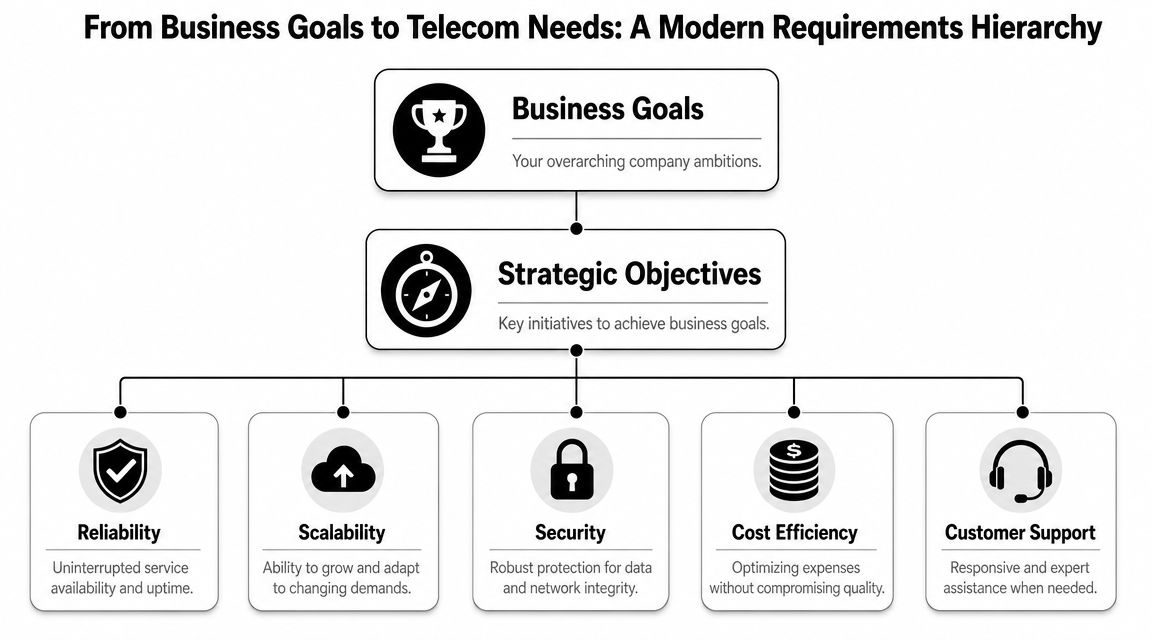
Start with business pressure, not products
If you begin with product names, you'll miss why the purchase matters. Start by asking what the business is trying to protect or enable.
For example:
- A distributed workforce usually points toward UCaaS, mobile-friendly call handling, and simpler user administration.
- Several offices or sites usually point toward SD-WAN, centralized visibility, and a standard branch design.
- Cloud application complaints often indicate inconsistent WAN policy, poor circuit diversity, or unmanaged quality issues.
- Strict compliance expectations push security logging, data handling, audit support, and documented change control much higher on the list.
Consider building requirements for a vehicle fleet. “We need trucks” is too vague. You need to know payload, terrain, route length, downtime tolerance, and maintenance support. Telecom is the same.
Audit your current state with a hard eye
Before talking to vendors, document what you already have. Not what you think you have. What is in production.
Your internal audit should cover:
Circuit inventory
List every internet connection, backup link, contract owner, term date, and location.Voice environment
Identify PBX platforms, handsets, contact center tools, call flows, and number porting dependencies.Network edge and branch gear
Record routers, firewalls, switches, LTE or 5G failover devices, and any managed hardware already under contract.Application dependency
Note which business systems break first during latency, packet loss, or outage conditions.Support burden
Track where your team loses time. Escalations, provisioning delays, finger-pointing between vendors, poor change communication, and weak ticket ownership all belong here.
A practical market scan can help you compare this against available service types in the city. Reviewing the local market of broadband providers in Houston often reveals whether your current connectivity model is outdated for your footprint.
Turn business goals into technical requirements
Once the audit is done, build a requirements document that providers must respond to. Many teams remain too superficial at this stage. They list “VoIP,” “SD-WAN,” and “fiber” without defining operating expectations.
Use requirement statements like these instead:
- Voice continuity: Calls must continue through branch outages using mobile or secondary path failover.
- Branch standardization: New sites must follow one approved design for circuit handoff, routing, voice, and monitoring.
- Remote user support: Home and mobile staff need reliable collaboration without full VPN complexity for every basic communication task.
- Operational visibility: IT needs centralized monitoring, alerting, and a clean escalation path.
- Scalability: The provider must support new office activation, user adds, and service changes without custom redesign each time.
Buy outcomes first. Products are just the packaging.
Define what “good” actually means
A lot of telecom requirements fail because they stop at features. Features don't tell you whether the deployment will work under pressure.
A better requirements document defines success in operational language:
| Requirement Area | What to Define Internally | What Vendors Must Answer |
|---|---|---|
| Connectivity | Primary and backup path expectations | How they deliver failover and monitor both paths |
| Voice | Calling patterns, remote users, call routing | How they handle continuity, porting, and administration |
| Multi-site networking | Site types, cloud traffic, branch standards | How they design SD-WAN policy and branch templates |
| Support | Escalation expectations, after-hours coverage | Who owns incidents and how local support responds |
| Growth | New sites, M&A, seasonal changes | How quickly they can extend the standard architecture |
If your requirements are crisp, providers have to show their work. If your requirements are vague, they'll fill the gaps with assumptions, and you'll end up inheriting those assumptions during deployment.
Building Your Houston Vendor Shortlist
A Houston firm usually starts shortlisting vendors after a trigger event. The lease is signed on a second site. A call center platform is failing during peak hours. Leadership wants to retire aging voice gear and fold telecom into a broader IT refresh. At that point, the wrong shortlist creates months of wasted meetings, bad pricing comparisons, and proposals that do not match how the business operates.
Houston gives buyers real choice. Large carriers, regional providers, master agents, and managed service firms all compete here. That helps, but it also creates noise. I usually tell clients to treat the shortlist as a filtering exercise, not a popularity contest. The goal is to identify providers that can support your sites, your uptime targets, your compliance needs, and the full lifecycle of the environment after install.
Group vendors by delivery model
Start by separating providers into categories that reflect how they deliver service.
Carrier-led providers are often the right fit when you want direct ownership of core transport, fewer parties in the support chain, and standardized service across several sites. They tend to work best in environments with clear requirements and stable branch templates.
Regional specialists and local integrators can be stronger when the rollout includes site-by-site exceptions, older wiring closets, mixed voice requirements, or heavy coordination with building management. In Houston, that matters more than many buyers expect. Flood exposure, generator planning, and building access rules can turn a simple turn-up into a messy project if the provider has never handled those conditions before.
Advisers, brokers, and multi-carrier managed firms can reduce sourcing effort if your footprint crosses serviceability boundaries or you want one point of commercial management. The trade-off is simple. You need to know exactly where accountability sits when a circuit fails, a port stalls, or a branch cutover slips.
Cut the list with practical filters
A vendor belongs on the shortlist only if it clears a few early screens.
- Houston service reality: Can it deliver to your addresses, including backup options, or is it just quoting broad coverage?
- Local operating depth: Does it have local project management, field coordination, or trusted dispatch coverage for hands-on work?
- Industry exposure: Has it handled environments like healthcare, energy, legal, logistics, or multi-site retail where downtime and record handling carry real consequences?
- Architecture fit: Can it support the stack you are standardizing on without forcing a redesign?
- Lifecycle discipline: Does it address hardware retirement, recordkeeping, and secure disposition when old telecom gear comes out of service?
That last point gets missed constantly. A provider can install new edge devices, handsets, or conferencing hardware and still leave your team with a pile of retired equipment containing call logs, stored credentials, and configuration data. For regulated businesses, shortlist vendors that can either manage that process directly or coordinate with your internal ITAD process without creating a custody gap.
Compare support behavior, not just product menus
Marketing pages make providers look interchangeable. Operations do not.
Large providers often have stronger procurement power, established carrier relationships, and cleaner standard offers. They can also struggle when your project needs exception handling, close scheduling control, or fast answers from the same people week after week. Smaller firms may communicate better and own the design more tightly, but some depend on upstream carriers for pieces of the service they do not directly control.
Neither model is automatically better. The risk sits in the handoff points.
Ask one early question: who owns the problem at 8:30 p.m. when a Houston office loses primary connectivity and voice registration starts dropping? If the answer is vague during shortlisting, it will be worse after contract signature.
Use a weighted scorecard before meetings start
A scorecard keeps the team from rewarding the best sales presentation. I prefer a simple weighted model with no more than six criteria, because anything more usually turns into theater.
| Shortlist Factor | What You Are Testing |
|---|---|
| Serviceability | Actual support for each site, including primary and backup path options |
| Deployment fit | Ability to handle your building conditions, cutover windows, and branch complexity |
| Support ownership | Clear responsibility for incidents, escalation, and after-hours response |
| Security and compliance | Handling of access control, logging, data exposure risk, and retired hardware disposition |
| Commercial clarity | Pricing, contract terms, installation charges, and change order discipline |
| Growth fit | Ability to add sites, users, and services without rebuilding the design |
For teams evaluating smaller firms, this review of small business telecom providers in Houston is a useful cross-check. It helps clarify which providers compete on flexibility, support access, and niche service models versus pure scale.
Keep the field tight
Three to five vendors is usually enough for a first major telecom overhaul. More than that burns time and makes side-by-side evaluation worse, not better.
By the end of shortlisting, every candidate should pass three tests:
| Shortlist Test | What It Means |
|---|---|
| Real serviceability | The provider can support your sites, not just market into Houston |
| Real operating fit | Its delivery and support model matches your internal team and risk tolerance |
| Real lifecycle fit | It can support deployment, ongoing changes, and controlled retirement of replaced telecom assets |
If a provider cannot explain support ownership, local execution, and what happens to retired hardware after the cutover, it has not earned a place on the shortlist.
The Strategic RFP and Deep Vetting Process
A telecom RFP should force providers to reveal how they operate. If all you ask for is pricing on internet, voice, and managed services, you'll get polished proposals that hide the weaknesses until contract signature or deployment kickoff.
A better RFP reads like an investigation. It tests scope discipline, implementation maturity, support mechanics, resilience design, and commercial transparency. It also tells vendors that your team knows what to ask.
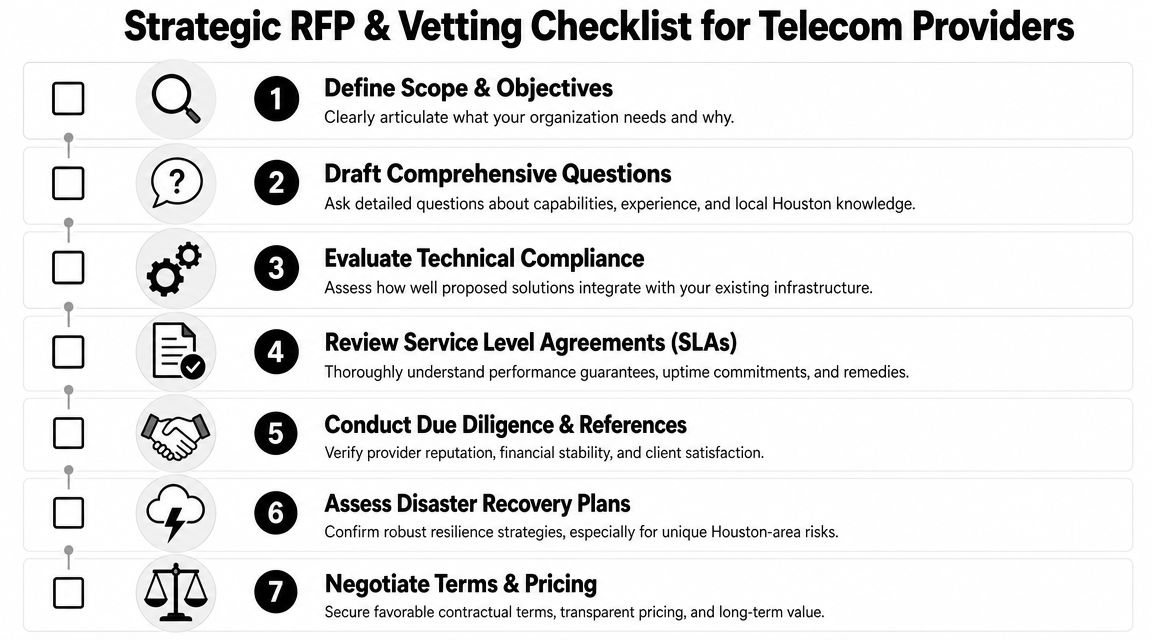
Ask questions that expose the delivery model
Many proposals look strong until you ask who owns the service after go-live. That's where the gap appears between sales language and operational reality.
Your RFP should require responses on:
- Implementation ownership: Who manages number porting, cutovers, site coordination, and testing?
- Escalation path: What happens when a circuit fails after hours or a branch loses voice service?
- Monitoring model: What is proactively monitored, and what only gets addressed after the customer opens a ticket?
- Change management: How are adds, moves, policy changes, and branch upgrades requested and documented?
- Service boundaries: Which components are fully managed, partially managed, or customer-owned?
A useful local comparison point is this roundup of local telecom companies, which helps distinguish broad marketing claims from the practical questions buyers should ask in a live procurement process.
Vet AI and automation through operations, not marketing
Many buyers often get distracted. Providers increasingly talk about automation, AI-enhanced support, and digital operations. Those ideas matter, but only if they show up in measurable service delivery.
McKinsey notes that top-tier telecom transformations prioritize efficiency through digital technologies and gen AI in customer service, and that buyers should insist on metrics for network operations, service assurance, ticket deflection, and Mean Time To Resolution because those are areas where AI is already showing strong returns (McKinsey on the future of telcos). That doesn't mean every provider has to sound like a software company. It does mean they should show evidence that automation improves customer experience.
Ask for examples of how they use telemetry, event correlation, automated triage, or proactive alerting in production support. If the answer stays at the marketing level, keep pushing.
A provider doesn't earn points for saying “AI.” It earns points for proving incidents get identified faster, routed correctly, and resolved with fewer handoffs.
Review SLAs like contract language, not brochure text
The SLA isn't a decorative attachment. It's the document that tells you what the provider is willing to stand behind.
Focus on:
| Category | Question | Why It Matters |
|---|---|---|
| Uptime | What service levels are contractually committed, and what remedies apply if they miss them? | You need enforceable accountability, not informal promises |
| Latency and quality | How do they define acceptable latency, jitter, and packet loss for voice and cloud traffic? | Voice and real-time collaboration break long before a full outage |
| Monitoring | Is the service proactively monitored around the clock, and what events trigger action automatically? | Reactive support creates longer business disruption |
| Escalation | What are the severity definitions and response expectations? | A branch outage and a minor ticket shouldn't enter the same queue |
| Support ownership | Who owns carrier coordination if underlying access fails? | Finger-pointing between vendors is a common source of delay |
| Security | How do they handle admin access, logs, configuration changes, and customer data? | Telecom services now sit close to sensitive business operations |
| Resilience | How is failover designed, tested, and supported? | Backup service that isn't validated often fails when needed most |
Push beyond compliance checkboxes
Security reviews often become a paperwork exercise. Buyers ask whether the vendor has certain certifications or policies, then move on. That misses the operational side of telecom risk.
You need to know:
- Who can access your environment and under what controls
- How changes are logged and approved
- How incidents are communicated during an outage
- How customer data is handled when devices are replaced or services are migrated
This last point matters more than many teams realize. A telecom overhaul often leaves behind devices and media that still contain configurations, call data, credentials, or business information. If the RFP ignores end-of-life handling, the project stays incomplete from a risk standpoint.
Use references to verify behavior under stress
Reference calls shouldn't be generic. Ask each reference what happened when the provider missed a date, mishandled a port, faced a major outage, or had to support a difficult site.
Here are the questions that usually produce honest answers:
- What changed after contract signature?
- How often did you need to escalate?
- Did the implementation team match the sales promise?
- How clear was communication during service disruption?
- Would you buy the same scope from them again?
Those answers tell you much more than a polished customer testimonial ever will.
Decoding Proposals and Planning Deployment
When proposals arrive, many organizations look first at monthly recurring cost. That's understandable, but it's also where expensive mistakes begin. The cheaper proposal often becomes the costlier one after installation charges, change fees, support gaps, and redesign work show up.
The better approach is to compare commercial structure, technical assumptions, and deployment realism side by side.
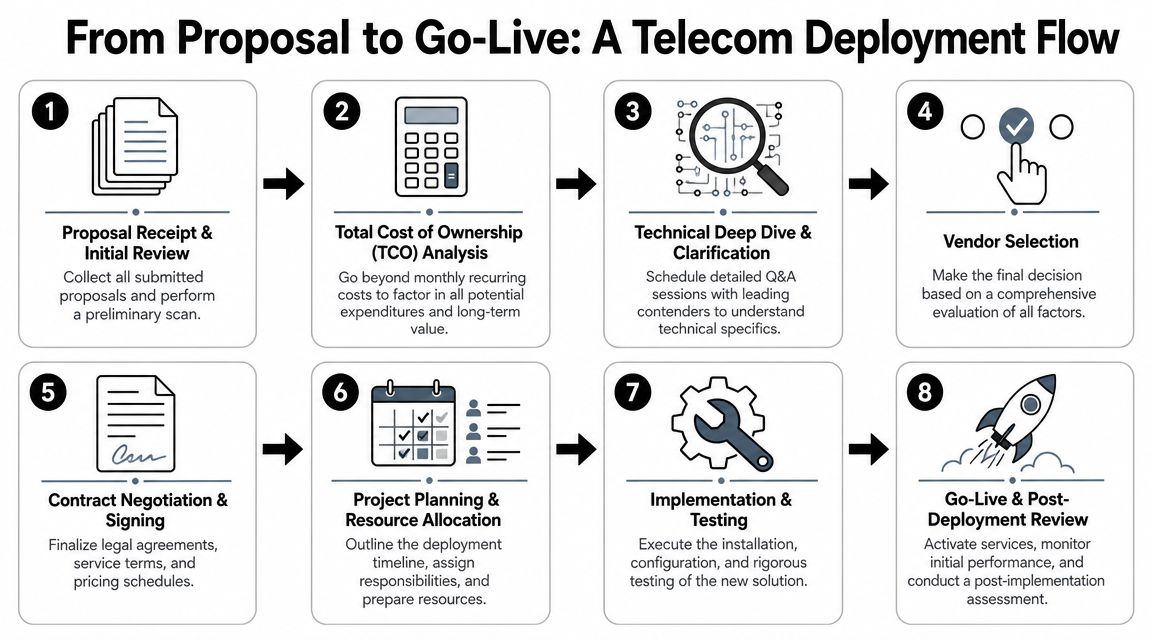
Read the proposal for assumptions first
Before comparing numbers, identify what each vendor assumed about your environment. One may include managed hardware while another expects you to supply it. One may price failover. Another may mention it as optional. One may include onboarding and training. Another may leave those tasks to your internal team.
That's why line-by-line price comparison often fails. You're not comparing the same service, even when the proposal headings look similar.
Compare total cost of ownership, not just recurring spend
A practical proposal review should include these cost buckets:
- Monthly recurring charges: internet, voice, managed services, licensing
- One-time charges: installation, activation, migration, porting, professional services
- Operational costs: internal labor, support overlap, added monitoring tools, after-hours change support
- Change costs: future site adds, MACDs, policy updates, handset swaps, branch rework
- Exit costs: contract terms, early termination exposure, hardware return obligations
A proposal with a lower monthly number can still be a weak commercial fit if it pushes too much work back onto your staff or leaves key pieces undefined.
Use a gated deployment model
Bain's telecom guidance points to a disciplined four-gate rollout: assess current usage, standardize the target architecture, pilot with a limited site set, and then scale with centralized monitoring. In the cited case context, this approach was associated with up to a 30% reduction in service deployment times and 20% operational cost savings when process mapping and change management were optimized (Bain on battling telecom goliaths).
That four-gate model works because it prevents a common first-time buyer mistake. Rolling out everywhere before you've validated branch templates, failover behavior, and support workflows.
Don't let a provider turn “pilot” into a symbolic demo. A real pilot should test the ugliest parts of your environment, not the easiest site in the portfolio.
Build the deployment plan jointly
The best providers co-build the implementation plan with your team. They don't just send a project schedule and ask for approval.
Your joint plan should define:
| Deployment Area | What Needs to Be Explicit |
|---|---|
| Milestones | Discovery, ordering, porting, staging, testing, cutover, post-go-live review |
| Roles | Who owns internal coordination, vendor PM tasks, branch contacts, and executive escalation |
| Training | End-user training, admin training, support desk handoff, quick-reference materials |
| Testing | Voice quality checks, failover validation, call routing, branch connectivity, monitoring alerts |
| Communications | Change windows, user notices, leadership updates, issue reporting path |
A realistic deployment also protects business continuity. Number porting, handset turnover, contact center changes, and branch cutovers should be scheduled based on operating impact, not just vendor convenience.
If the preferred vendor can't explain how it manages pilot feedback, remediates issues before scale-up, and documents lessons learned, the deployment risk is still high no matter how attractive the quote looks.
Beyond Installation Managing Risk and Lifecycle
Many teams act as if the project ends when users can make calls and branches are online. That's the wrong finish line. In Houston, a telecom decision has to hold up during storms, flood risk, utility disruption, and the messy reality of equipment refresh cycles.
The biggest blind spot I see is that resilience and retirement planning get treated as secondary topics. They shouldn't be. They belong in the original selection criteria.
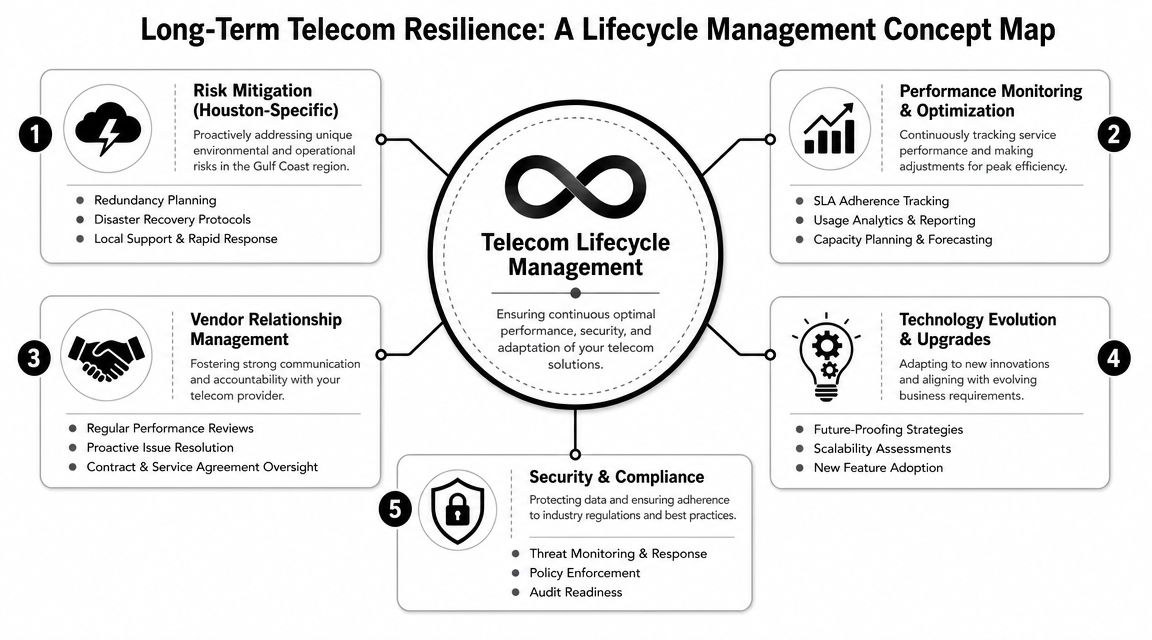
Design for Houston conditions
A key gap in much provider content is planning for Houston's outage risks from hurricanes and floods. Current buyer guidance argues that modern selection criteria should prioritize availability engineering, including managed failover and multi-site redundancy, as baseline requirements rather than premium add-ons (Houston telecom provider selection guidance).
That means asking different questions during design:
- If a building loses primary connectivity, what path takes over?
- If the primary carrier has a local outage, is the backup diverse?
- If staff can't access one office, how do calls, collaboration, and customer contact continue?
- If the local site is impaired, what support remains reachable and responsible?
What resilience looks like in practice
Resilience is usually built from a few concrete design choices, not one grand solution.
Diverse entry and last-mile planning matters more than many buyers realize. Two circuits from the same provider that enter the same way may satisfy a spreadsheet, but not a real outage.
Automatic failover needs validation, not assumption. If the branch depends on backup wireless or a secondary path, test it under real cut conditions.
Central monitoring should include service health and incident ownership. Visibility without action doesn't reduce downtime.
The backup path only counts if your team has seen it work, knows how traffic behaves during failover, and knows who gets alerted first.
Don't ignore the retired hardware problem
A telecom overhaul leaves a trail behind it. Legacy PBX hardware, desk phones, routers, firewalls, network appliances, UPS batteries, storage media, and cabling all need a documented end-of-life path.
This issue is often ignored in Houston-facing telecom content, even though migration, merger activity, and infrastructure refreshes create exactly these retirement events. The buying gap matters because organizations need secure decommissioning, documented chain of custody, and responsible recycling when old telecom assets leave service (dark fiber and telecom infrastructure buying context).
For regulated organizations, the risk isn't theoretical. Old devices can still contain call records, admin settings, credentials, configuration files, and other sensitive information. A telecom provider may not handle any of that for you unless you ask directly.
Add ITAD to the project plan from day one
The full lifecycle view changes the quality of the project. Add a retirement workstream alongside deployment.
That workstream should cover:
Asset identification
What's being removed, from which sites, and who owns it.Data-bearing risk review
Which devices may retain sensitive information or usable configuration data.Chain of custody
How equipment is tracked from removal through final disposition.Data destruction documentation
What proof the organization requires for audit and compliance purposes.Environmental handling
How batteries, electronics, and mixed telecom scrap are processed responsibly.
For teams that need a practical framework, this guide to IT equipment recycling for telecom in Houston is a useful reminder that telecom refreshes create downstream obligations, not just deployment wins.
A provider that installs cleanly but leaves your retired hardware unmanaged hasn't solved the whole problem.
Making a Confident Final Decision
The final decision should be easy to explain in one sentence to leadership. Choose the provider that best supports business continuity, operating simplicity, and long-term risk control. Not the one with the prettiest slide deck or the lowest opening number.
If you've done the work properly, the winner should stand out for a few practical reasons. Its design matches your actual environment. Its support model is clear under pressure. Its SLA language is specific. Its deployment plan is realistic. Its resilience posture fits Houston. And your team knows what happens to both the new environment and the equipment being retired.
That's the shift that matters. You're not buying telecom as a utility line item. You're selecting a partner that will affect uptime, user experience, internal workload, and audit exposure for years.
A first major telecom overhaul can feel heavy because it touches so many parts of the business at once. But the process becomes manageable when you force clarity at each step: define requirements, narrow the field, thoroughly vet, objectively compare proposals, and treat lifecycle risk as part of the original project.
Make the decision that reduces operational friction later. That's usually the right one.
If your Houston telecom upgrade is also leaving behind phones, network gear, batteries, or other retired technology, Dallas Fortworth Computer Recycling can help you close the loop securely. The company supports organizations that need compliant IT asset disposition, certified data destruction, and documented chain of custody, which is especially important when telecom refresh projects create regulated end-of-life equipment that can't be handled casually.