
Telecom Installation Company Chicago: Expert Guide

You're probably dealing with this right now. A lease is ending, a floor is being reconfigured, a data room has to be cleaned up, or a business unit wants better bandwidth and cleaner carrier handoffs before the next busy season. The pressure isn't just technical. It's operational, financial, and political. If the cutover slips, users complain. If the scope is fuzzy, change orders stack up. If the old gear gets pulled without a plan, you inherit a compliance problem after the new network is already live.
That's why choosing a telecom installation company in Chicago deserves more rigor than a quick bid comparison. In this market, installation isn't just about cable pulls and rack work. It's a coordination exercise across buildings, carriers, facilities teams, procurement, security, and eventually decommissioning. The teams that handle it well think in lifecycle terms from day one.
Why Choosing a Telecom Installer in Chicago is Different
Chicago creates a different kind of telecom project. You might be planning a downtown office move, a warehouse refresh, a hospital renovation, or a multi-site enterprise rollout. On paper, the work may look familiar. In practice, Chicago adds density, older building conditions, stricter coordination demands, and a telecom footprint that has been important for decades.
That history matters. Chicago has long been a foundational telecom market. In 1977, AT&T installed the first optical telephone communication system under downtown Chicago, using optical fibers to transmit information 65,000 times faster than traditional copper wires, and today the city ranks #4 among top U.S. data center markets with recognized strengths in fiber connectivity and cloud availability. The same market also saw data center absorption increase by 79 MW from 2021 to 2022, according to Skybox Datacenters' overview of Chicago's telecom roots and current data center position.
That mix of legacy infrastructure and modern demand is what makes vendor selection harder. Your installer has to understand old risers, crowded pathways, active production spaces, and the expectations that come with enterprise-grade uptime.
For buyers evaluating a telecom installation company Chicago firms often resemble one another at a glance. Most can quote labor. Fewer can manage pathing constraints, carrier dependencies, and clean documentation in a way that reduces project risk. A useful local reference point is this overview of telecommunications services in Chicago, which reflects how broad the service mix can be.
Practical rule: In Chicago, the contractor who understands building access, carrier coordination, and cutover discipline is usually more valuable than the one who simply offers the lowest labor rate.
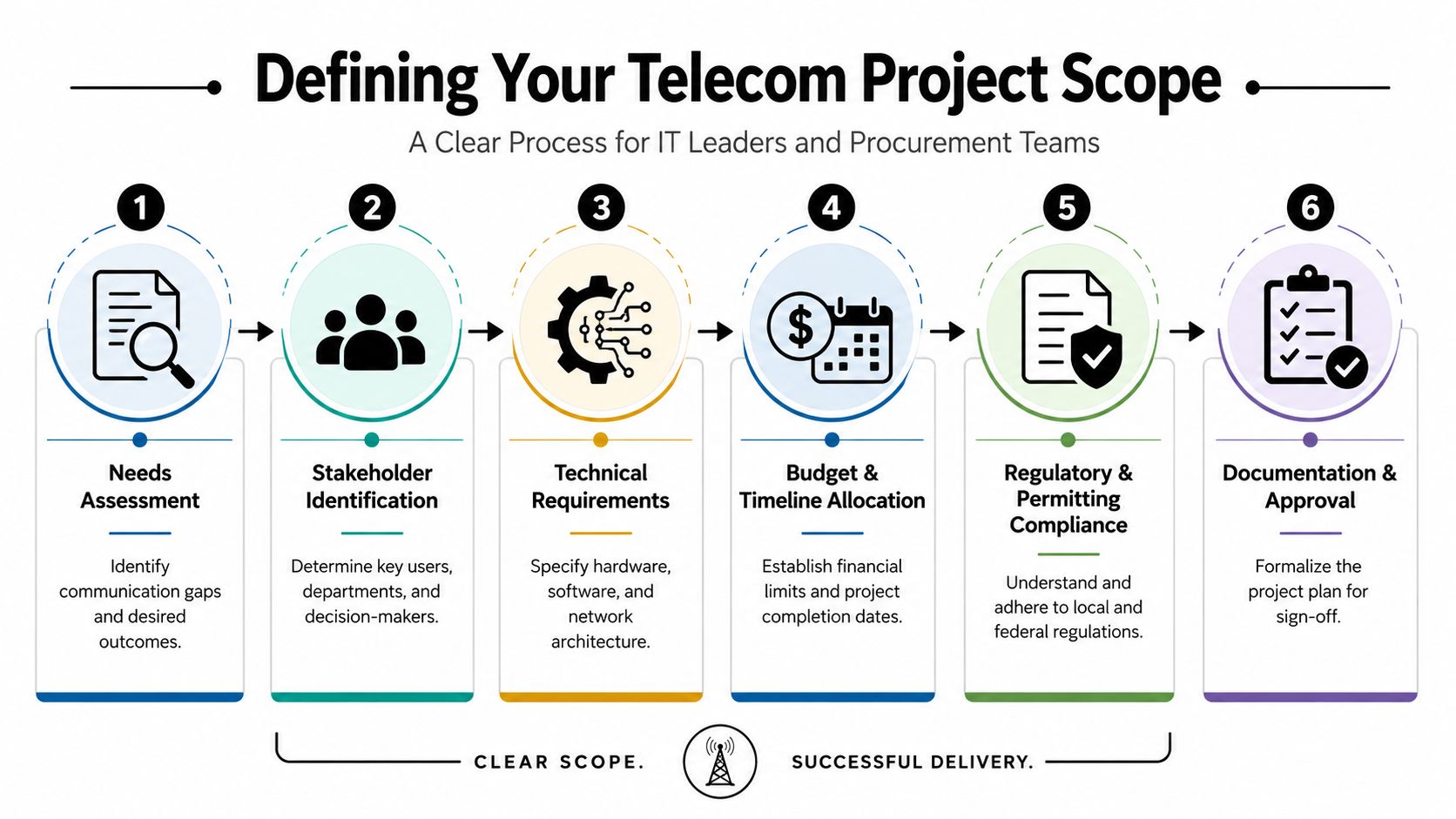
Defining Your Project Scope and Requirements
The quality of your installer shortlist depends on the quality of your scope. If your statement of work is vague, every bid will look artificially attractive. Then the project starts, assumptions surface, and the actual price appears through change orders, schedule slips, and finger-pointing between facilities, IT, and the vendor.
A solid scope defines more than “install cabling and turn up service.” It should describe the environment, the endpoints, the dependencies, the acceptance criteria, and what happens to the gear being replaced. It should also make clear what your team owns versus what the installer owns.
Build the scope around the full operating environment
Start with the site conditions. A downtown high-rise floor with limited riser access is different from a suburban office, and both are different from a warehouse, data center, clinic, or public-sector facility. The physical environment changes labor sequencing, staging needs, access windows, and material choices.
Use this as a minimum scope framework:
- Business outcome: Are you supporting an office move, carrier change, network refresh, floor re-stack, M&A consolidation, or a new site opening?
- Physical environment: Document risers, conduits, MDF and IDF locations, rack elevations, ladder tray, ceiling type, floor type, and after-hours access rules.
- Network scope: Identify backbone fiber, horizontal cabling, wireless access point drops, carrier demarc extensions, cross-connects, patching, rack and stack, and labeling standards.
- Dependencies: List carrier delivery dates, building approvals, power readiness, security access, and application cutover windows.
- Retired assets: Define what gets disconnected, removed, stored, remarketed, recycled, or destroyed.
If you want vendors to bid intelligently, give them the same facts. Don't let one bidder assume existing pathways are reusable while another assumes net new pathways and firestopping. Those mismatches make price comparisons meaningless.
Price drivers that change the project fast
A lot of telecom budgets go sideways because the initial request leaves out basic design and installation conditions. You don't need to over-engineer the RFP, but you do need to identify the variables that affect labor and sequencing.
Common examples include:
- Retrofit versus clean build: Retrofits usually require more tracing, demolition, patching, access coordination, and workarounds around occupied space.
- Cabling type and pathway constraints: The difference between standard office runs and tighter, higher-spec environments affects both materials and testing expectations.
- Occupied versus unoccupied work areas: Work in active facilities often shifts to evenings or weekends and requires more communication with users and building operations.
- Data center or MDF work: Dense rack environments increase the importance of labeling, patch discipline, airflow considerations, and exact change control.
- Cutover complexity: Replacing a simple internet handoff is one thing. Migrating multiple circuits, voice components, and cross-site dependencies is another.
A cheap bid often means the vendor priced the visible work and ignored the coordination work.
That's why many teams benefit from reviewing examples of enterprise telecom solutions in Chicago before issuing a formal request. The point isn't to copy someone else's design. It's to confirm that your scope addresses commercial reality.
Phase the work instead of forcing a big-bang migration
The biggest planning mistake is trying to compress everything into one cutover event. In large environments, phased migration is safer. Rationalize the architecture first. Then move functions in controlled waves. Stabilize each wave. Decommission only after validation.
That's not just theory. In the Illinois CMS IT and telecom rationalization case, a phased approach produced more than $210 million in savings across FY04 and FY05 and a reported return of $6.08 for every $1 spent, according to the Illinois CMS rationalization case study.
What belongs in your statement of work
Before you ask for pricing, make sure your SOW answers these questions:
- What is being installed? Include quantities, locations, standards, and testing requirements.
- What is the sequence? Spell out surveys, staging, install windows, cutovers, punch-list closure, and legacy removal.
- Who coordinates third parties? Name responsibility for carriers, building management, security, and facilities.
- What proves completion? Require as-builts, labeling records, test results, and acceptance sign-off.
- What happens to legacy assets? Document disconnect, removal, storage, data handling, and final disposition.
If you do this well, the project starts with clarity instead of assumptions. That alone filters out weak vendors.
Qualifying and Vetting Chicago Telecom Installers
Once the scope is defined, the next job is separating polished sales teams from operationally mature installers. Most vendors can say they handle structured cabling, fiber, and turn-ups. The useful question is whether they can run a controlled deployment under real-world conditions without creating new risk for your team.
Discipline matters more than pitch decks. Industry analysis cited in Reworx's discussion of enterprise telecom deployment in Chicago notes that disciplined deployment processes, including standardized acceptance tests and pre-configured hardware, can increase project success rates by up to 40%. That number tracks with what infrastructure teams see in practice. Repeatable process usually beats improvisation.
Start with non-negotiables
Before you get impressed by a low bid or a fast promise, verify the basics. If a vendor struggles to produce standard qualification documents, the project won't get easier once work begins.
Use this screening list early:
- Licensing and local operating readiness: Confirm they're properly set up to perform the work required in Chicago and in your building type.
- Insurance and COI discipline: Ask for current certificates and make sure coverage can satisfy landlord, property management, or enterprise procurement requirements.
- Relevant certifications: Look for evidence of structured cabling and deployment competence, not just general electrical labor.
- Documented testing methods: Ask how they certify cabling, validate links, and record exceptions.
- Project management ownership: Require a named project manager, escalation path, and change-order process.
You're not trying to trap vendors. You're trying to see who runs a professional operation.
Questions that reveal how they actually work
The best vetting questions are operational. They force the vendor to explain process, not just capability. If the answer is vague, you've learned something important.
Ask questions like these during the first serious call:
| Question | What a strong answer sounds like | Warning sign |
|---|---|---|
| How do you handle pre-install site surveys? | They describe path validation, access checks, power review, rack conditions, and documented constraints. | They say they'll “figure it out on site.” |
| What do you stage before arrival? | Pre-labeled materials, pre-configured hardware where appropriate, test plans, and installer work packs. | They rely on field improvisation. |
| How do you manage cutovers? | They describe validation steps, rollback planning, user impact windows, and sign-off points. | They frame cutover as simple unless the job is tiny. |
| What deliverables do we get at closeout? | As-builts, test results, labeling records, punch-list resolution, and acceptance documentation. | They focus only on “completed install.” |
| Who coordinates changes with carriers and the building? | They can name the role, the cadence, and the dependency tracking method. | They assume your team will handle all third-party coordination. |
A useful benchmark when comparing providers is reviewing how different local telecom companies position their services. You'll notice quickly which firms talk about methodology and which mostly talk about labor availability.
If a vendor can't explain its acceptance testing and closeout package clearly, don't expect clean turnover at the end of the project.
Look for evidence, not reassurance
A strong installer should be able to show examples of actual project controls. Ask for anonymized samples if necessary. Useful artifacts include change logs, rack elevation updates, labeling schemes, cutover plans, punch-list formats, and closeout checklists.
Also pay attention to how they challenge your scope. Good vendors ask pointed questions about demarc ownership, after-hours access, facility escorts, sequencing, and decommissioning boundaries. Weak vendors accept everything at face value because they haven't thought through execution yet.
The goal isn't to find the most impressive presenter. It's to find the team that won't create avoidable surprises once the work starts.
Navigating Chicago-Specific Installation Hurdles
Chicago punishes vague ownership. In less complicated markets, an installer can sometimes absorb field surprises and still finish close to plan. In dense urban environments, the hidden work often sits outside the telecom room. Permits, building approvals, street access, utility locates, and attachment rules can drive the schedule harder than the physical install.
That isn't a minor footnote. In dense markets like Chicago, logistical hurdles such as coordinating city permits, pole attachments, street closures, and utility locates can dominate project timelines and costs more than the install itself, as noted by KACE Communications' overview of telecom service logistics.

Building rules can break your timeline
Many telecom projects fail before cabling starts because no one locked down building operations requirements. High-rise properties, older buildings, healthcare environments, and industrial sites all impose their own controls. Some require certificates of insurance in a specific format. Some limit freight elevator access. Some require escorts, off-hours work, or pre-approved subcontractors.
Ask these questions before finalizing the schedule:
- Who approves riser access and when?
- What are the freight and loading dock rules?
- Are there quiet hours, after-hours labor restrictions, or shutdown windows?
- Does the building require specific firestopping, pathway, or penetration documentation?
- Who signs off on completed work inside common pathways?
This sounds administrative until it pushes an install by weeks. Then it becomes a business issue.
Exterior work has different owners than interior work
A lot of buyers assume the installer controls all telecom dependencies. That's rarely true. Interior cabling may sit with your contractor, while exterior path access, carrier handoff timing, utility coordination, and right-of-way approvals may involve separate entities with separate clocks.
That's why you should identify, in writing, who owns each of these tasks:
| Dependency | Typical owner | Why clarity matters |
|---|---|---|
| Carrier demarc delivery | Carrier, with customer oversight | If the handoff isn't ready, interior work may finish with nothing to activate |
| Building access approval | Property management or landlord | Installers can't force access without prior approval |
| Street or exterior work coordination | Vendor, carrier, or specialty subcontractor | Work windows and permits often determine the schedule |
| Utility locate coordination | Assigned party must be explicit | Delays here can freeze outside plant activity |
| Final service activation | Carrier and customer IT | Physical install doesn't guarantee service readiness |
If your project includes fiber extensions or outside plant touches, it helps to review practical examples of fiber optic installation services near you and compare that scope against your own assumptions.
Field note: The handoff between building management, carrier operations, and the installer is where many “mysterious” delays start. There's usually nothing mysterious about them. No one assigned ownership clearly enough.
De-risk Chicago work before the first truck rolls
Three habits reduce trouble fast.
First, hold a pre-construction meeting that includes IT, facilities, property management, and the vendor. Don't let those conversations happen in separate chains.
Second, require a dependency tracker. Not a generic project plan. A real list of permits, access approvals, deliveries, carrier milestones, and cutover prerequisites.
Third, insist on photos and path validation from the survey. In Chicago buildings, the path that looked open in conversation may be inaccessible in reality.
Good installers know this. Great clients enforce it.
The Procurement Process From RFP to Contract
Procurement problems usually start with missing detail, not bad intentions. The IT team assumes the vendor understands the environment. The vendor assumes procurement understands the technical dependencies. Legal focuses on commercial language. Facilities has building rules that don't make it into the purchase order. Then everyone acts surprised when disputes show up over scope, schedule, and acceptance.
A stronger RFP closes those gaps. It defines the work in operational terms, not just commercial ones. If you want a vendor to behave like an accountable delivery partner, the contract has to describe what accountable delivery looks like.
What the RFP must specify
Your RFP should make it impossible for bidders to hide behind assumptions. If some vendors include testing, labeling, and closeout while others exclude them, you won't get apples-to-apples bids. You'll get pricing theater.
Use the checklist below as a baseline.
| Category | Item | Why It's Critical |
|---|---|---|
| Project scope | Site list and locations | Prevents bidders from pricing a different footprint than the one you need |
| Project scope | Detailed bill of materials or expected material classes | Reduces ambiguity around what is included |
| Physical environment | Building conditions and access constraints | Helps vendors price labor and sequencing accurately |
| Technical standards | Cabling, labeling, pathway, and testing standards | Defines quality expectations before work starts |
| Installation method | Required survey, staging, install, and cutover steps | Forces bidders to price process, not just labor |
| Third-party coordination | Carrier, landlord, facilities, and security responsibilities | Prevents ownership disputes mid-project |
| Change control | Formal approval process for scope changes | Limits surprise charges and undocumented decisions |
| Documentation | As-builts, test results, rack elevations, labeling records | Protects the business after the crew leaves |
| Acceptance | Punch-list process and sign-off criteria | Establishes what “done” means |
| Warranty | Workmanship and remediation terms | Gives you recourse when defects appear after activation |
| Commercial terms | Payment schedule tied to deliverables | Prevents overpayment before verification |
| Legacy environment | Disconnect, removal, storage, and disposition expectations | Stops decommissioning from becoming an afterthought |
Make acceptance measurable
A lot of contracts say the work must be completed “in a professional manner.” That language is too soft to help you. Define acceptance in terms people can verify.
For example, acceptance can require:
- Cabling tested to the specified standard and documented
- Labels installed according to the agreed scheme
- Rack and patching work matching approved elevations
- As-built documentation delivered and reviewed
- Punch-list items closed
- Cutover completed and validated by the customer team
Those are concrete. They also reduce arguments at invoice time.
SLA terms that actually matter
Not every telecom installation project needs a long post-install service agreement, but most need some operational commitments after turnover. The mistake is copying generic SLA language that looks impressive and means little.
Focus on a few items that matter:
- Workmanship remediation: If an issue is tied to installation quality, how quickly must the vendor respond and correct it?
- Documentation turnaround: When are as-builts and test results due after substantial completion?
- Punch-list closure: What is the timeline for resolving incomplete or defective work?
- Escalation path: Who gets involved if the vendor misses a milestone or a closeout requirement?
The best SLA is one your operations team can enforce without arguing about interpretation.
Contract language that protects operations
Some of the most useful terms aren't glamorous. They force order into the project.
Add language covering these points:
- Named project roles: Require a project manager and a technical lead.
- Site conduct requirements: Include hours, access rules, escort requirements, and cleanup expectations.
- Subcontractor visibility: Require disclosure when the vendor uses subs for portions of the work.
- Dependency assumptions: Attach a list of customer-provided items and third-party conditions.
- Closeout package definition: Spell out every document required for final acceptance and payment release.
This level of detail isn't bureaucratic excess. It's what turns “we thought that was included” into “the contract says exactly what happens.”
Managing Installation and Coordinating Asset Disposition
The true test starts after the contract is signed. This is the point where planning quality shows up in the field. A good deployment feels controlled. Survey notes match site reality. Materials arrive staged. Install crews know what's approved. Cutovers happen against a plan. Documentation closes the loop.
A weak deployment feels reactive. The team discovers blocked pathways late. Hardware arrives unprepared. The customer becomes the project manager by accident. Then the old environment gets left behind because everyone is focused on go-live.
That last problem is common, and it carries more risk than many teams admit. A recurring gap in telecom project planning is failure to address the disposal of decommissioned equipment. That matters because obsolete hardware may contain sensitive data, and organizations need documented chain of custody and responsible handling, as discussed in this overview related to telecom installer planning and retired equipment risk.
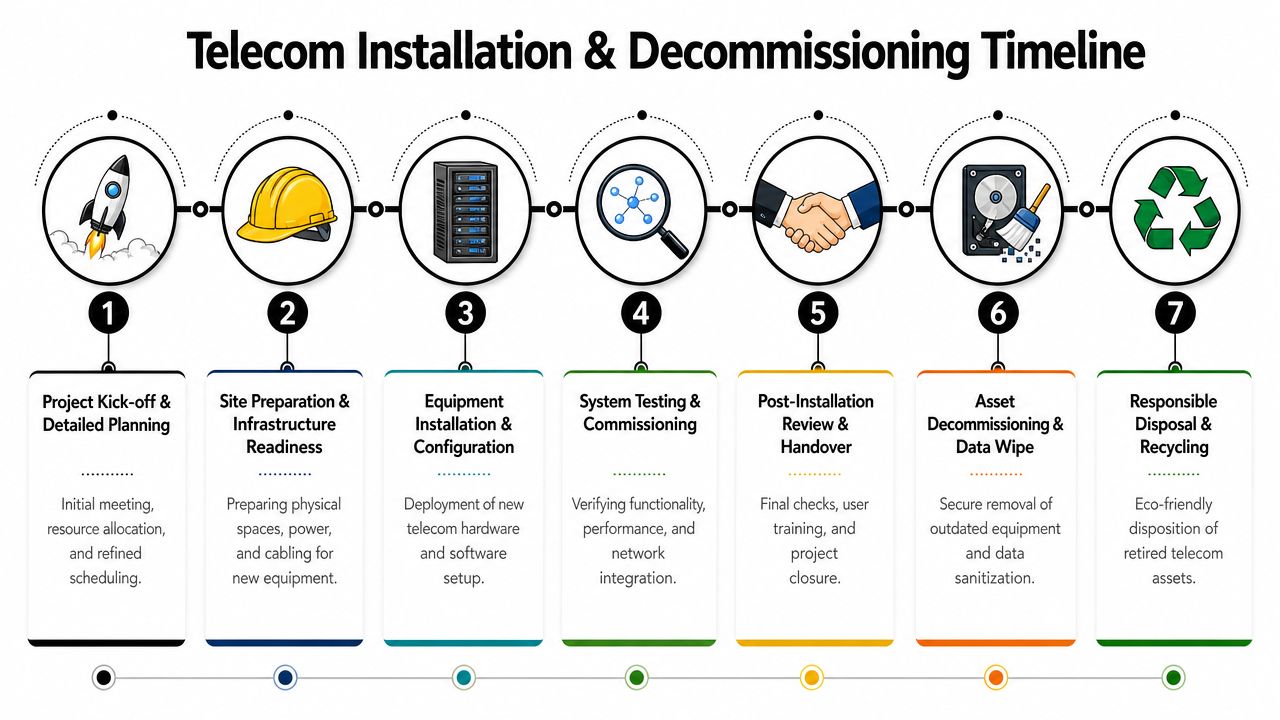
What a controlled deployment lifecycle looks like
Professional telecom installation follows a sequence. The details vary by environment, but the logic doesn't.
Survey and path validation
Competent teams eliminate fiction from the project. They verify risers, conduits, rack space, grounding conditions, power availability, access windows, and physical obstructions. They don't rely on last year's floor plan or a verbal description from the building engineer.
The output should include marked-up drawings, photos, assumptions, and exceptions. If the survey finds blocked pathways or bad rack conditions, deal with that before ordering the final material set.
Design confirmation and staging
After the survey, the install plan should get tighter, not looser. Labels are prepared. Rack elevations are reviewed. Patching logic is confirmed. Hardware that can be staged in advance should be staged in advance.
This is also where cutover sequencing gets real. Your team should know which links are new, which are replacing active services, what the rollback trigger is, and who has authority to pause the change.
Installation and field quality control
This phase is visible, but it isn't just labor. Good field execution includes pathway discipline, clean terminations, accurate labels, proper support and dressing, and immediate handling of deviations. If crews discover a mismatch between drawings and site conditions, they escalate through change control instead of improvising independently.
Three things separate mature vendors here:
- They keep redlines current: Drawings evolve with field reality.
- They test as they go: They don't save every verification task for the very end.
- They maintain housekeeping: Messy closets usually signal messy project control.
Cutover is where planning either pays off or fails
Cutover should never be a theatrical event. It should be a controlled sequence with prerequisites, communication, checkpoints, and rollback criteria.
A clean cutover plan usually includes:
| Cutover element | What to define |
|---|---|
| Scope | Exactly which circuits, racks, ports, or services are changing |
| Timing | Approved window, user impact expectations, and hard stop |
| Roles | Vendor lead, IT owner, carrier contact, facilities contact |
| Validation | What gets tested before declaring success |
| Rollback | Conditions that trigger reversal and who approves it |
| Documentation | What must be updated immediately after the change |
If your installer can't walk through this calmly and clearly, they're not ready for high-stakes work in a live environment.
Good cutovers feel almost boring. That's the standard you want.
Don't leave the old environment behind
Many projects treat decommissioning as cleanup. That's a mistake. Old racks, switches, routers, batteries, radios, patch panels, and cabling can create security, safety, and compliance exposure if they're pulled without a documented process.
Some common failures look small at first:
- Untracked equipment removal: No one can later prove what left the site.
- Storage media left in retired hardware: The installation is complete, but the data risk remains.
- Abandoned cabling and rack debris: Closets become harder to operate and harder to audit.
- No value recovery review: Reusable assets get treated like waste.
- No chain of custody: Procurement and compliance teams lose the paper trail they need.
The installer's role and the disposition partner's role need to connect cleanly. The installer may disconnect and physically remove legacy infrastructure. A qualified asset disposition partner should then take custody under documented procedures, especially when storage media, regulated environments, or auditable disposal requirements are involved.
A practical primer on that downstream process is this guide to what IT asset disposition involves. For infrastructure teams, the key point is simple. Removal is not the same thing as compliant retirement.
How to coordinate installation with disposition
The best time to plan decommissioning is before the install starts. Put it on the project plan as a workstream, not an afterthought.
Use this operating model:
Create a legacy asset register
Include rack units, network gear, voice components, UPS-related telecom support gear where applicable, batteries, and loose spares. Note whether any devices may contain storage.Define disposition categories
Some items may be reused internally. Some may be remarketed. Some must be destroyed or recycled. Decide that before crews begin removing equipment.Separate disconnect from custody
The installer can disconnect and stage retired gear. Custody transfer should be documented when the disposition partner takes over.Require chain-of-custody records
This matters most in data centers, healthcare, public sector, and any environment with audit or privacy obligations.Specify data handling
Don't assume network gear is harmless. If there's any chance of retained configuration or stored data, treat it accordingly.Close the loop with final reporting
You want final records showing what was removed, where it went, and how it was processed.
The handoff that protects the business
The installer's closeout package should connect to the decommissioning package. One tells you what's now live. The other tells you what's no longer your risk.
That handoff should answer four questions:
- What new infrastructure was accepted?
- What old infrastructure was removed?
- Who took custody of retired assets?
- What documentation proves final disposition?
When those questions are answered cleanly, the project is finished. Until then, your organization is still carrying avoidable exposure in the background.
Conclusion Choosing a Partner for the Full Lifecycle
A telecom installation project in Chicago isn't just a field job. It's an operating event with consequences for uptime, budget control, user experience, compliance, and future maintainability. That's why the right selection process starts with scope discipline, not vendor outreach. It continues through serious vetting, local coordination planning, and procurement language that defines accountability in detail.
The installer you want is the one who can handle the whole chain of execution. They survey thoroughly, document assumptions, manage dependencies, stage intelligently, cut over carefully, and close out with usable records. They don't treat permitting, building coordination, or rollback planning as side issues. They know those items often determine whether the project succeeds.
Most important, they understand that installation is only half the lifecycle. The old network, retired hardware, abandoned cabling, and removed equipment still need a managed end state. A project isn't fully successful when the new links go live. It's successful when the replaced environment is also removed, accounted for, and retired in a way your operations, security, procurement, and compliance teams can all stand behind.
If you're evaluating a telecom installation company in Chicago, don't ask only who can install it. Ask who can get it installed with control, document it properly, and leave you with less risk than you started with.
If your project includes retiring old network gear, racks, cabling, or data center hardware, Dallas Fortworth Computer Recycling can support the last mile that many installation plans miss. They help organizations handle secure, compliant IT asset disposition, data destruction, and electronics recycling so the project ends with documented chain of custody and responsible final processing, not a pile of legacy equipment in the corner.