
Mastering Laboratory Waste Management Safely
If you're responsible for a lab, a clinic, a research floor, or even the infrastructure that supports one, waste probably shows up in your week as a string of small problems. A red bag in the wrong bin. An old freezer monitor with patient or research data still on it. A shelf of unlabeled bottles no one wants to claim. A cleanout that turns into a compliance project.
That's why laboratory waste management can't sit with housekeeping alone. It touches safety, procurement, facilities, IT, EHS, legal, and vendor oversight. The organizations that handle it well usually do one thing differently. They treat waste as an operational system, not as an afterthought at the end of a workflow.
Why Laboratory Waste Management Is a Critical Function
Laboratories generate up to 5.5 million metric tons of plastic waste each year, which is nearly 2% of the global total, and research facilities can produce up to 12 times more waste per square foot than office spaces, according to My Green Lab's overview of laboratory waste. That changes the conversation immediately. This isn't a back-room disposal issue. It's a high-volume, high-risk operating function.
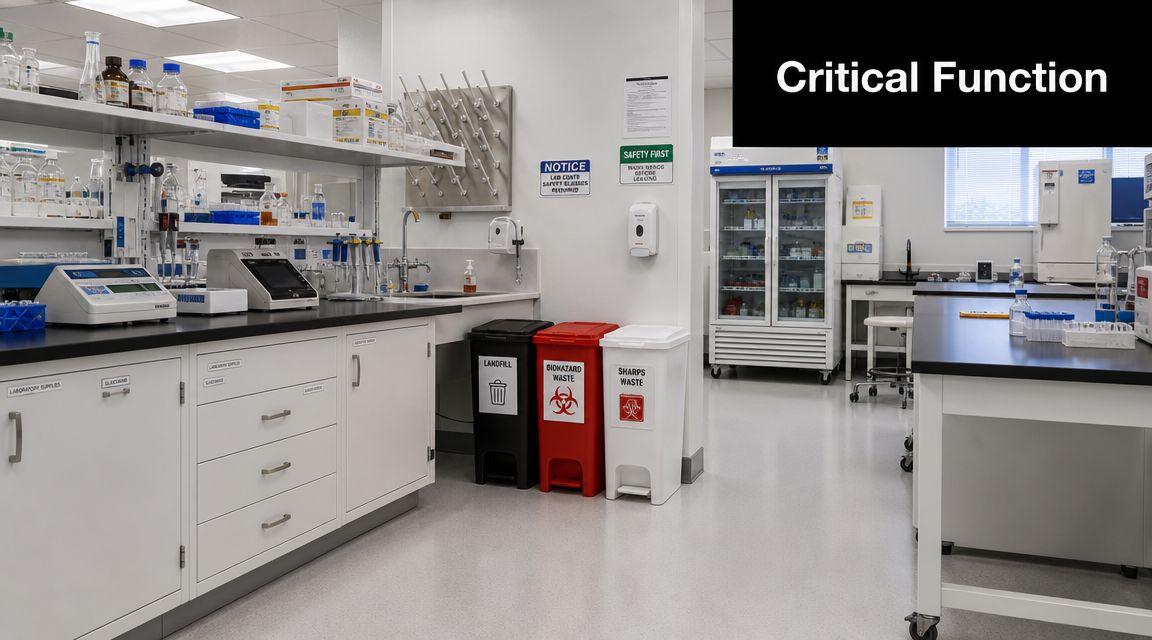
A lab creates waste streams that standard office processes were never built to handle. Some are regulated because of toxicity, infection risk, or reactivity. Others look ordinary but become expensive and risky when staff mix them into the wrong stream. Then there's a category many standard guides barely address. Electronic lab devices and specialized instruments often carry both environmental obligations and data exposure risk, which is why the broader environmental impact of electronic waste belongs in the same conversation as chemical and biological handling.
What managers usually underestimate
The first mistake is treating waste as a disposal event. In practice, waste decisions start at purchasing, continue at the bench, and end only when documentation is complete and the downstream vendor has done what they said they would do.
The second mistake is assuming the biggest risk is a spill. Spills matter, but so do misclassification, poor labeling, expired accumulation timelines, unsecured data-bearing devices, and undocumented transfers during cleanouts.
Practical rule: If a waste stream needs special handling, it needs a defined owner, a container standard, a storage rule, and a documented exit path.
Why this belongs on the operations agenda
A strong laboratory waste management program does four jobs at once:
- Protects staff: It reduces exposure to incompatible chemicals, contaminated sharps, biological residues, and damaged equipment.
- Controls spending: It keeps non-hazardous material out of expensive hazardous channels and avoids repeat pickups caused by poor preparation.
- Supports audits: It gives facilities and compliance teams clear records, labeling discipline, and traceable vendor handoffs.
- Reduces blind spots: It forces equipment retirement, inventory cleanup, and data destruction into one controlled process.
Waste is one of the clearest signals of whether a lab's operational discipline is real. If segregation, labeling, and final disposition are weak, other controls usually are too.
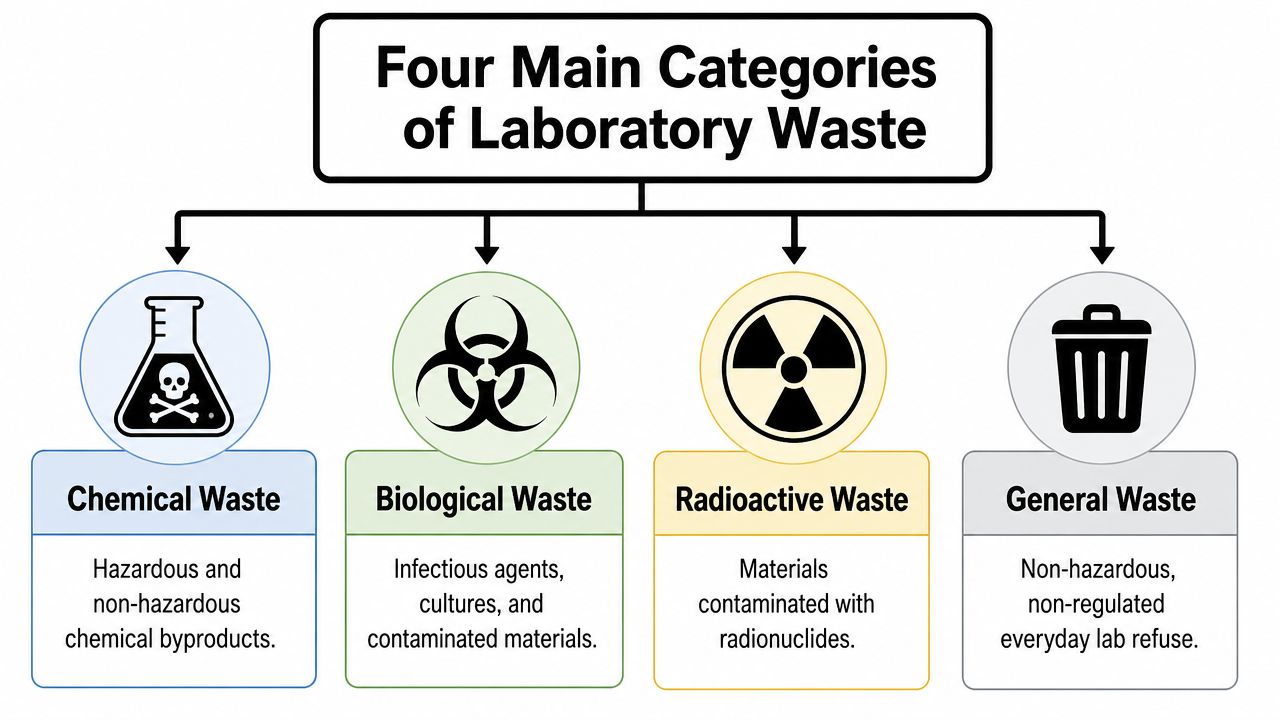
The Four Main Categories of Laboratory Waste
Most facilities benefit from a simple sorting model. Think of laboratory waste like incoming mail in a busy organization. If every item goes into one pile, delivery fails, urgent material gets lost, and someone eventually handles the wrong thing the wrong way. Lab waste works the same way. Classification first, movement second.
Chemical waste
Chemical waste usually creates the most classification questions. This category can include spent solvents, unused reagents, corrosives, oxidizers, flammables, and legacy containers with partial contents. The operational challenge isn't just hazard. It's compatibility.
Facilities teams run into trouble when they focus on container count instead of contents. A full room of well-labeled compatible containers is easier to manage than a small number of mixed, badly identified bottles. Chemical waste also tends to create the most vendor coordination issues during cleanouts because old inventory rarely arrives in neat, current packaging.
Biological waste
Biological waste includes cultures, contaminated PPE, plates, tubes, tissues, and other material that may carry infectious risk or requires controlled handling because of its source. The handling requirement often matters more than appearance. Something that looks like ordinary trash may belong in a regulated stream because of contact history.
One practical failure point is the gap between lab procedure and custodial procedure. If the lab knows what a bag or container holds but the next person in the chain doesn't, the system has already broken.
The safest biological waste program is the one that assumes the person moving the container later wasn't present when it was filled.
Radioactive waste
Radioactive waste requires a tighter control structure than most general guides acknowledge. Segregation, storage, labeling, and release procedures have to match the radionuclide and the facility's internal controls. This stream usually has the least tolerance for improvisation.
For facilities and IT leaders, the key point is that radioactivity can affect equipment retirement too. A device may look like ordinary surplus equipment but still require screening or decontamination review before it can leave a controlled environment.
General and electronic waste
Waste categorization often becomes unclear for many programs. General lab waste includes ordinary, non-regulated refuse. But in modern labs, a second practical bucket deserves equal attention: electronic and specialized equipment waste. Bench-top analyzers, balances, refrigerated controllers, data loggers, chromatography systems, imaging components, and embedded PCs don't fit neatly into office recycling assumptions.
Here's a useful distinction:
| Waste type | Primary concern | Common mistake |
|---|---|---|
| General refuse | Routine disposal | Over-classifying harmless material |
| Electronic equipment | Data, components, contamination history | Sending devices to standard surplus or trash |
| Specialized instruments | Hazard plus value recovery and chain of custody | Ignoring decontamination before pickup |
When organizations miss this category, they create two exposures at once. They mishandle e-waste, and they forget that retired lab equipment may still contain research records, system logs, user credentials, or regulated information.
Navigating Key Regulatory and Compliance Requirements
The most important compliance principle in laboratory operations is also one of the simplest. “No activity should begin unless a plan for the disposal of nonhazardous and hazardous waste has been formulated,” according to the National Academies' Prudent Practices in the Laboratory, which also sets a preference order of source reduction, reuse, and only then treatment or land disposal in the full guidance from the National Academies.
That principle matters because most waste failures don't start at pickup. They start earlier, when a team orders materials without a disposition path, opens containers without a storage rule, or retires equipment without deciding who owns decontamination and data destruction.
What compliance looks like in practice
For a facilities or IT manager, compliance isn't about memorizing every agency framework. It's about making sure the organization can answer a few operational questions at any time:
- What is this waste stream
- Who classified it
- Where is it stored
- What documentation follows it
- Who takes custody next
If those answers are inconsistent, the program is fragile.
A mature program also treats generator responsibility as a management discipline. You can outsource transport, treatment, recycling, and destruction. You can't outsource oversight. That's especially true when the waste includes data-bearing devices or instrumentation routed through an R2-certified electronics recycler, because documentation has to satisfy both environmental and information-governance expectations.
The hierarchy that actually works
The source reduction, reuse, then treatment sequence sounds abstract until you apply it to real operations. It usually means:
- Reduce avoidable purchasing so fewer chemicals, consumables, and devices age out unused.
- Reuse where safe and allowed through controlled internal processes, not informal bench-level habits.
- Treat or dispose last after segregation, labeling, and approvals are complete.
Compliance gets easier when fewer materials enter the waste stream in the first place.
The labs that struggle most are often doing the opposite. They buy broadly, classify late, store inconsistently, and call for disposal only when space runs out. That model increases cost, compresses timelines, and invites shortcuts during the most sensitive part of the process.
Effective On-Site Segregation and Handling Protocols
A peer-reviewed editorial notes that about 85% of laboratory waste is non-harmful but is often mixed with the 15% hazardous fraction, which inflates disposal volume, cost, and risk. The same piece points to waste audits and staff training as underused tools, and also notes practical nuances such as some chemicals being recyclable or distillable and some sewer disposal requiring prior notification to the local POTW in this laboratory waste discussion on PMC. That's the operational heart of laboratory waste management. Segregation is not paperwork. It's cost control and risk control happening at the same time.
What works on the lab floor
The best systems are boring on purpose. They remove judgment calls from routine disposal by making the right action obvious at the point of generation.
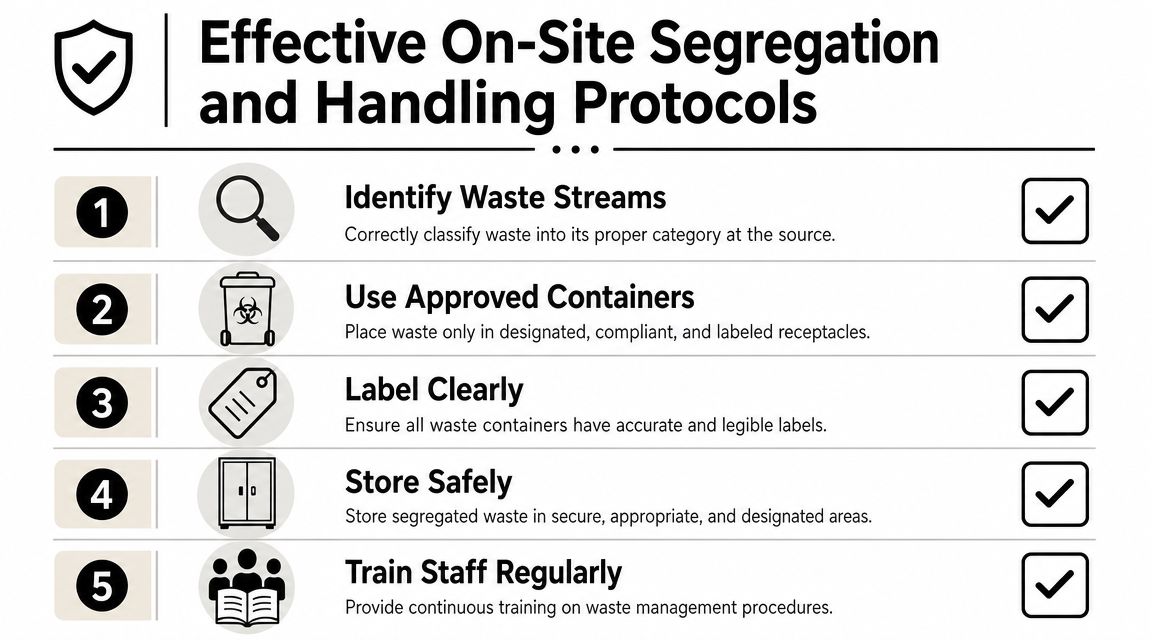
Use a short operational checklist:
- Identify at the source: Staff should classify waste where it is generated, not later in a hallway or accumulation room.
- Match container to stream: Approved containers matter because lids, material compatibility, puncture resistance, and closure rules are part of control, not decoration.
- Label immediately: A container without a clear label becomes an investigation project later.
- Separate storage locations: Keep incompatible streams apart and avoid convenience stacking that defeats segregation.
- Train by scenario: Staff remember examples better than policy language. Show them what goes where using actual items from their workspace.
A lot of organizations overinvest in signage and underinvest in repetition. A laminated poster helps. A monthly walk-through with real correction points helps more.
Where handling protocols usually break down
The weak points are predictable. Temporary staff use the nearest open container. Researchers inherit old materials with poor labels. Custodial or facilities personnel move items that were never prepared for transfer. IT removes an instrument because it's “just hardware” and no one checks contamination status.
The fix is to build handoff discipline into the process. If waste leaves a bench, someone should know four things about it: category, condition, destination, and owner.
Field observation: The most expensive container in the room is usually the one holding material that never belonged there.
A practical model for mixed operations
Facilities that support both lab operations and technical equipment retirement should standardize around a shared intake process.
| Control point | Lab materials | Electronics and instruments |
|---|---|---|
| Initial classification | By hazard and process origin | By device type, contamination history, and data sensitivity |
| Container or staging | Approved waste container | Tagged staging area or palletized secure hold |
| Labeling | Contents and handling requirements | Asset ID, status, chain of custody, wipe or destroy instruction |
| Pickup route | EHS or regulated waste vendor | Secure electronics pick-up service with custody records |
That table matters because many sites run two separate disposal cultures. One exists in the lab. The other exists in IT. The gaps between them are where unmanaged equipment, unlabeled peripherals, and undocumented removals tend to collect.
Managing Lab IT and Specialized Electronic Equipment
This is the category that gets mishandled most often because it sits between departments. Facilities may see a retired analyzer as surplus equipment. IT may see it as a hardware asset. The lab may see it as nonfunctional clutter. In reality, it can be all three, plus a contamination control issue.
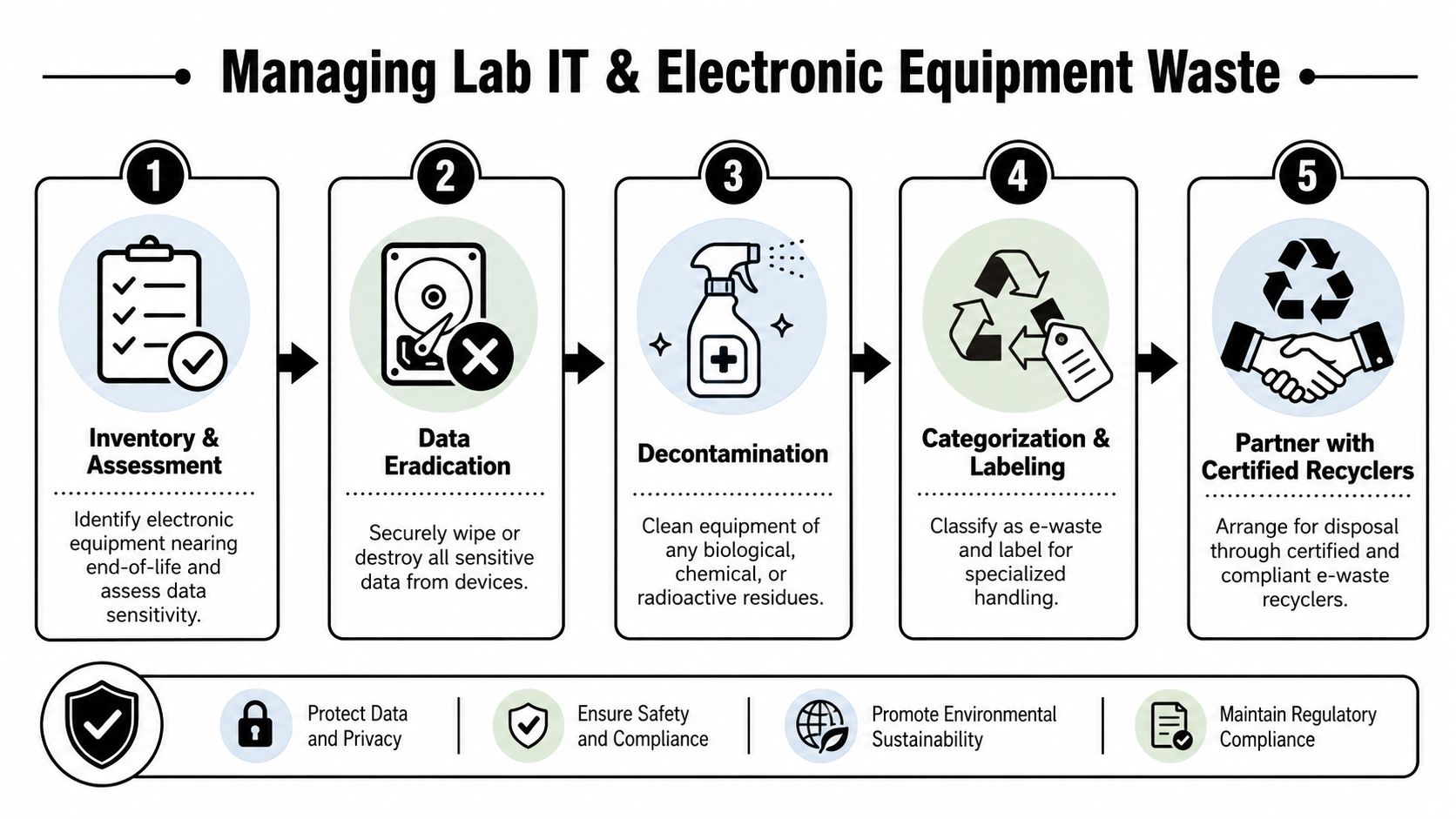
A modern lab instrument rarely stands alone. It may contain onboard storage, removable media, embedded operating systems, calibration records, user credentials, network settings, patient-related files, research datasets, audit logs, and licensed software. Even a simple refrigerator controller or environmental monitor can hold operational data your organization wouldn't want released.
Why standard e-waste thinking falls short
General office electronics recycling processes often assume devices are either clean enough for resale or straightforward enough for basic recycling. Lab equipment complicates that assumption.
A sequencer, mass spectrometer workstation, imaging console, chromatography controller, or pathology-adjacent system may need all of the following before final disposition:
- Asset review to identify what the device is, who used it, and whether it stores data
- Decontamination review to confirm it can be safely handled outside the lab environment
- Data eradication or destruction based on the storage media and sensitivity of the contents
- Chain-of-custody documentation that tracks who touched it and when
- Final recycling or destruction routing appropriate for the device and its components
If any one of those steps is skipped, the organization can create a data problem, a safety problem, or both.
The dual-risk model
The useful way to think about lab electronics is through a dual-risk lens.
First, there is material risk. Devices may contain batteries, circuit boards, lamps, specialty components, or residual contamination from the environment where they were used.
Second, there is information risk. The device may still hold confidential research, internal network details, regulated records, or intellectual property.
Those risks don't cancel each other out. They stack.
A retired lab device isn't “just e-waste” if no one has confirmed what's inside it, what's on it, and what touched it.
What a defensible process looks like
The organizations that avoid surprises usually build one retirement workflow for all lab-related electronics, rather than making exceptions for each department.
A defensible workflow typically includes:
Inventory first
Tag the device, record its model and location, and identify whether it has internal or attached storage.Confirm release status
The lab or EHS owner should verify whether the equipment is cleared for handling, needs decontamination, or requires additional review.Decide data handling upfront
Don't wait until the pallet is on the dock. Decide whether media will be sanitized, removed, or physically destroyed before pickup.Stage securely
Keep retired equipment in a controlled area, not in hallways, receiving zones, or unsecured cages.Use a specialized downstream channel
Standard scrap removal isn't enough for this category. The right IT equipment recycling process needs to address both environmental handling and auditable data destruction.
Common failure scenarios
A few examples come up repeatedly in real operations:
- A lab closes and sends attached PCs with instruments to surplus without checking drives.
- A freezer monitor is removed during renovation and discarded with facilities scrap.
- An analyzer gets picked up by a general recycler before contamination clearance is documented.
- A third-party mover disconnects systems but no one tracks serial numbers or custody.
None of these failures look dramatic in the moment. That's why they persist. The problem appears later, when an audit, incident review, or internal inquiry asks for proof of what happened.
Secure Disposal and Recycling Pathways
Once waste is classified and staged correctly, the next decision is downstream routing. Many programs lose discipline here. Staff assume every stream has one standard destination. It doesn't.
Different waste types require different endpoints. Some biological materials may go through treatment such as autoclaving before final disposal. Certain chemical streams require controlled treatment or incineration. Some residuals may move to permitted landfill only after proper handling. Electronics may be dismantled for reuse, parts recovery, or material recycling, while data-bearing devices require documented destruction or sanitization before anything else happens.
Matching the pathway to the waste
A simple comparison helps:
| Waste stream | Typical downstream need | Main management concern |
|---|---|---|
| Biological materials | Controlled treatment before disposal | Exposure risk and packaging integrity |
| Chemical waste | Compatibility-based treatment or incineration | Misclassification and mixed contents |
| Legacy cleanout materials | Profiling and careful review | Unknown inventory and labeling gaps |
| Electronic equipment | Secure data handling plus recycling | Chain of custody and contamination status |
The key is fit. The cheapest apparent option often becomes the most expensive once rejections, reclassification, additional packing, or repeat pickups enter the picture.
Documentation is part of disposal
A pickup ticket alone isn't enough for sensitive waste streams. Facilities managers should expect a documentation trail that makes later questions answerable. That usually includes internal logs, custody records, waste profiles where required, and final proof that the material was treated, destroyed, or recycled through the intended channel.
For electronics and media, that proof may include records tied to shred and recycle services for data-bearing equipment. For regulated lab streams, it means maintaining the paperwork needed to show that material moved through the correct process without undocumented detours.
If a vendor can't explain what document closes the loop for each waste type, the program is still carrying liability.
Cleanouts and decommissioning change the risk profile
Routine disposal is one thing. Lab shutdowns, moves, and decommissioning are different because they compress years of deferred decisions into a short timeline. University guidance notes that hazardous waste containers generally must be removed within 12 months of the accumulation start date in Western Carolina University's laboratory waste management plan. In practice, that means cleanouts can't rely on ad hoc scheduling.
During decommissioning, old reagents, half-identified containers, obsolete instruments, and forgotten peripherals tend to surface at the same time. The responsible approach is to triage by risk and certainty. Clearly identified materials move first. Unclear or legacy items get reviewed before anyone tries to “simplify” the pile by combining, moving, or discarding them. Speed matters during a cleanout, but documentation matters more.
Mitigating Costs and Risks Through a Strategic Partner
Well-run laboratory waste management programs usually look expensive only when viewed one line item at a time. In practice, they reduce larger and more damaging costs. They prevent hazardous overclassification, cut down on rejected pickups, reduce time spent resolving unknown inventory, protect staff during handling, and keep retired devices from becoming data incidents.
That only happens when the program is joined up. Chemical, biological, and sharps handling can't operate in one silo while instrument retirement and e-waste move through another with weaker controls. An integrated approach treats all outbound material as a chain-of-custody problem first, then assigns the right treatment, recycling, or destruction pathway based on its actual characteristics.
What to expect from a competent partner
A strong disposal or ITAD partner should help make the process more controlled, not more mysterious. Look for practical capabilities rather than marketing language.
- Documented intake discipline: They should be able to tell you how assets or waste are identified, logged, and segregated on receipt.
- Clear chain of custody: You want named custody points, not vague assurances.
- Data destruction options: For equipment with storage media, they should offer auditable sanitization or physical destruction paths.
- Experience with specialized equipment: Lab devices aren't the same as office laptops. The partner should understand that.
- Transparent downstream handling: Ask where material goes after pickup and what records close the loop.
- Coordination during cleanouts: Large retirements and decommissioning events require planning, packaging discipline, and schedule control.
Questions worth asking before you sign
Instead of asking whether a vendor is “full service,” ask operational questions:
- How do you handle a mixed pickup that includes ordinary IT gear, lab-adjacent devices, and specialized instruments?
- What happens if an item arrives with unclear contamination status?
- What proof do you provide for data destruction, recycling, or final disposition?
- How do you prevent untagged or unlogged equipment from leaving a site?
- Can your team support site cleanouts without pushing classification decisions back onto internal staff at the last minute?
Those questions expose whether the vendor understands real operating conditions.
A good partner won't eliminate responsibility. That isn't possible. What they can do is reduce uncertainty, strengthen auditability, and give your internal teams a process people can follow under pressure.
If your organization needs a partner for secure, compliant retirement of lab IT, medical electronics, or data-bearing equipment, Dallas Fortworth Computer Recycling provides nationwide IT asset disposition and electronics recycling services with documented chain of custody, certified data destruction, and support for specialized equipment workflows. For facilities, healthcare, and research environments that need more than a generic recycler, they offer a practical path to reduce e-waste risk while keeping sensitive technology disposition controlled and auditable.