
What is it asset disposition: A Secure IT Asset Lifecycle Guide
When business technology—servers, laptops, networking gear—hits the end of its useful life, you can't just toss it in a dumpster. That old equipment is often a treasure trove of sensitive information, from customer records to company secrets. Leaving it in a forgotten storage closet or handing it off to the wrong recycler is a recipe for a security disaster.
IT Asset Disposition (ITAD) is the formal process for securely and responsibly retiring that technology. It's more than just disposal; it's a critical risk management function that protects your data, ensures you're legally compliant, and can even put money back in your pocket from outdated equipment.
Understanding IT Asset Disposition and Its Critical Role
Think of ITAD like decommissioning a bank vault. You wouldn’t just leave the door hanging open. You’d follow a strict, documented procedure to empty the contents, account for everything, and make sure the vault is either securely sealed or dismantled. ITAD applies that same disciplined mindset to your digital assets.
Without a solid plan, you're exposed to enormous security and legal risks. A single misplaced hard drive could lead to a catastrophic data breach, costing you millions in fines and lost customer trust.
Four Pillars of a Modern ITAD Program
A truly effective ITAD strategy isn't just about one thing—it’s a balanced approach covering security, compliance, finances, and the environment. Getting this right means you’ve covered all your bases, leaving no room for error. Neglecting any one of these pillars can quickly lead to data breaches, regulatory fines, or environmental penalties.
Here's a quick breakdown of what a comprehensive ITAD strategy should cover.
Core Components of a Modern ITAD Strategy
| Pillar | Objective | Primary Benefit |
|---|---|---|
| Data Security | To permanently and verifiably destroy all data on retired devices, making it impossible to recover. | Prevents data breaches and protects sensitive corporate information. |
| Environmental Compliance | To ensure all electronic waste (e-waste) is recycled or disposed of according to federal, state, and local laws. | Avoids fines and supports corporate sustainability goals. |
| Value Recovery | To identify functional equipment or components that can be refurbished and resold on the secondary market. | Generates revenue from retired assets, offsetting disposition costs. |
| Logistics & Chain of Custody | To securely manage and track every asset from the moment it leaves your facility to its final disposition. | Provides an auditable trail that proves secure and compliant handling. |
These pillars work together to create a secure and efficient end-of-life process for your IT hardware.
This structured approach is becoming non-negotiable as technology refresh cycles get shorter and data privacy laws get tougher. The global ITAD market, currently valued at USD 25.31 billion, is expected to skyrocket to USD 54.54 billion by 2030. This explosive growth shows just how seriously businesses are taking the secure retirement of their IT assets. Discover more insights about the ITAD market's growth.
At its heart, what is IT asset disposition? It is a risk management function disguised as a disposal process. Its primary goal is to close the final chapter of an asset's lifecycle securely, leaving no loose ends that could harm the business.
Ultimately, a rock-solid ITAD program is a crucial part of any complete IT asset management strategy. You can learn more about IT asset management best practices in our article to see how ITAD fits into the bigger picture. By understanding its role, you can protect your organization from hidden threats while maximizing the value of every technological investment.
Breaking Down the End-to-End ITAD Process
A proper IT asset disposition program is much more than a simple "trash-and-go" operation. Think of it as a meticulously planned relay race—each step is critical, and dropping the baton at any point can put your entire organization at risk.
The journey starts long before a single piece of equipment leaves your facility. The first, and arguably most important, step is a thorough inventory and asset tracking phase. You simply can't protect what you don't know you have. This means creating a detailed, serialized list of every asset slated for retirement, from servers and laptops down to individual hard drives. This verified inventory becomes the master manifest for the entire disposition project.
Once you have a complete asset list, the next stage is secure logistics. This is where the physical chain of custody officially begins. It involves packing assets into sealed, tamper-evident containers and moving them in GPS-tracked, secure vehicles. Just like a bank uses an armored truck to move cash, a certified ITAD partner uses secure transport to move your data-bearing assets, making sure nothing gets lost or stolen along the way.
Certified Data Destruction
When the assets arrive at a secure facility, the most critical step gets underway: certified data destruction. The goal isn't just to delete files but to make that data forensically unrecoverable, permanently shutting the door on a potential breach. There's no one-size-fits-all solution here; the right method depends on the device and your organization's security policies.
The three main methods of data destruction are:
- Data Wiping: This software-based approach overwrites every sector of a hard drive with random ones and zeroes, effectively erasing the original data. It’s perfect for assets you plan to remarket because it leaves the hardware intact and ready for reuse.
- Degaussing: This technique uses an incredibly powerful magnetic field to scramble the magnetic domains on tapes and hard disk drives where data is stored. It renders the drive completely inoperable and is a fast, effective way to sanitize magnetic media.
- Physical Shredding: For the highest level of security, nothing beats physical destruction. Industrial shredders grind hard drives, SSDs, and other media into tiny, unsalvageable fragments, guaranteeing the data can never be pieced back together.
Proper data destruction is a non-negotiable part of any compliant ITAD plan, especially for complex projects. You can learn more about the data center decommissioning process, where these security measures are absolutely essential.
Final Disposition Pathways
After the data has been verifiably destroyed, the physical assets reach their final destination. This isn't a single endpoint but a branching path determined by an asset’s condition, age, and market value. A strategic ITAD program sorts each item into one of three main channels to maximize both financial return and environmental responsibility.
This visual breaks down how the core pillars of ITAD guide the process from start to finish.
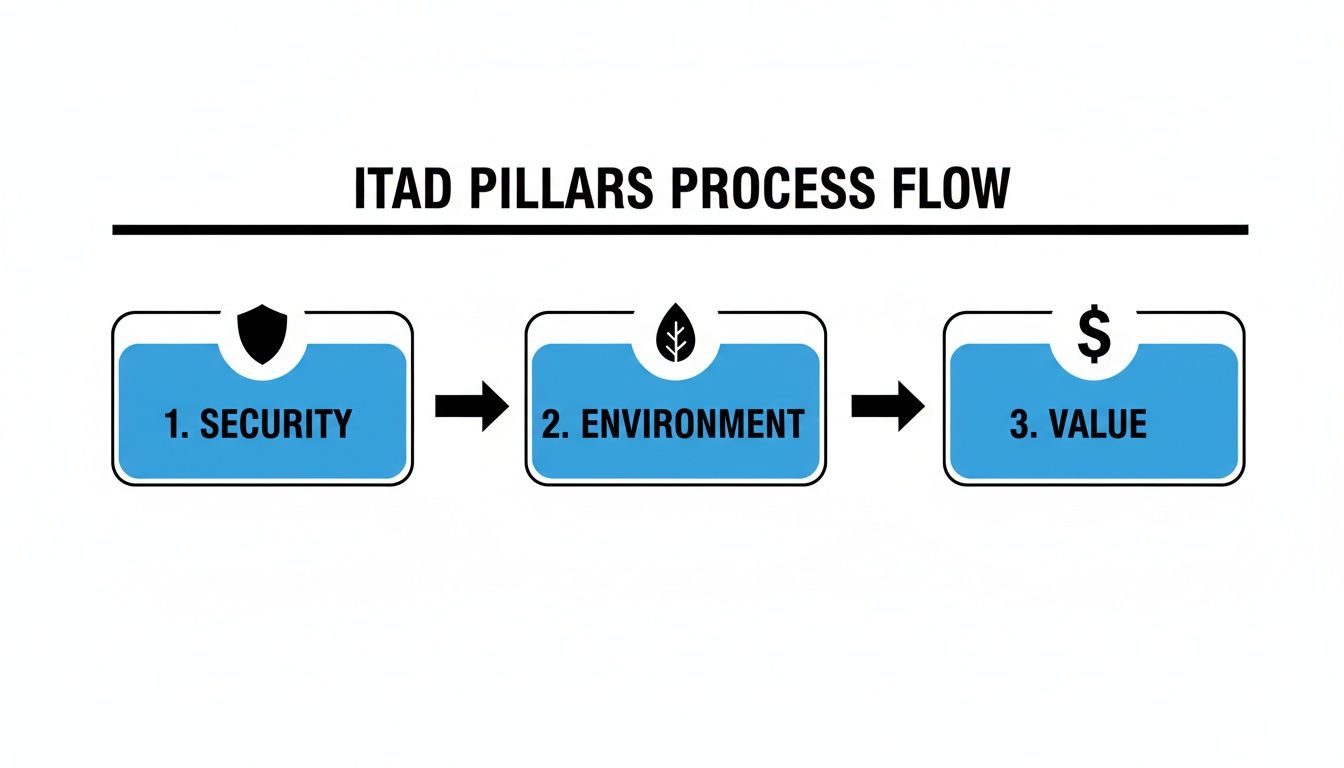
The flow highlights that security, environmental stewardship, and value recovery are all interconnected parts of one cohesive strategy.
The three final disposition paths are:
- Remarketing and Reuse: Functional equipment that still has some value is tested, graded, and refurbished for resale. This is the best outcome financially and environmentally, turning retired assets into a revenue stream.
- Responsible Recycling: For assets that are too old or damaged to be resold, the focus shifts to recovering raw materials. Certified recyclers de-manufacture the equipment, separating commodities like steel, aluminum, copper, and plastic to be used in new products.
- Proper Disposal: A very small fraction of materials, like certain hazardous components, simply cannot be recycled. These are disposed of following strict environmental regulations to prevent landfill contamination.
By following this end-to-end process, organizations can confidently manage the complexities of IT retirement. Every step, from inventory to final disposition, is a deliberate action designed to mitigate risk, ensure compliance, and get the most value out of every retired asset.
Navigating Complex ITAD Regulations and Compliance
In IT asset disposition, compliance isn't a suggestion—it's the foundation of a responsible strategy. Getting it wrong doesn't just put you at risk of fines; it can cause lasting damage to your company's reputation. While the landscape of rules and regulations can seem complex, understanding the core requirements is actually pretty straightforward.
Think of these regulations as the rules of the road for retiring your technology. They exist to make sure you handle sensitive data and electronic waste in a way that protects your customers, your business, and the environment. Ignoring them is like driving blind—sooner or later, you're going to run into trouble.
Environmental Stewardship and Key Certifications
When you hand over your old equipment, how can you be sure it won't end up in a landfill, leaking hazardous materials? This is exactly where environmental certifications come into play. They act as a guarantee that your e-waste is managed responsibly from the moment it leaves your hands.
Two of the most important certifications in the ITAD industry are:
- R2 (Responsible Recycling): This standard provides a clear framework for electronics recyclers to ensure toxic materials are handled safely. An R2-certified partner is regularly audited to verify they protect worker health and safety and have a secure process for managing every asset.
- e-Stewards: Often considered one of the most rigorous standards, e-Stewards certification is laser-focused on preventing the export of hazardous e-waste to developing nations. It also includes strict criteria for data security and social responsibility.
Working with a certified partner isn't just about doing the right thing. It's your auditable proof that you're meeting your environmental, social, and governance (ESG) goals and that your retired assets won't become an environmental liability down the road.
Data Privacy Laws and Their Impact on ITAD
Beyond environmental rules, data privacy laws impose strict requirements on how you handle the information left on retired devices. A single improperly wiped hard drive can easily trigger a major data breach, leading to severe penalties and a public relations nightmare.
Several key regulations directly impact how you must handle IT asset disposition:
- HIPAA (Health Insurance Portability and Accountability Act): For any organization handling protected health information (PHI), HIPAA mandates that all data be rendered completely unreadable and unusable before an asset is disposed of.
- GDPR (General Data Protection Regulation): This European Union law applies to any company that processes the personal data of EU citizens, no matter where that company is located. It demands complete data erasure and comes with steep fines for non-compliance.
- NIST (National Institute of Standards and Technology): While not a law itself, NIST Special Publication 800-88 provides the gold-standard guidelines for media sanitization. Federal agencies and their contractors must follow it, and it has become the de facto standard for secure data destruction across the private sector.
The financial stakes for getting this wrong are massive. The data center ITAD market is projected to grow from USD 11.96 billion to USD 23.66 billion in the next seven years. Within this rapidly expanding market, improper disposition can lead to GDPR fines exceeding €20 million. Explore more data center ITAD market insights on fortunebusinessinsights.com.
The Importance of an Auditable Paper Trail
Ultimately, compliance is all about proof. You need a clear, documented record showing you took every necessary step to protect both data and the environment. This is where an auditable paper trail becomes your most valuable defense.
A professional ITAD partner provides essential documentation that serves as your legal evidence of compliance. The most crucial document is the Certificate of Destruction. This legally binding report lists the unique serial numbers of every single hard drive and data-bearing device that was sanitized or destroyed. You can learn more about the importance of a Certificate of Destruction for hard drives in our guide.
This certificate, combined with a detailed chain of custody record, demonstrates that your organization fulfilled its due diligence. It closes the loop on the asset lifecycle, giving you peace of mind and a powerful defense against any future legal or regulatory challenges.
Mitigating Risk with a Secure Chain of Custody
When you hand over retired IT assets, you're not just getting rid of old equipment. You're entrusting a vendor with your company's data, its reputation, and its compliance standing. This is where the chain of custody comes in—it’s the single most critical element in any secure ITAD process.
Think of it like evidence in a high-stakes court case. Every person who touches the evidence signs for it, and its location is documented at all times. If there’s a single gap in that chain, the evidence can be thrown out. The same exact principle applies to your old servers, laptops, and hard drives. Any break in the chain of custody creates a massive security risk.
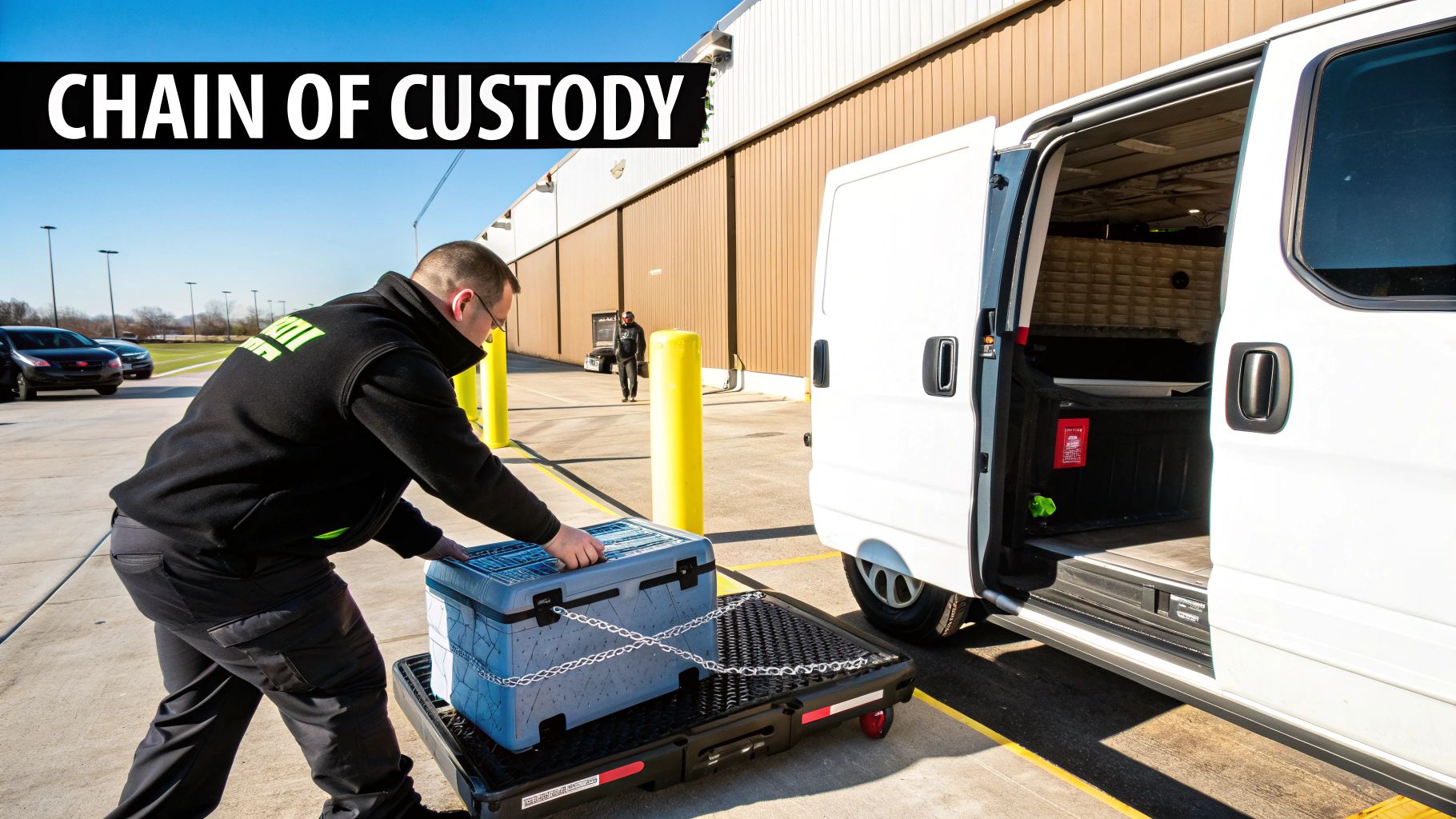
This unbroken, documented trail isn't just a best practice; it's your primary defense against data theft and regulatory fines. It provides the auditable proof you need to show that every reasonable precaution was taken to protect sensitive information from the moment it left your building.
Core Components of a Secure Chain of Custody
A secure chain of custody isn't just an idea; it’s a series of concrete, documented actions. Each step is designed to create a verifiable record, ensuring no asset ever goes missing or unaccounted for. This process turns a simple disposal task into a documented, risk-management strategy.
A truly robust chain of custody is built on several key pillars:
- Serialized Asset Tagging: From the start, every single device—right down to the individual hard drives—is scanned and given a unique serial number. This creates a detailed manifest that acts as the master list for the entire project.
- Locked and Sealed Transport: Assets are moved in locked, tamper-evident containers. This simple step ensures that nobody can access the equipment while it’s on the road between your facility and the processing plant.
- GPS-Monitored Vehicles: The trucks themselves are often equipped with GPS tracking. This gives you real-time visibility into where your assets are at all times, adding another powerful layer of security and accountability.
- Access-Controlled Facilities: Once the assets arrive, they enter a secure, monitored facility with strict access controls. Only authorized, background-checked personnel can handle the equipment, which prevents internal theft or mishandling.
Each of these steps builds on the last, creating a formidable security protocol that protects your assets at every single touchpoint.
A secure chain of custody is the narrative of an asset's final journey. It answers the critical questions for auditors and stakeholders: Who had it? Where was it? And what happened to it?
The Final Step: Documentation and Legal Proof
The chain of custody isn’t complete until you have the final documentation in hand. This isn't just paperwork; it’s your legal proof that the IT asset disposition process was handled securely and in full compliance with data privacy laws.
The most important document you’ll receive is the Certificate of Data Destruction. This report lists the unique serial number of every single data-bearing device that was sanitized or physically destroyed. It serves as your official, auditable record that you fulfilled your due diligence. If you'd like to understand more about this critical step, check out our guide on how to wipe a hard drive completely.
This final documentation closes the loop on each asset’s lifecycle. It provides you with the irrefutable evidence needed to demonstrate compliance during an audit, giving you and your stakeholders complete peace of mind. Without this proof, your organization is left exposed to significant legal and financial risks.
Finding the ROI in Professional ITAD Services
Thinking of IT asset disposition as just another line-item expense is a common—and costly—mistake. A professional ITAD program isn't a cost center. It's actually a powerful value driver that shields your business from massive financial risks while generating a surprising return on investment.
The real cost comes from doing nothing. A single hard drive tossed in the trash can lead to a data breach, triggering staggering regulatory fines, painful legal fees, and irreparable harm to your brand's reputation. When you skip certified ITAD, you aren't saving money—you're gambling with your company's future.

Shifting from Liability to Revenue
The clearest financial upside of professional ITAD is value recovery. Not all of your retired tech is junk. Functional equipment like servers, networking gear, and laptops often hold on to significant residual value that can be captured and put right back into your budget.
A certified ITAD partner knows how to unlock that value. They'll assess each asset to see what it's worth on the secondary market.
This usually involves:
- Testing and Grading: Skilled technicians evaluate the hardware for its functionality and cosmetic condition.
- Secure Refurbishment: Devices are securely wiped of all data, repaired if needed, and prepped for resale.
- Strategic Remarketing: Your partner uses their established sales channels to sell the refurbished gear at the best possible price.
Suddenly, that outdated equipment taking up space in a storage closet transforms from a liability into a real source of revenue. The funds recovered can often offset, or even exceed, the cost of the disposition services themselves.
Maximizing Your Return on Retired Assets
Smart IT asset disposition is a serious financial lever for any organization. The global market is valued at a whopping USD 17.5 billion, driven largely by enterprises that get this ROI potential. The core of this value comes from balancing bulletproof data destruction—a USD 5 billion service segment that's essential for preventing breaches that have exposed 2.6 billion records globally—with strategic value recovery. By remarketing viable assets, organizations can see a 20-40% ROI, turning a necessary security process into a budget-friendly operation. You can learn more about these ITAD market findings on gminsights.com.
The financial case for professional ITAD is hard to argue with. The table below breaks down the risks of going it alone versus the returns you can expect from a certified partner.
Cost of Inaction vs ROI of Professional ITAD
| Factor | DIY or Uncertified Disposal (Potential Costs) | Professional ITAD Partner (Potential ROI) |
|---|---|---|
| Data Breach Risk | High risk of fines (millions of dollars), legal fees, and brand damage. | Minimized risk through certified data destruction, reducing liability. |
| Asset Value | Zero value recovered. Assets are treated as waste, becoming a disposal cost. | 20-40% ROI through remarketing and resale of functional equipment. |
| Compliance | High risk of penalties for non-compliance with HIPAA, GDPR, etc. | Guaranteed compliance with documentation and certificates of destruction. |
| Internal Resources | Significant staff time and resources spent on a non-core, high-risk activity. | Frees up internal IT teams to focus on core business functions. |
| Environmental | Potential fines for improper disposal and negative impact on sustainability goals. | Adherence to R2/e-Stewards standards, enhancing corporate social responsibility. |
The numbers speak for themselves. The potential costs of a single misstep far outweigh the investment in a secure, professional process.
By partnering with an ITAD expert, you're not just getting rid of old hardware. You're investing in a secure, compliant process that pays for itself by unlocking the hidden financial value in your retired technology.
This makes the conversation with any IT leader much easier. Instead of seeing old equipment as a problem to be solved, a professional ITAD program reframes it as an opportunity. It provides a strong justification for investing in a secure, certified partner who can protect your data while delivering a positive financial return. Properly managed computer equipment recycling isn't just environmentally responsible; it's fiscally smart.
Choosing the Right ITAD Partner: A Vetting Checklist
Picking an IT asset disposition provider is a big deal. This decision has a direct impact on your company's security, compliance standing, and even your bottom line. Think of it less like hiring a vendor and more like bringing on a partner you're entrusting with your sensitive data and brand reputation.
Get it wrong, and you're looking at massive liabilities, from data breaches to environmental fines. But a great partner becomes a strategic ally, one who helps you dodge risks and actually recover value from old equipment. This checklist will help you ask the right questions to find a provider who truly gets what's at stake.
Certifications and Compliance Standards
First things first: you need to see their credentials. Certifications are the absolute baseline—they're non-negotiable. They provide third-party proof that a vendor follows strict industry rules for security and environmental safety. Without them, you have no auditable trail to prove you did your due diligence.
Start by asking for their current status on these critical standards:
- Environmental Certifications: Ask for proof of their R2 (Responsible Recycling) or e-Stewards certification. These are the gold standards, ensuring your old gear is handled ethically and won’t end up illegally dumped in a landfill.
- Data Security Standards: The provider must follow the NIST 800-88 Guidelines for Media Sanitization. This is the playbook for secure data destruction. If they don't know it inside and out, walk away.
- Security and Quality Management: Look for certifications like NAID AAA for secure data destruction and ISO 9001 for quality management. These show they have documented, repeatable processes, not just good intentions.
A vendor’s certifications are the foundation of trust. They are your first and best indicator that the provider operates with a proven commitment to security and responsible practices. Without them, you are relying on promises instead of proof.
On-Site Security and Logistics Protocols
Once you've confirmed their papers are in order, it's time to dig into their physical security and how they handle logistics. A secure chain of custody is only as strong as its weakest link. You need to know exactly how they’ll protect your assets from the moment they leave your building until they’re gone for good.
Get specific when you ask about their day-to-day operations:
- Facility Security: Are their facilities locked down with access controls, cameras, and alarm systems? More importantly, are the data destruction areas physically separate and restricted to authorized, background-checked employees only?
- Secure Transportation: How does your equipment get from point A to point B? Insist on locked, GPS-tracked vehicles. Your assets should be packed in sealed, tamper-evident containers before they even hit the loading dock.
- Downstream Vendor Vetting: No ITAD company does everything themselves. Ask them how they audit their recycling partners. A certified provider must have a documented process for making sure every company in their network also meets strict environmental and security standards.
Reporting and Value Recovery Processes
Finally, a top-tier ITAD partner gives you transparent reporting and has a clear plan for getting you the most money back from your retired assets. Their ability to deliver detailed, auditable reports is what closes the compliance loop. Their remarketing strategy is what turns ITAD from a necessary cost into a source of revenue.
Ask them about their documentation and financial models:
- Serialized Reporting: Can they provide a report that tracks every single asset by serial number, from your door to its final destination? This is essential for your records.
- Certificates of Destruction: Will they issue legally binding Certificates of Data Destruction? These documents should list the serial number of every single drive they sanitized or destroyed.
- Value Recovery Model: Have them walk you through their process for testing, grading, and reselling functional equipment. What’s their revenue-sharing model? How do they prove you're getting the best possible return on your gear?
Choosing the right partner is a critical step in a successful ITAD strategy. By using this checklist to vet potential vendors, you can make an informed decision that protects your organization and aligns with your security, compliance, and financial goals.
Common Questions About IT Asset Disposition
Even with a clear process, IT managers often have questions about how IT asset disposition fits into their day-to-day work. It's easy to get bogged down in the details of data security, value recovery, and environmental rules. This section answers some of the most common questions we hear, helping to clarify the core concepts.
Getting these distinctions right is the key to building an ITAD strategy that is both compliant and good for your bottom line. Let’s clear up a few things.
What Is the Difference Between ITAD and Electronics Recycling
While electronics recycling is a part of ITAD, it’s just one piece of a much larger puzzle. Simple e-recycling is all about breaking down equipment to recover raw materials like plastic and metal. It's an environmental function, plain and simple.
In contrast, IT Asset Disposition (ITAD) is a complete, security-first process. It's designed to manage the entire lifecycle of a retired asset to protect your business from risk. A proper ITAD program always includes:
- Certified and fully documented data destruction.
- A secure, auditable chain of custody from the moment we pick it up to final processing.
- Compliance reporting to meet legal standards like HIPAA or GDPR.
- Value recovery by finding a second life for functional assets through remarketing.
At the end of the day, a recycler just handles waste. A real ITAD partner manages your risk and recovers your value.
How Can I Be Sure My Data Is Completely Destroyed
Verifiable data destruction is the absolute foundation of any reputable ITAD service. A certified partner should offer several destruction methods that meet tough standards like NIST 800-88, including software-based wiping, powerful degaussing, and physical shredding.
But the single most important thing you should receive is a Certificate of Data Destruction.
This legal document is your official, auditable proof that your data was sanitized securely and in full compliance with privacy laws. It should list the unique serial numbers of every single drive we destroy, protecting your organization from any future liability.
Without this certificate, you have no way to prove you met your legal and ethical duties to protect sensitive information. It's non-negotiable.
Can I Recover Financial Value from My Old IT Equipment
Absolutely. This is one of the biggest upsides of a professional ITAD program and a key difference from basic recycling. Assets that still have a useful life—like servers, laptops, networking gear, and storage arrays—can often be refurbished and resold on the secondary market.
A good ITAD partner will test, grade, and strategically remarket these assets for you. They then return a portion of the sales revenue back to your organization. This process, known as value recovery, can significantly offset your disposition costs. In many cases, it can even turn your retired IT equipment from a headache and a liability into a new revenue stream for your department.
Ready to implement a secure, compliant, and value-driven ITAD strategy? Dallas Fortworth Computer Recycling offers nationwide services with certified data destruction and transparent value recovery to protect your organization. Learn how we can help you manage your retired assets with confidence at https://dallasfortworthcomputerrecycling.com.