
ITAD Pricing Transparency: Decode Vendor Quotes
You're probably looking at an ITAD quote right now that doesn't read like a quote. It reads like a hedge. There's a pickup charge, some recycling language, a vague reference to data destruction, and a revenue share estimate that sounds promising until you ask how the number was calculated. By the time you reach the bottom, you still don't know what your actual cost exposure is.
That's a problem, because IT asset disposition isn't a soft-cost exercise. It touches regulated data, chain of custody, resale value, environmental handling, and audit risk. If the pricing is fuzzy, the operating model behind it is usually fuzzy too. A vendor that can't explain its invoice clearly usually won't perform clearly when exceptions show up.
Pricing transparency matters. Not as a marketing slogan, and not as a generic good-governance talking point. In ITAD, transparent pricing is a control mechanism. It helps you predict budget, isolate hidden fees before the contract is signed, and test whether a vendor has enough process discipline to handle your equipment responsibly. If you're comparing IT asset disposition companies, pricing clarity is one of the fastest ways to separate serious operators from sales-heavy brokers.
Low headline pricing doesn't protect you. Detailed pricing does. The right quote lets you trace every cost driver, understand every deduction, and verify how resale proceeds are calculated. That's what turns disposition from a financial guessing game into a managed process.
Introduction
Most IT leaders don't struggle to find an ITAD vendor. They struggle to compare one. Quotes arrive in different formats, with different assumptions, and with just enough detail to sound complete while hiding the terms that drive the final invoice.
One vendor rolls everything into a flat service fee. Another offers revenue sharing but leaves testing standards undefined. A third promises “no-cost recycling” until low-value assets appear and processing charges suddenly show up. None of that is unusual. It's the normal pattern in a market where service scope, downstream handling, and residual value all affect the economics.
The mistake is treating that confusion as unavoidable.
Why this matters to IT and procurement
An opaque quote creates three immediate problems. First, finance can't forecast the actual cost of a refresh, closure, or decommissioning event. Second, legal and compliance teams can't tell whether critical services such as data destruction, serialized reporting, or exception handling are included or assumed. Third, procurement is at a disadvantage because vendors define the pricing language on their own terms.
Practical rule: If you can't map the quote to the actual operational steps, you don't have a price. You have a promise.
In other industries, buyers have pushed for more structured disclosure because hidden pricing makes comparison nearly impossible. The same discipline applies here. In ITAD, transparency means the vendor breaks the work into auditable components and shows how each component affects your invoice or settlement.
What a useful quote should do
A usable ITAD quote should answer basic business questions without a follow-up call:
- What are you charging for collection and logistics
- What happens to assets with no resale value
- Which data services are included by default
- How is remarketing value determined and shared
- What events trigger extra charges
If those answers aren't visible in writing, your risk hasn't been priced. It's been deferred.
What Is ITAD Pricing Transparency Really
A vendor sends a quote for a data center cleanout. The total looks acceptable, the resale estimate looks promising, and the project gets approved. Two weeks later, the invoice includes palletizing, bad-drive handling, serialized reporting, and freight surcharges that were never clear in the proposal. That is the gap pricing transparency is supposed to close.
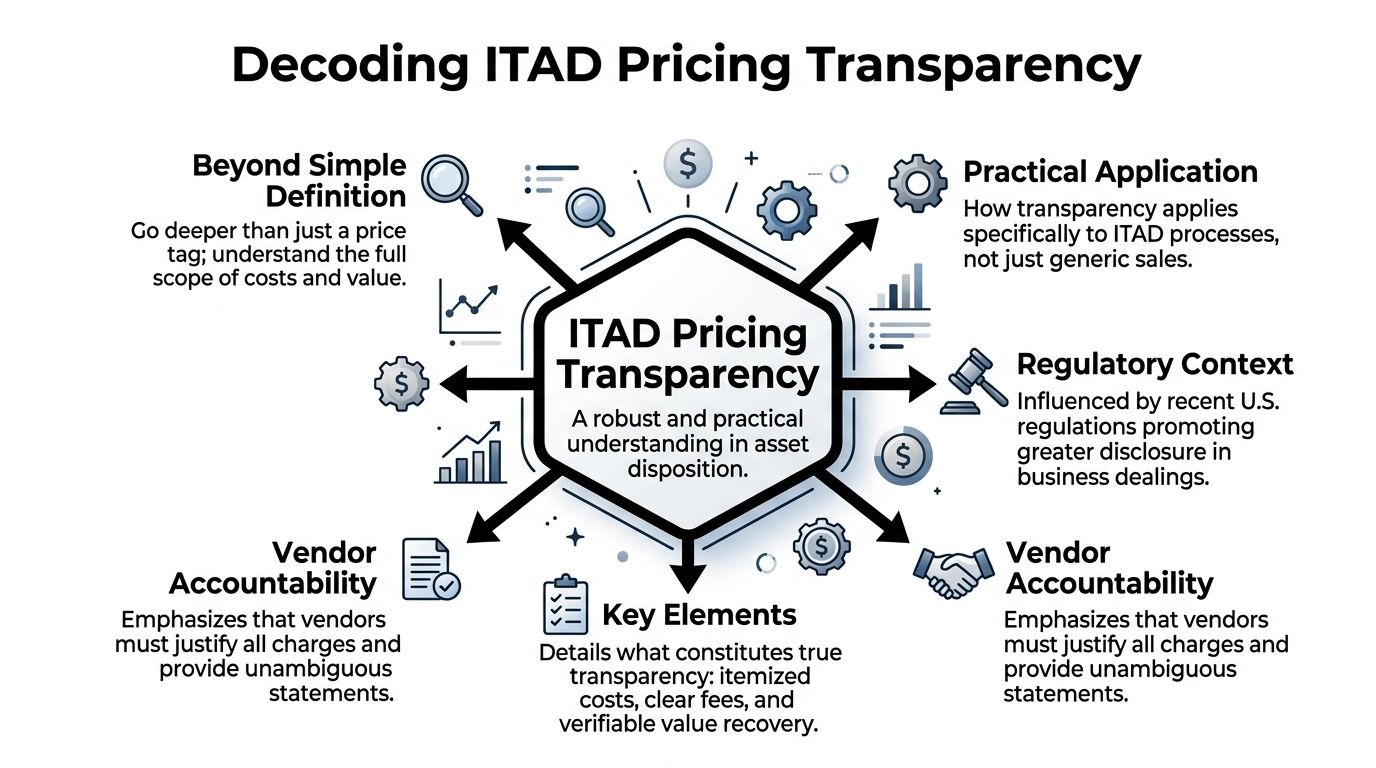
In ITAD, pricing transparency means the commercial model is clear enough to test before you sign and easy enough to reconcile after the work is done. You should be able to see every charge, every credit, every pricing assumption, every exclusion, and the method used to calculate residual value on remarketed assets.
A useful reference point comes from another complex service market. The U.S. Hospital Price Transparency Rule, effective January 1, 2021, pushed providers to publish pricing data in a form buyers could review instead of relying on vague estimates, as outlined in CMS guidance on hospital price transparency. The lesson for IT leaders evaluating ITAD vendors is practical. If pricing is bundled into one number, comparison breaks down and financial control goes with it.
Transparency is about price logic
Low cost is not the test. Clear cost is the test.
A transparent ITAD vendor shows the mechanics behind the number, including:
- Service line items for pickup, packing, sorting, audit, wiping, shredding, recycling, and reporting
- Residual value methodology for devices that may be resold, harvested for parts, or treated as scrap
- Exception pricing rules for locked, damaged, incomplete, obsolete, or nonconforming assets
- Settlement calculations that show deductions, fees, and revenue-share treatment in plain terms
This level of detail matters because two vendors can present the same projected net return and produce very different financial outcomes. One may include onsite labor, asset matching, and final serialized reporting. The other may bill each of those items after the fact.
What mature transparency looks like
Mature transparency gives procurement data that can be sorted, compared, and audited. The Office of the National Coordinator for Health Information Technology's discussion of standardized, machine-readable data reflects a broader buyer need that applies here too. Structured information supports review, validation, and system-to-system comparison. Sales summaries do not.
That same standard should apply to ITAD quotes and settlements. Ask for pricing in a format that matches operational steps, asset categories, and exception conditions. Then check whether the commercial terms line up with the vendor's chain of custody documentation, because undocumented handoff points often become disputed charges or disputed liability later.
Good pricing transparency gives you a quote you can challenge, a settlement you can reconcile, and a vendor model you can control.
The Business Case for Demanding Transparency
Transparent pricing protects more than budget. It protects decision quality.
Too many IT teams treat disposition pricing as a back-end procurement detail because the visible project pressure is elsewhere. The refresh needs to happen. The storage room needs to be cleared. The data center needs to be decommissioned. In that environment, vague pricing slips through because everyone is focused on execution. That's exactly when hidden costs show up.
Where the business value actually appears
Research into transparency initiatives shows that the strongest benefits are often realized by institutional buyers and employers, not individual consumers. For IT leaders, that means the value of transparency is benchmarking, negotiation, and accountability in vendor contracts, as discussed by the Healthcare Value Hub review on healthcare price transparency.
That finding maps cleanly to ITAD. Your organization benefits when transparent pricing helps you compare vendors on equal terms, pin down service scope, and challenge unsupported deductions in settlement reports.
Four outcomes worth caring about
Budget predictability
A transparent quote gives finance a planning number that survives contact with reality. You can separate fixed charges from variable charges, identify conditions that change pricing, and avoid explaining surprise invoices after the project closes.
Risk mitigation
If data sanitization, media shredding, serialized reporting, or exception handling aren't clearly priced, they may not be clearly operationalized either. Mature vendors price compliance-heavy work because they've built repeatable processes around it. Weak vendors wave it through with generic language.
Value recovery discipline
Remarketing can be legitimate value recovery or a black box. Transparent vendors explain testing, grading, resale channels, and deduction logic. That lets you determine whether low returns reflect asset condition or vendor discretion.
Contract accountability
When charges and credits are itemized, you can write service expectations into the agreement. That's where certifications, reporting routines, and audit provisions become enforceable rather than aspirational. If you're reviewing a provider's operational maturity, their approach to certification maintenance often tells you whether their price sheet reflects real controls or just polished sales language.
Buyers don't gain leverage from having more quotes. They gain leverage from having comparable quotes.
That's the practical business case. Transparent pricing is one of the best screening tools you have because it exposes whether the vendor understands their own process well enough to price it cleanly.
Decoding Common ITAD Pricing Models
A pricing model shapes more than the invoice. It determines who carries resale risk, how predictable your budget will be, and where disputes usually show up after pickup. For IT leaders evaluating ITAD vendors, that makes pricing structure a risk-control decision as much as a commercial one.
Most proposals land in two models: fee for service and value sharing. Neither is necessarily safer or more profitable. The right choice depends on your asset profile, internal reporting requirements, and whether you want predictable processing costs or are willing to accept settlement variability in exchange for upside on resale.
The practical rule is simple. If a vendor cannot break a quote into parts you can compare across bidders, you cannot benchmark it properly. Public procurement guidance from the U.S. Government Accountability Office on cost estimating and assessment reflects the same discipline. Complex services need a clear cost structure before buyers can test price reasonableness.
Fee for service model
In this model, you pay for defined activities. The quote usually lists pickup, onsite labor, inventory, data sanitization, shredding, recycling, reporting, and project management as separate charges or grouped service lines. Any resale value may appear as a credit, but the service cost stands on its own.
This model fits organizations that need cost control first. It is common for low-value equipment, mixed scrap loads, damaged assets, older peripherals, and projects with strict chain-of-custody requirements. Finance teams usually prefer it because accruals are easier and invoice review is more straightforward.
The trade-off is margin visibility. You may get clean execution and clean paperwork, but less participation in resale upside unless the contract spells out credits clearly.
Value sharing model
In a value sharing arrangement, the vendor resells reusable assets and remits an agreed share of net proceeds to you. This can work well for newer laptops, tablets, phones, servers, and network gear with active secondary-market demand.
It also creates more room for commercial slippage.
Your return depends on how the vendor defines testing, grading, repair thresholds, channel fees, parts harvesting, and deductions. If those rules are broad or loosely documented, the final settlement becomes hard to challenge. A proposal that promises aggressive recovery without defining the deduction logic deserves extra scrutiny.
Comparison of ITAD Pricing Models
| Feature | Fee for Service Model | Value Sharing Model |
|---|---|---|
| Primary payment structure | Client pays for defined services | Vendor pays or credits client based on remarketing outcome |
| Budget predictability | Usually higher | Usually lower unless deductions are tightly defined |
| Best fit | Compliance-heavy projects, low-value assets, mixed scrap | Reusable assets with clear resale potential |
| Main buyer concern | Paying for service elements that do not apply to the project | Understated resale value or excessive deductions |
| Reporting requirement | Service completion and asset disposition records | Service records plus asset grading, valuation, and settlement detail |
Line items you should expect to see
A credible quote usually separates the operational work into distinct cost buckets. That matters because each bucket can change based on site conditions, asset quality, or handling requirements.
- Logistics and pickup. Transportation, route planning, packing standards, dock access, stairs, liftgate use, and onsite labor.
- Intake and audit. Count verification, sorting, serial capture, exception logging, and reconciliation against your asset list.
- Data destruction. Software wiping, degaussing, shredding, and media-specific handling based on policy and device type.
- Refurbishment and triage. Functional testing, cosmetic grading, battery checks, imaging removal, parts replacement, and cleaning.
- Recycling and downstream handling. Manual dismantling, hazardous components, commodity recovery, and charges for low-value material.
- Reporting and certificates. Asset-level disposition records, destruction certificates, settlement detail, and exception reporting.
If the scope includes portable devices with active resale demand, ask how the vendor routes them to market and how that affects net recovery. That question matters whether you are selecting a full ITAD partner or evaluating options for selling used business laptops.
What changes the price
Price usually moves on a few operational variables. Asset condition matters. So does the quality of your asset list, the amount of packaging work required, the type of data-bearing media, and the percentage of equipment that can be resold.
Site conditions also matter more than many buyers expect. A ground-floor dock pickup of palletized hardware prices differently than a multi-floor office cleanout with loose equipment, badge access delays, and manual carry-outs.
A quote that ignores those factors is not simple. It is missing cost drivers that tend to reappear later as change orders, deductions, or invoice disputes.
How to Audit and Verify Vendor Pricing
A vendor's claim of transparency means nothing until you test it. Yet, many IT teams back off. They ask for a quote, maybe one revision, and then assume the final invoice will sort itself out. It won't. You need to audit the commercial model before the first pallet leaves your site.
One lesson from healthcare transparency is especially relevant here. Even with federal mandates, one peer-reviewed review found that only 29% of hospitals were compliant with the U.S. hospital price transparency rule, despite a penalty of $300 per day for non-compliance, according to this review of transparency compliance and data challenges. The practical takeaway for ITAD is simple. A disclosure requirement doesn't guarantee useful disclosure. Verification still matters.
Documents to request before you sign
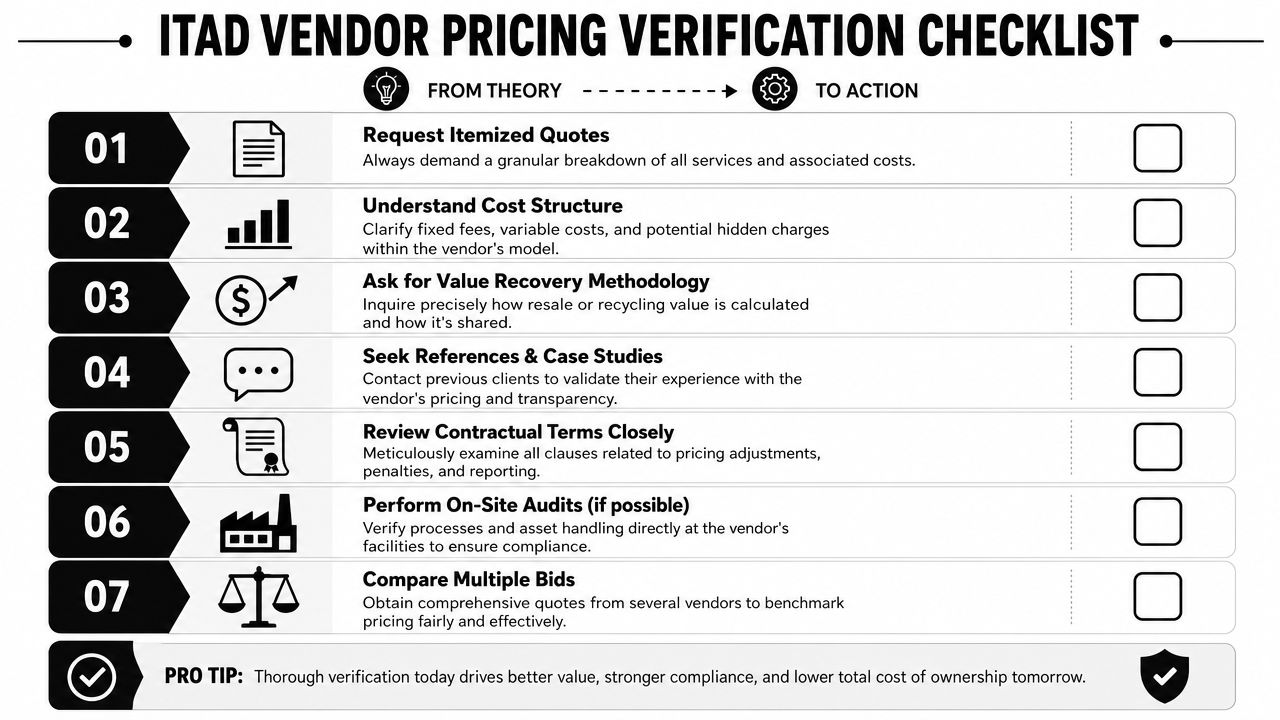
Ask for evidence, not assurances. At minimum, request:
- A full fee schedule that includes standard services, exceptions, environmental handling charges, low-value asset processing, and any conditions that trigger extra labor.
- Sample settlement reports for a mixed load and for a high-value device load, with customer details removed.
- Testing and grading criteria used to determine resale category, especially for laptops, tablets, and phones.
- Data destruction documentation examples that show how serialized assets are recorded from receipt through final disposition.
- Contract language for disputes and adjustments so you know how valuation disagreements are handled.
If the vendor says those materials are proprietary, treat that as a warning sign. Process details may be proprietary. Billing logic shouldn't be.
Questions that expose weak pricing models
Use direct questions. Polite but exact.
- How do you calculate fair market value for remarketed assets
- What deductions are applied before revenue is shared
- Which services are included in the base quote and which are conditional
- How do you handle nonfunctional, locked, or cosmetically damaged devices
- Can we audit serialized chain of custody and downstream disposition records
- What does the final settlement report look like
- Who decides grading disputes and what evidence supports that decision
Ask for the answer in writing. Verbal transparency disappears as soon as operations starts.
What to verify operationally
Pricing review should connect to facility and process review. If possible, inspect how the vendor receives, sorts, wipes, shreds, stores, and reports on assets. If an onsite visit isn't feasible, ask for independent control evidence and third-party audits that support their claimed workflow.
A transparent pricing model should line up with the actual work being performed. If the vendor describes a premium process but can't show where that process appears in documentation, staffing, or audit records, the quote is only cosmetic.
Red Flags and Effective Negotiation Tactics
The most expensive ITAD quote isn't always the one with the highest price. It's often the one with the cleanest-looking top line and the weakest underlying definitions. Opaque vendors know buyers compare headline numbers first. That's why they keep the deductions, exceptions, and recovery assumptions buried in the fine print or outside the quote entirely.
Policy analysis in healthcare offers a useful insight here. Price transparency tends to work better as a negotiation and benchmarking tool for informed buyers than as a simple shopping tool for consumers, as discussed in JAMA Network Open on price transparency policy and buyer use cases. That is exactly how IT leaders should use pricing transparency with ITAD vendors. Not as a nice-to-have disclosure, but as an advantage.
Red flags that deserve immediate pushback
Some warning signs show up before the first call ends.
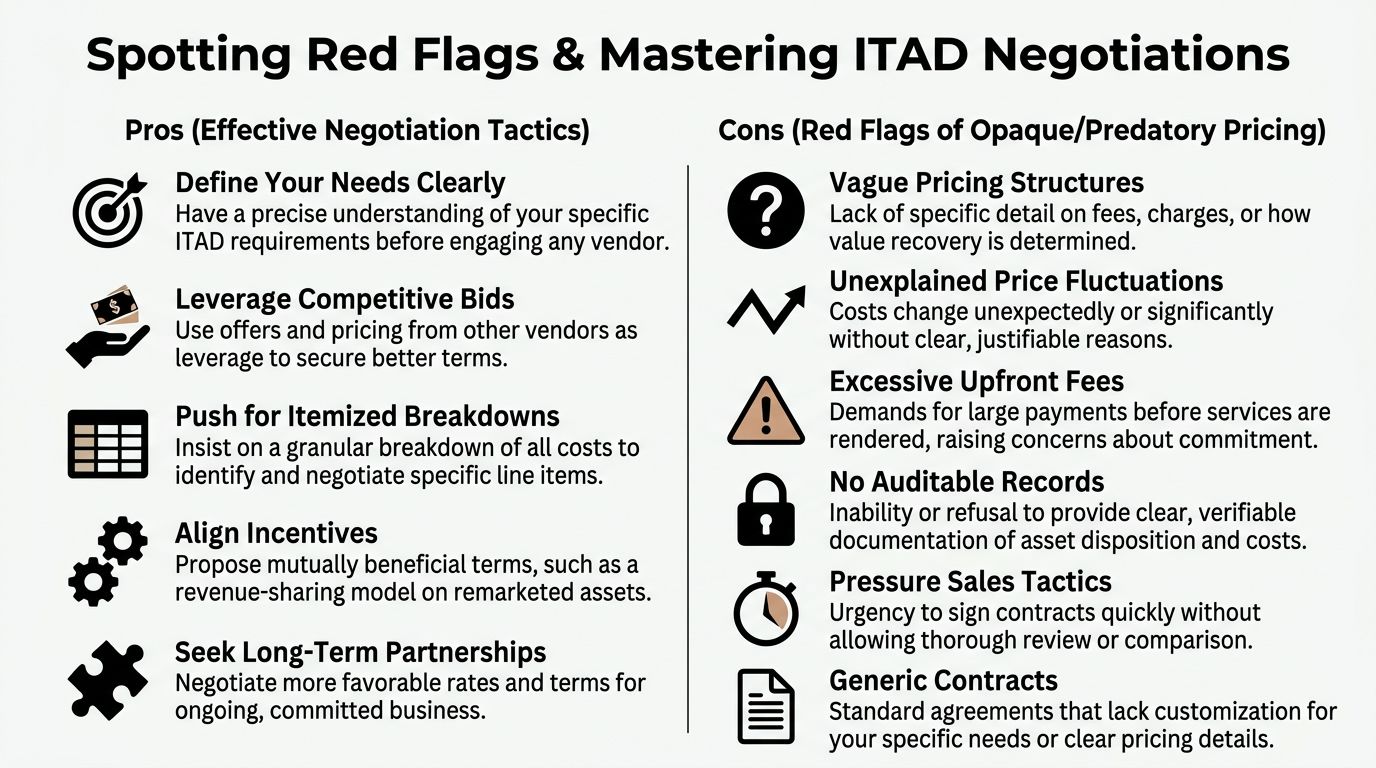
- Vague revenue-sharing language. If the vendor says you'll receive a share of “net proceeds” but won't define the deductions behind net, assume the formula favors them.
- Guaranteed purchase language without grading detail. A strong upfront number can be offset later through downgrades, exception fees, or rejection categories.
- Bundled compliance claims. If secure data destruction, reporting, and environmental handling are all “included,” ask exactly how each service is documented.
- No serialized sample reporting. If they can't show a realistic asset-level report, they probably can't support disputes cleanly.
- Pressure to sign before review. Urgency is often used to keep weak pricing mechanics from being examined.
If a vendor resists detail during sales, they will resist accountability during settlement.
Negotiation tactics that actually work
Don't negotiate only on the top-line rate. Negotiate the definition set behind the rate.
Lock the reporting standard
Define the settlement format in the agreement. Require serialized asset reporting where applicable, clear disposition categories, and documented treatment for no-value assets.
Cap surprise charges
List the only scenarios that permit additional fees. If an event isn't named, it shouldn't be billable. This forces the vendor to think through exceptions before the work starts.
Define grading and valuation rules
For value-sharing engagements, require written grading criteria, timing for valuation, and a dispute path for challenged assessments. If the vendor uses internal categories, those categories should be visible to you.
Tie audit rights to payment rights
If the vendor can charge based on handling, testing, or recycling activity, you should be able to review the records supporting those charges. Audit rights don't need to be adversarial. They need to be usable.
Compare bids on normalized assumptions
Make each bidder price the same scope. Same pickup conditions, same data destruction requirements, same reporting outputs, same assumptions about packaging and asset condition. Otherwise you're not comparing vendors. You're comparing storytelling styles.
Reframe the negotiation
The strongest position in ITAD negotiation is not “give me the lowest price.” It's “give me the most controllable commercial model.” Once that standard is set, pricing transparency becomes a contract term, not a favor.
The Bottom Line Impact of Transparency
Two companies can dispose of similar equipment and have completely different outcomes.
Company A chooses the vendor with the most attractive headline quote. The proposal looks efficient because key details are missing. After pickup, the final invoice includes added processing charges for low-value material, separate fees for some data-bearing assets, and deductions that reduce the expected resale credit. The project still gets completed, but finance has to explain why the actual result didn't match the approved estimate.
Company B handles the same decision differently. The team asks for itemized pricing, sample settlement reports, written grading criteria, and clear rules for exception billing. They negotiate reporting standards into the contract and make audit rights part of the commercial terms. The project may not start with the cheapest-looking quote, but it ends with a predictable financial outcome and far fewer disputes.
That's the impact of pricing transparency in ITAD. It gives you control before the equipment leaves your custody, and accountability after it does. When you're selecting a vendor, treat pricing clarity as evidence of operational maturity. In this market, that's often the difference between a managed disposition program and a cleanup project.
If you need an ITAD partner that understands why pricing transparency matters to budget control, auditability, and chain-of-custody risk, Dallas Fortworth Computer Recycling is worth a look. The company supports organizations that need secure, documented technology disposition with nationwide service, compliant data destruction, and practical workflows built for IT and procurement teams.