
Certification Maintenance for R2, SOC2, and ISO
The message usually lands at the worst time. An auditor confirms a surveillance visit. Someone in security asks for current vendor certifications. Operations needs proof that technicians completed required handling training. Suddenly, people are digging through shared drives, old email threads, and last year's corrective action notes.
That scramble is common in ITAD. It's also avoidable.
If you're managing R2, e-Stewards, ISO, SOC 2, HIPAA-related controls, and customer-specific security requirements at the same time, certification maintenance can't live in a binder or in one compliance coordinator's inbox. It has to run like a program. The companies that stay calm during audits aren't lucky. They've built repeatable controls for evidence, ownership, deadlines, and vendor oversight.
Beyond the Binder Why Certification Maintenance Needs a Program
A lot of teams still treat certification maintenance like an annual admin task. That works until the standards overlap.
In ITAD, they always overlap. R2 touches downstream due diligence and chain of custody. ISO environments demand controlled documents and internal audits. SOC 2 pulls in access reviews, change management, and evidence discipline. HIPAA-related obligations add another layer whenever protected health information can enter the retirement stream. None of these frameworks sits neatly in its own lane once assets start moving.
The real problem is coordination
The issue usually isn't that the organization has no documentation. The issue is that the documentation is scattered, owned by different departments, named inconsistently, and updated on different schedules. That's why certification maintenance becomes an operational problem, not a reminder problem.
Independent renewal guidance makes that point clearly. It notes that the administrative burden and audit risk across multiple credentials comes from overlapping renewal calendars, documentation requirements, and approved-provider rules, which turns maintenance into a scale problem for organizations managing many certifications at once (guidance on common renewal mistakes).
A binder can store records. It can't manage dependencies.
The moment you need evidence from operations, security, HR, procurement, and a downstream vendor in the same week, you no longer have a filing problem. You have a program management problem.
What reactive maintenance looks like
Reactive maintenance has a familiar pattern:
- Evidence is collected late. Teams pull records only when an auditor asks.
- Ownership is blurry. Everyone assumes someone else updated the policy, training log, or vendor file.
- Standards are managed separately. R2 lives with operations, SOC 2 with IT, ISO with quality, and nobody reconciles the overlaps.
- Corrective actions close on paper. The finding is marked complete, but the root cause stays in the process.
That model creates stress and weakens audit performance. It also burns staff time. Your subject matter experts end up repeating the same work for every audit cycle.
What a program changes
A program treats certification maintenance as continuous control management. That means one calendar, one evidence structure, one set of owners, and one method for proving that work happened when it was supposed to happen.
For IT directors, compliance starts to support operations instead of interrupting them. The same discipline that improves maintenance of certifications also improves asset tracking, policy control, and exception handling. If you already think in terms of IT asset management best practices, the logic is the same. Centralize the system of record, define accountability, and stop relying on memory.
Building Your Certification Maintenance Framework
Most failed maintenance efforts don't fail because people don't care. They fail because the program never had structure.
That's not unique to compliance work. In predictive-maintenance programs, 60 to 70% of initiatives fail to achieve targeted ROI within the first 18 months, with major issues tied to skills gaps at 65 to 80% and legacy-system integration problems at 70 to 85% (predictive-maintenance implementation findings). The lesson carries over cleanly. Roles, tools, and workflows aren't support items. They are the control system.
Assign owners before you assign tasks
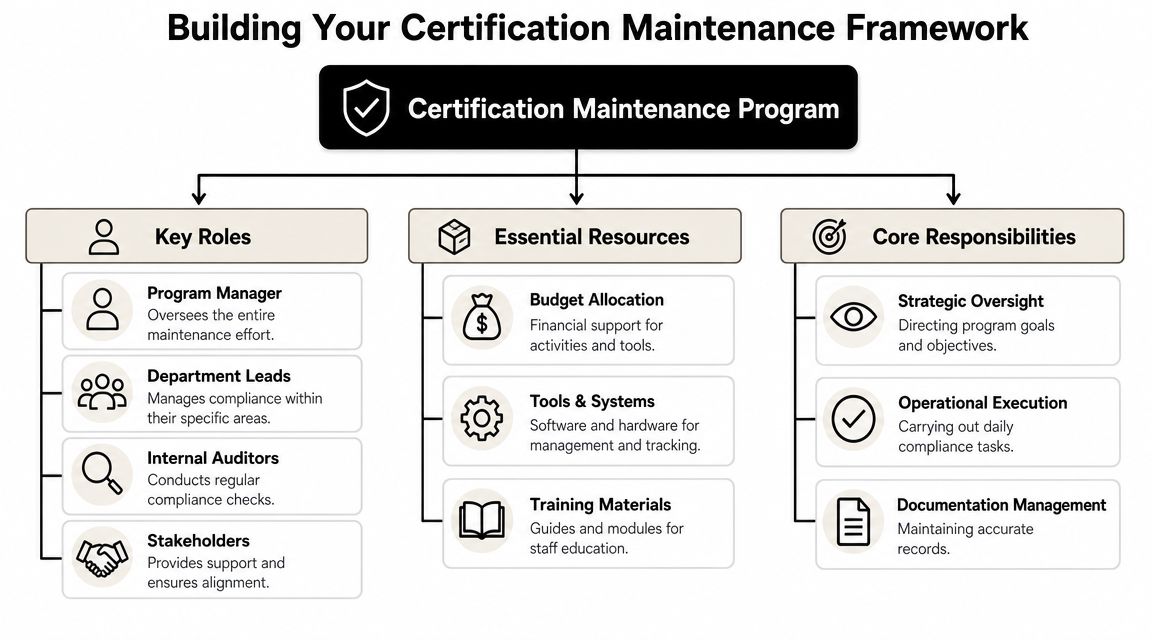
A resilient framework starts with named accountability. In practice, four groups matter most.
| Role | What they own | What goes wrong without them |
|---|---|---|
| Program manager | Master calendar, audit coordination, status reporting | Deadlines slip and evidence requests become chaotic |
| Department leads | Process-level controls in operations, security, HR, logistics, and procurement | Policies exist but don't match actual practice |
| Internal auditors | Periodic checks, sampling, follow-up on findings | Gaps stay hidden until the external audit |
| Executive sponsor | Priority, budget, escalation authority | Compliance work loses out to urgent operational work |
The program manager doesn't have to create every artifact. But that person must know where the artifact lives, who owns it, and when it was last validated.
Build one source of truth
The framework also needs a shared operating layer. If every team keeps its own tracker, you'll spend audit week reconciling versions.
Use a master certification calendar that includes:
- Renewal and surveillance dates for each standard or customer requirement
- Training due dates by role, not just by department
- Internal audit windows and corrective action deadlines
- Vendor verification review dates
- Policy review dates and document approval checkpoints
Pair that with a central evidence repository. The repository should reflect how an auditor asks questions, not how your departments are charted. I've seen teams save time by organizing folders around evidence themes such as training, downstream due diligence, incident response, media handling, chain of custody, and corrective actions.
Practical rule: If a record can't be found in two minutes by someone outside the department that created it, it isn't audit-ready.
Standardize the minimum control set
Not every certification clause needs its own workflow. That's where teams overcomplicate maintenance.
Start with a small control set that can support multiple standards at once:
- Document control
- Training and competency records
- Internal audits
- Corrective and preventive action
- Vendor qualification and re-verification
- Management review
- Access and security evidence
- Operational logs and chain-of-custody records
That structure scales better than standard-by-standard administration. It also aligns with the reality of ITAD work, where one operational event often satisfies several requirements at once. A properly documented destruction workflow, for example, may support customer assurance, downstream traceability, and internal security evidence all at the same time.
A program built this way does more than preserve certifications. It creates repeatable control over services like R2-certified electronics recycling, where operational proof matters as much as policy language.
Executing the Program Documentation, Training, and Internal Audits
A framework matters only if it drives recurring behavior. The work that keeps certifications active is repetitive by design. That's a good thing. Repetition is how you make audits boring.
The most reliable operating loop has five parts: document the work, train the people, test the controls, correct the gap, and update the system. Teams that skip one of those steps usually end up recreating it under pressure later.
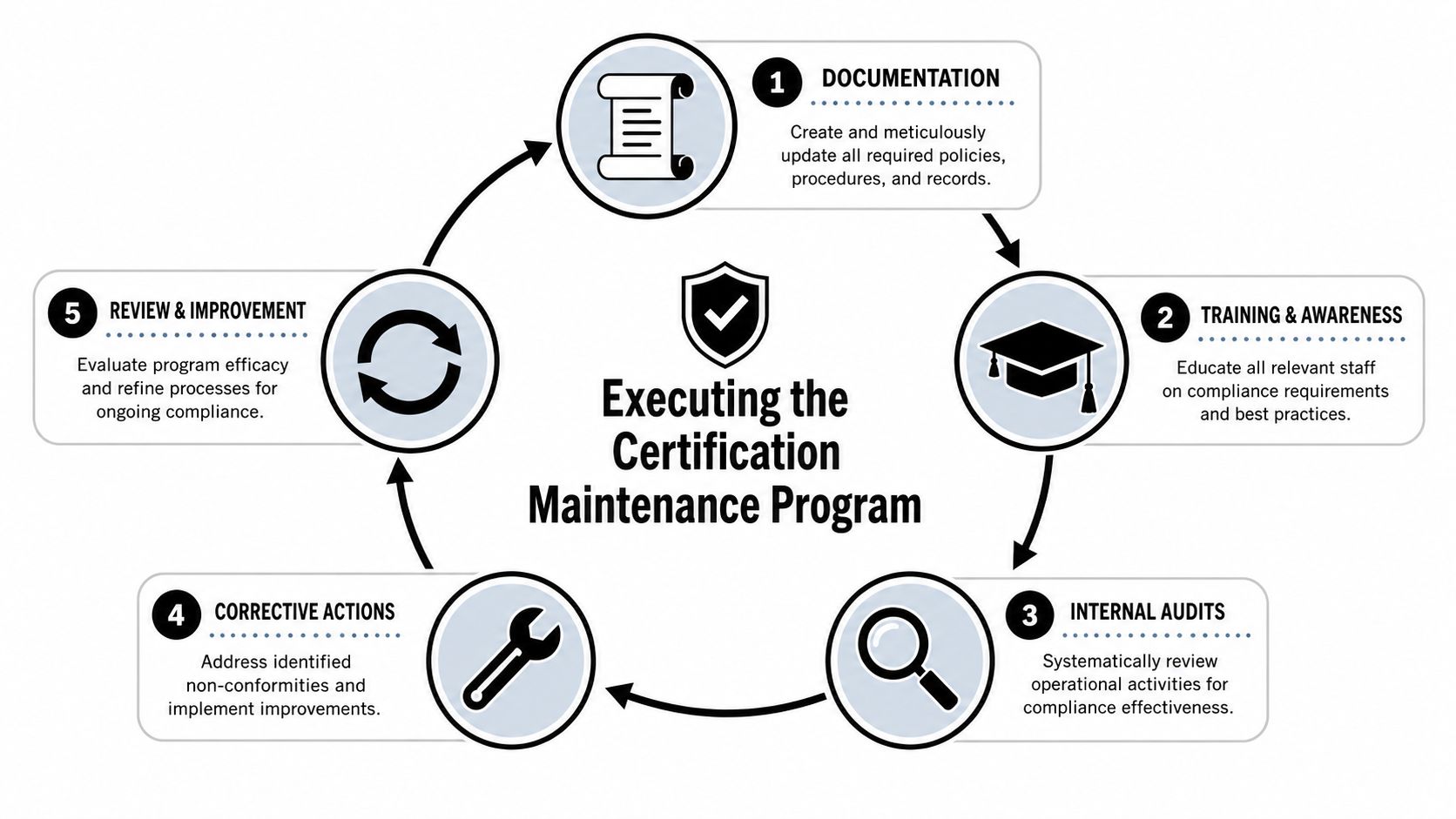
Documentation has to happen close to the work
Late evidence is weak evidence. If an operator completes intake reconciliation, if a technician performs data sanitization, or if procurement approves a downstream partner, the supporting record should be created and stored as part of that activity. Not weeks later.
Misconceptions about documentation lead many programs to fail. People assume documentation is clerical. It isn't. Documentation is the proof that the control existed and operated.
A simple rule helps: every recurring compliance activity should produce a predefined artifact. That might be a signed log, a ticket, a reviewed report, a training acknowledgment, a vendor attestation, or a corrective action record. The exact format matters less than consistency and retrieval speed.
Training should be role-based, not generic
Annual awareness sessions have their place, but they don't maintain certification by themselves. Auditors want to see that staff members understand the part of the process they perform.
Use a training matrix tied to job functions:
- Receiving and warehouse teams need handling, labeling, segregation, and chain-of-custody instruction.
- Technicians need process-specific controls for media handling, sanitization, verification, and exception escalation.
- Customer service and account teams need guidance on commitments made in contracts, certificates, and client questionnaires.
- Procurement and vendor managers need re-verification procedures and escalation criteria for expired documentation.
- IT and security staff need evidence discipline for access, logging, and incident handling.
A documented program matters. A 2025 report by the E-Waste Compliance Institute found that organizations with a documented certification maintenance program were 60% less likely to receive a major non-conformance during surveillance audits for standards like R2v3 and e-Stewards (audit non-conformance finding).
Internal audits should feel like rehearsals
The best internal audits aren't broad lectures on compliance. They are narrow checks against real evidence.
Use targeted audits that ask practical questions:
- Can the team retrieve the current approved procedure?
- Can they show the last completed training record for the people doing the work?
- Can they produce objective evidence for a sampled transaction?
- Can they show what happened when something went wrong?
- Can they prove that a prior finding was fixed in the process, not just in the report?
That approach lowers defensiveness because it feels operational, not ceremonial.
Internal audits work best when they sample live records from actual jobs, not curated examples chosen because they look clean.
Close the loop on findings
A mature maintenance program doesn't stop at identifying gaps. It verifies that the fix changed the system.
Use a short corrective action format:
| Question | What you need |
|---|---|
| What happened | Clear statement of the nonconformity |
| Why it happened | Root cause tied to process, ownership, or training |
| What changed | Specific procedural, technical, or training fix |
| Who verified it | Independent check that the fix is real |
| When it will be reviewed again | Follow-up date to confirm durability |
That loop is especially important in regulated disposition workflows such as secure data destruction, where training gaps and missing records create both audit exposure and customer risk.
Extending Compliance to Your Vendor Chain
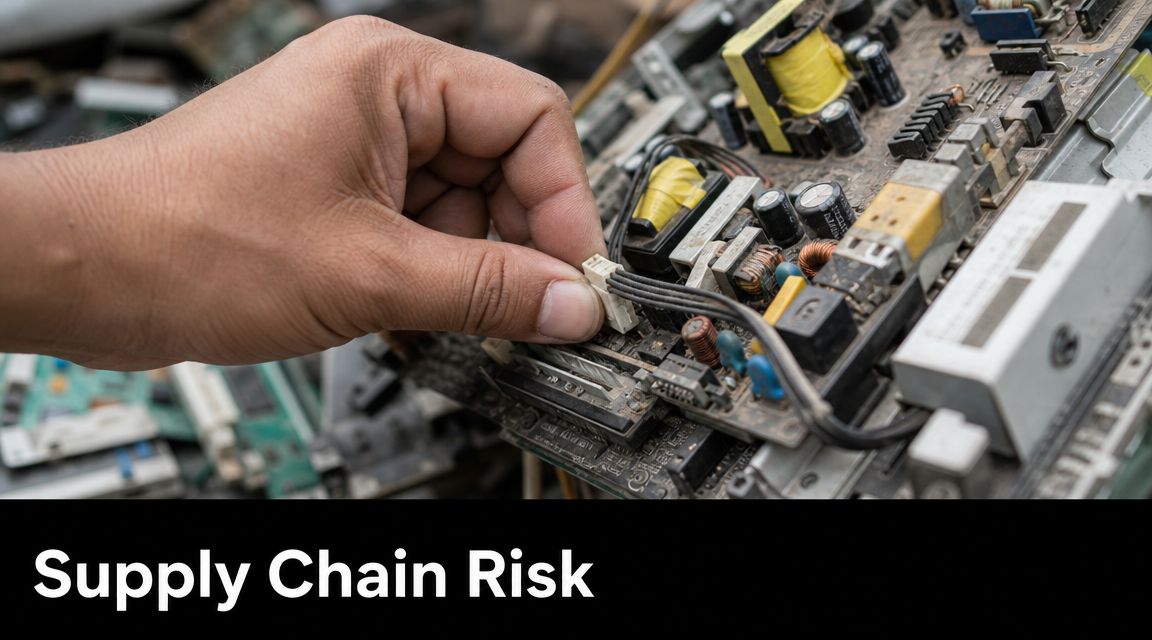
An internal program can be tight and still fail if your downstream vendor lets a certification lapse, changes scope, or stops following the documented process. In ITAD, your compliance claim travels through the chain of custody. If that chain breaks, your paperwork won't save you.
That's why vendor certification maintenance belongs inside the same program as your internal controls, not in a separate procurement file.
Initial due diligence isn't enough
A vendor may look solid during onboarding and become risky later. Certifications expire. Scopes change. Ownership changes. Facilities add subcontractors. Audit findings build up.
That risk isn't theoretical. Data from the National Association for Information Destruction shows that 45% of data breaches in the ITAD chain of custody are linked to lapsed or non-compliant vendor certifications, which is why continuous verification matters in practice.
The mistake I see most often is annual review by calendar only. That's too thin for high-risk vendors handling media, downstream materials, or regulated devices.
What to verify on a recurring basis
Use a re-verification checklist that goes beyond “send me your current cert.”
- Certification status. Confirm the certificate is current, in scope, and issued to the correct legal entity and facility.
- Scope alignment. Check that the activities you outsource are covered by the vendor's certification scope.
- Insurance and contractual terms. Make sure required coverage and security language still match your risk profile.
- Incident history and corrective actions. Ask whether there were reportable events, material findings, or major process changes since the last review.
- Subcontracting and downstream use. Identify any new third parties that now touch your customer assets or materials.
- Operational proof. Sample shipping records, destruction records, or downstream tracking documents when the relationship is high impact.
Some vendors resist this level of review. That's useful information by itself.
If a downstream partner treats re-verification as an annoyance, treat that reaction as part of the risk assessment.
Put vendors on tiered review cycles
Not every vendor needs the same level of scrutiny. A shredding partner handling serial-numbered media deserves more frequent review than a low-risk service provider with no custody of client data.
A workable tier model looks like this:
| Vendor tier | Typical example | Review approach |
|---|---|---|
| High risk | Downstream processors, media handlers, destruction partners | Scheduled re-verification plus event-driven review |
| Moderate risk | Logistics or storage partners with controlled access | Periodic documentation review and sample testing |
| Lower risk | Support vendors with no direct custody | Basic current-document confirmation |
That discipline strengthens the whole disposition chain, especially when evaluating IT asset disposition companies that may participate in regulated or customer-audited workflows.
Navigating Surveillance Audits with Confidence
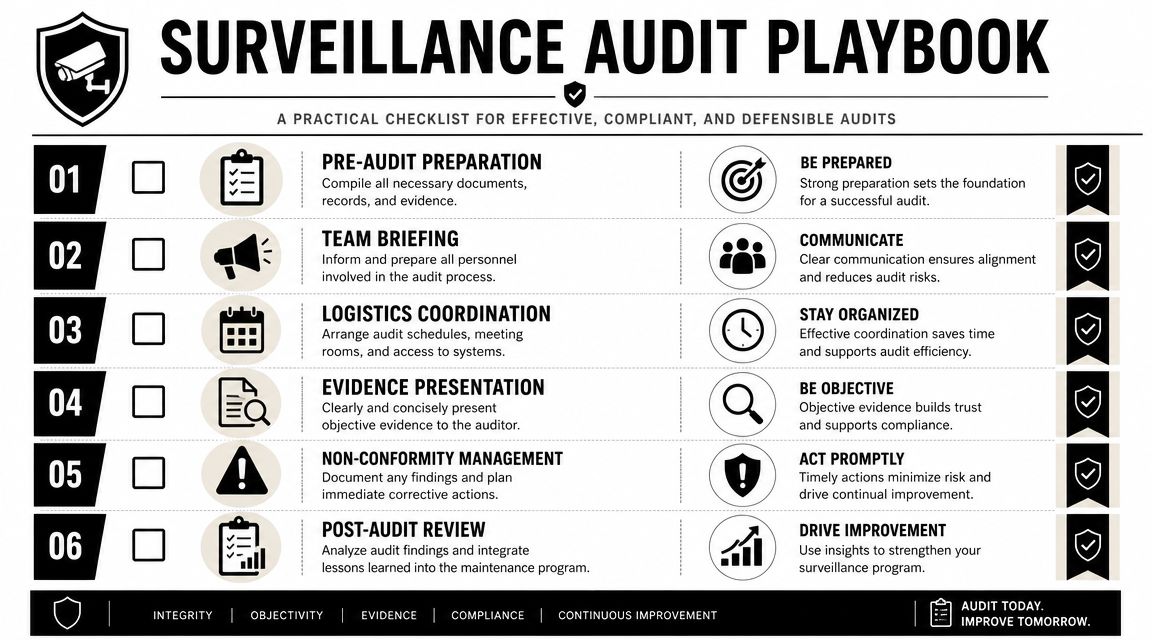
A surveillance audit shouldn't feel like a surprise inspection. It's a scheduled verification of whether your maintenance program operates the way you say it does.
That's consistent with how maintenance works in other credentialing systems. Some programs require annual upkeep, while others run on longer cycles. Salesforce, for example, requires one maintenance badge per year for many certifications, while other systems use multi-year cycles. The pattern is the same. Maintenance is an ongoing competency check, not a one-time event (Salesforce maintenance requirements).
Prepare the room before the auditor arrives
Good audit days are built the week before.
Start with a controlled prep list:
- Freeze the evidence set for the requested period so people aren't editing documents during review.
- Brief each interviewee on their process, their records, and the limits of their role.
- Stage your repository so requested files are easy to retrieve in sequence.
- Assign a scribe to log every request, answer, file provided, and open issue.
- Confirm logistics such as access, escort rules, conference space, and system availability.
The scribe role is underrated. Memory gets unreliable as soon as multiple requests start moving at once. A written log prevents confusion and helps with post-audit response.
Answer narrowly and prove what you say
During the audit, the biggest mistake is overexplaining. Auditors need clear answers and objective evidence. They don't need a theory lecture or a guess.
Use a simple response pattern:
- State the process briefly.
- Name the controlled record that proves it.
- Retrieve the evidence.
- Stop.
If the auditor asks a broader question, answer that question. Don't volunteer adjacent issues unless they're necessary for accuracy. That isn't evasive. It's disciplined.
Field advice: Never let the auditor's first view of a process be a draft document, a side spreadsheet, or an outdated local file. Show the controlled record first.
Treat findings professionally
Even strong programs receive findings, observations, or requests for clarification. The difference between a mature and immature team shows up in the response.
When a nonconformity is raised:
- Clarify the exact requirement tied to the finding
- Confirm the objective evidence reviewed
- Avoid arguing in the room unless the record is plainly incorrect
- Assign ownership before the closing meeting ends
- Separate immediate containment from root-cause correction
That separation matters. If a training record is missing, immediate containment may be to verify the employee's status and remediate the file. Root-cause correction may involve changing the training assignment workflow, repository permissions, or supervisor review step.
For customer-facing asset disposition work, keeping audit evidence clean also supports downstream deliverables such as a certificate of destruction for hard drives, where documentation quality directly affects client trust.
From Maintenance to Continuous Improvement
Passing the audit isn't the endpoint. It's a health check.
The strongest certification maintenance programs use every cycle to tighten the system. A missed signature might reveal weak supervisor review. A late vendor file might expose a broken reminder process. A confusing interview response might show that training content doesn't match the floor reality. When you treat those signals as process data, maintenance starts producing operational value.
Use a small set of management indicators
You don't need a dashboard packed with vanity metrics. Track a short list that tells you whether the program is functioning:
- On-time completion of scheduled reviews
- Open corrective actions by age
- Training completion by role
- Vendor re-verification status
- Document review currency
- Internal audit findings by recurring root cause
That's enough to tell whether the system is holding.
A lot of teams buy software and assume the problem is solved. It usually isn't. Up to 80% of CMMS implementations fail, and about 80% of users don't use all available software functions, which shows how poor tool adoption creates weak records and audit gaps (maintenance KPI and CMMS adoption analysis). The same pattern shows up in compliance platforms. If people don't use the workflow consistently, the tool becomes expensive wallpaper.
Improve the program where work actually happens
Continuous improvement should show up in daily operations, not just in management review slides.
That usually means practical changes such as:
| Weak point | Better approach |
|---|---|
| Late evidence uploads | Require record creation at the point of task completion |
| Training records missing approvals | Add supervisor verification before closure |
| Vendors slipping past review dates | Tie escalations to procurement and shipping holds |
| Policies nobody reads | Rewrite procedures around the actual task flow and job role |
The result is a quieter operation. Fewer surprises. Faster retrieval. More confidence when customers send security questionnaires or auditors ask for samples.
A durable program doesn't just help you keep certifications current. It helps you run an ITAD environment that can prove what it did, when it did it, and who verified it.
Dallas Fortworth Computer Recycling helps organizations build defensible ITAD workflows with secure handling, documented chain of custody, and nationwide service for retirement of technology assets. If you need a disposition partner that supports audit readiness across data destruction, recycling, and downstream compliance, explore Dallas Fortworth Computer Recycling.