
Your Guide to Secure Computer Disposal Service for Modern Businesses
A professional computer disposal service isn't just a junk hauler; it's a specialized security and logistics partner managing the entire end-of-life process for your company's IT assets. This goes far beyond simple trash removal, providing a secure, documented system to protect sensitive data, ensure you meet all regulatory requirements, and even recover value from outdated equipment.
What Is a Computer Disposal Service Really?
It's helpful to think of a computer disposal service less like a waste management company and more like a team hired to decommission a secure facility. When a sensitive building is retired, you don’t just walk away and leave the doors unlocked. You follow a strict protocol to ensure nothing valuable—or dangerous—is left behind.
Your old computers are no different. Each one is a vault containing sensitive business data, customer information, and intellectual property. A professional service treats them that way. This is a comprehensive process designed to manage risk from the moment a computer is unplugged to its final, documented disposition. For any business that values data security and its reputation, this is a critical function.
More Than Just Recycling
The core mission of a computer disposal service is to provide a secure and auditable end-of-life solution for your technology. This is built on a few key pillars that separate professional services from a standard recycling drop-off:
- Data Security: The absolute top priority is ensuring that any data on your devices is completely and irreversibly destroyed. This is your shield against the devastating data breaches that can happen when hardware is discarded improperly.
- Regulatory Compliance: These services help you navigate a complex web of laws, from data privacy regulations like HIPAA to state-level e-waste rules. They provide the necessary documentation to prove you handled every asset responsibly.
- Value Recovery: Not all old equipment is worthless. A good disposal partner can test, refurbish, and resell functional assets, often turning a disposal cost into a revenue stream for your company. You can learn more about this in our guide to IT asset disposition.
The need for these services has never been greater. Globally, we generated a staggering 62 million tonnes of e-waste in 2022, a massive 82% jump from 2010. Even more concerning, e-waste is growing five times faster than documented recycling efforts, which underscores the urgent need for responsible disposal. You can read the full research about these e-waste trends and their impact.
By framing this service correctly, IT leaders can move from seeing it as a simple expense to recognizing it as an essential component of their risk management and corporate social responsibility strategy. It is a vital safeguard for your company's reputation and bottom line.
The Secure Journey of Your Retired IT Assets
Ever wonder what really happens to your company’s computers after they leave the office? It’s not a simple trip to a local dumpster. Instead, a professional computer disposal service kicks off a secure, multi-stage process built to protect your data, recover any remaining value, and ensure every piece is handled responsibly.
Think of it as a secure chain of custody, where each link is forged with precision and accountability. From the moment a server is unplugged or a laptop is collected, its journey is meticulously tracked and documented. This isn't just about getting rid of old hardware; it's a strategic operation to safely decommission digital vaults.
Secure Logistics and Transportation
The journey starts the moment your assets are scheduled for pickup. This initial step, secure logistics, is absolutely critical for preventing data leaks before the equipment even leaves your property. A professional service doesn’t just show up with a generic moving truck.
Instead, their trained technicians follow a documented process:
- Asset Tagging: Every device—from servers down to individual hard drives—is scanned and inventoried right there on-site, creating the first link in the chain-of-custody record.
- Secure Transport: Your assets are then loaded into sealed, locked vehicles equipped with GPS tracking, ensuring a secure and auditable path from your door to the certified facility.
This initial phase is designed to eliminate any opportunity for unauthorized access during transit, which is often the most vulnerable point in the entire disposal lifecycle.
Certified Data Destruction
Once the assets arrive at the secure facility, the most critical phase begins: certified data destruction. This is the digital equivalent of permanently sealing a vault and melting down the key. The goal is to make any data stored on the devices completely and irreversibly unrecoverable.
This graphic shows how sensitive data is protected by a secure service, with the end result being responsibly recycled materials.
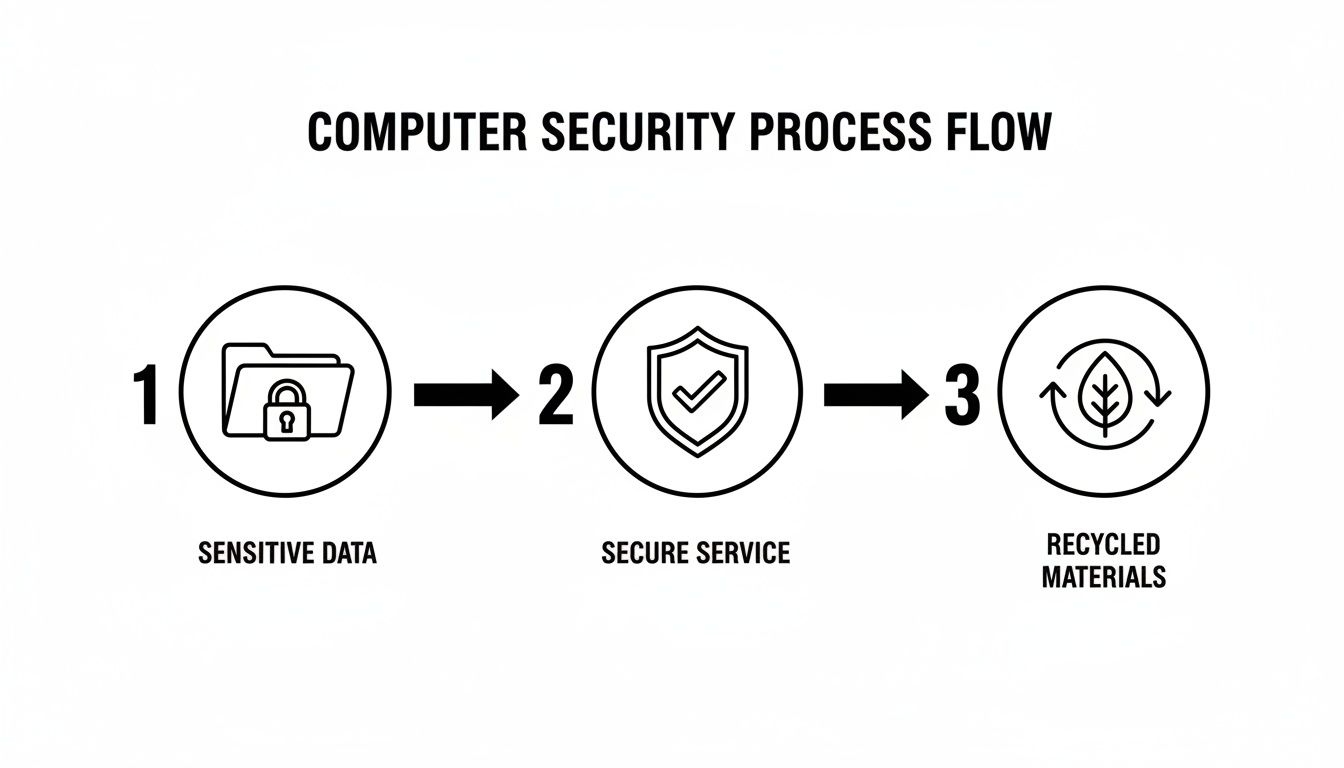
As the visual shows, the core function of a computer disposal service is to act as a secure shield between your confidential information and its final, eco-friendly state.
Vendors use several industry-standard methods to make this happen, often following rigorous standards like NIST 800-88.
NIST 800-88 Compliant Wiping: This is a software-based approach where the entire storage drive is overwritten multiple times with random data. This process effectively sanitizes the drive, making the original information impossible to pull even with forensic tools.
For drives that are broken, damaged, or held extremely sensitive data, physical destruction is the only acceptable answer. This involves industrial shredders that grind hard drives, SSDs, and other storage media into tiny, unrecognizable fragments. You can learn more about the specific techniques in our guide to secure data destruction services. Once complete, you’ll receive a Certificate of Data Destruction—a legal document that serves as your auditable proof of compliance.
Value Recovery and Remarketing
Not all retired technology is waste. A big part of the journey involves value recovery, where functional equipment is given a second life. This is where a computer disposal service can shift from being a cost center to a potential source of revenue for your business.
The process is systematic:
- Triage and Testing: Technicians evaluate each asset to determine its functional condition and potential market value.
- Refurbishment: Viable equipment is cleaned up, repaired, and upgraded to meet current market standards.
- Resale: The refurbished assets are sold through established secondary market channels, with a portion of the revenue often returned to your organization.
This step doesn’t just recover financial value; it also aligns with sustainability goals by promoting reuse, which is the most effective form of recycling.
Responsible Recycling and Demanufacturing
For assets that have no resale value or have failed testing, the final stage is responsible recycling. This is far more involved than simply tossing items into a bin. It requires a meticulous demanufacturing process governed by a strict zero-landfill policy.
Certified recyclers carefully dismantle each device to separate the raw materials.
- Commodity Recovery: Valuable materials like gold, copper, aluminum, and plastics are extracted and sent back into the manufacturing supply chain.
- Hazardous Material Management: Toxic components such as lead, mercury, and cadmium are safely removed and processed according to strict environmental regulations.
This final step ensures that your company's old assets don't contribute to the growing e-waste problem. By partnering with a certified computer disposal service, you guarantee that every component is handled in an environmentally sound manner, completing a secure and responsible journey from your office to its final disposition.
Staying Compliant in a World of Digital Risk
Disposing of old technology without a documented, compliant process is like leaving your company's front door wide open. In a world where a single data breach can lead to millions in fines and irreparable damage to your reputation, navigating the maze of security and environmental regulations isn't optional. It’s a core business function.
A professional computer disposal service acts as your compliance partner. They’re the experts who ensure every retired asset is handled according to strict legal and industry standards, protecting you from what you don’t know. This isn't just about avoiding penalties; it's about proving you did things the right way.

Demystifying NIST 800-88 Data Destruction
The absolute cornerstone of secure data sanitization is the NIST Special Publication 800-88. Think of this not as a guideline, but as the gold standard—a legal and technical framework for making sure data is truly gone for good. Any credible computer disposal service builds their entire process around these methods.
NIST 800-88 breaks down media sanitization into three distinct levels:
- Clear: This involves overwriting data with new, random data. It's effective for blocking simple recovery tools but might not hold up against a determined forensic expert.
- Purge: A much stronger approach. This uses techniques like degaussing (for magnetic drives) or cryptographic erasure to protect data from even the most advanced laboratory recovery attempts.
- Destroy: This is the final answer. It means physically disintegrating the media through shredding, melting, or pulverizing, making data recovery completely impossible.
So which one is right for you? It all comes down to the sensitivity of the data. For most corporate hard drives, a certified Purge is more than enough. For highly classified information or physically damaged drives, Destroy is the only way to go. To understand the proof you should get back, check out our guide on the Certificate of Destruction for hard drives.
Industry-Specific and Environmental Regulations
On top of the foundational data security rules, many industries and government bodies have their own strict requirements. For healthcare organizations, the Health Insurance Portability and Accountability Act (HIPAA) is non-negotiable. It mandates that all patient health information (PHI) on retired devices be rendered unreadable and unusable. The fines for non-compliance are severe.
Financial institutions face similar pressure under the Gramm-Leach-Bliley Act (GLBA), which requires them to safeguard consumers' private financial information. That responsibility doesn't just disappear when a server is unplugged; it follows the device until it is certifiably destroyed.
It's crucial to understand the rules that govern your specific industry when disposing of old IT hardware. The table below summarizes some of the key regulations and standards you'll encounter.
| Regulation/Standard | What It Governs | Why It Matters for Your Business |
|---|---|---|
| NIST 800-88 | Data sanitization methods for digital media. | Provides a defensible, government-backed standard for proving data was properly destroyed. |
| HIPAA | Protection of patient health information (PHI). | Healthcare organizations face massive fines for data breaches involving unsecured PHI on old devices. |
| GLBA | Security of consumer financial information. | Financial institutions must ensure customer data on retired assets is completely unrecoverable. |
| State E-Waste Laws | The proper disposal and recycling of electronics. | Many states prohibit dumping e-waste in landfills and mandate specific recycling procedures. |
| R2 & e-Stewards | Third-party certifications for recyclers. | These certifications prove a vendor adheres to the highest standards for security and environmental safety. |
Working with a vendor who understands these nuances is the only way to ensure you're fully covered, from data privacy to environmental impact.
The Importance of R2 and E-Stewards Certifications
How can you be sure a vendor actually does what they promise? The answer is third-party certifications. These aren't just fancy logos for a website; they are proof of a rigorous, ongoing commitment to the highest security and environmental standards in the industry.
Two certifications stand out as the ones to look for:
- R2 (Responsible Recycling): The R2 standard covers the entire lifecycle of electronics repair and recycling, with a heavy focus on protecting the environment, worker safety, and data security. An R2-certified vendor is audited to ensure they track every component to its final destination.
- e-Stewards: Often considered the most stringent certification, e-Stewards was founded on the principle of preventing hazardous e-waste from being exported to developing countries. It also has tough requirements for data security and a strict "no landfill, no incineration" policy.
Partnering with a certified computer disposal service is your ultimate safeguard. It gives you an auditable, defensible paper trail that proves your organization acted responsibly, protecting you from legal trouble and ensuring your old equipment never becomes someone else's problem.
Choosing the Right Computer Disposal Partner
Picking a partner to handle your computer disposal is a decision with real weight. You're not just hiring a moving company; you're trusting a security firm with your company’s most sensitive information. The right partner is your final line of defense for your data, your reputation, and your compliance record.
Making the wrong choice can lead to a world of hurt—data breaches, steep environmental fines, and a complete loss of customer trust. That's why you have to look past the glossy brochures and sales pitches. You need to dig into their certifications, processes, and security protocols with a critical eye.

Verifying Certifications: The Non-Negotiable First Step
The very first filter in your vetting process should be third-party certifications. These aren't just fancy badges for a website. They are hard-earned proof that a vendor has passed rigorous, independent audits of their security, environmental, and safety standards. Without them, you're just taking a company at its word.
There are two gold standards in our industry you absolutely must look for:
- R2 (Responsible Recycling): This certification proves a vendor follows best practices for electronics recycling, hitting all the key marks for environmental protection, worker safety, and data security. An R2 partner means you’re getting a documented and secure process from start to finish.
- e-Stewards: Often considered the toughest standard out there, e-Stewards was created specifically to stop hazardous e-waste from being dumped in developing countries. It mandates a strict zero-landfill policy and maintains the highest data security protocols.
Any vendor without an R2 or e-Stewards certification should be an immediate dealbreaker. These are the baseline requirements for proving a computer disposal service operates ethically and securely.
Demanding a Transparent Chain of Custody
Once you've confirmed their certifications, it's time to zoom in on their process. A critical piece of any reliable computer disposal service is a clear and unbroken chain of custody. This is the documented paper trail that tracks every single one of your assets from the second it leaves your building to its final destruction or resale.
This should never be a "black box" process where your gear disappears and you just hope for the best. A trustworthy partner will provide detailed, auditable reports at every single stage. This documentation is your legal proof of due diligence, showing you took every necessary step to protect data and comply with regulations. You can get more insights by checking out how different IT asset disposition companies handle their processes.
Key Questions to Ask Potential Vendors
To really get a feel for a potential partner, you need to ask specific, direct questions that cut right through the marketing fluff. Use this checklist during your evaluations to make sure you cover all the critical bases.
Security and Compliance Questions:
- Can you provide us with copies of your current R2 or e-Stewards certifications?
- How do you document the chain of custody for each asset?
- What specific data destruction methods do you use, and do they meet NIST 800-88 guidelines?
- Will we get a serialized Certificate of Data Destruction for every single hard drive?
- What are the security protocols at your facility and for your transport vehicles?
Logistics and Capabilities Questions:
- Can you handle pickups from all our office locations, even if they're nationwide?
- Are your technicians trained to de-install specialized equipment, like servers from our data center racks?
- What does your on-site process for inventorying and scanning our assets look like?
- Can you give us a clear quote that breaks down all costs and any potential revenue we might get from remarketed assets?
- What kind of reporting can we expect, and how soon after a pickup is it available?
How a vendor answers these questions will tell you everything you need to know about their capabilities and reliability. A partner who answers confidently and transparently is one you can trust with your assets, your data, and your company’s good name. The right choice here turns a routine task into a strategic move for managing risk.
The True Cost and Value of Responsible Disposal
When you get a quote for a professional computer disposal service, it’s tempting to look at it as just another line-item expense. But that’s a narrow view. The real financial picture isn’t just about the cost—it’s about the massive value you get back through risk mitigation, revenue recovery, and strengthening your brand.
Of course, understanding the direct costs is simple enough. The price tag is usually shaped by a few key things: how many assets you have, what kind of equipment it is (servers are different from laptops), and the specific data destruction you need. On-site physical shredding, for instance, is going to have a different cost profile than off-site software wiping.
Shifting from Cost Center to Revenue Stream
The real game-changer is value recovery. This is where a certified partner turns your retired hardware from a liability into a potential revenue source. Many of your devices, once they've been securely sanitized, are still perfectly functional and can be refurbished and sold on the secondary market.
This revenue-sharing approach can completely change the economics of your IT retirement project:
- Cost Offset: The money generated from selling remarketed assets can often be enough to completely cover the service fees for data destruction and recycling.
- Net Profit: In many situations, especially if you have newer equipment, the revenue can actually exceed the costs. Your disposal project just became a profitable one.
When you work with a service that has a strong remarketing network, you’re not just paying for disposal. You’re investing in a system built to squeeze every last drop of value from your old assets. You can check out our guide on where to sell computer parts to get a better sense of how this secondary market works.
The Tangible Value of Environmental Responsibility
Beyond the direct financial return, responsible disposal delivers huge value by aligning your company with its corporate social responsibility (CSR) goals. This is more than a feel-good buzzword; it has a real, measurable impact on your brand’s reputation and the trust you build with customers and stakeholders.
A certified computer disposal service guarantees that your e-waste is handled under a strict zero-landfill policy. This prevents toxic materials like lead and mercury from contaminating the environment and ensures valuable resources are put back into the supply chain.
This commitment to sustainability is becoming non-negotiable in the global market. The electronic waste recycling sector is booming, with its market size projected to hit USD 80,432.8 million by 2025. North America is a major player in this space, accounting for about 37% of the global market, thanks to strong regulations and advanced recycling infrastructure. You can discover more insights about the global e-waste recycling market and its growth.
By choosing a certified partner, you become a part of this positive trend. You get tangible environmental metrics you can use in your sustainability reports and marketing, building a powerful business case that proves investing in responsible disposal pays dividends far beyond the initial quote.
Common Questions About Computer Disposal Services
Even after you understand the basics, a few specific questions always come up when IT and compliance leaders start looking into a professional computer disposal service. Getting straight, clear answers is the key to making the right call. Let's walk through the most common concerns to clear up any lingering doubts.
How Can I Be Sure My Data Is Completely Destroyed?
This is, without a doubt, the most important question. The ultimate proof you’re looking for is a legal document called a Certificate of Data Destruction. Any reputable service will issue one for every single asset they handle, confirming that all data was wiped clean according to standards like NIST 800-88.
This certificate is your auditable proof of due diligence and an essential record for any compliance audit. For organizations that need an even higher level of assurance, on-site services are a great option. A technician brings a mobile shredder right to your facility and physically destroys the hard drives in front of you before the shredded fragments are securely transported away.
The bottom line is this: a transparent, documented chain of custody from the moment your equipment leaves your building to its final destruction is non-negotiable. This process gives you a defensible record and ensures your data's security is never in question.
What Happens to My Old Computers After Pickup?
Your old assets don’t just end up in a landfill. Once they arrive at a secure processing facility, every device is triaged to figure out the best path forward, maximizing both value and sustainability.
- For functional equipment: Devices that still have some life in them are data-wiped, tested, and refurbished for resale. This value recovery can generate revenue that is often shared back with your organization, helping to offset the disposal costs.
- For non-working or obsolete devices: These are responsibly dismantled in a process called demanufacturing, where technicians carefully separate all the raw materials for recycling.
This eco-friendly approach guarantees a zero-landfill policy. Hazardous materials like lead and mercury are managed safely according to environmental regulations, while valuable commodities like copper, gold, aluminum, and plastics are recovered and put back into the supply chain to make new products.
Is a Professional Disposal Service Expensive?
It’s more accurate to see a professional computer disposal service as an investment in risk management, not just another line-item expense. The potential cost of a single data breach—from fines and legal fees to the hit on your reputation—is almost always going to be far higher than the service fee for doing things right.
Besides, the final cost isn't always a simple debit. As mentioned, many professional services have strong value recovery programs. The money made from reselling your viable assets can significantly reduce, and in some cases, completely cover the entire cost of the service.
The final price tag will depend on a few things:
- Volume of assets
- Types of equipment (e.g., laptops vs. data center servers)
- Logistics and location
- Type of data destruction required (e.g., on-site shredding vs. off-site wiping)
Always ask for a detailed quote that breaks down all the costs and potential credits. That way, you’ll get a clear picture of the total investment and potential return.
What Types of Equipment Can Be Handled?
A true IT asset disposition (ITAD) partner can handle much more than just desktops and laptops. Their services are built to manage the entire range of your organization's technology.
This typically includes:
- Data Center Hardware: Servers, storage area networks (SANs), and networking gear like switches and routers.
- Office Electronics: Monitors, printers, docking stations, and all the peripherals that go with them.
- Mobile Devices: Smartphones and tablets, which are often packed with sensitive company data.
- Specialized Equipment: Many certified providers can also handle regulated electronics from specific industries, like medical devices from healthcare or ATMs and point-of-sale systems from finance.
Before you sign on with a partner, it’s critical to confirm they have the right certifications and experience to process every type of asset your organization needs to retire. A truly capable computer disposal service should be a one-stop shop for all your end-of-life technology.
Managing the end-of-life for your company's IT assets requires a partner you can trust. At Dallas Fortworth Computer Recycling, we provide secure, compliant, and nationwide computer disposal services designed to protect your data and reputation. Learn more about how we can create a custom disposition plan for your organization.