
A Business Guide to Computer Equipment Recycling
Computer equipment recycling is the secure dismantling and processing of retired IT hardware to recover valuable materials and keep hazardous components out of landfills. For any business, this isn't just an environmental feel-good task—it's a core function of data security, risk management, and even financial strategy.
A well-managed recycling program guarantees that sensitive data is permanently destroyed and that every piece of equipment is accounted for from start to finish.
Why Computer Equipment Recycling Is a Business Imperative
That growing stack of outdated servers, laptops, and monitors in your storage closet isn't just taking up space. It's a ticking clock of potential liabilities. Many organizations see old hardware as a simple disposal problem, but it’s more accurate to think of it as a locked vault. Inside that vault, you'll find sensitive corporate data, customer information, and untapped financial value.
Ignoring it is no longer an option.
Mishandling this equipment exposes your business to serious risks. Data breaches that originate from discarded hard drives can lead to brand-damaging headlines and catastrophic financial penalties. On top of that, non-compliance with environmental regulations can result in steep fines, turning a "free" trip to the local dump into an expensive mistake.
The Strategic Shift from Disposal to Disposition
A modern approach reframes this challenge through IT Asset Disposition (ITAD), a structured process that transforms retired hardware from a liability into a managed asset. This is about more than just breaking things down; it's a strategic de-commissioning process that protects your business and can even recover value.
An effective ITAD program is built on four pillars that directly impact your bottom line and reputation. You can learn more by exploring our dedicated guide on corporate e-waste solutions.
An effective computer equipment recycling program is an extension of your company’s security and compliance team. It provides a documented, auditable trail proving that every asset was handled responsibly from the moment it left your facility.
The Four Pillars of Strategic Computer Equipment Recycling
Shifting from a "throw it away" mindset to a strategic disposition plan is essential. Here are the four business drivers that make a formal ITAD program a non-negotiable part of modern business operations.
| Pillar | Business Implication |
|---|---|
| Data Security | Protects sensitive corporate and customer data on retired devices, preventing costly data breaches and lawsuits. |
| Risk & Compliance | Ensures adherence to environmental laws (like EPA regulations) and data privacy rules (like HIPAA), avoiding fines. |
| Financial Recovery | Recovers value from retired assets through remarketing and responsible recycling, turning a cost center into revenue. |
| Brand Reputation | Demonstrates corporate social responsibility (CSR) and a commitment to sustainability, building trust with stakeholders. |
Ultimately, these pillars work together to turn a logistical headache into a strategic advantage, safeguarding your company's security, finances, and public image.
The Growing E-Waste Challenge
The scale of this issue is immense and growing at an alarming rate. Globally, e-waste generation is surging, but recycling rates remain dangerously low. In 2022, the world generated a staggering 62 million tonnes of e-waste, a figure projected to swell to 82 million tonnes by 2030.
Shockingly, only 22.3% of that 2022 e-waste was properly collected and recycled. This left a massive US$62 billion in recoverable materials like gold, copper, and palladium sitting in landfills.
These global computer recycling trends highlight not just an environmental crisis but a huge economic opportunity lost every time a business fails to implement a professional recycling program.
The ITAD Journey: From Your Doorstep to Final Reporting
So, your old hardware is stacked on pallets and ready to go. What happens next? The journey your equipment takes from your loading dock to its final destination is a carefully choreographed process designed to protect your data, eliminate risk, and pull out any remaining value.
This isn't like calling a standard freight company. Think of it more like an armored car service for your technology, where every single laptop, server, and hard drive is tracked under a strict chain of custody.
From the moment a professional ITAD partner takes over, the number one priority is maintaining that unbroken, auditable trail. This is the bedrock of secure computer equipment recycling, ensuring no device ever goes missing and that every single action taken is documented. It's how a potential liability becomes a transparent, controlled asset.
This diagram shows how a secure process turns risk into security and financial returns.
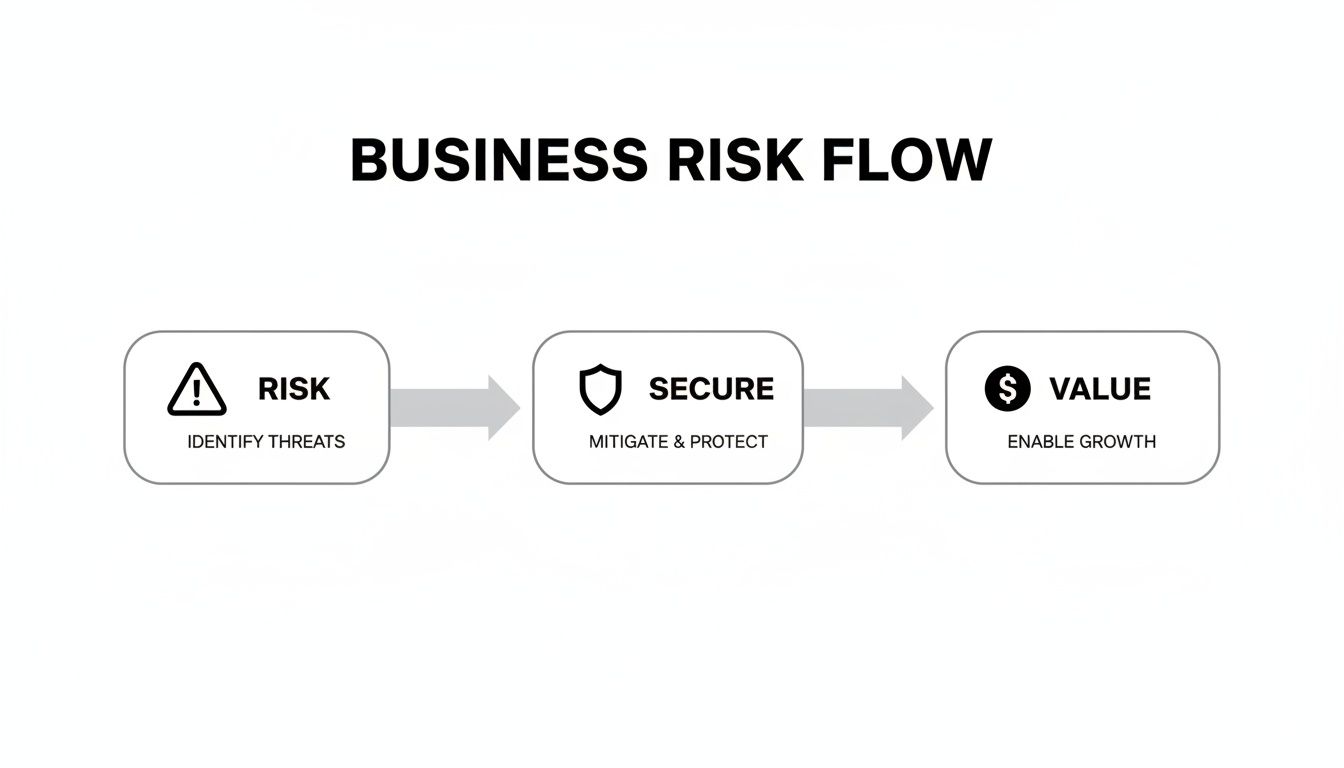
As you can see, a structured workflow effectively neutralizes the initial threats of data exposure and non-compliance, which in turn unlocks the financial potential hiding in your retired IT assets.
Stage 1: Secure Logistics and Receiving
The process kicks off with secure transportation. Your assets are moved from your facility to a secure, access-controlled processing center. The moment they arrive, every single device is scanned into an inventory management system.
This initial scan is where each asset's permanent record begins, capturing key details like:
- Asset Tag: Your internal ID number.
- Serial Number: The unique manufacturer identifier.
- Make and Model: Specifics like "Dell Latitude 7420" or "HPE ProLiant DL380."
- Parent/Child Assets: A server (the parent) is logged along with its corresponding hard drives (the children).
This careful check-in process confirms that everything that left your building has arrived safely, setting the foundation for every step that follows.
Stage 2: Triage and Data Destruction
With all the equipment logged, the critical triage phase begins. Technicians inspect each piece of hardware to decide its best path forward. Is it new enough to be refurbished and find a second life, or is it destined for responsible materials recycling?
No matter which path it takes, the next step is absolute and non-negotiable: certified data destruction. This is the single most important security checkpoint in the entire ITAD journey.
Data isn’t just "deleted." It's forensically and permanently destroyed using methods that meet government and industry standards like NIST 800-88. This is what guarantees that no sensitive company or customer information can ever be recovered, protecting your business from a devastating breach.
Depending on the asset's condition and your company's security policies, one of two methods is used:
- Data Erasure (Wiping): Specialized software overwrites the entire hard drive with random data, making the original information completely unrecoverable. This keeps the physical drive intact for reuse.
- Physical Destruction (Shredding): For ultimate security, hard drives and other storage media are fed into industrial shredders. These machines grind them into tiny, unrecognizable metal fragments, ensuring total data annihilation.
Once the job is done, the process is documented with a Certificate of Data Destruction—a legal document that serves as your proof of compliance.
Stage 3: Value Recovery and Final Reporting
After data has been securely sanitized, any assets flagged for remarketing are fully tested, repaired, and cleaned up. These refurbished items are then sold through established secondary markets to recover their remaining financial value. This process can significantly offset the costs of your ITAD program and, in some cases, even generate a net return for your business.
To get a better sense of the complete lifecycle, you can review our guide on IT asset disposition services in Dallas Fort Worth Texas.
Assets that can't be resold are de-manufactured. They are carefully broken down into their core components—steel, aluminum, plastic, circuit boards, and precious metals. These raw commodities are then sent to certified downstream partners for responsible recycling.
Finally, the entire journey is wrapped up in a comprehensive reporting package delivered right to you. This audit-ready documentation provides everything you need, including:
- A full inventory report detailing every single asset processed.
- Certificates of Data Destruction for all data-bearing devices.
- A Certificate of Recycling to confirm environmental compliance.
- Financial settlement reports if any assets were sold.
This final package closes the loop, giving you the verifiable proof needed to satisfy internal audits, meet regulatory requirements, and achieve your corporate responsibility goals.
Navigating Data Security Regulations and Certifications
When you're dealing with computer equipment recycling, compliance isn't just another box to check—it's the bedrock of your risk management strategy. Simply getting rid of old hardware without a plan is a fast track to data breaches and steep regulatory fines. This is where a solid grasp of data security rules and industry certifications becomes your company’s best defense.
Think of these standards less like dense legal documents and more like a documented promise. They give you a proven framework to ensure that once a hard drive leaves your facility, the sensitive data on it is verifiably and permanently gone. For any business, that's not just good practice; it’s a legal and ethical must.
The Gold Standard for Data Destruction
At the core of secure ITAD is a clear set of guidelines that define what "destroyed" really means. The most respected standard in the United States comes straight from the National Institute of Standards and Technology (NIST).
Specifically, NIST Special Publication 800-88 is the official guide for media sanitization. It lays out three distinct methods for making sure data can never be recovered:
- Clear: This involves overwriting existing data with new, random data. It’s a solid choice for lower-risk information.
- Purge: This is a much more intense sanitization process that protects against even laboratory-level data recovery attempts.
- Destroy: This is the final word in data sanitization. It means the physical destruction of the storage media through shredding, disintegration, or pulverization.
Choosing an ITAD partner who follows NIST 800-88 means you’re aligning with the same benchmark used by federal agencies for data security. It’s your proof that their methods are sound, tested, and reliable. For a closer look at the technical side of things, check out our guide on how to wipe a hard drive.
Understanding Key Industry Certifications
On top of government standards, the ITAD industry has its own tough certifications that work like a seal of approval. These certifications tell you that a vendor has been independently audited and confirmed to meet high standards for security, environmental responsibility, and professional operations.
Think of these certifications like a building inspection for your ITAD partner. An inspector doesn't just glance at the structure; they check the foundation, wiring, and plumbing to confirm everything is up to code. Similarly, R2 and e-Stewards auditors verify every step of a vendor’s process.
Two of the most important certifications to look for are R2 and e-Stewards. They provide a critical layer of assurance when you're trusting a partner with your company's assets and reputation.
Key ITAD Certifications and What They Mean for Your Business
Choosing an ITAD partner often comes down to evaluating their credentials. The table below compares the top industry standards to help you understand what they guarantee and which one best fits your company's priorities.
| Certification | Primary Focus | Why It Matters to You |
|---|---|---|
| R2v3 | A balanced approach covering environmental, health, safety, and data security. | Offers flexibility while ensuring strong, auditable processes for the entire lifecycle of computer equipment. |
| e-Stewards | A strict environmental standard with a zero-landfill policy for hazardous waste. | Guarantees that no hazardous e-waste will be exported to developing nations, appealing to CSR-focused organizations. |
Ultimately, working with a partner holding either of these certifications drastically reduces your risk. It confirms they have the infrastructure, security controls, and documented procedures needed to handle your retired computer equipment responsibly. For industries like healthcare, which must comply with HIPAA, partnering with a certified vendor isn't just a smart move—it's an essential part of your due diligence to protect patient data and avoid costly violations.
Choosing the Right Computer Recycling Partner
Picking a partner to handle your company's computer equipment recycling isn't just another line item on a procurement spreadsheet. This is one of the most critical security and risk management decisions you’ll make. You're entrusting another organization with your sensitive data, your brand reputation, and your legal compliance.
A low-cost vendor might look good on paper, but the potential fallout from a data breach or a regulatory fine for improper disposal can be catastrophic. The right partner acts as a true extension of your security and compliance team, delivering an auditable, transparent, and secure service from start to finish.
Core Competencies to Evaluate
When you’re vetting potential ITAD vendors, you have to look beyond the price tag and focus on their core operational capabilities. This should be a deep dive into their processes, security protocols, and documentation practices. Any truly professional partner will welcome this level of scrutiny and have the evidence ready to go.
Start by asking these non-negotiable questions:
- Certifications: Are you certified to standards like R2v3 or e-Stewards? These are the gold standard. They verify that a third-party auditor has confirmed the vendor's processes meet strict industry benchmarks for both security and environmental handling.
- Data Destruction: What are your specific processes for certifying data destruction, and do they align with NIST 800-88 standards? A capable vendor will offer multiple levels of destruction, from software-based wiping to physical shredding, and prove it.
- Chain of Custody: Can you provide a detailed, documented, and auditable chain of custody for every single asset you handle? This is the verifiable paper trail that proves no device was lost or mishandled from the moment it leaves your door to its final disposition.
With the global computer recycling market valued at USD 13,634.26 million and forecasted to hit USD 22,981.53 million by 2033, the number of vendors is exploding. This growth, driven by new regulations and sustainability goals, makes careful selection absolutely vital. You can find more insights about this expanding market and its implications.
Beyond the Basics: A Vendor Vetting Checklist
Once a vendor has cleared the basic certification hurdles, it’s time to dig deeper. You need to understand their operational maturity and how they manage risk on a daily basis. A robust partner will have clear, confident answers to more advanced security and logistics questions.
A vendor's reporting capabilities are a direct reflection of their process integrity. Vague or incomplete reports are a major red flag, suggesting a lack of control and accountability in their operations.
Use this checklist to guide your conversations and separate the true professionals from the rest:
- Reporting and Auditing: Ask for sample reports. Can they provide serialized asset tracking, certificates of data destruction, and certificates of recycling for past projects? These documents are your proof of due diligence.
- Downstream Vendor Management: How do they vet their own downstream partners (like smelters and refiners)? A certified vendor is responsible for ensuring their entire supply chain adheres to the same high standards they do.
- Security Protocols: What are the physical security measures at their facility? Look for controlled access, 24/7 surveillance, and segregated, secure areas for processing any devices that hold data.
- Insurance and Liability: What level of liability and data breach insurance do they carry? This coverage is your financial backstop, protecting your organization in the unlikely event of a security incident.
- Industry Experience: Have they worked with businesses in your industry? This is especially critical if you operate in a highly regulated sector like healthcare or finance where experience with standards like HIPAA is a must-have.
Finding a partner who can confidently address these points ensures you aren't just hiring a disposal service—you're engaging a risk mitigation expert. For instance, our local electronics recycling center is built around these rigorous principles specifically to serve the needs of local businesses.
Turning E-Waste into a Corporate Responsibility Win

A secure, compliant computer equipment recycling program does more than just protect your business from risk—it builds your brand. In an era where customers, investors, and employees demand transparency, a well-managed ITAD strategy becomes a powerful story for your company. It shifts the narrative from simple disposal to active corporate citizenship.
This approach directly supports modern Corporate Social Responsibility (CSR) and Environmental, Social, and Governance (ESG) goals. Instead of viewing retired laptops and servers as waste, you can reframe them as opportunities for positive community impact. This turns a routine operational task into a tangible demonstration of your company's values.
Beyond Recycling: The Power of Refurbishment and Donation
Not every retired asset has reached the end of its useful life. Many devices, after undergoing certified data destruction and professional refurbishment, are perfectly capable of serving new users. Strategic donation programs offer a second life for this equipment, creating a ripple effect of positive impact.
By partnering with an ITAD vendor that manages donation logistics, you can support a wide range of organizations and initiatives:
- Local Schools and Educational Programs: Providing students with access to laptops and desktops they might not otherwise have.
- Nonprofit Organizations: Equipping charities with the technology needed to run their operations and serve their communities more effectively.
- Community Centers: Bridging the digital divide by offering public access to reliable computing resources.
This is where recycling evolves into a contribution to the circular economy—a system where resources are kept in use for as long as possible. Rather than just extracting materials, you are extending the functional life of your assets, which is a far more sustainable outcome.
A thoughtfully executed donation program transforms your ITAD process from a cost center into a cornerstone of your community engagement strategy. It provides a compelling, authentic story that showcases a commitment to sustainability and social good that goes far beyond the balance sheet.
Crafting Your Brand's Sustainability Narrative
For business leaders, this approach offers a powerful story to share with stakeholders. It provides concrete evidence of your company's commitment to responsible practices. Instead of abstract pledges, you can point to specific outcomes, like the 50 refurbished laptops your company donated to a local youth center or the server equipment that now powers a neighborhood food bank.
This reframes computer equipment recycling as a proactive investment in your brand's reputation. It demonstrates that your organization is not just complying with regulations but is actively seeking ways to create shared value. To see how these programs are structured, you can learn more about e-recycling and electronics recycling services for businesses in Dallas Fort Worth Texas.
Ultimately, integrating CSR into your ITAD program builds trust and resonates with today’s conscious consumer. It proves that your company understands its responsibility extends beyond its own four walls and into the community it serves, turning e-waste into a win for everyone.
Your Computer Equipment Recycling Questions Answered
Even with a solid plan, you're bound to have questions when it’s time to retire old IT assets. This is where the details really matter. We've put together some straightforward, practical answers to the most common questions we hear from IT leaders to help clear up any confusion.
What Is the Difference Between Computer Recycling and ITAD?
People often use these terms interchangeably, but they are worlds apart in terms of security and service. Think of it this way: basic computer recycling is like a standard junk removal service, while IT Asset Disposition (ITAD) is a high-security, logistics-driven operation.
A simple computer recycler focuses on one thing: breaking down old equipment into raw materials like plastic and metal to keep it out of a landfill. Their primary goal is meeting basic environmental rules.
ITAD, on the other hand, is a comprehensive, security-first process built for businesses. It covers everything from secure logistics and a documented chain of custody to certified data destruction, remarketing valuable assets, and finally, responsible recycling. For any organization with sensitive data—which is pretty much every organization—ITAD is the only real option. It's designed to manage the serious data security and compliance risks that a simple recycling service completely ignores.
How Can I Be Sure My Data Is Completely Destroyed?
Absolute proof comes down to certified processes and proper documentation. Any reputable ITAD partner will provide a Certificate of Data Destruction for every single project. This isn't just a piece of paper; it's a legal document that confirms your data-bearing devices were sanitized or physically destroyed according to strict standards like NIST 800-88.
The most reliable methods include multi-pass data wiping software, degaussing (which uses powerful magnets to erase magnetic media), and physical shredding. If you need maximum peace of mind, ask your vendor about on-site shredding. You can literally watch your hard drives get turned into metal fragments.
This certificate is your auditable proof that you’ve done your due diligence to protect your company's information.
Can Our Company Make Money from Old Equipment?
Absolutely. This is done through a process called value recovery, or asset remarketing, and it's a key part of any smart ITAD strategy. An experienced partner will evaluate all your retired gear to find anything that still has market value.
You'd be surprised what can be resold. Items that often hold their value include:
- Laptops and desktops from the last few generations
- Enterprise-grade servers and networking equipment
- High-demand components like CPUs and RAM
The revenue from selling these assets is typically shared back with you. In many cases, it can offset the costs of recycling and data destruction, and sometimes, you might even turn a profit. It’s a great way to turn a line-item expense into a positive return.
At Dallas Fortworth Computer Recycling, we provide the secure, compliant, and auditable ITAD services your business needs. We transform your retired hardware from a liability into a managed asset with certified data destruction and transparent reporting. Find out how we can protect your business and recover value from your old equipment by visiting https://dallasfortworthcomputerrecycling.com.