
A Guide to Data Center Decommissioning Services
Data center decommissioning isn't just about unplugging old servers and hauling them away. It's a highly specialized service for retiring your IT infrastructure securely and systematically. This process covers everything from creating a detailed asset inventory and performing certified data destruction to the physical removal of equipment and responsible electronics recycling.
Think of it as a critical final chapter for your hardware's lifecycle, one that protects your organization from the massive risks of data breaches and environmental liability.
Understanding the Core Mission of Decommissioning
Your data center is the digital fortress protecting your organization's most valuable asset: its information. When it’s time to upgrade, move to a new facility, or migrate to the cloud, you can't just abandon that fortress and leave the doors unlocked.
Professional data center decommissioning services are the specialized teams you bring in to dismantle that fortress brick by brick, ensuring nothing critical gets left behind. It's a complete, end-to-end project that demands logistical precision, unwavering security, and strict compliance. A true partner manages every step, from the initial planning session to the moment the empty site is handed back to you.
The Essential Components of Decommissioning
At its heart, decommissioning is all about managing risk while recovering whatever value is left in your old assets. The entire process is broken down into several key stages, each one designed to protect your organization. If any of these steps are mishandled, the door is opened to costly mistakes like data breaches, compliance fines, or environmental penalties.
Here's what's always involved:
- Detailed Asset Inventory: Every single piece of hardware—from servers and storage arrays down to the last network switch and cable—gets tagged, documented, and tracked. This creates a bulletproof record for your accounting team and establishes a clear chain of custody.
- Certified Data Destruction: This is the absolute, non-negotiable core of the entire operation. Every device that holds data is either forensically wiped or physically shredded according to strict standards like NIST 800-88. The goal is simple: make sure sensitive information can never be recovered.
- Physical Removal and Logistics: Safely de-racking, packing, and moving heavy, fragile IT equipment is a specialized job. It takes the right tools and experience to prevent equipment damage and keep everyone on-site safe.
- Responsible Recycling and Reuse: Not all of your retired gear is junk. Newer equipment often has resale value that can help offset the project's cost. For older assets, a responsible partner ensures everything is handled correctly. Knowing the specifics of data center equipment recycling is essential for meeting today’s environmental, social, and governance (ESG) goals.
The primary goal of a professional decommissioning service is to transform a complex and high-risk logistical project into a secure, compliant, and financially optimized transition. It provides the framework to retire legacy assets without compromising data security or environmental standards.
Ultimately, these services give you and your team peace of mind. They provide the structured oversight needed to navigate a high-stakes project, all backed by certified processes and auditable paperwork that proves your organization did everything by the book.
The Decommissioning Roadmap From Plan to Completion
Executing a data center decommissioning feels a lot like coordinating a high-stakes move from a secure facility. It’s not just one big job—it's a series of carefully planned phases, where each step builds on the last to guarantee a secure, compliant, and smooth exit. Let's walk through the entire journey, breaking it down into a manageable, step-by-step roadmap.
When you bring in professional data center decommissioning services, the whole project gets framed as a set of clear mission objectives. Every stage has a distinct goal, from the initial strategy session to the final site cleanup. Following this structured path takes the guesswork out of the equation and dramatically cuts the risk of expensive mistakes.
To give you a clearer picture, here's a quick overview of the key phases involved in a typical project.
Key Phases of a Decommissioning Project
This table outlines the critical stages of a decommissioning project, showing what we aim to achieve at each step and the key tasks involved.
| Phase | Objective | Key Activities |
|---|---|---|
| 1. Strategic Planning | Align all stakeholders on goals, scope, and budget. | Create timelines, define asset scope, set security protocols, assign roles. |
| 2. Asset Auditing | Create a complete inventory and establish chain of custody. | On-site inventory, serial number tagging, master asset list creation. |
| 3. Data Destruction | Ensure 100% of data is irretrievably destroyed. | On-site/off-site shredding, certified data wiping (NIST 800-88). |
| 4. Equipment Removal | Safely dismantle and transport all physical hardware. | De-racking servers, disconnecting cables, secure logistics coordination. |
| 5. Value Recovery | Maximize financial return from retired assets. | Sorting, testing, remarketing valuable equipment, responsible recycling. |
| 6. Site Remediation | Return the data center space to a clean, usable state. | Removing cabling and racks, repairing floors, general cleanup. |
Each phase is designed to flow logically into the next, ensuring nothing gets missed along the way. Now, let's dig into the details of each step.
Phase 1: Strategic Planning and Project Scoping
Before a single server gets unplugged, the most important work happens: creating a rock-solid plan. This initial phase gets everyone—IT, finance, facilities, and your decommissioning partner—on the same page about the project's goals, scope, and limitations. It's where you define exactly what a successful outcome looks like.
Key activities here include setting realistic timelines, nailing down the budget, and identifying every piece of equipment in scope. This is also when security protocols are outlined and roles are assigned to every team member. A good plan is the foundation for a seamless project.
This strategic groundwork is more important than ever as tech cycles get shorter. The global market for these services was valued at USD 89.35 billion in 2024 and is expected to jump to USD 95.67 billion in 2025, largely because of rapid upgrades to AI and cloud infrastructure that make older hardware obsolete.
Phase 2: Meticulous On-Site Asset Auditing
With the plan locked in, the next step is to create a definitive record of every single asset being retired. This isn't just a quick headcount. It's a detailed on-site audit where every server, switch, PDU, and cable is inventoried, tagged with a unique serial number, and logged into a master asset list.
This audit accomplishes two critical things. First, it establishes an unbroken chain of custody, which is absolutely essential for security and compliance. Second, it gives you the detailed data needed for financial reconciliation and figuring out what your old gear might be worth.
This simplified workflow shows how we move from inventory to secure data destruction and finally to responsible recycling.
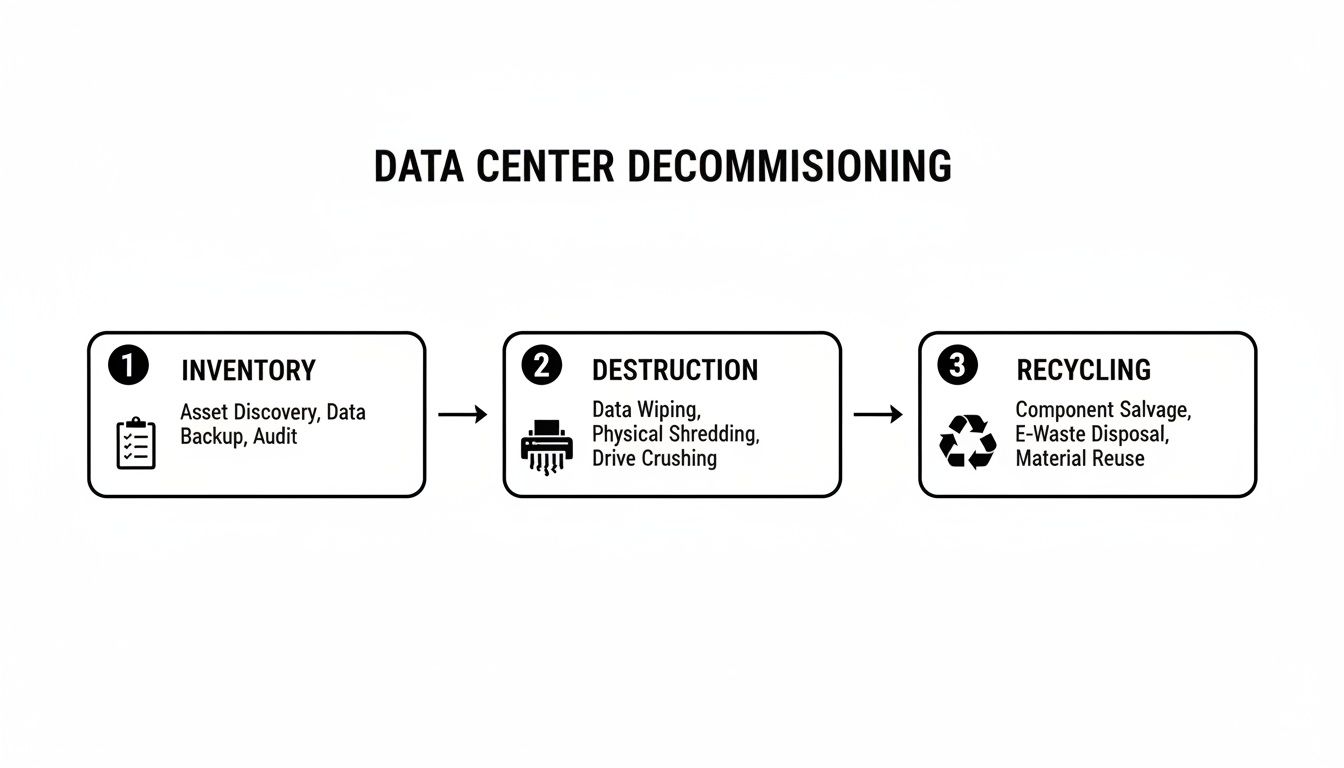
As the graphic shows, a successful project depends on managing both the physical hardware and the digital data with the same level of care.
Phase 3: Certified Data Destruction
This is the most sensitive and non-negotiable part of the entire process. Every device that holds data—from server hard drives and SSDs to networking gear with built-in storage—has to be completely sanitized so no information can ever be recovered.
Professional services use several methods to get this done, all aligned with standards like NIST 800-88.
- On-Site Shredding: A mobile shredding truck comes right to your facility to physically destroy drives before they ever leave your control, offering maximum peace of mind.
- Off-Site Shredding: Devices are securely transported to a certified facility for destruction, with a full chain-of-custody log tracking them the whole way.
- Data Wiping: Software-based tools overwrite data, which keeps the drive intact for potential resale. To learn more, check out our guide on how to wipe a hard drive properly.
Once finished, you receive a serialized Certificate of Data Destruction. This is a legal document that serves as your proof of compliance.
Phase 4: Safe Equipment Removal and Logistics
With all data securely destroyed, the physical work of dismantling the infrastructure can begin. This means de-racking servers, disconnecting all the power and network cabling, and getting the hardware ready for safe transport. It’s a labor-intensive job that requires specialized equipment and trained pros to avoid injuries and damage.
A professional team handles all the logistics, from scheduling freight and securely packing sensitive electronics to making sure everything is transported in line with regulations. This expertise is crucial for projects of any size.
Phase 5: Asset Sorting and Value Recovery
Not all of your retired equipment is junk. A lot of assets, especially those just a few years old, still have significant market value. In this phase, your decommissioning partner sorts through all the collected hardware to pick out items that can be remarketed.
Servers, networking gear, and storage arrays are tested, refurbished, and sold through established channels. The money generated from these sales can then be used to offset the project's costs, often turning what would have been a major expense into a budget-neutral—or even profitable—endeavor. Any equipment with no resale value is recycled responsibly.
Phase 6: Final Site Remediation
The last step is to return the data center space to its original condition, making it ready for whatever comes next. This can involve a variety of tasks, depending on your lease agreement and facility requirements.
Common remediation tasks include:
- Removing all leftover cabling (both above the racks and under the floor)
- Dismantling server racks, cabinets, and ladder racking
- Patching and repairing the raised floor
- Making sure the site is broom-swept and completely clear of debris
This final cleanup completes the decommissioning lifecycle, leaving you with a clean slate and all the certified documents to prove the project was handled securely and responsibly from start to finish.
Why Compliance and Chain of Custody Matter
When you're retiring a data center, pulling servers out of racks is the easy part. The real challenge—the one that absolutely cannot be overlooked—is managing risk through airtight regulatory compliance and a documented chain of custody. This isn't just about filling out forms; it's about protecting your company from massive fines, legal headaches, and a damaged reputation.
Think of every single hard drive in your data center as a critical piece of evidence. From the second it's disconnected, its every move must be tracked and documented. A solid chain of custody ensures every asset is accounted for from your facility all the way to its final destination, whether that's resale, recycling, or physical destruction. One drive going missing can turn into a full-blown, catastrophic data breach.
Navigating the Regulatory Minefield
Data privacy laws aren't friendly suggestions. They are strict mandates with serious consequences. Regulations like Europe's General Data Protection Regulation (GDPR) or the Health Insurance Portability and Accountability Act (HIPAA) in the US healthcare sector have very specific rules for handling sensitive data, even when it's on retired equipment.
For instance, a hospital system decommissioning servers has to prove that every last byte of patient health information (PHI) was completely and permanently destroyed. A failure here can lead to fines running into the millions of dollars. Likewise, GDPR demands that any personal data belonging to EU citizens is erased beyond recovery—and you have to be able to prove you did it.
This complex legal environment is a huge reason why professional data center decommissioning services are in such high demand. The market is projected to grow from USD 12.12 billion in 2025 to USD 19.94 billion by 2032, driven by an intense enterprise focus on secure data elimination. With AI workloads shortening equipment lifecycles to just 3-5 years, the need for certified, professional handling is only growing.
The Power of Provable Destruction
In the event of an audit or legal question, a verifiable chain of custody is your best defense. It creates a detailed, paper trail that proves you did everything by the book. At the end of the project, your decommissioning partner must provide a set of critical documents that formalize this process and transfer liability away from your organization.
These documents are the foundation of your compliance strategy:
- Master Asset List: A full inventory of every piece of equipment removed from your site, complete with serial numbers.
- Chain of Custody Forms: Detailed logs showing every person who handled the assets, along with dates, times, and locations.
- Certificates of Data Destruction: This is arguably the most important document of all. It certifies that all data-bearing devices were destroyed according to specific standards like NIST 800-88.
- Certificates of Recycling: Proof that any non-resalable e-waste was processed in an environmentally responsible way, meeting standards like R2.
Without this documentation, you have no verifiable proof that your organization's data was handled and destroyed securely. In the eyes of a regulator, if it isn’t documented, it didn’t happen.
It’s crucial to understand what these documents mean. For example, a proper certificate of destruction for hard drives provides the legally defensible proof you need to close the loop on your data security obligations.
Ultimately, focusing on compliance and maintaining a meticulous chain of custody turns a potential liability into a secure, well-managed, and defensible business process. It's how you protect your data, your customers, and your organization's good name.
Budgeting for Your Decommissioning Project
Figuring out the cost of a data center decommissioning project isn't like buying an off-the-shelf product with a fixed price tag. It’s a lot more like a home renovation—the final cost depends entirely on the size of the house, the materials you pick, and how complex the job is. The price is shaped by a unique mix of variables specific to your facility, equipment, and security needs.
A project to clear out a few server racks in a colocation space is going to be far less involved than shutting down an entire enterprise data hall with hundreds of assets. The sheer volume of equipment is the biggest driver, directly impacting labor, logistics, and how long the whole thing will take.
Key Factors That Shape Your Project's Cost
Several critical factors will influence the final quote you get from a data center decommissioning services provider. Each one adds a layer of complexity and cost, and understanding them upfront helps prevent budget surprises down the road. A good partner will walk you through these, but it pays to know what to expect.
- Project Scale and Equipment Volume: This is the big one. The number of servers, storage arrays, networking switches, and other hardware directly dictates the amount of labor needed for auditing, de-racking, and transportation.
- Data Destruction Method: On-site hard drive shredding provides the ultimate in security, as a mobile shredder comes directly to you. But that specialized equipment and personnel mean it typically costs more than off-site destruction. Software wiping is another route, often used for drives that still have resale value.
- Logistical Complexity: Where your data center is located and its physical layout really matter. A facility in a high-rise building without a freight elevator, or a site located far from processing centers, will naturally have higher logistical costs.
- Site Remediation Needs: Does your lease require you to return the space to its original "white box" condition? If so, you'll need to budget for removing old cabling, dismantling racks, and even repairing floors.
The best way to get a handle on your budget is through value recovery. Newer, functional equipment can be resold, generating revenue that directly offsets the costs of data destruction and recycling. This turns the project from a pure expense into a financially optimized operation.
The Impact of Value Recovery on Your Budget
The secret weapon for managing decommissioning costs is asset value recovery. Not all retired hardware is destined for the recycling bin. In fact, servers, networking gear, and storage devices that are just three to five years old often have significant value on the secondary market. A skilled ITAD partner will test, refurbish, and find new homes for these assets on your behalf.
This remarketing process is a central part of any good IT asset disposition services in Dallas Fort Worth Texas program and can dramatically lower your net project cost. The revenue from those sales is credited back to you, often covering a huge chunk of the project's expenses. That’s why you should always ask for a detailed breakdown of potential resale value when you're looking at vendor proposals.
Estimating Project Timelines
Just like costs, project timelines can vary widely based on the scale and complexity of the job. It's not a one-size-fits-all situation. Here’s a general framework to help set expectations:
- Small Scope (Single Server Closet/Few Racks): These are usually quick, taking about 1-2 weeks from planning and on-site work to final reporting.
- Medium Scope (Small Data Hall/Multiple Rows): Plan for 3-6 weeks. The timeline gets longer to account for more detailed inventorying, logistics, and data destruction for a larger volume of assets.
- Large Scope (Full Enterprise Data Center): A full shutdown is a major undertaking that can take anywhere from 2 to 6+ months. These large-scale projects require careful, phased execution to avoid disrupting business operations and involve complex logistical planning.
No matter the size, a precise timeline will be hammered out during the initial planning phase, making sure everyone involved is on the same page about key milestones and the final completion date.
How to Choose the Right Decommissioning Partner

Choosing a partner for your data center decommissioning is the single most important decision you'll make in this entire process. Think of it like hiring a specialized demolition crew for a bank vault. You wouldn't just hire anyone with a sledgehammer; you need a team that understands security, structural integrity, and asset management.
The right partner protects you from catastrophic risks, while the wrong one can expose you to data breaches and crippling fines. This decision moves far beyond a simple price comparison. You’re entrusting a vendor with your organization's sensitive data, valuable hardware, and legal compliance obligations, so the selection process has to be rigorous.
Look for Certified Expertise
The first filter in your search should always be industry certifications. These aren't just fancy badges; they are proof that a vendor adheres to strict, internationally recognized standards for security and environmental responsibility. They signify a commitment to best practices that have been audited by a third party.
Two of the most critical certifications to look for are:
- R2v3 (Responsible Recycling): This is the leading standard for electronics recycling, ensuring a vendor handles e-waste safely and ethically. It guarantees that hazardous materials are managed correctly and that downstream partners are also certified, preventing your old equipment from ending up in a landfill.
- e-Stewards: Another robust environmental certification, e-Stewards has a strong focus on preventing the illegal export of hazardous e-waste. It represents the highest level of environmental and social responsibility.
Beyond these, a NAID AAA certification is crucial for data destruction, as it verifies a vendor's processes for secure data sanitization, from hiring practices to access controls.
Verify Their Security and Reporting Framework
A potential partner’s security protocols and reporting transparency are non-negotiable. During consultations, you need to dig deep into how they will protect your assets and provide an auditable trail for every single piece of equipment.
Ask direct questions: How do you establish and maintain chain of custody? What methods do you use for data destruction, and do they align with NIST 800-88 guidelines? A confident partner will have clear, detailed answers and be ready to show you sample documentation, like Certificates of Data Destruction and Recycling.
Vetting a provider is about confirming their processes are as strong as their promises. An auditable, transparent reporting system isn't a "nice-to-have"—it's the core evidence you'll rely on to prove due diligence.
The scale of this industry makes careful vetting essential. As of March 2024, the U.S. was home to 5,381 data centers, a figure that dwarfs Germany's 521. This massive infrastructure fuels a robust decommissioning market, with North America alone generating around USD 1.5 billion in annual revenue from hardware retirement.
Ask the Right Questions
Finally, create a standardized checklist to evaluate each potential vendor consistently. This ensures you're comparing apples to apples and can make an informed decision based on concrete factors, not just a sales pitch. A proper vendor does more than just haul away old servers; they provide the framework for a secure and compliant transition. They ensure your retired assets are handled properly, whether they are destined for resale or recycling. For more details on responsible disposal, you can explore the services offered by a certified electronics recycling center.
Use the following table as a starting point to structure your vetting process and ensure you cover all critical areas before making your final selection.
Vendor Selection Checklist for Decommissioning Services
| Evaluation Criteria | Key Questions to Ask | Importance (High/Medium/Low) |
|---|---|---|
| Certifications & Compliance | Are you R2v3, e-Stewards, or NAID AAA certified? Can you provide proof of certification? | High |
| Data Security & Destruction | What specific data destruction methods do you offer (e.g., shredding, wiping)? Do they meet NIST 800-88 standards? | High |
| Chain of Custody & Logistics | How do you document and track assets from pickup to final disposition? What security measures are in place during transport? | High |
| Reporting & Documentation | What documentation will we receive (Certificates of Destruction, audit reports, asset lists)? Can we see a sample? | High |
| Value Recovery & Remarketing | What is your process for testing and remarketing our assets? How is the revenue shared with us? | Medium |
| Experience & References | Can you provide case studies or references for projects similar to our scale and industry? | Medium |
| Environmental Responsibility | What is your policy on landfill diversion? How do you ensure downstream partners are also certified? | High |
| Insurance & Liability | What are your insurance coverage limits for data breaches, environmental liability, and general liability? | High |
This checklist isn't exhaustive, but it provides a solid foundation for your due diligence. A transparent and qualified partner will welcome these questions and have clear, verifiable answers ready for you.
A Few Common Questions About Decommissioning
Even with the best plan, taking a data center offline can bring up some very practical questions. This section answers some of the most common things we hear from IT managers and procurement teams when they're getting ready for a data center decommissioning services project.
Think of these as quick, direct answers to help you feel confident about the process and reinforce some of the key ideas we've covered.
How Do You Keep My Data Secure During the Project?
Protecting your data isn't just a step in the process—it's the entire foundation of a professional decommissioning project. Security starts the moment our team walks on-site. We immediately establish a strict chain of custody for every single device that holds data.
Each asset is inventoried, tagged with a unique serial number, and tracked from your server rack all the way to its final destruction or resale. This creates a solid, auditable paper trail. We destroy all data using methods that are fully compliant with NIST 800-88 and Department of Defense standards. We can even do this at your facility before any hardware leaves the building, giving you complete peace of mind that sensitive information never leaves your control.
Once the job is done, you’ll receive a serialized Certificate of Data Destruction. This is your official, legally defensible proof that your company’s sensitive data was completely and permanently destroyed, closing the loop on your compliance needs.
Can We Get Any Money Back for Our Old Equipment?
Absolutely. Finding ways to get a financial return on your retired IT assets is a huge part of what we do. We start by doing a full assessment of all your equipment to see what still has resale value. This process, called value recovery, is one of the biggest financial upsides of working with a professional partner.
Hardware that’s still in good working order and in demand—like newer servers, network switches, or storage arrays—is tested, refurbished, and sold through our established global remarketing networks. The money we make from those sales is put directly toward the cost of your decommissioning project, which often makes the whole thing surprisingly affordable.
You’ll get a simple, transparent financial report that breaks down the value we recovered from every single resold asset. It’s a great way to turn what feels like a major expense into a potential source of revenue for your business.
What Happens to Hardware That Has No Resale Value?
For any equipment that’s truly at the end of its life and has no market value, we guarantee it will be recycled responsibly and in line with all environmental regulations. As an R2v3 certified recycler, we follow the strictest industry standards for safely taking apart and processing old electronic hardware. This commitment to sustainability is a critical part of our service.
Our process involves carefully sorting all the different materials—like precious metals, plastics, steel, and circuit boards. Each of these materials is then sent to certified partners who process them responsibly. This audited approach makes sure that no hazardous e-waste ever ends up in a landfill, helping your organization hit its environmental, social, and governance (ESG) targets.
To wrap it all up, we give you a Certificate of Recycling that documents the proper, sustainable handling of all your non-resalable equipment.
How Long Does a Decommissioning Project Usually Take?
The timeline for a data center decommissioning project really depends on the size and complexity of the job. There’s no simple answer because every facility is different. Still, we can give you a general idea based on projects we’ve handled in the past.
Here’s a rough breakdown of what to expect:
- Small Projects: Taking out a few racks at a colo facility or cleaning out a small server closet is pretty quick. These jobs are often done in about one to two weeks.
- Medium Projects: Retiring a small data hall or several rows of cabinets is a bigger job. These typically take anywhere from three to six weeks from start to finish.
- Large-Scale Projects: A complete shutdown of an enterprise data center is a major undertaking. These projects are carefully planned in phases and can take anywhere from two to six months or more, depending on how much gear is involved.
No matter the size, we kick off every project by building a detailed plan. This document lays out clear milestones, deliverables, and a realistic timeline that fits your business deadlines and operational needs.
Are you ready to retire your IT assets with confidence? Dallas Fortworth Computer Recycling offers nationwide data center decommissioning services that are secure, compliant, and financially optimized. Contact us today for a consultation.