
A Guide to Electronics Recycling in Albuquerque for IT Leaders
For any IT leader in Albuquerque, managing old electronics is much more than just "disposal." It’s a core function of risk management, data security, and environmental compliance. When you're dealing with anything from decommissioned servers to specialized lab equipment, partnering with a certified, nationwide IT Asset Disposition (ITAD) provider isn't just a good idea—it’s a strategic necessity.
Navigating Albuquerque's E-Waste Landscape
Handling the lifecycle of IT assets here in Albuquerque comes with its own set of challenges. While the city has some solid options for residential recycling, those programs simply don't have the security protocols or provide the documentation that a business absolutely needs.
Let's be clear: an IT or procurement manager can't just drop off a pallet of old servers at a municipal center and call it a day. That gap between residential convenience and commercial compliance creates massive risks. Every retired laptop, server, or smartphone is a ticking time bomb if its data isn't certifiably destroyed, potentially leading to data breaches, steep regulatory fines, and lasting damage to your company’s reputation.
The True Cost of Improper Disposal
The financial stakes are incredibly high. The local success of facilities like Albuquerque Computer & Electronics Recycling Co., which has processed millions of pounds of e-waste since 2008 with a zero-landfill policy, really shows the scale of the problem we're dealing with. You can see their commitment firsthand on their website.
This local challenge reflects a national crisis. Data breaches stemming from improperly disposed assets now cost U.S. businesses an average of $4.45 million per incident.
But the direct financial hit is just the beginning. You also have to consider:
- Regulatory Penalties: Getting on the wrong side of EPA, HIPAA, or SOX regulations can lead to some painful fines.
- Reputational Damage: A public data breach can shatter customer trust and send your shareholder value plummeting.
- Environmental Responsibility: Companies today are being judged more and more on their environmental, social, and governance (ESG) performance.
A Strategic Approach to ITAD
A well-planned ITAD strategy isn't an expense—it's a smart investment in your company's security and sustainability. This means you need to move beyond just basic recycling and implement a comprehensive program that guarantees a secure, unbroken chain-of-custody.
A certified partner brings the infrastructure to manage logistics, perform audited data destruction, and deliver the ironclad documentation you need to prove you’ve done everything by the book.
For an IT leader, the peace of mind that comes from a fully documented, zero-landfill recycling process is invaluable. It transforms a logistical headache into a verifiable asset for your company's risk management and corporate responsibility efforts.
This documented process is your proof. It gives you a clear audit trail from the second an asset leaves your facility to its final disposition, whether that’s through responsible recycling or secure remarketing. By truly understanding the environmental impact of electronic waste, your organization can make smarter, more defensible decisions about its ITAD partners and processes.
How to Choose the Right Certified Recycling Vendor
Choosing a partner for your electronics recycling in Albuquerque is the single most important decision you'll make in this entire process. I've seen it firsthand: the difference between a genuine IT Asset Disposition (ITAD) specialist and a run-of-the-mill recycler is massive. It directly impacts your data security, regulatory standing, and environmental footprint.
An enterprise-level ITAD partner operates on a completely different wavelength than a municipal drop-off or a recycler built for residential waste. For a business, this isn't just about disposal; it's about documented, verifiable risk mitigation. You absolutely need a partner who gets the stakes of handling corporate data and can deliver an auditable chain of custody from your door to final disposition.
Their entire operation should be built around security and compliance. Whether you're handling a complex multi-site office refresh or a full data center decommission, they need to execute with precision.
Decoding Key Industry Certifications
When you start looking at vendors, you’ll get hit with an alphabet soup of certifications. Understanding what these actually mean is critical to protecting your organization. These aren't just fancy badges; they represent proof of rigorous, third-party audits that verify a vendor’s processes from top to bottom.
I always tell clients to look for the "big three" certifications. They are the bedrock of a trustworthy ITAD program.
Here’s a quick breakdown of what to look for when evaluating potential partners for electronics recycling in Albuquerque.
Comparing Electronics Recycling Vendor Certifications
| Certification | What It Guarantees | Why It Matters for Your Business |
|---|---|---|
| R2v3 (Responsible Recycling) | A comprehensive global standard covering environmental protection, worker health and safety, data security, and full downstream material tracking. | Guarantees your e-waste won't end up in a landfill and that your vendor follows secure, ethical, and transparent practices. It’s the industry gold standard. |
| e-Stewards | Often considered the most stringent standard, with a strict ban on exporting hazardous e-waste to developing countries. Uses GPS tracking to verify. | Offers the highest level of assurance for environmental and social responsibility, protecting your brand from being associated with unethical disposal practices. |
| NAID AAA Certification | Focuses exclusively on secure data destruction, with exhaustive audits of operational security, employee screening, and the destruction process itself. | This is non-negotiable proof that a vendor can securely and permanently destroy your sensitive data, whether it's on-site or off-site. |
These certifications are your first line of defense. For instance, in Albuquerque, Techbros Electronic Recycle is an R2v3-certified facility, which is exactly the kind of validation you want to see. This is especially critical when you consider that national e-waste recycling rates are still below 20% and a staggering 90% of data breaches come from lost or stolen devices. Certified data destruction isn't a "nice-to-have"—it's a must.
Asking the Right Questions During Vetting
Once you've shortlisted vendors with the right credentials, it's time to dig in. Your goal here is to confirm their capabilities match your specific needs, whether it's a one-off project or an ongoing IT refresh cycle.
A vendor's response to detailed process questions reveals everything. A true partner will welcome the scrutiny and provide transparent, detailed answers. A less qualified recycler will give you vague assurances.
Here are some essential questions I always recommend asking a potential partner for electronics recycling in Albuquerque:
- Can you provide a complete, serialized audit report for our assets? (This is non-negotiable for an auditable chain-of-custody.)
- What are your specific procedures for on-site versus off-site data destruction?
- Do you have direct experience with our industry's compliance needs, like HIPAA or SOX?
- What is your process for asset remarketing, and how is the value shared with us?
- Can we schedule a tour of your facility? (A reputable vendor will have nothing to hide.)
Getting this choice right is fundamental to your entire ITAD strategy. To get a better handle on the specifics, our guide on the importance of the R2 certification for electronics recycling is a great next step.
Ensuring Compliant Data Destruction
When your company retires a server, laptop, or smartphone, the physical hardware is the least of your worries. The real liability is the mountain of sensitive data left behind on those drives. For any IT leader in Albuquerque, making sure that data is verifiably destroyed isn't just a best practice—it's a critical duty that shields your organization from catastrophic financial and reputational harm.
Just hitting 'delete' or reformatting a drive is dangerously inadequate. Data fragments can almost always be recovered by someone with the right tools, leaving your company completely exposed. That’s why certified data destruction is a non-negotiable part of any professional electronics recycling program. It’s about using proven, validated methods to make that data 100% unrecoverable. Forever.
Matching the Method to the Media
Not all storage devices are built the same, so you can't use a one-size-fits-all approach to data destruction. The right technique depends on the media type, how sensitive the data is, and your specific compliance rules, like HIPAA for healthcare or SOX for public companies.
A certified ITAD partner will have three primary tools in their arsenal:
- Software-Based Sanitization: This involves using specialized software to overwrite the entire drive with random data, usually following standards like NIST 800-88. It's the perfect solution for newer, working hard drives that you might want to resell, as it preserves the hardware's value while guaranteeing the data is gone.
- Degaussing: Think of this as a powerful magnetic blast. It scrambles the magnetic patterns on traditional spinning hard drives (HDDs) and old-school magnetic tapes, instantly rendering them unreadable. The catch? It also makes the drive totally unusable afterward.
- Physical Shredding: This is the final word in data destruction. The drive is fed into an industrial shredder that grinds it into tiny, unrecognizable metal fragments. It's the go-to method for top-secret data, solid-state drives (SSDs), and any media that’s already failed or can't be wiped with software.
Knowing the difference is key. For example, degaussing is completely useless on SSDs because they don't store data magnetically. A good partner will walk you through the right choice for each asset. You can dig deeper into the specifics behind secure data destruction services and how they map to compliance requirements.
The Unbreakable Chain of Custody
The destruction method is only half the battle. The entire process of getting a device from your office to the point of destruction—the chain of custody—is just as important. One mistake here can create the exact security gap you're trying to close.
A Certificate of Data Destruction is your final piece of evidence, but a serialized audit report is your proof of process. Without a documented journey for each asset, you have a critical compliance gap.
A secure chain of custody means meticulously tracking every single data-bearing device by its serial number, from the moment it leaves your building. This absolutely must include secure, GPS-tracked trucks and tightly controlled access at the recycling facility.
Once the process is complete, you have to receive a Certificate of Data Destruction. This is a legal document that lists the serial numbers of the destroyed devices, the method used, and the exact date it happened. It’s your auditable proof that you did your due diligence.
Streamlining Your IT Asset Disposition Logistics
Getting retired IT assets from your facility to a recycler securely is a project in itself. The logistics are about much more than just booking a truck—it’s about minimizing disruption, protecting assets in transit, and maintaining a rock-solid chain of custody for compliance.
Proper prep work is the first step. Before any pickup, your team needs a detailed inventory of everything heading out the door. This isn't just a simple count; it means physically separating data-bearing devices like servers and hard drives from non-sensitive gear like monitors and keyboards. This segregation is a critical security measure, ensuring your highest-risk items get priority handling from the get-go.
One-Time Project vs. Recurring Pickups
The logistics for a one-time data center cleanout are worlds apart from a recurring pickup schedule tied to your IT refresh cycle. A major decommissioning might call for professional packing, on-site palletizing, and dedicated, secure transport to handle a huge volume of sensitive equipment all at once.
In contrast, an ongoing program for regular electronics recycling in Albuquerque requires a more flexible rhythm. A nationwide partner can set up a pickup schedule that syncs with your retirement cadence, whether it's monthly or quarterly. This stops old gear from piling up in a storage closet—a common but risky habit—and keeps retired tech flowing out in a manageable, secure way.
This decision tree shows how the right data destruction method is chosen based on the device type.
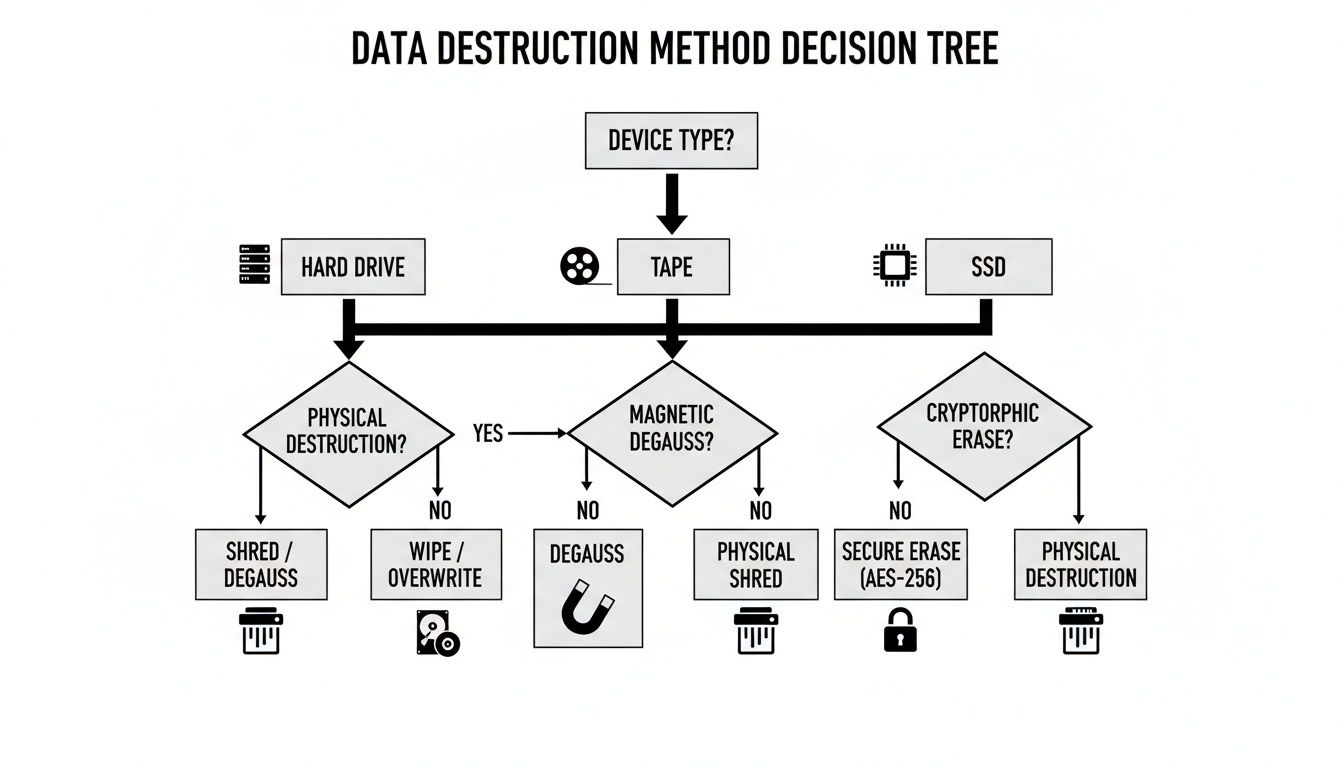
As the visualization shows, the path to secure data destruction depends entirely on the storage media, highlighting why a one-size-fits-all approach is inadequate.
A skilled ITAD partner takes this entire logistical headache off your team's plate. They manage everything from providing secure collection bins to dispatching trained, background-checked personnel for the pickup. Their drivers and vehicles are equipped for secure transport—often with GPS tracking and locked cargo holds—ensuring your assets are protected from the moment they leave your building. You can see how a comprehensive approach simplifies IT asset disposition services from start to finish.
The goal of logistics planning isn't just to move boxes. It’s to extend your security perimeter from your facility to the recycler's, ensuring every asset is accounted for and protected throughout its final journey. Any gap in this process represents a potential point of failure for your data security and compliance efforts.
Understanding the True ROI of Certified Recycling
When you start looking into electronics recycling in Albuquerque, it’s easy to get sidetracked by offers of "free" services. On the surface, a no-cost option seems like a quick win for the budget. But if you're a savvy IT leader, you know the real return on investment (ROI) is about much more than just a pickup fee. The complete financial picture involves understanding potential costs, dodging massive risks, and even unlocking hidden value in your old gear.
Sure, some specialized items might have a small cost attached. Things like old CRT monitors or certain industrial batteries often carry processing fees because of the hazardous materials inside. Logistics for a huge, multi-site cleanout can also incur charges. But getting hung up on these minor costs means you’re completely missing the much bigger financial upside of a certified ITAD partnership.
Beyond the Balance Sheet Value
A proper, certified recycling program creates serious value that you won't see on an invoice. For example, a good ITAD strategy includes asset remarketing. Your partner can often refurbish and resell newer, still-functional equipment like servers or laptops, and you get a cut of the proceeds. Just like that, a disposal cost turns into a revenue stream.
But here's the real kicker: the biggest ROI comes from risk mitigation. Think about it. The cost of a single data breach or a fine for not complying with EPA regulations can absolutely dwarf your entire ITAD budget for years to come. Certified data destruction and a documented chain of custody are your insurance policies against these kinds of catastrophic financial and reputational hits.
The most significant return from certified electronics recycling isn't just about recovering value from old hardware. It's about proactively eliminating the immense financial liability tied to your data and environmental compliance.
Documentation as a Financial Asset
The paperwork you get from a certified partner is an asset in itself—it's your proof of diligence. You should always demand and receive:
- A Certificate of Recycling: This document confirms your assets were processed according to all environmental regulations, which is essential for satisfying your ESG obligations.
- A Certificate of Data Destruction: This is your auditable proof that sensitive data was verifiably destroyed, protecting you from legal and financial fallout down the road.
- A Serialized Audit Report: This detailed inventory tracks every single asset from pickup to final disposition, giving you an unbreakable chain-of-custody record that’s priceless for internal audits.
While some vendors like STS Electronic Recycling Inc. offer free electronics recycling in Albuquerque for businesses—a huge departure from the national trend where only 12.5% of business e-waste is properly handled—the full ROI goes far beyond just the direct savings. By maximizing reuse, their services also slash the need for virgin materials by 95% for valuable metals, creating powerful indirect returns. The benefits of a well-structured e-waste recycling program are deep and multifaceted, strengthening both your security posture and your company's commitment to sustainability.
Common Questions About Business E-Waste Recycling
Even with a solid plan, a few specific questions always pop up during an IT asset disposition project. Getting straight answers is the only way to make confident decisions for your company’s electronics recycling in Albuquerque.
Here are some of the most practical questions we hear from IT leaders and procurement teams on a regular basis.
What Types of Electronics Require Certified Data Destruction?
This is a big one. Any device that can store sensitive information must undergo certified data destruction before it leaves your control. It’s a non-negotiable step for preventing data breaches and staying compliant with privacy laws.
The obvious items are servers, hard drives (both HDDs and SSDs), laptops, and smartphones. But don't forget the devices people often miss, like multifunction printers with internal storage, network appliances, and even some point-of-sale systems. Overlooking just one of these can create a massive security blind spot.
Can Our Business Use City of Albuquerque Recycling Centers?
While the City of Albuquerque provides great e-waste drop-off sites for residents, these facilities are simply not set up for commercial needs. Business and enterprise recycling comes with a much higher burden of proof for compliance and security.
A business requires a documented, auditable chain-of-custody and certified proof of data destruction. Municipal recycling centers just don't provide the detailed asset reporting and legal certifications needed to protect your organization from liability. For that, a dedicated B2B ITAD partner is essential.
How Should We Handle Specialized Medical or Lab Equipment?
Specialized equipment from medical or laboratory environments demands a recycler with proven expertise in handling sensitive and potentially hazardous materials. These devices often contain embedded systems with protected health information (PHI) and have complex components that need special care.
A qualified partner will follow strict protocols for:
- Decontamination: Making sure any biological or chemical residues are properly neutralized.
- Data Sanitization: Wiping data from embedded systems to meet healthcare-specific regulations like HIPAA.
- Responsible Recycling: Correctly processing complex materials to meet environmental standards.
What Documentation Is Essential After Recycling?
After your assets are processed, the paperwork is your ultimate proof of due diligence. At a bare minimum, you should always receive a Certificate of Data Destruction and a Certificate of Recycling.
But for total compliance and internal auditing, a true ITAD partner will also provide a serialized inventory report. This is the critical document that tracks each asset by its unique serial number from the moment of pickup to its final disposition. It creates an unbreakable chain-of-custody record that stands up to scrutiny and protects your business.
For organizations in Albuquerque and beyond seeking a secure, compliant, and documented process for their IT assets, Dallas Fortworth Computer Recycling offers nationwide services tailored to your needs. Learn more about our certified ITAD solutions.