
Telecom Solutions Near Me: Your IT Director’s Guide

A lot of IT teams start the search for telecom solutions near me after something has already gone wrong. A voice system drops calls during a customer escalation. A warehouse loses connectivity to a critical app. A new site opens, but the circuit handoff and internal cabling plan were never aligned, so the launch slips and everyone blames the carrier.
That’s usually the point where a routine vendor search turns into a business continuity problem.
The mistake is treating telecom like a one-time install. It isn’t. It’s a lifecycle decision that touches procurement, security, operations, finance, and eventually decommissioning. If you only optimize for monthly rate or fastest install date, you often inherit support gaps, invoice disputes, unclear responsibilities, and old network hardware sitting in a closet with sensitive configs still on it.
Beyond a Simple Search for Telecom Providers
A bad telecom decision rarely fails all at once. More often, it degrades in ways that look small until they stack up. Remote staff complain about call quality. A cloud app feels slow during peak hours. The failover circuit exists on paper, but no one tested it after cutover. Then one busy afternoon, a business-critical system stalls and leadership wants answers immediately.

That’s why the phrase telecom solutions near me should mean more than “find a nearby installer.” It should mean finding a partner that can support the entire path from site assessment to deployment governance to responsible retirement of replaced equipment. If you’re only comparing internet packages, you’re solving the smallest part of the problem.
Telecom's significance has risen because it is no longer a narrow utility purchase. The market itself reflects that shift. The global telecommunications market is projected to reach 1.6 trillion U.S. dollars in revenue by 2024, and global 5G adoption is expected to hit two billion subscriptions in 2024, according to Statista’s telecommunications market data. More capacity and more options sound good, but they also create more room for bad fit.
What a strategic local partner actually does
A capable local or regional telecom provider helps you answer practical questions before anyone runs cable or submits an order:
- Service fit: Does the location need fiber, cable, fixed wireless, or a blended design?
- Operational fit: Can the provider support multi-site rollouts, after-hours cutovers, and local dispatch?
- Security fit: Who owns demarc responsibilities, hardware custody, and change control?
- Lifecycle fit: What happens to replaced routers, switches, handsets, and edge devices?
If a provider can’t discuss those issues clearly, they’re not acting as a business partner. They’re acting as an installer.
Practical rule: If a vendor’s discovery call focuses on speed and price before they ask about applications, compliance, failover, and decommissioning, the process is already off track.
A lot of teams also overlook the difference between “available” and “usable.” A service may technically exist at a location, but lead times, construction requirements, building access restrictions, and support boundaries can still break the project. That’s one reason a broader search, including guidance from firms focused on telecommunications company selection and lifecycle planning, is more useful than a simple provider list.
Where telecom projects usually go sideways
The pattern is familiar:
- Procurement buys on monthly cost and underweights implementation complexity.
- IT assumes support coverage that isn’t in the SLA.
- Operations gets involved late and flags install constraints after orders are placed.
- Legacy gear remains in service too long or gets pulled without a documented retirement process.
The best telecom projects don’t start with vendor demos. They start with requirements discipline.
Defining Your Technical and Business Requirements
Most telecom buying mistakes happen before the first vendor meeting. Teams ask for “more bandwidth” when the actual issue is latency, traffic prioritization, poor Wi-Fi design, aging handsets, overloaded firewalls, or a branch layout that no longer matches the business.
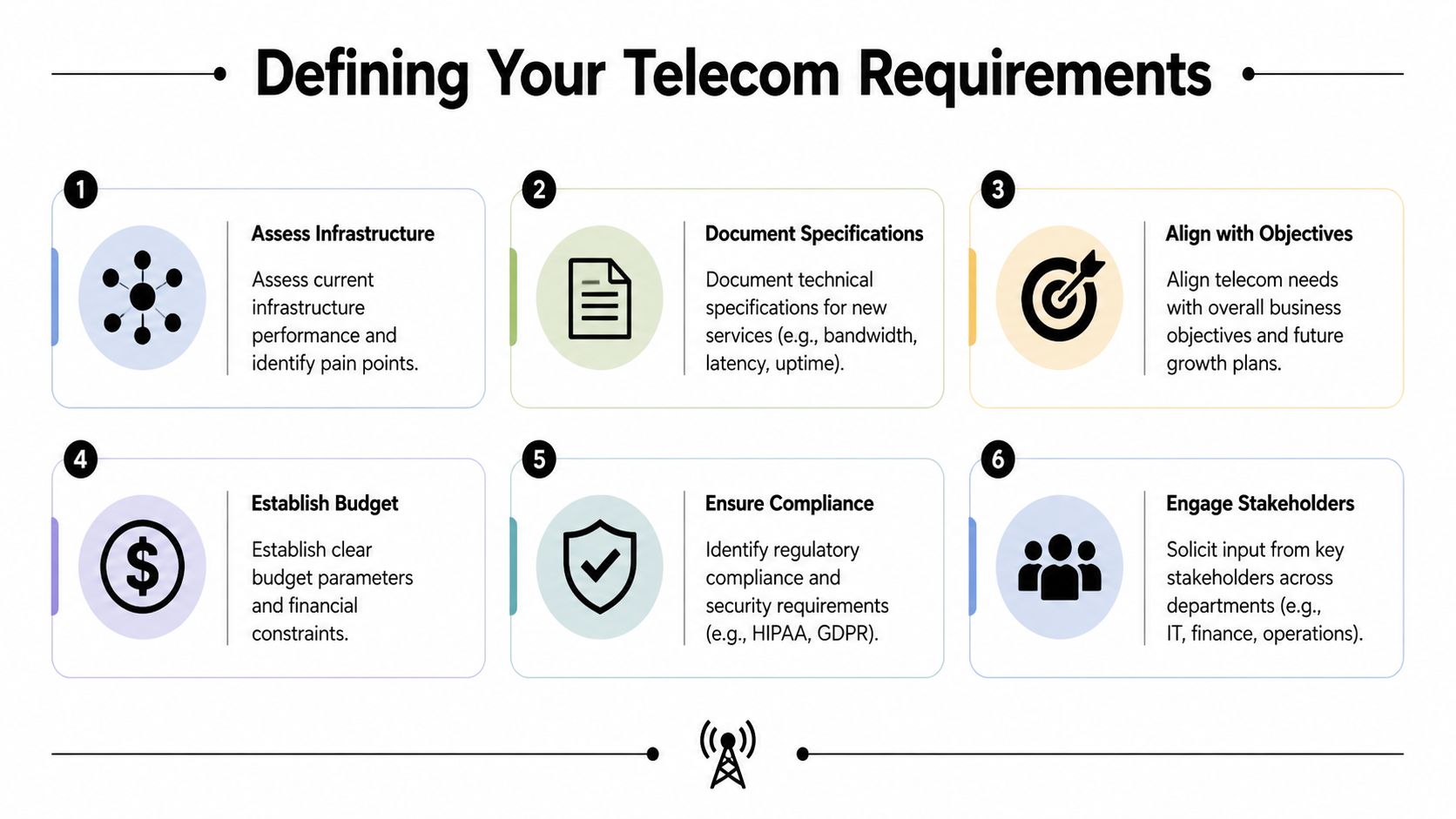
A disciplined requirements document forces clarity. It gives procurement something defensible to evaluate against, and it keeps sales conversations grounded in your environment instead of the vendor’s preferred bundle.
One reason this matters is the mix of access options in real markets. The infrastructure built after the 1996 U.S. Telecommunications Act produced hybrid access environments where a single market can show 99% cable coverage, 61% fiber availability, and 78% 5G access, according to BBB market context on telecommunications availability. That kind of variation is exactly why broad assumptions fail.
Start with business impact, not carrier product names
I usually tell teams to document what breaks when the network underperforms. That’s more useful than starting with terms like DIA, MPLS, SD-WAN, SIP, or fixed wireless.
Ask questions such as:
- Which applications are intolerant of delay? Voice, video, contact center tools, ERP transactions, and remote clinical workflows behave very differently from email or file sync.
- Which sites are revenue-producing or safety-critical? A warehouse, clinic, plant, or call center deserves a different resilience standard than a low-utilization office.
- What’s the acceptable outage window? If the business expects near-continuous service, then cutover design, failover testing, and support escalation need to be written into the project.
The cleanest RFPs I see are written in business terms first and technical terms second. Vendors can solve technical problems. They can’t guess your operational priorities.
Build the requirements document in six parts
You don’t need a bloated specification. You need a concise document that removes ambiguity.
Current-state inventory
List circuits, providers, contract end dates, network hardware, voice systems, cabling constraints, and known trouble spots. Include what’s owned versus leased.Application profile
Separate real-time traffic from bulk transfer. Note remote access, cloud dependence, call center workflows, guest access, and any traffic that can’t tolerate jitter or interruption.Security and compliance obligations
Spell out encryption expectations, segmentation needs, logging requirements, and regulated workflows. If you operate in healthcare, finance, government, or nonprofit environments with grant or donor data, this can’t stay implicit.Growth and location planning
Note pending office changes, site consolidations, new labs, branch openings, temporary sites, and expected workforce shifts. Don’t buy a design that only works for today’s floorplan.Support model
Define who needs 24/7 response, who approves change requests, who manages circuit inventories, and how incidents escalate. If you don’t define ownership, everyone assumes someone else has it.Asset lifecycle assumptions
Include what happens to existing routers, switches, phones, edge devices, and structured cabling when the upgrade is done. Strong IT asset management practices keep this from becoming an afterthought.
Trade-offs worth deciding early
Some decisions aren’t about right versus wrong. They’re about what risk you’re willing to hold.
Fiber versus fixed wireless
Fiber may offer stronger long-term stability for certain sites. Fixed wireless can be a practical option when lead time, physical build complexity, or temporary deployment matters more.Single strategic provider versus mixed providers
A single vendor can simplify management. A mixed approach may reduce concentration risk, but only if your team can handle the added complexity.Managed service versus internal control
Managed models reduce day-to-day burden. They can also reduce visibility if the provider’s reporting, configuration governance, and documentation are weak.
A good requirements document doesn’t lock you into one answer. It gives you a clear standard for evaluating trade-offs without guessing.
How to Find and Vet Local Telecom Solutions
Typing telecom solutions near me into a search engine gives you a list. It does not give you a shortlist. That requires a filter.
The first pass should identify providers that serve your geography, support your site type, and understand your use case. A firm that’s excellent at small-office voice installs may be a poor fit for a regulated lab, a distributed nonprofit, or a multi-location manufacturer with aging edge infrastructure.

Build the long list from multiple channels
Relying on search rankings alone is weak sourcing. Use several inputs:
Broker and agent networks
Good telecom brokers often know which carriers and managed service providers perform well in specific buildings, metros, or multi-site footprints.Peer referrals
Ask other IT leaders in your sector who handled the install, who handled escalation, and whether billing stayed clean after month three.B2B directories and local listings
These are useful for identifying regional installers, cabling firms, and providers that don’t dominate search results but do solid work locally.Internal operations feedback
Facilities, security, and branch admins usually know which vendors show up prepared.
If you’re comparing regional options, a curated view of local telecom companies can help you spot provider categories you might otherwise miss, especially when your project includes both connectivity and downstream hardware retirement.
Use a first-pass disqualification checklist
You don’t need a full RFP to eliminate weak candidates. You need a fast screen.
Here are the red flags I’d treat seriously:
Vague answers on support coverage
If the provider can’t explain who responds after hours, how dispatch works, or what escalation looks like, support will be a problem later.No clear implementation ownership
Sales sold it. Engineering hasn’t reviewed it. Project management “gets assigned later.” That handoff gap creates missed details and delayed installs.Thin documentation habits
If the vendor doesn’t produce clean scopes, site notes, test results, and cutover plans during presales, they won’t become disciplined after contract signature.Weak discussion of replaced equipment
If the conversation ends at activation and never touches old routers, switches, phones, or cabling, the provider is ignoring part of your risk profile.
Ask every finalist a simple question: “At project close, what exactly is left onsite, what is removed, and how is that documented?” Weak vendors struggle with that answer.
What strong vendors do in early conversations
The best providers don’t rush to quote. They ask practical, site-level questions. They want to know who uses the network, what can’t fail, how many sites are involved, whether you need temporary service during migration, and what dependencies sit outside telecom but still affect rollout.
They also distinguish between access, inside wiring, edge equipment, voice services, and support boundaries. That matters. A lot of ugly projects come from blurred responsibility between carrier, cabling contractor, firewall team, and local IT.
Keep local from becoming too local
“Near me” is useful when you need site surveys, physical installs, and rapid hands-on support. It becomes a limitation if the vendor can’t scale beyond one city, lacks process maturity, or can’t coordinate across multiple locations.
A local presence matters. So does operational discipline. You want both.
Building an RFP and Scoring Vendors Objectively
Once you’ve reduced the field, stop relying on informal conversations, as many teams get sloppy at this point. They compare one vendor’s polished presentation against another vendor’s rough estimate and call it due diligence.
A usable RFP doesn’t have to be long. It does have to force comparable answers.
What to include in the RFP
At minimum, ask every vendor to respond to the same core set of items:
Scope of service
Access type, hardware, managed components, inside wiring assumptions, installation responsibilities, and handoff points.Implementation plan
Milestones, dependencies, testing process, cutover approach, rollback method, and customer responsibilities.Support and SLA details
Hours of coverage, response process, ticketing model, escalation, local dispatch capabilities, and reporting cadence.Commercial model
Monthly recurring charges, one-time charges, contract term, hardware ownership, and any assumptions that affect future cost.Invoice and audit support
How invoices are structured, how disputes are handled, and what reporting is available for reconciliation and inventory control.
That last item gets less attention than it should. According to CTPros on telecom expense management, effective TEM can yield 15-30% cost savings, and 20-40% of unchecked enterprise telecom invoices contain billing errors. If a vendor can’t support invoice visibility and audit discipline, the quoted monthly rate doesn’t tell the whole story.
Use a weighted scoring matrix
Teams often say they want an objective decision, then choose the vendor with the best demo. A scoring matrix prevents that drift.
Here’s a simple template worth using:
| Evaluation Criterion | Weight (1-5) | Vendor A Score (1-10) | Vendor B Score (1-10) | Notes |
|---|---|---|---|---|
| Technical Solution Fit | ||||
| Total Cost of Ownership | ||||
| Support Quality and SLA Guarantees | ||||
| Implementation Timeline and Process | ||||
| Vendor Viability |
How to weight the criteria
Don’t assign equal weight unless your environment is unusually simple.
A few examples:
- If you run a regulated environment, support quality and process control may deserve the highest weight.
- If you expect site changes or growth, implementation maturity and technical fit often matter more than promotional pricing.
- If your current pain is billing sprawl across many locations, invoice quality, reporting, and auditability should move up the list.
A disciplined evaluation also includes lifecycle costs that don’t appear on a rate card. Old handsets, routers, and switches don’t disappear when the new service goes live. They create removal, tracking, sanitization, storage, and recycling decisions. That’s one reason many procurement teams pull in IT asset disposition partners during telecom planning instead of waiting until equipment starts piling up.
What not to overvalue
Be careful with the following:
The lowest monthly recurring charge
Low rates often hide weaker support, narrow scope assumptions, or ugly change-order behavior.The fastest quoted install date
Fast is good only if building access, demarc readiness, cabling, and cutover planning are real.The most polished presales engineer
You’re buying the delivery team and support model, not just the sales cycle.
A vendor score should explain the decision to finance, operations, security, and leadership without anyone needing to “trust the gut feel.”
If the scores are close, revisit risk. Most telecom regrets don’t come from paying slightly more. They come from buying something that looked simple and turned out to be brittle.
Managing Onboarding, Deployment, and Project Success
The contract is signed. Now the main work starts.
Most telecom failures happen in deployment, not in vendor selection. A strong provider can still deliver a weak outcome if nobody owns dependencies, no one validates assumptions onsite, or the cutover plan exists only in a project manager’s spreadsheet.
Run the project with structured flexibility
Telecom rollouts benefit from firm planning, but they also need room to adjust for site conditions, regulatory changes, and user impact. That’s why Hybrid Agile is useful here. Telecom projects using Hybrid Agile methods report up to 30% higher success rates in on-time, on-budget delivery compared to traditional Waterfall approaches, and scope creep affects 52% of traditional projects, according to HYS Enterprise on telecom project management.
In practice, that means locking down the essentials early, then managing execution in short, reviewable phases instead of assuming the original plan will survive unchanged.
The operating model that works
I’ve seen the cleanest deployments follow a simple pattern:
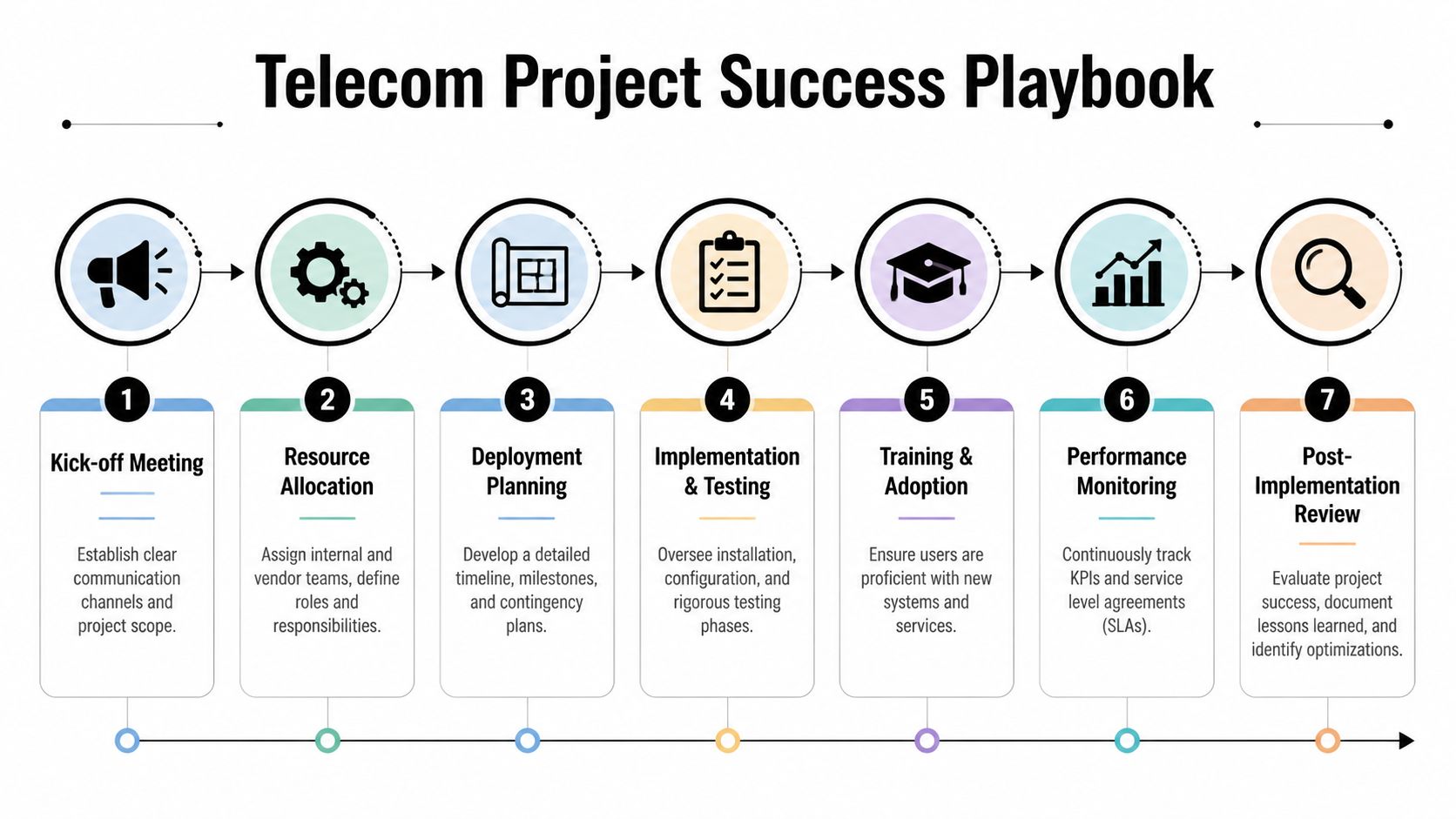
Kickoff with real decision-makers present
Bring in IT, facilities, operations, security, and the vendor’s delivery lead. Confirm dependencies and who approves changes.Validate the physical environment before install
Confirm rack space, power, patching paths, demarc access, labeling standards, and any building restrictions.Create milestone-based signoffs
Don’t wait until “go-live” to discover disagreements. Sign off on survey results, hardware staging, configuration readiness, and test results as separate gates.Use a phased cutover where possible
Migrate the least risky services first, prove stability, then move business-critical traffic.Document what changed
Update inventories, diagrams, support contacts, and escalation paths immediately, not weeks later.
Where deployment discipline matters most
Three areas deserve extra scrutiny:
Testing
Test failover, call routing, authentication dependencies, and application performance, not just link lights and basic connectivity.Change control
Any scope shift should be written down, approved, and tied to impact. That’s how you avoid “small” changes becoming expensive surprises.User readiness
Service can be technically live and still operationally messy if staff don’t know what changed, where to call, or how the new voice or connectivity setup behaves.
Short implementation cycles work best when each milestone has an owner, an acceptance standard, and a rollback decision.
A successful deployment leaves behind more than an active circuit. It leaves behind usable documentation, stable support paths, and a known list of equipment that’s now obsolete.
The Overlooked Final Step Compliant Telecom Decommissioning
Most telecom guides stop at activation. That’s a serious gap.
Old routers, switches, VoIP systems, firewalls, edge appliances, and even some seemingly simple telecom devices can hold sensitive configuration data, credentials, call records, or network details. If that equipment leaves a site without chain-of-custody discipline and verified data destruction, the telecom project created a new risk while solving an old one.

The numbers here are hard to ignore. A 2023 Deloitte report found that 65% of organizations experienced data exposure risks during hardware decommissioning due to inadequate chain-of-custody protocols, and FCC data showed a 22% surge in e-waste from 5G transitions in early 2026, as cited by ID Telecom’s discussion of telecom transition risk. If your upgrade plan doesn’t include controlled retirement of replaced assets, it is incomplete.
What compliant decommissioning should include
A proper decommissioning process usually covers:
Asset identification
Match removed equipment to an approved inventory so nothing disappears into a closet, loading dock, or informal reuse pile.Data sanitization and destruction controls
Legacy telecom hardware should be handled with the same seriousness as servers or laptops when it stores configuration or user data.Chain of custody
Every transfer point should be documented from rack removal through transport and final processing.Environmental handling
Cabling, switches, phones, and accessories need responsible downstream processing, not casual disposal.
Why this belongs in the original project plan
Decommissioning should be planned before the new service goes live, not after. That changes behavior in useful ways. It forces cleaner inventories. It reduces abandoned equipment. It clarifies ownership between telecom vendors, internal IT, facilities teams, and disposal partners.
It also prevents the common trap where old gear sits for months because nobody budgeted or scoped the final step. If your organization is replacing infrastructure at scale, a documented data center decommissioning process helps tie together removal, accountability, and audit readiness.
Telecom modernization isn’t finished when the new circuit works. It’s finished when the old environment is retired securely, documented properly, and removed responsibly.
That mindset is what separates a completed project from an exposed one.
Dallas Fortworth Computer Recycling supports organizations that need secure, compliant retirement of telecom and IT equipment after upgrades, consolidations, and infrastructure changes. If your team is planning a rollout and wants a documented path for chain of custody, certified data destruction, and responsible electronics recycling, Dallas Fortworth Computer Recycling is built for that end of the lifecycle.