
Telecom Equipment Buyers Los Angeles

You've probably got one right now. A telecom closet, cage, or server room corner full of retired gear that nobody wants to touch. Old Cisco switches, a PBX shelf from a voice migration, wireless backhaul radios from a site refresh, maybe a stack of handsets and power supplies in mismatched boxes. The network project is done, but the retired equipment is still on your floor, still on your asset ledger, and still carrying risk.
That pile isn't just clutter. Some of it may have resale value. Some of it may be scrap. Some of it may still hold configurations, call data, voicemail content, or removable media that your security team would never approve leaving the building without controls. In Los Angeles, that decision matters more than many IT teams expect because the buyer market is active enough that a sloppy process can leave money on the table just as easily as it can create audit problems.
Most pages targeting telecom equipment buyers Los Angeles give you the same message. Send a list. Get a quote. Schedule pickup. That's not enough for an IT Director who has to answer to finance, compliance, facilities, and security. The actual job is building a disposition workflow that recovers value where possible and closes risk everywhere else.
The Hidden Risks and Rewards in Your LA Server Room
The familiar version of this starts with a cleanup request.
Facilities wants space back. Finance wants old assets removed from records. Your network team says the legacy gear was disconnected months ago. Then someone opens the closet and finds a mix of routers, switches, call manager hardware, VoIP gateways, optics, antennas, and unlabeled spares sitting next to production patching. At that point, “find a buyer” sounds simple. It usually isn't.

What looks like junk often splits into three categories
The first category is gear with real secondary-market demand. That usually means complete, identifiable equipment with current relevance, known condition, and enough documentation that a buyer can test and resell it.
The second category is low-confidence equipment. Loose cards, incomplete systems, unknown modules, and untested shelves often fall here. These items may still have parts value, but only if someone can identify and sort them correctly.
The third category is risk-heavy equipment. Voice systems, call managers, voicemail platforms, security appliances, and devices with storage or saved configs belong in this lane until proven otherwise.
Practical rule: If your team can't say what data a telecom device may contain, treat it as sensitive until it's inventoried and sanitized.
Los Angeles adds another layer. The city isn't just a place with offices retiring gear. It's also a meaningful U.S. buying hub. ZoomInfo's May 2026 Los Angeles telecommunications manufacturing list shows local companies with substantial revenue footprints, including RTW at $59.9 million, Silvus Technologies at $48.9 million, and Doodle Labs at $41.8 million. That kind of regional activity supports a buyer ecosystem that can purchase, integrate, and refresh network hardware at scale.
Why delay creates its own cost
Retired telecom hardware doesn't improve while it sits. Labels fall off. Staff changes. Context disappears. Accessories get separated from base units. The person who knew which shelf came from which site leaves the company, and now your “inventory” is a handwritten note that says “old phone stuff.”
That's where projects go sideways. Buyers discount uncertainty. Security teams escalate when equipment leaves without documented handling. Finance gets a weak settlement report that doesn't tie back to asset records. What started as a storage cleanup becomes an internal controls problem.
For larger refreshes or room clear-outs, it helps to think in terms of a formal data center ITAD process, even if the project is limited to telecom gear. The discipline is the same. Identify assets, separate reuse from risk, control movement, and document the outcome.
From Inventory Chaos to Actionable Asset List
A buyer can't price what your team hasn't defined. “Pallet of Cisco routers” isn't an asset list. It's an uncertainty statement, and uncertainty gets priced against you.
The best first move is boring, but it's the move that fixes almost everything downstream. Build a serial-level inventory before you ask for quotes, before you schedule pickup, and before anybody starts rolling equipment toward a loading dock.
Start with identification, not valuation
Buyers and recycling teams consistently push the same order of operations. California property tax guidance for telecommunication property valuation notes four valuation approaches, and the same source includes a practical warning that fits disposition work exactly: “Inventory first. Value second. Security controls before pickup. Partner selection after that.”
That order matters because valuation depends on what the asset is, how complete it is, and whether it can legally and safely move into resale.
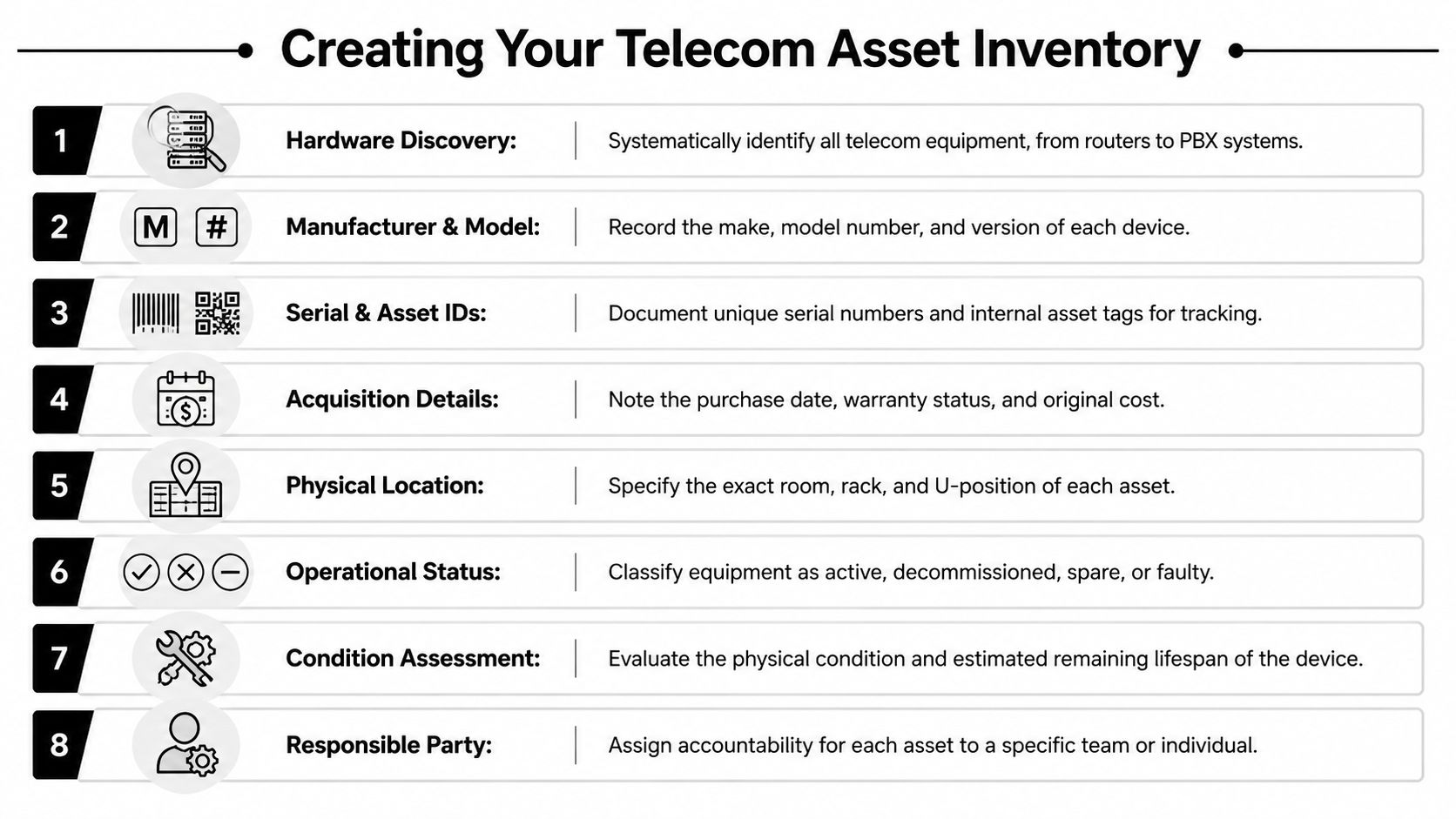
Use a spreadsheet or asset platform, but collect the same core fields either way.
What every line item should include
Manufacturer and exact model
“Cisco switch” is useless. Cisco ISR, Catalyst, ASR, Meraki, Avaya IP Office, ShoreTel, Mitel, and Ribbon all land differently in the market. Capture the exact model number printed on the chassis, not the generic family name.
If the model tag is missing, note that clearly. Don't guess.
Serial number and internal asset tag
This is your traceability anchor. Without it, you can't reconcile pickup records, destruction records, settlement reports, or internal fixed-asset schedules.
Serials also help flag units that may still be in service records or assigned to a site. For enterprise teams, IT, procurement, and internal audit usually need the same answer at this point.
Configuration details
A base chassis and a complete working unit are not the same thing. Record installed power supplies, controller cards, optics, supervisor modules, expansion cards, handsets, rails, and any removable components that affect resale or testing.
A telecom shelf with missing modules may be a parts lot. The same shelf with documented cards and power can be priced very differently.
Physical location
Write down the actual location. Building, floor, room, rack, and U position if applicable. In Los Angeles, logistics are often harder than valuation. A vendor can plan labor and removal correctly only if your list tells them where the gear sits today.
Operational status
Use simple status labels that mean something:
- Active but scheduled for retirement: Still installed or still linked to a business process.
- Decommissioned: Disconnected and approved for disposition.
- Spare: Held for contingency use.
- Faulty or failed: Known hardware issue or incomplete operation.
- Unknown: No verified test status.
Unknown is fine. False confidence isn't.
Add condition notes that a buyer can use
Condition doesn't need to be elegant. It needs to be honest.
A few practical examples:
- Clean pull from working environment: Good cosmetic shape, no visible damage, removed during refresh.
- Rack wear only: Scratches and minor wear, but complete.
- Damaged ports or bent chassis: This changes value fast.
- Missing faceplate, missing rails, missing power supply: Call it out directly.
- Untested after removal: Better than claiming functional without proof.
A clean spreadsheet beats a persuasive email. Buyers don't pay for enthusiasm. They pay for clarity.
Photos help when the lot is mixed or high value. One photo per asset line isn't always necessary, but grouped images of racks, shelves, handsets, and accessories save time and reduce back-and-forth.
Use a simple inventory template
A workable column structure looks like this:
| Field | Why it matters |
|---|---|
| Asset tag | Internal reconciliation |
| Manufacturer | Buyer routing and resale demand |
| Model number | Exact market identification |
| Serial number | Chain of custody and reporting |
| Description | Human-readable context |
| Location | Pickup planning |
| Status | Retirement readiness |
| Condition notes | Quote accuracy |
| Components included | Completeness |
| Data-bearing yes/no | Security workflow |
| Disposition lane | Resale, recycle, destroy, hold |
If your team needs a stronger asset governance process beyond this single project, these IT asset management best practices are a useful operational reference.
Separate the lot before the buyer sees it
One of the easiest wins is dividing inventory into lanes before you request pricing:
Resale candidates
Complete, identifiable, current-enough hardware with known condition.Parts and repair candidates
Partial systems, loose modules, accessories, and testable but imperfect gear.Recycling or destruction candidates
Obsolete, broken, incomplete, or security-sensitive equipment.
That separation keeps scrap from dragging down better assets. It also makes your security review cleaner because data-bearing devices can move under a different control path than passive or low-risk hardware.
How to Accurately Value Your Used Telecom Equipment
A Los Angeles IT director can have two racks of retired telecom gear that look similar on an inventory sheet and get very different offers. One lot has clean model numbers, complete power supplies, expansion cards, and hardware that still fits an active secondary market. The other has partial systems, unknown revisions, and equipment tied to voice platforms nobody wants to deploy anymore. The spread in value is real, and it usually comes down to detail, not age alone.
Original purchase price is almost useless here. Used telecom pricing follows present demand, support status, completeness, testability, and the buyer's confidence that the gear can be resold without surprises. That is why an older edge router may still bring money while a once-expensive PBX platform trades only for parts, or does not trade at all.
Los Angeles cleanouts often include a mix of network gear, voice systems, handsets, gateways, SBCs, optics, and loose modules from mergers, office consolidations, or UC migrations. General ITAD logic only gets you part of the way. Telecom value moves faster, and legacy voice equipment is the category that gets misread most often.
Why legacy voice gear creates the widest pricing swings
PBX shelves, voicemail hardware, PRI gateways, and digital handsets still appear in office closures across LA. The problem is not that every unit is worthless. The problem is that demand is thin, brand-specific, and highly dependent on who still supports that environment. RQ Communications' discussion of selling telecom equipment points to the practical driver. As organizations move to cloud UCaaS and SIP-based deployments, demand for older on-prem voice systems shrinks, while certain models still retain spare-parts value.
That leaves three common outcomes:
- Resale value for models with an active installed base and buyers who still know the platform
- Parts value for shelves, cards, phones, and accessories that support field maintenance
- No resale value for obsolete, incomplete, or unsupported gear that belongs in recycling
Treating all enterprise telecom gear as premium equipment is a pricing mistake. So is assuming old voice hardware is automatically scrap.
What experienced buyers actually use to price a lot
Support status and usable life
Support status affects who can buy the gear and what they can do with it. Hardware that is still supportable, patchable, or acceptable as a spare is easier to place. Hardware tied to expired software, dead licensing, or discontinued vendor support moves into a much narrower channel.
This matters a lot for session border controllers, security appliances, call managers, and switches with feature sets tied to software entitlement.
Exact model, revision, and product family
A brand name is not enough. Buyers price to the exact model, revision, interface mix, and installed options because that determines downstream demand. Two units with similar descriptions can trade very differently if one is a desirable revision and the other is not.
That is why vague manifests produce weak offers or aggressive repricing later.
Completeness
Complete hardware sells faster and with less buyer risk. Missing power supplies, faceplates, rails, SFPs, handsets, licensing dongles, or daughter cards can push an asset out of the resale lane and into parts recovery.
This is also why loose modules should not be treated as packing material. In many lots, the removable components carry more market value than the chassis.
Condition and testability
Cosmetic wear is expected in decommissioned rack gear. Functional uncertainty is expensive. Buyers discount for broken ports, bent rack ears, cracked plastics, corrosion, battery leakage, heavy dust, and anything that slows testing or refurbishment.
Untested does not always mean worthless. It does mean the buyer will protect margin against the risk of dead units.
Use the right value category before you review quotes
A mixed telecom lot rarely has one clean number. It usually has several value bands inside the same pickup.
| Value type | What it usually means |
|---|---|
| Fair market value | Identifiable, reusable equipment with active resale demand |
| Liquidation value | Faster sale assumptions with lower tolerance for missing parts or unknown condition |
| Parts value | Recoverable value in modules, accessories, phones, cards, or harvestable components |
| Recycling value or cost | Commodity recovery only, or a net cost to process low-value material |
This distinction matters in practice. If a buyer assigns fair market value to everything, expect adjustments after inspection. If they treat the full lot as scrap, you will lose recoverable value on the better hardware.
Los Angeles sellers should expect narrow demand, not broad demand
The secondary telecom market is selective. Buyers in Southern California may have strong channels for Cisco switching, specific carrier gear, or certain voice parts, but little interest in older systems outside those lanes. Office closures in Downtown LA, Century City, El Segundo, and the South Bay often produce mixed estates where only part of the lot has real resale demand.
That is normal.
The practical move is to value the lot by lane, not as one blended category. If you want a useful comparison for how downstream buyers price modules, components, and incomplete hardware, this guide on where to sell computer parts shows the same pricing logic at the component level.
Quote inflation usually follows a predictable pattern
A strong number on the phone means very little if the buyer has not reviewed a real manifest and asked hard questions. Repricing usually happens for the same reasons:
- The list is too vague to verify exact models
- The buyer assumed complete systems
- Loose modules and accessories were not separated clearly
- Untested and no-value material were priced as resale
- The quote does not define how failed or incomplete units are handled
Ask one direct question. What happens to the price if a percentage of the lot is incomplete, damaged, or only suitable for recycling?
A serious buyer will answer that cleanly. A weak buyer will stay vague until pickup day.
Accurate valuation is less about chasing the highest opening bid and more about getting a number that survives inspection, matches the actual market for legacy telecom gear, and holds up under finance review.
Secure Data Destruction and Chain of Custody Explained
A telecom buyer that talks about “data destruction” without explaining method, control points, and reporting is asking you to trust them at the exact point where trust isn't enough.
That matters because telecom hardware stores more than people expect. Config backups, dial plans, call records, voicemail content, credentials, SIM modules, user directories, and site-specific network information can survive long after a device is powered down. If your team handles general ITAD well but treats telecom gear as harmless infrastructure, you can miss the highest-risk devices in the room.

Why generic buyer language isn't enough
A common problem in this market is shallow security language. Greentek's Los Angeles telecom equipment buyer page highlights terms like “data destruction,” but the deeper operational gap is the important one. Many buyers do not clearly explain chain-of-custody controls, device-level erasure standards, or how voice infrastructure is segregated from general ITAD workflows. That gap matters because telecom hardware can contain residual data in voicemail systems, call managers, and SIM modules.
If a vendor can't tell you exactly how they identify data-bearing telecom devices, who signs for custody, how media is sanitized, and what reporting you receive, they haven't given you a security process. They've given you a marketing phrase.
What an unbroken chain of custody actually looks like
Chain of custody starts before the truck arrives. It begins when your team identifies which assets are approved for release and which require a specific sanitization method.
A defensible process usually includes:
- Serialized release documentation tied to your inventory
- Controlled handoff from your staff to the pickup team
- Tamper-aware packaging or sealed transport controls when required by policy
- Transport records showing where the assets moved and when
- Processing records that match the received equipment to sanitization or destruction outcomes
- Final certificates and settlement reports that reconcile back to the original manifest
Mixed telecom and IT estates often break down under these conditions. A buyer may know how to move laptops and desktops but have no clear process for call manager appliances, voice mail systems, removable telecom media, or niche network appliances.
The question isn't whether a vendor offers destruction. The question is whether they can prove what happened to each sensitive asset after it left your site.
Match the destruction method to the device
Different assets require different treatment. Reuse and data security don't always point to the same answer, so your policy has to decide which wins when they conflict.
Software-based erasure
This is the preferred path when the media is accessible, functional, and intended for reuse. The benefit is obvious. You preserve residual value while still sanitizing the device if the process is documented and verified.
But software erasure isn't a blanket answer. It doesn't help if media is failed, inaccessible, or not clearly identified.
Degaussing
This method applies in narrower cases, mainly where magnetic media is involved. It can be appropriate when policy requires rendering media unusable, but it typically ends the resale path for that component.
Physical destruction
For failed drives, unknown media, highly sensitive assets, or tightly regulated environments, physical destruction is often the cleanest and most defensible choice. If the device can't be trusted to sanitize correctly, destruction removes the ambiguity.
For organizations reviewing vendors, these secure data destruction services outline the kind of controls and documentation you should expect to see described clearly.
What a certificate should tell you
A Certificate of Data Destruction should be more than a generic PDF with a pickup date. At minimum, it should clearly tie the destruction or sanitization event to your organization and the assets processed. Depending on your workflow, that may include serial references, processing dates, method used, and confirmation that the assets listed were handled under the documented procedure.
If your auditor, legal team, or customer asks for proof six months later, a vague one-page letter won't help much. You need records that map to your manifest and custody trail.
The real decision
If you're choosing between the buyer with the highest theoretical payout and the partner with the strongest chain of custody, pick the controls. Every time.
Resale upside is useful. Security evidence is mandatory.
Choosing the Right Disposition Partner in Los Angeles
Not every company buying telecom equipment is solving the same problem. Some want only the easiest resale items. Some are basically commodity recyclers. Some can manage a mixed lot with data-bearing assets, reporting requirements, and no-value material in the same project.
If you're an IT Director, that distinction matters more than the headline offer.
Comparison of Los Angeles disposition partner types
| Partner Type | Value Recovery | Data Security | Compliance & Reporting | Best For |
|---|---|---|---|---|
| Reseller or broker | Often strongest on clean, current, resale-ready gear | Usually limited unless partnered with a separate destruction provider | Often light, may not support serialized closeout well | Straightforward resale lots with low security complexity |
| Scrap recycler | Usually lowest for reusable telecom hardware | Basic handling may exist, but security depth varies widely | Reporting may focus on weights or pickup completion, not asset-level detail | End-of-life material with little or no reuse value |
| Full-service ITAD firm | Balanced approach across resale, reuse, destruction, and recycling | Strongest fit for documented sanitization and chain of custody | Best fit for serialized reporting, certificates, and audit trails | Mixed estates, regulated environments, enterprise projects |
A pure reseller can be a good choice if your lot is clean, current, and low risk. A scrap-oriented recycler may be fine for broken power supplies, damaged racks, and obsolete material. But most telecom room cleanouts in Los Angeles aren't that simple. They contain some resale, some e-waste, some unknowns, and at least a few assets that should never move without security review.
What to ask before you release equipment
Use direct questions. If a vendor answers with marketing language instead of process details, keep looking.
- How do you handle mixed loads? Ask whether they buy only resale items or also process no-value and recycling-only material.
- What reporting do you provide? You want serialized asset reporting where applicable, not just a pickup receipt.
- How do you handle data-bearing telecom gear? Make them explain the actual workflow, not the slogan.
- Who performs onsite labor? Unracking, palletizing, labeling, and segregation all affect project scope and risk.
- What happens if received condition differs from the manifest? This tells you whether repricing will be disciplined or arbitrary.
- How do you manage downstream vendors? If they outsource part of the work, you need to know.
- What proof do you issue at closeout? Ask specifically about data destruction and recycling documentation.
What good partner behavior looks like
A serious disposition partner usually does three things early.
First, they challenge your inventory in a useful way. They ask about completeness, modules, storage, test status, and site access because those details affect execution.
Second, they separate workflow lanes. Resale, destruction, and recycling shouldn't be treated as one undifferentiated pile.
Third, they define the paperwork before pickup. That saves arguments later.
If your team is comparing vendors, this overview of IT asset disposition companies is a practical reference for what a mature provider should be able to manage.
A vendor who only wants the easy equipment isn't a disposition partner. They're a selective buyer.
Finalizing the Process and What Comes Next
The project isn't finished when the truck leaves. It's finished when your records are closed, your documentation is filed, and your internal stakeholders can prove what happened to every asset lane.
The documents you should expect
At closeout, most IT leaders should have a file set that includes:
- Final asset settlement report showing what was received and how it was categorized
- Certificate of Data Destruction for assets that required sanitization or physical destruction
- Certificate of Recycling or equivalent documentation for end-of-life material
- Any exception report covering missing items, damaged-in-transit issues, or manifest variances
These records form your audit trail. Finance uses them to close asset records. Security uses them to support due diligence. Sustainability and compliance teams may use them to support internal reporting.
Turn the one-off cleanup into policy
The bigger win is using this project to stop the next one from becoming a storage-room problem.
Create a standing disposition policy for telecom and adjacent IT assets. Define who owns inventory creation, who approves release, which device types require mandatory sanitization review, and what documentation must be retained. Add a simple retirement intake process so old voice gear, routers, and switches don't disappear into closets without records.
That policy doesn't need to be huge. It does need to be specific enough that your team knows what happens the next time a PBX shelf, firewall appliance, or stack of network hardware comes out of production.
Common Questions About Telecom Equipment Disposition
Can we donate retired telecom equipment instead of selling it?
Yes, if you treat donation like any other controlled disposition path.
A donated handset, gateway, or PBX module can still expose credentials, call records, configuration files, voicemail data, or network details. Los Angeles IT teams should require the same security review, sanitization decision, and asset documentation they would require for resale. If a device includes removable media, local storage, or retained configs, clear it first and keep the record.
Usability matters too. Donation makes sense when the equipment is complete, functional, and realistic for the recipient to deploy and support. If the gear is obsolete, missing components, or tied to software and support contracts that ended years ago, donation usually shifts cost and disposal burden to the next owner.
Do old PBX systems and VoIP phones still have value?
Sometimes. Value in legacy voice equipment is uneven, and that catches a lot of IT directors off guard.
Cloud migration has reduced demand for many on premises voice platforms, especially full systems with shrinking install bases. What still sells tends to fall into a narrower set of categories. Spare cards for installed systems, expansion modules, power supplies, and specific branded phones that match active deployments can still move. Complete older systems often do not.
The practical way to assess it is by resale lane. Some equipment has system value. Some has parts value. Some belongs in recycling. Buyer interest also clusters around a limited set of manufacturers and infrastructure categories, as noted earlier, which is why one shelf of telecom gear in an LA server room may generate a return while the rack next to it has scrap value only.
What should Los Angeles teams watch for on the environmental side?
Keep telecom gear inside the same e-waste compliance process you use for servers, laptops, and network hardware.
That matters in Los Angeles because retired telecom equipment often sits outside normal IT workflows. It ends up in MDF closets, branch offices, warehouse cages, and facilities storage with weak records. Once that happens, environmental accountability gets harder. Your team needs proof of where unusable material went, who handled it, and how it was processed downstream.
Keep those records with the same disposition file your security and finance teams use. One closeout package is easier to defend than fragmented records spread across IT, facilities, procurement, and building operations.
If your team needs a nationwide partner for secure, compliant retirement of telecom and IT assets, Dallas Fortworth Computer Recycling supports organizations with ITAD, certified data destruction, data center decommissioning, and electronics recycling workflows built for auditability and risk control. They work with business and public-sector clients that need clear reporting, reliable logistics, and responsible downstream handling.