
Your Guide to Finding an Electronics Recycling Center
An electronics recycling center is a specialized facility built to securely manage the entire end-of-life process for business technology—from disposal and data destruction to final recycling. It’s the compliant, environmentally sound alternative to letting sensitive IT assets end up in a landfill, a move that carries enormous data breach and regulatory risks.
Why Smart Businesses Partner with an Electronics Recycling Center
Every IT leader knows the scene: a storage closet or corner of a warehouse filled with retired servers, laptops, networking gear, and phones. This isn't just clutter. It's a compliance time bomb waiting to go off.
Each of those devices still holds sensitive corporate, customer, or employee data. One mistake in the disposal process can lead to a catastrophic data breach, painful regulatory fines, and a damaged reputation that’s hard to rebuild. An electronics recycling center is your partner in defusing that threat.
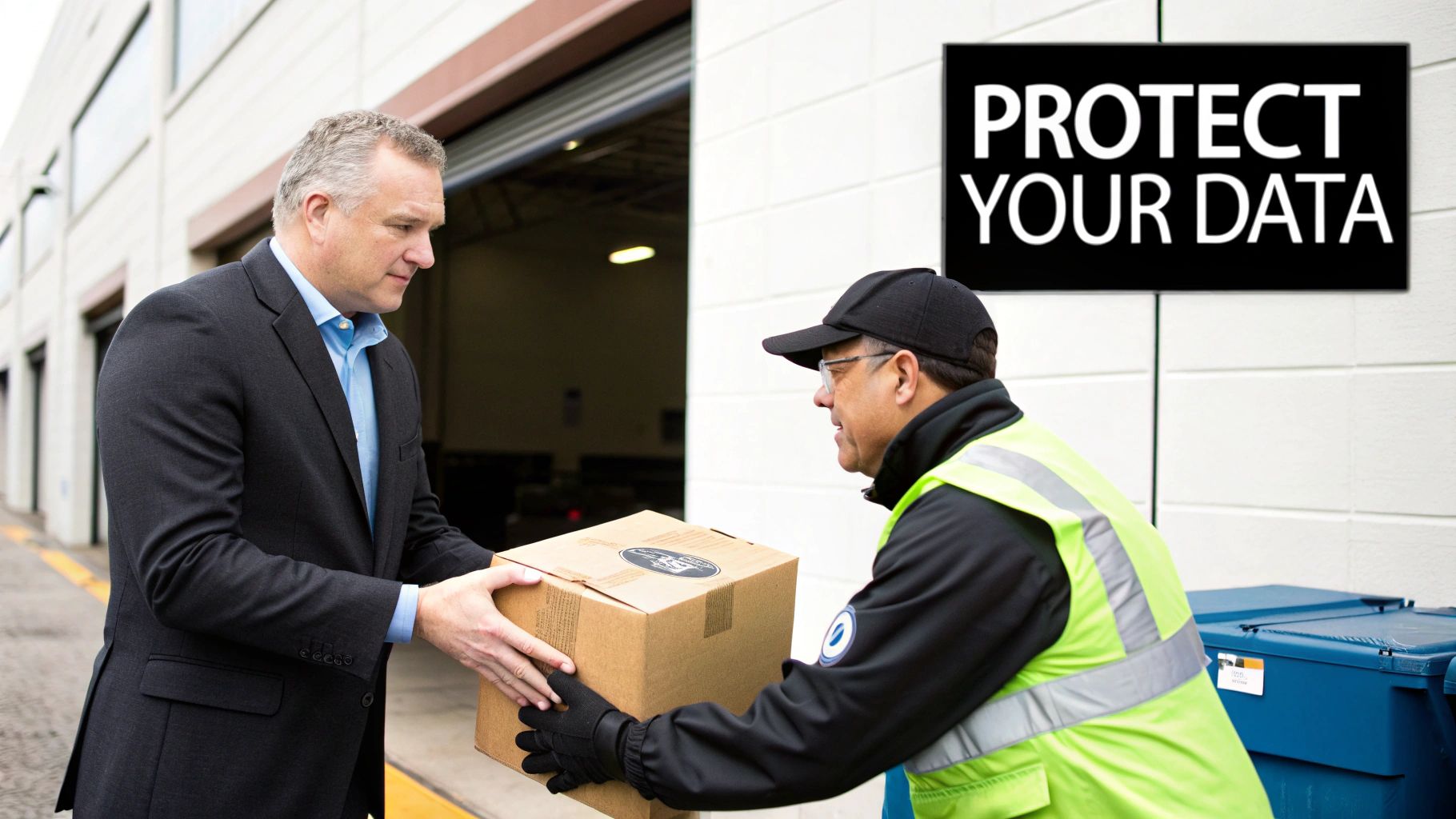
This is where a strategic partnership with a certified recycler becomes a non-negotiable. These facilities aren’t just waste handlers; they are expert IT Asset Disposition (ITAD) partners. A solid ITAD strategy turns a complex disposal headache into a secure, documented, and sustainable process that protects your organization at every turn.
Mitigating Risk Through Certified Processes
A specialized ITAD provider brings a structured framework to the table for managing the entire lifecycle of retired assets. This guarantees every piece of equipment is handled with a secure chain of custody, from the moment it leaves your building until its final disposition. That documented trail is absolutely critical for audits and proving compliance.
The scale of the e-waste problem is staggering and only getting worse. In 2022, the world generated an incredible 62 million tonnes of e-waste, which is an 82% jump from 2010. What's truly alarming is that only 22.3% of it was properly collected and recycled. With projections showing that number could hit 82 million tonnes by 2030, the risk of non-compliance and environmental liability for businesses retiring IT assets is escalating quickly.
The Value of a Strategic Partnership
For any organization that handles sensitive data, choosing a certified electronics recycling center is a must. These partners are vetted to meet tough standards for data security, environmental responsibility, and ethical operations. Their services go far beyond simple recycling, offering mission-critical value in several key areas:
- Data Security: Certified data destruction methods ensure every bit of information is irretrievably wiped clean, shielding your business from breaches.
- Compliance Assurance: They provide the necessary paperwork, like Certificates of Data Destruction, to prove you’ve met your obligations under laws like HIPAA or GDPR.
- Environmental Stewardship: A responsible partner maximizes reuse and recovers valuable materials, directly supporting your company's Environmental, Social, and Governance (ESG) goals.
By shifting from a simple disposal mindset to a strategic partnership, you turn a major liability into a well-managed, documented process. You can explore our guide on corporate e-waste solutions to see how a structured approach can protect your organization. A professional ITAD partner gives you peace of mind, ensuring your retired technology is handled securely, responsibly, and in full compliance with every regulation.
Understanding the Core Services of an ITAD Partner
A professional electronics recycling center does much more than just haul away old equipment. They offer a full range of services designed to manage risk, recover value, and keep your business compliant. This entire process is known as IT Asset Disposition (ITAD)—a strategic framework for handling retired technology not as junk, but as assets that demand secure and documented management from beginning to end.
Think of it as a secure end-of-life protocol for every piece of tech you own.
The process kicks off with a detailed inventory and valuation. Your ITAD partner will catalog every single device by its serial number, model, and specific configuration. This isn't just busywork; it's essential for establishing an unbroken chain of custody and figuring out which assets might still have value. A key goal here is maximizing value recovery by finding components or whole units that can be refurbished and resold, turning a disposal cost into a revenue stream.
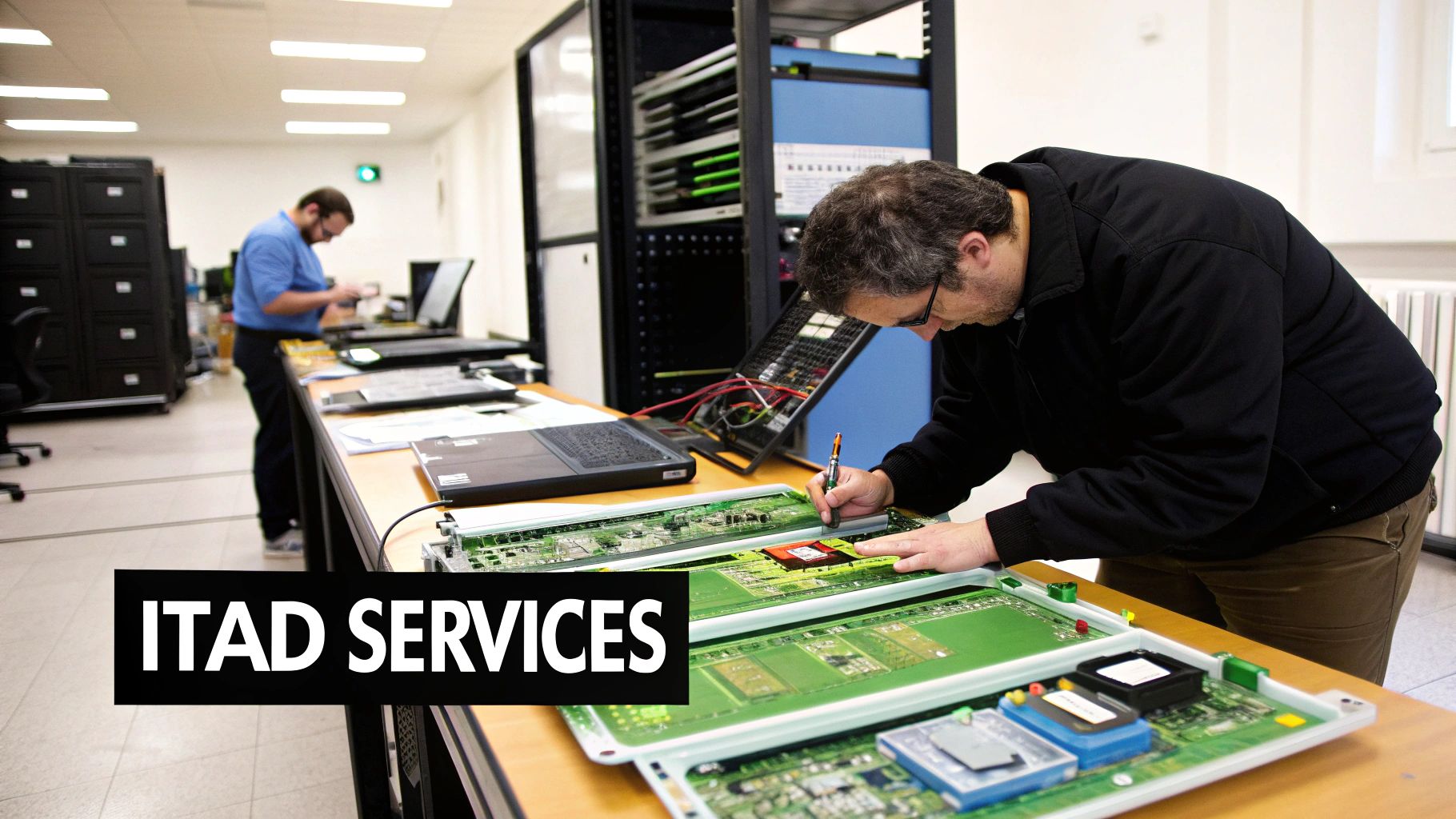
Demystifying Certified Data Destruction
At the very heart of any credible ITAD service is the permanent destruction of sensitive data. Even a single file left on a retired server’s hard drive can become a massive liability. Certified partners provide several methods to neutralize this threat, each with a different purpose and security level.
It's not enough to simply hit "delete"—professional data destruction is a science. The right method for your business depends on how sensitive the data is, what compliance rules you have to follow, and whether you want to reuse the storage media.
Let’s break down the common methods.
Comparing Data Destruction Methods
This table outlines the three primary ways data is destroyed, helping you decide which level of security is right for your retired assets.
| Destruction Method | Process Description | Security Level | Best For |
|---|---|---|---|
| Data Wiping | Software overwrites data with random characters (e.g., following NIST SP 800-88). The drive remains physically intact. | High | Reusing or reselling hard drives and SSDs. |
| Degaussing | A powerful magnetic field scrambles the magnetic domains on tapes and hard disk drives, making data unrecoverable. | Very High | Quickly sanitizing large volumes of magnetic media that will not be reused. |
| Physical Shredding | The storage device is physically destroyed, shredded into small, unrecognizable pieces. | Absolute | Top-secret or highly sensitive data where complete physical elimination is required. |
Ultimately, choosing the right method is about aligning your organization's risk tolerance with your compliance obligations.
Specialized Services for Complex Needs
A top-tier electronics recycling center also handles highly specialized projects that demand precision, logistical expertise, and airtight security protocols.
One of the biggest undertakings is data center decommissioning. This is the systematic teardown of server racks, networking gear, and all the supporting infrastructure. It requires a project management mindset to safely de-install, inventory, and transport hundreds—or even thousands—of assets without disrupting any ongoing operations. Every step is meticulously documented to give you a complete audit trail. You can find a more detailed breakdown of e-recycling and electronics recycling services for businesses to see how these large-scale projects are managed.
A true ITAD partner does more than dispose of assets; they dismantle risk. Their services are built around a core promise: to provide a secure, compliant, and auditable end to every piece of technology's lifecycle, protecting your data and your brand's reputation.
In the end, these core services transform an electronics recycler from a simple vendor into an essential operational partner. They give IT leaders a framework to manage asset retirement with the same rigor and security you apply to active devices, ensuring everything is accounted for from your facility to its final, documented disposition.
Navigating Critical Certifications and Compliance
For any IT leader, compliance isn't just a box to check—it's the foundation of your entire security program. When you’re choosing an electronics recycling partner, the certifications they hold are your first and best line of defense against data breaches and steep regulatory fines.
Think of these certifications as a "seal of approval" that's been rigorously audited. They confirm a vendor’s promises about data security and environmental handling are backed by proven, documented practices. Choosing an uncertified vendor, on the other hand, is a serious gamble. You're left with no third-party proof that your retired assets are being managed securely, creating a direct line of risk straight back to your organization.
The Gold Standards of ITAD Certifications
Not all certifications are created equal. In the world of IT asset disposition (ITAD), two standards stand out as the most respected and stringent: R2 (Responsible Recycling) and e-Stewards. A partner holding one or both of these has passed demanding audits covering everything from data security and environmental safety to employee health.
Here’s a quick-reference guide to the key certifications you should look for and what they really mean for your business.
Key ITAD Certifications and What They Mean
| Certification | Primary Focus | Why It Matters to Your Business |
|---|---|---|
| R2 (Responsible Recycling) | Risk-based approach to recycling, data destruction, and downstream vendor tracking. | Guarantees a secure chain of custody and ensures data is destroyed to global standards. Prioritizes reuse over simple recycling. |
| e-Stewards | Preventing the export of hazardous e-waste to developing nations and prohibiting prison labor. | Offers the highest level of assurance for environmental responsibility and ethical practices. Mandates data sanitization before devices leave a secure facility. |
| HIPAA Compliance | Handling of Protected Health Information (PHI) on medical devices and servers. | Essential for healthcare. A certified partner provides auditable proof that PHI has been destroyed, closing a critical compliance loop. |
| NIST SP 800-88 | Guidelines for Media Sanitization (Clear, Purge, Destroy). | This is the federal standard for data destruction. Adherence ensures your data is rendered completely unrecoverable, which is a core requirement for R2 and e-Stewards. |
For IT leaders, these credentials are far more than just logos on a website. They are your assurance that a vendor operates with a documented, secure chain of custody—effectively extending your own compliance framework to your retired assets.
These standards are especially critical when you look at the global picture. Europe leads with a 42.8% e-waste recycling rate, while North America is at 30%, and Asia lags far behind at just 11.8%. With major players like the US recycling only 15% of its 6.92 million tonnes of annual e-waste, a certified partner is essential for maintaining consistent, high standards no matter what. You can discover more insights about these global e-waste statistics on dtpgroup.co.uk.
Connecting Certifications to Regulatory Compliance
A certified ITAD partner does more than just follow industry best practices; they directly help your organization satisfy legal and regulatory mandates. This is where the real value comes in for regulated sectors like healthcare, finance, and government. A certified process provides the auditable proof you need to demonstrate due diligence.
Several key regulations intersect directly with how you handle old IT assets:
-
HIPAA (Health Insurance Portability and Accountability Act): If you're in healthcare, you absolutely must protect patient health information (PHI). A certified recycler provides documented proof that all data on retired medical devices and servers has been properly destroyed, a non-negotiable part of HIPAA compliance.
-
GDPR (General Data Protection Regulation): For companies handling the data of EU citizens, GDPR mandates secure data processing right through to destruction. Partnering with a certified vendor ensures your end-of-life data handling meets these tough international privacy standards.
-
NIST SP 800-88: This is the National Institute of Standards and Technology's official guideline for media sanitization. R2 and e-Stewards certified recyclers adhere to these protocols, providing a Certificate of Data Destruction as a formal record that your data was rendered unrecoverable.
The issuance of a Certificate of Data Destruction is the final, critical step in this process. It’s a legally defensible document detailing what was destroyed, when, how, and by whom. This document is your ultimate proof of compliance, closing the loop on an asset’s lifecycle for good. You can learn more about the importance of a Certificate of Destruction for hard drives in our detailed guide.
By demanding these certifications and the documentation they produce, you aren't just outsourcing a task—you're strategically managing risk. You're ensuring your company’s reputation and compliance posture are protected long after a device has been powered down for the last time.
The IT Asset Disposition Process Step by Step
Working with a professional electronics recycling center for IT Asset Disposition (ITAD) isn't just about hauling away old equipment. It's a structured, secure, and fully documented process that protects your business from the moment we arrive until the last report is signed.
Think of it as an unbreakable chain of custody. Every single asset is meticulously tracked, giving you a defensible audit trail that proves you did everything right. This isn't just about compliance; it's about operational excellence. Let's walk through what a typical ITAD engagement looks like, step by step.
Step 1: Scoping And Quoting
It all starts with a detailed conversation. A true ITAD partner needs to understand the full scope of your project—what kind of assets you have, where they are, and what specific security or compliance rules you're working under. We'll talk servers, laptops, networking gear, and any other specialized equipment.
From there, you'll get a transparent quote. It will clearly outline all costs, from logistics to data destruction, and also show you any potential value we can recover from assets that can be resold. This first step ensures we're all on the same page and sets the stage for a smooth project.
Step 2: Secure Logistics And Onsite Pickup
Once the plan is green-lit, our team gets to work. We don't just send a truck; we send trained, background-checked technicians in secure, GPS-tracked vehicles. They'll show up with everything needed—pallet jacks, secure containers, and asset tags—to safely pack and transport your equipment with minimal disruption to your operations.
For organizations with high-security needs, we can perform services like hard drive shredding or inventory scanning right at your facility. This means your sensitive data is neutralized before it ever leaves your building, offering an extra layer of protection from the very start.
Step 3: Secure Intake And Auditing
When your assets arrive at our secure electronics recycling center, they are immediately moved to a controlled-access area. Here, every single device is inventoried. We scan each serial number and check it against the initial pickup list, ensuring nothing gets lost in transit.
Each asset is then inspected, graded, and its technical specifications are recorded. This detailed audit is the backbone of the entire process, providing the data needed for all final reporting and confirming that every device is accounted for.
The image below shows the compliance journey your assets take once they're in a certified facility.
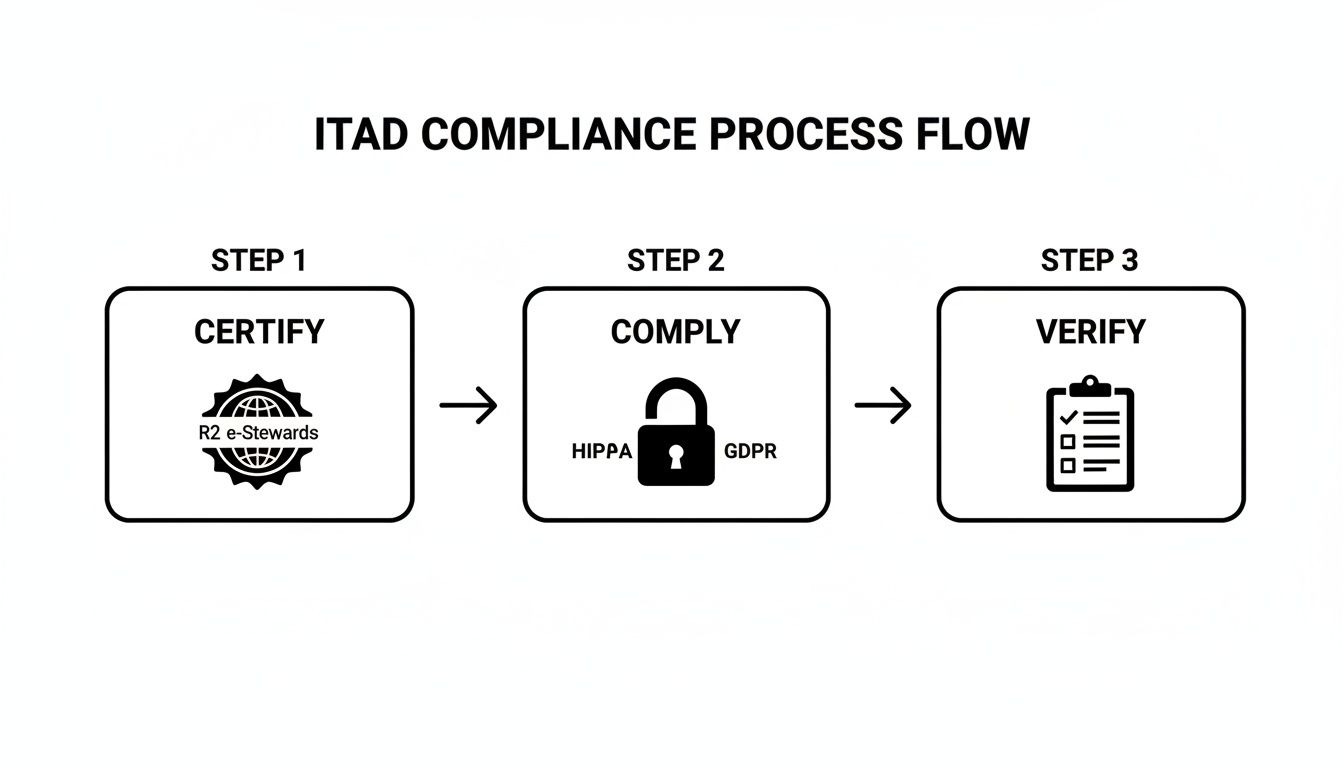
As you can see, every action is governed by strict certification standards, regulatory requirements, and verifiable auditing.
Step 4: Data Destruction And Sanitization
This is where the real security work happens. Every device that holds data undergoes certified data destruction, following rigorous standards like NIST SP 800-88. Depending on your security policy, this could mean secure data wiping, degaussing (using powerful magnets), or physical shredding.
The destruction method used for each device is documented against its unique serial number. This creates a permanent, auditable record that proves all sensitive information was completely destroyed—a non-negotiable step for meeting compliance mandates like HIPAA or GDPR. For larger projects like retiring a server farm, you can explore our specialized data center equipment disposal services to see how we handle these complex environments.
Step 5: Asset Triage And Final Reporting
With data security handled, we triage the assets. Devices that still have value are tested, refurbished, and prepared for resale to maximize your return on investment. Any equipment that's truly at the end of its life is responsibly dismantled for recycling.
Finally, we close the loop by providing you with a complete reporting package. This documentation is your proof of compliance and includes:
- A detailed inventory report listing every asset by serial number.
- A Certificate of Data Destruction to prove secure data sanitization.
- A Certificate of Recycling confirming responsible environmental handling.
- A settlement report detailing any revenue generated from remarketed equipment.
This step-by-step process, managed by a professional electronics recycling center, turns a potential risk into a controlled, secure, and documented business function.
How to Choose the Right Electronics Recycling Partner
Picking an IT asset disposition (ITAD) partner is one of those critical business decisions that goes way beyond a simple price quote. The right partner acts as a guardian for your data and a key player in your compliance strategy. The wrong one? They can expose you to staggering risks, from data breaches to heavy fines for improper disposal.
Making the right choice starts with asking the right questions. That cheap quote might look tempting, but it often hides serious gaps in security, compliance, or downstream accountability. We’ve seen it happen: a company gets hit with steep penalties because their "low-cost" vendor illegally dumped electronics, with asset tags tracing right back to them. Another common disaster is a data breach stemming from improperly wiped drives that were sold on the secondary market.
These aren't just hypotheticals. They are costly realities that prove why a thorough evaluation process is so important.
Vetting Security and Compliance Protocols
Your first and most important focus should be on how a potential partner handles your data and meets regulatory standards. Their security protocols need to be airtight and fully documented, leaving absolutely no room for error. If a vendor is hesitant to provide clear answers or documentation on these points, consider it a major red flag.
Start digging into their core processes with these essential questions:
- Certifications: Are you R2 or e-Stewards certified? Can you provide a copy of your current certificate?
- Data Destruction: What data destruction methods do you use, and do they align with NIST SP 800-88 guidelines?
- Chain of Custody: Can you walk me through your secure chain of custody process, from the moment you pick up our assets to their final disposition?
- Facility Security: What physical security measures—like access controls and surveillance—are in place at your facility?
- Employee Screening: Are your technicians and drivers background-checked and properly trained in data security protocols?
This line of questioning helps you quickly separate the true security experts from vendors who are little more than waste haulers.
Evaluating Downstream and Financial Accountability
A recycler's responsibility doesn't end when your assets leave their building. A certified partner is required to audit their own downstream vendors—the companies that process the raw materials after dismantling. This is your guarantee that your e-waste is never illegally exported or handled irresponsibly.
The global electronics recycling market is rapidly maturing, projected to surge from USD 43.2 billion in 2025 to USD 147.9 billion by 2035. For IT leaders, this explosive growth signals a more professionalized industry where strategic, accountable partnerships are the new standard. Read the full research about the electronics recycling market on factmr.com.
To confirm your partner is financially stable and fully accountable, ask about their insurance and reporting capabilities.
- Insurance Coverage: What are your liability insurance limits, and does your policy specifically cover data breaches?
- Downstream Audits: How do you audit and verify your downstream recycling partners?
- Reporting: What specific documentation will I receive, such as a Certificate of Data Destruction and a serialized inventory report?
Choosing the right electronics recycling partner is about assessing total risk, not just the upfront cost. For IT leaders looking to establish a secure and compliant process, you can learn more about our proven IT asset disposition services in Dallas Fort Worth, Texas and how we protect our clients nationwide. By conducting this level of due diligence, you can confidently select a partner that truly safeguards your organization's data, reputation, and environmental commitments.
Common Questions About Electronics Recycling and ITAD
Even with a clear plan, IT leaders always have a few practical, bottom-line questions before pulling the trigger on an ITAD project. Let's tackle the most common ones so you can move forward with total confidence.
What Is the Difference Between a Recycling Center and a Scrap Yard?
This is a big one, and the difference is night and day, especially if you handle sensitive data. A general scrap yard is in the business of recovering raw commodity value from materials like steel, copper, and aluminum. Their process is built for bulk metal, not for data security.
Handing electronics to a scrap yard is a huge gamble. It's common for devices to be shredded or processed without any certified data destruction first. If a hard drive goes into that shredder physically intact, a determined person can still recover data from the shredded fragments. It's a massive security blind spot.
A certified electronics recycling center, on the other hand, is a security and compliance partner first.
Our entire operation is built around a secure, documented chain of custody that’s audited and mandated by standards like R2 or e-Stewards. Data destruction isn't an afterthought—it's a required, documented first step before any recycling happens. The risk is neutralized from the start.
For any business bound by regulations like HIPAA or GDPR, a scrap yard simply can't provide the legally required Certificate of Data Destruction, making them a non-starter.
How Are IT Asset Disposition Costs Determined?
There’s no simple, flat-rate price for professional ITAD services because every project is different. The final cost—or even a potential revenue return—is a calculation based on a few key factors. A good partner will give you a detailed quote breaking everything down so you know exactly what you’re paying for.
Here’s what goes into the calculation:
- Type and Volume of Equipment: A pallet of laptops requires a different process than a rack of blade servers or specialized lab equipment. The mix of assets sets the stage for the logistics and labor involved.
- Potential Resale Value: This is where you can see a return. Newer, functional equipment can often be refurbished and sold. We share that revenue back with you, which can significantly offset or sometimes even cover the entire cost of the service.
- Required Data Destruction: The specific method you need affects the cost. On-site physical shredding, for instance, means bringing a shred truck and crew to your location, which is naturally more involved than wiping drives securely back at our facility.
- Logistics and Location: The complexity of the pickup matters. Getting gear out of a high-security data center or a downtown high-rise is different from a simple ground-floor office pickup. Distance to our processing facility also plays a role.
Ultimately, a reputable electronics recycling center frames the project as a total value proposition, balancing secure disposal costs against potential asset recovery revenue.
What Kind of Reporting Should I Expect?
Solid reporting isn't just a "nice-to-have"—it's the cornerstone of any professional ITAD project. This paperwork is your official, legally defensible proof that you did your job right when retiring company assets. Without it, you have no way to prove to an auditor that your data was destroyed or your equipment was handled responsibly.
When the job is done, you should receive a complete documentation package that creates an unbroken audit trail for every single asset we picked up.
This package must include:
- A Serialized Inventory Report: This is a detailed list of every single device we processed, identified by its unique serial number, make, and model. It's the master record confirming that everything that left your facility was accounted for.
- A Certificate of Data Destruction: This is your golden ticket. It formally states that all data-bearing devices were sanitized according to a specific standard, typically NIST SP 800-88. It details the method used (wiping, degaussing, or shredding) and is your proof of data security compliance.
- A Certificate of Recycling: This document confirms that all non-reusable materials were recycled in an environmentally compliant manner, following all local, state, and federal rules. It’s perfect for your company's sustainability and ESG reports.
- A Settlement Report (if applicable): If any of your assets were resold, this report provides a transparent financial breakdown showing the revenue generated, any fees, and the net payment coming back to you.
Together, these documents close the loop on the asset lifecycle, giving you the complete, auditable trail that auditors, regulators, and your own leadership team require.
Can You Handle Specialized Medical and Lab Equipment?
Absolutely. A qualified B2B electronics recycler has the specific expertise to manage sensitive equipment from regulated industries like healthcare and scientific research. This isn't just an add-on for us; it's a core competency. We know that devices from these environments don't just hold sensitive data—they often have unique handling requirements.
For hospitals and clinics, this means processing everything from patient monitors and diagnostic machines to the servers storing electronic health records (EHR) in a fully HIPAA-compliant way. Our processes are designed to ensure all Protected Health Information (PHI) is destroyed for good, and we provide the exact documentation HIPAA auditors demand.
Likewise, for labs and research institutions, we handle the disposition of scientific instruments, control systems, and data storage that contain priceless intellectual property. Our secure chain of custody ensures your proprietary data is protected from the moment we arrive until it’s verifiably destroyed. A specialized partner has the experience to handle these unique assets safely and securely, giving you true peace of mind.
Ready to implement a secure, compliant, and responsible ITAD program? Dallas Fortworth Computer Recycling offers nationwide services for businesses, government agencies, and healthcare providers, ensuring your retired assets are managed with an unbreakable chain of custody. Contact us today to schedule your pickup and protect your organization.