
IT asset disposition Arlington: Secure End-of-Life IT Responsibly
For any business in Arlington, that closet full of old servers, laptops, and hard drives is more than just clutter—it’s a liability. Secure IT asset disposition in Arlington is the formal process for retiring that end-of-life equipment responsibly. It’s how you protect your company from data breaches, steep environmental fines, and regulatory penalties.

Why Secure IT Asset Disposition in Arlington Is a Critical Business Priority
As an IT director or procurement manager in the Arlington area, you know that every piece of outdated tech represents a risk. Each device is a ticking time bomb loaded with sensitive data, environmental hazards, and potential compliance violations. The days of just stockpiling old equipment or having it hauled away without a clear plan are long gone.
Today, a well-defined IT asset disposition (ITAD) strategy is a cornerstone of modern corporate risk management. Ignoring this process can have severe consequences that hit your finances, reputation, and legal standing hard.
The Real-World Risks for Arlington Businesses
Every single retired asset carries hidden dangers. A single hard drive from a former employee’s laptop could hold confidential customer lists, financial records, or your company’s intellectual property. If that device ends up in the wrong hands or a landfill, the fallout can be catastrophic.
Here are the tangible threats your organization faces:
- Data Breach Vulnerabilities: Retired assets are a goldmine for data thieves. A staggering 70% of data breaches are linked back to lost or stolen devices, many of which were improperly decommissioned.
- Regulatory Non-Compliance: Laws like HIPAA for healthcare, GLBA for finance, and GDPR for international data have strict rules for protecting information. Failing to prove you securely destroyed data can lead to crippling fines.
- Environmental Impact: Electronic waste (e-waste) is a massive environmental problem. Illegally dumping electronics can result in penalties and seriously tarnish your company's public image. You can find compliant solutions in our guide on Arlington electronics recycling.
"A well-defined ITAD plan isn't an expense; it's an investment in risk mitigation. It transforms a potential liability into a structured, auditable process that protects your data, your brand, and your bottom line."
The urgency is clear when you look at the market itself. The global ITAD market is projected to grow from USD 20.66 billion in 2025 to USD 31.89 billion by 2029, according to a market analysis from Research and Markets. This explosive growth is fueled by shorter IT refresh cycles and mounting regulatory pressure, confirming that smart businesses are turning to certified partners to manage these complex security demands.
Building Your Internal ITAD Framework
Before you even think about calling an IT asset disposition vendor in Arlington, the most important work happens inside your own walls. You need to build a solid internal framework that clearly defines what your project involves. It all starts with a complete inventory of every single asset you plan to retire.

This isn't just a simple device count. Your team should be documenting the specifics for each asset: serial numbers, internal asset tags, make, model, and its physical condition. This detailed record is the backbone of your entire project, from auditing data destruction to getting accurate quotes from partners.
Asset Classification Is Key
With a complete inventory list in hand, the next step is classification. This is where you sort your assets into logical groups based on their risk, potential value, and specific disposal needs. Not all equipment is created equal, and your disposition strategy needs to reflect that reality.
Think about a common Arlington scenario. A local healthcare provider has to classify laptops containing electronic protected health information (ePHI) as high-risk. This means they'll require onsite physical destruction. At the same time, a logistics firm might classify its old warehouse scanners as low-risk, making them perfect candidates for standard offsite data wiping and recycling.
Here are the main categories to think about as you classify your equipment:
- Data Sensitivity: Is the data public, internal, confidential, or regulated by laws like HIPAA? This will determine the required method of data destruction.
- Resale Potential: Does the asset still have market value? Newer laptops, servers, and networking gear can often be refurbished and sold, which can generate a return to help offset your disposition costs.
- Recycling Needs: Does the equipment contain hazardous materials? Items like old CRT monitors or certain batteries need specialized handling to stay compliant.
A well-documented scope of work is your most powerful tool when engaging ITAD vendors. It eliminates guesswork, ensures you receive apples-to-apples quotes, and holds your chosen partner accountable for every single asset.
This level of detailed prep work is fundamental to effective IT asset management best practices, making sure no device slips through the cracks.
Documenting for a Clear Scope of Work
Once your inventory is classified, you can put together a formal scope of work. This document gives potential vendors a crystal-clear picture of the job, laying out the quantity and types of assets, where they are located, and your specific security requirements. An accurate scope prevents surprise fees and misunderstandings later on.
The huge volume of retired computers and laptops alone makes this process essential. These devices make up the biggest slice of the ITAD market, valued at USD 14.94 billion globally in 2024. And when you consider that proper disposition can recover up to 95% of materials for reuse, your detailed framework also helps you achieve a more sustainable outcome.
This disciplined approach ensures your IT asset disposition in Arlington is secure, compliant, and environmentally responsible right from the start.
Choosing the Right ITAD Partner in Arlington
Picking a vendor for your IT asset disposition in Arlington isn’t just another line item in a procurement spreadsheet. This is the single most important decision in the entire asset retirement process. You’re not just hiring a disposal service; you’re entrusting a partner with your company's data, your compliance record, and your environmental reputation.
Going for the cheapest option can backfire spectacularly, turning a small savings into a massive expense from a data breach or compliance fine.
The stakes are higher than ever. With the U.S. ITAD market projected to reach USD 5.3 billion by 2025, regulations are tightening, and for good reason. It’s why an estimated 80% of large organizations now outsource their ITAD—they know the risks of getting it wrong. Working with a Texas-based partner who understands the local landscape provides a significant advantage in logistics and compliance.
Vet Certifications for Security and Compliance
Certifications are your first line of defense. They provide independent, third-party proof that a vendor adheres to strict industry standards for data security, environmental processing, and employee safety. Don't just take their word for it—ask for certification numbers and verify them directly with the issuing body.
Here are the non-negotiables:
- R2v3 (Responsible Recycling): This is the premier standard for the electronics recycling industry. An R2v3 certified partner is committed to a "reuse first" model and follows environmentally sound practices for processing old electronics.
- e-Stewards: Like R2, e-Stewards is a globally respected certification that specifically prohibits the illegal export of hazardous e-waste to developing nations. It ensures your assets won’t contribute to pollution elsewhere.
- NAID AAA: This is the gold standard for data destruction. To maintain this certification, a provider must pass rigorous, unannounced audits of everything from their hiring process to their physical security and destruction methods. It’s your best guarantee that your data is gone for good.
Treat these certifications as your minimum entry requirement. If a potential partner lacks R2v3, e-Stewards, or NAID AAA, it's a major red flag. It signals a potential weakness in their security or compliance framework that you can't afford to risk.
To help you systematically evaluate potential partners, we've put together a checklist of the key qualifications to look for.
ITAD Partner Vetting Checklist
| Qualification | What to Look For | Why It Matters for Your Business |
|---|---|---|
| Industry Certifications | R2v3, e-Stewards, and NAID AAA. Ask for certificates and verify them. | These are independent proof of a vendor’s commitment to security, environmental responsibility, and legal compliance. |
| Data Destruction Methods | Offers multiple DoD and NIST-compliant methods (wiping, degaussing, shredding). | Provides flexibility to meet your specific security policies for different types of media. One size doesn't fit all. |
| Chain of Custody | A secure, documented process from pickup to final disposition. Ask for sample reports. | An unbroken chain of custody is your legal proof of proper handling and protects you during an audit. |
| Insurance Coverage | Ask for a Certificate of Insurance (COI) covering general liability, data breach, and pollution. | Protects your organization from financial loss in the unlikely event of an incident during transport or processing. |
| Logistics and Security | Secure vehicles, background-checked employees, and defined on-site protocols. | Ensures your assets are protected from the moment they leave your facility, preventing theft or loss. |
| Reporting and Documentation | Detailed, serialized asset reports, Certificates of Data Destruction, and Certificates of Recycling. | This paperwork is your auditable trail, proving you met all legal and environmental obligations for every single asset. |
Using a structured checklist like this ensures you're comparing vendors on the criteria that truly matter for protecting your business.
Evaluate Reporting and Chain of Custody
A professional ITAD partner provides a complete, unbroken chain of custody from the moment your assets leave your building. This documentation is your armor in an audit and your legal proof of compliance. Always ask potential vendors for sample reports to see exactly what you’ll be getting.
At a bare minimum, their final documentation package must include:
- A serialized inventory list that matches the equipment you handed over.
- A formal Certificate of Data Destruction for every single hard drive, SSD, or other data-bearing device.
- A Certificate of Recycling that confirms all non-reusable materials were disposed of in an environmentally compliant way.
This detailed paperwork creates the crucial auditable trail that protects your organization from liability. We take a closer look at what separates the best from the rest in our guide to the top IT asset disposition companies. By focusing on vendors with transparent reporting and the right certifications, you're not just hiring a service—you're buying peace of mind.
Mastering Data Destruction and Compliance
When it comes to IT asset disposition, nothing is more important than ensuring your data is gone for good. Just hitting 'delete' on a file doesn't cut it. Lingering data can easily be recovered, leaving your Arlington business wide open to a breach. Real data security demands a formal, documented destruction process that meets today's tough industry standards.
There are three professional methods for certified data destruction. The one you choose will depend on your specific needs, the type of assets you have, and your internal security policies.
The Core Methods of Data Sanitization
The right approach for a financial firm in Arlington managing sensitive client data is going to be different from a marketing agency retiring a few old laptops. It all comes down to the media type and your risk tolerance.
Your options break down into these main categories:
- Data Wiping (NIST 800-88): This is a software-based process that overwrites every bit of data on a drive with random 1s and 0s. Following the NIST 800-88 Clear standard with a single pass is more than enough for most business scenarios, making the original data completely unrecoverable. It's the perfect choice for newer devices that can be resold, as it preserves the hardware's value.
- Degaussing: For magnetic media like older backup tapes or traditional hard disk drives (HDDs), degaussing is a great option. It uses an incredibly powerful magnetic field to instantly scramble the stored data. One critical thing to remember: degaussing does not work on Solid-State Drives (SSDs), and it also makes the degaussed drive totally unusable.
- Physical Destruction (Shredding): This is the end of the line for a hard drive and the gold standard for data security. The drive is physically shredded into tiny, confetti-like metal fragments. We see this method chosen most often for devices that held highly sensitive intellectual property, financial records, or protected health information. Many Arlington businesses also request onsite shredding to watch the destruction happen with their own eyes.
The Non-Negotiable Proof of Compliance
No matter which method you go with, the job isn't done until you have the paperwork to prove it. This is where a Certificate of Data Destruction (CoDD) is absolutely essential. It’s not just a receipt—it's your official, auditable record that your company’s data was destroyed according to certified standards.
A Certificate of Data Destruction is your legal safeguard. It’s the document that stands between your company and a potential lawsuit or regulatory fine, proving you upheld your duty to protect sensitive information.
A proper certificate is issued for every single data-bearing device and must include specific, non-negotiable details:
- Unique Serial Numbers: Every drive or device must be listed individually.
- Destruction Method Used: It has to state whether the asset was wiped, degaussed, or physically shredded.
- Standard of Destruction: The certificate should name the standard followed, like NIST 800-88.
- Date and Location: It must clearly show when and where the destruction occurred.
- Chain of Custody: It serves as confirmation of the secure transfer of your assets to the certified technician who did the work.
This documentation is the bedrock of a defensible IT asset disposition Arlington program. To see how it fits into your broader compliance strategy, you can learn more about the importance of a Certificate of Destruction for hard drives in our detailed guide. Without it, you have zero verifiable proof that you’ve met your legal and ethical obligations to protect company and customer data.
Managing Project Logistics from Pickup to Final Report
Once you've picked a certified partner, the success of your IT asset disposition Arlington project comes down to execution. It’s all about smooth logistics—from the moment your assets are staged for transport until that final compliance report lands on your desk. The goal is to create a secure, efficient process that doesn’t disrupt your day-to-day operations.
Your vendor should work with you to schedule pickups at a time that makes sense for your business, whether that’s after hours or during a quiet part of the day. A professional team will show up with the right equipment and trained staff to handle your assets safely.
Preparing for Secure Transport
Proper prep work is the key to a seamless pickup. This means getting all your retired equipment consolidated into a single, secure location. For bigger projects, assets need to be carefully stacked and shrink-wrapped onto pallets.
This doesn't just make loading faster; it adds a crucial layer of security during transit. When the truck arrives, your team needs to have the pre-project inventory list ready to cross-reference with the driver's manifest before a single thing leaves your building. This check is the very first link in your chain of custody.
The choice between onsite and offsite processing also shapes the logistics.
- Onsite Processing: For services like hard drive shredding, the vendor brings their equipment right to your facility. This gives you maximum transparency since you can witness the destruction yourself.
- Offsite Processing: Assets are transported in a secure, GPS-tracked truck to the vendor's certified facility for auditing, data destruction, and processing. This is usually more efficient for large volumes or mixed asset types.
Your loading dock is a critical control point. Always confirm the identity of the pickup crew and make sure every pallet or container is logged before it's loaded onto the truck. This simple step validates the chain of custody from the start.
Choosing the right data destruction method is a huge part of this process, affecting both logistics and your compliance posture. This flowchart breaks down the main options for hard drives.
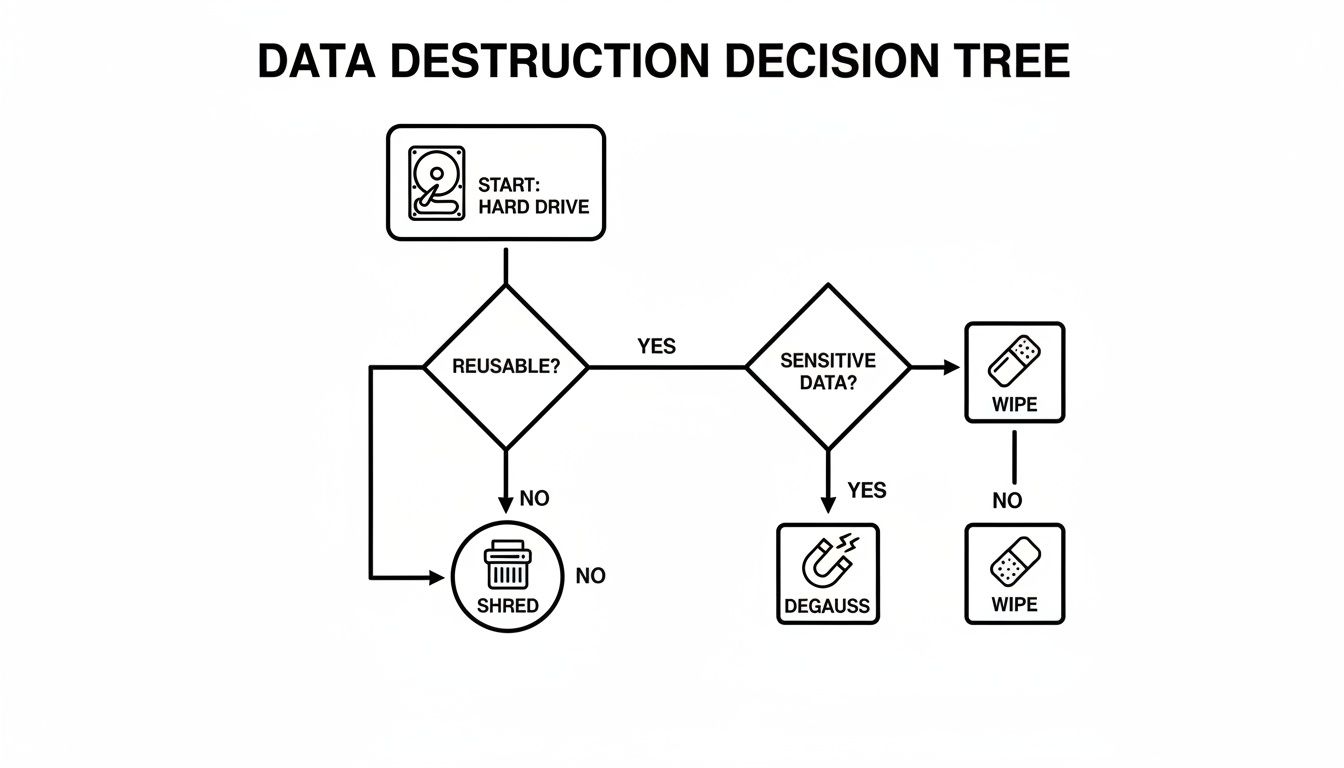
As you can see, wiping preserves the drive for potential reuse, but physical shredding provides the ultimate security by completely destroying the media. It’s the go-to choice for any high-risk data.
The Final Step: Comprehensive Reporting
The project isn't over until you have detailed, asset-level reports in hand. This documentation is the final piece of your compliance puzzle, giving you an auditable record of every single device.
A thorough report from your partner will include serialized Certificates of Data Destruction and Certificates of Recycling. This is your proof that every asset was handled responsibly and securely from start to finish.
If you need local services, our guide on where to find computer recycling near you in Arlington, TX offers more logistical tips. Ultimately, managing the pickup, transport, and reporting this meticulously turns a complex chore into a controlled, verifiable business process.
Frequently Asked Questions About IT Asset Disposition in Arlington
If you're an IT director or procurement manager in Arlington, you know that retiring old tech isn't as simple as it used to be. Building a secure and compliant IT asset disposition Arlington strategy brings up a lot of questions, and you need clear, straightforward answers. We've handled countless projects for businesses just like yours, so we've put together some practical answers to the most common concerns we hear.
Let’s get right to it.
What Does IT Asset Disposition in Arlington Typically Cost?
This is almost always the first question we get, and the honest answer is: it varies. The final cost really depends on what you have. The type and volume of your equipment, your data destruction needs (onsite shredding costs more than offsite wiping), and logistics all play a part. But here's the factor that often changes the whole equation: asset value.
If you have newer equipment with resale value, you could get a significant rebate. For many of our clients, this return on investment is enough to offset all the service fees, making the entire project cost-neutral or even profitable.
A professional ITAD partner will always provide a transparent, itemized quote. Be cautious of any price that seems suspiciously low or lacks detail—it’s often a sign that they’re cutting corners on data security or environmental compliance, putting your business at risk.
For older equipment that has no market value, you can expect recycling fees. These cover the cost of responsible de-manufacturing and materials processing. The only way to get a solid number is to get a custom quote based on a detailed inventory of your assets.
How Do I Prove My Company's Data Was Actually Destroyed?
Proof is all about the documentation. You should only partner with a certified ITAD vendor that provides a serialized Certificate of Data Destruction for every single hard drive and data-bearing device they process. This is your auditable, legal proof that your data was sanitized according to standards like NIST 800-88.
For businesses with highly sensitive or regulated data, we always recommend another layer of security: onsite shredding. This allows you to physically witness the destruction of your hard drives at your Arlington facility before they’re even loaded onto the truck. Also, make sure your vendor holds a NAID AAA Certification. This means their data destruction process is subject to unannounced, third-party audits, giving you ultimate peace of mind.
What Happens to My Old Equipment After It's Picked Up?
A responsible ITAD provider operates on a strict "reuse, then recycle" model. This approach maximizes your financial return while ensuring total environmental compliance.
Here's how it works:
- Audit and Triage: As soon as your equipment arrives at the secure facility, every single asset is logged and checked against the pickup manifest.
- Test and Refurbish: Devices with remaining value are securely data-wiped, tested, and prepped for resale on secondary markets. This is the step that generates your rebate.
- De-manufacture and Recycle: Equipment that is truly at the end of its life is carefully de-manufactured. Raw materials like metals, plastics, and the precious metals from circuit boards are separated and sent back into the supply chain.
This process ensures we meet zero-landfill goals and that your company stays compliant with all local and federal e-waste regulations.
Why Should I Use a Nationwide Provider for My Arlington Office?
It might seem counterintuitive, but a nationwide provider often offers major strategic benefits, even for a single Arlington office. In today’s business world, many companies have remote employees, satellite offices, or data centers spread across different states.
Working with a single, national partner means you can standardize your ITAD program everywhere. You get consistent security protocols, uniform compliance reporting, and one point of contact for your entire operation. Instead of vetting a new local vendor every time you have a need in another city, you have one trusted partner who can manage secure logistics for you anywhere in the country.
Ready to create a secure, compliant, and streamlined ITAD program? Dallas Fortworth Computer Recycling offers nationwide services with the local expertise Arlington businesses trust. Learn more at https://dallasfortworthcomputerrecycling.com and get a transparent quote for your project today.