
Business electronics recycling pickup Texas: Your Quick Guide
For busy IT managers and business owners in Texas, arranging an electronics recycling pickup comes down to a few key decisions. You'll need a clear picture of what you have, a solid plan for data destruction, and the right certified partner to handle the job. Getting these three things right from the start is the secret to a smooth, compliant process.
A Quick Guide to Scheduling Your E-Waste Pickup
When it's time to retire old IT assets, the logistics can feel overwhelming. But with a clear roadmap and an experienced partner, it's actually a very manageable process. The key is knowing what to expect at each stage, from your first phone call to the moment you receive your final compliance documents.
This simple flow chart gives you a bird's-eye view of the entire process.
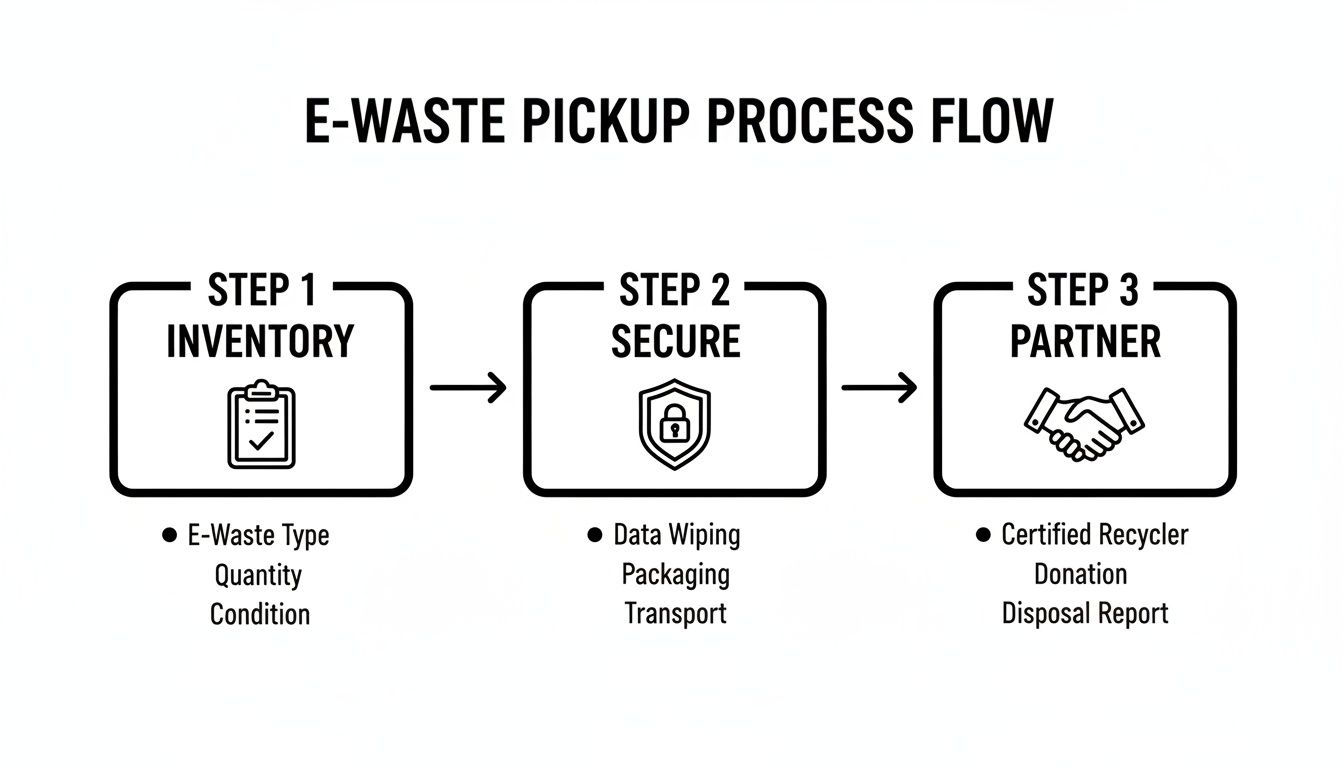
As you can see, the journey starts with your internal prep work (Inventory), moves into risk management (Secure), and finishes with execution (Partner). This approach makes sure no critical steps are missed along the way. For a closer look at the different pickup options available, check out our guide on computer recycling pickup in Dallas.
The Pickup Roadmap
To give you a better sense of the timeline and what’s involved, we’ve mapped out the entire journey. Think of this as your high-level project plan for achieving compliant electronics disposal from start to finish.
A successful pickup is 90% preparation. The work you do before our truck arrives—like creating an asset inventory and defining your data security needs—has the biggest impact on the efficiency and compliance of the entire project.
Here’s a high-level summary of the process, breaking down what happens at each phase.
Texas Business E-Waste Pickup Roadmap
The table below breaks down each phase, outlining the key action required from your team and what you can expect from your recycling partner in return. It’s a simple framework to set clear expectations for everyone involved.
| Phase | Key Action | What You Can Expect |
|---|---|---|
| Initial Inquiry | Contact a certified recycler with a rough scope of your project. | A consultation call to discuss your equipment, needs, and service options. |
| Inventory & Quoting | Provide a detailed list of assets for recycling. | A formal quote outlining any costs, potential rebates, and a service agreement. |
| Scheduling & Logistics | Confirm the quote and coordinate a pickup date and time. | Confirmation of the truck arrival window, on-site contact, and building access needs. |
| On-Site Service | Have assets gathered and ready for the collection team. | Professional packing, palletizing, and loading of all equipment onto a secure truck. |
| Final Documentation | Await post-pickup compliance and asset reports. | Receipt of your Certificate of Data Destruction and Certificate of Recycling. |
Knowing what to expect—like needing to provide building access details during the "Logistics" phase or that a "Certificate of Recycling" is a standard deliverable—helps you prepare ahead of time and close out the project with confidence.
Understanding Texas E-Waste Regulations for Businesses
Getting a handle on e-waste regulations isn't just about being green—it's your company's front line against expensive fines, brand damage, and serious data breaches. For any business in Texas, this means going beyond simple recycling to understand your specific legal duties. The rules for consumers just don't apply in the corporate world, where the standard of care is much, much higher.
The legal side isn't one single state law. It’s actually a mix of federal rules, state statutes, and local ordinances that all define what your responsibilities are. This complexity is exactly why a professional business electronics recycling pickup in Texas isn't just a convenience; it's a core part of managing risk.
Differentiating Business and Consumer Rules
You’ve probably seen ads for community e-waste drop-off events or take-back programs at big-box stores. It’s critical to know these are built for households, not businesses. Commercial organizations generate e-waste on a completely different scale and are legally held to a higher standard known as a "duty of care."
This duty means your business is legally on the hook for its electronic waste from the day it’s unplugged until it’s been properly destroyed and recycled—with proof.
What happens if a server you thought was recycled somehow ends up in a landfill and its hard drives get compromised? The legal and financial fallout lands directly on your company, not the hauler who dumped it. This is why a verifiable chain of custody isn't just a nice-to-have; it's non-negotiable for any business.
The real difference comes down to accountability. Consumer programs are all about collecting volume. In contrast, business-to-business (B2B) recycling is built around compliance, bulletproof data security, and the documentation to prove it.
Key Regulations Texas Businesses Must Know
While Texas doesn't have one giant e-waste mandate covering all businesses, a few key laws create a de facto regulatory framework you have to follow. Texas is one of the nation's top generators of e-waste, which has led to a complex environment that requires smart navigation for any business electronics pickup. The state largely relies on federal rules from the EPA and local ordinances to govern how companies handle their e-waste.
Here are the key regulations that directly impact your business:
- Texas Health and Safety Code Chapter 361: This is the foundation. It gives the Texas Commission on Environmental Quality (TCEQ) the power to regulate solid waste. For businesses, the crucial part is that it classifies certain electronics with materials like lead, mercury, and cadmium as potentially hazardous waste, which means much stricter disposal rules apply.
- EPA's Resource Conservation and Recovery Act (RCRA): This is the big federal law for solid and hazardous waste. If your old gear—like CRT monitors with leaded glass or circuit boards with heavy metals—is classified as hazardous waste, your business must follow stringent RCRA rules for handling, transport, and disposal.
- TCEQ Transportation Regulations: Just moving your e-waste is regulated, too. The TCEQ has specific requirements for anyone transporting industrial solid waste, a category that often includes large loads of corporate electronics. Your recycling partner absolutely must have the right permits to haul these materials.
Ignoring these rules can lead to major penalties. Picture this: a state environmental inspector finds a pallet of your company’s old computers, complete with your asset tags still on them, dumped behind a warehouse. The fines and required cleanup costs could easily dwarf what you would have spent on a compliant recycling program from the start. You can learn more about managing these assets in our guide to enterprise IT equipment recycling in Texas.
This entire legal framework is there to prevent environmental damage and, just as importantly, to protect sensitive data. For your business, it all points to one clear need: a certified recycling partner who truly understands these regulations and gives you the paperwork to prove you’ve done everything right. Your liability doesn’t end when the truck leaves your dock; it ends when you have a Certificate of Recycling in hand.
How to Prepare Your IT Assets for a Secure Pickup
A smooth business electronics recycling pickup in Texas really starts long before our truck pulls up to your door. The prep work you do upfront is what makes the whole process efficient, secure, and compliant from day one.
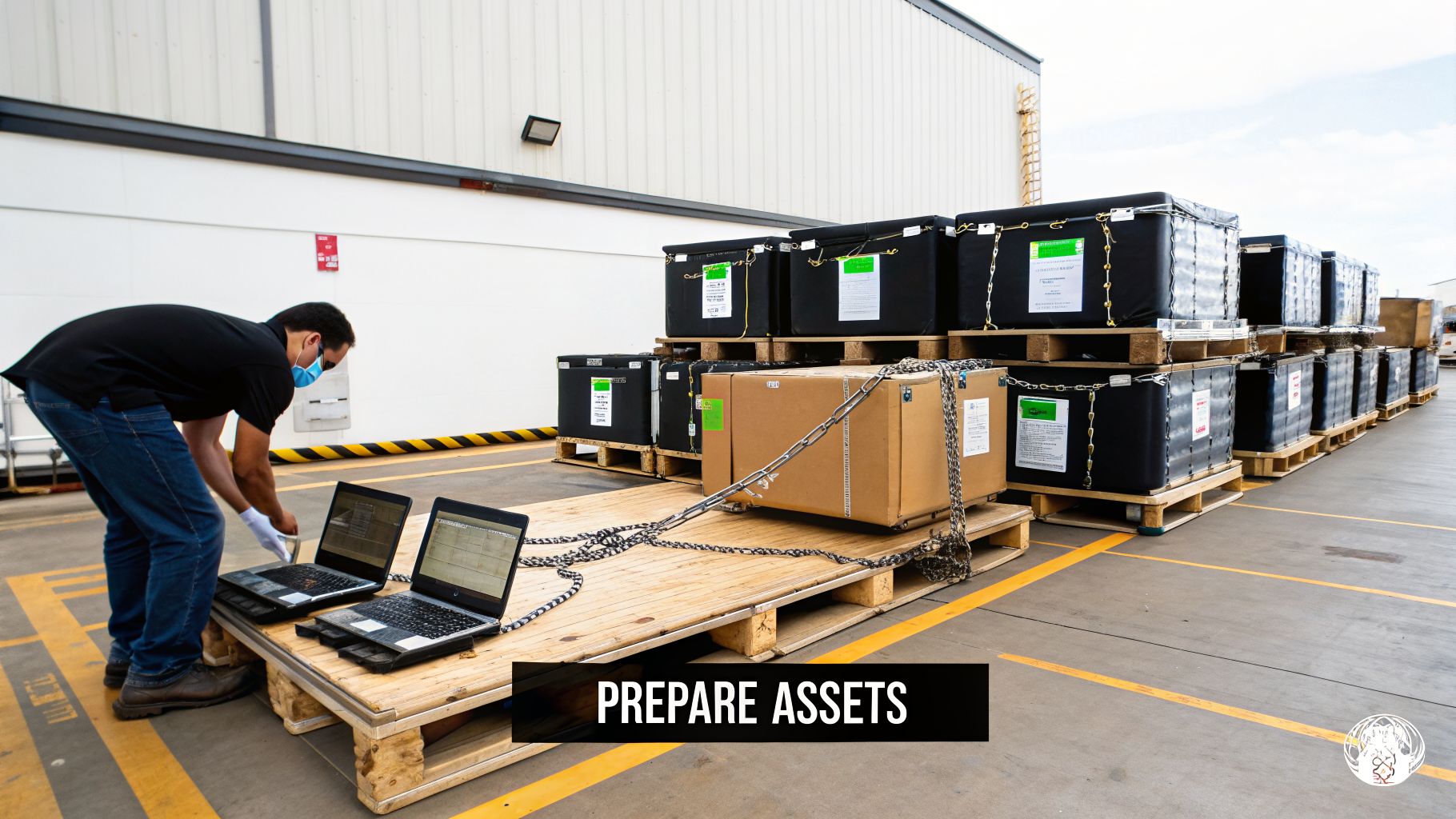
Getting a handle on your inventory and sorting the equipment is the foundation. It lets a recycling partner give you a precise quote, plan the logistics correctly, and make sure every single device is tracked. This isn't just about counting old monitors; it’s about building an audit trail for every asset leaving your control.
Building Your Asset Inventory
First things first: you need a detailed inventory list. This is more than a simple headcount—it’s a comprehensive record that captures the key details of every piece of equipment you're retiring.
A solid inventory does two things: it helps you get an accurate quote, and it serves as the first link in your chain of custody. For instance, a vague request for "50 computers" leaves way too much to chance. A professional inventory, however, will specify models, asset tags, and serial numbers.
What to include in your inventory spreadsheet:
- Item Type: Be specific (e.g., Dell Latitude 7490 Laptop, Cisco 2960 Switch).
- Asset Tag: Your company’s internal tracking number is crucial.
- Serial Number: The unique manufacturer ID for each device.
- Physical Condition: Note any obvious damage or missing components.
- Location: If assets are in different rooms or floors, noting this helps make the pickup itself much faster.
This level of detail simply makes the entire process more secure and streamlined for everyone involved.
The Critical Step of Data Destruction
Once you know what you have, the next, most important question is what to do with the data on it. Every hard drive, server, and smartphone is a container for sensitive information. Hitting 'delete' just doesn't cut it—proper data destruction is a non-negotiable security step.
You really have two main paths, guided by standards like NIST 800-88. The right choice hinges on your company's security policies, industry rules, and how much risk you're willing to accept.
1. Software-Based Data Wiping
This process uses specialized software to completely overwrite a hard drive with random data, which makes the original files impossible to recover. It's a very effective method that keeps the drive intact so it can be reused, which is always the better environmental option.
2. Physical Destruction
For the highest level of security assurance, nothing beats physical destruction. This means shredding hard drives into small, mangled pieces of metal. The process is irreversible and is often the required method for devices that held highly sensitive or classified data.
Deciding between wiping and shredding often comes down to risk. If your drives contain PII, financial records, or intellectual property, physical shredding provides absolute certainty that the data can never be compromised. For less sensitive assets, certified wiping is a perfectly secure and sustainable alternative.
Many businesses we work with take a hybrid approach—shredding drives from executive laptops and servers while wiping standard office PCs. A good recycler can walk you through this decision. For those who want to dig into the technical side, you can learn more from our guide on how to erase a computer hard drive for total security.
Staging and Consolidating for Pickup
With your inventory ready and your data destruction plan sorted, the last step is to physically stage the assets. A disorganized pile of electronics shoved in a storage closet just creates delays and safety risks on pickup day.
Try to consolidate all the items into one, easy-to-access area, like a vacant office or a designated spot on your loading dock. This keeps the pickup crew from needing to hunt through your facility, minimizing disruption to your workday.
If you can, sort the equipment by type—stack laptops together, palletize monitors, and box up loose cables and peripherals. This kind of organization helps the pickup team work quickly and ensures nothing gets left behind. These simple logistical moves are the final piece of the puzzle for a seamless and secure business electronics recycling pickup in Texas.
Alright, you’ve inventoried your assets and figured out your data destruction plan. Now it’s time to handle the actual pickup.
This is where all that prep work pays off, turning what could be a logistical headache into a smooth, predictable process. A professional business electronics recycling pickup in Texas is specifically designed to get in and out with minimal disruption to your daily operations.
It all starts with giving your recycling partner the right details. Beyond your asset list, they need to understand the physical layout of your location. Are you in a high-rise office with a busy, shared loading dock? A simple ground-floor suite? Or a high-security data center with strict access rules? Giving them a clear picture from the start prevents surprises and delays on pickup day.
Providing Key Logistical Information
To make sure the pickup runs like clockwork, you’ll need to share a few key details about your facility. Think of it as giving the recycling crew an all-access pass so they can work efficiently without constantly needing to ask for directions or help.
Here’s what your recycler needs to know:
- On-site Contact: Who is the main point of contact on the day of the pickup? Make sure to provide their name and cell number.
- Building Access: Are there security desks to check in with? Will the crew need temporary badges or a dedicated escort to get around?
- Loading Dock Details: Do you have a dock? Is it truck-height? Are there specific hours or time limits for its use?
- Parking and Staging Areas: Where should the truck park? Is there a designated spot where the equipment will be gathered and ready for pickup?
We often work with businesses in multi-tenant office buildings where the loading dock has to be reserved or has a strict 30-minute time limit. Telling your recycler this upfront allows them to bring enough staff to get everything loaded quickly, ensuring you stay compliant with your building's rules.
On-Site Packing vs Pre-Palletizing
Next, you'll need to decide how the equipment will be prepped for transit. Most professional recyclers offer a couple of different service levels to match your team’s bandwidth and your company’s security requirements.
The two main choices are full-service on-site packing or having your own team pre-palletize everything.
1. Full-Service On-Site Packing and Removal
With this option, the recycling crew does all the heavy lifting. They show up with pallets, packing materials, and shrink wrap to securely pack and palletize every piece of equipment right there in your office or storage room. This is the ideal choice if your team is short on time or if you want to ensure the assets are handled by trained professionals from beginning to end.
2. Pre-Palletized Pickup
If your team has the time and resources, you can stage and palletize the equipment yourself before the truck arrives. This can be a more cost-effective approach and gives you complete control over how assets are grouped. When the recycler’s crew arrives, they simply load the finished pallets onto their truck and go.
A critical factor in this decision is security. For high-security environments, having a certified recycling team handle the packing on-site maintains the chain of custody from the moment a device is touched. This minimizes the risk of an asset being misplaced before it's even loaded onto the truck.
The Importance of the Chain of Custody
As the recycling crew loads your equipment, they will create one of the most important documents in the entire process: the chain of custody manifest.
This document is your official record transferring liability for the assets from your company to the recycler. It should list a detailed count of everything being collected—for example, the number of pallets, servers, laptops, and monitors.
This manifest isn't just a simple receipt. It’s the first link in the audit trail that proves you properly handed off your e-waste to a licensed hauler. Both you and the driver will sign it before the truck leaves, creating a legally-binding record of the transfer. For businesses looking for an overview of local services, you can find more details on e-waste pickup options in the DFW area.
The need for these documented, professional services is growing fast. In 2026, for example, the Houston metro area saw a significant increase in business electronics recycling. One provider alone processed over 14,200 items—totaling 82 tons of e-waste from more than 340 local businesses—a 23% increase from the previous year, with activity peaking in Q4 as companies cleared out old assets. You can discover more insights about this trend from the Houston e-waste report. This just goes to show how essential organized, compliant pickups have become for businesses across Texas.
Verifying Compliance After Your E-Waste Is Collected
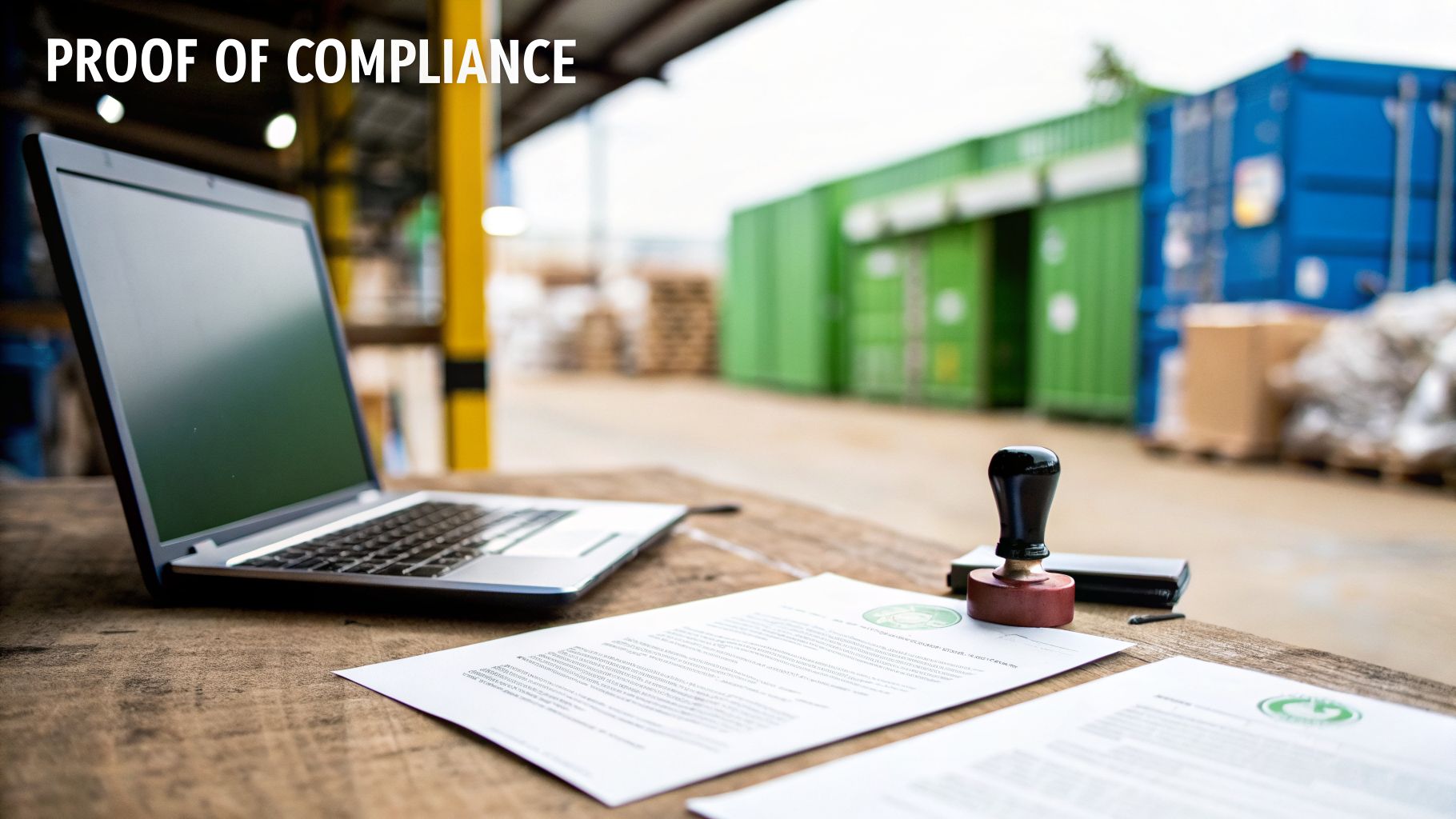
The job isn't finished just because your old electronics are gone. In fact, what happens after the truck leaves your facility is the most critical part of the entire process. This is where your recycling partner performs the work that truly protects your business—and you get the paperwork that proves it.
For any business electronics recycling pickup in Texas, this final stage is all about accountability.
Without the right documentation, you have no verifiable proof of compliance. These records are essential for passing internal audits, satisfying regulatory inquiries, and supporting your company's environmental, social, and governance (ESG) goals. They are the non-negotiable final step in closing the loop on your IT asset disposition project.
The Two Certificates You Must Have
After your assets are processed, you should expect to receive two essential documents from your certified recycling partner. These certificates are your official proof that your e-waste was managed correctly from both a data security and an environmental standpoint.
Certificate of Data Destruction: This document is your guarantee that all sensitive data was permanently destroyed. A legitimate certificate is far more than a generic statement; it's a detailed report listing every single hard drive by its serial number, confirming the date and method of destruction (e.g., wiping or shredding).
Certificate of Recycling: This certifies that your electronic assets were recycled in accordance with all environmental laws and industry best practices. It confirms the materials were processed by a certified facility with a zero-landfill policy, meaning no part of your e-waste ended up polluting the environment.
These two certificates are not optional add-ons; they are the core deliverables of any professional e-waste service. If a potential partner is vague about providing them or can't show you a sample, it's a major red flag that their process may not be compliant.
The scale of recycling in the state highlights why this formal paperwork is so important. Since their inception, manufacturer-led programs have collected a massive 488,032,667 pounds of electronics in Texas, with the vast majority being recycled. These numbers show the need for specialized B2B partners who can extend this same level of documented compliance to the commercial sector. You can explore the full state-level data in the TCEQ's program report.
Closing the Loop with a Final Asset Report
For organizations requiring the highest level of accountability, a final serialized asset report completes the chain of custody. This report reconciles the initial inventory list you created with the final disposition of each item, providing a complete device-by-device audit trail.
This final report will typically detail:
- The make, model, and serial number of each asset.
- The serial number of the hard drive that was inside it.
- Confirmation of whether the asset was recycled, resold, or redeployed.
This document connects the dots from the moment an asset left your control to its final end-of-life processing. It provides total peace of mind and is invaluable for asset management teams and compliance officers. You can learn more about the specifics of this documentation by checking out our guide on the Certificate of Destruction for hard drives.
Ultimately, a professional business electronics recycling pickup in Texas is a service defined by its documentation. The physical removal of equipment is just the start; the real value lies in the certified, auditable proof that you protected your data and met your environmental duties.
Common Questions About Texas Business E-Waste Pickups
Even the most straightforward plan for a business electronics recycling pickup in Texas can bring up a few questions. That's perfectly normal. When you're dealing with compliance, data security, and costs, you want to get it right.
We get these questions all the time from IT managers and business owners across the DFW area. Here are the direct, no-nonsense answers we provide to help you move forward with confidence.
What Types of Electronics Can We Include?
This is almost always the first question we hear, and the answer is simple: just about everything. A professional business pickup is designed to handle the full scope of standard IT equipment.
You can expect to include items like:
- Computers and Laptops: Any desktops, all-in-ones, or notebooks, regardless of age or condition.
- Servers and Networking Gear: Rack and blade servers, switches, firewalls, and routers.
- Monitors: Both modern LCD flat-screens and older, bulky CRT monitors.
- Peripherals: Keyboards, mice, printers, scanners, and all the cables that come with them.
- Telecom Equipment: Office phone systems, VoIP phones, and company mobile devices.
One thing to keep in mind is that a certified recycler can also handle more specialized equipment. We’ve managed everything from point-of-sale (POS) systems to proprietary lab and medical devices. The best practice is always to share your full inventory list with us beforehand. This confirms we can take every item and allows our team to plan for any unique handling needs.
How Is Our Company Data Kept Secure?
For a reputable e-recycling partner, data security isn't just a selling point—it's the entire foundation of the service. Your company's sensitive information has to be protected from the second it leaves your building until it’s verifiably destroyed. This is achieved through a strict, documented process.
It all starts with a secure chain of custody. Your assets are transported from your site in a locked, GPS-tracked vehicle and taken directly to a secure, access-controlled facility. Once inside, every device containing a hard drive or storage media is separated for destruction.
You should be offered data destruction options that meet NIST 800-88 guidelines, the government's gold standard for media sanitization. The most common methods are software wiping for drives that can be reused and physical shredding for ultimate security. Choosing a NAID AAA Certified partner is your best guarantee that these standards are being met without fail.
In the end, your proof is the serialized Certificate of Data Destruction. This document lists every single hard drive by its unique serial number, confirming its destruction. It’s an auditable record that insulates your business from the massive financial and reputational fallout of a data breach.
What Does a Business E-Waste Pickup Cost in Texas?
The cost structure for a business electronics recycling pickup in Texas is often much better than most companies anticipate. In many cases, pickups are free or can even generate a rebate if your retired IT assets have remaining resale value.
Several key factors determine the final quote:
- Volume and Type of Equipment: A large load of newer laptops or enterprise servers with valuable components can easily offset or completely cover any service costs.
- Logistical Needs: Services like on-site packing, de-installing servers from racks, or navigating stairs and elevators can add to the labor cost.
- Hazardous Materials: Certain items, especially old CRT monitors or specific batteries, contain materials that require special handling and may have a small, per-item fee.
- Location and Accessibility: Your proximity to the recycling facility and whether you have a loading dock can also influence the cost.
Getting a custom quote is essential. It will break down every potential cost and credit, giving you a transparent view of the bottom line. When you weigh that against the potential fines for improper disposal—which can easily hit thousands of dollars—a professional pickup is nearly always the more economical choice.
What Documentation Should We Expect?
The paperwork you get after the pickup is your most important tool for proving compliance. These documents are non-negotiable, serving as the official record that you fulfilled your legal and environmental duties.
A certified recycler must provide two critical documents:
- A Certificate of Data Destruction, which itemizes every data-bearing device by serial number and confirms the date and method of destruction.
- A Certificate of Recycling, which attests that all your non-reusable assets were processed according to a zero-landfill policy and in an environmentally responsible manner.
These certificates are your definitive proof of due diligence. They are absolutely essential for passing internal or external audits, showing compliance with regulations like HIPAA or PCI-DSS, and backing up your company’s ESG (Environmental, Social, and Governance) reports. Without them, you have no way to close the loop on your asset disposition and prove your e-waste was handled correctly.
Ready to schedule a secure and compliant pickup for your business's retired IT assets? Dallas Fortworth Computer Recycling offers nationwide services tailored for organizations that require certified data destruction and responsible electronics recycling. Let our 13+ years of experience simplify the process for you. Get your free quote today.