
Telecommunications Services Dallas: A Director’s Guide

Most Dallas IT directors hit the same moment sooner or later. A lease is ending, a floor is being consolidated, a call platform is being replaced, or a fiber contract is finally up for renewal. On paper, it looks like a telecommunications project. In practice, it’s two projects running at once.
The first project is visible. You’re comparing carriers, checking building access, reviewing hosted voice options, and deciding whether your next environment belongs in-house, in colocation, or split across both. The second project is quieter and easier to delay. Old switches still hold configs. Routers still have logs. PBX gear still occupies rack space. Cabling under the floor still has to be removed, documented, or preserved correctly.
That second project is where many Dallas organizations create avoidable risk. The buying side gets executive attention. The retirement side gets pushed to the end of the timeline, when movers are booked, the new circuit is live, and everyone wants the old equipment gone by Friday. That’s exactly when chain-of-custody mistakes, incomplete inventories, and sloppy removals show up.
A strong telecommunications services Dallas strategy has to cover the whole lifecycle. Selection matters. Contracting matters. So does the secure, compliant disposition of the hardware that made the old environment run.
Navigating Your Next Dallas Infrastructure Project
A common Dallas scenario looks like this. A mid-size enterprise is moving from a legacy office footprint into a newer space with better carrier access. At the same time, the IT team is retiring an on-prem phone system, replacing older edge gear, and deciding which workloads stay local versus move into a data center environment. Every meeting starts with bandwidth and uptime. By the end of the project, the harder questions are usually about what happens to the retired hardware.

Dallas makes these projects attractive because the market is deep. The city is home to AT&T, and the Dallas-Fort Worth metro hosts about 600 telecom-related companies and has generated over 230,000 telecom-related jobs in the last 25 years, which is a big reason the region keeps attracting infrastructure investment and technical talent, according to Prototype IT’s Dallas tech company overview.
That density helps on the front end. You usually have more provider choice, more design options, and more local implementation support than you’d find in a thinner market. It also means refresh cycles happen fast. Teams upgrade circuits, swap firewalls, retire appliances, and decommission cages more often because the ecosystem supports it.
Practical rule: If your telecom project changes connectivity, voice, or physical network layout, assume it also creates a disposition project on day one.
What works is treating retirement planning as part of procurement. Build the equipment inventory before cutover. Decide what gets reused, remarketed, wiped, recycled, or destroyed before installers arrive. Require documentation standards early, not after the racks are empty.
What doesn’t work is waiting until the migration is complete and calling disposal “cleanup.” In telecom, cleanup still involves regulated data, physical infrastructure, and audit exposure.
Decoding Core Telecommunications Services in Dallas
Dallas buyers usually sort telecommunications services into a few practical buckets. The names vary by provider, but the operating choices are familiar. You’re deciding how traffic enters the building, who manages it, how your users communicate, and where critical equipment lives.
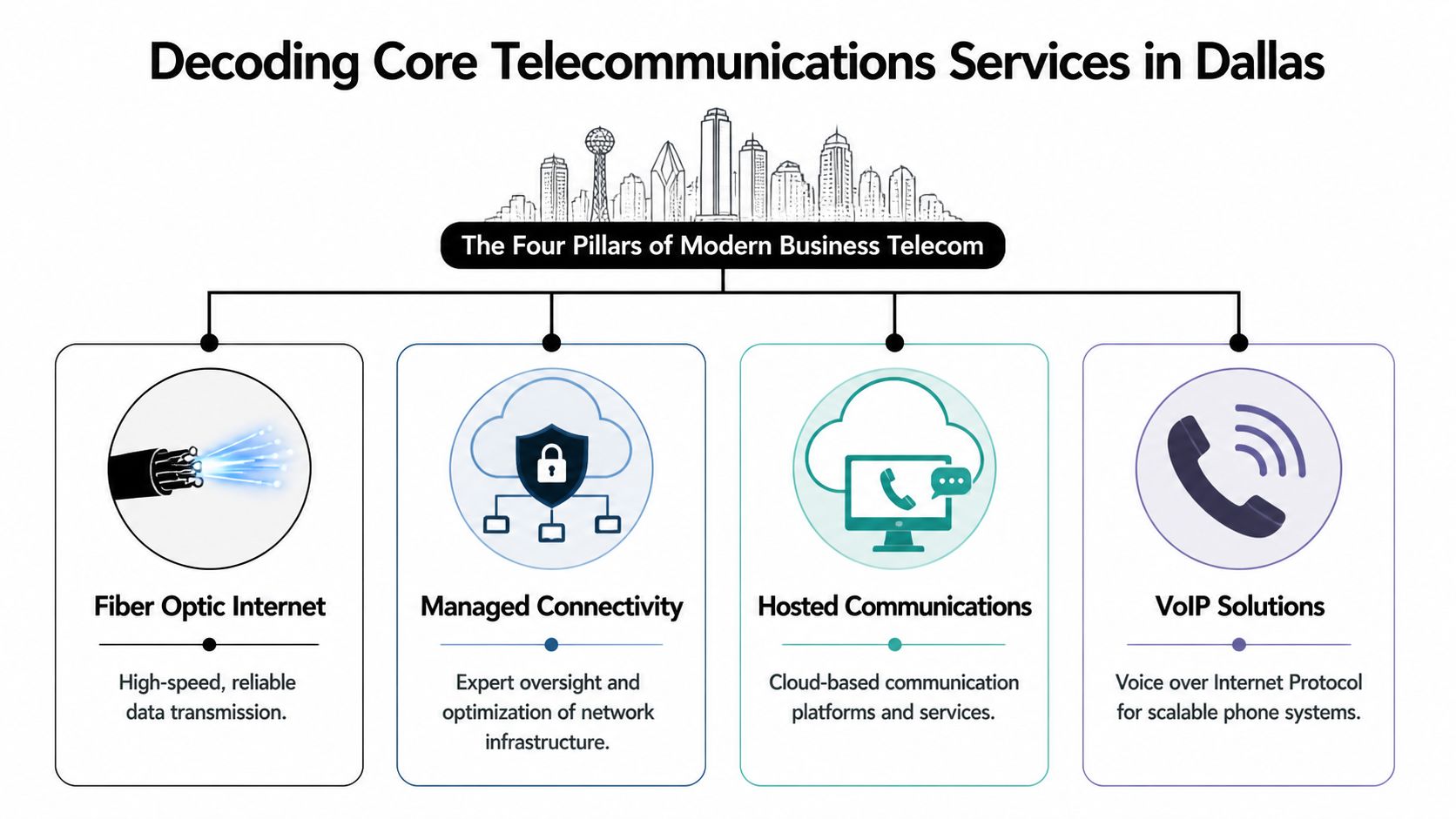
Fiber internet and dedicated access
Think of business fiber like choosing the road system for every application your company depends on. Some routes are shared. Some are reserved. Some are cheap until congestion or support delays hurt you.
For most enterprise environments, dedicated internet access buys consistency, cleaner support escalation, and better contract clarity than a best-effort business circuit. In Dallas, that decision is stronger than in many markets because carrier density is real, not theoretical. Local buyers evaluating telecom services near Dallas businesses usually have room to negotiate around route diversity, install responsibility, demarc location, and failover design.
What works:
- Separate procurement from marketing language. Ask whether the provider controls the last mile or resells another network.
- Verify physical path diversity. Two circuits from two logos can still share the same vulnerable route.
- Check building reality. A lit address on a provider map doesn’t always mean fast turn-up inside your suite.
Managed connectivity
Managed connectivity is what you buy when your team wants outcomes more than raw transport. The provider may supply monitoring, edge management, circuit coordination, configuration support, and escalation handling across multiple carriers.
This model works well for lean internal teams, distributed offices, and organizations that can’t afford to have senior infrastructure staff chasing every handoff issue. It’s also where service language can get slippery. “Managed” might mean full operational support, or it might mean a portal and a ticket queue.
A useful test is simple. Ask who owns the problem at 2 a.m. when voice quality drops after a carrier change. If the answer is “your network team needs to open tickets with several vendors,” that service isn’t managed in the way most enterprises mean it.
Hosted communications and VoIP
Hosted communications moves calling, messaging, and related collaboration functions into a provider-managed platform. VoIP is the transport method that lets voice ride your data network instead of a legacy phone system.
These are often discussed together, but the buying decision has two layers:
| Service area | What you’re really buying | Common trade-off |
|---|---|---|
| Hosted platform | Features, administration, continuity options | Less physical hardware, more dependency on provider design |
| VoIP performance | Call quality on your network | Great software won’t fix weak switching, bad QoS, or poor cabling |
Hosted voice usually simplifies adds, moves, changes, and remote work support. It can also expose weaknesses in the local network that your old PBX masked. Teams blame the phone platform when the underlying issue is switching, power, or cabling discipline.
Good voice projects start with the LAN, not the handset catalog.
Colocation and carrier hotels
Colocation is the middle ground between keeping everything in your own server room and moving everything to public cloud. You place hardware in a third-party facility and buy power, cooling, physical security, and network access around it.
In Dallas, this is a serious option because the region’s telecom foundation supports dense interconnection. Carrier hotels and highly connected facilities matter when you need redundancy, private connections, cross-connect flexibility, or a place to stage critical systems during a migration.
The mistake here is assuming colocation is just “renting rack space.” It’s a network decision, an operations decision, and eventually a decommissioning decision. Every router, switch, storage node, and server you place there will one day need to leave with the same level of control you required when it went in.
Procurement and Compliance for Dallas Organizations
Procurement gets easier when you stop evaluating telecom providers as bandwidth vendors and start evaluating them as risk-transfer partners. Every contract promises service. Not every provider can support your compliance posture, your escalation model, or your eventual exit.

Dallas gives buyers an advantage because the market is large and infrastructure-rich. The local data center market was valued at 2.01 GW in 2025 and is projected to reach 2.55 GW by 2031, and Dallas ranks as the 2nd largest data center market in the US, supported by dense fiber and interconnected internet exchanges, according to Mordor Intelligence’s Dallas data center market analysis. That scale creates options, but options only help if your evaluation process is disciplined.
Teams comparing local telecom companies in Dallas should look beyond the proposal spreadsheet. The cheapest monthly number often hides the most expensive operational compromise.
What to validate before signature
Procurement reviews should test four things at once:
- Carrier access reality: Confirm who serves the building now, who needs construction, and who can deliver diverse paths.
- Support model: Find out whether support is local, centralized, or channel-routed. Escalation speed matters more than brochure language.
- Security alignment: For regulated environments, ask how the provider supports your logging, retention, and incident response requirements.
- Exit conditions: Understand what happens at term end, during relocation, or during partial disconnects.
A provider that can’t describe a clean disconnect process usually hasn’t thought seriously about asset retirement, demarc cleanup, or documentation.
SLAs are only useful when they match your actual failure modes
Too many telecom reviews focus on uptime language and miss the details that cause operational pain. A strong SLA is specific about response, restoration, maintenance windows, credit mechanics, and who coordinates third-party carriers.
Here’s the practical distinction:
| Contract focus | What sounds good | What actually helps |
|---|---|---|
| Availability | Broad uptime commitment | Defined restoration obligations and escalation paths |
| Support | “24/7 monitoring” | Named responsibility for triage, updates, and handoffs |
| Performance | Generic voice readiness | Clear accountability across transport, edge, and provider-managed services |
If your environment supports healthcare, public sector workloads, legal data, or regulated lab operations, push further. Ask where logs live, who can access management planes, how changes are approved, and what records are available after a service incident.
Dallas-specific procurement trade-offs
The Dallas market rewards organizations that ask physical questions, not just service questions. Dense fiber, major interconnection points, and facilities with broad provider access create genuine advantages. They also create more ways for teams to assume redundancy they haven’t purchased.
Buy diversity you can verify, not diversity that appears only on a carrier slide.
Another trade-off is speed versus control. Dallas providers and integrators can move quickly, especially for office expansions and migration projects. That speed is useful, but it can tempt teams into accepting vague scopes around inside plant work, demarc responsibilities, old equipment removal, and post-cutover cleanup.
What works is tying procurement to operations. Require an asset list of anything being replaced. Define who removes abandoned cabling, who documents handoff points, and who signs off that retired telecom equipment leaves the site under control. If those details aren’t in the project record, they’ll become your problem later.
The Lifecycle Link From Telecom Upgrades to IT Asset Disposition
Every telecom upgrade creates a retirement event. That’s true whether you’re replacing a PBX with hosted voice, moving from copper to fiber-backed services, collapsing server rooms, or shifting equipment into colocation. The new service gets attention. The retired hardware carries the risk.

The asset list is usually broader than stakeholders expect. It includes routers, switches, firewalls, wireless controllers, handsets, PBX appliances, rack servers, optics, UPS units, patch panels, and structured cabling that still has value or still carries handling requirements. Some of it stores data directly. Some of it holds credentials, call records, network maps, or configuration history that shouldn’t walk out of the building in a generic recycling bin.
Dallas infrastructure projects add another layer because structured cabling standards and removal practices matter. Local structured cabling work must align with TIA/EIA-568-B, and improperly decommissioned data center cabling requires certification before removal to support NIST 800-88 chain-of-custody expectations. Failure can raise e-waste handling costs by up to 30%, according to CMC’s Dallas network infrastructure guidance.
Why telecom teams miss this
Telecom upgrades are often split across vendors. A carrier handles circuits. A cabling contractor handles pathways. A voice provider handles migration. An internal team handles cutover. Then someone asks facilities to “clear out the old room.”
That handoff model is where control breaks down.
If you’re planning IT asset disposition in Dallas for retired infrastructure, the right time to start is before implementation, not after service activation. Retirement planning belongs in the project workbook with the same status as installation milestones.
What a mature project includes
A mature telecom lifecycle plan usually includes:
- Pre-cutover inventory: Serial numbers, device roles, rack locations, and data-bearing status.
- Disposition path by asset class: Reuse, resale, redeployment, destruction, or recycling.
- Cabling decision: Remove, retain, certify, or label for future use.
- Chain-of-custody trigger: The exact moment responsibility shifts from operations to disposition.
The cleanest migrations are the ones where the decommissioning work order exists before the first new circuit is turned up.
What doesn’t work is improvising the back half. Once project teams disperse, documentation quality drops fast. Ports get unlabeled, patching gets disturbed, and old hardware loses context. At that point, even routine disposition becomes slower, less auditable, and more expensive.
Securely Retiring and Recycling Telecom Assets in Dallas
Generic e-recycling is not enough for telecom hardware. That’s the first distinction IT directors need to hold firmly. A pallet of old monitors and keyboards is one thing. A lot of retired network gear, PBX equipment, edge appliances, and structured cabling from a telecom refresh is another.
Telecom assets sit closer to the operating core of the business. They may contain saved credentials, call routing data, site topology, VLAN details, firewall rules, admin keys, or stored logs. Even when the data footprint is smaller than on a file server, the security consequence can be larger because the device reveals how your environment is built.
What secure retirement actually looks like
A proper retirement process starts before pickup. The equipment should be inventoried, matched to a disposition decision, and physically controlled until transfer. Devices with storage need a documented destruction or sanitization path. Network equipment without obvious disks still needs careful handling because many appliances store sensitive configuration data in ways non-specialists overlook.
The next requirement is chain of custody. That means you can account for equipment from the moment it leaves the rack until final disposition. If a vendor can’t explain how it tracks custody across pickup, transit, processing, and downstream handling, you don’t have a secure process. You have a hope-based process.
Documentation matters just as much as physical handling. For regulated organizations, your records need to stand up during procurement review, internal audit, cyber review, or legal inquiry. At minimum, expect itemized records, destruction confirmation where applicable, and a clear statement of what was reused versus recycled.
Why cabling deserves more attention
Cabling gets treated as scrap too often, especially during PBX retirement and office consolidation. That’s a mistake. Low voltage infrastructure still affects asset value, reuse options, and project cleanliness after a telecom change.
Properly specified low voltage cabling with PoE++ can prevent over 25% packet loss in VoIP traffic, and preserving cabling integrity during retirement of old PBX systems can increase asset reuse rates by 20-40%, reducing e-waste volume, according to Shelby Communications’ network cabling guidance.
That matters in two ways. First, if you’re upgrading voice and wireless at the same time, poor handling of the existing cable plant can degrade the new service. Second, if the cabling is removed carelessly, you lose the opportunity to preserve value, verify reuse potential, or document environmental handling properly.
Organizations looking at electronics recycling in Dallas for telecom refresh projects should treat cabling, handsets, switches, and rack gear as separate disposition streams, not one mixed pile.
Red flags to avoid
Watch for these warning signs during vendor selection:
- No detailed intake process: If the vendor doesn’t ask for asset categories, data-bearing status, or pickup conditions, they’re not preparing for secure handling.
- Vague destruction language: “We wipe everything” isn’t enough. Ask what gets wiped, what gets destroyed, and how each outcome is documented.
- No distinction between reuse and scrap: Strong disposition programs preserve value where appropriate and recycle responsibly where necessary.
- Loose logistics: Unscheduled pickups, unlabeled containers, or unclear custody transfer points create preventable exposure.
What works in the real world
The best results come from pairing telecom operations discipline with disposition discipline. That means your network team signs off on what’s truly out of production, your compliance team knows which assets require documentation, and your facilities team understands that equipment doesn’t leave the premises casually just because a migration is done.
Here’s a practical sequence that holds up well:
- Freeze the retirement list after cutover validation.
- Separate data-bearing from non-data-bearing assets before pickup.
- Document exceptions such as retained spare gear or cabling left in place.
- Require final records that match the original inventory closely enough to satisfy audit review.
The organizations that handle this well don’t treat retirement as janitorial work. They treat it as the final controlled phase of the telecom project.
A Decision Checklist for Dallas IT Directors
This is the checklist I’d want in front of me before approving a Dallas telecom refresh. It keeps procurement and disposition tied together, which is where most projects either stay clean or start drifting.
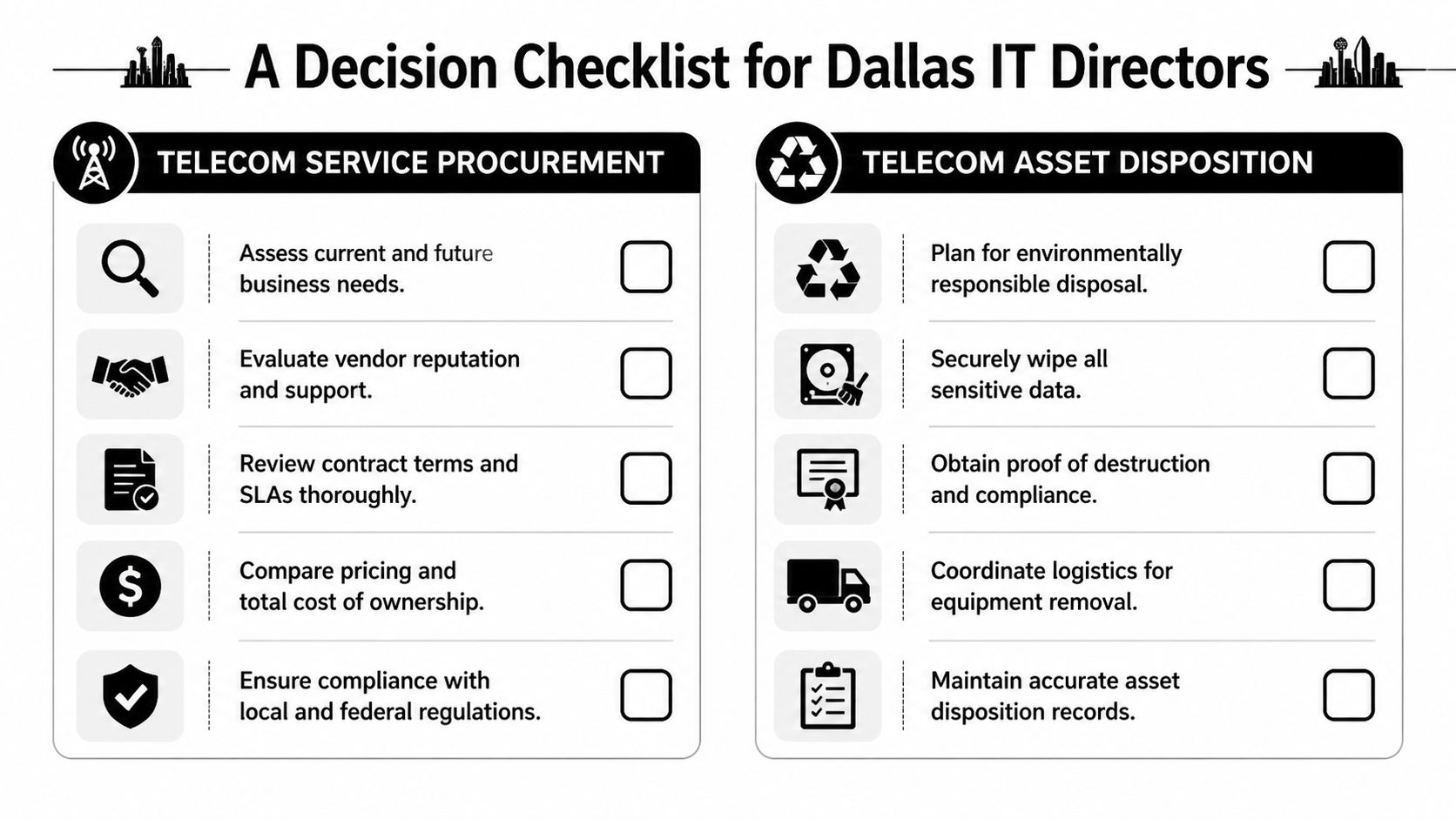
Recent fiber expansions and dedicated internet access upgrades in Dallas are also driving more telecom e-waste and exposing chain-of-custody gaps during refreshes, as noted in the Texas digital divide and broadband infrastructure discussion published by THSA. That makes the back half of the checklist just as important as the front.
Telecom procurement checks
- Need profile: Define what the business needs over the next contract term. Separate branch needs, HQ needs, voice needs, and data center needs so one circuit type doesn’t get forced into every role.
- Carrier path review: Ask where the service enters the building and whether backup service is diverse in physical routing.
- Provider operating model: Determine whether your provider manages incidents end to end or brokers circuits.
- Contract scrutiny: Review SLA language, restoration commitments, maintenance windows, and disconnect terms with the same attention you give monthly recurring cost.
- Compliance fit: Confirm the service can support your organization’s logging, documentation, retention, and access-control expectations.
- Migration ownership: Name who handles cutover coordination, legacy service cancellation, and handoff validation.
A low monthly price can still be the high-risk option if nobody owns the transition details.
Telecom asset disposition checks
- Retired asset inventory: Build the list before migration starts. Include edge devices, voice hardware, rack equipment, and cable plant components affected by the change.
- Data-bearing classification: Mark which devices may hold configs, credentials, logs, call data, or local storage.
- Cabling decision record: Identify what gets removed, what gets retained, and what must be certified or preserved for reuse.
- Chain-of-custody plan: Decide exactly when and how custody transfers after decommissioning.
- Documentation standard: Require itemized reporting, destruction records where needed, and records that support procurement and audit teams.
- Environmental handling: Confirm that assets intended for recycling are processed through responsible downstream channels, not mixed disposal.
A simple review table
| Project area | Approval question |
|---|---|
| Connectivity | Do we know who owns the circuit, the physical path, and the escalation path? |
| Voice | Have we validated that the LAN, switching, and power design can support the new platform? |
| Facility | Do we know what stays in place and what must be removed from racks, closets, and cable pathways? |
| Disposition | Can we prove what happened to every retired telecom asset after cutover? |
If you can’t answer those four questions cleanly, the project is not fully ready.
Your Partner for the Full Telecom Lifecycle
Dallas gives IT leaders a strong market to work in. There’s deep carrier presence, serious data center capacity, and no shortage of firms selling telecommunications services Dallas organizations can buy. The challenge isn’t access. The challenge is governing the full lifecycle well enough that the project ends as cleanly as it starts.
That matters even more in parts of the region where connectivity remains uneven. The wind-down of the Affordable Connectivity Program in 2024 affected 42% of Dallas households that previously lacked fixed internet, creating business risks tied to e-waste and ITAD logistics in areas with unreliable connectivity, according to United Way of Metropolitan Dallas. For organizations with distributed operations, community sites, or mixed urban and underserved footprints, that kind of local reality affects support planning, refresh timing, and pickup coordination.
The practical takeaway is simple. Don’t split telecom strategy from disposition strategy. Procure with the end in mind. Decommission with documentation in hand. Treat every migration, office move, and voice upgrade as both a service decision and an asset control decision.
If your team needs a documented, secure approach to retirement after a network refresh, office consolidation, or data center change, review the options for IT asset disposition services in Dallas Fort Worth Texas before the old environment becomes a last-minute problem.
Frequently Asked Questions About Telecom Disposition
Is generic e-recycling enough for retired telecom equipment
Usually, no. Generic recycling may be fine for low-risk peripherals, but telecom gear often stores configurations, credentials, logs, or operational metadata. A proper ITAD process handles data risk, inventory control, and documentation in a way basic scrap pickup usually doesn’t.
Which telecom assets are most commonly missed during retirement
Teams usually remember routers, switches, and servers. They often miss firewalls, wireless controllers, PBX appliances, conference systems, backup circuit gear, optics, small SSD-based appliances, and patching components left in closets or remote racks.
Should we let installers remove and dispose of old gear
Installers can remove equipment physically, but that doesn’t mean they should own final disposition unless that responsibility is explicitly defined and documented. Installation scope and secure retirement scope are different things. If nobody is tracking custody and final handling, you may not be able to prove what happened to the equipment.
Old telecom hardware is still part of your security boundary until documented disposition is complete.
What about cabling left behind in offices or data rooms
Not all legacy cabling needs to be ripped out immediately. Some should be retained, labeled, or documented for future use. Some should be removed because it creates confusion, airflow issues, or compliance problems. The key is making that decision intentionally instead of treating all cable as either junk or untouchable infrastructure.
How early should disposition planning start in a telecom project
At the beginning. Once the telecom design changes the environment, the retirement path should already be defined. Early planning gives you cleaner inventories, better internal coordination, and fewer surprises after cutover.
What documents should an IT director expect after disposition
Expect records that identify what was received and how it was handled. For data-bearing assets, you should also expect documentation that supports your internal compliance and audit needs. The exact package can vary by project, but vague summaries aren’t enough for enterprise work.
Why does telecom disposition create more risk than people expect
Because the equipment looks routine. A used switch or handset doesn’t look as sensitive as a database server, so teams relax too early. But network and voice systems expose architecture, access patterns, and operational history. In the wrong hands, that information is useful.
If you’re planning a carrier change, voice migration, office relocation, or data center decommission, Dallas Fortworth Computer Recycling can help you manage the retirement side with secure handling, documented disposition, and compliant electronics recycling built for business and public-sector environments.