
Your Guide to Telecom Services in Atlanta

Atlanta closed 2025 with 1,459.2 MW of data center capacity and 2,076 MW under construction, making it the second-largest U.S. data center market behind Northern Virginia according to CBRE’s Atlanta market update. That number matters because it changes how a CIO should think about telecom services in Atlanta.
This isn’t just a city where you can buy circuits. It’s a market where fiber density, carrier competition, colocation growth, and edge deployment all shape how fast you can launch, how resilient your architecture will be, and how painful your next migration becomes. The procurement decision is only half the job. The other half is planning what happens to the hardware you replace when those circuits, routers, firewalls, optical gear, and access platforms age out.
Teams that expand into Atlanta successfully usually do three things well. They map service choices to application behavior, they vet providers beyond marketing language, and they treat decommissioning as part of the architecture plan rather than a cleanup task at the end.
Why Atlanta is a Top-Tier Digital Infrastructure Hub
Atlanta closed 2025 with more than 1,459 MW of data center capacity and over 2,000 MW under construction, as noted earlier in the CBRE report. For a CIO, that scale changes the telecom decision from basic circuit buying to infrastructure positioning.
Atlanta gives enterprises a dense mix of fiber routes, carrier options, colocation inventory, and interconnection points in one market. That concentration affects how quickly teams can turn up service, how much path diversity they can buy, and how much room they have to renegotiate as application demand shifts.
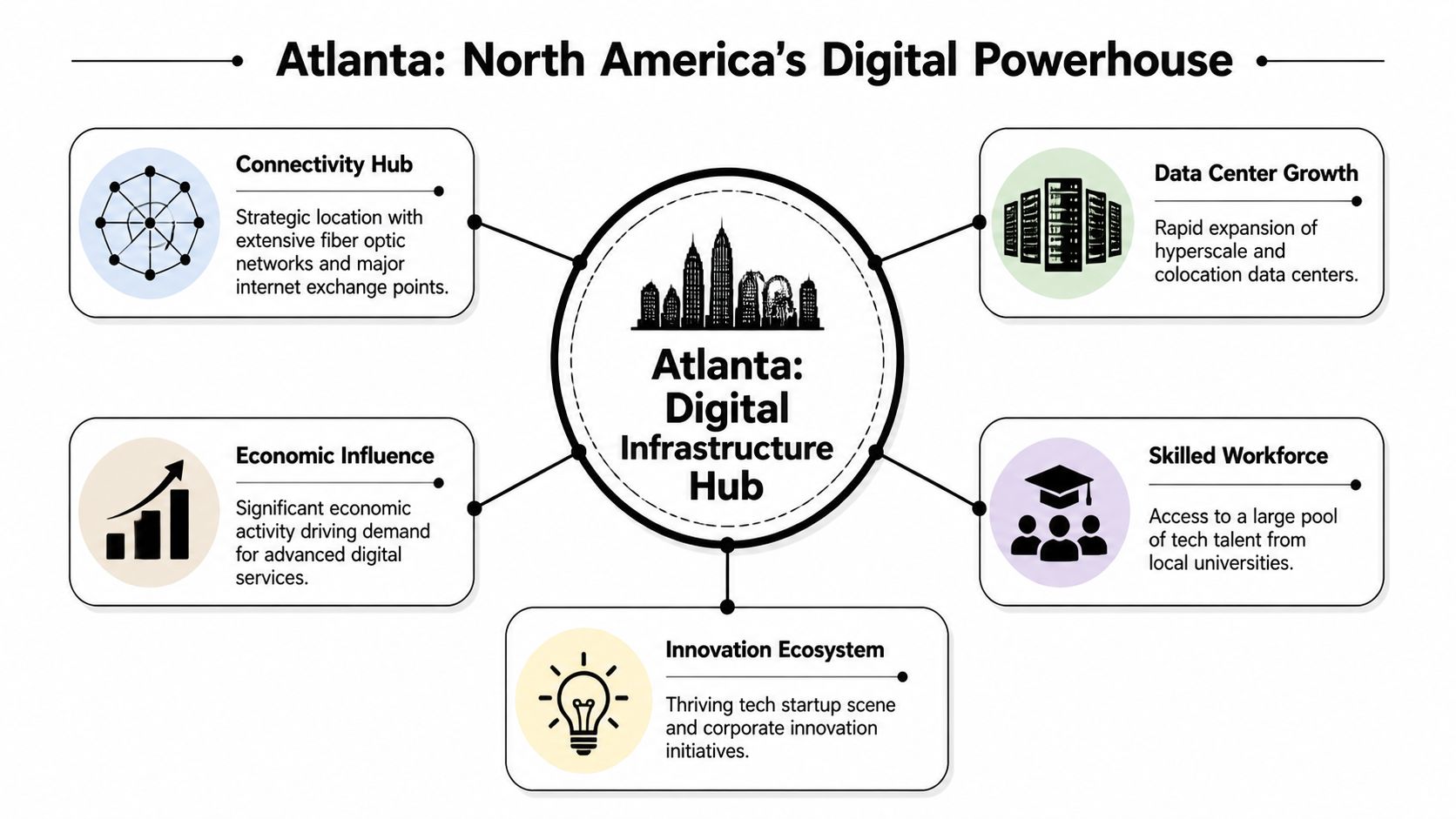
What that infrastructure means in practice
A market can look strong in a carrier map and still create ugly deployment constraints. Atlanta usually holds up under real architecture requirements because network density and facility growth are happening at the same time.
That matters in a few practical ways. Dense downtown interconnection gives enterprises more options for metro transport, internet transit, cloud access, and cross-connect strategy. If one provider cannot deliver the route, handoff point, or install timeline you need, there is often another viable path. That is a very different operating reality from a secondary market where every design ends up routed through the same incumbent footprint.
The right way to assess Atlanta is as an interconnection and scaling market. Branch-office assumptions will lead to weak decisions.
Why CIOs care about the market shape
Rapid market growth changes provider behavior. Carriers and colo operators prioritize high-capacity buyers, AI-driven demand, cloud adjacency, and customers that can commit to multi-site growth. Enterprises with a clear architecture plan can use that to improve pricing and contract terms. Enterprises that buy reactively usually inherit avoidable constraints, especially around building access, diversity claims, and expansion rights.
I advise clients to evaluate network and facility choices together in Atlanta. A cheap port in the wrong building can cost more over three years than a higher-rate service in a better-connected facility. Cross-connect fees, meet-me-room access, riser congestion, power roadmap, and available carrier mix all affect the long-term result.
Migration timing also deserves more attention than it usually gets. Teams planning a buildout or relocation should review data center migration best practices before final contract signature, because sequence errors create stranded circuits, compressed cutovers, and duplicate spend.
The lifecycle issue many teams miss
Atlanta’s growth also accelerates refresh cycles for routers, firewalls, optical gear, voice systems, and edge hardware. As enterprises upgrade transport and add capacity, older equipment leaves production faster. That creates a second workstream that procurement teams often ignore until racks are already filling with retired assets.
That is a mistake.
Telecom expansion should include an exit plan for the hardware it replaces. Decommissioning affects chain of custody, data security, lease returns, warehouse costs, and e-waste exposure. In a market where infrastructure changes quickly, IT asset disposition should be built into the original deployment plan, not treated as a cleanup task after migration.
The strategic takeaway
Atlanta is a top-tier digital infrastructure hub because it combines carrier density, facility growth, and sustained enterprise demand in a way that supports serious network architecture. That gives buyers real options, but it also raises the cost of poor planning.
The best Atlanta strategies account for the full lifecycle. Buy the right service, place it in the right facility, preserve room to scale, and know how you will retire the equipment that becomes obsolete once the new design is live.
Decoding Key B2B Telecom Services for Your Enterprise
A service name on an order form tells you very little about how that circuit will behave under load, during failover, or six months into a migration. In Atlanta, the difference between a good decision and an expensive one usually comes down to matching the service to the application, the facility, and the hardware lifecycle behind it.
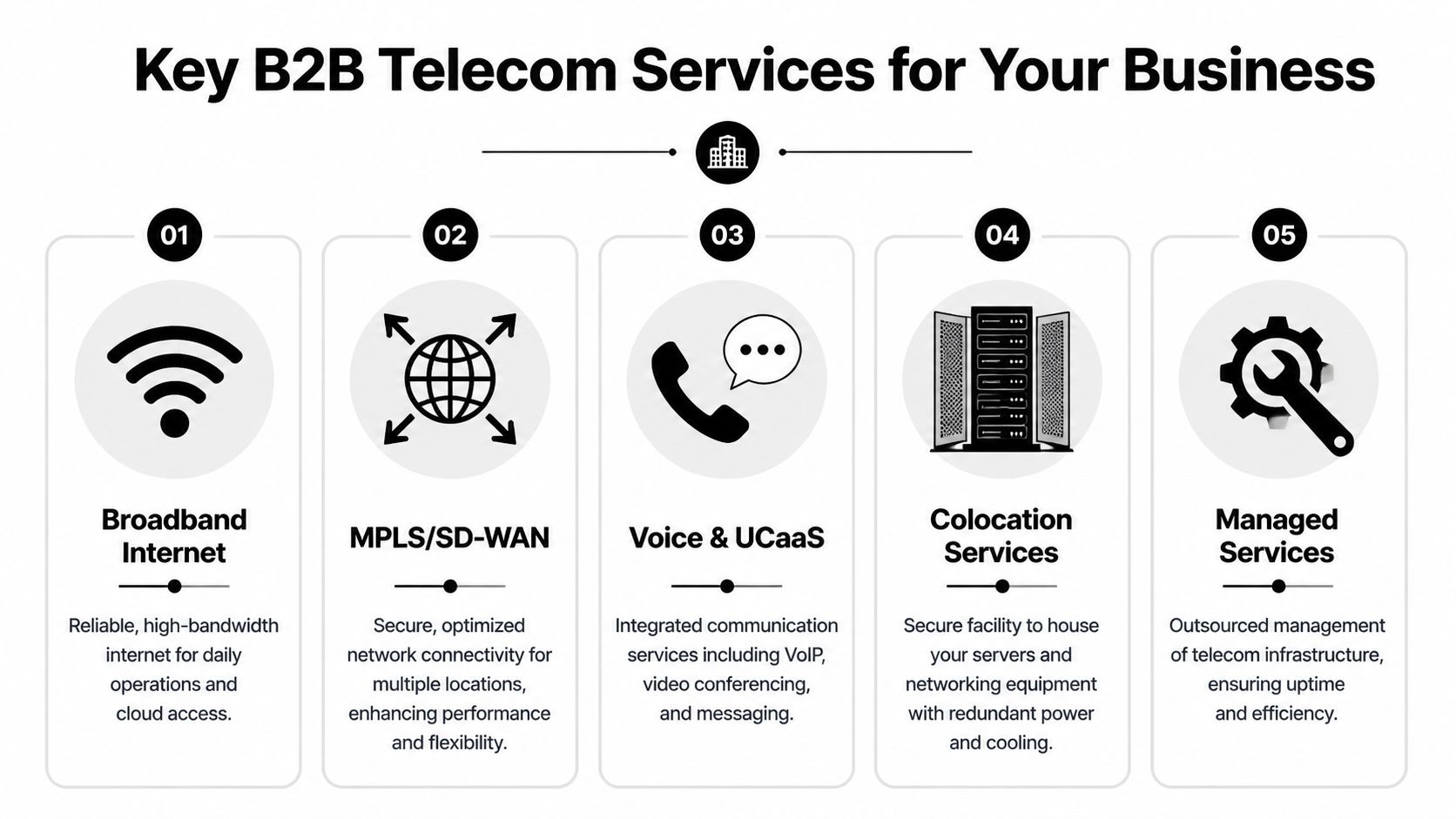
Fiber internet access
Fiber Internet Access is the default entry point for many enterprises building in Atlanta. It supports cloud access, SaaS, remote connectivity, public-facing applications, and general corporate traffic with simpler commercial terms than legacy private WAN models.
It fits best when the business is already cloud-heavy and branch traffic no longer belongs in a centralized hub-and-spoke design. It is less effective when site-to-site traffic needs strict path control or when a business unit expects internet transport to behave like private infrastructure.
Good use cases include:
- Cloud-first branch architecture: Local internet breakout cuts unnecessary backhaul.
- Dual-carrier internet edge: Two providers can improve resilience if the routes are physically separate.
- SD-WAN underlay: Internet access works well as a transport foundation when policy and application steering sit above it.
Common mistakes include:
- Accepting “diverse” at face value: Ask for conduit, entrance facility, and path details.
- Treating DIA as a substitute for engineered private transport: Some traffic classes still need tighter SLAs and more deterministic routing.
MPLS and private WAN
MPLS still solves real problems. Enterprises with transaction-heavy applications, regulated workloads, or large voice footprints often keep some MPLS in place because predictable traffic handling and carrier-managed QoS still matter.
The trade-off is cost and agility. MPLS usually takes longer to modify, and price per megabit is harder to justify if most traffic now terminates in Microsoft 365, Zoom, Salesforce, or public cloud platforms. For many Atlanta deployments, the right answer is not full MPLS or full internet. It is a selective private WAN core for sensitive traffic, with internet-based transport handling the rest.
SD-WAN
SD-WAN gives your team policy control across multiple transports such as DIA, broadband, LTE, and private circuits. It is useful when branch conditions vary, cloud traffic patterns have changed, and the network team wants centralized control without engineering each site by exception.
It does not repair weak carrier delivery. If the local loop is unstable, the handoff is congested, or the provider misses installation details, the overlay exposes those problems faster.
Use SD-WAN when:
- You operate many sites with uneven access options.
- Application traffic no longer fits a traditional hub-and-spoke model.
- You want to combine transport types while keeping policy consistent.
Skip the marketing language and judge the design on underlay quality, controller resilience, security integration, and operational ownership. For teams comparing multi-market options, this guide to business telecom service options near your locations is a useful reference point alongside Atlanta-specific provider reviews.
VoIP and UCaaS
Voice is now part of a broader communications stack that includes meetings, messaging, contact center, identity, and endpoint policy. The better question is not whether to deploy VoIP. It is how much control to keep in-house versus how much to hand to a UCaaS provider.
That decision has operational consequences. Survivability during WAN loss, E911 handling, session border controller placement, call recording requirements, and security review all need answers before contract signature. In healthcare, public sector, and lab environments, those details affect uptime and compliance, not just user experience.
Dark fiber and high-capacity interconnects
For larger enterprises, Atlanta becomes far more interesting once the discussion shifts from access circuits to interconnect strategy. A TAG communications services brochure notes that providers in Atlanta can offer long-haul dark fiber and very high-capacity optical transport because of the city’s position on major intercity fiber routes (TAG brochure). The URL date looks unusual, so confirm the current version during procurement before you rely on it in an executive packet.
Dark fiber makes sense when your team needs direct control of optical transport, large replication windows, or bandwidth headroom that would make repeated upgrades of lit services inefficient. It also shifts responsibility to your side. Optics, monitoring, sparing, and fault isolation do not disappear just because the route is attractive.
Dark fiber usually fits when:
- Data center interconnect capacity is sustained and high: Replication, storage traffic, and east-west movement justify direct control.
- Disaster recovery depends on deterministic throughput: Failover plans need known capacity, not best effort assumptions.
- Security policy favors tighter transport control: Some organizations prefer limiting dependence on shared lit services.
It is often the wrong choice when:
- Traffic volumes are still moderate: Lit wave or Ethernet services are usually simpler to deploy and support.
- The operations team lacks optical expertise: Owning the layer means owning repair coordination, monitoring, and spare strategy.
- A refresh is already pending: If transport upgrades will retire routers, optics, or edge gear within the next planning cycle, factor in ITAD early so displaced hardware does not sit in cages or storage rooms after cutover.
Last mile and building realities
The last mile still decides whether the design survives contact with the building. Carrier maps do not show riser congestion, landlord approval delays, conduit exhaustion, meet-me-room bottlenecks, or access restrictions inside older properties.
This is also where hardware lifecycle planning returns to the table. New access methods, demarc changes, or edge redesigns often force replacement of firewalls, routers, optical gear, or voice appliances earlier than expected. If decommissioning, chain of custody, lease return handling, and e-waste processing are excluded from the telecom plan, the migration is only half planned.
A strong Atlanta telecom strategy selects the service and defines what happens to the hardware it replaces.
Evaluating Atlanta's Top Telecom Providers
Atlanta isn’t a one-provider city. The market is broad enough that the provider category often matters more than the provider logo. Your short list should balance route ownership, support quality, metro reach, commercial flexibility, and the provider’s willingness to engage with your architecture rather than force a standard package.
The verified data describes about 15 telecom companies generating over $1 billion in revenue in Atlanta, with AT&T operating the largest fiber and switching infrastructure in the downtown Central Business District, which contributes to a competitive pricing and service environment according to this Atlanta telecom market summary. That scale benefits buyers, but only if you categorize vendors correctly.
Four provider types that matter
Incumbent carriers usually win on building access, local reach, and operational familiarity. If your project spans headquarters, branches, voice, and regulated sites, incumbents can reduce coordination friction. The trade-off is that their designs can be rigid, and escalations sometimes move slower than enterprise teams want.
Fiber specialists tend to be stronger when route performance, custom builds, or inter-data-center connectivity matter most. These providers can be excellent for metro dark fiber, wavelength services, or high-performance enterprise transport. Their weak point is sometimes coverage outside their strongest corridors.
Cable and broadband operators can be useful in branch-heavy designs, temporary installs, or cost-sensitive backup links. They’re often part of a sound secondary-path strategy. They’re less attractive when your primary requirement is deterministic performance for sensitive workloads.
Managed service providers make sense when internal network teams are lean or when the CIO wants one throat to choke across transport, edge, and support. The risk is abstraction. If the MSP won’t disclose underlying carriers, peering behavior, or handoff details, your team may inherit blind spots that become painful during outages.
How to vet the providers, not just the proposals
Use provider interviews to test operational maturity. Ask who owns the local loop. Ask which portions of the route are leased. Ask how they handle root cause analysis when the fault sits between a carrier partner and their managed edge platform.
A practical comparison approach:
- Coverage fit: Match provider strength to your actual sites, not just Atlanta generally.
- Support model: Determine whether you’ll get an account team, a generic queue, or a named engineer.
- Escalation clarity: Outages reveal the actual vendor, not the polished sales deck.
- Service transparency: Providers who avoid path detail usually create surprises later.
A broader market view can help when shaping the shortlist. This overview of telecom providers near me is useful if your Atlanta procurement is one node in a larger regional selection effort.
The best provider for a downtown core interconnect usually isn’t automatically the best provider for suburban branches, voice survivability, or managed WAN support.
That’s why mature teams often award multiple vendors. One provider may own the strategic core. Another may deliver diversity, backup access, or specific site coverage the primary vendor can’t match well.
Your Framework for Critical Service Evaluation
Most telecom RFPs fail because they compare monthly recurring cost before they compare architecture quality. Price matters. It just shouldn’t lead the process.
In Atlanta, especially for enterprises tying office, lab, edge, and data center environments together, service evaluation should focus on three questions. Does the circuit behave the way the application needs? Can the provider prove the path is resilient? Will the support model hold up under stress?
Start with application behavior
A low-cost service that performs poorly under real workloads isn’t a savings. It’s deferred operational pain. Evaluate telecom services in Atlanta against the traffic they’ll carry.
For example, healthcare labs and similar uptime-sensitive facilities often need stronger in-building wireless support, not just better WAN connectivity. According to TELECO’s Atlanta DAS overview, Public Safety DAS solutions in Atlanta are engineered to amplify FirstNet signals and achieve -85 dBm signal strength across 95% of a building, mitigating the 20-30 dB signal loss common in dense urban structures. That’s a reminder that “network performance” includes indoor mobility, emergency communications, and fail-safe operations, not only circuit throughput.
Compare the service, not the sales language
Use a checklist that forces vendors to answer the same questions in the same format.
| Evaluation Criterion | What to Look For | Key Question for Vendor |
|---|---|---|
| Bandwidth fit | Service sized for actual traffic profile, burst behavior, and growth pattern | How did you size this service for our application mix? |
| Path diversity | Physically separated routes, separate entrances where possible, clear local loop detail | Can you document route diversity from building entry to core network? |
| Latency and jitter suitability | Performance appropriate for voice, UC, transactional apps, and replication | Which applications is this service best and worst suited for? |
| SLA strength | Clear uptime commitments, fault handling, repair process, and credit terms | What triggers service credits, and how do you handle chronic issues? |
| Building readiness | Verified carrier availability, riser access, handoff location, landlord coordination | What site dependencies could delay installation at this address? |
| Security and compliance | Support for segmentation, secure handoffs, logging, and regulated environments | How do you support compliance and incident documentation? |
| Managed support quality | Named contacts, escalation path, after-hours response, change coordination | Who owns incidents and changes once the service is live? |
| Hardware lifecycle impact | Clear cutover planning for existing routers, switches, firewalls, and optics | What assumptions are you making about our current equipment? |
The trade-offs that matter most
Some trade-offs are worth paying for. Others aren’t.
- Primary versus backup links: Your primary path should be engineered for performance. Your backup path should be engineered for survivability, not perfection.
- Managed CPE versus customer-managed edge: Managed edge simplifies support but can limit visibility and change control.
- Single-provider simplicity versus multi-carrier resilience: One vendor is easier to govern. Multiple vendors can reduce shared-failure risk.
Field advice: Ask every vendor to explain what fails if their local access partner has an outage. The quality of that answer tells you more than the SLA summary.
Don’t skip the fine print around transition
The circuit itself is only part of service quality. Migration support, demarc clarity, test procedures, and rollback planning matter just as much during cutover week. Many “provider problems” are transition-management problems created by loose assumptions about handoffs, patching, or old equipment dependencies.
If your deployment spans more than one location, use a common scorecard and make the vendors respond site by site. That’s the only way to compare apples to apples when one building is easy and another has serious access constraints.
For broader local-market context while doing that comparison work, this directory of local telecom companies can help your team round out the evaluation set.
The Procurement and Service Transition Playbook
Telecom projects go sideways when procurement, implementation, and retirement happen in separate conversations. They should be one project plan.
The practical sequence is simple. Define the operating requirement, buy to that requirement, stage the migration with rollback discipline, and retire replaced equipment under documented controls. Enterprises that skip the last step often leave old firewalls, WAN appliances, optics, or voice gear sitting in closets, cages, and IDFs long after production has moved on.
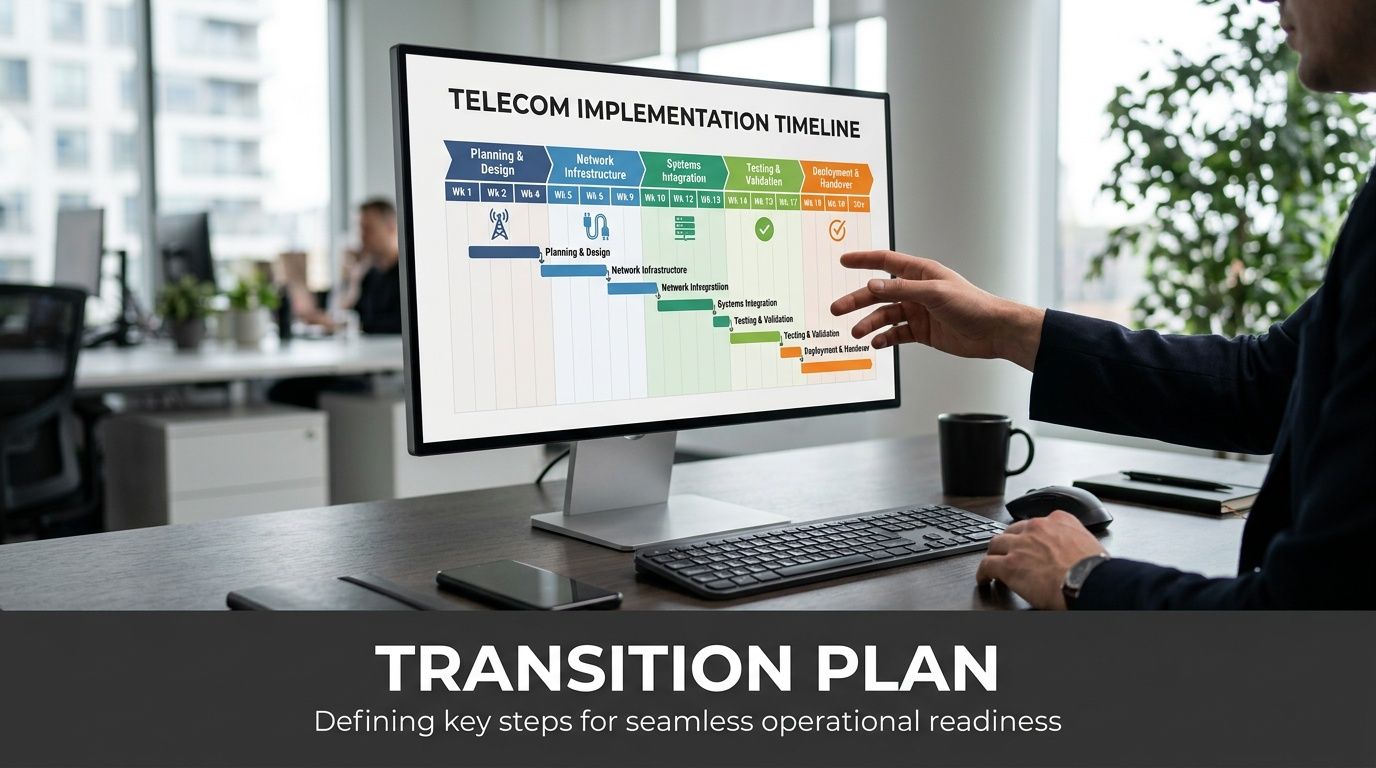
Build the business case before the RFP
Start with operational outcomes, not circuit types. The CIO should be able to state why the business is buying this service in one paragraph. Faster cloud access, cleaner branch resilience, stronger voice continuity, better inter-site replication, or lower dependence on aging provider contracts are valid answers. “Upgrade bandwidth” is not enough by itself.
Then inventory what will be affected:
- Network edge gear: Routers, firewalls, SD-WAN appliances, optical transport, LTE failover units.
- Site dependencies: Power, rack space, structured cabling, building access, MDF and IDF conditions.
- Application coupling: Voice, badge systems, cameras, lab devices, OT links, out-of-band access.
Run a disciplined procurement process
A strong telecom RFP asks vendors to design against your requirements instead of quoting a menu. That means you specify service objectives, resilience expectations, test criteria, implementation constraints, and support requirements.
During negotiation, push on the points that matter operationally:
- Installation accountability.
- Route diversity language.
- Escalation commitments.
- Acceptance testing standards.
- Disconnect timing for replaced services.
If your migration includes a facility change or significant footprint reshaping, it helps to align procurement with data center migration services so the network cutover and equipment retirement happen under one schedule instead of competing schedules.
Treat decommissioning as part of cutover
This is the overlooked Atlanta issue. The verified data specifically flags the e-waste generated by frequent network upgrades, and notes that Georgia is directing over $400M in grants to expand broadband, which increases the need for enterprises to use compliant disposition partners for surplus IT assets according to this analysis of Atlanta Ethernet private line considerations. That matters because every network upgrade creates a tail of retired equipment that still carries security and compliance risk.
A clean transition plan includes:
- Asset capture: Record every retired router, switch, firewall, handset platform, access point, and optic.
- Data handling: Identify devices with configs, logs, credentials, call records, or embedded storage.
- Chain of custody: Document who removed the asset, where it went, and when it left the site.
- Reuse versus recycle decision: Some gear can be redeployed in low-risk roles. Some should be destroyed and recycled.
Old network gear becomes a security problem before it becomes a storage problem. Treat it that way.
Execute cutover in controlled waves
Don’t cut everything at once if the business depends on continuous operation. Pilot one site. Validate monitoring, voice behavior, failover logic, and support responsiveness. Then move in waves that match your team’s ability to observe and remediate.
What works is boring execution. Pre-stage configs. Label every handoff. Freeze unrelated changes. Keep the old path available long enough to prove the new one is stable. What doesn’t work is relying on verbal assurances from multiple vendors while your internal team tries to discover dependencies during the maintenance window.
A Vendor Selection Template for Your RFP
A useful RFP doesn’t ask vendors to repeat product sheets. It asks questions that expose design quality, delivery risk, and support maturity. The template below works well for enterprise telecom services in Atlanta because it forces providers to answer operational questions, not just commercial ones.
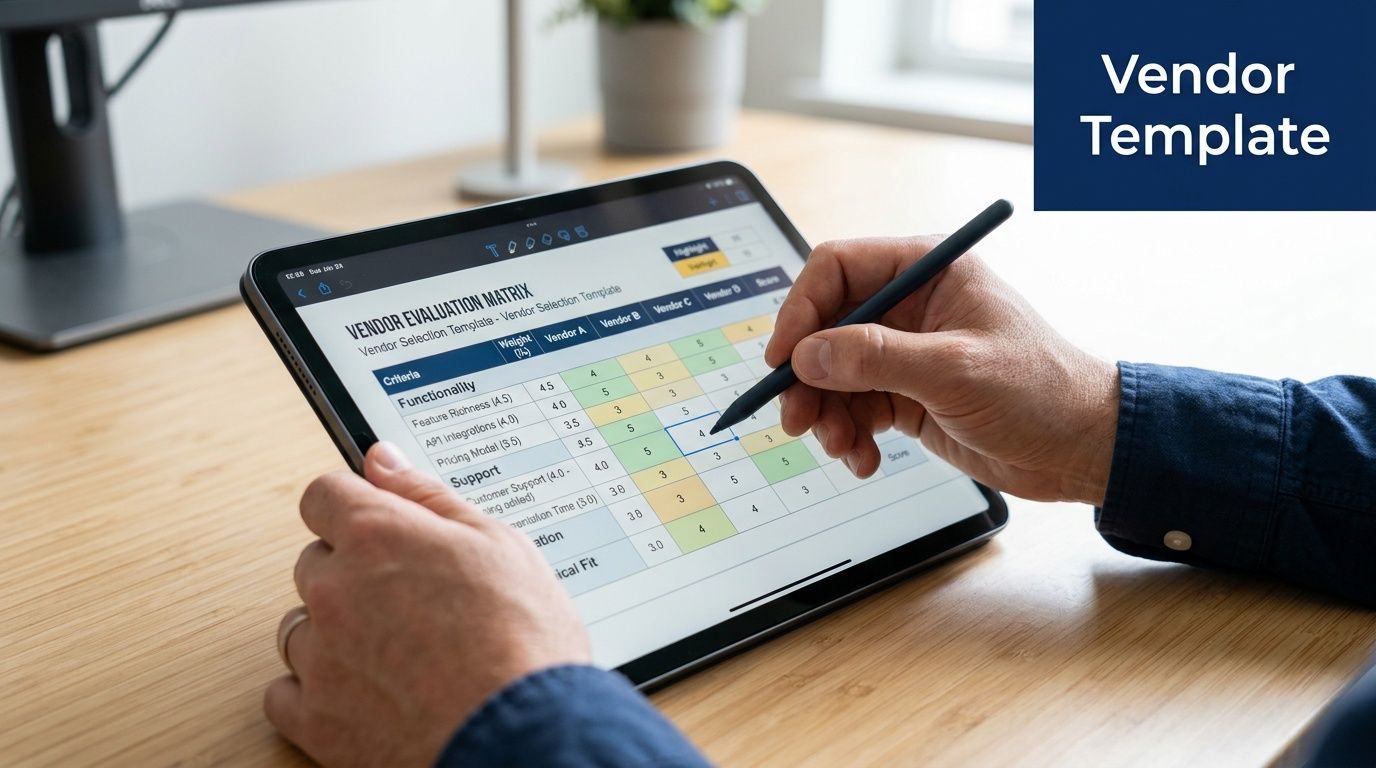
Network performance and architecture
Ask vendors to describe the service path in plain language. Require them to identify what they own, what they lease, and where your handoff sits. If they’re proposing internet, ask how they handle congestion and routing visibility. If they’re proposing private transport, ask how they provision diversity and how they validate it.
Useful prompts:
- Metro design: Describe your network presence in the Atlanta metro relevant to our addresses.
- Access method: Explain the local loop and any third-party dependencies.
- Failure domains: Identify likely shared points of failure in the proposed design.
Security and compliance
Telecom providers love to talk about uptime. Make them talk about controls. If your environment handles regulated workloads, your network provider needs to support auditability, segmentation, and incident documentation that your internal teams can use.
Include questions like:
- How do you support secure handoffs and segmented traffic?
- What outage records and root cause detail do customers receive?
- How do you handle device access when managed CPE is included?
Implementation and support
This category separates polished sellers from reliable operators. Ask for the project workflow from order acceptance through turn-up, testing, escalation, and post-cutover support. Require named roles, not vague statements about a support organization.
A practical scorecard might look like this:
| Category | Example scoring focus |
|---|---|
| Architecture fit | Alignment with application and site requirements |
| Delivery risk | Building readiness, third-party dependence, install clarity |
| Support maturity | Escalation quality, after-hours coverage, ownership model |
| Security posture | Visibility, access control, audit support |
| Commercial terms | Contract flexibility, disconnect terms, pricing transparency |
Good RFP responses are specific about operations. Weak responses are broad, polished, and hard to test.
Commercial and lifecycle terms
Don’t stop at monthly charges and term length. Ask what happens at renewal, during disconnect, and when managed hardware is removed. Clarify ownership of installed equipment, return obligations, and end-of-service handling. A vendor that can’t explain service exit cleanly often creates avoidable friction when your architecture changes later.
Finalizing Your Telecom Strategy
The right telecom strategy in Atlanta isn’t a carrier purchase. It’s an infrastructure decision that shapes resilience, application performance, migration risk, and hardware lifecycle cost.
Strong teams align service choice with workload behavior. They separate provider reputation from provider fit. They score offers against route diversity, support quality, building reality, and transition discipline. Then they plan the last mile and the last day at the same time.
That last step matters more in Atlanta than many teams expect. Rapid network expansion, competitive carrier builds, and frequent refresh cycles mean old equipment accumulates fast unless somebody owns the retirement process. Secure decommissioning, documented chain of custody, and responsible recycling shouldn’t be treated as cleanup work. They’re part of responsible infrastructure management.
The best telecom services in Atlanta are the ones you can deploy cleanly, operate confidently, and retire without creating security, compliance, or e-waste problems.
If your team is expanding, migrating, or retiring network and data center equipment as part of an Atlanta telecom project, Dallas Fortworth Computer Recycling can support the final stage with secure, compliant IT asset disposition, certified data destruction, and nationwide logistics for enterprise decommissioning.