
Expert Telecom Consulting Services Dallas

You usually know something is off before you ever call a telecom consultant.
The monthly carrier invoices don’t line up with what your sites use. A contract auto-renewed while your team was busy with a migration. Someone added mobile lines for a project that ended months ago. Your voice environment still includes pieces of an old PBX stack, but your users expect Teams, Zoom Phone, or a polished contact center experience from anywhere in the Metroplex.
That mix is common in Dallas. Fast-growing companies, multi-site operations, healthcare groups, logistics firms, manufacturers, and public-sector departments often inherit telecom environments instead of designing them cleanly from day one. The result isn’t just overspend. It’s operational drag, procurement friction, and security risk.
That’s why telecom consulting services Dallas buyers look for now are broader than rate negotiation. The better engagements connect contracts, circuits, collaboration tools, lifecycle planning, and the retirement of whatever gets replaced.
Why Dallas Businesses Need a Telecom Strategy Refresh
Dallas businesses move fast, but telecom environments tend to age in place. A company can modernize its ERP, refresh laptops, move workloads to the cloud, and still run on a telecom structure built around old assumptions about office occupancy, branch connectivity, and voice traffic. Bills keep getting paid, so the mess stays hidden.
That approach doesn’t hold up when you’re supporting hybrid work, expanding into new facilities, consolidating locations, or cleaning up vendor sprawl. At that point, telecom becomes a strategic operations issue. It affects uptime, user experience, budgeting, compliance, and the pace of every infrastructure change you need to make next.
The broader market reflects that shift. The global telecom consulting market was valued at USD 7,291.0 million in 2024 and is projected to reach USD 14,519.6 million by 2030, growing at a CAGR of 12.2%, reflecting rising demand for help with digital transformation, network optimization, and cost management, according to P&S Market Research’s telecom consulting market analysis.
For Dallas teams, that trend shows up in practical ways. More organizations now treat telecom consulting as part of infrastructure governance, not just a one-time sourcing exercise. They’re reviewing voice platforms, carrier contracts, wireless estates, SD-WAN design, cloud connectivity, and facility turnover as one connected program.
A useful starting point is understanding how your telecom footprint maps to your physical and operational footprint. If you’re evaluating local infrastructure decisions, it helps to review Dallas telecommunications service considerations for business environments before you speak with outside firms.
Practical rule: If your telecom costs, contracts, and hardware lifecycle are managed by different teams with no shared inventory, you don’t have a telecom strategy. You have a collection of recurring charges.
Conducting Your Internal Telecom Needs Assessment
Before you compare firms, write an RFP, or take a sales call, get your own house in order. The most productive telecom consulting engagements start with a client that knows what it has, what hurts, and what must change.
That doesn’t mean producing a perfect inventory. It means building a usable one.
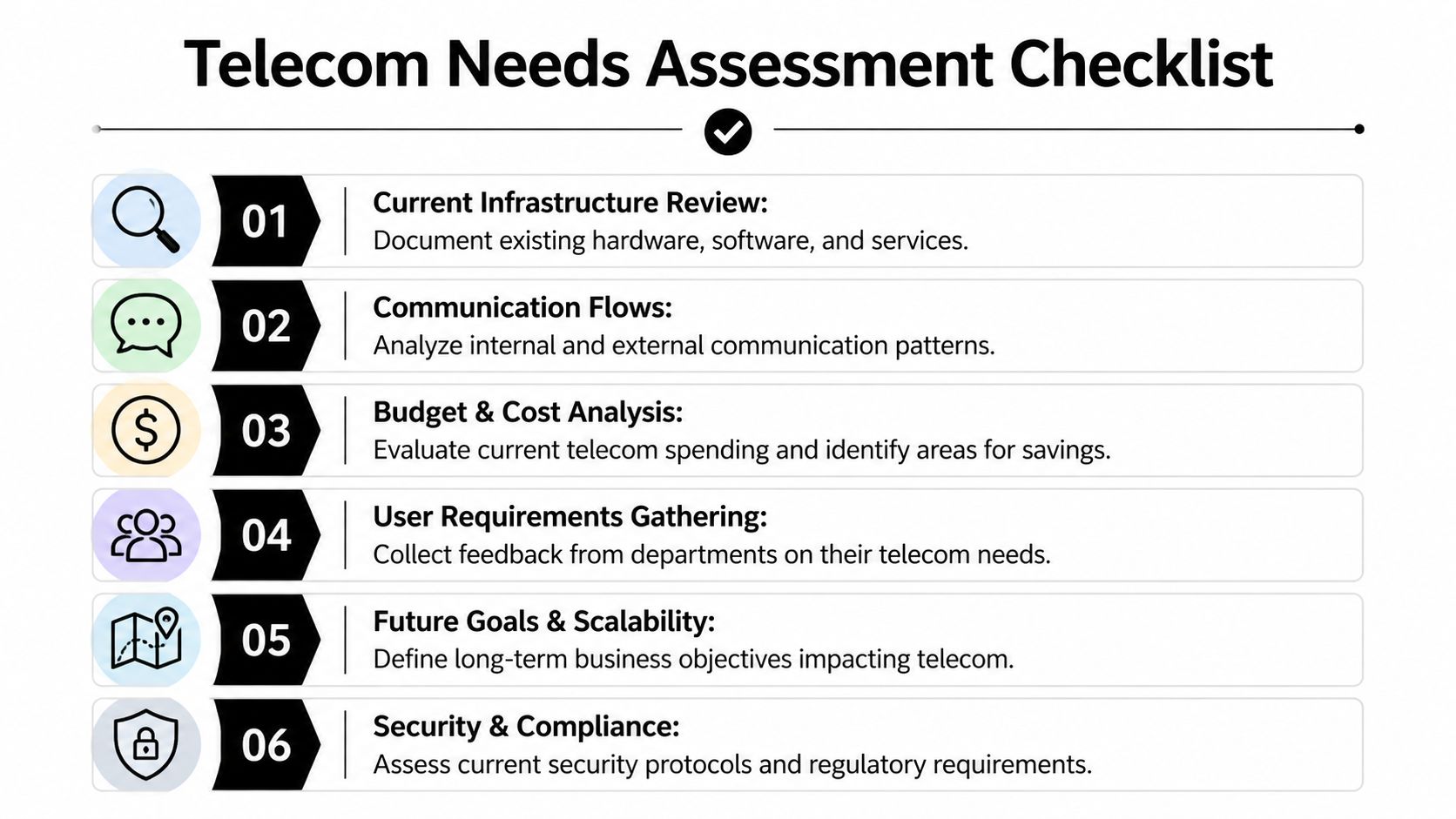
Start with services, not vendors
Many IT teams organize telecom information by provider name. That’s understandable, but it creates blind spots. A better approach is to inventory by service category first, then attach the vendor, contract, location, and owner.
Capture at least these areas:
- Voice services including SIP trunks, PRI remnants, contact center platforms, voicemail systems, call recording tools, and any on-prem phone system that still matters.
- Data connectivity such as internet circuits, MPLS, Ethernet transport, private links, broadband backup, SD-WAN overlays, and cloud interconnects.
- Wireless estates covering smartphones, tablets, hotspots, pooled plans, executive exceptions, and dormant lines.
- Collaboration platforms like Microsoft Teams Phone, Zoom Phone, Webex Calling, and room systems that may have created overlapping spend.
- Physical telecom hardware including handsets, routers, switches assigned to voice, firewalls in telecom closets, session border controllers, paging gear, and legacy PBX appliances.
In these situations, many teams realize they’re carrying duplicate functions. Two business units may use different conferencing platforms. A recently acquired office may still have its own local carrier agreement. A warehouse may have old analog lines no one wants to touch because they support alarms, faxing, or door entry.
Gather the documents people usually ignore
You can’t assess spend or risk from memory. Pull the source material.
Build a working folder that includes:
- Current contracts and amendments for every carrier and managed service agreement.
- Recent invoices across wireline, wireless, UCaaS, and contact center services.
- Site list and circuit list matched to addresses, business units, and technical contacts.
- Escalation lists and support contacts for each provider.
- Architecture diagrams if they exist, even if they’re outdated.
- Move, add, change, and disconnect history from the last major period of operational change.
If you don’t know where a given circuit terminates or what business process depends on it, note that explicitly. Unknowns are part of the assessment. Pretending they don’t exist is what slows every later phase.
Teams doing this kind of prep often also compare nearby options and market availability, especially when they need local provider context. If that’s relevant, review telecom solutions near Dallas-area operations as a market-orientation step rather than a buying shortcut.
Define what success means before the consultant does
A consultant can only optimize against the goals you set. If your objective is vague, you’ll get vague recommendations.
Use a short goal sheet with clear business outcomes. Good examples include:
- Contract cleanup for overlapping or auto-renewing services
- Carrier consolidation after mergers, relocations, or branch closures
- Voice modernization away from unsupported or fragmented platforms
- Improved support model with fewer handoffs during outages
- Compliance-ready decommissioning for systems that will be retired
The strongest client teams don’t start by asking, “Can you save us money?” They start by asking, “What should our telecom environment look like after this project, and what has to be true for operations, finance, and security to sign off?”
Name stakeholders early
Telecom projects fail subtly when the wrong people are left out. Finance sees invoice anomalies. Facilities knows what’s physically in the closets. Security knows which systems hold sensitive data. Legal understands renewal language and data handling obligations. Operations knows what can’t break during cutover.
Create a small working group with one accountable owner. Without that, your consultant will spend half the engagement reconciling internal disagreements instead of solving technical and commercial problems.
Evaluating Consultants in the DFW Metroplex
Dallas has no shortage of firms that can talk about telecom. The harder task is separating general advisers, carrier brokers, implementation specialists, and expense-management shops that all use similar language but deliver very different outcomes.
The best way to evaluate telecom consulting services Dallas providers is to look at process, local fit, and incentives. If one of those is weak, you usually feel it later in the project.
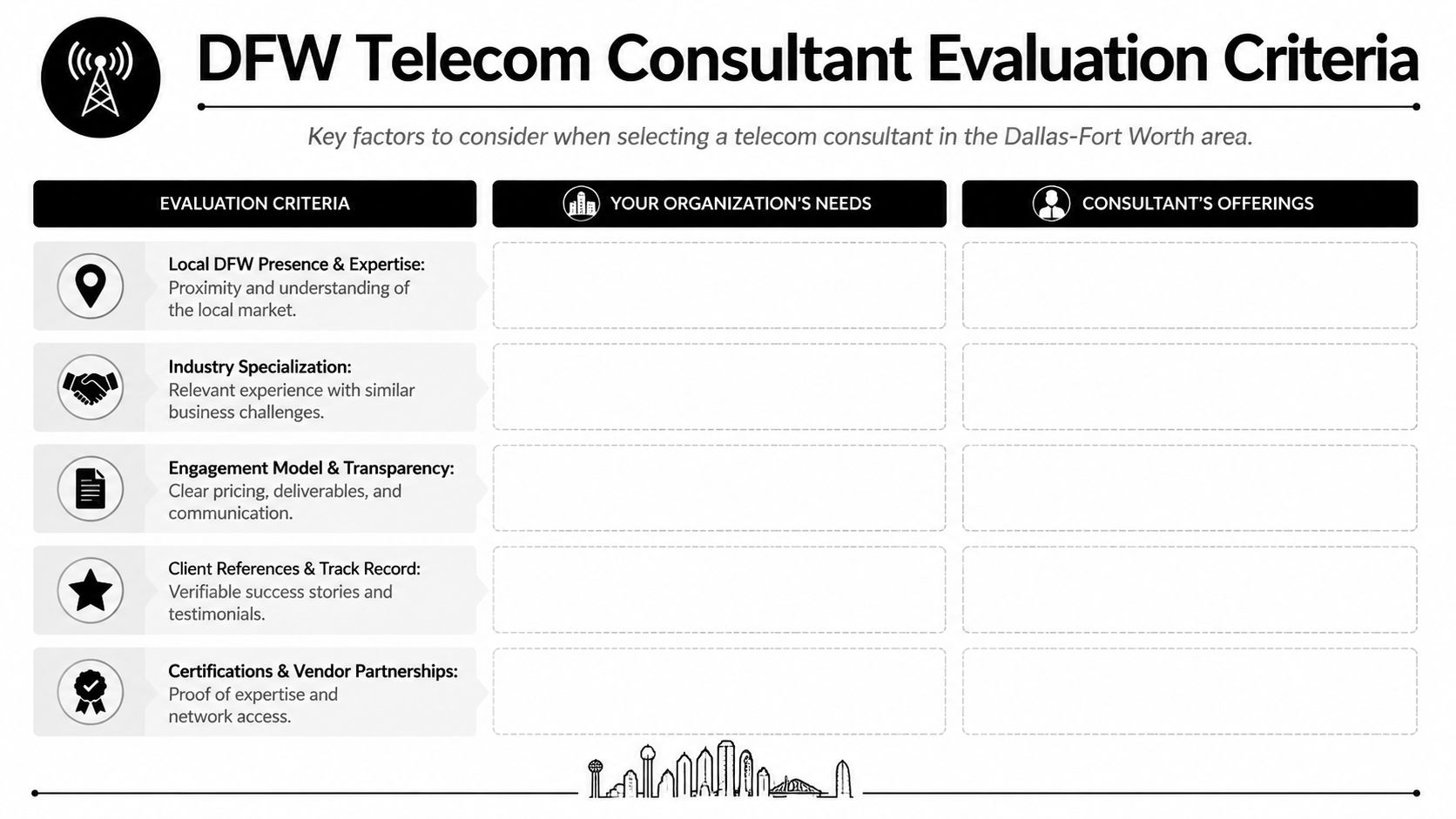
Separate advisers from sales channels
Start with a direct question. Ask whether the consultant is carrier-agnostic in practice, not just in branding.
Some firms are excellent at sourcing and negotiations but still operate through preferred supplier relationships that can shape recommendations. That doesn’t automatically disqualify them. It does mean you should understand where incentives sit. If the adviser benefits more from placing you with one class of provider than another, that matters.
A useful comparison looks like this:
| Evaluation point | What you want to hear | What should make you probe deeper |
|---|---|---|
| Incentive model | Clear explanation of fees and any provider compensation | Vague answers about “no cost” advisory |
| Recommendation method | Documented scoring, requirements mapping, trade-off analysis | Strong push toward a narrow set of vendors early |
| Deliverables | Audit findings, sourcing options, negotiation support, implementation governance | Mostly introductions and quote collection |
| Independence | Willingness to validate keeping current providers when appropriate | Assumption that change is always necessary |
Look for a disciplined audit process
Good consultants don’t begin with product demos. They begin with discovery and technical audit.
That matters because expert telecom consulting follows a structured methodology, starting with a deep technical audit, and organizations that implement the resulting recommendations typically see measurable ROI within 3-6 months. Benchmark data also shows that mid-sized organizations often have 50+ unused lines causing over $24,000 in annual losses, according to Macronet Services on telecom expense management consulting.
That benchmark is useful because it describes a pattern many IT leaders recognize. The waste isn’t always dramatic. It’s buried in inactive lines, duplicate services, legacy call paths, disconnected projects, and billing exceptions no one has time to chase.
Ask every consultant to walk you through the sequence they use. A credible answer should cover:
- Technical review of WAN, voice, contact center, and cloud connectivity
- Commercial review of billing, contract terms, and service inventories
- Recommendation phase tied to business priorities, not just price
- Implementation support for order management, cutover planning, and vendor follow-up
- Validation so savings or service changes are verified after the fact
Test for DFW reality, not generic telecom knowledge
A consultant can be smart and still be wrong for your environment. Dallas-Fort Worth has a mix of downtown offices, suburban campuses, medical sites, industrial facilities, logistics networks, and data-center-heavy operations. That means local construction lead times, building access issues, provider availability by corridor, and multi-site operational sequencing often matter more than polished slide decks.
Ask questions that reveal whether the consultant understands North Texas execution:
- Have they managed telecom transitions for organizations with multiple sites across DFW?
- Do they know how to coordinate with facilities and local operations during closet access, demarc review, and cutover windows?
- Can they support a project where some sites need modernization while others must remain stable for now?
- Have they handled environments with both cloud calling and leftover on-prem telephony?
If you’re screening the local market, a quick review of local telecom company categories in the Dallas area can help frame which firms act as consultants, providers, brokers, or implementation partners.
Don’t hire the firm that gives the fastest answer. Hire the one that asks the sharpest questions about your inventory, contract posture, support model, and cutover risks.
Ask for proof in the form of work product
References matter, but sanitized praise doesn’t tell you much. Ask for redacted examples of audit findings, inventory reconciliation outputs, recommendation summaries, governance trackers, or implementation runbooks.
You’re not just hiring expertise. You’re hiring operating discipline. In telecom, that’s often the difference between a clean transition and six months of invoice disputes after the “project” supposedly ended.
Decoding Consultant Pricing and Engagement Models
Pricing confuses a lot of buyers because telecom consulting doesn’t follow one template. Two firms can propose the same outcome and price it in completely different ways. If you don’t understand the engagement model, it’s hard to compare proposals fairly.
Modern firms have gotten more flexible for a reason. Outcome-based pricing has become more common for mid-size businesses, where 73% historically avoided consulting due to cost concerns, and the common models now include Project-Based, Success-Based, Retainer, and Phased Implementation, according to Innowave Telco’s review of telecom consulting pricing models.

What each model is good at
Different structures fit different problem sets.
| Model | Best fit | Main advantage | Watch-out |
|---|---|---|---|
| Project-Based | Defined audit, sourcing, or contract work | Clear scope and budget | Change orders if your inventory is messier than expected |
| Success-Based | Expense reduction and billing recovery work | Aligns payment to verified results | Define “savings” carefully |
| Retainer | Ongoing TEM, vendor management, lifecycle oversight | Consistent support and predictable cadence | Can drift if deliverables aren’t explicit |
| Phased Implementation | Multi-site transformations or staged modernization | Matches cost to project stages | Needs tight governance between phases |
Where buyers get tripped up
The cheapest-looking model can become the most expensive if the contract leaves too much open to interpretation. Success-based arrangements are a good example. They can work well, but only when both sides agree on the baseline, validation method, exclusions, and duration of the fee period.
Project-based work sounds cleaner, but fixed-fee engagements often rely on assumptions about inventory quality and stakeholder access. If your records are scattered, your “fixed” scope may not stay fixed for long.
A practical procurement screen includes these questions:
- How is value measured? Ask whether the firm tracks billing reduction, contract avoidance, service stabilization, process improvement, or all of the above.
- What is excluded? Make them identify activities that will trigger additional fees.
- Who owns implementation? Some consultants stop at recommendations. Others stay involved through order tracking and post-cut verification.
- How often are results reviewed? Monthly governance is different from a one-time presentation deck.
If you’re comparing firms and need context on the broader local provider market, Dallas-area telecom provider options can help you understand where a consultant fits relative to direct carriers and managed service partners.
Match the model to your internal maturity
A disciplined IT shop with strong inventory records can use project-based work effectively. A lean team with ongoing carrier churn may benefit more from a retainer. A company preparing a headquarters move, branch consolidation, or major voice migration often gets the best control from a phased structure because milestones can be tied to discovery, sourcing, cutover, and validation.
No model is universally best. The right one is the one your finance, IT, and operations teams can govern without confusion.
Crafting a Rock-Solid Consulting Contract and SOW
The contract is where optimism meets reality. A strong sales process can still lead to a poor engagement if the statement of work leaves room for assumptions, handoffs, or silent exclusions.
Most telecom consulting disputes aren’t dramatic. They’re annoyingly predictable. The consultant thought implementation support meant weekly advisory calls. The client thought it meant active order management. The consultant expected clean billing files. The client expected the consultant to reconstruct them. Nobody was exactly lying. The SOW just wasn’t precise enough.

Scope needs operational detail
A good SOW doesn’t stop at broad labels like “audit,” “optimization,” or “implementation support.” It spells out what the consultant will specifically do, what the client must provide, and what counts as completion.
These are the contract points worth tightening:
Inventory responsibility
State whether the consultant validates inventories, builds them from source data, or relies on client-provided lists.Provider interaction
Clarify whether the consultant will contact carriers directly, lead negotiations, manage ticket escalations, and track provisioning.Deliverable format
Require specific outputs such as an audit report, contract matrix, recommendation summary, implementation plan, and savings validation log.Decision rights
Make clear who approves vendor selections, migration sequencing, and change requests.
Acceptance criteria prevent drift
“Delivered” is not the same thing as “accepted.” Tie major milestones to objective outputs.
For example, an audit phase might only be accepted when the consultant has reconciled contracts, invoices, and active service inventories to a standard your team can review. An implementation phase might require documented carrier order status, test results, issue logs, and closure criteria for every site in scope.
A telecom consulting SOW should read like an operating manual, not a marketing brochure.
Protect data and knowledge transfer
Telecom projects touch more than carrier pricing. They can expose call flows, contact center logic, invoice records, service addresses, escalation paths, user counts, and business continuity dependencies. Your agreement should define confidentiality and handling requirements for those materials.
Also define the handoff at the end of the project. If the consultant built inventory files, contract summaries, circuit maps, or governance trackers, your team should receive them in usable form. Don’t accept a polished final deck if the working data remains trapped in the consultant’s own system.
A practical review table helps:
| Contract area | What to require |
|---|---|
| Deliverables | Named documents, formats, owners, and due dates |
| Governance | Meeting cadence, issue escalation path, status reporting |
| Changes | Written process for out-of-scope work |
| Data handling | Confidentiality obligations and access controls |
| Exit terms | Knowledge transfer, final files, open item disposition |
Write the exit before the kickoff
Every engagement ends. Sometimes it ends successfully on schedule. Sometimes priorities shift, budgets tighten, or the consultant isn’t the right fit.
Your contract should say what happens if you stop. Define transition assistance, document handover, ownership of working materials, and treatment of in-flight savings claims or disputed fees. If you don’t write the ending early, you may discover later that your team paid for guidance it can’t fully operationalize without the same consultant staying indefinitely.
The Final Step Closing the Loop with IT Asset Disposition
It's at this stage that many telecom projects gradually lose control.
The consultant completes the audit. Contracts are renegotiated. New circuits go live. A cloud calling platform replaces the old phone system. Contact center functions move. Branches consolidate. Everyone focuses on the cutover, because that’s the visible milestone.
Meanwhile, the retired hardware is still sitting in a closet, rack, storage room, or warehouse corner.
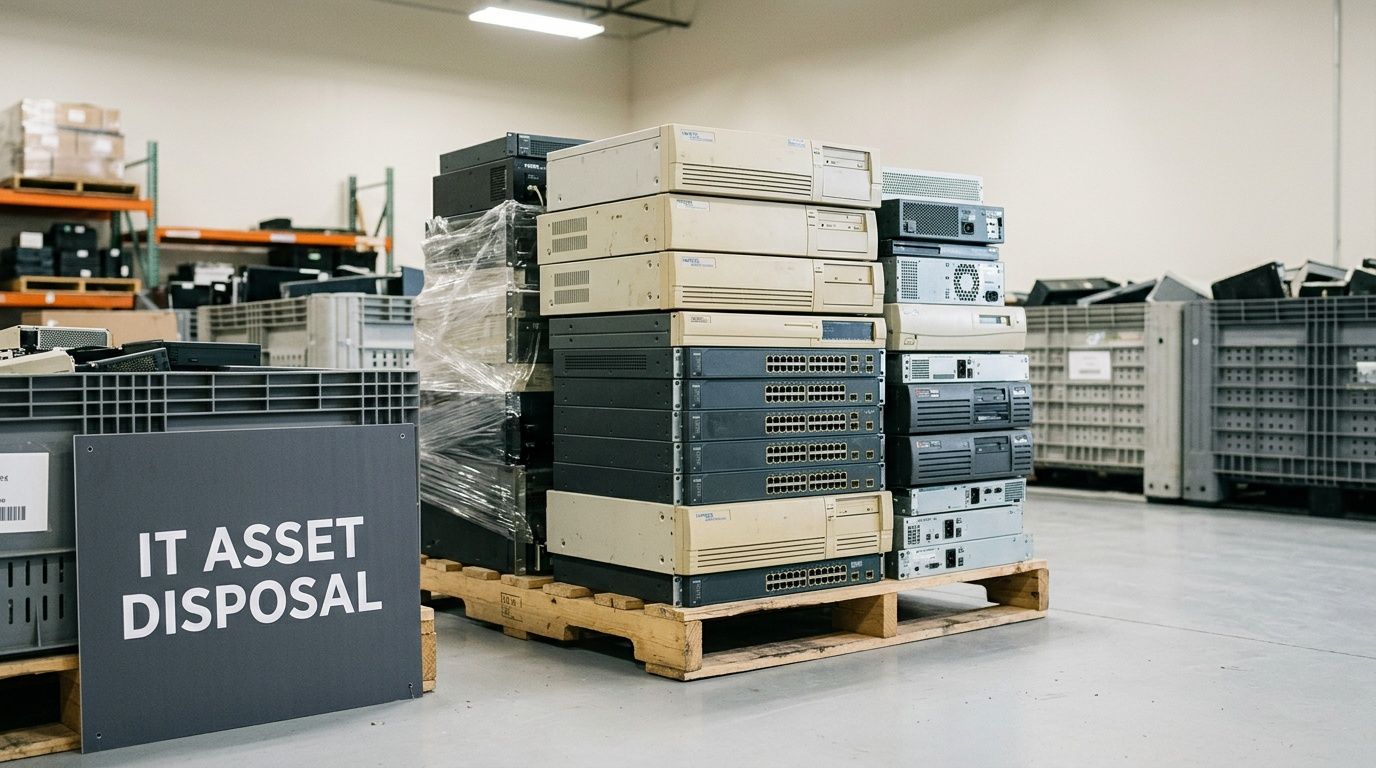
Why retired telecom gear is a real risk
A major gap in the market is that telecom consulting guidance rarely covers the secure decommissioning of retired telecom infrastructure. Legacy systems can contain sensitive data, creating a compliance vacuum for regulated organizations that need certified data destruction and documented disposal, as outlined in Bearstone’s discussion of Dallas telecom consulting gaps.
That point deserves more attention than it usually gets. Telecom equipment isn’t just metal and cabling. Depending on the environment, retired systems may hold configuration files, call detail records, voicemail content, user directories, credential artifacts, contact center data, and network settings. Even when a device seems obsolete, it may still carry information your security or compliance team would not want mishandled.
This is especially important when projects involve:
- Legacy PBX or voice mail systems that stored user and call data
- Call center platforms with recordings, routing logic, or integrations
- Routers, firewalls, and session border controllers containing configuration and authentication details
- Multi-site shutdowns or consolidations where hardware is removed quickly and chain-of-custody can get sloppy
Build asset retirement into the telecom project plan
The practical fix is simple. Treat hardware retirement as a defined project workstream, not a cleanup task for “later.”
A usable checklist looks like this:
Identify every asset leaving service
Match each retired handset system, PBX appliance, switch, router, server, or storage component to the new-state architecture.Classify the data risk
Don’t assume voice gear is data-light. Review whether the equipment stores logs, call records, voicemails, credentials, or user information.Define custody and removal steps
Document who disconnects, who transports, where assets are staged, and how serial-level tracking will be maintained.Require destruction and disposition records
Your audit trail should support internal governance and external review, especially if you operate in healthcare, finance, government, or any environment with strict handling requirements.Coordinate timing with cutover validation
Don’t remove or dispose of assets before rollback windows close and service acceptance is complete.
Retired telecom hardware shouldn’t become invisible just because the migration succeeded. End-of-life equipment is still part of your risk surface until it is documented, sanitized, and properly processed.
What works and what doesn’t
What works is assigning one owner for post-cutover asset control. In many organizations, that person sits between infrastructure, security, and facilities. They maintain the retirement list, verify what came out of service, and make sure disposition documents align with the project record.
What doesn’t work is assuming the telecom consultant, carrier installer, or local site contact has this covered by default. Sometimes they’ll help. Often they won’t. Their scope typically ends when service is moved, not when every retired device is accounted for and processed.
If secure retirement is part of your broader operating model, it helps to align telecom transformations with IT asset disposition services in Dallas-Fort Worth for retired infrastructure workflows. The point isn’t to bolt on disposal at the end. It’s to make sure modernization and asset retirement are governed together from the beginning.
Regulated teams should insist on documentation
Healthcare systems, public agencies, and financial organizations already know how quickly “old equipment” becomes a compliance question. If your project replaces voice, networking, or site hardware, ask for documentation standards before work starts, not after assets have been moved.
That discipline closes the gap between optimization and risk control. It also gives procurement, legal, and audit teams a complete record of what changed, what was retired, and how those retired assets were handled.
Building Your Strategic Telecom Roadmap
A telecom refresh shouldn’t end with lower invoices or a successful migration. It should leave your organization with a cleaner operating model. That means clear inventories, stronger contracts, better-fit providers, defined governance, and a documented plan for what happens to infrastructure when it leaves service.
Too many teams still treat telecom consulting as a narrow sourcing exercise. That’s an outdated view. Telecom consulting includes network optimization, customer experience, and regulatory compliance support, and the market continues to grow because organizations need help reducing operational costs and improving efficiency, as noted in Cognitive Market Research’s telecom consulting market overview.
The part many teams still miss is the end-of-life phase. If your consultant helps you modernize but nobody owns retired equipment, you’ve only solved part of the problem. In Dallas, where organizations often run multi-site operations and mixed legacy environments, that final step matters as much as the initial audit.
A strong roadmap does three things well. It aligns telecom to business operations, creates accountability from assessment through cutover, and closes the loop on secure retirement of the hardware left behind.
If your team is upgrading voice, networking, contact center, or site infrastructure, don’t leave retired equipment sitting in storage or handled through an informal cleanup. Dallas Fortworth Computer Recycling helps organizations retire technology through secure, documented IT asset disposition workflows that support certified data destruction, chain-of-custody requirements, and responsible recycling. For Dallas IT leaders who want telecom modernization to end cleanly, that last mile matters.