
Telecom Equipment Recycling Atlanta: Secure & Certified
Your storage room is full again. A data center refresh is moving faster than expected, the network team has already swapped in newer gear, and now the old stack is sitting there: Cisco switches, firewalls, rack servers, VoIP hardware, spare modules, unlabeled power supplies, and a few devices nobody wants to claim. The temptation is to treat it like a cleanup project.
That's where Atlanta IT teams get into trouble.
Telecom equipment retirement isn't just about removing old hardware. Routers, switches, firewalls, call managers, and edge appliances often hold configuration files, authentication data, routing information, VPN settings, and user or customer-related records. If you manage healthcare, finance, government, or a multi-site enterprise environment, disposal is a security and compliance event. It also affects audit readiness, sustainability reporting, and whether any value can be recovered from the equipment.
A sound telecom equipment recycling Atlanta process starts before the first pallet is wrapped. It starts with inventory discipline, role clarity, data sanitization planning, and a recycler that can prove what happened to every asset.
The Telecom Equipment Challenge for Atlanta Businesses
An Atlanta IT director usually sees the problem before procurement does. Gear starts piling up after a branch consolidation, UC migration, or firewall replacement. Some equipment still works. Some is obsolete. Some has drives or flash storage. Some devices look harmless but still contain retained network configurations.
That mix is what makes telecom disposition harder than general office electronics recycling. You're not clearing out old keyboards. You're handling infrastructure that once sat inside your security boundary.

Atlanta has become a strong market for structured ITAD because the volume is real. The Georgia telecom e-waste recycling market grew 30% year-over-year from 2019-2024, and local providers report 98% landfill diversion through component-level recovery, according to Georgia telecom recycling market reporting.
What makes telecom gear riskier
A retired switch can still contain VLAN settings, IP schema history, passwords, and device-level certificates. A firewall or unified communications appliance may hold far more. Even if the hardware has no obvious hard drive, it may still use internal flash storage or removable media.
That's why mature teams don't assign this work to facilities alone. IT, security, compliance, and procurement all need a defined part in the project.
Telecom retirement should be treated like controlled offboarding for infrastructure, not like surplus removal.
There's also an environmental and governance angle. Atlanta businesses operate in a market where customers, boards, and internal audit teams increasingly expect proof that retired electronics didn't go into informal scrap channels. A recycler that can show downstream accountability matters just as much as one that can send a truck.
The practical shift
The strongest organizations moved away from ad hoc cleanouts years ago. They use repeatable workflows for pickup scoping, data-bearing segregation, audit records, and final reporting. If you're reviewing providers for telecom disposition support in Atlanta, look for those process controls before you compare pricing.
Three outcomes matter most:
- Security protection: Data-bearing devices are identified before anything leaves the site.
- Compliance protection: Chain-of-custody records and destruction evidence are available when audit asks.
- Financial protection: Reusable equipment is separated from true scrap so you don't erase residual value by mistake.
If you get those three right, telecom equipment recycling Atlanta becomes manageable. If you skip them, a routine refresh turns into an avoidable risk event.
Building Your Disposition Blueprint Assessment and Inventory
The inventory phase decides whether the rest of the project runs cleanly or falls apart. Most failures in telecom disposition don't start at pickup. They start when the asset list is vague, ownership is unclear, and nobody has verified what stores data.
An effective blueprint is more than a spreadsheet count. It's the working record that ties your assets to sanitization decisions, logistics planning, and final audit evidence.
Start with a field-ready inventory structure
Your inventory should be usable on the floor, not just in a meeting. I prefer a format that operations staff, security reviewers, and the recycler can all understand quickly.
Include these fields:
- Asset identity: Serial number, internal asset tag, manufacturer, model, and hostname if available.
- Equipment type: Router, switch, firewall, PBX component, VoIP phone system hardware, server, storage shelf, UPS network module, or telecom accessory.
- Data-bearing status: Known storage, suspected embedded storage, removable media present, or no storage confirmed.
- Condition and completeness: Working pull, failed unit, missing rails, no power supply, damaged chassis, or unknown.
- Disposition path: Reuse candidate, recycle, destroy, or hold for review.
- Location details: Building, floor, room, rack, and business owner.
- Compliance notes: System role, sensitivity, and any retention or legal hold concern.
That level of detail gives you a controlled handoff. It also makes the recycler's receiving report easier to reconcile against your internal records.
For teams tightening internal workflows, these IT asset management best practices are a useful benchmark for how inventory and disposition records should align.
Separate assets into the right streams
Don't throw everything into one pile and decide later. Telecom projects move faster when you sort early into clear disposition paths.
Potential reuse or resale
Equipment with current enterprise demand, clean physical condition, and complete identifiers belongs here. Keep rails, power supplies, faceplates, optics, and matching modules together when possible. Incomplete lots lose buyer confidence quickly.Secure recycling
Gear that's obsolete, damaged, unsupported, or economically impractical to refurbish should be marked for responsible materials recovery. This stream still needs chain-of-custody controls.Data destruction required
Firewalls, servers, appliances, and any network equipment with flash or removable storage should be isolated immediately. Label this stream clearly so nothing is loaded before sanitization status is confirmed.
Practical rule: If the device was ever configured, authenticated, or managed, assume it needs review before release.
Watch the devices teams usually miss
The obvious assets get counted. The hidden-risk assets get forgotten.
These are the ones I see missed most often:
- Firewall appliances with internal flash storage
- WAN optimizers that cache data or configs
- Call management appliances tied to user and routing records
- Network modules installed inside larger chassis
- Out-of-band management devices with saved credentials
- Loose drives and removable media left in drawers or cable bins
A good staging pass catches these before pickup day. A rushed project usually doesn't.
Make ownership visible
Every decommissioning project needs named owners for four decisions: technical validation, security approval, release authorization, and logistics coordination. If those roles stay fuzzy, equipment gets held too long or shipped too early.
Use a short pre-release checklist:
| Checkpoint | What must be confirmed |
|---|---|
| Asset record complete | Serial, model, location, and business owner verified |
| Data review done | Storage presence and sanitization path confirmed |
| Disposition assigned | Reuse, recycle, destroy, or hold |
| Approval documented | IT, security, and site contact signoff captured |
This isn't paperwork for its own sake. It's how you keep a telecom retirement project auditable, efficient, and defensible.
Ensuring Zero Data Exposure Certified Sanitization and Destruction
Factory reset is not data destruction. It's configuration cleanup at best.
That distinction matters because telecom hardware often stores information in places teams don't inspect closely: onboard flash, RAID sets, removable media, management modules, controller cards, and embedded operating environments. If you release equipment based on reset status alone, you're trusting a convenience function to perform a compliance function. That's a bad trade.
Match the method to the device
The right sanitization method depends on the media type and your risk profile.
Software wiping
Software-based erasure is appropriate when the media is functional, identifiable, and intended for compliant reuse. In Atlanta telecom environments, that often applies to servers, storage devices, and selected appliances where drives can be accessed and wiped under controlled procedures.
The benchmark worth knowing is that leading recyclers achieve verified data sanitization success rates of 99.97% using DoD 5220.22-M wipes or equivalent methods, according to verified telecom data sanitization reporting.
Software wiping preserves resale potential, but only when the chain of custody is tight and the media is healthy enough for validation.
Degaussing
Degaussing has a narrower role. It applies to magnetic media, not solid-state storage or many embedded flash environments found in network gear. If your project includes older hard drives, degaussing may be part of the destruction path. It is not a universal answer for telecom assets.
Physical destruction
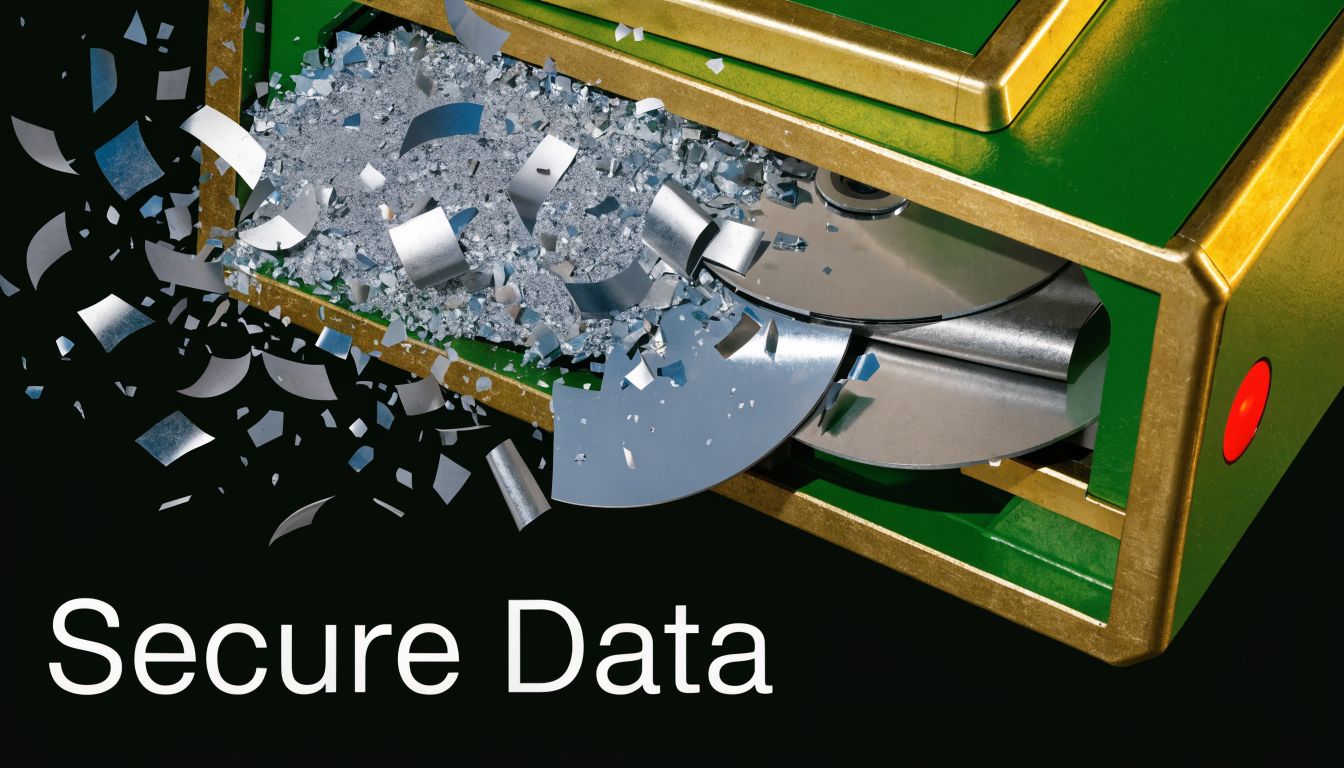
Shredding is the right call when media is failed, inaccessible, highly sensitive, or not worth reselling. For many organizations, physical destruction is the cleanest risk decision for firewalls, mixed-condition appliances, and unidentified storage pulled from decommissioned racks.
If your scope includes direct media destruction, review what a documented certified hard drive destruction process should include before release.
Document before you sanitize
One of the most expensive mistakes in telecom disposition happens before the first wipe starts. Teams remove devices without preserving enough operational context to verify what the asset was, how it was configured, and whether it qualifies for remarketing.
The same industry benchmark notes a critical pitfall: failing to document device configurations pre-decommissioning hinders verification and reduces resale value. That's especially true for enterprise routing gear, security appliances, and telecom platforms where provenance affects buyer confidence.
Capture the following before removal:
- Configuration context: Device role, location, environment, and known provisioning history
- Identity proof: Serials, asset tags, installed modules, and photos if needed
- Media map: What storage is present and whether it can be wiped, removed, or must be shredded
- Approval trail: Who authorized sanitization method and release
A certificate matters, but the documentation leading up to it matters just as much.
Know when reuse stops making sense
Not every unit deserves the same effort. Some assets will fail testing, some won't justify labor, and some will be too incomplete to place into a compliant resale channel. The disciplined move is to separate those units early instead of wasting time trying to recover value from hardware that should go straight to parts harvesting or recycling.
Sanitization and value recovery work together only when the device is documented, testable, and complete enough to sell responsibly.
What to require from your recycler
Ask for evidence, not promises. At minimum, your provider should be able to supply:
- Serialized tracking from pickup through final disposition
- Method-specific data destruction records tied to asset identifiers
- Certificates of data destruction for wiped or shredded media
- Exception handling records for failed drives, inaccessible devices, or discrepancies
- Final reconciliation that matches your release list to actual processed assets
That paper trail is what protects your organization if someone asks six months later what happened to a specific firewall, SSD, or appliance from a regulated environment.
Understanding Atlanta's Recycling Laws and Industry Certifications
Compliance in Atlanta starts with understanding that electronics disposal isn't just a vendor issue. It's your issue until you can prove proper transfer, processing, and data handling.
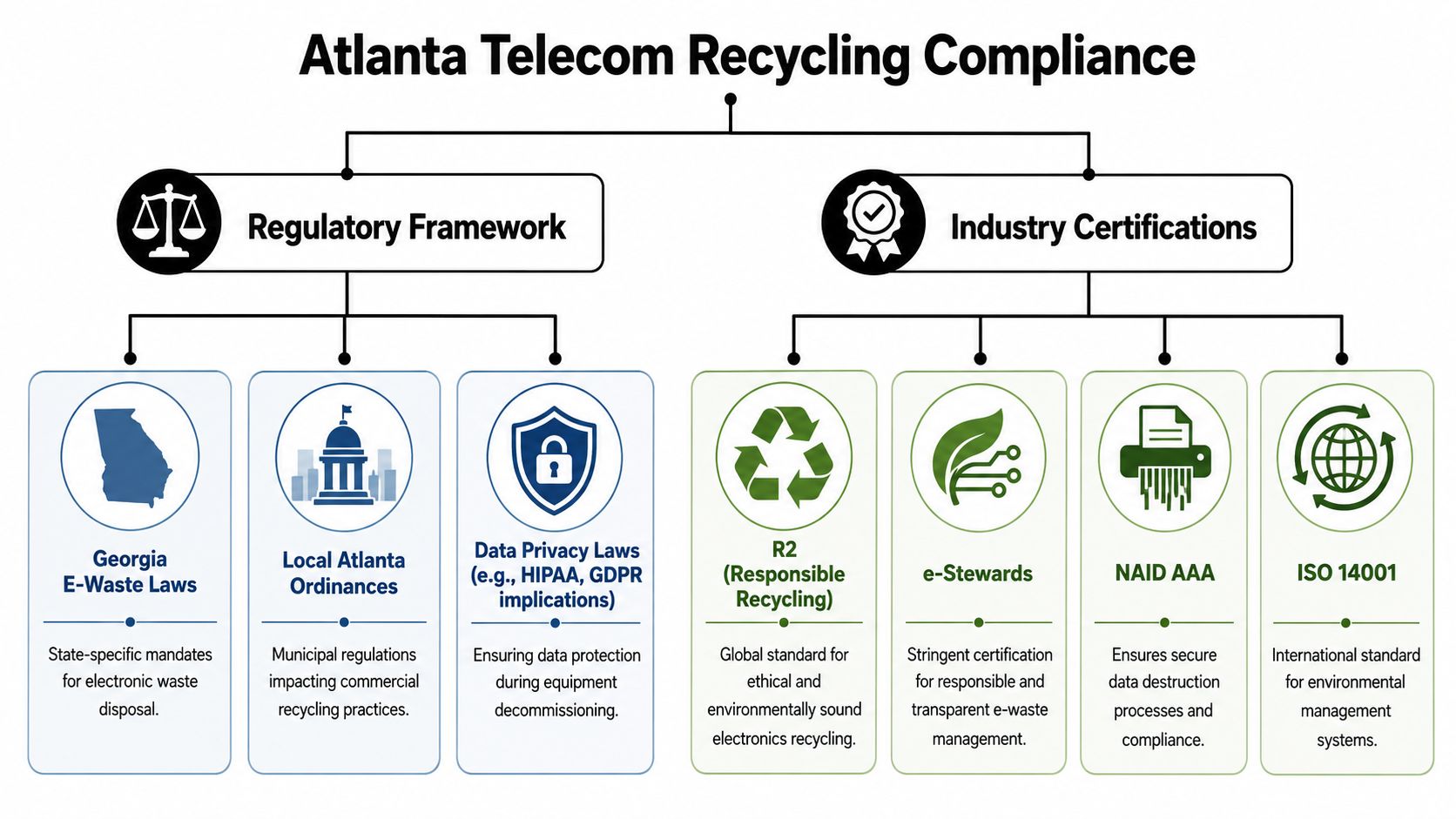
Georgia pushed the market toward formal electronics recycling with a clear legal trigger. The Georgia Electronics Recycling Act of 2010 banned landfill disposal of certain electronics starting July 1, 2011, and this spurred a 25% annual increase in recycled telecom volumes through 2020 as Atlanta's certified facilities scaled up, according to Atlanta networking equipment recycling guidance.
What the law means in practice
For an IT director, the practical takeaway is simple. You can't treat telecom hardware as ordinary trash or uncontrolled scrap. You need a disposition path that accounts for environmental handling and data security together.
That means your internal policy should require:
- Approved release procedures before hardware leaves any site
- Documented custody transfer at pickup or drop-off
- Verified downstream handling for non-resalable material
- Evidence retention for audits, security review, and sustainability reporting
Healthcare and government teams usually understand this immediately. Commercial enterprises should apply the same discipline.
Certifications that actually matter
Certifications are useful only if you know what they signal operationally.
R2
R2 is the baseline most enterprise buyers should expect in telecom equipment recycling Atlanta. It indicates a structured approach to responsible electronics handling, downstream controls, and process accountability. If a recycler can't show current R2 qualification, that's a serious warning sign.
You can compare your vendor's claims against what an R2-certified electronics recycler should provide operationally.
ISO 14001
ISO 14001 points to an environmental management framework. It doesn't replace data security controls, but it does show the provider operates within a documented environmental system rather than informal scrap practices.
ISO 45001
ISO 45001 matters more than many IT teams realize. Worker safety and controlled operating environments are part of operational maturity. A recycler with weak site controls often has weak documentation controls too.
Compliance strength usually shows up in small behaviors first: labeling, intake discipline, exception records, and who signs the chain-of-custody forms.
What certifications don't do
A logo on a website doesn't erase your need to verify scope, process, and evidence. A certified recycler can still be the wrong fit if they can't support multi-site pickups, serialized reporting, on-site services, or secure handling for mixed telecom assets.
Use certifications as a screen, not a final decision.
Selecting Your Atlanta Telecom Recycling Partner A Checklist
Vendor selection is where good policy becomes a real control or a false sense of control. Plenty of recyclers can remove hardware. Fewer can manage telecom assets in a way that protects security, preserves resale options, and stands up to audit review.
The mistake I see most often is letting price lead the evaluation. Low-cost pickup sounds attractive until you discover the vendor's intake process is loose, reporting is generic, and nobody can tell you what happened to a specific serial number.
The first question isn't price
Start with this: can the provider operate inside your risk model?
If you're handling routers, firewalls, UC systems, branch equipment, and data center gear, your recycler should be comfortable with mixed loads, data-bearing assets, and structured reconciliation. If they mainly process commodity office electronics, they may not have the controls you need.
A documented pitfall affects 30-40% of organizations undertaking these projects: they fail to establish clear points of contact with the disposition partner, which creates chain-of-custody gaps. The same guidance says your vendor should provide proof of R2, ISO 14001, and ISO 45001 as baseline qualifications, according to Georgia recycler evaluation guidance.
Questions every IT director should ask
Use these in the first call, not after the quote arrives.
- Who owns the account operationally: Ask for the primary contact, backup contact, and who signs custody records on pickup day.
- How is data-bearing telecom gear identified: Don't accept “we handle that.” Ask how they separate firewalls, appliances, drives, and embedded-storage devices from general scrap.
- What documentation is serialized: You want asset-level reconciliation where feasible, not just a truck-level receipt.
- How are downstream vendors controlled: Ask what happens to non-resalable boards, metals, plastics, batteries, and shredded media.
- What insurance is in place: Confirm environmental and liability coverage, especially if regulated data or large-volume pickups are involved.
- Can they support on-site and off-site workflows: Some projects require on-site segregation or destruction, while others work better through centralized processing.
For broader benchmarking, review how established IT asset disposition companies describe custody, reporting, and service scope.
Vendor Selection Checklist for Telecom Recycling
| Evaluation Criteria | What to Ask / Look For | Vendor A | Vendor B |
|---|---|---|---|
| Certifications | Current proof of R2, ISO 14001, and ISO 45001 | ||
| Account structure | Named primary contact and backup contact | ||
| Chain of custody | Pickup documentation, serialized tracking, exception handling | ||
| Data destruction | Wiping, shredding, certificates, treatment of inaccessible media | ||
| Telecom experience | Familiarity with switches, routers, firewalls, PBX, and rack gear | ||
| Downstream controls | Documentation for non-resalable material handling | ||
| Insurance | Proof of relevant liability and environmental coverage | ||
| Reporting quality | Inventory reconciliation and final disposition reporting | ||
| Logistics capability | Ability to manage multi-site or high-volume pickups | ||
| Value recovery process | Clear method for testing, grading, and remarketing reusable assets |
Red flags that usually predict trouble
Some warning signs are obvious. Others hide behind polished sales language.
Watch for these:
- No current certification proof: If they say they're certified but can't provide documentation quickly, keep moving.
- Vague destruction language: “We erase everything” isn't enough.
- No exception process: Assets go missing when discrepancies aren't formally handled.
- Generic receipts only: A weight ticket is not the same as an auditable asset record.
- One-person dependency: If the whole relationship runs through one salesperson, service quality becomes fragile.
The right recycler should make your internal controls easier to enforce, not harder to explain.
Managing Logistics Costs and Unlocking Asset Value
A telecom disposition project succeeds or fails in the handoff between the server room and the processing floor. That's where cost, timing, security, and asset value all meet.
When logistics are sloppy, organizations pay twice. First in avoidable service friction, then again in lost recovery value. Equipment gets damaged in staging, mixed with scrap, stripped of accessories, or moved without enough documentation to support resale.

Logistics discipline protects margin
You don't need an elaborate warehouse process, but you do need consistency.
The best projects usually follow this sequence:
Scope the load accurately
Confirm equipment types, rack status, loose components, pallet count expectations, and any devices that need special handling.Stage by disposition path
Keep reuse candidates, destruction items, and scrap in clearly separate zones. Mixed staging causes mistakes.Preserve completeness
Pair chassis with power supplies, modules, rails, faceplates, and accessories where possible. Enterprise buyers care about complete, identifiable lots.Control pickup windows
Schedule around site access, dock availability, escorts, and chain-of-custody signoff. Rush pickups usually create reconciliation issues later.
Value recovery is real if you protect the assets
This is the part many IT directors underestimate. Disposition doesn't have to be pure cost.
The U.S. telecom recycling market grew 18% in 2025, driven by resale of refurbished enterprise gear that can yield 40-60% recovery value. That's why 5G and infrastructure refresh cycles have changed the economics of telecom retirement. Reuse and resale can turn part of the project into a value-recovery event instead of a write-off.
That opportunity depends on handling. If a recycler receives organized, complete, documented assets, they can test and route them intelligently. If they receive a mixed truckload of damaged gear and unlabeled hardware, most of the value disappears before processing even starts.
What affects financial outcome
Some variables are under your control. Some aren't.
You can influence:
- Asset completeness: Missing power supplies and modules reduce remarketing options.
- Documentation quality: Clear identifiers and known provenance support buyer confidence.
- Condition at pickup: Poor packaging or rough movement can turn reusable gear into parts-only inventory.
- Disposition accuracy: Sending good equipment straight to destruction wipes out value by policy failure, not market reality.
You can't fully control:
- Current secondary market demand
- Model-specific support status
- Buyer appetite for certain configurations
- Commodity recovery markets for non-resalable material
Good logistics don't just move equipment. They preserve options.
Build the pickup around evidence
For enterprise and regulated environments, logistics planning should answer these questions before the truck arrives:
| Logistics question | Why it matters |
|---|---|
| Who signs the release? | Prevents unauthorized handoff |
| What leaves first? | Keeps destruction items separate from resale candidates |
| How are exceptions handled? | Missing or extra assets need immediate reconciliation |
| What proof is created at pickup? | Starts the auditable record |
| What report comes later? | Connects removal to final disposition and settlement |
A disciplined provider will talk in those terms. A weak provider will talk mostly about convenience.
Don't confuse free pickup with best outcome
Sometimes free pickup is appropriate. Sometimes it's a poor financial decision hidden behind easy messaging.
If your lot includes enterprise routers, switches, firewalls, or current-generation rack gear, ask how the vendor evaluates resale potential, how they grade condition, and how settlement is calculated. If they can't answer clearly, they may be monetizing your assets without giving you visibility into the recovery path.
That's the difference between disposal and managed ITAD. One removes clutter. The other controls risk and captures value where value exists.
Frequently Asked Questions About Telecom Recycling in Atlanta
Can we get paid for old telecom equipment
Yes, sometimes. If the equipment is business-grade, identifiable, complete, and still has secondary market demand, it may qualify for remarketing rather than basic scrap processing.
The biggest factors are model relevance, condition, completeness, and whether the equipment can be sanitized and documented cleanly. Enterprise switches, routers, servers, and security appliances usually have a better chance than damaged, incomplete, or obsolete gear.
What if we only have a small amount of equipment
You still need a controlled process. Small volumes can create the same data exposure as large data center loads.
The difference is in service model. Some recyclers support pickup, while others may offer a drop-off or consolidated scheduling option. The important part is that your chain of custody, data handling, and final documentation don't get relaxed just because the volume is smaller.
How is telecom recycling different from standard computer recycling
Telecom gear often contains non-obvious storage, retained configurations, and infrastructure-specific data. It also tends to include modular hardware, installed transceivers, management cards, and mixed-value components that need smarter sorting.
A desktop recycling workflow may not account for firewall rulesets, switch configs, branch routing history, or telecom platform provisioning records. That's why telecom equipment recycling Atlanta needs tighter technical review before release.
Is a factory reset enough before equipment leaves our site
No. A factory reset may remove visible settings, but it doesn't replace certified sanitization or verified destruction.
If the device stored configurations, credentials, logs, or customer-related information, you need a defensible sanitization path and evidence that the process occurred.
What documents should we expect after the project
Expect documentation that proves custody, processing, and final outcome. That usually includes pickup records, inventory reconciliation, data destruction evidence where applicable, and final disposition reporting.
For regulated organizations, the quality of that paperwork matters almost as much as the physical processing.
Should we shred everything to be safe
Not always. Shredding reduces risk, but it can also eliminate legitimate recovery value from reusable equipment.
The better approach is to classify assets properly. Reuse what can be sanitized and remarketed safely. Destroy what is inaccessible, failed, highly sensitive, or unsuitable for compliant reuse.
What's the most common project mistake
Teams rush the removal before they've aligned inventory, roles, and sanitization decisions. That's when assets get mixed, records become incomplete, and nobody can reconcile what left the building against what was processed.
If you slow down long enough to define the asset list, ownership, and release controls, the project usually runs much more cleanly.
If you're planning a network refresh, site consolidation, or data center cleanout, Dallas Fortworth Computer Recycling can help you manage the process with secure ITAD workflows, certified data destruction, nationwide logistics, and audit-ready reporting built for enterprise and public-sector environments.