
Telecom Support Services Near Me: IT Leader’s Guide

A lot of IT leaders start with the phrase telecom support services near me when they're already under pressure. A circuit is flapping at a branch. Voice quality has degraded at a call-heavy site. An ISP points at the carrier, the carrier points at customer equipment, and nobody local can put eyes on the problem fast enough to stop business disruption.
That search sounds tactical, but it rarely stays that way. Telecom support touches uptime, dispatch, vendor coordination, security, compliance, legacy line migration, and eventually decommissioning. If you outsource it poorly, you don't just buy help. You add another escalation layer, another third party with access, and another contract that can fail when you need it most.
Why Local Telecom Support Is a Strategic Decision
The weak version of telecom support is a phone number and a generic ticket queue. The strong version is a partner that can diagnose issues across circuits, handoffs, voice services, edge devices, and site dependencies without forcing your team to orchestrate every step.
That difference matters because telecom support is no longer a basic call-center function. In the U.S. telecommunications subsector, customer service representatives earned a median annual wage of $47,840 in May 2023, with the 75th percentile at $53,520, according to the Bureau of Labor Statistics profile for NAICS 517. That wage spread reflects a labor market where support roles often combine customer care with technical diagnostics, not just script-based issue intake.
If you're evaluating local providers, that should change the questions you ask. You're not only buying responsiveness. You're buying technical judgment, field coordination, and the ability to work inside a telecom environment that supports voice, data, text, sound, and video services.
What local really means
Local support isn't valuable just because the office is nearby. It's valuable when proximity translates into practical capability:
- Faster site presence: Someone can inspect demarcation points, cabling, power, and provider equipment without waiting on a distant dispatch chain.
- Regional carrier familiarity: Teams who work your market often know the common failure patterns, building access constraints, and last-mile quirks.
- Parts and replacement planning: Good providers don't discover hardware lead times during an outage.
- Business continuity alignment: They understand which locations are revenue-critical, patient-facing, compliance-sensitive, or operationally irreplaceable.
Practical rule: If a provider talks only about tickets and not about site impact, they're selling labor, not operational resilience.
A strategic evaluation also means checking whether the provider fits your broader environment. If you're comparing carrier-adjacent firms, MSPs, and telecom specialists, this overview of local telecom companies is a useful starting point for framing the context.
Finding Capable Telecom Support Beyond a Simple Search
A search engine will give you a mixed bag. You'll see residential repair shops, carrier storefronts, national vendors with thin local coverage, and some legitimate B2B specialists. The problem isn't finding names. It's filtering for enterprise capability fast.

The first screen should remove providers that only talk about home internet, handset repairs, or “cheap phone service.” Those companies may be fine for consumers, but they usually aren't built for multi-site incident response, change coordination, or regulated environments.
Use search language that reflects business requirements
Refine your query so the results have to match your operating reality. Useful modifiers include your metro area plus terms like:
- Managed voice and data support
- Business telecom field services
- Carrier circuit support
- SD-WAN support
- VoIP maintenance
- Multi-site network support
- Healthcare telecom support
- Telecom vendor management
Then inspect how providers describe themselves. If their site only promises “fast repairs” and “friendly service,” keep moving. If they discuss carrier escalation, branch cutovers, voice quality, WAN dependencies, and support for business continuity, they're at least speaking the right language.
A broader market scan can also help you separate general providers from firms built around ongoing operations. This page on managed telecom services near me is a useful comparison point when building a shortlist.
Look for digital-first operations, not just dispatch
Modern telecom support isn't measured by how many people answer phones. It's shaped by how many issues never need a live agent in the first place. According to Salesforce industry analysis cited in the verified data, around 56% of telecom customer issues are now resolved through self-service channels, which makes platform maturity more important than queue length. The implication for vendor selection is straightforward. Favor providers that invest in self-service, multi-channel support, proactive notifications, and digital-first resolution paths rather than those that sell “24/7 answering” as the main feature. See the Salesforce telecom customer service analysis for that industry context.
Pressure-test the provider's public footprint
Don't treat a polished homepage as evidence. Read the service pages and ask what they reveal.
Good signs include:
- Specific environments: Corporate campuses, branch networks, data centers, healthcare sites, public-sector facilities.
- Specific work types: Circuit turn-up support, carrier coordination, voice migrations, outage triage, site surveys, failover testing.
- Specific language: Terms like SIP, QoS, SD-WAN, PRI replacement, demarc extension, outage notification, change windows.
- Specific accountability: Escalation paths, monitoring processes, service boundaries, and support hours by severity.
Bad signs are just as clear.
A provider that markets itself like a neighborhood phone fixer will usually operate like one when your core location goes dark.
Ask peers before you ask sales
The fastest way to improve a shortlist is to ask IT peers which vendor they'd trust at 2 a.m. Reach out through local CIO groups, LinkedIn, regional infrastructure communities, and industry associations. Ask what happened during a real outage, how the vendor escalated with the carrier, and whether they owned the issue or waited for direction.
That last point matters most. During telecom incidents, a passive vendor creates work. A capable one removes it.
Your Vetting Checklist for Telecom Support Vendors
A shortlist is where the easy part ends. Most providers can sound competent in a discovery call. Fewer can explain how they diagnose intermittent issues, handle legacy dependencies, or prove they'll reduce operational drag instead of adding it.
The strongest vendors show two things at once. They have hands-on technical depth, and they can run a disciplined service operation. If either side is weak, your team ends up compensating for it.
Ask how they prevent issues, not just react to them
A mature telecom partner shouldn't describe support as “call us when something breaks.” Leading operators use advanced analytics to predict customer issues before they happen, and McKinsey notes that proactive resolution depends on an end-to-end workflow backed by measurable outcomes and validated targeting. That's the benchmark worth borrowing when you vet a vendor. Ask whether they can show a predictive service workflow tied to first-contact resolution, churn reduction, or preempted incidents, not just ticket counts. The reference point is McKinsey's analysis of winning in telecom customer experience.
A good answer sounds operational. They'll talk about integrating billing, ticketing, engagement, and service data. They'll explain how they flag recurring site conditions, watch for issue clusters, and trigger outreach before the customer has to report the problem.
A weak answer sounds like this: “Our team is very responsive.”
Focus your questions on field reality
A provider can have smart engineers and still fail in execution. That usually shows up in dispatch quality, sparing strategy, and escalation discipline.
Use these prompts in vendor interviews:
- Site coverage: Which metros do you directly cover with your own staff, and which ones rely on subcontractors?
- Parts handling: What do you stock locally, what's ordered on demand, and who owns replacement logistics during an outage?
- Carrier management: Do you open, track, and escalate carrier tickets for us, or just advise us on what to say?
- Legacy support: Can you support POTS, PRI, analog adapters, paging, fax, alarm interfaces, and other awkward holdovers?
- Change management: How do you handle maintenance windows, rollback planning, and after-hours cutovers?
- Documentation: What will we receive after incidents, changes, and root-cause investigations?
Score vendors the same way every time
Without a scorecard, teams drift toward whoever gives the best pitch or the lowest monthly number. Use a simple comparison framework and force evidence into each category.
| Qualification Area | What to Ask / Verify | Vendor A Score (1-5) | Vendor B Score (1-5) |
|---|---|---|---|
| Technical depth | Can they support voice, data, broadband, edge devices, and carrier coordination in your environment? | ||
| Local presence | Do they have direct field coverage, clear dispatch procedures, and real regional support? | ||
| Predictive operations | Can they show proactive monitoring, issue forecasting, and measurable operational outcomes? | ||
| Legacy system support | Can they handle older line types and business-critical analog dependencies? | ||
| Enterprise fit | Do they primarily serve multi-site businesses, regulated sectors, or complex infrastructures? | ||
| Documentation quality | Are incident reports, change records, and escalation paths documented and consistent? | ||
| Security maturity | Can they explain access control, data handling, and technician governance in detail? | ||
| SLA discipline | Do they offer measurable service commitments tied to business impact? |
If you need a second reference point for evaluating outside expertise, this page on telecom consulting services in Los Angeles is useful because it frames telecom support in business terms rather than consumer repair language.
The best vendor interviews feel less like a sales meeting and more like an incident review. Specific answers usually indicate real experience.
Asking the Right Security and Compliance Questions
A telecom support vendor can touch sensitive systems fast. They may access call records, network diagrams, provider portals, branch equipment, wireless failover configurations, inventory databases, or physical telecom closets. That makes security review essential.
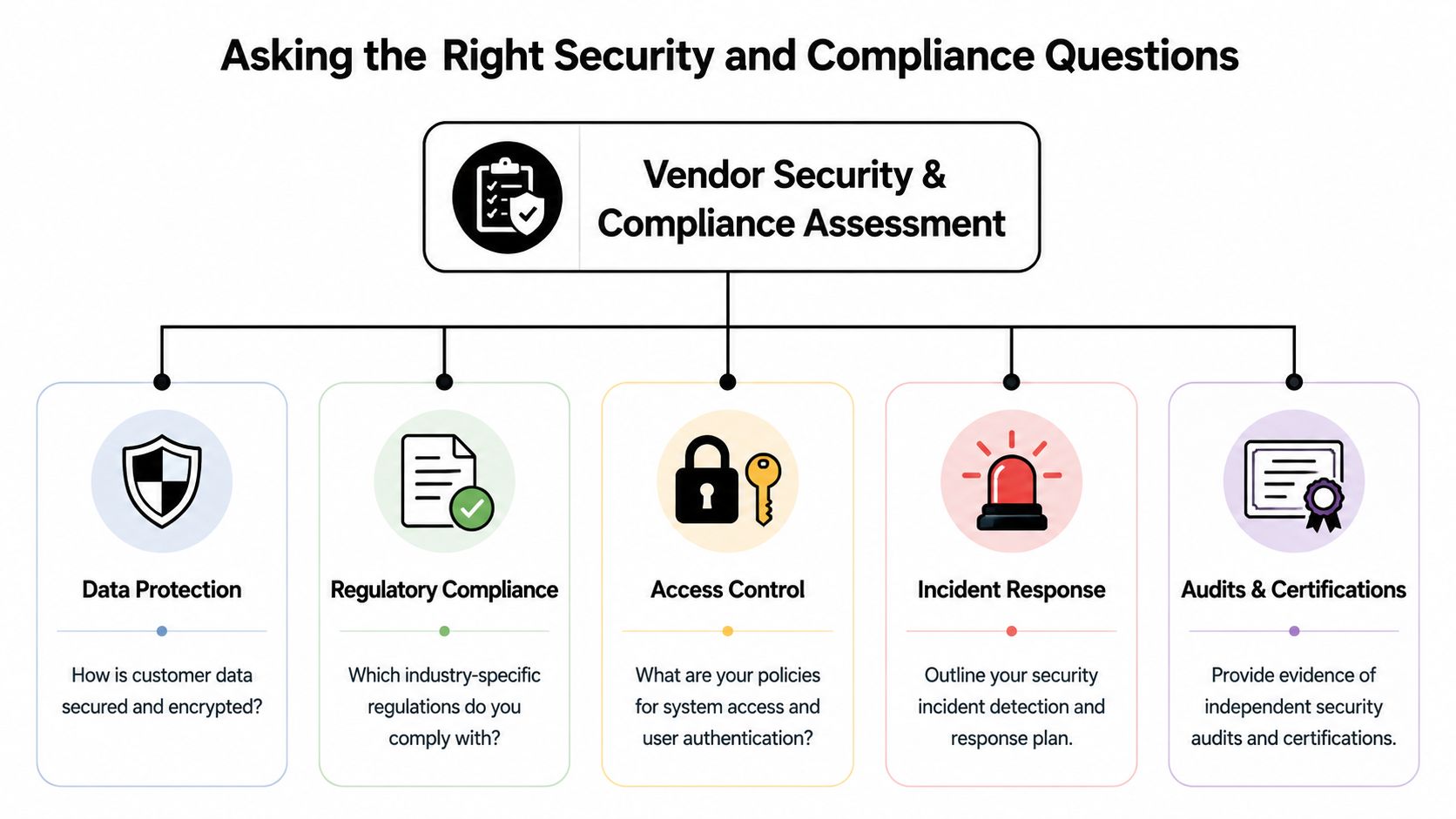
A mature provider won't act annoyed when you ask hard questions. They'll expect them, and they'll answer with documents, process descriptions, and named controls. A weak provider will answer with reassurance, branding language, or “we've never had an issue.”
Data handling and access control
Start with how they access and protect your environment.
Ask:
- What customer data do you collect or store? You need a concrete inventory, not a vague “only what's necessary.”
- How is access granted and revoked? Look for role-based access, named accounts, approval workflows, and prompt deprovisioning.
- Do technicians use MFA and managed devices? If remote access can occur from unmanaged endpoints, stop there.
- How are credentials handled during emergency work? Shared logins and ad hoc password passing are disqualifiers in serious environments.
A strong answer includes documented process, auditability, and separation between technician convenience and customer security.
Personnel controls and incident response
Telecom work often involves on-site access. That means the vendor's people matter as much as its tools.
Probe areas like:
Background screening
Ask which roles are screened, how often screening is refreshed, and whether subcontractors follow the same policy.Security training
Look for recurring training that covers phishing, customer data handling, escalation hygiene, and physical access expectations.Incident workflow
Ask how they detect, classify, contain, and communicate security incidents involving customer systems or data.Escalation ownership
Find out who contacts your team, what timeline they follow, and how evidence is preserved.
Risk check: If a vendor can describe how they restore service but can't describe how they handle a security event, you're looking at an operations shop with a governance gap.
Compliance claims need proof
Many vendors say they “follow best practices.” That phrase is useless unless they can map those practices to your requirements. If you're in healthcare, payments, government, or another regulated setting, ask them to explain how their support model aligns with your obligations.
Look for answers in this pattern:
- Documented controls instead of verbal assurance
- Evidence of audits or certifications where relevant
- Defined data retention and destruction practices
- Chain of custody for devices or storage media
- Clear subcontractor governance
If data-bearing telecom gear, retired storage, or network appliances are part of the engagement, their downstream handling matters too. Secure retirement should be treated as part of the support lifecycle, not a separate afterthought. This overview of secure data destruction is a useful benchmark for what disciplined end-of-life handling should look like.
What a good answer sounds like
You're listening for precision. Good vendors can tell you who has access, under what approval, from what device posture, through which systems, and how they prove it later. They can also explain what happens when a technician leaves, when a subcontractor is used, or when a customer requests data deletion.
Poor vendors retreat into slogans. That usually means the process lives in people's heads instead of in a system you can trust.
How to Negotiate Telecom Support SLAs and Pricing
Most telecom support contracts fail in two places. The SLA is too vague to enforce, and the pricing model implicitly rewards the wrong behavior.
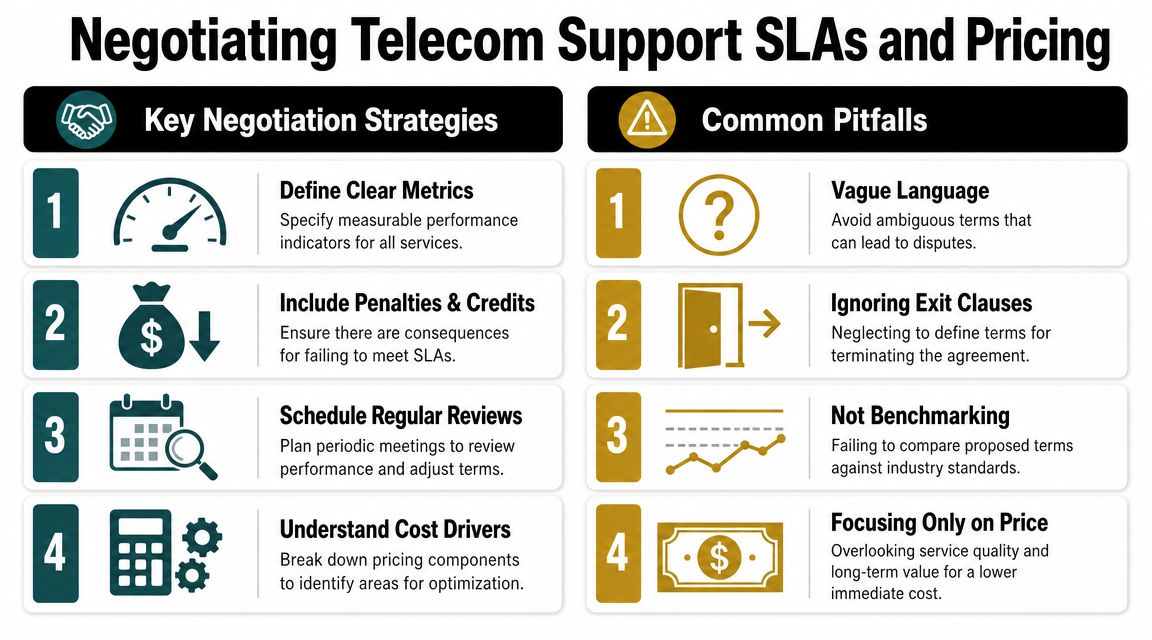
If your agreement says “24/7 support available,” that doesn't tell you who responds, how fast they engage, what counts as resolution, or what happens when the provider misses. You need language that ties support performance to service quality and business impact.
According to the verified industry guidance, effective telecom support is measured by network-side KPIs like call success rate, data speed index, and service availability, not just call center wait times. That's the right mindset for contract negotiation. Your SLA should reflect actual network outcomes and be tied to real-time monitoring reports, as noted in this telecom KPI and monitoring reference.
Build the SLA around operational reality
A practical telecom SLA usually needs several layers:
- Severity definitions: What counts as a critical outage versus a degraded but usable service?
- Response commitments: How quickly the provider acknowledges and begins active work.
- Restoration targets: Expected timelines for workaround, partial recovery, or full service restoration.
- Escalation thresholds: When the issue moves to senior engineering, carrier management, or executive visibility.
- Reporting obligations: What incident updates, root-cause summaries, and post-incident reviews you'll receive.
Don't let the vendor define everything around ticket response. A fast first reply with no meaningful action isn't service.
Push for measurable language
Use wording that can survive a dispute review. Better terms include:
- Defined service availability measurement methods
- Named reporting cadence for KPI reviews
- Credits or penalties for missed commitments
- Exclusions that are narrow and understandable
- Clear maintenance window rules
- Exit assistance requirements if the contract ends
“Available” is not the same as “working.” Your SLA should care about the second one.
Compare pricing models by failure mode
Pricing isn't just about cost control. It shapes behavior.
Retainer model
This works well when you have multiple sites, recurring moves-adds-changes, or complex carrier relationships. It can support continuity, familiarity with your environment, and better prioritization. The risk is paying for a passive vendor that logs tickets but doesn't improve operations.
Per-incident model
This can fit low-volume environments or temporary coverage gaps. It looks clean on paper, but it often discourages proactive work. Vendors paid only when something breaks don't have much incentive to reduce breakage.
Project-based model
This is useful for migrations, cutovers, circuit cleanups, and site consolidations. The risk is assuming a project vendor can also run steady-state support. Those are different muscles.
A practical negotiation approach is to separate recurring support from special projects and major after-hours changes. That keeps your baseline contract stable while giving both sides room to price unusual work transparently.
Review clauses people skip too often
Before signature, pay attention to the parts that aren't on the pricing summary:
| Contract Area | What to Look For |
|---|---|
| Out-of-scope work | Make sure exclusions are specific enough that normal support tasks don't become surprise invoices |
| Subcontractor use | Require visibility into when third parties are used and what standards govern them |
| Termination rights | Define notice periods, transition support, documentation handoff, and credential return |
| Price changes | Limit unilateral increases and require notice for rate adjustments |
| Service credits | Spell out how they're calculated, requested, and applied |
The best contract doesn't assume goodwill. It documents accountability.
Connecting Telecom Support to ITAD and Decommissioning
Most telecom support buying decisions focus on today's outages and tomorrow's tickets. That's too narrow. A telecom environment has a lifecycle, and support quality should be judged by how well the provider handles the end of that lifecycle too.
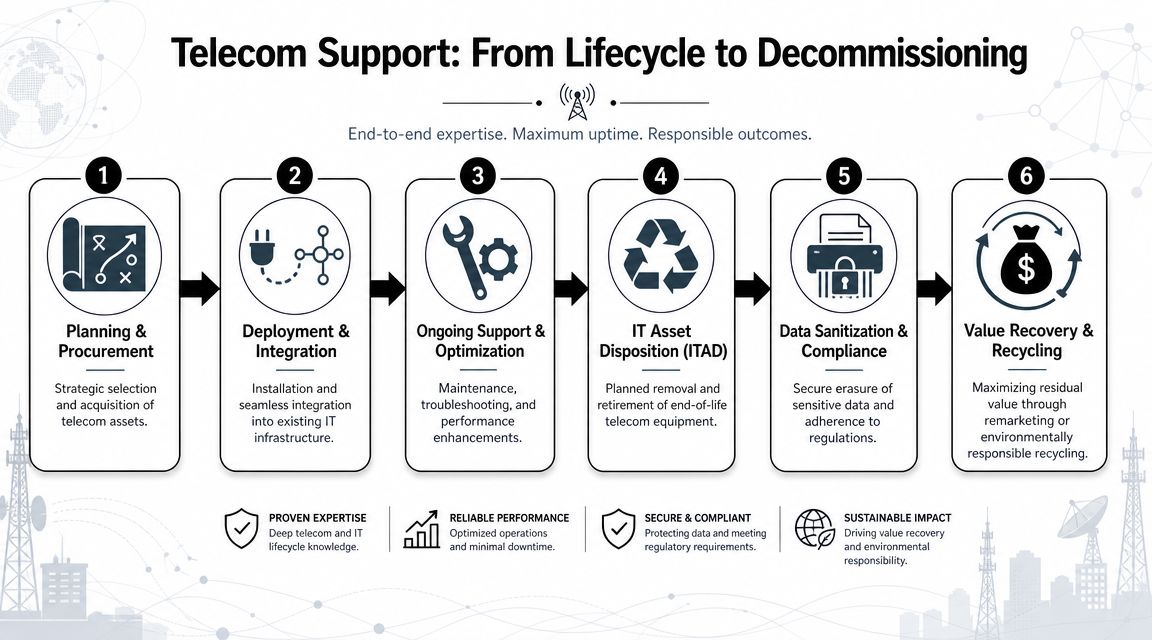
That issue is getting sharper as carriers move away from legacy copper and PSTN-dependent systems through 2026, a transition that creates practical risk for organizations still relying on alarm panels, elevators, point-of-sale terminals, fax machines, medical devices, or backup circuits. A support partner that only offers troubleshooting isn't enough. You need one that can inventory dependencies, test failover, and manage migration planning for business continuity, as reflected in the legacy network transition context.
Daily support and decommissioning are connected
The same provider that troubleshoots your estate should help answer questions like:
- Which sites still depend on analog lines or older voice infrastructure?
- Which devices are business-critical, safety-related, or compliance-sensitive?
- What has to be migrated, what can be retired, and what needs parallel testing?
- Which assets contain data or configuration that must be sanitized before disposal?
A provider that understands only the live environment will often miss retirement risk. That's how organizations end up discovering a forgotten analog dependency during a branch closure or a line disconnect.
Build a lifecycle checklist into vendor management
A practical telecom lifecycle review should include:
Dependency inventory
Maintain a current list of line-dependent systems, edge devices, and telecom-linked business processes.Migration testing
Require documented testing before disconnecting old services, especially where safety, payments, or regulated operations are involved.Removal coordination
Align carrier disconnects, equipment removal, cabling cleanup, and rack updates so nothing is retired out of order.Disposition controls
Treat retired telecom hardware like any other IT asset. Review chain of custody, data handling, and environmental disposition.
For larger environments, support and retirement planning often converge during site exits, network refreshes, and infrastructure consolidation. That's where a coordinated data center ITAD process becomes relevant, especially when telecom gear is mixed with servers, storage, security appliances, and networking equipment.
Legacy telecom isn't just old technology. It's hidden business dependency. Support partners who understand that save you from disruptive surprises.
Red Flags to Watch For and How to Engage a Partner
A few warning signs show up early if you know where to look. Be cautious if the vendor dodges security questions, uses a one-size-fits-all SLA, can't explain local dispatch coverage, or keeps steering the conversation back to price. Those patterns usually signal an operational gap the contract won't fix.
Also pay attention to how they talk about scope. If every meaningful task sounds “billable outside standard support,” the relationship will become expensive and adversarial fast. If they can't name the environments they serve best, they probably haven't built a repeatable practice.
Start small once you choose a provider. Give them a limited-scope pilot such as one region, one carrier estate, or one class of telecom incidents. Define escalation paths, meeting cadence, reporting expectations, and who owns communication with carriers and site contacts.
Then review performance in business terms. Did they shorten diagnosis? Reduce internal coordination burden? Improve change discipline? Surface hidden dependencies before they caused outages? That's what determines whether the vendor becomes a force multiplier or just another inbox.
If your telecom environment is heading into refreshes, site closures, legacy line retirement, or broader infrastructure decommissioning, Dallas Fortworth Computer Recycling can help you manage the end-of-life side without adding compliance or chain-of-custody risk. Their team supports secure IT asset disposition, data destruction, and responsible electronics recycling for organizations that need documented, business-ready retirement of technology.