
Expert Guide to Hire Telecom Company Near Me: 2026 Insights

Your project is already late. A site expansion is waiting on new fiber handoff, a call center is dealing with unstable voice quality, or an office relocation exposed just how old the network closet really is. Someone opens a browser, types hire telecom company near me, and gets a messy list of carriers, cabling crews, staffing firms, low-voltage installers, consultants, and managed service vendors that all sound interchangeable.
They aren't interchangeable.
Telecom buying gets complicated because you're rarely buying one thing. You're buying design judgment, field execution, support coverage, contract accountability, and, in many cases, a clean way to retire the infrastructure you're replacing. If you treat it like a simple local search, you usually end up comparing unlike-for-like proposals and negotiating the wrong terms.
Why Hiring a Local Telecom Company Is More Complex Than It Seems
Most buyers start with geography. That makes sense if the issue is urgent and physical work is involved. But local presence alone doesn't tell you whether a provider can handle inside plant work, carrier coordination, structured cabling, VoIP migration, branch cutovers, or regulated environments.
That confusion exists because telecom is a huge market. The global telecommunications services market was estimated at more than $1.8 trillion in 2024, which helps explain why a local search often surfaces a broad vendor ecosystem rather than a narrow specialty list, as noted in this telecom market context. In practical terms, buyers usually choose nearby telecom firms based on service specialization, turnaround speed, and regulatory capability, not simple distance.
A “near me” result can include companies that do any of the following:
- Carrier services: Circuit procurement, broadband, WAN, SIP, and mobility.
- Field infrastructure: Cabling, rack-and-stack, demarc extensions, patching, and onsite remediation.
- Telecom staffing: Contract technicians, network support personnel, and deployment labor.
- Managed communications: Ongoing administration of voice, UC, and related services.
The wrong telecom partner doesn't always fail at installation. Many fail later, when a ticket sits too long, a change request stalls, or a compliance requirement appears halfway through the project.
That's why the first screen shouldn't be “Who is close?” It should be “Who is built for the work I need done?” If you're sorting through local options, this guide to telecom solutions near you is a useful example of how to frame the search around service scope instead of proximity alone.
Defining Your Telecom Requirements Before You Search
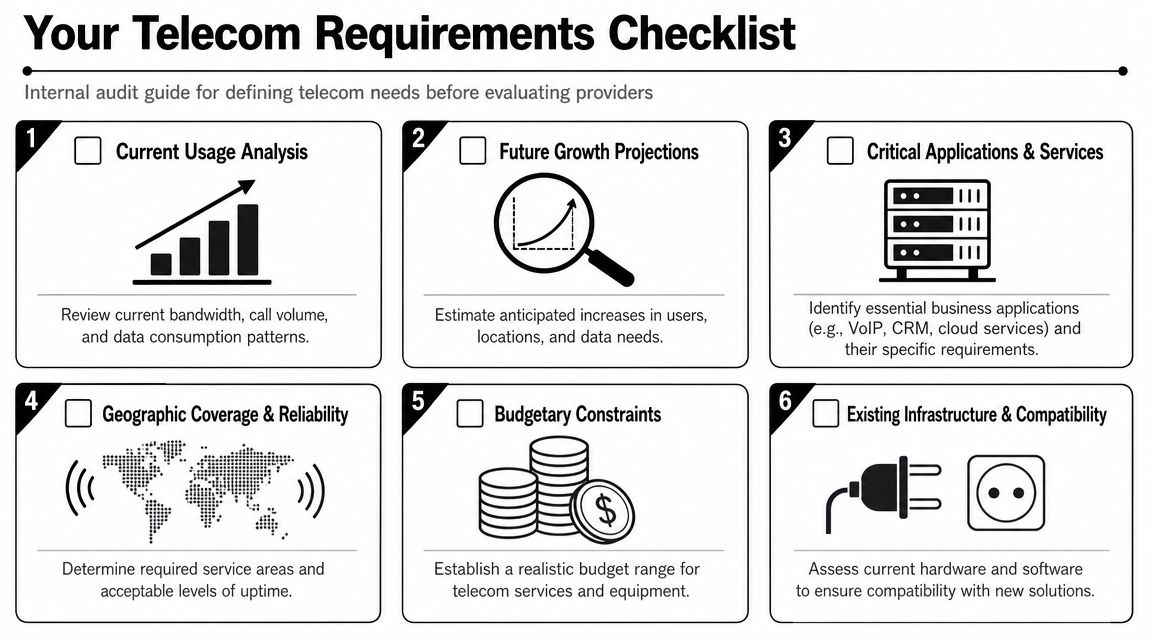
A good telecom search starts inside your organization, not in a vendor directory. If your team can't define the problem clearly, providers will define it for you, and they will define it in ways that fit what they sell.
The biggest mistake I see is bundling very different needs into one vague request. A buyer asks for “telecom support” when the actual need is one of several very different work types. Industry context shows that telecom roles can range from inside plant technicians to cable installers, with work that includes fiber troubleshooting, headend migrations, and other specialized responsibilities, which is why local search content often blurs the line between telecom infrastructure, IT staffing, and general low-voltage work in this industry overview of telecom roles.
Separate the work into real categories
Before you contact anyone, write down which of these buckets applies:
- Circuit and carrier work: New connectivity, bandwidth changes, DIA, SIP, failover, or last-mile coordination.
- Physical infrastructure: Cabling, MDF/IDF cleanup, cross-connects, rack installations, patch panel work, and demarc extensions.
- Voice and collaboration: PBX replacement, UC rollout, handset deployment, call routing changes, and number porting.
- Field support or staffing: Temporary technicians, rollout labor, site surveys, dispatch support, or recurring maintenance coverage.
These are not the same procurement event. A firm that's strong at sourcing carrier services may not be the right crew to rework a congested telecom room. A staffing provider may solve a labor gap but still leave you responsible for engineering, quality control, and acceptance.
Build a short internal requirements brief
Keep it practical. One to two pages is enough if it answers the right questions.
Include:
Business trigger
Why is this happening now? Office move, branch opening, cloud migration, persistent outages, compliance issue, merger, or equipment end-of-life.Site scope
Single location, multi-site rollout, remote branches, warehouses, clinics, or data center adjacency.Application dependency
Which systems break if service degrades? VoIP, contact center, VPN, cloud ERP, security systems, point-of-sale, badge access, or production systems.Service expectations
Required uptime, acceptable latency, after-hours support, onsite dispatch expectations, and maintenance windows.Constraints
Budget range, procurement rules, landlord restrictions, change freezes, union site rules, and facility access limits.Existing environment
Current carrier contracts, cabling condition, handoff types, legacy phone systems, rack space, power, and battery backup.
Practical rule: If you can't describe what success looks like at handoff, acceptance testing, and steady-state support, you're not ready to request a proposal.
Include the retirement question early
Teams often think only about the incoming service or new installation. They don't map what happens to outgoing hardware, abandoned cabling, retired routers, old switches, or decommissioned voice gear. That omission creates security, logistics, and budget problems later.
This is also where broader operational discipline helps. Teams that already track hardware lifecycle and inventory through tools and workflows tend to scope telecom changes more cleanly. If your organization needs to tighten that side of the process, this overview of IT asset management software considerations is worth reviewing before you issue an RFP or request quotes.
How to Evaluate a Telecom Vendor's Capabilities
Once your requirements are defined, stop reading marketing claims and start testing operating capability. Telecom projects don't fail because a proposal looked weak. They fail because the provider couldn't staff the work properly, couldn't coordinate dependencies, or couldn't support the environment after cutover.
The labor market matters here. The U.S. Bureau of Labor Statistics projects about 23,200 openings per year on average for telecommunications technicians due to replacement needs, and the same outlook reinforces that networks require continuous maintenance, night and weekend work, and frequent site travel in this BLS employment outlook for telecom technicians. For buyers, that means local telecom procurement is driven as much by ongoing support continuity as by expansion.
What to verify beyond the proposal
A capable vendor should be able to answer operational questions without hand-waving. I look for clarity in four areas.
| Evaluation area | What strong vendors show | What weak vendors do |
|---|---|---|
| Technical fit | They define exactly which parts of your scope they perform directly | They say yes to everything |
| Field coverage | They explain dispatch model, local coverage, and escalation paths | They stay vague on after-hours support |
| Project control | They document milestones, dependencies, and acceptance criteria | They rely on informal updates |
| Support model | They distinguish install team from steady-state support team | They assume the install crew can cover everything |
Ask for evidence tied to your environment
Don't ask, “Can you handle a project like this?” Ask narrower questions.
- For multi-site work: How do you schedule site access, pre-stage equipment, and handle no-access events?
- For voice projects: Who owns number port coordination, dial plan validation, and cutover rollback decisions?
- For physical infrastructure: Who certifies the work, labels it, and updates as-built documentation?
- For ongoing support: What happens on a weekend outage, and who is accountable if the first responder can't resolve it remotely?
A vendor that has done this repeatedly will answer with process, not slogans.
Score the vendor as if you're hiring a leader
The best procurement teams evaluate vendors the same way disciplined hiring teams evaluate technical staff. You need objective criteria, multiple evaluators, and a clear view of what the provider will own in production.
I also prefer building a simple scorecard with weighted categories such as service fit, field readiness, project management discipline, support maturity, and commercial flexibility. That makes comparison more defensible, especially when one bidder is cheaper but obviously thinner on delivery depth.
If you're evaluating providers in a complex market, this reference on telecom consulting services in Los Angeles shows the kind of broader advisory lens that's often needed when local provider choices look similar on paper.
A low bid often hides one of three things: subcontracting risk, weak support coverage, or an incomplete understanding of your environment.
Decoding SLAs Security and Compliance
Most telecom contracts look acceptable until something goes wrong. Then you discover the response commitment applies only during limited hours, the uptime language excludes major parts of the service path, or the security schedule says less than your internal policy requires.
The Service Level Agreement is where you find out whether the provider is selling outcomes or just selling effort.
The logic is straightforward. Hiring experts recommend defining success up front with measurable outcomes, and one cited benchmark warns that poor alignment can cost up to 30% of a salary when fit is wrong, according to this discussion of measurable hiring success and bad-fit cost. That principle maps directly to telecom contracts. If the SLA doesn't define success in measurable terms, you're relying on interpretation during an outage or dispute.
Translate business needs into enforceable terms
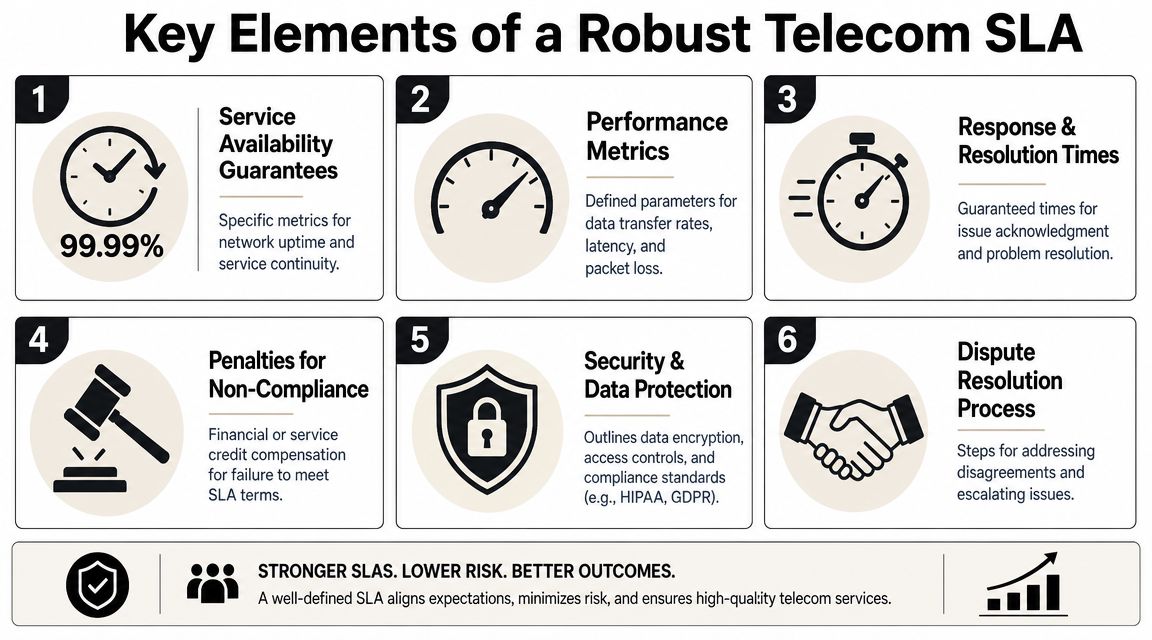
A contract should express service in operational language your team can validate.
Focus on clauses like these:
- Availability definition: What service is covered, how downtime is measured, and what exclusions apply.
- Performance metrics: Latency, packet loss, jitter, throughput thresholds, and how they are tested.
- Response and resolution commitments: Separate acknowledgment time from actual fix time.
- Escalation path: Named tiers, timing, and authority to engage carrier or field resources.
- Maintenance handling: Notice periods, approved maintenance windows, and emergency change exceptions.
- Security obligations: Access control, remote administration controls, incident notification, and handling of customer data.
Read the exclusions harder than the promises
Most boilerplate SLAs look strong in the summary page. The actual exposure is in the carve-outs.
Watch for language that excludes customer-premises equipment, local loop dependencies, third-party carrier segments, utility disruptions, or maintenance periods that are broad enough to swallow the guarantee. Those may be commercially reasonable, but they need to be understood before signature.
If the vendor can't show how a promised metric is measured, reported, and disputed, treat that metric as marketing language, not contractual protection.
Match the security addendum to your environment
Healthcare, government, finance, and multi-site enterprises shouldn't accept generic security statements. If the provider will access admin consoles, support voice recordings, touch network closets, or remove retired hardware, your contract should specify control expectations in writing.
That means defining who can access what, how credentials are handled, what happens during an incident, and how evidence is preserved if equipment is removed or replaced. For organizations with broader infrastructure concerns, this guide to telecom infrastructure services in Los Angeles reflects the kind of end-to-end thinking contract language should support.
Comparing Pricing Models and Negotiating Your Contract
Price comparison gets distorted when buyers compare monthly charges without comparing commercial structure. Two proposals can look similar in year one and behave very differently once usage changes, a site closes, service expands, or a cutover slips.
The practical way to evaluate pricing is to ask one question first. What cost pattern best matches your operating reality?
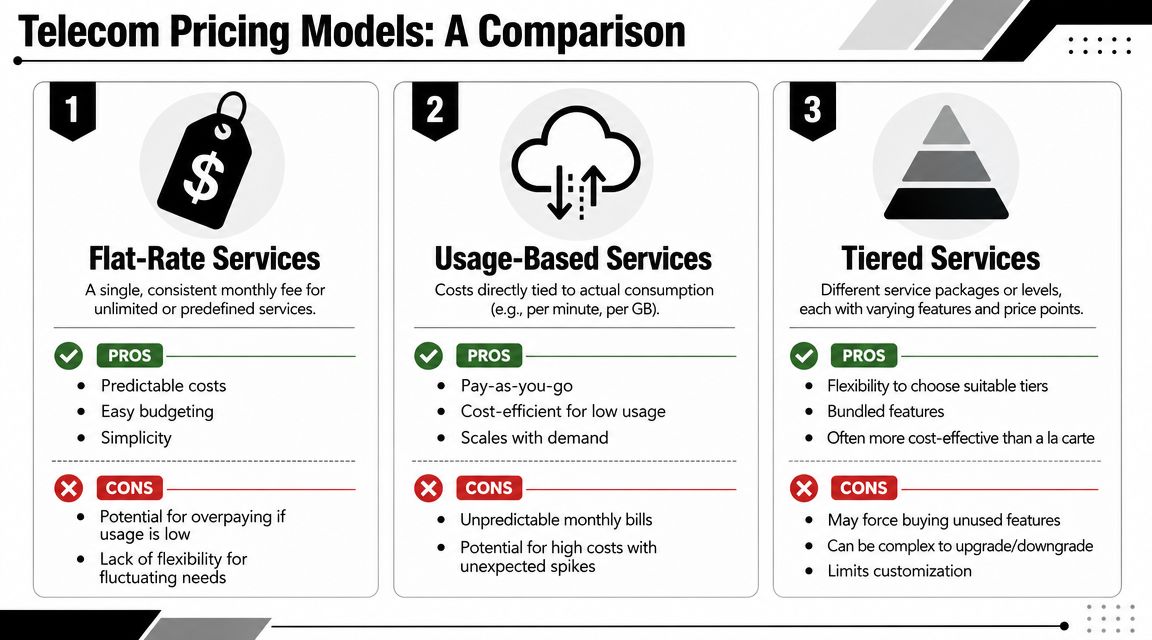
How the common models differ
| Pricing model | Best fit | Main benefit | Main risk |
|---|---|---|---|
| Flat-rate | Stable locations with predictable demand | Easier budgeting | You may pay for unused capacity or services |
| Usage-based | Variable environments or seasonal activity | Better alignment to actual consumption | Monthly bills can become hard to forecast |
| Tiered | Organizations that want packaged features and upgrade paths | Flexible middle ground | Bundles may include features you won't use |
The model itself isn't good or bad. It becomes expensive when it doesn't match your environment.
A small branch portfolio with stable voice and connectivity needs may benefit from flat recurring charges because finance can forecast more easily. A business with event-driven traffic or fluctuating site activity may prefer usage-linked pricing if the contract has clean reporting and sensible thresholds. Tiered offers can work well when the provider's feature bundles match your roadmap, but they can also hide forced purchases.
Build your comparison around total contract behavior
Don't compare only setup fees and monthly recurring charges. Look at what the contract does under pressure.
Review:
- Term length: Longer terms can improve pricing, but they also raise exit friction.
- Upgrade path: Can you add bandwidth, users, or sites without reopening the whole deal?
- Early termination language: What happens if a location closes, a carrier misses delivery, or your strategy changes?
- Dependency costs: Truck rolls, after-hours work, number porting support, MAC work, project management, and change orders.
- End-of-term handling: Auto-renewals, notice windows, equipment return, and site cleanup responsibilities.
Your leverage is strongest before you award the work. Once the provider has your schedule pressure, your negotiation position gets weaker.
What actually works in negotiation
I rarely advise buyers to chase the last dollar. The better move is to trade commercial concessions for operational protection.
Ask for things like clearer acceptance criteria, capped change-order handling, stronger response commitments during cutover, defined escalation rights, flexible adds and moves, and explicit responsibilities if third-party dependencies delay delivery. Those terms often matter more than a modest reduction in recurring price.
If a bidder won't improve weak language but offers a lower monthly number, treat that as a warning sign. Cheap service with vague accountability becomes expensive fast.
The Overlooked Final Step Planning for Asset Disposition
This is the part most telecom buying guides skip. The project starts with new service, new cabling, or new hardware. It ends with old routers, switches, racks, batteries, phones, and cabling that someone has to remove, document, secure, transport, and retire properly.
If that work isn't defined up front, it gets pushed into the final week of the project, where mistakes are most likely.
Industry context makes the point clearly. Procurement risk is often miscalculated because buyers focus on installation speed and ignore hidden dependency chains and asset disposition during decommissioning. The scale of telecom infrastructure is large, with Array Digital Infrastructure stating it manages 4,400 towers in the U.S., and that broader asset reality is part of why buyers need a partner that can coordinate logistics, chain of custody, and compliant removal without disrupting service, as described on Array Digital Infrastructure's site.
What should be in scope before work begins
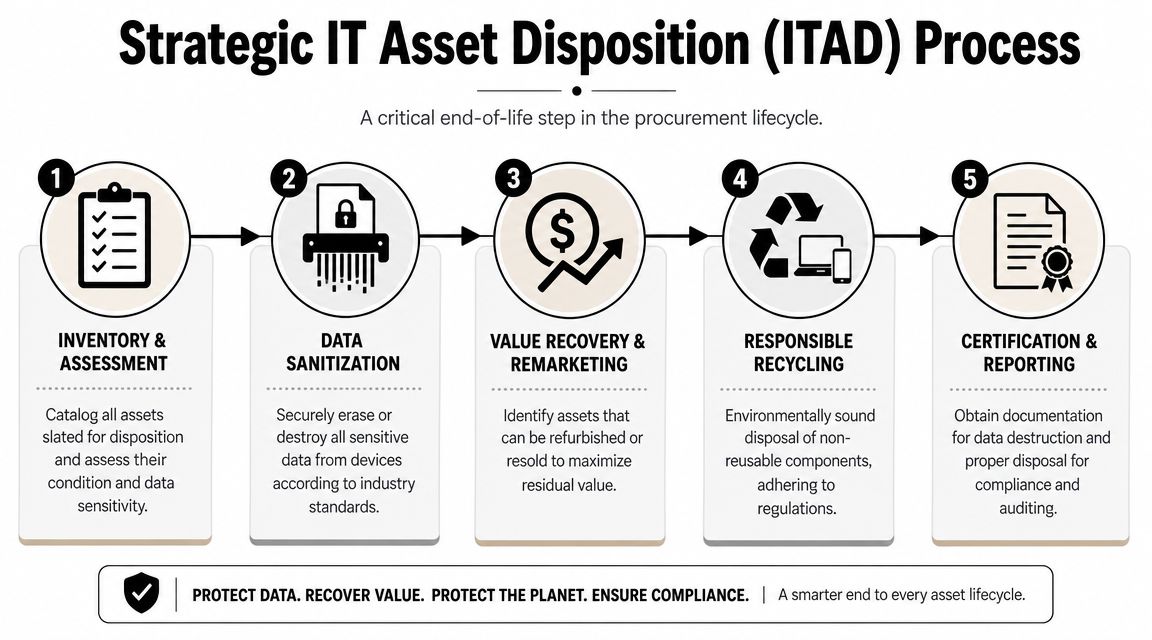
A telecom provider doesn't need to perform every downstream disposition function directly. But someone must own the process, and the responsibility should be written down.
At minimum, define:
- Inventory control: Which assets are being removed, where they are, and who signs off.
- Data handling: Which devices may contain configurations, credentials, call data, logs, or stored media.
- Chain of custody: Who touches the equipment, where it goes, and what documentation follows it.
- Service protection: What stays in place until cutover is validated.
- Disposition route: Reuse, resale, certified destruction, recycling, or regulated disposal.
Why this matters during vendor selection
I've seen otherwise solid projects create avoidable risk at the end. An installer pulls equipment before rollback is complete. A site team stacks retired gear in an unsecured room. No one documents serials. Cabling gets abandoned because removal wasn't priced. Later, audit and facilities teams inherit the mess.
This isn't a cleanup issue. It's a procurement issue.
A telecom project isn't complete when the new circuit comes up. It's complete when the old environment is retired in a way your security, compliance, and facilities teams can defend.
If your organization needs to account for retired network gear responsibly, this resource on environmentally friendly telecom disposal near you shows the type of disposition planning that should be considered during vendor selection, not after the installers leave.
Conclusion Choosing a Partner for the Full Lifecycle
The right answer to hire telecom company near me isn't the nearest vendor with a polished website. It's the provider, or provider team, that can match your technical scope, support the environment after go-live, commit to measurable service terms, and handle the end of the lifecycle with the same discipline as the beginning.
That means doing the internal work first. Define what you need. Separate carrier work from field infrastructure, staffing, and managed support. Evaluate vendors on operating maturity, not just sales responsiveness. Push measurable outcomes into the SLA. Compare pricing models based on contract behavior, not headline price.
Then ask the question many buyers ask too late. What happens to the old equipment, the removed cabling, the retired voice systems, and the network gear that still contains business data?
A telecom partner worth hiring won't treat that as someone else's problem. They will account for transition risk, support continuity, and the controlled retirement of replaced assets. That's what mature procurement looks like. It protects uptime, reduces surprises during implementation, and leaves your organization with a cleaner operational record when the project is done.
Choose for the full lifecycle, and the project usually goes better from day one.
If your team needs a secure, compliant way to retire telecom and IT equipment at the end of a project, Dallas Fortworth Computer Recycling helps organizations manage decommissioning, certified data destruction, and responsible electronics recycling with the chain-of-custody discipline procurement teams need.