
Best IT Asset Management Software a Comprehensive Guide
The right IT asset management software gives you a single, real-time source of truth for all your hardware and software. It’s what elevates an IT department from a cost center to a strategic partner in the business. Top-tier platforms like ServiceNow, Alloy Navigator, and ManageEngine AssetExplorer are built to automate asset discovery, rein in software licenses, and secure every device from deployment to retirement. Making the right choice here is absolutely critical for controlling costs, staying compliant, and closing security gaps.
What Is IT Asset Management and Why It Matters
IT Asset Management (ITAM) is the business practice of managing and optimizing every piece of technology in your organization—across its entire lifecycle. It goes way beyond a simple inventory spreadsheet. A proper ITAM strategy connects the dots between financial, contractual, and physical asset data to give leadership a complete picture of where their tech dollars are going.
This isn't just an IT chore; it's a core business function. It provides the hard data you need to stop reacting to problems and start making proactive, strategic decisions.
The Core Pillars of Modern ITAM
A mature ITAM program, powered by good software, delivers real value in three key areas. Think of these as the shift from basic tracking to gaining strategic control over your entire technology environment.
- Cost Optimization: ITAM directly hits the bottom line by spotting underused software licenses, preventing duplicate purchases, and accurately tracking asset depreciation. You finally stop paying for what you don't use.
- Risk Mitigation: Proactively managing software compliance helps you avoid costly vendor audits and steep fines. A clear inventory is also your first line of defense against security threats from shadow IT or unpatched devices.
- Operational Efficiency: Automating asset discovery and tracking frees up your IT team's time for more important work. When someone joins or leaves the company, the ITAM system makes provisioning and recovering their devices a smooth, documented process, preventing asset loss.
From Procurement to Disposition
The best ITAM software gives you visibility into the complete asset journey, from the moment a purchase order is cut to the day a device is securely retired. This lifecycle approach is what allows for truly informed decision-making.
A critical—and often ignored—final step is IT Asset Disposition (ITAD). A strong ITAM system keeps a definitive record of every device, making it easy to flag assets that are ready for retirement. This data is essential for maintaining a secure chain of custody during disposal and ensuring sensitive information is completely destroyed. You can learn more about its importance in our complete guide on what IT asset disposition entails.
An effective ITAM program is the bedrock of a defensible security and compliance posture. It creates an auditable trail for every piece of hardware and software, proving due diligence from acquisition through secure destruction.
The growth of the global IT asset management software market highlights just how vital this has become. The market is projected to expand from USD 2.31 billion in 2025 to USD 3.54 billion by 2032, a clear sign that organizations are recognizing its strategic value. You can find more market growth insights on coherentmarketinsights.com.
Evaluating Core Capabilities of ITAM Software
When you're comparing the best IT asset management software, it’s all too easy to get lost in feature lists that start to look identical. The real difference isn't just if a feature exists, but how well it actually works. A top-tier platform does more than just basic tracking; it gives you a single source of truth for every piece of technology your organization owns.
This unified inventory is the absolute heart of any effective ITAM strategy. It pulls together hardware specs, software licenses, purchase dates, warranty details, user assignments, and maintenance histories into one place. This is the foundation that lets you make smart, strategic decisions and turns your IT department from a reactive fire-fighting crew into a proactive business partner.
Automated Asset Discovery and Inventory
Let's be honest: manual inventory is a recipe for mistakes, security holes, and wasted time. The bedrock of any modern ITAM solution is its power to automatically find and catalog every single device on your network—from servers and laptops to printers and IoT gadgets.
This isn't just about making a list one time. The best discovery tools are constantly scanning to spot new devices, identify changes to existing assets, and flag unauthorized hardware. This real-time visibility is critical for shutting down security gaps from shadow IT and making sure your inventory is always dead-on accurate. Trying to do this by hand is a losing battle.
A strong discovery function should deliver:
- Agent-based and agentless scanning: You need the flexibility to monitor everything, whether it’s a corporate laptop with an agent installed or network gear that can't have one.
- Detailed data collection: It should grab more than just the device name. Think hardware specs, installed software, patch levels, and network configurations.
- Scheduled and on-demand scans: Set it and forget it with automatic scans, but also have the power to kick one off manually when you need an immediate update.
To help you gauge a platform's maturity, here’s a breakdown of what to expect at different levels.
ITAM Software Core Feature Evaluation Matrix
| Core Capability | Basic Functionality | Intermediate Functionality | Advanced Functionality |
|---|---|---|---|
| Asset Discovery | Manual import or scheduled network ping scans. | Agent-based and basic agentless discovery (SNMP, WMI). Differentiates asset types (e.g., laptop vs. server). | Hybrid discovery with dependency mapping. AI-driven normalization of data. Detects rogue and IoT devices. |
| Software License Management | Manually tracks license keys and purchase orders. Basic license counts. | Automated software recognition and license reconciliation. Tracks key metrics like installations vs. entitlements. | Proactive compliance alerts. Manages complex licenses (CPU, core, cloud). Optimizes license usage and automates re-harvesting. |
| Lifecycle Management | Tracks purchase date and basic warranty info. | Manages contracts, leases, and maintenance agreements with renewal alerts. | Full lifecycle automation from procurement to disposal. Integrates with ITAD workflows. Predictive analytics for hardware refresh cycles. |
| Reporting & Analytics | Pre-built reports on asset counts and locations. | Customizable dashboards. Reports on software compliance, asset aging, and cost allocation. | Predictive analytics for budget forecasting. TCO analysis. Business intelligence (BI) integration for cross-departmental insights. |
| Integrations | Basic CSV import/export functionality. | Pre-built connectors for major IT Service Management (ITSM) and endpoint management tools. | A robust API with extensive documentation. Deep integrations with procurement, finance (ERP), and security (SIEM) systems. |
This matrix should give you a clear framework for matching your specific requirements to a solution that truly fits, rather than just settling for one with the longest feature list.
Comprehensive Software License Management
Software is easily one of the biggest and most complicated line items in any IT budget. Solid software license management (SLM) isn't just a nice-to-have; it's what stops you from failing a costly vendor audit or wasting money on licenses nobody is using.
A powerful ITAM tool doesn’t just show you a list of your licenses—it actively manages them. It checks the software it finds on your network against your purchase records, giving you a crystal-clear view of your compliance status. This immediately helps you spot over-licensed software where you’re paying for too many seats and under-licensed apps that could get you hit with huge fines.
By proactively monitoring license usage, organizations can often reclaim 20-30% of their software spend within the first year of implementing a mature ITAM solution. This comes from re-harvesting unused licenses and negotiating smarter contracts based on real data.
Full Lifecycle and Contract Management
The best IT asset management software keeps an eye on assets long after they're deployed. True lifecycle management gives you total visibility from the moment an asset is purchased to the day it’s retired. Your platform should manage warranty information, lease agreements, and maintenance contracts, and send you automatic alerts before they expire.
This proactive approach lets you make informed decisions about renewing a contract, extending a lease, or retiring an asset. It’s also essential for planning your IT asset disposition (ITAD). When a laptop or server hits the end of its life, the ITAM system should have all the data—model, age, data-bearing status—needed to kick off a secure and compliant disposal process. For more on this, check out our guide on IT asset management best practices.
The market has also clearly voted on how these systems should be deployed. Cloud-based models are now the standard, expected to hold 62.62% of the market share by 2025. This shift to the cloud is all about swapping big, upfront capital costs for predictable operational expenses, since you no longer need to buy and maintain your own on-premise hardware.
Aligning ITAM with Security and Compliance
Effective IT asset management isn’t just about keeping track of inventory for the finance department. It's a cornerstone of your organization's entire security and compliance posture. The best ITAM software is, at its heart, a powerful risk management tool, giving you the detailed, auditable records needed to navigate a minefield of regulations. Without it, you’re flying blind and can’t prove due diligence or secure sensitive data throughout an asset’s lifecycle.
This connection becomes crystal clear at the end of an asset’s life. A well-kept ITAM database is the launchpad for a secure IT Asset Disposition (ITAD) program. It provides a definitive history of every device—from deployment to retirement—making sure no data-bearing asset gets left behind.
Bridging ITAM Data with Secure ITAD Workflows
The data you carefully log in your ITAM system isn't just for day-to-day operations; it directly fuels a secure and defensible disposition process. When an asset is flagged for retirement, the ITAM platform should kick off a series of controlled, documented steps. This seamless handoff is what separates a mature, risk-aware organization from one exposed to data breaches and compliance failures.
The process starts by using ITAM reports to pinpoint which assets are nearing end-of-life based on age, performance, or lease agreements. Once identified, these devices are segregated for pickup by a certified ITAD partner. The ITAM system then maintains an unbroken chain of custody, tracking the asset from the moment it leaves your building until it’s finally destroyed.
Think of your ITAM platform as your central evidence locker. For every retired asset, it must store the corresponding proof of data destruction. This creates an permanent, auditable record that will stand up to scrutiny from any regulatory body.
This documentation is absolutely non-negotiable for proving compliance. The ability to connect a specific serial number to a signed certificate of destruction is the ultimate proof of your organization's commitment to data security. You can get a better sense of why this paperwork is so vital by learning what a certificate of destruction for hard drives entails.
Meeting Specific Compliance Mandates
Different industries operate under unique regulatory pressures, and a solid ITAM tool is essential for meeting those demands. The detailed asset records and lifecycle tracking in top-tier software provide the hard evidence needed to satisfy auditors and avoid costly penalties.
Just look at these real-world scenarios:
- HIPAA in Healthcare: A hospital needs to retire a cart of laptops that handled electronic protected health information (ePHI). The ITAM system gives them a precise list of serial numbers, proves the drives were encrypted, and later archives the certificates of destruction. This shows all patient data was sanitized according to HIPAA’s strict security rules.
- NIST Standards for Government: A federal agency decommissions a server and must follow NIST 800-88 guidelines for media sanitization. The ITAM platform documents the exact data destruction method used (like degaussing or shredding) and links it to that server’s asset record, creating an audit trail that confirms it met federal mandates.
- e-Stewards for Environmental Responsibility: A corporation focused on sustainability uses its ITAM data to confirm its retired electronics go to an e-Stewards certified recycler. The system tracks the assets to the certified facility, verifying that hazardous e-waste was handled responsibly and didn’t harm the environment.
In every case, the ITAM software provides the crucial link between internal policy and external compliance. It turns a high-risk process into a managed, auditable workflow. It transforms the vague requirement of "being compliant" into a series of concrete, verifiable actions recorded for every single asset. That capability is a core feature you should be looking for when evaluating the best IT asset management software for your organization.
Choosing the Right ITAM Solution for Your Industry
Picking the best IT asset management software is never a one-size-fits-all decision. What works for a sprawling enterprise just won’t cut it for a highly regulated hospital or a budget-focused government agency. Generic feature lists don't help because every industry faces its own unique operational pressures, compliance rules, and security threats.
To make the right choice, you have to focus on the features that solve your sector’s biggest headaches. A must-have feature for one organization might be a low priority for another. This practical approach ensures you’re investing in a tool that solves real-world problems, not just checking boxes on an RFP.
Healthcare ITAM Requirements
In healthcare, ITAM is really about patient safety and data security. The software has to do more than just count computers; it needs to manage a complex web of medical devices, data-bearing assets, and traditional IT gear, all while staying compliant with HIPAA.
The main focus is on detailed tracking and compliance. A solid ITAM solution in a hospital or clinic must be able to:
- Manage Regulated Medical Devices: This means tracking everything from infusion pumps and diagnostic imaging machines to patient monitors right alongside laptops and servers. The software has to log maintenance schedules, calibration records, and firmware updates to keep things running safely for patients.
- Ensure HIPAA Compliance for Data-Bearing Assets: Every single device that stores or sends electronic protected health information (ePHI) needs to be tracked meticulously. When it’s time to retire an asset, the ITAM system must kick off a secure, auditable disposal process that links a serial number to a certificate of data destruction.
- Support Network Segmentation: The platform should help identify and classify medical devices, allowing IT teams to isolate them on the network to shrink the potential attack surface.
A key differentiator for healthcare is the ability to manage the full lifecycle of specialized medical equipment. The best ITAM software provides a single pane of glass for both clinical engineering and IT assets, creating a unified strategy for security and compliance.
Government and Public Sector Needs
Government agencies work under a microscope, with a clear mandate for fiscal responsibility and airtight data security. For them, ITAM is all about accountability, auditability, and sticking to federal rules like the Federal Information Security Management Act (FISMA) and NIST standards.
The software has to provide a clean, verifiable record for every single asset, from the day it’s purchased to the day it’s destroyed. The priorities here are very different from the private sector.
For instance, a government agency has to prioritize:
- Rigorous Chain-of-Custody Tracking: From the moment a server is taken offline to its final disposal, its location and status must be documented without fail. The ITAM system is the primary tool for this evidence trail, which is absolutely critical during audits. Our guide on the data center decommissioning process shows just how crucial this step-by-step tracking is.
- Adherence to Federal Data Security Mandates: The platform must support specific data sanitization standards, like NIST 800-88. It needs to record the exact data destruction method used for each asset, giving you definitive proof of compliance.
- Detailed Lifecycle Cost Reporting: Public funds demand strict oversight. An ITAM tool must be able to generate detailed reports on total cost of ownership (TCO), asset usage, and maintenance costs to justify budgets and show responsible stewardship of taxpayer money.
Enterprise and Corporate Environments
For large, multi-location enterprises, the main drivers for ITAM are scalability, cost savings, and operational efficiency. The software has to plug into a complex tech stack and deliver insights that support bigger business goals. With so many assets, manual work is out of the question—automation is essential.
An enterprise-grade ITAM platform has to deliver:
- Seamless ITSM Integration: The tool needs robust, pre-built connectors for platforms like ServiceNow, Jira, or BMC Helix. This weaves asset data directly into your incident, problem, and change management workflows for a complete picture of the IT environment.
- Focus on Total Cost of Ownership (TCO): Beyond just tracking assets, the software should have powerful analytics to calculate TCO. This means factoring in purchase prices, software licenses, maintenance contracts, and disposal fees to help inform hardware refresh cycles and budget forecasts.
- Scalability for a Global Footprint: The solution must be able to discover and manage tens of thousands of assets across different networks and geographic locations without slowing down. Cloud-native platforms are often preferred for this reason, giving you the flexibility to scale up or down as needed.
By mapping your industry's specific challenges to these distinct feature sets, you can move past generic comparisons and find the best IT asset management software that will truly deliver value for your organization.
How to Evaluate and Select Your ITAM Software
Choosing the right IT asset management software can feel like a shot in the dark, but a structured evaluation process turns it into a strategic, data-backed decision. This isn't just about ticking off feature boxes; it's about finding a solution that aligns with your real-world needs for the long haul.
The first step is getting the right people in the room. Pull together a small team with stakeholders from IT, finance, and procurement to make sure every angle is covered. Their first job is to get on the same page about your primary goals, non-negotiable features, and budget. This defines what "best" actually means for your organization.
This decision tree shows how different industries tend to weigh their ITAM needs, which can be a great starting point for your team's discussion.
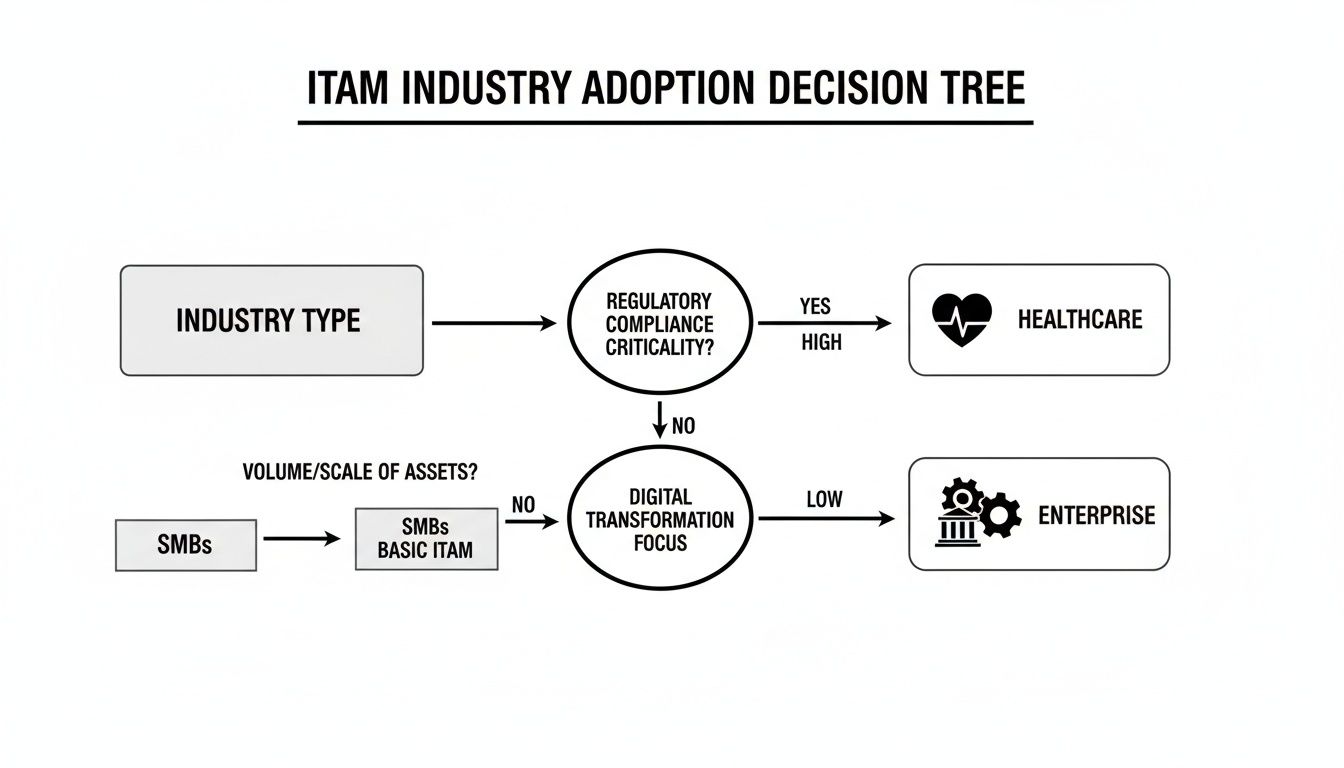
As you can see, core ITAM functions are universal, but specific security and compliance demands often become the deciding factor.
Building a Weighted Scoring Model
For a truly objective comparison, a weighted scoring model is your best friend. It forces your team to prioritize what’s most important and stops you from getting distracted by a single flashy feature. This simple tool removes bias and gives you a clear, defensible reason for your final choice.
Here’s the breakdown:
- Identify Core Categories: List your main evaluation areas. Think beyond features and include criteria like security, vendor support, integration capabilities, and total cost of ownership.
- Assign Weights: Distribute 100 percentage points across those categories based on what matters most. A financial services firm might give security a 30% weight, whereas a nonprofit might assign that same weight to overall cost.
- Score Vendors: As you watch demos and talk to vendors, score each one on a scale of 1-5 for every category. A 5 means they nail your requirements perfectly; a 1 means they're not even close.
- Calculate Weighted Scores: Multiply each vendor's score by the category weight to get a weighted score. Add them all up for a final number that shows how well each platform truly fits your needs.
A common mistake is treating all criteria equally. A weighted model ensures that critical requirements, such as SOC 2 compliance or robust API access, are given the mathematical importance they deserve in the final decision.
Key Criteria Beyond the Feature List
Asset discovery and inventory are table stakes. The real long-term value of an ITAM solution often comes from factors that aren't on the main feature list. Don't overlook these.
- Total Cost of Ownership (TCO): Look past the sticker price. Ask about implementation fees, training costs, charges for extra integrations, and ongoing support contracts. A low initial price can easily hide significant long-term expenses.
- Security and Compliance Certifications: This is non-negotiable in many fields. Make sure the vendor holds relevant certifications like SOC 2 Type II or ISO 27001 and can help you meet regulations like HIPAA or GDPR.
- API and Integration Capabilities: Your ITAM tool can't be an island. Check the quality of its API documentation and look for pre-built connectors to your existing tools—like your ITSM, endpoint management, and accounting software. A strong integration ecosystem is what creates a true single source of truth.
- Vendor Support and Partnership: How good is their support? What are their SLAs? Do you get a dedicated account manager? Talk to their existing customers to get the real story on their responsiveness and expertise. You want a partner, not just a software supplier.
A simple scoring template can make this process much easier to manage. Here's a sample of what that might look like as you compare vendors side-by-side.
Sample ITAM Software Scoring Template
| Evaluation Category | Weight (%) | Vendor A Score (1-5) | Vendor B Score (1-5) | Weighted Score |
|---|---|---|---|---|
| Core Features | 25% | 4 | 5 | A: 1.00 / B: 1.25 |
| Security & Compliance | 30% | 5 | 3 | A: 1.50 / B: 0.90 |
| Integrations/API | 20% | 4 | 4 | A: 0.80 / B: 0.80 |
| Vendor Support | 10% | 5 | 4 | A: 0.50 / B: 0.40 |
| Total Cost (TCO) | 15% | 3 | 5 | A: 0.45 / B: 0.75 |
| TOTAL | 100% | A: 4.25 / B: 4.10 |
This structure makes it clear that while Vendor B excels in cost and core features, Vendor A's superior security and support make it the better overall fit based on our assigned weights.
Running Effective Vendor Demos
A demo is your chance to see the software solve your problems, not just watch a canned sales pitch. To get the most out of it, give vendors a few of your real-world use cases ahead of time. For example, ask them to walk you through the entire lifecycle of a new hire's laptop, from procurement all the way to secure disposal.
This forces them to show you how the tool would actually perform in your environment and gives you a consistent yardstick for comparing vendors. Speaking of disposal, it’s critical to understand the role professional computer recycling companies play in that final, crucial stage of an asset's life.
By focusing on these practical, in-depth evaluation criteria, you can move past the marketing hype and confidently select an ITAM solution that will deliver real value for years to come.
Frequently Asked Questions About ITAM Software
Diving into the world of IT asset management always brings up a few common questions, especially when you’re trying to find the right software for your organization. Let's clear the air and provide some straightforward answers to the queries we hear most often from IT leaders.
Think of this as a quick guide to help you get the fundamentals right. A solid understanding here is what separates a good software choice from a great one.
What Is the Difference Between ITAM and an Asset Tracking System?
It's a common point of confusion, but the difference is massive. While both involve keeping an eye on your assets, their purpose and scope are worlds apart. A basic asset tracking system—like a spreadsheet or a simple inventory tool—is all about the physical location of your hardware. It answers one question: "Where is it?" It can tell you a laptop is in the storage closet or assigned to an employee, but that's about it.
ITAM, on the other hand, is a complete business strategy that covers the entire lifecycle of an asset. We're talking procurement, deployment, software license compliance, maintenance history, contract management, and eventually, secure disposal.
The best IT asset management software doesn't just tell you where an asset is; it tells you the 'why' and 'how much' behind it. It weaves together financial, contractual, and inventory data to give you the full picture needed to cut costs, stay compliant, and manage risk.
In short, asset tracking is just one small piece of the ITAM puzzle. It lacks the strategic depth to manage the financial and compliance side of your tech portfolio.
How Does ITAM Software Integrate with Other IT Systems?
Solid integration isn't just a nice-to-have feature; it's a dealbreaker. Any top-tier ITAM platform is built to be the central nervous system for all your asset data. It uses pre-built connectors and APIs to talk to your other business-critical systems, breaking down data silos and automating workflows that span multiple departments.
A few of the most essential integrations include:
- ITSM Platforms: Linking assets to help desk tickets in tools like ServiceNow or Jira gives your support teams the context they need to resolve issues faster.
- Endpoint Management Tools: Syncing with systems like Microsoft Intune provides a constant stream of real-time device data, making sure your ITAM database is always accurate.
- Financial and ERP Software: Tying into your financial systems helps the accounting team reconcile procurement records, track depreciation, and manage department budgets.
- HR Systems: Automating asset assignments during employee onboarding and reclamation during offboarding is a game-changer. It streamlines the whole process and drastically reduces asset loss.
When these connections are in place, your ITAM repository becomes the undisputed single source of truth for every asset in your organization.
What Are the Key Steps for a Successful ITAM Implementation?
Getting an ITAM rollout right is about process, not just software installation. A common mistake is rushing the implementation, which almost always leads to messy data and frustrated users who won't adopt the system.
A phased, strategic approach is always the better route. Here are the key steps:
- Secure Executive Buy-In: Get leadership on board by defining clear, measurable goals. Think in terms of reducing software spend by 15% or hitting a 98% success rate on audits.
- Establish a Cross-Functional Team: Bring people from IT, finance, procurement, and even legal to the table. This ensures everyone's needs are met and the processes make sense for the whole business.
- Conduct a Baseline Audit: Before you do anything else, you need a clean starting point. A thorough physical and network audit of your current assets is non-negotiable.
- Define and Document Processes: Create crystal-clear, standardized procedures for every stage of an asset's life, from the day it's purchased to the day it's retired.
- Start with a Phased Rollout: Don't try to boil the ocean. Start with a single, high-impact asset class, like data center servers or employee laptops, to iron out the kinks before expanding.
- Provide Comprehensive Training: Make sure every user knows their role and how to use the system properly. Just as important, establish ongoing processes to keep your data clean.
How Can ITAM Software Improve Our IT Asset Disposition Process?
Your ITAM software is the bedrock of a secure, compliant, and defensible IT Asset Disposition (ITAD) program. It holds the complete, auditable history of every single asset—its specs, its data storage, and its user history. When an asset hits its end-of-life, that data is absolutely critical.
When it's time to retire equipment, the ITAM system is what kicks off the disposition workflow. It can generate the exact lists of assets that are ready for pickup by your certified ITAD partner.
Even more importantly, it allows you to document an unbroken chain of custody from the second an asset leaves your building to the moment it's destroyed. You can then attach the official certificates of data destruction and recycling right back to the asset's record in the system. This creates a permanent, audit-proof trail that proves you're compliant with data privacy laws like HIPAA and environmental regulations, dramatically lowering your organization's risk.
When your IT assets reach the end of their lifecycle, a secure and compliant disposition process is non-negotiable. Dallas Fortworth Computer Recycling provides nationwide, certified ITAD services to ensure your data is destroyed and your equipment is handled responsibly. Learn more about our secure ITAD solutions.