
Your 2026 Guide to Dallas Fort Worth Intl Airport

If you're reading this before a flight, you're probably trying to answer a simple question that gets complicated fast. Which terminal am I using, how early do I need to leave, where do I park, and if I'm moving company equipment near the airport, who can handle that without creating a security or compliance mess?
That's what makes dallas fort worth intl airport different from a standard airport guide. DFW is a passenger hub, a freight engine, a construction zone, and a tightly managed operating environment all at once. A traveler feels that in the time it takes to change terminals. An IT manager feels it when arranging a pickup for retired laptops, network gear, or decommissioned servers near airport property.
The people who move through DFW smoothly usually do one thing well. They plan around how the airport operates, not how they assume airports operate.
Understanding DFW Airport's Massive Scale
DFW works best when you stop thinking of it as a single building. It operates more like a distributed system with terminals, roads, airside operations, cargo movement, parking flows, tenant spaces, and security layers that all have to stay in sync.
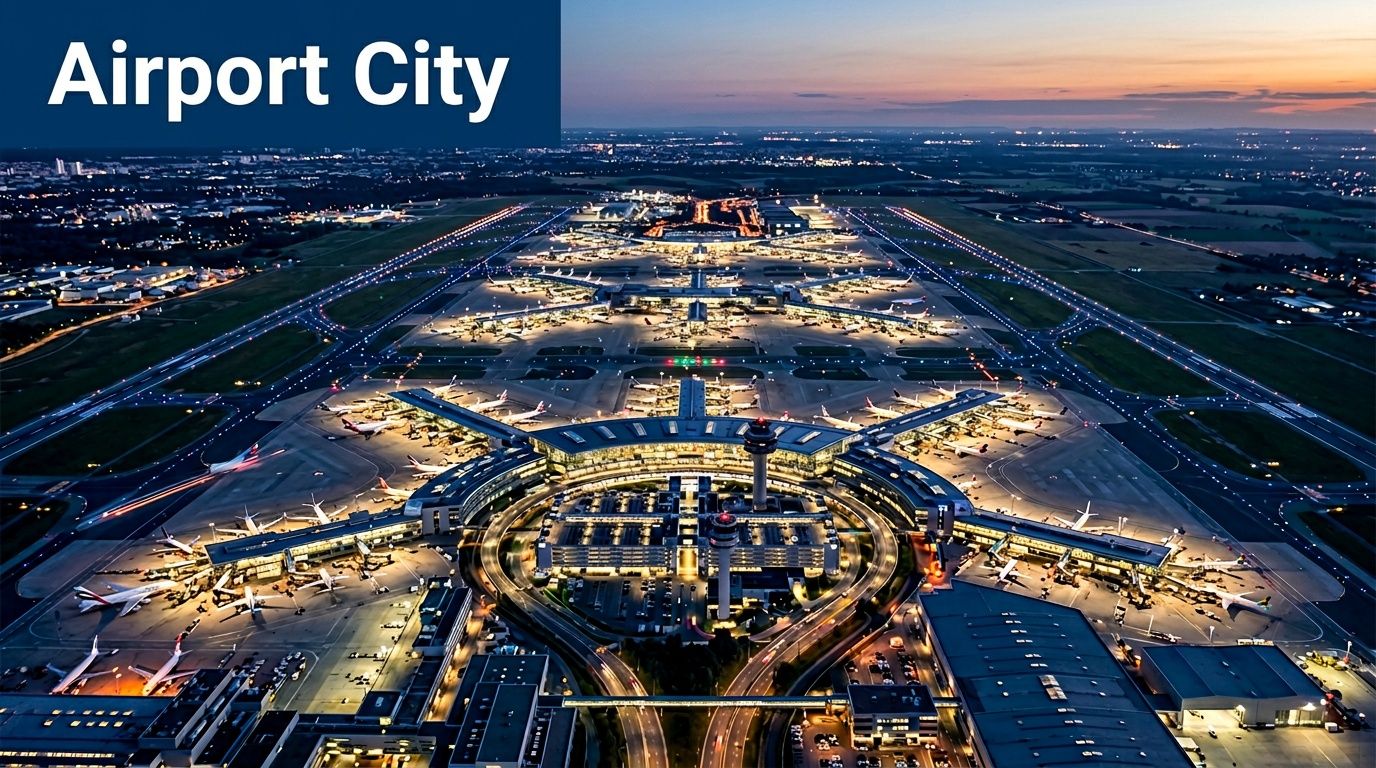
That scale isn't abstract. DFW served 87.8 million passengers in 2024, up 7.4% from 2023, and its growth rate outpaced both Atlanta and Dubai. Its passenger volume has nearly doubled since 1994 according to the DFW passenger traffic report. For travelers, that means more movement, more pressure on curb space, and less tolerance for sloppy timing. For operations teams, it means every handoff matters.
Why scale changes your decisions
At a smaller airport, a mistake is annoying. At DFW, a small mistake compounds.
Miss the right entrance road and you lose time. Assume all terminals work the same way and you add unnecessary walking. Schedule a business pickup with vague instructions and the driver can get delayed by access controls, congestion, or a mismatch between building rules and cargo handling procedures.
The same applies to electronics disposition. Companies near DFW often need secure handling that fits into a busy operating corridor, not a generic consumer recycling drop-off. That's why teams looking for business-focused options often start with providers that specialize in Dallas Fort Worth electronics recycling.
Practical rule: Treat DFW like a campus with aviation-level controls, not like a suburban terminal with easy improvisation.
Two airports in one
Most guides only cover the passenger side. That's useful, but incomplete.
DFW is also where cargo schedules, vendor access, tenant operations, and infrastructure projects intersect. A traveler sees gates and restaurants. A logistics manager sees controlled access points, time windows, loading constraints, chain-of-custody requirements, and the operational cost of showing up unprepared.
If you keep both realities in mind, the airport starts to make sense.
A Practical Guide to DFW's Terminals
DFW's terminal system is easier to use than many first-time visitors expect. The trick is not memorizing every gate area. The trick is understanding the role each terminal plays, then using the fastest connection method instead of trying to brute-force your way across the airport.
How to think about the terminal layout
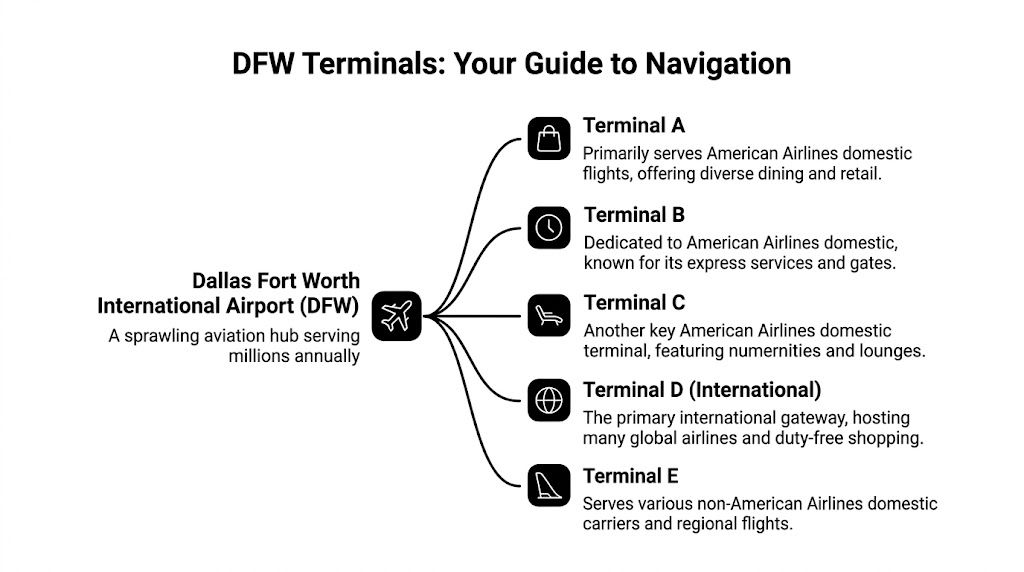
DFW has five terminals: A, B, C, D, and E. In practical terms, Terminals A, B, and C are where many domestic travelers spend their time. Terminal D is the primary international gateway. Terminal E typically serves a mix of domestic and regional activity from non-American carriers and other operators.
That matters because terminal choice affects everything else:
- Your parking decision changes if you want the shortest walk versus the easiest exit.
- Your connection strategy changes if you're staying post-security or need to switch landside.
- Your meeting point changes if you're coordinating with a colleague, car service, or vendor.
What usually works best
For most connecting passengers, Skylink is the right move. It's the post-security train that links all terminals, and it saves time compared with exiting and re-entering security.
Use this rule set:
- Already through security: Take Skylink.
- Meeting someone curbside or changing transport modes: Go landside only if you need to.
- Unsure whether your next flight boards from a nearby gate or a different terminal: Check first, then move once.
People waste time at DFW by moving too early without confirming the gate. They also waste time by staying put too long and then trying to sprint across a terminal when a train ride would've been easier.
Terminal-by-terminal practical use
Terminal A
Common choice for domestic American Airlines travel. If your trip is straightforward and domestic, this is often where your day starts or ends.
Best use case: business travelers who want a predictable domestic flow and easy airline support.
Terminal B
Also heavily tied to domestic operations. This terminal can feel more utilitarian, which isn't a criticism. For many travelers, that's a good thing because straightforward terminals reduce friction.
Best use case: shorter domestic turns and simpler gate routines.
Terminal C
Another major domestic area. Here, people often underestimate how much time they need, especially during busy travel windows.
Best use case: domestic travelers who should budget time for gate changes and terminal movement.
Terminal D
This is the international anchor. If your trip includes customs, international carrier check-in, or premium long-haul service, Terminal D is usually the center of gravity.
Best use case: international departures, arrivals, and meetings involving travelers coming off overseas itineraries.
Terminal E
A practical terminal for various domestic and regional carriers. Good for travelers who aren't flying the airport's dominant operator and need to verify pickup zones or baggage claim details carefully.
Best use case: travelers who need to double-check airline location before heading in.
If you're connecting at DFW, the fastest path usually isn't the shortest-looking path on a map. It's the one that keeps you inside security and uses the train.
Mastering Airport Access Parking and Ground Transportation
The expensive mistake at DFW usually isn't the parking charge. It's choosing the wrong access method for the kind of trip you're making.
A same-day business trip has different needs than a weeklong trip. A consultant carrying a backpack can use transit more easily than a team moving demo kits, pelican cases, or checked equipment. A traveler landing late may value simplicity over savings.
Pick the access method by trip type
Here's the cleanest way to decide.
| Trip situation | Best fit | Why it works |
|---|---|---|
| Short business trip, tight schedule | Terminal parking | Fastest path from car to terminal |
| Multi-day trip with cost sensitivity | Express or remote parking | Better value if extra transfer time is acceptable |
| No car needed at destination | Rail or scheduled ride | Avoids parking and return-car friction |
| Heavy luggage or sensitive gear | Preplanned ride or terminal parking | Reduces handoff complexity |
| Group travel | One vehicle or car service | Keeps people and bags on one plan |
Parking trade-offs that matter
Terminal parking works when your priority is time, not price. You park closer, walk less, and avoid shuttle dependencies.
Express and remote options make sense when schedule slack exists. The trade-off is simple. You save money, but you add another operational step, and every added step is another chance for delay.
Valet can be reasonable for some travelers, especially if timing on the return is more important than cost. It's less attractive if you need gear retrieval or want full control over vehicle access.
Ground transportation without guesswork
DFW supports the usual modes. Ride-share, taxis, rental cars, and rail all have a place, but none of them is ideal for every use case.
Use public transit if your destination lines up and you're traveling light. Use ride-share if flexibility matters and you're not moving specialized equipment. Use a rental car if your trip includes multiple stops around the Metroplex. Use a scheduled car service if the cost of a late arrival is higher than the fare difference.
A few practical habits prevent most access problems:
- Confirm terminal first. Ground pickup confusion often starts with bad terminal assumptions.
- Screenshot instructions. Cell service and app switching can get messy during arrivals.
- Build in curbside time. DFW road activity changes throughout the day.
- Keep baggage count simple. Every extra case slows transfers between rail, shuttle, and curb.
Travelers tend to over-focus on the terminal and under-focus on the first and last mile. At DFW, that first and last mile often determines whether the trip feels smooth or chaotic.
DFW as a Global Business and Cargo Hub
The passenger side of DFW gets the attention. The commercial side explains why the airport matters so much to North Texas businesses.
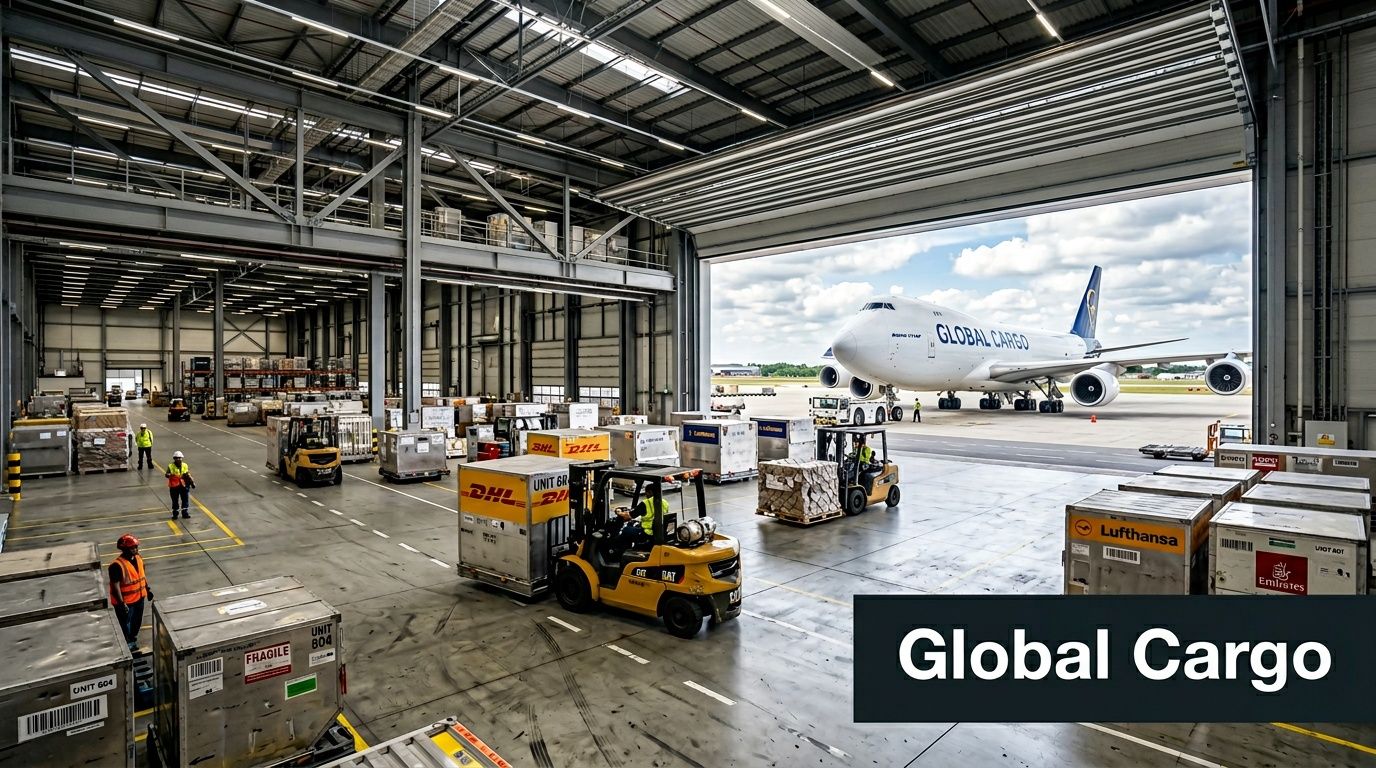
In 2024, shipping activity through DFW Airport accounted for $62.6 billion in total trade value, a 148% increase since 2003. That trade directly supported nearly 90,000 jobs and contributed $8.3 billion to Texas' gross domestic product, according to the Texas Comptroller's DFW trade summary. Those numbers tell you something practical. DFW isn't just moving passengers efficiently. It's moving high-value business activity at scale.
Why that matters for technology logistics
Air cargo hubs are important to IT teams for one reason above all others. They compress distance.
When an organization needs to move replacement hardware, network appliances, storage equipment, or decommissioned assets through a major corridor, airport-adjacent logistics can simplify routing. But scale cuts both ways. High throughput creates opportunity, and it also raises the standard for documentation, packaging discipline, scheduling accuracy, and chain-of-custody control.
For high-value equipment, the wrong logistics plan usually fails in familiar ways:
- Loose inventory control creates receiving disputes.
- Weak packaging standards increase damage risk during handoffs.
- Unclear ownership transfer creates compliance headaches later.
- Assuming office moving rules apply to airport logistics leads to delay.
What works in real operations
Companies that move technology assets around DFW usually get better outcomes when they separate freight movement from disposition strategy. Moving equipment is one project. Deciding whether it should be redeployed, remarketed, destroyed, or recycled is another.
That distinction matters even more during larger facility changes. A server room closure, office consolidation, or infrastructure refresh near the airport can involve many asset classes with different handling requirements. In those situations, teams often need specialized support for data center equipment disposal services in Dallas Fort Worth Texas, not just a freight carrier.
Cargo capability doesn't remove operational risk. It increases the need for process discipline because more handoffs are possible.
DFW's business value isn't only in cargo buildings
The airport's influence extends into nearby offices, warehouses, distribution sites, medical facilities, and technology environments that rely on fast regional and national reach.
That matters for two groups. Travelers benefit because the airport has the service depth of a major hub. Enterprise teams benefit because the surrounding corridor supports time-sensitive logistics, vendor coordination, and rapid movement of specialized assets.
If you manage hardware lifecycles, DFW should be viewed less as a travel endpoint and more as a logistics platform.
Logistics Planning for Corporate IT Asset Pickups
Most airport guides stop at cargo. That's where the hard part starts for IT teams.
If you're arranging pickup of retired laptops, failed network switches, storage arrays, rack servers, or mixed electronic scrap near DFW, the challenge isn't just transportation. It's controlled movement through a busy environment where access, timing, documentation, and security all have to line up.
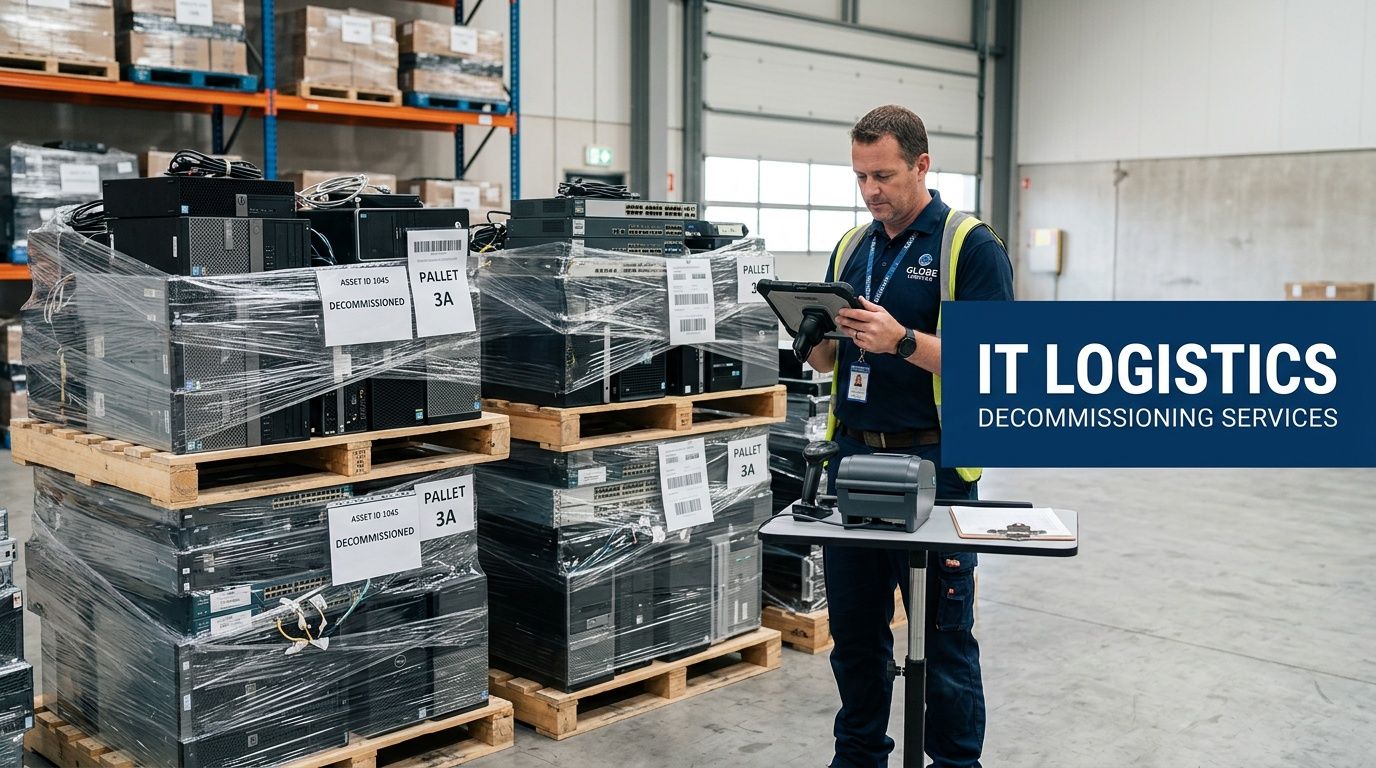
As noted in reporting on DFW's operational environment, logistics for secure IT equipment disposal at DFW must account for complex access and high-traffic operations. While DFW excels in passenger experience, B2B logistics for regulated materials like electronics require specialized partners who can manage security and scheduling constraints, especially as airport expansions increase the volume of enterprise-scale e-waste in the CBS Texas coverage of DFW operations and customer service recognition.
Start with a pickup plan, not a truck request
A lot of pickup failures start with a message like, "We have some equipment ready." That's not a plan.
A usable pickup brief should identify:
- Asset categories such as laptops, desktops, servers, drives, networking gear, or lab devices
- Packaging state such as loose, palletized, rack-mounted, boxed, or still installed
- Building constraints including dock access, elevator limits, security escort rules, and approved vendor entry windows
- Data-bearing items that require separate tracking or destruction procedures
- Decision owner on site who can sign off if something changes
If any of that is missing, the pickup may still happen, but it won't happen cleanly.
Timing matters more than people expect
The most workable service windows are regular business hours, especially Monday through Friday, 8:00 AM to 5:00 PM, because that aligns with facility staff, security desks, dock teams, and internal approvers. Outside those windows, the technical work might still be possible, but the coordination risk rises.
Use this sequence for smoother execution:
- Freeze the asset list before scheduling.
- Confirm building access rules with property or security teams.
- Separate reusable equipment from scrap before the truck arrives.
- Label pallets and containers in a way that matches the inventory sheet.
- Assign one escort who stays with the move from start to departure.
Chain of custody isn't paperwork theater
For regulated or sensitive environments, chain of custody begins when equipment leaves user control, not when it reaches a processing facility.
That means the pickup team should be able to document what was collected, from where, under whose authorization, and in what condition. If data-bearing assets are mixed into a general pile without inventory discipline, you create audit exposure immediately.
Specialized services such as DFW e-waste pickup become operationally useful. The value isn't just hauling. It's controlled collection with enough structure to support compliance review later.
The cleanest pickups are boring. Everyone knows the access point, the asset list matches the floor, and the paperwork doesn't need detective work.
What doesn't work
Three habits cause repeat trouble near major airports:
- Last-minute scheduling with incomplete site information
- Mixing office cleanout material with regulated IT assets
- Assuming a general junk hauler can manage data-bearing equipment
The airport corridor rewards precision. If you're moving enterprise electronics in that environment, vague instructions cost time first, then create risk.
DFW's Tech-Forward Operations and Security Implications
DFW's infrastructure decisions send a clear signal to business partners. The airport operates in a data-rich, real-time environment, and it expects systems to support proactive decisions instead of reactive cleanup.
That isn't just a branding point. DFW Airport is implementing an AI/ML-driven operational framework to manage its complex environment, using predictive tools and real-time sensors for everything from utility management to emergency response. This integration of GIS, BIM, and data analytics helps optimize operations and informs proactive decisions, mirroring the need for real-time tracking in secure IT asset disposition, as described in the overview of DFW's AI and analytics framework.
What that means for vendors and tenants
An airport using predictive operations and integrated data systems won't be well served by loose vendor processes.
If your team handles technology assets in or around DFW, you should assume that good enough process design isn't good enough. The standard should include:
- Live status visibility for pickups and handoffs
- Asset-level tracking for data-bearing devices
- Consistent naming and inventory discipline
- Documented exceptions when counts, conditions, or serials don't match
This is the same logic behind strong secure data destruction in DFW. The issue isn't only whether destruction happens. The issue is whether the process can be verified in a way that stands up to internal audit, customer review, or regulatory scrutiny.
Security posture follows operational maturity
Mature environments don't rely on memory. They rely on systems.
A facility as dynamic as DFW has to combine sensors, mapping, event response, and operational visibility because too many things are moving at once. That same principle applies to retiring enterprise IT equipment. If the disposition process depends on emails, manual spreadsheet edits, or verbal confirmation alone, the control structure is weak.
A stronger model looks like this:
| Weak control | Strong control |
|---|---|
| Verbal equipment counts | Signed inventory with item detail |
| Mixed pallets of unknown devices | Segregated loads by asset type |
| Pickup arranged by ad hoc email chain | Scheduled workflow with named approvers |
| Generic disposal receipt | Audit-ready destruction and disposition records |
Airports teach a useful lesson. Speed is safest when visibility is high.
The practical takeaway for IT teams
DFW's operating model rewards predictability. If you're providing services, moving assets, or retiring equipment around the airport, bring the same discipline the airport applies to its own environment.
That means fewer assumptions, tighter tracking, clearer authorization, and documented handoffs at every stage.
Managing E-Waste and Electronics Disposal at DFW
DFW has a strong public sustainability profile. The problem for many businesses is that public sustainability messaging doesn't automatically translate into clear disposal procedures for enterprise electronics.
The gap matters. Despite becoming North America's first carbon-neutral airport and aiming for net-zero emissions by 2030, DFW's public-facing sustainability initiatives often overlook specific guidance for B2B e-waste management. This gap presents a compliance risk for on-site businesses that need certified data destruction and responsible disposal for IT assets like servers and computers, based on the case study discussing DFW's sustainability efforts and waste programs.
Why ordinary disposal isn't enough
For a tenant office, lab, healthcare operation, or public-sector department near DFW, retired electronics don't become harmless just because they're unplugged.
A surplus desktop may still hold regulated data. A failed server may still contain storage media. Network gear may still need inventory reconciliation before release. Even non-functional hardware can create chain-of-custody and environmental handling issues if it's discarded casually.
That's why broad sustainability language doesn't solve the actual business problem. IT managers need answers to operational questions:
- Who's authorized to remove equipment?
- How is data destruction documented?
- Can pickups be coordinated without disrupting site operations?
- What happens to equipment that can be reused versus recycled?
- How is proof of disposition retained?
The compliance argument is stronger than the convenience argument
Convenience tempts teams to use the fastest available outlet. That's often the wrong decision.
General waste streams, informal surplus removal, and undocumented hauling can create three separate problems at once. You lose asset visibility, you weaken data protection, and you undercut sustainability reporting.
A specialized B2B pathway, such as DFW electronics recycling, is often the safer operational choice because it aligns disposal with documentation, handling controls, and downstream accountability.
The key point is simple. In an airport business corridor, electronics disposal is not janitorial work. It's risk management.
Your Strategic Takeaway for Navigating DFW
DFW rewards preparation.
If you're traveling, know your terminal, choose ground transport based on your real schedule, and use the airport's internal connection tools instead of guessing your way across the property. If you're managing business logistics, treat DFW like the controlled environment it is. Confirm access, document assets, and don't separate speed from accountability.
For IT leaders, the biggest mistake is treating technology retirement as an afterthought. Near a hub as active as dallas fort worth intl airport, asset disposition needs the same discipline as procurement, deployment, and security operations.
The teams that do well at DFW don't rely on improvisation. They use clear process, realistic timing, and partners who can work inside a complex operating environment.
If your organization needs a dependable B2B partner for retiring technology in the DFW corridor or anywhere nationwide, Dallas Fortworth Computer Recycling provides IT asset disposition, electronics recycling, data destruction, and decommissioning support built for auditability, chain of custody, and practical scheduling.