
Texas Recycling A Guide for Business E-Waste & ITAD

Old laptops stack up fast. A few retired desktops move into a storage closet, then some monitors, then a box of hard drives from the last office refresh. Before long, that room stops being extra space and starts being a liability.
Most Texas organizations don't get into trouble because they meant to mishandle electronics. They get into trouble because outdated equipment sits too long, nobody owns the disposition process, and "recycling" gets treated like junk removal instead of a controlled compliance function. That's when risks pile up. Data remains on drives. chain of custody breaks. Equipment with resale value gets scrapped. Problem materials end up in the wrong downstream channel.
For business leaders, texas recycling isn't mainly about putting more items in a blue bin. It's about controlling regulated assets, protecting sensitive information, documenting what happened to every device, and keeping retired equipment out of the landfill stream whenever practical. The broader waste picture in Texas only raises the stakes, especially in heavy commercial regions.
A useful starting point is understanding the environmental impact of electronic waste. But the operational question is tougher: how do you retire IT assets in a way that is secure, auditable, and commercially sensible?
Introduction The Hidden Risks in Your Storage Closet
The typical storage closet isn't full of "old electronics." It's full of unresolved decisions.
That stack of endpoint devices may contain employee data, cached credentials, customer records, proprietary files, or regulated information. The retired network gear may still hold configuration data. Lab equipment and medical devices can create a separate set of handling and documentation issues. If no one can say what data was on the equipment, where it went, and who touched it, your organization has a process gap.
Why this becomes a business risk
Three problems show up again and again.
- Data exposure: Hard drives, SSDs, phones, and embedded storage don't become safe because the equipment was unplugged.
- Compliance failure: If your organization can't produce records, many policies and audit requirements aren't meaningfully satisfied.
- Value loss: Usable equipment often sits until it becomes obsolete, damaged, or impossible to redeploy.
A lot of internal teams also underestimate environmental liability. General waste vendors, office cleanout crews, and informal donation channels may solve the space problem while creating a downstream accountability problem.
Practical rule: If an item ever touched business data, treat disposition as a controlled workflow, not a facilities side task.
What works and what doesn't
What works is simple. Assign ownership, inventory assets before pickup, choose a processor that understands business electronics, and require documentation at each handoff.
What doesn't work is "free pickup" with vague promises, mixed loads where storage media isn't separated, or bulk removal with no serialized reporting. In practice, that approach usually fails at the exact moment leadership, legal, or an auditor asks for proof.
The Texas Recycling Landscape for Businesses
Texas businesses operate inside a recycling environment that's bigger, more uneven, and more commercially important than most internal teams realize. Residential recycling gets most of the public attention. Business recycling has different stakes because the material stream is larger, the documentation burden is higher, and the consequences of poor handling are sharper.
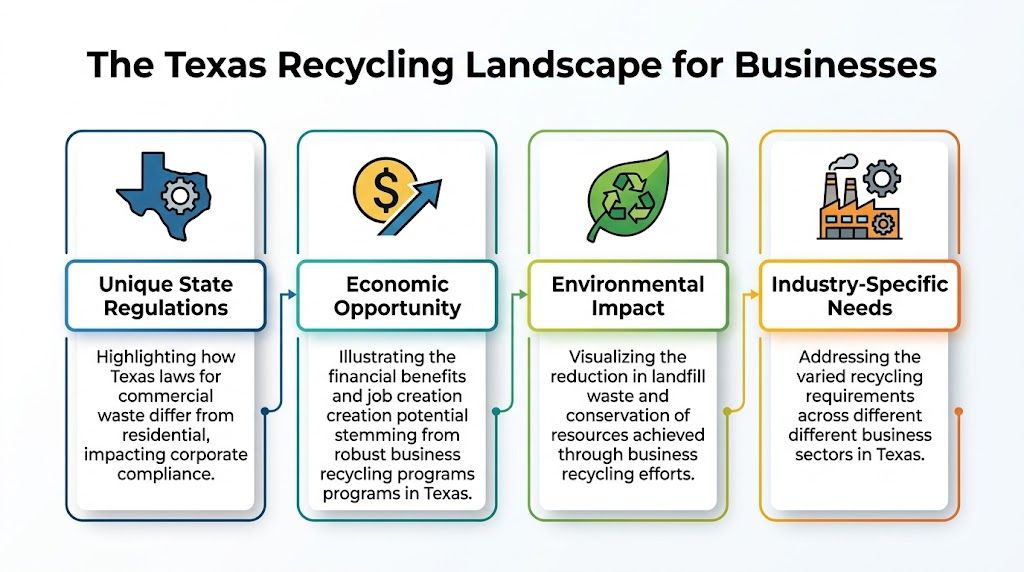
In Texas, scale matters. In 2015, Texas recycled 9.2 million tons of municipal solid waste, generated $702 million in material value, and supported over 17,000 jobs. As of 2024, the state landfilled 41.3 million tons of waste annually, with the Dallas-Fort Worth region accounting for 29% of the total and facing a projected 37 years of remaining landfill capacity according to the Texas recycling economic impact study from TCEQ.
Those numbers aren't about electronics alone, but they matter for IT leaders. They show that material recovery in Texas is not a niche activity. It's a major operating and economic issue. They also show how much pressure remains on landfill capacity in the state's largest commercial region.
Why business recycling differs from curbside recycling
A curbside model is built for convenience. Business disposition is built, or should be built, for control.
An enterprise asset stream may include:
| Asset type | Main business concern | Why standard recycling falls short |
|---|---|---|
| Laptops and desktops | Stored data, asset tracking | Devices need inventory and destruction records |
| Servers and storage arrays | Confidential data, chain of custody | Removal often requires controlled deinstallation |
| Networking gear | Configuration exposure, reuse value | Equipment needs sorting, testing, and documented handling |
| Displays and peripherals | Material separation | Mixed downstream processing can reduce recovery quality |
That distinction is why many organizations in Texas eventually separate office recycling from IT asset disposition. They aren't the same function.
The business case is stronger than most teams assume
A lot of companies still frame recycling as a cost center. That's too narrow.
Material recovery has real market value in Texas, and poor handling creates real operating loss. The gap isn't only environmental. It's financial. If devices that can be redeployed or remarketed sit in a closet for a year, the business loses useful value. If data-bearing assets get mixed into a generic haul-away stream, the business absorbs unnecessary security risk.
For organizations moving equipment through ports, warehouses, or multi-site operations, regional planning also matters. Teams handling cross-border or logistics-heavy assets often need a more specialized process than municipal programs can offer. That's why some businesses look for options tied to Texas port recycling operations when mapping broader disposition logistics.
Texas treats recycling as an economic system, not just a household habit. Businesses should do the same with retired IT.
What practical operators do differently
Seasoned compliance teams usually make three adjustments.
- They separate waste streams: Cardboard, pallets, scrap metal, and electronics shouldn't move under one vague recycling label.
- They assign internal ownership: IT, security, procurement, and facilities each have a role. One team still needs final accountability.
- They insist on proof: A vendor's verbal assurance doesn't help during an audit, litigation hold, or internal investigation.
Good texas recycling programs for businesses don't begin at pickup day. They begin when the organization decides that retired technology is still a managed asset until documented disposition is complete.
Navigating E-Waste and Electronics Regulations
Electronics aren't hard to recycle because they're bulky. They're hard to recycle because they're complex.
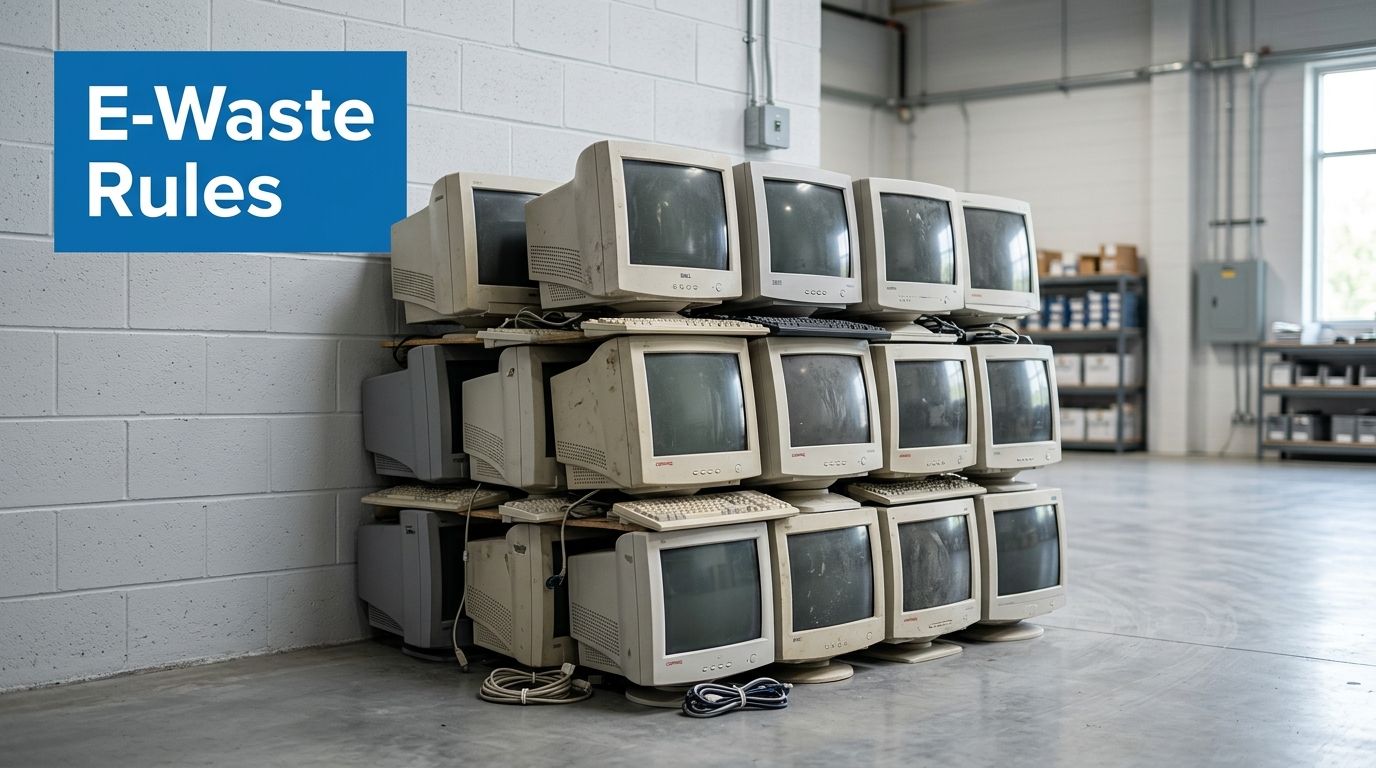
A cardboard box is mostly one material. A server isn't. A single device can contain metals, plastics, glass, batteries, circuit boards, and data-bearing storage in one unit. That means compliance has to address both material handling and information security.
Why electronics require a different process
Texas recycling data shows why generalized assumptions break down. Paper in Texas reaches an approximately 68% recycling rate, while plastics reach just 9% in the Texas recycling materials discussion. That matters because computer casings, connectors, and other components rely heavily on polymers, while boards and assemblies also contain recoverable metals that need separate processing channels.
For ITAD, that creates a basic rule. You can't treat a retired workstation like office paper, and you can't treat a pallet of mixed electronics like a single commodity.
The difference is visible in the hardware itself:
- Circuit boards: Multi-material assemblies that need dismantling or specialized downstream processing.
- Plastic housings: Recoverable in some circumstances, but limited by polymer degradation and contamination.
- Metals: Often the most recoverable portion, but only if upstream sorting is done correctly.
- Storage media: Security-sensitive from the moment of removal to final destruction or sanitization.
Where regulations become operational
Many teams ask for "the Texas e-waste law" as if one rule controls the whole process. In practice, organizations face a mix of environmental requirements, internal governance standards, contractual obligations, privacy expectations, and sector-specific rules.
That is why a compliant process usually includes these controls:
Asset identification before movement
You need to know what you're shipping. Unknown mixed loads create avoidable risk.Secure segregation of data-bearing devices
Hard drives, SSDs, backup media, and embedded storage shouldn't disappear into a gaylord box without tracking.Appropriate downstream processing
Plastics, metals, glass, batteries, and boards move through different recovery paths.Documented chain of custody
If custody isn't documented, the organization may have no defensible evidence of proper handling.
A practical Texas reference point for business equipment planning is the broader Texas electronics recycling landscape, especially for organizations trying to distinguish household recycling messaging from enterprise obligations.
A circuit board is closer to a manufactured assembly than a simple recyclable. Your process has to reflect that complexity.
What businesses often get wrong
The most common mistake is assuming the recycler will "figure it out."
That assumption fails in two ways. First, the vendor may not be equipped to manage secure data destruction. Second, even when the vendor is capable, your organization still needs evidence that the process occurred as required.
Another mistake is letting convenience drive handling decisions. If the fastest option mixes batteries, monitors, servers, phones, and loose drives into one collection stream, the company has already made downstream compliance harder.
Good e-waste management starts upstream. By the time a truck arrives, the organization should already know which devices require destruction, which can be tested for reuse, and which need specialized handling because of their components or regulatory context.
Meeting Compliance and Documentation Requirements
If a regulator, auditor, customer, or internal investigator asks what happened to a retired asset, "we recycled it" isn't an acceptable answer. Compliance lives or dies on documentation.
Texas has a useful precedent for this mindset. The Texas Department of Transportation launched a statewide recycling program in 1994, and by 2001 it was spending $200 million annually on recycled products while diverting nearly 2.6 million tons of waste from landfills since inception, as described by the Federal Highway Administration's account of TxDOT recycling in Texas. The point for business ITAD isn't the road material itself. It's the operating model. Large-scale recovery only works when specifications, approvals, and accountability are built into the process.
The documents that actually matter
For electronics disposition, several records are mandatory.
- Asset inventory records: Device type, serial number where applicable, and internal ownership or location.
- Chain-of-custody logs: Who released the asset, who received it, when transfer occurred, and under what conditions.
- Data destruction records: Evidence that storage media was wiped, shredded, degaussed, or otherwise processed according to policy.
- Settlement or disposition reporting: What was reused, what was recycled, and what moved to downstream processors.
If your organization handles drives separately, a certificate of destruction for hard drives is often one of the clearest documents to require and retain.
A compliant process versus a risky process
The difference is easy to spot.
| Process area | Compliant approach | Risky approach |
|---|---|---|
| Pickup preparation | Assets sorted and inventoried | Mixed room cleanout with no verification |
| Transfer | Signed custody handoff | Verbal pickup confirmation |
| Data-bearing devices | Destruction method documented | Assumed wiped or removed |
| Final records | Itemized reporting retained | One invoice marked "recycling" |
Most organizations don't need more policy language. They need tighter execution.
What to retain internally
The vendor's paperwork matters, but so does your own.
Keep internal approvals showing who authorized disposition. Retain device lists exported from your asset management system. Record exceptions, such as missing serial numbers, damaged media, or equipment removed during an emergency shutdown. When something doesn't follow the normal process, write that down immediately.
Documentation isn't administrative overhead. It's the evidence that separates a controlled disposition event from an unprovable one.
Where companies lose defensibility
They lose it in handoffs.
A secure process can still become hard to defend if the loading dock team signs nothing, if boxed drives leave without reconciliation to an asset list, or if business units bypass IT and arrange disposal directly. I've seen organizations invest heavily in security controls and then undermine them with informal asset removals during moves, remodels, and lease exits.
The fix isn't complicated. Build one disposition workflow, require every business unit to use it, and reject vendors that can't support an audit trail from release through final processing.
Best Practices for Secure IT Asset Disposition
The strongest ITAD programs don't start with recycling. They start with a decision tree.
Some assets should be reused internally. Some should be remarketed. Some should be destroyed immediately because the risk profile is too high. Some have no reuse value and belong in a compliant materials recovery stream. If every retired device gets the same outcome, you're probably destroying value somewhere in the process.
Texas has already shown that landfill diversion leaves room for major improvement. The state's municipal solid waste recycling rate was 27.5%, while an estimated 43.8% of materials in landfills could have been recycled, according to the state recycling analysis summarized by ECOS. For IT leaders, the lesson is practical. General waste systems miss recoverable material. A specialized ITAD process is how you keep electronics from joining that lost stream.
Start with a disposition hierarchy
A disciplined team usually works in this order:
Reuse internally
Spare devices, lab systems, and non-critical endpoints may still fit another business function.Remarket if appropriate
Equipment with residual value should be evaluated quickly. Delay destroys recovery potential.Sanitize or destroy data-bearing media
Choose the method based on asset type, policy, and risk tolerance.Recycle remaining materials through a qualified downstream chain
For this process, proper separation of metals, boards, plastics, and peripherals is important.
That order protects both value and compliance.
Match destruction method to risk
Not every asset needs the same treatment.
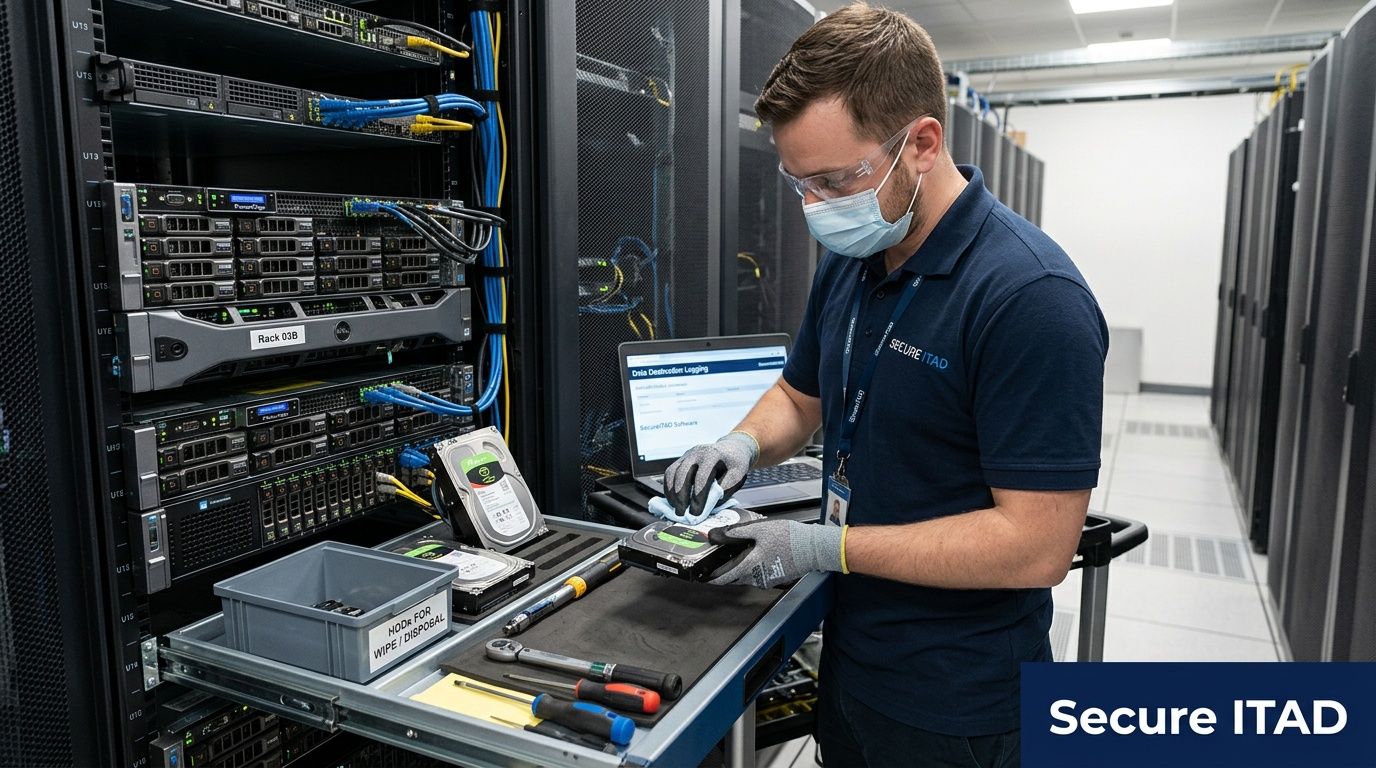
A redeployable laptop might qualify for verified sanitization under policy. A failed drive from a regulated environment may need physical destruction. A data center shutdown often requires a coordinated combination of onsite handling, serialized media capture, and final destruction reporting.
The mistake is choosing one method for convenience. Secure wiping, degaussing, and shredding each have a place. The right choice depends on whether the asset is being reused, what data class it held, and how much proof your organization needs afterward.
What mature programs do better
They don't wait until refresh day.
- They plan disposition during procurement: Retirements become easier when ownership, asset records, and endpoint standards are already consistent.
- They separate collection from decision-making: Not every collected asset should be shredded on arrival.
- They involve security early: InfoSec should help define destruction thresholds, not just review incidents later.
Good ITAD isn't "take it away safely." It's "apply the right outcome to each asset, then prove it happened."
Where ROI actually comes from
The return isn't just commodity recovery.
It comes from avoided breach exposure, better asset recovery timing, cleaner remarketing decisions, and fewer emergency projects when offices, clinics, or server rooms need to be cleared quickly. It also comes from reducing process friction. When IT, security, and facilities all know the workflow, pickups stop turning into one-off fire drills.
The broad texas recycling conversation often focuses on landfill diversion. For enterprise teams, the more useful lens is operational discipline. Secure ITAD pays off when it reduces uncertainty.
How to Choose a Certified Recycling Partner
Most vendors sound good in a proposal. The differences show up when you ask hard questions about data, downstream handling, and documentation.
That's where many Texas organizations run into a real information gap. Texas recycling information often focuses on residential programs and overlooks the needs of businesses that require compliant e-waste disposition, secure data destruction, and auditability, as noted in the TRDI-related Texas recycling discussion. That gap is exactly why buyers need a more disciplined vetting process.

What certifications should tell you
Certifications such as R2 and e-Stewards matter because they signal that a provider operates within defined controls for environmental management and downstream accountability. They are useful starting points, not substitutes for due diligence.
A certification should prompt better questions:
- What exactly is covered by the certification scope?
- How are downstream vendors qualified and tracked?
- What records will the client receive?
- How are data-bearing devices segregated from non-data-bearing material?
If the vendor can't answer clearly, the logo on the website won't help you.
For organizations comparing providers, this is the point where looking at experienced IT asset disposition companies becomes more useful than browsing generic recycling directories.
The buyer's checklist
Use a short, hard-edged checklist during procurement.
| Question to ask | What a strong answer sounds like | Warning sign |
|---|---|---|
| How do you handle chain of custody? | Documented handoff process with traceable records | "We keep it simple" |
| What proof of data destruction do you provide? | Itemized or media-specific reporting, based on service | Generic invoice only |
| Where do materials go after initial processing? | Named downstream controls and documented pathways | Vague references to partners |
| Can you support multi-site pickups? | Structured scheduling and consistent process | Ad hoc local-only model |
| How do you handle non-working equipment? | Clear triage into reuse, destruction, or recycling streams | Everything goes into one bulk channel |
What to ask beyond the sales deck
Ask how exceptions are handled.
What happens if serial numbers are missing? What if drives are found loose in a box of peripherals? What if a clinic sends mixed biomedical-adjacent equipment and standard office IT? Strong vendors have an exception process. Weak ones improvise in the moment.
Ask about insurance coverage, escalation paths, and who signs for assets at pickup. Ask whether they can support your sector's needs, especially if you're in healthcare, government, education, or regulated research.
The safest partner isn't the one with the best marketing. It's the one whose process still makes sense when something goes wrong.
What usually works best
A specialized B2B partner usually outperforms a general recycler for one reason. Business electronics require operational consistency. You need the same custody logic, the same destruction standards, and the same reporting format whether you're retiring ten laptops or decommissioning an entire floor.
If the vendor's process changes every time the project changes, your compliance posture changes with it. That's not a partnership. That's a recurring risk.
Dallas Fortworth Computer Recycling Your Nationwide Partner in Texas
For organizations that need a practical answer instead of more theory, Dallas Fortworth Computer Recycling fits the profile Texas businesses usually need: a B2B-focused ITAD and electronics recycling partner built around secure handling, auditability, and nationwide service coverage.
The company has operated since 2012 and supports organizations that can't treat retired technology as a casual recycling task. That includes mid-size and enterprise IT teams, healthcare providers, public-sector departments, laboratories, nonprofits, and infrastructure groups managing complex refreshes or decommissions.
Where the service model fits real business needs
The core value isn't just pickup. It's controlled disposition.
Dallas Fortworth Computer Recycling provides services such as certified data destruction, IT equipment disposal, computer and laptop disposal, data center decommissioning, and handling for specialized medical and laboratory equipment. That combination matters because many organizations don't retire one clean asset category at a time. They retire mixed environments.
A few common use cases make the fit clearer.
Healthcare and regulated environments
A healthcare system retiring nursing station PCs, back-office laptops, printers, and specialty devices needs more than a truck. It needs a processor that understands that some assets contain storage, some don't, and some may sit near regulated workflows that require extra care in removal and documentation.
In that setting, the practical requirement is chain of custody plus clear proof of data destruction. Equipment cannot merely leave the premises under a generic recycling label. The handoff must support internal compliance review.
Data center and infrastructure projects
A server room shutdown creates a different challenge.
Racks, servers, storage hardware, network gear, PDUs, and loose drives often come out under schedule pressure. Facilities wants the space back. IT wants the project done fast. Security wants certainty around media. A qualified nationwide ITAD partner helps by coordinating deinstallation, segregation of data-bearing assets, and final reporting without collapsing everything into one undifferentiated bulk load.
That kind of project is where many generic vendors fail. They can haul equipment, but they can't preserve enough process integrity for security and audit teams.
Multi-site enterprise refreshes
A company with offices across Texas and beyond usually needs consistency more than anything else.
Dallas Fortworth Computer Recycling's nationwide pickup model is useful here because the same service logic can apply across multiple locations. That reduces one of the biggest administrative headaches in ITAD: every site inventing its own retirement process. Standardized pickups, clear item acceptance guidance, and predictable service windows make it easier for corporate IT to control disposition centrally.
Why the company stands out in practice
Several characteristics matter for serious buyers.
- B2B orientation: The workflows are built for business and public-sector needs, not household drop-offs.
- Data-focused controls: Certified destruction is part of the service set, not an afterthought.
- Complex equipment handling: Specialized medical and lab equipment support matters for organizations with mixed technology estates.
- Environmental stewardship: The operating emphasis is to maximize reuse and recycling in order to reduce landfill impact.
- Nationwide logistics: Organizations with distributed footprints don't need to manage separate local vendors everywhere.
The Beyond Surplus initiative also adds a useful dimension for nonprofits and community-minded organizations that want responsible electronics management paired with broader social value. That doesn't replace compliance. It complements a disposition strategy when equipment is suitable for extension programs or responsible redistribution pathways.
What type of client benefits most
The best fit is an organization that needs all three of these at once:
| Need | Why it matters |
|---|---|
| Secure retirement of data-bearing assets | Reduces exposure and supports internal security controls |
| Documented audit trail | Gives legal, compliance, and procurement teams defensible records |
| Scalable logistics | Supports single-site cleanouts and distributed operations |
That's a large share of the market in Texas. Fast-growing companies, hospital systems, municipalities, school systems, labs, and data-driven enterprises all face the same underlying issue. Technology ages out faster than internal disposition processes mature.
When that happens, the backlog lands in closets, cages, and storerooms. The right partner helps turn that backlog into a controlled, documented project instead of a recurring source of risk.
Frequently Asked Questions About Texas Business Recycling
Do we need a formal ITAD process if we only have a small amount of e-waste?
Yes, if the equipment held business data or falls under your internal asset controls.
Volume doesn't determine risk. A handful of laptops with customer files can create more exposure than a truckload of non-data-bearing peripherals. Small projects still need inventory, secure handling, and documented disposition. The process can be lighter, but it can't be casual.
What's the right way to handle a large office cleanout or data center shutdown?
Separate the project into streams before pickup.
Keep data-bearing devices identifiable. Separate loose drives from general equipment. Decide in advance what will be reused, what will be remarketed, and what requires destruction. For a data center, include deinstallation planning and access control so equipment removal doesn't turn into an untracked facilities exercise.
What happens to broken or obsolete equipment that has no resale value?
It should still move through a controlled downstream path.
That usually means material recovery rather than reuse. Metals, boards, plastics, displays, and power components may each require different handling. The fact that an asset is dead doesn't remove the need for secure data destruction if storage is present, and it doesn't remove the need for reporting.
What documentation should a business expect from a recycling or ITAD provider?
At minimum, expect records that show what was transferred and how sensitive media was handled.
Depending on the project, that may include asset lists, chain-of-custody documentation, destruction records, and final disposition reporting. The exact package can vary, but the documents should let your organization answer basic audit questions without guesswork.
Can a Texas-based provider support nationwide operations?
Yes, if the provider is set up for it operationally.
The important question isn't whether a vendor will accept a call from another state. It's whether they can deliver a consistent chain of custody, scheduling process, and reporting standard across all locations. For multi-site organizations, consistency matters more than local convenience.
Is donation enough for retired business electronics?
Sometimes, but only after security and compliance requirements are satisfied.
Donation isn't a shortcut around data destruction, asset tracking, or internal approval. If equipment is suitable for reuse, donation can be part of a responsible strategy. But it should happen through a controlled process, with records, not as an informal handoff to "someone who can use it."
If your organization needs a secure, documented way to retire computers, servers, storage, medical devices, or lab equipment, Dallas Fortworth Computer Recycling offers nationwide IT asset disposition and electronics recycling services built for business and public-sector requirements. Their team helps Texas organizations manage pickups, certified data destruction, decommissioning, and compliant downstream handling without turning disposition into a guessing game.