
E-Waste Pickup Frisco: A Guide to e-waste pickup Frisco
That closet full of old computers, servers, and networking gear isn't just taking up space. For any business in a fast-growing city like Frisco, that pile of outdated equipment is a serious data security and compliance liability waiting to happen. A professional e-waste pickup Frisco service is the only way to turn that risk into a secure, documented, and fully managed process.
Why Your Frisco Business Needs a Secure E-Waste Strategy
In a technology hub like Frisco, upgrading IT assets is a constant. For IT directors, facilities managers, and procurement teams, this means the storage room is always filling up with retired equipment. This isn't just an operational headache; it’s a direct threat to your company’s financial stability and brand reputation.
Just think about the fallout from a single improperly handled hard drive. If that drive contains customer lists, financial records, or proprietary business data, the consequences of a breach can be catastrophic. You could be facing steep financial penalties, protracted legal battles, and a total loss of customer trust that can take years, if not decades, to earn back.
The Real-World Risks of Improper Disposal
The risk goes far beyond data security. State and federal environmental regulations have very strict rules for how electronics must be disposed of. A simple mistake, like having an employee toss old monitors into a commercial dumpster, can trigger significant fines for non-compliance.
These laws are in place because e-waste is full of hazardous materials like lead, mercury, and cadmium, which can contaminate soil and groundwater if they end up in a landfill.
Looking at the global picture sharpens the focus on our local responsibilities. The world is on track to generate 65.3 million metric tons of e-waste by 2026, a figure that grows by an average of 2.6 million tons every single year. Worse, only 22.3% of e-waste was properly collected and recycled in 2022, leaving a massive amount of hazardous material and sensitive data unaccounted for.
For a Frisco business, this isn't some abstract global issue—it's a direct operational risk. Every single piece of unmanaged e-waste in your office adds to this statistic and multiplies your company's exposure to legal and financial damage.
Moving From Liability to a Strategic Asset
A documented, secure e-waste strategy isn't a "nice-to-have" anymore. It's an essential part of modern corporate risk management. When you partner with a specialized IT Asset Disposition (ITAD) provider like Dallas Fortworth Computer Recycling, you change the entire conversation. E-waste stops being a burden and becomes the final, secure step in your IT asset lifecycle.
A professional partner guarantees:
- Compliance: Full adherence to all environmental laws, protecting you from costly fines.
- Data Security: Certified data destruction methods that eliminate the risk of a breach.
- Chain of Custody: A complete, documented trail showing where every asset goes, from your door to its final disposition.
- Efficiency: Streamlined logistics that minimize any disruption to your day-to-day operations.
By implementing a formal process, you turn a potential crisis into a controlled, auditable, and secure procedure. This is about far more than just getting rid of old equipment; it's about fundamentally protecting your business. To learn more about local options, you can explore our detailed guide on electronics recycling in Frisco. This guide will give you the step-by-step framework to make it happen.
How to Vet and Choose the Right E-Waste Partner in Frisco

When your Frisco business needs to get rid of old IT equipment, who you choose to handle it matters. A lot. It’s tempting to go with a generic scrap hauler offering a cheap—or even free—pickup, but that decision can open the door to serious data security and environmental compliance headaches down the road.
You need a partner, not just a pickup service. The right provider acts as an extension of your own IT and compliance teams, helping you navigate complex regulations, guarantee data destruction, and deliver an auditable trail that proves you did everything right.
Look Beyond the Pickup Truck to Key Certifications
The first thing you should check for any potential e-waste pickup Frisco provider is their certifications. These aren't just fancy logos for a website; they represent a commitment to strict, independently audited standards for security and environmental safety.
The single most important certification to look for is R2 (Responsible Recycling). A partner with an R2 certification has proven they follow rigorous protocols for:
- Data Security: Following established processes to ensure all data is properly sanitized or physically destroyed.
- Environmental Protection: Adhering to standards that prevent hazardous e-waste from polluting the environment.
- Worker Safety: Maintaining a safe operational environment for their employees.
- Downstream Accountability: Tracking all recycled materials to their final destination to ensure they aren't illegally dumped or exported.
A vendor operating without an R2 certification is a major red flag. It points to a lack of transparency and a potential gap in their process that could leave your business liable for data breaches or environmental fines.
Working with an R2-certified partner like Dallas Fortworth Computer Recycling gives you peace of mind that your equipment is managed to the highest industry benchmarks from the moment it leaves your office.
Questions Every Business Should Ask
Once you have a shortlist of certified vendors, it’s time to dig a little deeper. Treat this like an interview, because you're trusting them with your company's data and reputation. Your goal is to get a clear picture of their process and security measures.
Here are a few essential questions to ask any potential e-waste partner:
Can you provide a sample Certificate of Data Destruction? This document is your official proof that sensitive data has been destroyed. You need to see exactly what their final report includes to make sure it satisfies your internal auditing and compliance needs.
What does your chain-of-custody process look like? A professional firm should be able to walk you through their entire chain-of-custody, which includes serialized asset tracking from the moment they pick up your equipment to its final disposition.
Do you offer on-site data destruction? For equipment with highly sensitive information, you may need hard drives physically destroyed before they even leave your building. Ask if they provide on-site shredding and how they manage that process.
Can you show proof of your liability insurance? A reputable vendor must carry comprehensive insurance, including pollution liability and data breach coverage. This protects both of you in the event of an unexpected incident.
The answers you get will quickly separate a professional IT Asset Disposition (ITAD) firm from a simple hauling service. For businesses that need a comprehensive solution, it’s worth it to explore dedicated ITAD services in Frisco that cover the entire asset lifecycle. This ensures you have a partner who can manage everything from inventory and logistics to final reporting with complete transparency.
Mastering Data Destruction Before Your E-Waste Pickup
When you look at a closet full of old IT equipment, the hardware itself is the least of your worries. The real liability is the sensitive data still living on those devices. A single hard drive that wasn't properly wiped could hold anything from customer financial records and employee PII to your company’s next big product strategy.
This makes secure data destruction the single most important step before you even think about scheduling an e‑waste pickup in Frisco.
For a Frisco-based healthcare provider, for example, retiring old laptops isn't just about making space. It's a fundamental HIPAA compliance issue. If a device containing protected health information (PHI) is mishandled, the fines and damage to your reputation can be catastrophic. Understanding your data destruction options isn't just an IT task—it's a core business security function.
The sheer volume of devices being retired makes this urgent. IT and telecommunication equipment is projected to make up 45.7% of the entire e-waste stream by 2026. This is fueled by rapid tech refreshes and the ongoing shift to remote work, putting immense pressure on businesses in tech-heavy hubs like Frisco.
With a formal recycling rate of only 22.3%, millions of tons of electronics are mishandled every year, creating a massive security blind spot. You can see more on these trends in this comprehensive e-waste management report.
Choosing Your Data Destruction Method
You have a few solid ways to make sure your data is gone for good. The right method really depends on the data's sensitivity, your industry's compliance rules, and your budget. A professional ITAD partner will walk you through the options to find the right fit for each type of asset.
Software-Based Data Wiping: This process uses specialized software to overwrite a hard drive with random characters. For most functional drives, a single pass is enough. For higher security needs, we use multiple passes that meet the DoD 5220.22‑M standard. This is a great choice for newer, working drives that can be refurbished and find a second life.
Degaussing: Think of a degausser as an incredibly powerful magnet. It emits a magnetic field so intense it completely scrambles the platters inside a hard drive where data is stored. The drive is instantly destroyed and rendered useless. It’s a fast and highly effective method for older or non-functional hard drives.
Physical Shredding: This is the final word in data destruction. The hard drive is fed into an industrial shredder that tears it into tiny, confetti-like metal fragments. There is absolutely zero chance of data recovery. For maximum security, many Frisco businesses request on-site shredding, where we bring the shredder to your facility and destroy the drives before they ever leave your property.
Here's a quick look at how these methods stack up:
Comparing Data Destruction Methods
This table breaks down the most common methods, how they work, and where they fit best for securing your business assets.
| Method | How It Works | Best For | Compliance Level |
|---|---|---|---|
| Software Wiping | Overwrites drive data with random characters using certified software. | Newer, functional drives intended for reuse or resale. | High (Meets DoD & NIST standards) |
| Degaussing | Exposes the drive to a powerful magnetic field, destroying the magnetic platters. | Older or non-functional hard drives where reuse is not a goal. | Very High (Renders drive inoperable) |
| Physical Shredding | An industrial shredder grinds the drive into small metal fragments. | The highest level of security for sensitive data; ensures total destruction. | Absolute (No possibility of data recovery) |
Each method has its place, and a certified partner can help you build a strategy that uses the right approach for the right assets, balancing security with sustainability.
Key Takeaway: The goal is to make data completely irretrievable. While software wiping works well for reuse, only degaussing and physical shredding guarantee the data can never be accessed again. A certified partner helps you align the method with your risk profile.
The Importance of Certified Proof
Once the drives are destroyed, the job isn't done until you have the paperwork. A Certificate of Data Destruction is the legally defensible document that serves as your official audit trail.
This certificate must clearly list:
- The unique serial numbers of every destroyed hard drive.
- The exact method of destruction used (e.g., shredding, degaussing).
- The date and location where the destruction took place.
- A statement of indemnification from your vendor, transferring liability.
This document is your proof of due diligence. It shows you took the proper, compliant steps to protect your company's sensitive information. Without it, you have no verifiable evidence that your data was handled correctly.
Professional partners like Dallas Fortworth Computer Recycling provide these detailed, auditable reports as a standard part of our service, ensuring your business is fully protected. For a deeper look into our process, check out our guide on secure hard drive destruction in Frisco.
How to Prepare Your Assets for a Flawless Pickup
A scheduled pickup is only as good as the prep work you do beforehand. For your IT and facilities teams, a little organization on the front end makes the entire process faster, more secure, and keeps disruption to your business at a minimum.
Think of it like getting ready for office movers. You wouldn’t leave everything scattered around; you’d consolidate items, label things, and clear a path. The same logic applies to an e-waste pickup in Frisco. A properly staged collection area prevents last-minute scrambles and helps our logistics crew get in and out efficiently.
Create a Staging Area and Basic Inventory
Start by designating a single, secure spot for all outgoing electronics. This could be a corner of your warehouse, an empty office, or a space near your loading dock—anywhere that's out of the way of your daily workflow. Getting everything in one place is the best way to make sure no items are accidentally missed.
Once you’ve gathered the equipment, a simple inventory list is a huge help. This doesn’t have to be complicated. A basic spreadsheet listing the item type (e.g., laptop, server, monitor), brand, and serial number is perfect for tracking. It gives you a clear record for your own asset management and makes it easy to reconcile against the final report you get from us.
This simple act of organizing your assets is a critical first step. In 2022, only 22.3% of the world's 62 million tons of e-waste was properly recycled. By staging your equipment for a professional pickup, your Frisco business is directly helping to close that gap.
Packing and Palletizing for Safety and Efficiency
How you pack your assets has a direct impact on the safety and speed of the pickup. The goal is to make everything stable and easy for our team to handle. Loose items and tangled cables are a hazard for everyone involved.
Here are a few practical tips from what we see in the field every day:
- Palletize Heavy Equipment: Servers, large network switches, and especially UPS battery backups should always be palletized. Stack them securely on a standard pallet and use shrink wrap to keep everything tight. This allows for safe moving with a pallet jack and prevents equipment from shifting or falling in transit.
- Bundle Loose Cables: Power cords and ethernet cables should be bundled with zip ties or straps. Tossing them loose into a box just creates a tangled mess that has to be sorted later.
- Stack Monitors Safely: LCD monitors are fragile. The best way to stack them is screen-to-screen and back-to-back to protect the glass. A layer of cardboard between them adds extra protection. For safety, never stack them more than four or five high on a pallet.
Once your prepared assets arrive at our facility, they enter a secure data destruction process. This infographic shows the certified methods we use.
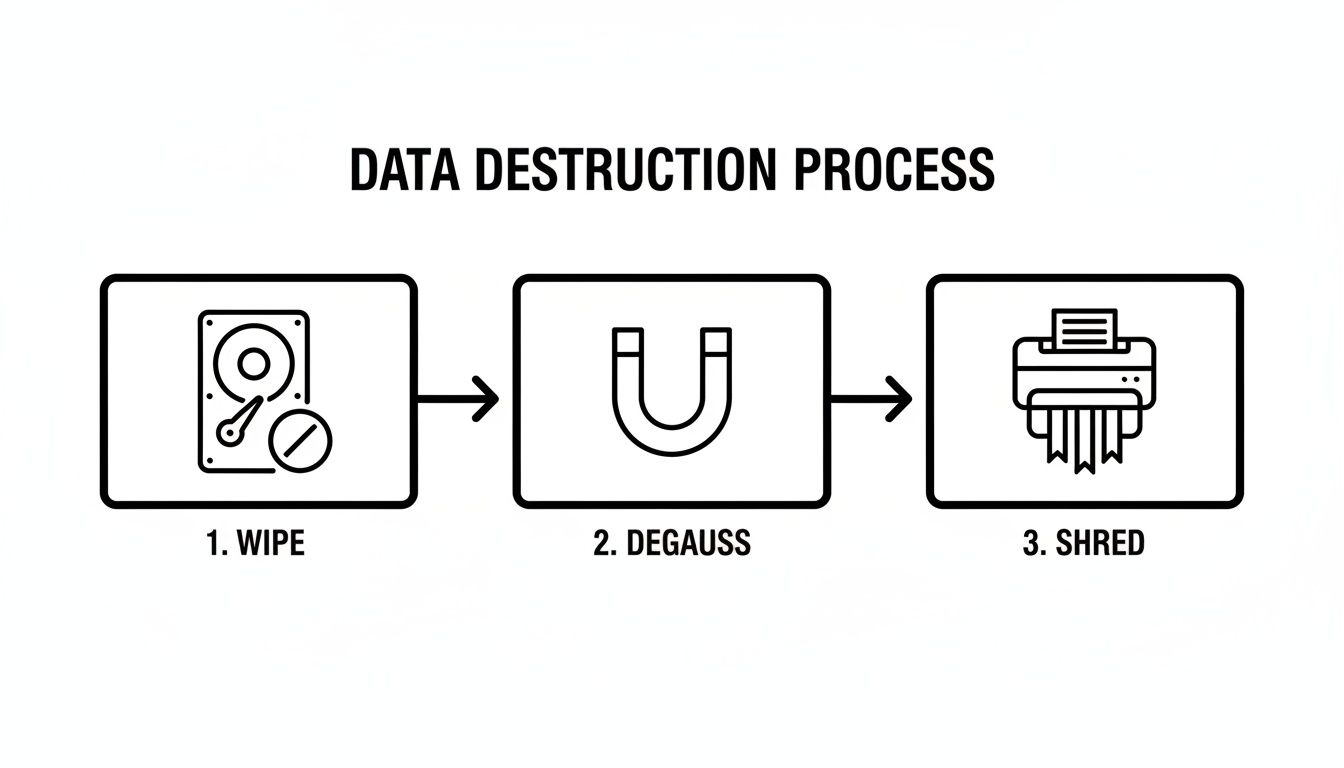
Whether an asset is slated for reuse (wipe) or physical destruction (degauss/shred), the data is handled using fully documented and certified protocols.
Final Checks for a Smooth Pickup Day
On the day of your e-waste pickup, our logistics team will be ready to go. A few final checks on your end will ensure a seamless experience.
Pro Tip: Do a quick walkthrough before our truck arrives. Make sure the path from your staging area to the loading dock or exit is completely clear of obstacles. This simple check saves a surprising amount of time and prevents accidents.
Ensure you have clear access to a loading dock or a ground-level exit where our truck can park. If your staging area is on an upper floor, please confirm that elevators are available and accessible. Giving us a heads-up on these details allows our team to bring the right equipment to get the job done right the first time.
For assets like servers, this kind of planning is essential. You might find our server decommissioning checklist helpful as you prepare for the removal.
What Happens After Your E-Waste Leaves Your Facility
The truck has pulled away from your Frisco office, loaded with your old IT equipment. For many business owners, this is where the process can feel like a black box. You’ve handed everything over, but what happens next? This is the stage where a professional partner’s value really comes through, turning a simple pickup into a documented, secure, and compliant asset disposition journey.
The moment your assets leave your site, they are under our secure transportation protocols. Your equipment isn't just tossed into a truck; it's moved in GPS-tracked vehicles operated by trained logistics personnel. This creates an unbroken, secure chain of custody from your Frisco loading dock directly to our controlled processing facility.
The Arrival and Auditing Process
Upon arrival at our secure facility, your equipment is carefully unloaded into a monitored receiving area. The first and most critical step is reconciliation, where we check the initial inventory you prepared against the physical assets we've received.
Every single item—each server, laptop, and monitor—is accounted for. This audit isn't just a formality; it confirms that every asset that left your facility has arrived safely and is ready for processing. It also identifies any discrepancies immediately, ensuring total transparency.
This meticulous auditing process is the foundation of a trustworthy e-waste pickup Frisco service. It’s the first checkpoint that guarantees full accountability.
Sorting and Data Destruction
Once the audit is complete, your assets are sorted based on their final disposition path. This is a crucial decision point where we triage equipment for either reuse and refurbishment or responsible recycling.
Any device containing data—like hard drives, SSDs, or server arrays—is immediately segregated and moved to a secure data destruction area. This is where we perform certified methods like wiping, degaussing, or physical shredding. The key here is that all data destruction is verified and documented by serial number.
A key insight for Frisco businesses is that the journey to a certified facility is just the beginning. The real work involves detailed auditing, secure data handling, and responsible material processing—all of which must be documented to protect your company.
This documented process is your shield against future liability. You can learn more about how we integrate secure destruction into our services by reading about our shred and recycle solutions. It's this level of detail that separates a professional ITAD partner from a simple scrap hauler.
The Final Reporting and Your Proof of Compliance
After all processing is complete, you receive the most important part of the entire service: the final documentation. These reports are far more than just receipts; they are your legal proof that you’ve fulfilled your corporate and environmental responsibilities.
You should expect a complete documentation package that includes:
- A Certificate of Recycling: This document certifies that your non-reusable electronic assets were processed in an environmentally responsible manner, compliant with all local, state, and federal regulations.
- A Certificate of Data Destruction: This critical document lists the serial numbers of every single hard drive and data-bearing device that was destroyed. It specifies the destruction method used and provides an auditable record for compliance with regulations like HIPAA or GLBA.
- A Final Asset Disposition Report: This comprehensive summary reconciles the initial inventory with the final outcome for each asset, showing whether it was resold, recycled, or destroyed.
These documents are essential for your internal audits, corporate social responsibility (CSR) reporting, and demonstrating due diligence. They close the loop on your e-waste project, giving you the peace of mind that comes from a fully transparent and documented process. The clarity and detail of this final paperwork is the ultimate deliverable.
Common Questions About E-Waste Pickup in Frisco
Even with a solid plan, IT managers and business owners in Frisco often have a few final, practical questions before scheduling their first professional e-waste pickup. Getting clear answers to these common concerns is the last step to moving forward confidently.
Based on our experience working with businesses across the DFW metroplex, here are the answers to the questions we hear most often.
What Does an E-Waste Pickup Typically Cost?
This is usually the first question, and the final cost depends on a few key variables. The total volume and types of electronics you have are the biggest factors, along with your specific location in the Frisco area and the level of service required.
For instance, a simple dock-to-dock pickup where your team has already palletized the servers will cost less than a project requiring our crew to perform an "inside pickup"—gathering, inventorying, and packing equipment from multiple floors of your office. Specialized services like on-site hard drive shredding also have their own costs.
However, it's important to know that many professional ITAD partners, including us, often provide free pickups for qualifying loads. If your inventory contains a good amount of valuable, reusable assets like newer servers, networking switches, or a large number of laptops, the remarketing value we can recover from those items can offset the entire service cost. The best way to know for sure is to request an itemized quote that breaks down all potential fees.
Can You Take Our Unusual or Very Old Equipment?
Yes, absolutely. A comprehensive IT Asset Disposition (ITAD) provider is set up to manage a far wider range of electronics than just standard office computers and monitors. We regularly handle pickups that include:
- Specialized Lab Equipment: Devices from medical, scientific, or research environments.
- Telecommunications Systems: Old PBX hardware, VoIP equipment, and legacy phone systems.
- Industrial Electronics: Control panels, automated machinery components, and other factory-floor hardware.
The key is to communicate this upfront. When you schedule your e-waste pickup Frisco service, providing a list of any non-standard items ensures our logistics team arrives with the right equipment and knowledge. This allows us to handle everything safely and correctly, adhering to any specific recycling requirements for that gear.
Don't assume an item is too old or obscure to be recycled. A certified partner has the network and expertise to find a responsible downstream solution for almost any electronic device, preventing it from ending up in a landfill.
What Is the Minimum Amount of Equipment for a Pickup?
Minimums can vary quite a bit between providers. Some companies focus exclusively on massive, enterprise-level cleanouts and aren't set up for smaller jobs. Others, like us, have designed our logistics to be more flexible and accommodate businesses of all sizes in the Frisco area.
For smaller batches of equipment that don't meet the threshold for a dedicated truck, there are usually still great options. We can often schedule your pickup on a consolidated route with other local businesses to maximize efficiency. Some providers might also offer scheduled drop-off days at their facility, which is a perfect solution for just a few items.
The best course of action is to simply ask. A quality partner will be transparent about their minimums and will work with you to find a practical solution, whether it's a scheduled pickup or another arrangement that fits your needs.
How Long Does the Entire Process Take?
Once our truck leaves your facility, you can typically expect the entire disposition process to be completed within 15 to 30 business days. This timeline accounts for all the critical steps needed to guarantee a secure, documented, and compliant outcome.
Here’s what generally happens during that time:
- Transport & Receiving (1-3 days): Your assets are securely transported to our facility and checked in.
- Auditing & Inventory (3-5 days): We perform a detailed reconciliation, matching every asset by serial number against your original inventory list.
- Data Destruction & Processing (5-10 days): We execute and verify all data sanitization, then sort materials for recycling, refurbishment, or remarketing.
- Final Reporting (3-5 days): We compile your complete documentation package, including the Certificate of Data Destruction and Certificate of Recycling.
A reliable partner will provide a clear and realistic timeline in their service agreement. This transparency ensures you know exactly when to expect your final, auditable proof of compliance.
Navigating the complexities of secure IT asset disposition is our specialty. At Dallas Fortworth Computer Recycling, we provide the certified, documented, and reliable e-waste pickup services that Frisco businesses trust. Let us help you turn your e-waste risk into a streamlined, secure solution. Schedule your free consultation and quote today at https://dallasfortworthcomputerrecycling.com.