
Hard drive destruction Frisco: 2026-Ready, Secure Data Elimination
For businesses in Frisco, secure data elimination isn't just an IT task—it's a fundamental security measure. Simply tossing old hard drives is like leaving your company’s confidential files on a park bench in Frisco Square. It creates a massive and unnecessary risk, and professional hard drive destruction Frisco services provide the only guaranteed way to protect your sensitive information.
Why Secure Data Destruction Is Critical in Frisco
Think about a thriving tech company in Hall Park or a busy healthcare clinic near Baylor Scott & White Medical Center. Both organizations create and store enormous amounts of sensitive data, from intellectual property and financial records to protected health information (PHI). When the computers, servers, and other devices holding this data reach their end of life, the risk doesn't just disappear.
Simply deleting files or even reformatting a hard drive isn't enough. It's like wiping a whiteboard with a dry eraser—you can almost always see faint traces of what was written before. With the right tools, data recovery specialists can easily retrieve "deleted" information from discarded drives, leaving your company exposed to serious threats.
The Real Risks of Improper Disposal
Ignoring secure destruction opens the door to severe consequences that can impact every part of your organization. The primary risks fall into three main categories:
- Financial Penalties: A data breach is incredibly expensive. In 2023, the average cost of a breach hit $4.45 million, a figure that can cripple even a successful enterprise. This doesn't even account for potential regulatory fines, which can be even more severe.
- Legal and Compliance Violations: Frisco businesses, especially those in healthcare, finance, and legal sectors, must adhere to strict data privacy laws like HIPAA and FACTA. Failing to prove compliant data destruction can lead to audits, lawsuits, and crippling fines.
- Reputational Damage: Trust is a company's most valuable asset. A public data breach shatters customer confidence, drives away clients, and can cause irreversible damage to your brand's reputation in the community.
The growing demand for data security is undeniable. The global market for hard disk destruction equipment is projected to reach $2,600 million by 2033, driven by the need to combat rising cyber threats and meet stringent regulations.
Ultimately, professional hard drive destruction isn't an expense; it's a vital investment in risk management. It provides a definitive, final step in the data lifecycle, ensuring retired assets cannot become future liabilities. By partnering with a certified expert, you transform a potential vulnerability into a documented security control—a critical component of any modern IT asset disposition and business computer recycling strategy in Frisco.
Understanding Your Data Destruction Options
When it's time to retire old hardware, simply “deleting” files isn't enough to protect your business. Think of it like this: some methods are like scribbling over a sensitive document with a marker, while others are like running that same document through an industrial-grade shredder until it's just confetti. For any Frisco organization handling confidential data, only the second option provides real security.
To make the right choice for hard drive destruction in Frisco, you have to know the difference between the various levels of data sanitization. The methods range from software-based wiping to complete physical obliteration, each offering a different degree of security and compliance assurance.
This decision tree clearly shows how securing old hard drives is a direct path to preventing a costly data breach.
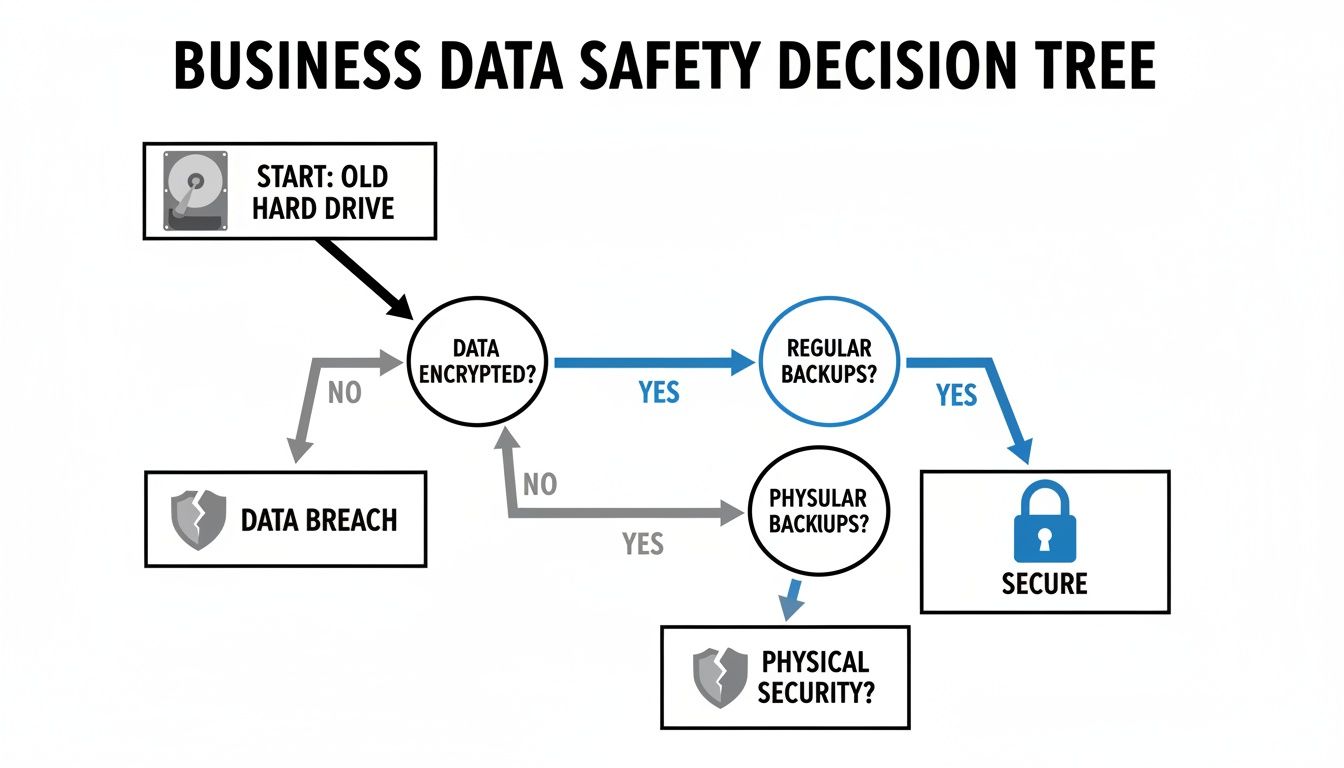
As the graphic illustrates, the choice is simple: either take proactive steps to secure your retired IT assets or leave your organization exposed to a breach.
Software-Based Wiping
Software wiping, also known as data erasure, uses special programs to overwrite the data on a hard drive with random 1s and 0s. This process essentially buries the original information under layers of junk data.
Wiping can be a decent option for drives you plan to reuse internally, but it has serious drawbacks for retired assets. It’s slow, requires technical staff to manage, and is completely useless on damaged or non-working drives. Most importantly, the physical drive remains intact, leaving a small but real chance that a determined thief with forensic tools could recover data fragments.
Physical Destruction Methods
For any IT asset that is leaving your control, physical destruction is the only method that guarantees data is 100% unrecoverable. These methods destroy the drive itself, making it physically impossible for anyone to access the information it once held. It’s not just a best practice; it's the industry standard for meeting strict compliance mandates like HIPAA and FACTA.
There are three main approaches to physical destruction, each providing a different level of security.
1. Degaussing
Degaussing uses an incredibly powerful magnetic field to instantly scramble the magnetic coating on a traditional hard disk drive's (HDD) platters. It's like using a giant magnet to completely and permanently erase an old cassette tape. In seconds, the data is gone.
But degaussing has a massive blind spot: it is completely ineffective on Solid-State Drives (SSDs). Since SSDs use flash memory and not magnetic storage, a degausser does nothing to them. As more businesses adopt SSDs, relying only on degaussing creates a major security gap.
2. Crushing
Crushing involves a hydraulic press that punches a hole through or severely bends the hard drive, shattering the internal platters. While this makes the drive unusable and looks destructive, it doesn’t guarantee total data destruction. Skilled forensics experts might still be able to recover data from the remaining platter fragments.
Crushing is certainly better than just tossing a drive in a dumpster, but it falls short of the strict sanitization standards set by the National Institute of Standards and Technology (NIST).
3. Shredding
This is the gold standard. An industrial shredder grabs the entire hard drive—platters, casing, circuit boards and all—and pulverizes it into tiny, useless metal fragments. This process ensures that not a single piece of data can ever be reconstructed. In fact, NIST guidelines warn that over 80% of discarded drives still contain recoverable data if not physically destroyed.
As hardware refresh cycles get shorter, this risk only grows, making physical shredding a non-negotiable part of risk management. To see how we bring this level of security directly to your doorstep, you can learn more about our on-site shredding services for the Dallas area. It's the only way to be certain your company's sensitive data is gone for good.
Data Compliance and Destruction Requirements for Frisco Businesses
For any business in Frisco, especially those in healthcare or finance, data disposal isn't just a best practice—it's a legal requirement. The digital records you handle daily, from patient information to client credit card numbers, are all subject to strict regulations that define how you must destroy them.
Getting this wrong can open your business up to serious financial penalties and legal trouble. Think of it less as a suggestion and more as a set of non-negotiable rules for protecting your customers and your company.
The Key Data Regulations to Know
Several major federal laws require secure data destruction. While the names can be a mouthful, they all share one common goal: protecting sensitive information from falling into the wrong hands. Depending on your industry, your Frisco business is likely governed by one or more of these.
- HIPAA (Health Insurance Portability and Accountability Act): This is mandatory for any healthcare provider, clinic, or related business that handles Protected Health Information (PHI). When a Frisco medical office gets rid of old servers, it’s legally obligated to destroy the hard drives so the PHI is 100% unrecoverable.
- FACTA (Fair and Accurate Credit Transactions Act): This law affects a broad range of businesses, from lenders and auto dealers to any company that handles consumer credit reports. FACTA's Disposal Rule specifically demands the physical destruction of media containing this information. Just tossing an old office PC in a dumpster could be a direct violation.
- PCI-DSS (Payment Card Industry Data Security Standard): Any organization that accepts, processes, or stores credit card data must follow PCI-DSS. This applies to everyone from retailers at Stonebriar Centre to local Frisco e-commerce sites. The standard is clear: stored cardholder data on electronic media must be made unrecoverable once it's no longer needed.
A Frisco financial advisor upgrading office computers can't just wipe the old hard drives and call it a day. To satisfy FACTA and PCI-DSS, those drives must be physically destroyed, and they need proof that the job was done correctly.
Your Legal Shield: The Certificate of Destruction
This is why verifiable hard drive destruction in Frisco is so important. It’s not enough to say you destroyed the drives; you have to be able to prove it. That's the entire purpose of a Certificate of Destruction.
This document is much more than a receipt. It’s your official legal record proving you followed the law and took the necessary steps to protect sensitive data. If an audit or data breach investigation ever occurs, this certificate is your proof of due diligence.
A compliant Certificate of Destruction is an essential part of your risk management strategy. To see exactly what goes into one, you can learn more about what a Certificate of Destruction for hard drives entails and why it's a non-negotiable document.
A legitimate Certificate of Destruction will always include:
- A unique, serialized transaction number
- The date and location where the destruction took place
- A clear description of the destruction method used (e.g., shredding)
- The name of the certified vendor who performed the service
- An official signature from a representative of the vendor
Without this critical paperwork, you have a major gap in your compliance and no official record to back up your data disposal process. Partnering with a certified destruction vendor who provides this documentation isn't just a good idea—it's a fundamental part of doing business responsibly.
The True Cost of DIY Hard Drive Destruction

When your company is ready to retire a stack of old servers or PCs, the idea of destroying the hard drives yourself can seem straightforward. After all, how difficult can it be to take a hammer or a drill to a few drives? While this DIY approach often comes from a well-intentioned goal to control costs, it dangerously overlooks the significant hidden expenses and liabilities involved.
The price of a desktop crusher or a new drill from the hardware store is only the beginning. For any Frisco business, understanding the true costs—in labor, liability, and compliance—is critical before tasking an employee with a job that requires professional expertise.
Labor, Logistics, and Lost Productivity
The first real cost is the drain on your team's time. Think about pulling a skilled IT technician away from a critical network upgrade to spend hours, or even days, manually dismantling computers and attempting to destroy drives one by one. This isn't just inefficient; it's a poor use of your most valuable asset—your skilled employees.
You also have to manage the logistics, which are rarely as simple as they sound.
- Employee Hours: How much time will your staff spend inventorying, removing, and destroying each drive? Every minute spent on this is a minute not spent on revenue-generating projects.
- Space and Tools: Where will this work happen? You need a secure, designated area and the right equipment to handle different media, especially SSDs that can't be reliably destroyed with a drill.
- Risk of Injury: Using improper tools to physically break down hardware creates a very real risk of workplace accidents and potential liability claims.
Then there's the challenge of proper e-waste disposal. Globally, a staggering 136 billion pounds of e-waste were generated in 2022, yet only 22% entered legitimate recycling streams. Simply tossing destroyed drives in a dumpster isn't just bad for the environment; it can also violate local Frisco ordinances and state laws. Learning more about how professional recycling combats e-waste risks on omegaecycles.com puts the scale of this problem into perspective.
The Incalculable Cost of a Single Failure
The biggest risk of a DIY approach is what happens when it fails. A single improperly destroyed drive that falls into the wrong hands can trigger a catastrophic data breach. A hammer blow might shatter the casing, but it often leaves the internal platters intact enough for a determined actor to recover your data with forensic tools.
DIY destruction methods create a false sense of security. They provide the appearance of destruction without the guaranteed, auditable certainty that your data is gone forever. It’s a gamble no business can afford to take.
Worse, a DIY process generates no official Certificate of Destruction. This leaves your organization with a massive compliance hole. If you face an audit, you have no verifiable proof that you followed HIPAA, FACTA, or PCI-DSS requirements for data disposal, leaving you completely exposed.
In contrast, professional hard drive destruction in Frisco is designed to eliminate these variables entirely. A certified vendor provides a documented, compliant, and efficient process from start to finish. It's a strategic investment that saves time, mitigates all risk, and delivers a clear return by providing the auditable proof of your security diligence. It's helpful to first understand how to completely wipe a hard drive and recognize the limitations of software-only methods.
How to Vet a Hard Drive Destruction Vendor

Choosing a partner for hard drive destruction in Frisco is a critical security decision. The right vendor is an extension of your security team, offering a documented and compliant process for handling your end-of-life data. The wrong one can expose your business to the very data breach you’re working to prevent.
Think of it this way: you wouldn't hire a security firm without checking their credentials and references. The same rigor applies here. You need to look past a simple price list and dig into a vendor’s certifications, security protocols, and operational transparency.
This isn't just about getting rid of old hardware. It’s about protecting your data, your reputation, and your bottom line.
The Power of Industry Certifications
Certifications are your fastest way to tell a qualified, professional operator from an unvetted one. They provide independent, third-party proof that a vendor follows strict industry standards for security, employee screening, and operational processes.
When evaluating a vendor, certain certifications are non-negotiable. They show a clear commitment to security and responsible handling that protects your Frisco business from every angle.
Key Certifications for Data Destruction Vendors
These industry-standard credentials provide objective proof that a vendor meets the highest standards for both data security and environmental compliance.
| Certification | What It Guarantees | Why It Matters for Your Frisco Business |
|---|---|---|
| NAID AAA | The vendor is subject to surprise, unannounced audits of their entire security process—from employee background checks to truck security and shred residue size. | This is the gold standard. It provides verifiable proof that your data is being destroyed securely, helping you meet HIPAA, PCI-DSS, and GLBA compliance. |
| R2 | The vendor follows a strict hierarchy of reuse, recycling, and responsible disposal, preventing e-waste from ending up in landfills and ensuring worker safety. | This demonstrates a commitment to environmental responsibility, supporting your corporate social responsibility (CSR) and ESG goals. It also ensures all materials are handled properly after destruction. |
A vendor with both NAID AAA and R2 certifications gives you dual assurance. You get documented proof of top-tier data security and a verified commitment to environmentally sound practices. Without them, you’re just relying on a vendor’s promise.
Demanding a Documented Chain of Custody
The moment your hard drives leave your building, you need to know exactly where they are and who has them. That’s the purpose of a chain of custody—a detailed, unbroken log that tracks your assets from pickup to final destruction.
A proper chain of custody from a professional vendor must include:
- Serialized Asset Tracking: Every single device should be scanned and recorded by its serial number at your Frisco location before it moves an inch.
- Secure, Sealed Transport: Drives should be placed in locked, tamper-evident containers before they are loaded onto the truck.
- Signed Handoffs: Every transfer of custody, from your employee to the vendor’s technician, must be documented with a signature.
- GPS-Tracked Vehicles: For maximum security, the vendor’s trucks should have GPS tracking to monitor their route from your site to the destruction facility.
This level of detail is absolutely essential for compliance. It provides the concrete evidence needed to prove to an auditor that your assets were secure at every step of the process. It's a foundational part of any legitimate ITAD services program for a Frisco-based business.
Verifying Insurance and Downstream Due Diligence
Even with the best protocols, you need to be prepared for the unexpected. A professional data destruction vendor must carry specialized insurance to protect their clients. Always ask for proof of data breach liability insurance. This policy is specifically designed to cover costs if a security failure occurs while your assets are in their care.
Finally, ask them about their downstream partners. After your drives are shredded into tiny fragments, where does the metal and plastic go? A responsible vendor has a thoroughly vetted and audited network of downstream recyclers to ensure every component is managed in an environmentally compliant way. This confirms their commitment to security and responsibility extends all the way to the very end of the line.
Common Questions About Hard Drive Destruction
Even when you know how important secure data disposal is, practical questions always come up during the planning stage. For business owners and IT managers in Frisco, getting clear answers is the key to moving forward with confidence and ensuring total compliance.
Here are some of the most common questions we get about professional hard drive destruction in Frisco. Our goal is to give you direct, real-world answers to help you make the right security decisions for your organization.
Do I Need to Destroy SSDs Differently Than HDDs?
Yes, absolutely. This is one of the most critical details in modern data destruction, and getting it wrong can leave a massive security hole. Traditional Hard Disk Drives (HDDs) and the Solid-State Drives (SSDs) in newer machines store data in completely different ways, which means they must be destroyed differently.
Think of an old HDD as a stack of vinyl records. Data is written magnetically onto spinning platters. A powerful degausser uses a massive magnetic field to completely wipe those "records" clean, scrambling the data beyond recovery.
An SSD, on the other hand, is built more like a circuit board full of tiny light switches. It stores data on flash memory chips with no moving or magnetic parts. Because of this, a degausser has zero effect on an SSD—it would be like trying to erase a light switch with a magnet. It just doesn't work.
For this reason, physical destruction is the only guaranteed way to destroy data on an SSD. The drive must be shredded into fragments so small that the individual memory chips are shattered, making it impossible to repair them or recover any data.
Key Takeaway: A certified destruction partner will use industrial shredders specifically rated for SSDs and other flash media. This ensures that whether your retired assets are old-school HDDs or modern SSDs, the data is destroyed for good, every single time.
What Documentation Should I Expect After the Service?
Proper documentation isn’t just a nice-to-have; it's your proof of compliance and your legal paper trail. After any professional destruction service, you need to receive two key documents that create a complete, auditable record. Without them, you’re left with a serious gap in your security posture.
These two documents work together to tell the complete story of your old hard drives.
- Chain-of-Custody Form: This is your asset’s detailed travel log. It tracks every hard drive from the moment it leaves your Frisco office to its final destruction, listing every serial number, the date and time of pickup, the technician's name, and signatures at every handoff. This proves your assets were never lost or unaccounted for.
- Certificate of Destruction: This is your official, legal proof that the job was done correctly and in line with data privacy laws like HIPAA or FACTA. It certifies the date, location, and method of destruction (e.g., shredding to a specific particle size) and is signed by your certified vendor. This is the document an auditor will ask for.
Think of it like shipping a valuable package. The chain of custody is the tracking information showing its journey, and the Certificate of Destruction is the signed delivery confirmation. You need both for a complete, defensible record.
How Much Does Professional Hard Drive Destruction Cost?
The cost for professional hard drive destruction in Frisco can vary based on a few key factors. While it’s tempting to shop on price alone, it’s better to view this as a small investment in risk management, not just another operational expense.
Pricing is usually determined by:
- Quantity: The total number of drives you have. Most vendors offer volume pricing, where the cost per drive goes down as the quantity goes up.
- Service Type: On-site mobile shredding, where a truck comes to your location, typically costs a bit more because of the added logistics. Off-site destruction at a secure plant is often more cost-effective, especially for larger jobs.
- Media Type: The pricing structure for destroying small media like SSDs, M.2 drives, or backup tapes might differ from standard 3.5-inch HDDs.
- Bundled Services: If hard drive destruction is part of a larger IT asset disposition (ITAD) project that includes computer recycling or server decommissioning, the cost can often be rolled into a more economical package deal.
While there is a direct cost to professional destruction, it’s nothing compared to the potential $4.45 million average cost of a single data breach. Any reputable provider will give you a clear, no-obligation quote upfront, so you know exactly what to expect.
Is Drilling Holes in My Hard Drives Good Enough?
Drilling holes in a hard drive is a common DIY attempt at data destruction, but it is not a secure or compliant method. While it will definitely break the drive, it creates a false sense of security and leaves your company exposed.
A hard drive’s data lives on its platters. Drilling a hole only damages a tiny fraction of those platters, leaving the rest of the data perfectly intact on the remaining surfaces. A determined thief with forensic recovery tools could still piece together sensitive information from those undamaged fragments. It’s like tearing one chapter out of a book—the rest of the story is still there.
More importantly, this approach fails on two critical fronts:
- It doesn’t meet compliance standards: The National Institute of Standards and Technology (NIST) guidelines for media sanitization do not recognize drilling as a valid form of data destruction.
- It leaves you with no proof: You get no Certificate of Destruction, which means you have no legal documentation to show an auditor.
In contrast, professional shredding pulverizes the entire drive—platters, electronics, and all—into tiny, mixed-up pieces. This guarantees complete and irreversible data destruction, giving your Frisco business the absolute certainty and auditable proof it needs.
Don't leave your company's data security to chance. Partner with a certified local expert who guarantees compliant and secure destruction every time. For a transparent quote and a documented process you can trust, contact Dallas Fortworth Computer Recycling today. Our team is ready to help you build a secure and responsible IT asset disposition program. Schedule your secure hard drive destruction service now.