
E Waste Recycling Dallas: e waste recycling dallas for Secure IT Asset Disposal
Every server refresh, office move, or tech upgrade leaves a trail of obsolete electronics. For most Dallas businesses, this old hardware silently piles up in storage closets or forgotten corners of the office. But this isn't just clutter—it's a ticking clock of business risk.
Failing to manage your e waste recycling in Dallas isn't a minor oversight. It can open the door to devastating data breaches and land your company with steep fines for non-compliance.
The Hidden Costs of Outdated Tech for Dallas Businesses
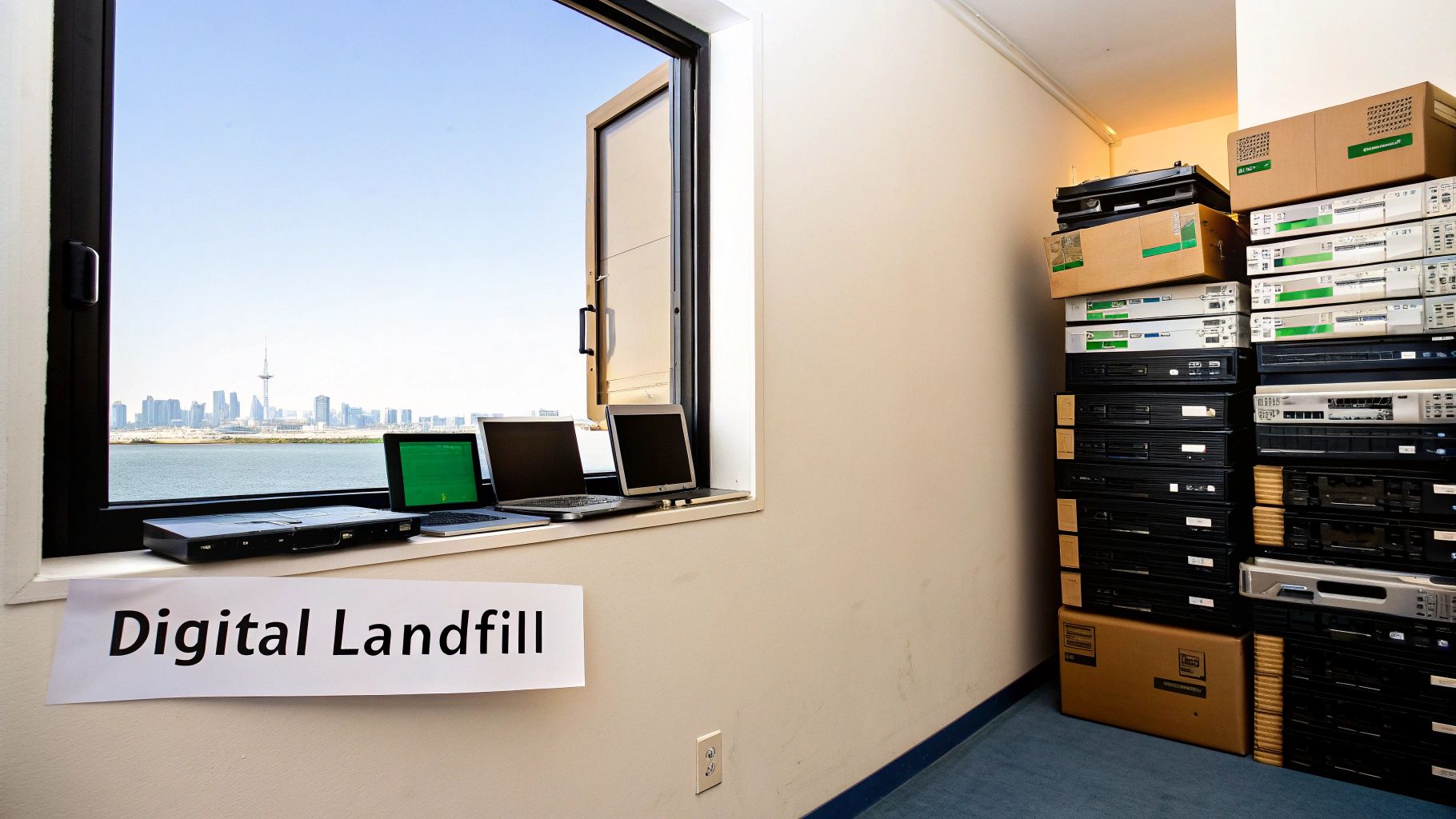
That dusty server room isn't just taking up valuable real estate; it's a vault of potential liabilities. Every old hard drive, laptop, and network switch holds a ghost of its former life—customer data, financial records, and proprietary secrets. Just hitting "delete" or wiping a device isn't a guarantee that the data is gone for good. This leaves your organization dangerously exposed.
And this problem is growing at a frankly alarming rate. In 2022 alone, the world generated a staggering 62 million tonnes of e-waste, which is an 82% increase from 2010. Worse yet, projections show this number surging another 32% to 82 million tonnes by 2030. The need for a real disposal strategy has never been more urgent.
More Than Just a Storage Problem
For IT directors across Dallas, managing this electronic surplus is a constant headache. The pressure to roll out new technology often leaves little time to think about what happens to the old gear. That oversight can have severe consequences that hit your company's reputation and bottom line.
The greatest risk isn't the physical space the old equipment occupies, but the unseen data it still holds. A single forgotten hard drive can become the source of a catastrophic data breach years after it was taken out of service.
Without a formal IT Asset Disposition (ITAD) plan, your business is left vulnerable to several key threats. Failing to properly handle old electronics isn't just about being green; it's about protecting your business from very real financial and legal fallout.
Here's a breakdown of what's at stake:
Key Risks of Improper E-Waste Disposal
| Risk Category | Description | Potential Impact on a Dallas Business |
|---|---|---|
| Data Security Breaches | Discarded drives and devices often contain recoverable sensitive information. Cybercriminals actively target improperly disposed assets. | A single breach can lead to massive financial penalties, customer lawsuits, and irreversible damage to your brand's reputation and trust. |
| Environmental Non-Compliance | Texas has specific regulations for electronics disposal. Tossing old computers or monitors into a dumpster is illegal and violates environmental law. | Your business could face significant fines from state and federal agencies, legal trouble, and negative publicity for environmental negligence. |
| Wasted Asset Value | Many outdated IT assets still hold residual value. Simply storing or trashing them means throwing away money. | You miss out on a potential return on your initial investment. A professional ITAD partner can often refurbish and resell equipment. |
Ultimately, a proactive approach to e waste recycling in Dallas isn't an expense—it's a critical investment in your company's security, compliance, and financial health. When you understand the benefits of e-waste recycling, you can turn what seems like a liability into a genuine strategic advantage.
Understanding Texas E-Waste Regulations
Trying to make sense of the legal side of electronics disposal can feel overwhelming, but for any Dallas business, it's a non-negotiable part of corporate responsibility. These aren't just guidelines; they're state-mandated requirements built to protect both our environment and your sensitive data.
The foundation for all of this is the Texas Computer Equipment Recycling Act. Think of it as the official rulebook for how manufacturers and businesses must handle old computer equipment. It creates a system where manufacturers are on the hook for providing free and convenient recycling options.
What this really means is you can't just toss old office computers, monitors, or laptops into the commercial dumpster out back. Doing that isn't just poor form—it's a direct violation of state law that can bring on some serious penalties.
The Texas Landfill Ban on Electronics
A critical piece of Texas law is the specific ban on sending certain electronics to landfills. This isn’t a minor detail; it’s the teeth behind the law that makes proper e waste recycling in Dallas a legal must-do. The main focus is on computer equipment, which the act defines pretty broadly.
So, what exactly has to be recycled? The regulations specifically call out:
- Computers and Laptops: Your desktops, towers, and portable computers are all covered.
- Monitors: This applies to every type, from the old, heavy CRT models to modern flat-panel displays.
- Keyboards and Mice: The peripherals that ship with a computer fall under this umbrella, too.
Basically, if it's part of a standard computer setup, the state of Texas says it must be recycled, not trashed. This is exactly why finding a qualified, professional recycling partner is so essential for staying compliant.
The regulations are about more than just preventing pollution. They create a "closed-loop" system where manufacturers are financially responsible for recycling the products they sell, making sure hazardous materials like lead and mercury are managed safely from start to finish.
Your Responsibilities as a Dallas Business
Knowing the law is step one, but what really matters is how you apply it to your day-to-day operations. Your company's responsibility doesn't just stop when you unplug an old server. You have to prove that it entered a compliant recycling stream—and have the paperwork to back it up.
This is where the idea of chain of custody becomes so important. You need a clear, documented trail showing exactly where your assets went and how they were handled. Without it, you have no way to verify that your business met its legal obligations. For any company handling sensitive information, finding corporate e-waste solutions that provide detailed reporting isn't just a good idea—it's a critical part of managing risk.
Documentation Proving Compliance
To stay on the right side of Texas regulations, your business must keep records that prove proper disposal. This paperwork is your official proof of compliance if you ever face an audit. Your recycling partner should always provide two key documents:
- Certificate of Recycling: This document confirms your electronic assets were processed according to all state and federal environmental laws. It's your guarantee that the materials were responsibly recycled instead of ending up in a landfill.
- Certificate of Destruction: If your equipment had hard drives or any other data storage, this is absolutely non-negotiable. It gives you a serialized account of every single drive that was physically destroyed, guaranteeing your company's sensitive data is gone for good.
These certificates are your official record, proving you've done your due diligence. They're what protect your business from potential fines and legal headaches down the road.
Why Industry Certifications Are Your Best Insurance Policy

When you hand over your retired IT assets, you're placing an immense amount of trust in your recycling partner. How can you be certain your sensitive data won't be exposed and your equipment won't end up illegally dumped overseas?
The answer isn’t a handshake or a promise—it’s independent, third-party certification.
Think of these certifications as a rigorous background check for e-waste recyclers. They aren't just fancy badges; they're proof that a company has voluntarily submitted its entire process to intense scrutiny by an accredited auditor. A certified vendor has proven they have the systems, security, and ethical standards in place to handle your assets correctly.
Choosing a certified provider for your e waste recycling in Dallas is the single most effective way to protect your business from downstream liability. It’s your insurance policy against data breaches, environmental fines, and reputational damage.
The Gold Standards of Electronics Recycling
While several certifications exist, a few key credentials stand out as the gold standard in the IT asset disposition industry. Each one focuses on a specific, critical aspect of the recycling process, ensuring comprehensive protection for your organization. Understanding them helps you ask the right questions.
These top-tier certifications prove a vendor’s commitment to excellence:
- R2v3 (Responsible Recycling): This is one of the most widely recognized standards, focusing on environmental protection, worker health and safety, and data security through the entire recycling chain.
- e-Stewards: Known for its extremely strict environmental standards, e-Stewards has a zero-tolerance policy for exporting hazardous e-waste to developing countries, ensuring your equipment is never part of a global pollution problem.
- NAID AAA: This certification is laser-focused on one thing: secure data destruction. A NAID AAA certified vendor has passed unannounced audits confirming their procedures for destroying hard drives and other media are foolproof.
An uncertified recycler might offer a lower price, but that price often comes with hidden risks. Certifications act as a guarantee that a vendor has invested in the proper infrastructure, training, and security protocols required to manage your assets without cutting corners.
By working with a certified partner, you're not just hiring a service; you're adopting a vetted, secure, and compliant extension of your own risk management strategy. For a deeper dive, our guide on being an R2 certified electronics recycler breaks down exactly what that standard means for your business's security.
Comparing Key E-Waste and Data Security Certifications
Not all certifications cover the same ground. A recycler holding multiple credentials offers layers of assurance that protect you from every angle—environmental, data security, and operational. Each seal of approval tells a different part of the story about a vendor’s qualifications and commitment to best practices.
Here's a quick comparison of what each primary certification guarantees.
Comparing Key E-Waste and Data Security Certifications
| Certification | Primary Focus | Why It Matters to Your Business |
|---|---|---|
| R2v3 | Environmental Safety & Data Security | Provides a comprehensive framework ensuring your equipment is managed responsibly from pickup to final disposition, covering both environmental and data security risks. |
| e-Stewards | Strict Environmental & Ethical Standards | Guarantees your assets will never be illegally exported, protecting your brand from being associated with environmental harm in developing nations. |
| NAID AAA | Secure Data Destruction | Offers the highest level of assurance that your sensitive data is completely and verifiably destroyed, which is crucial for compliance with laws like HIPAA or FACTA. |
Ultimately, these certifications separate the true professionals from the risky operators in the e waste recycling dallas market. They are your confirmation that a partner's processes aren't just claims, but are audited, verified, and held to the highest industry standards. This verification is essential for protecting your organization's data, reputation, and bottom line.
How to Choose the Right ITAD Partner in Dallas
When you’re looking for a partner for e waste recycling in Dallas, you’re doing more than just comparing prices. You're hiring a guardian for your company's data, a steward for your environmental compliance, and the final link in your asset’s lifecycle. Making the wrong choice isn't just an inconvenience—it can expose your business to staggering data breach risks and serious legal penalties.
This isn't a decision to take lightly. Think of it like bringing on a key employee who will have access to your most sensitive information. You need to look past the sales pitch and really dig into their operations, security protocols, and compliance frameworks. You have to be sure they offer genuine protection.
A true ITAD partner doesn’t just show up with a truck to haul away old equipment. They provide a secure, transparent, and fully auditable process that protects your business from the moment an asset leaves your building to its final disposition. The checklist below covers the essential questions you must ask to tell a top-tier vendor from a risky operator.
Vetting Your Potential Partner
Before you even think about signing a contract, your IT and procurement teams need to do their homework. A trustworthy partner will welcome your questions and provide clear, verifiable answers. Use these points as your guide to confidently size up their capabilities.
Verify Their Certifications: Ask for copies of their R2v3, e-Stewards, and NAID AAA certifications. Don’t just take their word for it. Go to the certifying body's official website and confirm the certificates are current and valid. These credentials are your first and best assurance of their commitment to industry standards.
Inspect Their Facility: Request a tour of their processing facility, either in person or virtually. Look for clear, organized workflows, secure access controls like keycard entry and surveillance cameras, and a generally professional environment. A chaotic or unsecured facility is a massive red flag.
Review Their Insurance Coverage: Any professional ITAD vendor should carry solid insurance policies, including general liability, pollution liability, and—most importantly—cyber and data breach insurance. Ask for their Certificate of Insurance to confirm they have enough coverage to protect you if the worst happens.
The Critical Questions Checklist
Once you've narrowed down your list of potential vendors, it's time to get into the nitty-gritty of their process. How they answer these questions will tell you everything you need to know about the real strength of their security and compliance.
Data Security and Destruction
- What are your specific data destruction methods? They should offer multiple options, like data wiping that meets NIST 800-88 standards for reusable drives and physical shredding for devices at the end of their life.
- Can you perform data destruction services onsite at our facility? Onsite shredding provides the highest level of security because you can witness the destruction yourself before the assets ever leave your control.
- How do you maintain a secure chain of custody? They must be able to describe a detailed, serialized tracking process from pickup to final destruction, all documented with scan-in and scan-out logs at every single step.
Your goal is to find a partner who provides an unbroken, auditable trail for every single data-bearing asset. Vague answers about "secure processing" aren't good enough; demand specifics on serialization, documentation, and reporting.
Logistics and Operations
- Describe your process for pickups. Do they use their own vetted, uniformed employees driving branded, GPS-tracked vehicles? Subcontracting logistics to third parties introduces significant, unnecessary security risks.
- What documentation will we receive upon project completion? A qualified partner will provide a Certificate of Destruction and a Certificate of Recycling that details every single serialized asset they processed. This paperwork is your proof of compliance.
Transparency and Reporting
- Can you provide asset value recovery reports? If you have newer equipment that might be resold, they should have a transparent process for evaluating, testing, and sharing the revenue from those sales. Ask about their fee structure and how they determine fair market value.
- Who are your downstream partners? Certified recyclers are required to vet their downstream vendors (like smelters and refineries). They should be able to explain their auditing process for these partners, ensuring your materials are handled responsibly all the way down the line.
Choosing the right partner for e waste recycling in Dallas is a strategic decision that has a direct impact on your organization's security and reputation. By using this checklist to ask detailed, probing questions, you can move beyond simple price comparisons and select a vendor that delivers true peace of mind.
Achieving Bulletproof Data Destruction and Asset Tracking
For most Dallas businesses, the single biggest concern with retiring old IT equipment is the data left on it. A single server hard drive can hold years of sensitive customer records, financial reports, or proprietary information. Just handing it over and hoping for the best isn't a security strategy—it's a liability waiting to happen.
Real peace of mind comes from a process that is both physically secure and fully auditable. This turns a potential data breach into a verifiable, compliant, and completely documented procedure. Your equipment’s journey must be tracked with precision from the moment it leaves your facility to its final, certified destruction.
Data Wiping vs. Physical Shredding
When it comes to data-bearing devices, there are two primary methods for making sure the information is gone for good: data wiping and physical destruction. They serve different purposes, and knowing the difference is key for both security and getting the most value out of your old assets.
- Data Wiping: This is a software-based approach that overwrites the existing data on a hard drive with random characters, making the original files impossible to recover. It's the perfect choice for newer, functional hard drives that can be refurbished and resold, letting you recoup some of their value. Any reputable partner will use methods compliant with NIST 800-88 standards, the gold standard for secure data erasure.
- Physical Shredding: For the ultimate in data elimination, there’s physical shredding. The hard drive is fed into an industrial shredder that grinds it into small, unrecognizable metal fragments. This is the go-to method for older drives, damaged media, or when your company policy demands absolute, irreversible destruction. There is zero possibility of data recovery.
This visual breaks down the simple but critical process for vetting a partner who can handle these services securely.
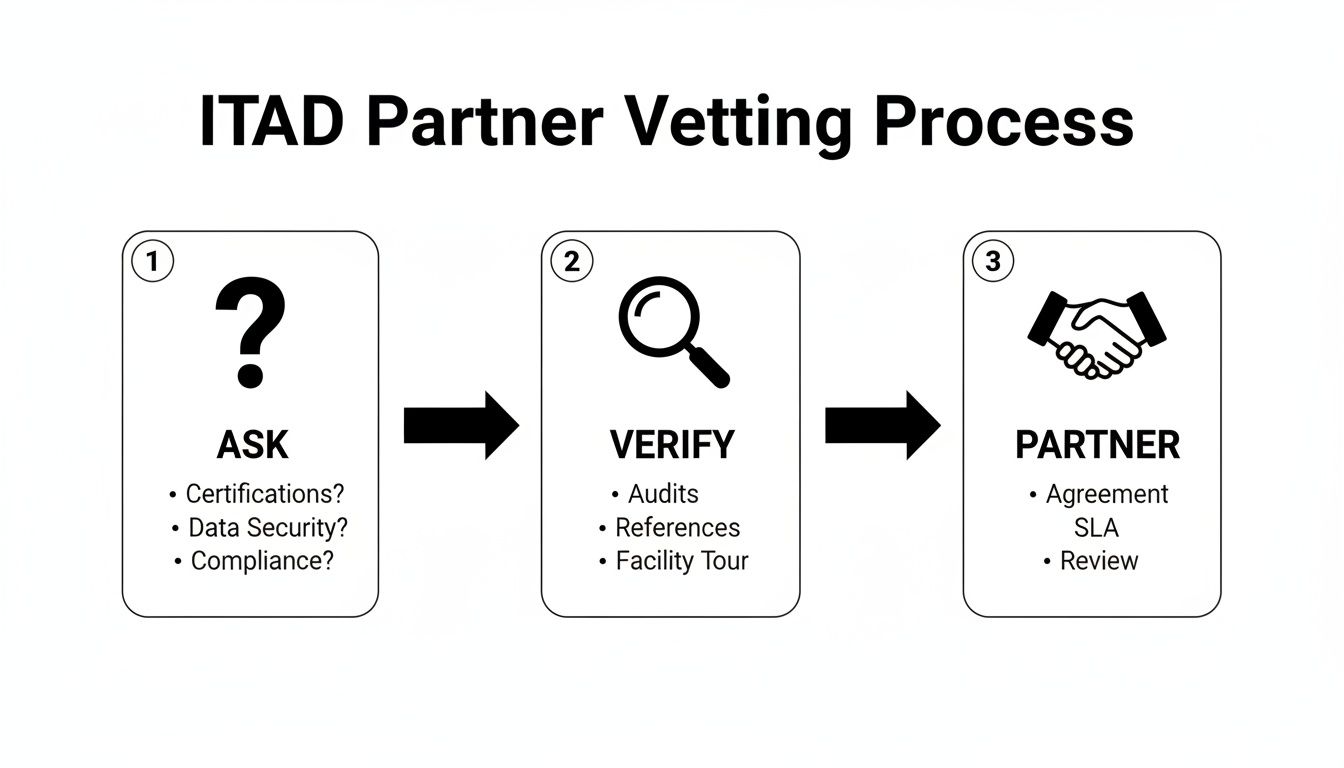
As the infographic shows, a secure partnership is built on asking the right questions, verifying their credentials, and then building a trusted relationship.
The Importance of a Serialized Audit Trail
How do you prove to auditors, stakeholders, or regulators that your data was handled correctly? The answer is a serialized, unbroken chain of custody. This isn't just a promise; it's a tangible, documented process that tracks every single data-bearing device by its unique serial number.
A secure chain of custody means that from the moment our team scans an asset at your Dallas office, its entire journey is logged. Every single touchpoint—from transit and arrival at our secure facility to the final destruction process—is recorded. This creates an auditable paper trail that holds up under any scrutiny.
This level of detail is non-negotiable for any business subject to compliance frameworks like HIPAA, SOX, or GDPR. A generic receipt saying "50 hard drives received" just won't cut it. You need a detailed report that lists each serial number, confirming its secure and final destruction.
This meticulous tracking culminates in a critical document: the Certificate of Destruction. This is your official, legally binding proof that your data has been permanently destroyed according to industry best practices. It's the final piece of the puzzle that closes the loop on your asset's lifecycle and protects your business from future liability. To see what this looks like in practice, you can learn more about the importance of a certificate of destruction for hard drives and how it solidifies your compliance.
Choosing the right partner for e waste recycling in Dallas means finding one that delivers this kind of bulletproof, transparent, and fully documented process. It’s the only way to be absolutely certain your sensitive data is truly gone for good.
Expertly Handling Specialized IT and Medical Equipment
A standard office desktop is one thing, but a server rack from a data center or a diagnostic machine from a hospital is another matter entirely. Not all electronics are created equal. For highly regulated industries in Dallas, the stakes of IT asset disposition are significantly higher, and specialized equipment demands a specialized approach.
Data centers, healthcare facilities, financial institutions, and research labs all rely on high-value, proprietary equipment. Decommissioning these assets involves far more than just unplugging them—it requires meticulous logistical planning, heightened security protocols, and a deep understanding of industry-specific compliance rules.
Think about it: a hospital retiring an old MRI machine or patient monitoring system must ensure all Protected Health Information (PHI) is irrefutably destroyed to comply with HIPAA. In the same way, a bank decommissioning servers has to guarantee that sensitive financial data is completely eliminated, meeting strict regulatory standards.
Data Center Decommissioning Challenges
A complete data center cleanout is one of the most complex projects in the world of e waste recycling in Dallas. These projects often mean dismantling and removing hundreds or even thousands of assets, from server racks and blade servers to network switches and storage arrays.
This process demands a partner with proven experience in large-scale logistics. Key considerations include:
- Onsite Project Management: Coordinating the systematic shutdown, de-installation, and removal of equipment without disrupting your ongoing operations.
- Secure Asset Tagging: Serializing every single asset before it leaves the secure environment to establish an immediate, unbroken chain of custody.
- Specialized Handling: Using the right equipment and trained personnel to safely move heavy, sensitive, and high-value hardware.
Handling a data center decommissioning isn't just a moving job; it's a security operation. Every step, from the initial inventory to the final transport in a secure, GPS-tracked vehicle, must be executed with precision to prevent any asset from going unaccounted for.
Medical and Laboratory Equipment Nuances
Healthcare and lab equipment bring their own unique challenges that go beyond data security. These devices may have been exposed to biohazards or other contaminants, requiring specific sanitation procedures before they can be safely handled, transported, and recycled.
A qualified ITAD partner has to understand these nuances. They need established protocols for handling devices that fall under specific health and safety regulations. This protects everyone involved in the recycling process and shields your organization from potential liabilities tied to the improper handling of medical-grade hardware. For organizations facing these complex scenarios, it is crucial to understand the specifics of data center equipment disposal services in Dallas-Fort Worth to ensure a compliant and secure process.
Ultimately, choosing a partner experienced in these high-stakes environments is non-negotiable. They bring the necessary expertise in security, logistics, and regulatory compliance to manage the unique risks associated with specialized IT, medical, and financial equipment, making sure your organization remains protected.
Your E-Waste Recycling Questions, Answered
Even with a solid plan, you're bound to have a few practical questions when it’s time to retire your company's old IT assets. We get it. Here are some straightforward answers to the questions we hear most often from businesses right here in Dallas.
What Kinds of Electronics Do You Take?
We handle the full spectrum of business and commercial IT hardware. Think servers, laptops, desktops, networking gear like switches and routers, monitors, and printers. Our services are built for B2B needs, whether you're clearing out a small office or decommissioning an entire data center.
We generally don't accept consumer appliances like microwaves, refrigerators, or TVs. The best way to know for sure is to give our team a call to go over your specific inventory list.
How Do We Get Our Old IT Equipment Picked Up?
Scheduling a pickup is simple. You can call us directly or, if you prefer, fill out the service request form on our website to get the ball rolling.
Our logistics team will then connect with you to confirm a few key details:
- The type and amount of equipment you have.
- Any specific access requirements at your facility, like a loading dock.
- A pickup time that works for your team and won’t disrupt your day.
We’ve designed our service to fit seamlessly into the schedules of busy IT departments, making the entire process smooth and efficient.
The most important part of the pickup is ensuring a secure, documented transfer of your assets. Our trained, uniformed technicians arrive in a branded, secure vehicle to start the chain-of-custody process right there at your facility, giving you immediate peace of mind.
What Paperwork Proves Our Data and Equipment Were Handled Correctly?
Once we've completed the job, you’ll receive a full documentation package. This is your official record for compliance audits and internal controls, and it's a non-negotiable part of any responsible e waste recycling dallas program.
This package always includes two key documents:
- A Certificate of Destruction: This is a serialized report listing every single hard drive or data-bearing device we destroyed. It certifies that your sensitive information was eliminated according to strict NIST 800-88 standards.
- A Certificate of Recycling: This document verifies that all your non-data-bearing equipment was processed in an environmentally responsible way, fully compliant with top-tier R2 and e-Stewards standards.
This complete audit trail provides the verifiable, legally sound proof you need to demonstrate corporate due diligence and full regulatory compliance.
Ready to put a secure, compliant, and hassle-free IT asset disposition strategy in place? The team at Dallas Fortworth Computer Recycling is here to help protect your data and meet your environmental goals. Schedule your professional e-waste pickup today.