
Enterprise Telecom Solutions Atlanta: Your 2026 Guide

You’re probably dealing with a telecom environment that grew by accumulation, not by design. A few circuits were added for a branch office. A cloud calling platform came in during a remote work push. Legacy PRI or SIP trunks stayed alive because one call queue still depended on them. Then someone renewed a carrier contract before the larger architecture was settled.
That’s the normal starting point for enterprise telecom solutions Atlanta projects. The actual challenge isn’t choosing a phone system. It’s lining up connectivity, voice, security, support, contracts, and hardware retirement so the upgrade reduces risk instead of redistributing it.
In Atlanta, that often means balancing hybrid work, multi-site operations, regional logistics needs, and compliance demands at the same time. It also means remembering the part many teams postpone until too late: what happens to the old PBX shelves, routers, handsets, edge devices, and telecom servers after cutover. If you ignore that lifecycle step, a clean migration can still end with an audit problem, a data exposure issue, or a pile of equipment nobody wants to own.
Aligning Telecom Strategy with Your Atlanta Business Goals
A telecom overhaul fails when it starts with products instead of business outcomes. If the first conversation is “Should we move to UCaaS?” you’re already too far down the stack. Start with what the business is trying to do over the next contract term.
For one company, the driver is hybrid workforce consistency between Midtown headquarters and remote staff. For another, it’s supporting a warehouse, a clinical office, and a back-office team on one communications policy. For a growing firm opening space in Alpharetta, the primary issue may be speed to provision, not feature depth.
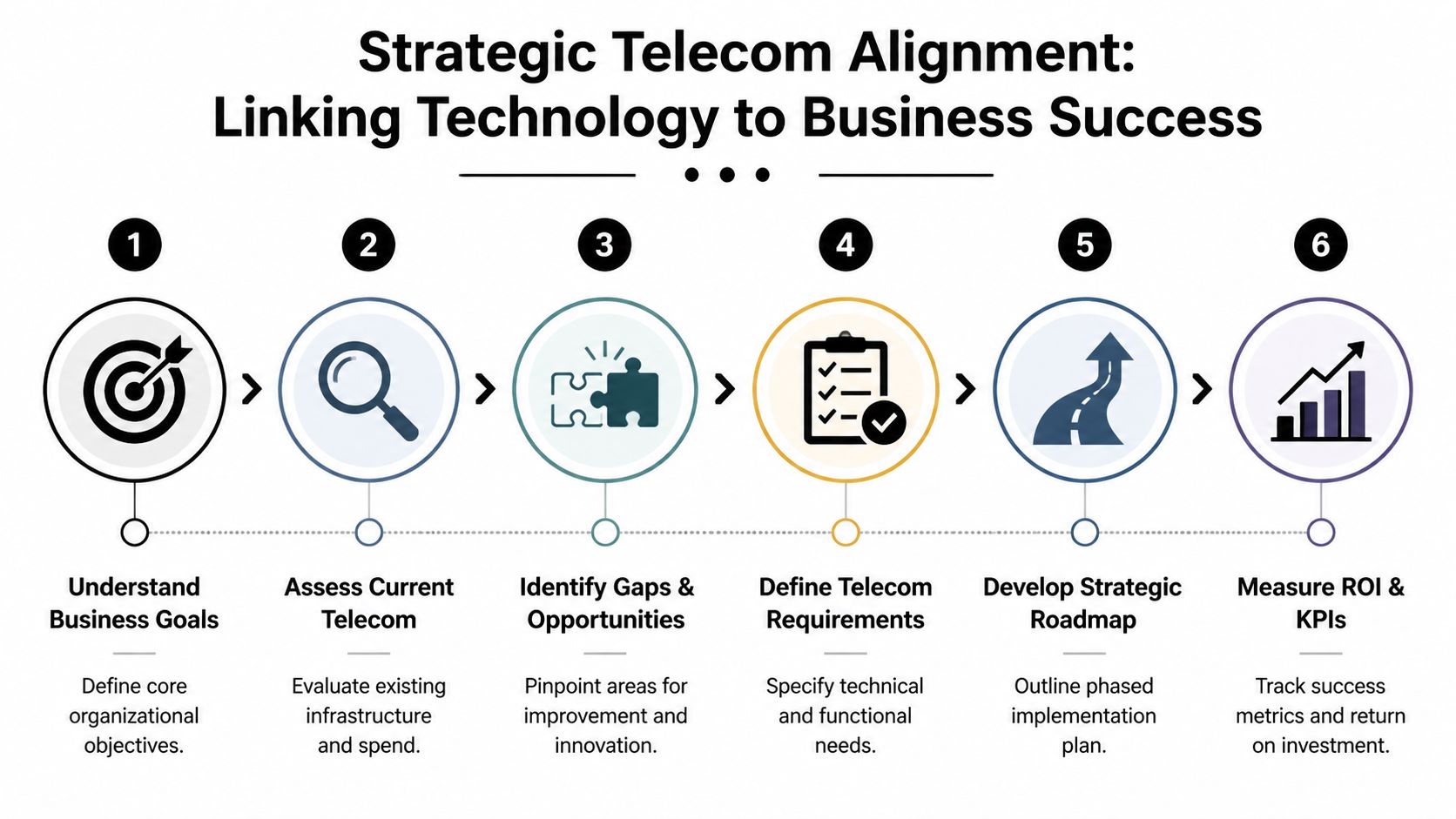
Start with a business audit, not a circuit inventory
The technical audit matters, but it shouldn’t come first. The first pass should identify where communications friction is slowing the business.
Talk to department leaders directly. Sales usually cares about mobile consistency, CRM integration, and call quality during high-volume periods. Operations will focus on uptime, site failover, and whether voice and data dependencies can survive a carrier issue. HR often sees problems that IT misses, especially onboarding delays, desk phone logistics, and inconsistent experiences for remote hires.
Use stakeholder interviews to document:
- Revenue impact points: Which teams lose business when inbound routing fails, voicemail-to-email breaks, or softphone quality drops.
- Service dependencies: Which locations can’t operate if call queues, contact center functions, or ISP redundancy fail.
- Compliance triggers: Which users handle regulated conversations, recordings, or archived communications.
- Expansion needs: Whether the business expects new Atlanta-area sites, relocations, or temporary project offices.
Then run the technical inventory. Map every carrier, every renewal date, every billing account, every phone system component, and every dependency between voice, WAN, firewall, and identity tools.
A solid inventory usually reveals the same issues:
- Duplicate spend on old trunks or licenses nobody wants to disconnect.
- Operational drift where one site uses Microsoft Teams Phone, another uses a standalone VoIP platform, and a third still hangs on to aging PBX hardware.
- Contract misalignment that locks WAN, voice, and support into different renewal windows.
- No clear owner for handsets, cabling, edge devices, or decommissioned gear.
Practical rule: If finance can’t understand the telecom bill and IT can’t explain the failover design on one page, the environment isn’t ready for a clean upgrade.
Build the case in terms executives approve
Executives rarely approve telecom upgrades because “the PBX is old.” They approve them because the project supports hiring, site growth, resilience, customer experience, or compliance.
That means your business case should connect telecom changes to specific operating needs. If the company is competing for talent, consistency for hybrid workers matters. If it’s supporting logistics or distributed operations, resilient connectivity and faster incident response matter. If service quality affects retention, then call routing, queue visibility, and integration quality matter.
Many teams often over-standardize the proposal. Standardization helps support and governance, but users don’t always want one bundled stack for everything. In the broader market, roughly half of SMBs prefer best-of-breed solutions over bundled offerings, which creates complexity for providers and buyers alike. At the same time, operators that simplify the buying experience and tailor messaging by user persona have seen a 30-70% increase in new customer acquisition, according to enterprise telecom market analysis from Credence Research.
That matters even inside your company. Your help desk, contact center supervisors, field leaders, and executives are different user groups. If you present one generic migration story, adoption suffers. If you explain how the design solves each group’s actual work, decisions get easier.
For teams comparing local service structures and rollout considerations, it helps to review the options for telecom services in Atlanta before the architecture conversation gets locked in.
Define success before vendor outreach
Before you speak with carriers or platform vendors, write down the conditions that would make the project successful one year after go-live. Keep it operational, not promotional.
A practical scorecard includes:
| Business objective | Telecom requirement | Evidence of success |
|---|---|---|
| Support hybrid staff | Consistent calling, messaging, and identity policies across devices | Fewer support escalations tied to user location |
| Enable multi-site growth | Fast site turn-up and standardized templates | New offices can be added without custom redesign |
| Improve customer response | Better routing, queue visibility, and continuity planning | Fewer service interruptions during operational events |
| Tighten governance | Clear ownership of contracts, assets, and retired hardware | Audit trail exists from procurement through disposal |
The strongest telecom plans are boring in the best way. Everyone knows what is being replaced, why it is changing, who owns each decision, and what will happen to the old equipment.
That’s the point where strategy becomes useful. You’re no longer shopping for telecom. You’re designing a controlled business system that can survive growth, turnover, audits, and the next round of technology changes.
Evaluating Architecture and Vendor Options in Atlanta
Most enterprise telecom decisions come down to a handful of architectures. The mistake is treating them as ideology. None of them is universally right. They fit different risk profiles, operational models, and support realities.

Matching architecture to operating reality
A UCaaS model works well when the business wants simpler administration, easier user provisioning, and a consistent experience across distributed teams. It’s often the cleanest answer for professional services firms, regional sales teams, and organizations that don’t want voice infrastructure sitting in a server room for another contract cycle.
An on-premise PBX still has a place when a company has specialized workflows, tightly controlled environments, or dependencies that cloud migration won’t cleanly absorb. Some regulated or operationally rigid sites stay on-prem longer because the cost of redesigning connected workflows is higher than maintaining the core platform for a defined period.
A hybrid telecom model is usually the realistic middle ground. It lets you migrate knowledge workers and low-friction workflows to cloud platforms while keeping specific call paths, analog dependencies, paging, door systems, or specialty devices on local infrastructure until they can be retired properly.
SD-WAN isn’t a voice platform, but it often determines whether the voice platform performs well. For multi-site enterprises in Atlanta, it can improve policy control, path selection, and visibility across branches. It’s especially useful when the network grew through acquisitions or site-by-site carrier decisions.
Here’s how I frame architecture choices during peer reviews:
- Choose UCaaS if your pain is administrative sprawl and inconsistent user experience.
- Choose hybrid if you have real legacy dependencies that can’t be ripped out safely.
- Keep selected on-prem elements only when you can document why they still serve a controlled purpose.
- Add SD-WAN when branch performance, failover, and application steering are part of the problem.
Mini-scenarios that reflect real trade-offs
A multi-location healthcare group in Atlanta may prefer a hybrid design. Clinical locations often have specialized analog devices, local workflows, and uptime expectations that make a full cutover risky. In that case, hybrid isn’t hesitation. It’s disciplined sequencing.
A professional services company with heavy mobile use, frequent travel, and a lean infrastructure team often benefits from UCaaS plus strong identity controls. The value isn’t just cloud calling. It’s easier lifecycle management for users, devices, and policy enforcement.
A distribution business serving regional operations may care less about advanced calling features and more about WAN resilience, branch survivability, and whether the network team can manage policy centrally. That points the conversation toward SD-WAN and carrier diversity before anyone debates handset models.
Don’t let a vendor turn “modern” into “cloud-only.” In mature enterprise environments, the better design often looks transitional on paper because it respects operational dependencies.
Vetting vendors beyond demos and pricing
Vendor selection in enterprise telecom solutions Atlanta projects should include both service capability and execution reality. National providers may offer broader platforms, stronger portals, and more packaged bundles. Regional or local carriers may provide better knowledge of local construction constraints, serviceability details, and support escalation paths.
Neither is automatically better. The important question is who owns what.
Ask every vendor these direct questions:
- Network ownership: Which access paths do you own, and which are resold?
- Support model: When service degrades, who opens the carrier ticket and who stays accountable until resolution?
- Implementation staffing: Are migrations run by internal engineers or subcontracted teams?
- Security roadmap: How are zero-trust controls, identity integrations, and future encryption changes being addressed?
- Local execution: Who handles site surveys, dispatch coordination, and building-entry issues in the Atlanta market?
For local market comparison, some teams also review directories of local telecom companies to see how regional providers position support, service reach, and infrastructure ownership.
Security has to be a selection filter
This isn’t optional anymore. In Atlanta’s tech corridor, telecom breaches rose 35%, and newer federal security expectations are pushing vendors toward stronger zero-trust controls. NIST’s 2025 post-quantum mandates are also expected to affect 60% of federal contracts, which makes a vendor’s encryption roadmap more than a niche issue. Those points are summarized in Atlanta enterprise telecom security guidance.
If I’m vetting a telecom provider now, I want a plain answer to five questions:
| Vetting area | What to ask |
|---|---|
| Identity | How does the platform integrate with centralized identity and access control |
| Encryption roadmap | What is your plan for post-quantum readiness in voice and data handling |
| Audit support | What logs, reporting, and evidence can you provide during security review |
| Segmentation | How do you isolate tenants, sites, and administrative roles |
| Incident ownership | Who leads response when the fault crosses provider, carrier, and customer boundaries |
One more warning. A clean demo can hide a weak operational backend. If the vendor can’t explain how they support cutovers, escalations, and post-incident review, they’re selling a portal, not a managed enterprise service.
Mastering the Procurement Process from RFP to SLA
By the time you issue an RFP, the hardest strategic decisions should already be made. Procurement is where discipline replaces assumptions. If the document is vague, vendors will fill the gaps with marketing language, bundled pricing, and exclusions that don’t become obvious until implementation.
A strong RFP forces comparability. It makes providers answer the same operational questions in the same format, so your team can evaluate risk instead of guessing from slide decks.
What belongs in the RFP
Most telecom RFPs spend too much space on features and too little on delivery. Features matter, but implementation quality, support maturity, and contract clarity matter more once the environment goes live.
Include these sections at minimum:
- Current environment summary: Sites, users, major systems, carrier dependencies, and transition constraints.
- Scope of work: Voice, WAN, internet, contact center, SD-WAN, managed edge, security overlays, and hardware handling.
- Implementation method: Discovery, design validation, pilot, cutover sequencing, rollback, and training.
- Support operations: Escalation paths, support hours, severity definitions, and named responsibility boundaries.
- Security and compliance: Identity integration, logging, encryption roadmap, administrative controls, and evidence retention.
- Asset transition: How replaced handsets, PBX equipment, edge appliances, and retired infrastructure will be documented and removed.
Here’s a practical checklist that keeps responses comparable.
| Category | Component | Key Question to Ask |
|---|---|---|
| Business fit | Use case alignment | How does your solution support our specific site mix, user groups, and operating model |
| Technical design | Architecture | What architecture do you recommend, and what assumptions drive that recommendation |
| Implementation | Migration plan | What are the cutover phases, dependencies, rollback steps, and acceptance criteria |
| Support | Service desk | Who handles incidents, what are the escalation paths, and how are handoffs managed |
| Security | Access and controls | How are admin roles, logging, identity integration, and policy enforcement handled |
| Compliance | Documentation | What records do you provide for audits, policy review, and service validation |
| Commercials | Pricing structure | Which costs are recurring, which are one-time, and which items are excluded |
| Contracting | Renewal terms | What auto-renewal, notice, and termination clauses apply |
| SLA | Performance commitments | How are uptime, latency, packet loss, and restoration obligations defined |
| Asset lifecycle | Legacy removal | What happens to replaced hardware, and who owns chain-of-custody documentation |
If you’re pressure-testing local availability and procurement options, it can help to compare broader telecom solutions near me before finalizing your vendor short list.
Force vendors to answer in operational language
Don’t ask, “Do you support migration?” Ask, “Describe the exact sequence for pilot, user validation, cutover weekend, hypercare support, and rollback authority.”
Don’t ask, “Is support available 24/7?” Ask who answers after hours, how severity is assigned, whether telecom incidents are triaged by voice specialists, and how fast a ticket reaches engineering if the outage affects a critical Atlanta office.
Don’t ask, “Do you have security controls?” Ask for the customer-facing controls, admin segregation model, evidence package, and roadmap for future cryptographic requirements.
Procurement works better when every vendor has to explain the ugly parts. Outage handling, failed porting, billing disputes, and hardware retirement reveal more than feature matrices do.
Negotiate the SLA like it will be used
Monthly recurring cost is often negotiated aggressively, with the SLA receiving only a cursory review. That’s backwards. Price differences narrow over time. A weak SLA becomes expensive every time the provider underperforms.
Pay close attention to these areas:
Service definitions
Define what “available” means. If voice registration is up but calls fail, is that counted as service available or degraded service? The contract should say.Measurement boundaries
Clarify where the provider’s responsibility starts and stops. If managed equipment is included, the SLA should account for that. If not, support finger-pointing becomes routine.Response and restoration language
Separate acknowledgment from action. Fast ticket acknowledgment doesn’t fix a broken branch.Credits and remedies
Service credits should be tied to meaningful failures, not token thresholds that never trigger in real incidents.Change control
Require notice for material support changes, portal changes, and any architecture adjustments that affect policy or performance.
A short negotiation worksheet helps internal teams stay aligned:
- Finance cares about total contract exposure, hidden fees, and renewal mechanics.
- IT operations cares about escalation speed, fault isolation, and change control.
- Security cares about access governance, logging, and evidence retention.
- Business leadership cares about continuity at the sites that drive revenue or customer service.
Red flags that deserve immediate pushback
Some proposals look polished but create downstream trouble. Watch for these patterns:
- Bundled pricing with limited detail: Hard to benchmark, harder to audit.
- “Standard SLA” language: Usually means inflexible terms that favor the provider.
- Undefined implementation assumptions: Hidden costs often appear after discovery.
- No hardware exit language: Legacy devices become your cleanup problem.
- Renewal clauses buried in attachments: Procurement teams miss these more often than they should.
The best telecom contract is one your operations team can use during a bad week. If legal, finance, and IT can all read it and reach the same interpretation, you’re in good shape.
Executing a Low-Risk Migration and Compliant Decommissioning
The riskiest day in any telecom project isn’t the day you sign the contract. It’s the day traffic starts moving to the new environment while the old one is still half alive in the background.
That’s when assumptions get tested. Porting windows slip. An analog dependency appears late. A firewall rule that looked harmless in staging becomes a real voice quality issue under load. The migration plan has to absorb that friction without turning the cutover into a business disruption.

How a controlled migration actually runs
The cleanest enterprise migrations don’t happen all at once. They move in phases, and each phase has an owner, a test plan, and a rollback decision point.
A disciplined sequence usually looks like this:
Design validation
Confirm number inventories, routing logic, device counts, integrations, emergency calling requirements, and carrier handoffs before implementation starts.Pilot group migration
Move a limited user group that reflects real complexity. Include people who use mobile apps, desk phones, call queues, voicemail, conferencing, and any business-critical integrations.Site-based waves
Migrate locations in manageable blocks. Keep support staffing visible and local decision-making clear.Hypercare period
Staff the first days after cutover as if issues are expected, because they are. That means named escalation contacts, triage windows, and fast approval paths for changes.Legacy shutdown approval
Don’t power down the old system because the new one “seems fine.” Shut it down only after acceptance criteria are met and dependencies are fully mapped.
For organizations handling multiple sites, voice transitions often overlap with wider infrastructure work. That’s why some IT teams use proven data center migration services as a reference point for sequencing, dependency mapping, and controlled hardware retirement.
Communication is part of the migration plan
End-user confusion causes avoidable support volume. So does poor coordination with business leaders. People don’t need a technical lecture. They need the exact changes that affect their work.
A practical communication plan includes:
- Role-based notices: Executives, reception teams, contact center users, branch managers, and remote staff each need different instructions.
- Known-change windows: Tell users when phones may reboot, when apps need re-authentication, and when temporary call handling changes may occur.
- Support path clarity: Publish one support number, one escalation method, and one owner for day-one issues.
- Manager briefing notes: Give department leaders short, usable guidance they can forward without editing.
The migration isn’t complete when calls can be made. It’s complete when the business knows how to work inside the new environment without improvising around it.
The part most teams neglect
Now the uncomfortable question. What happens to the hardware you just replaced?
Many otherwise competent telecom projects often become sloppy. Old PBX cabinets get pushed into storage. Retired routers stay on shelves. Handsets pile up in closets. Nobody closes the loop on data-bearing devices, chain-of-custody, or environmentally compliant disposal.
That’s not a side task. It’s part of the project.
As Atlanta’s telecom environment continues shifting with broader hybrid-cloud adoption, enterprises are retiring large volumes of legacy equipment. In the U.S., 1.2 million telecom servers and PBX units were decommissioned in 2025, and 40% were disposed of non-compliantly. The same market context notes that certified ITAD partners can recover 70-80% of material value and potentially offset migration costs by 15-20%. Those figures are summarized in telecom decommissioning guidance tied to Atlanta migration trends.
What compliant decommissioning should include
If the retired environment handled voice traffic, configurations, call records, credentials, or user data, your decommissioning process needs to be auditable. At minimum, I expect these controls:
| Decommissioning step | What good looks like |
|---|---|
| Asset inventory | Every retired telecom asset is tagged to a site, owner, and disposition path |
| Data handling | Storage-bearing devices are identified before they leave custody |
| Chain of custody | Pickup, transfer, processing, and final disposition are documented |
| Reuse and recycling | Equipment is evaluated for remarketing, parts recovery, or compliant recycling |
| Certificates and reporting | IT and compliance teams receive records they can retain for audits |
This matters for more than environmental housekeeping. It affects security, legal exposure, and cost recovery.
A few practical examples:
- Old call servers and gateways may contain configuration backups, admin credentials, or stored logs.
- Session border controllers and firewalls can carry certificates, policy files, and routing history.
- Voicemail appliances and management servers may still hold sensitive data after service has moved.
- Handsets and edge devices may not hold much value individually, but they still create inventory and disposal control issues at scale.
What works and what fails
What works is assigning decommissioning ownership before cutover. One workstream should own retired hardware inventory, staging, secure transport, and final documentation.
What fails is treating disposal as a facilities problem. Facilities can help with physical logistics, but they shouldn’t be deciding whether a telecom server is data-bearing, whether a PBX shelf needs certified downstream handling, or whether you have enough records for a future audit.
What also fails is indefinite storage. A room full of legacy telecom gear isn’t a strategy. It’s delayed risk.
If the old platform is out of service but still sitting in a closet, your project isn’t fully closed.
The strongest migrations end with a signed acceptance package that includes service validation, updated inventories, retired asset records, and documented disposition outcomes. That’s what turns a telecom upgrade from a technical event into a controlled lifecycle program.
Sustaining and Optimizing Your Telecom Ecosystem
Go-live is where operational discipline starts paying off. It’s also where many teams relax too early. The telecom environment you just implemented will drift unless someone owns performance, cost control, user adoption, and future readiness as an ongoing practice.
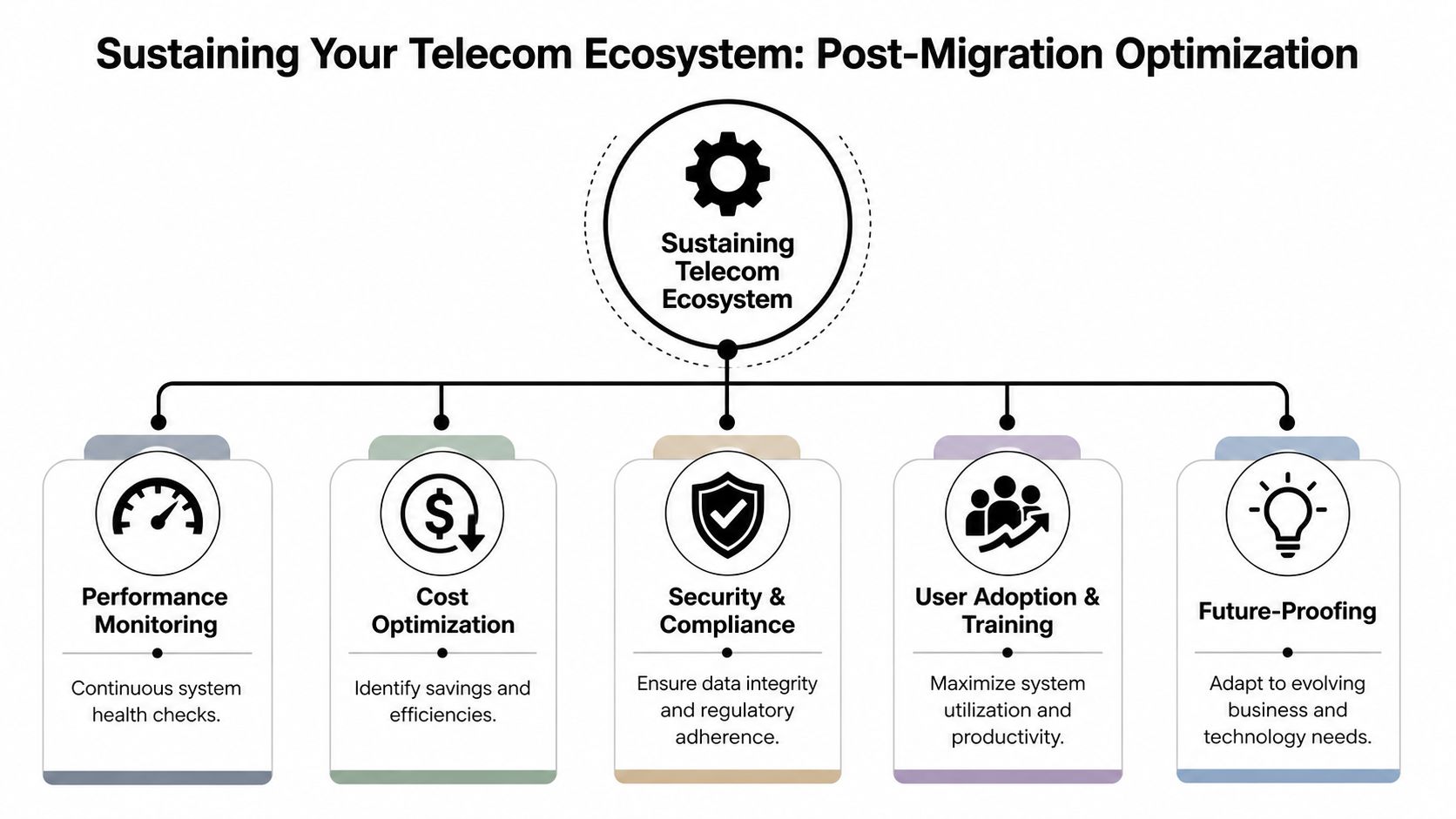
Run telecom like a managed business system
The first post-migration priority is visibility. Build a dashboard that combines service performance, incident trends, license use, and site-level exceptions. Don’t rely on the provider’s monthly summary alone. Your internal view should show whether branches are stable, whether call quality issues cluster around specific networks, and whether users are adopting the tools you paid for.
Invoice review matters just as much. Telecom billing errors often show up after site changes, partial disconnects, or user migrations. A recurring audit against actual inventory catches licenses that should’ve been removed, circuits that should’ve been disconnected, and support line items that no longer match the design.
For teams formalizing ownership after migration, these IT asset management best practices are useful as a governance model for tracking telecom hardware, contract alignment, and retirement workflows.
Keep optimization tied to governance
Post-go-live optimization usually breaks down into five disciplines:
- Performance monitoring: Watch SLA adherence, call quality patterns, and site-specific degradation instead of waiting for complaints.
- Cost optimization: Reconcile invoices to active inventory and remove orphaned services before renewal windows close.
- Security and compliance: Review admin roles, logging, and policy changes regularly so the telecom stack doesn’t become a blind spot.
- User adoption: Revisit training when feature use lags. Underused platforms often look like technical failures when workflow fit is the actual problem.
- Lifecycle control: Keep procurement, deployment, support, and retirement records connected so the next migration starts from clean data.
One forward-looking area deserves executive attention. Autonomous Network Operations is promising, but adoption is still early. Only 20% of operators have achieved Level 4 or 5 maturity in select domains, and realistic deployment timelines are at least 2-3 years, with success heavily dependent on C-suite sponsorship, cross-functional collaboration, and work on technical debt and interoperability first, according to Bain’s review of autonomous network readiness.
That should shape expectations. Don’t buy telecom on the promise of near-term autonomy if the provider can’t demonstrate mature operations today. Build the environment so it’s governable now, interoperable later, and easy to audit throughout its life.
The telecom stack that stays healthy isn’t the one with the most features. It’s the one your team can measure, govern, and retire cleanly when the next change arrives.
If your organization needs a partner for secure retirement of retired PBX equipment, network gear, telecom servers, handsets, or broader infrastructure tied to a migration, Dallas Fortworth Computer Recycling provides nationwide IT asset disposition, certified data destruction, and documented chain-of-custody support for enterprise, healthcare, public-sector, and nonprofit environments. They’re a practical fit when the telecom project doesn’t end at cutover and you need the old hardware handled with the same discipline as the new deployment.