
Hard Drive Shredding Arlington: hard drive shredding Arlington 2026
For Arlington businesses, hard drive shredding is the only method that guarantees sensitive data from old IT assets is gone for good. It’s a physical destruction process that makes data completely unrecoverable, serving as a critical last line of defense against a costly data breach.
Why Shredding Is the Only Real Data Security Solution
Simply deleting files or reformatting a hard drive is like trying to erase a permanent marker by scribbling over it with a pencil. These software-based methods only remove the pointers that tell your computer where to find the files. The actual information remains on the drive, easily recoverable with basic forensic tools.
In a major business center like the Dallas-Fort Worth metroplex, the risk from an improperly retired hard drive is huge. A single discarded device can hold a treasure trove of your most confidential information:
- Customer lists and personal data
- Proprietary financial records
- Employee PII (personally identifiable information)
- Trade secrets and intellectual property
For any Arlington organization, a data breach from an old, carelessly disposed-of drive can be catastrophic. The fallout often includes steep financial penalties, lasting damage to your reputation, and a total loss of customer trust. Physical destruction is the only way to permanently close this security gap.
The Problem With Software Wiping and Degaussing
Software wiping tools, which overwrite data with random characters, are often mistaken for a secure solution. In reality, they can be slow, require careful verification, and frequently fail on drives with bad sectors or physical damage. Even degaussing (using a powerful magnet) can be unreliable with newer drive technologies and offers no visual confirmation of success.
Most importantly, neither method provides the tangible proof of destruction that is often required to pass a compliance audit.
Hard drive shredding physically pulverizes the storage platters where your data lives. Think of it like turning a glass plate into fine sand; there is simply no way to piece the original information back together. This irreversible process is why it's the gold standard for permanent data elimination.
To put it in perspective, here’s how these common methods stack up against each other.
Data Deletion Methods Compared
| Method | Security Level | Risk of Recovery | Best For |
|---|---|---|---|
| File Deletion | Very Low | Very High | Clearing space for temporary files. Never for sensitive data. |
| Drive Formatting | Low | High | Preparing a drive for reuse within the same secure environment. |
| Software Wiping | Medium | Low to Medium | Sanitizing drives for reuse, but requires verification and fails on damaged media. |
| Degaussing | High | Low | Sanitizing magnetic media, but is ineffective on SSDs and provides no proof. |
| Physical Shredding | Absolute | Zero | Permanent, compliant destruction of all sensitive data on any drive type. |
As you can see, when the goal is to ensure data can never be recovered by anyone, shredding is the only reliable choice.
A Growing Necessity For Arlington Businesses
The demand for definitive data destruction is growing fast. The global market, with hard drive shredding as a key service, is projected to jump from $11.93 billion in 2025 to $24.75 billion by 2030. North America accounts for over 40% of this market, driven by businesses and public-sector organizations in tech-heavy areas like Arlington.
With studies revealing that a staggering 91% of breached records originated from improperly retired drives, it’s easy to see why physical destruction has become non-negotiable. You can explore more data destruction market trends on TheBusinessResearchCompany.com.
This makes professional hard drive shredding in Arlington not just a best practice, but a business necessity. For companies in healthcare, finance, or legal services, it's a fundamental requirement for meeting stringent compliance mandates. Learn more about compliant options by reading our guide on secure hard drive disposal methods. Physical destruction provides the certainty and peace of mind that software-based solutions simply can't offer.
A Look Inside The Hard Drive Shredding Process
So, what really happens when you hand over a hard drive for destruction? It's not just a case of feeding it into a big metal-chewing machine. The reality is a precise, industrial process engineered for one thing: absolute data security.
Let's walk through the final journey of a single hard drive, from your facility in Arlington to its complete and irreversible destruction. It all begins with the secure collection and detailed logging of your IT assets. Once the drives arrive at a secure facility—or are loaded into a mobile shredding truck at your location—the physical destruction can begin.
The path an old drive takes, if not managed correctly, almost always creates a significant risk of data theft. The only proven method to break that chain of risk is through certified physical destruction.
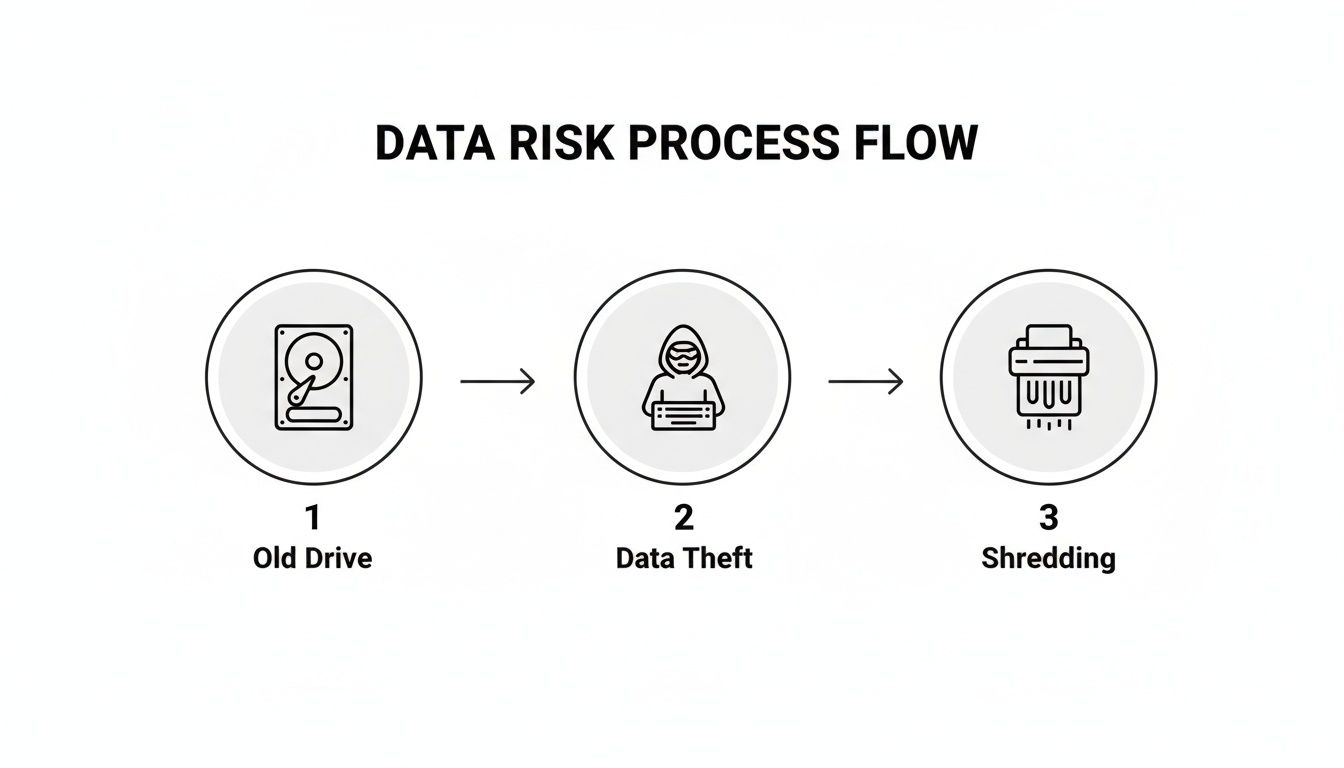
As you can see, professional shredding is the critical intervention that completely neutralizes the threat of a data breach from your retired equipment.
The Heart of The Machine
Drives are fed into an industrial-grade shredder, a powerful piece of machinery equipped with rotating steel blades. These are nothing like the paper shredders in your office; they are built to tear through a drive’s tough metal case, internal platters, controller boards, and every other component inside.
This first pass, often called a coarse shred, typically reduces a drive to metal strips about 1.5 inches wide. For many standard security needs, this is more than enough. But for organizations with higher security requirements, the process goes a step further.
Why Shred Size Is The Ultimate Security Metric
The true measure of security in hard drive shredding comes down to the final particle size. While a coarse shred certainly mangles a drive, a determined attacker with sophisticated forensic tools could theoretically recover data fragments from larger pieces of the platters.
To eliminate this risk, high-security shredding adds a second stage. The coarse strips are fed back into another shredder or passed through a screen with much smaller holes. This cross-cutting action pulverizes the material into tiny, unrecognizable fragments.
The gold standard for government and high-security applications, defined by agencies like the National Security Agency (NSA), is a shred size of just 2mm. At this level, the drive's platters are essentially reduced to metallic dust, making data recovery a physical impossibility.
Think of it as trying to reassemble a shattered photograph from a pile of confetti. The original picture—your data—is gone for good.
Destroying Every Component
A thorough shredding process guarantees the destruction of more than just the magnetic platters. It obliterates every part of the drive that could possibly hold information.
- Platters: These are the spinning disks where the bulk of your data is magnetically stored. Pulverizing them is the primary goal.
- Controller Board: This circuit board manages the drive and often contains cache memory. Shredding destroys these chips completely.
- Read/Write Heads: These are the tiny arms that access data. While they don’t store data long-term, their destruction is part of a complete process.
- Memory Chips (for SSDs): For Solid State Drives, shredding is even more critical. It physically shatters the NAND flash memory chips where data is stored—a task that degaussing simply cannot accomplish.
This complete physical obliteration is why companies offering hard drive shredding in Arlington can provide a Certificate of Destruction. It’s a verified, witnessed process that gives you legal proof of data elimination.
After destruction, the fragments are securely transported for responsible recycling, ensuring both data security and environmental compliance. Many businesses find it beneficial to explore combined services; for instance, you can shred and recycle your IT assets in a single, documented process. This comprehensive approach ensures that from pickup to final recycling, your data is never at risk.
Meeting Compliance Demands with Certified Destruction
For any Arlington business in a regulated field like healthcare, finance, or government contracting, compliance isn't just a buzzword—it's a legal mandate. When it comes to retiring old IT assets, simply hitting "delete" on a file is not enough. Certified hard drive shredding is the only way to get the auditable, physical proof you need to satisfy strict data protection laws.
This isn't just about destroying data. It's about creating a documented, defensible record that proves your organization met its legal obligations to protect sensitive information. Without it, you’re leaving yourself exposed to serious risk.
Staying Compliant with Key Regulations
Several major regulations dictate exactly how organizations must handle data at the end of its life. Professional shredding services are specifically designed to meet and exceed these standards.
HIPAA (Health Insurance Portability and Accountability Act): For any healthcare organization, protecting patient health information (PHI) is non-negotiable. HIPAA demands that PHI on old drives be rendered "unreadable, indecipherable, and otherwise cannot be reconstructed." Physical shredding is the most direct and verifiable method to achieve this.
GLBA (Gramm-Leach-Bliley Act): Financial institutions are required to safeguard consumer financial data. The GLBA Safeguards Rule mandates the secure disposal of customer records, and shredding provides the physical security needed to prevent unauthorized access.
FACTA (Fair and Accurate Credit Transactions Act): This act was created to prevent identity theft by requiring the proper disposal of consumer information. FACTA’s Disposal Rule specifically lists physical destruction as a compliant method for making data unrecoverable.
The stakes are high. The global market for hard drive shredding services was valued at USD 0.72 billion in 2024 and is expected to reach USD 1.2 billion by 2033, driven almost entirely by these strict laws. In some cases, healthcare organizations can face 40% higher compliance fines for improper disposal, which makes certified destruction an essential part of any risk management strategy.
NIST Standards and NAID AAA Certification
Beyond specific laws, the National Institute of Standards and Technology (NIST) offers the gold standard for media sanitization in its Special Publication 800-88. This framework classifies physical destruction (shredding) as the highest and most definitive form of sanitization, labeling it as "Purge."
But just saying you shredded a drive isn’t enough for an auditor. You need proof from a trusted, third-party verified partner. This is where NAID AAA Certification becomes a critical factor for any Arlington business.
NAID AAA Certification is a voluntary but rigorous program for information destruction companies. It sets strict standards for security, employee screening, documented processes, and insurance. Choosing a NAID AAA Certified provider guarantees that your vendor is regularly audited by an independent security professional.
This certification is your assurance that a vendor follows the industry’s highest best practices, from secure chain of custody to the final destruction of your media. It's the single most important credential to look for when vetting a hard drive shredding Arlington service provider.
The Certificate of Destruction: Your Legal Shield
The final step in any certified shredding process is receiving the Certificate of Destruction (CoD). This document is much more than a receipt; it is your official legal proof of compliance.
It serves as the formal record that your company took the necessary steps to responsibly destroy sensitive data. A proper CoD should always include:
- A unique serial number to track the specific service event.
- The date and location of destruction.
- An inventory of the media destroyed, ideally with serial numbers for a complete audit trail.
- A statement of confidentiality confirming all materials were handled securely.
- The signature of an authorized witness from the destruction company.
This document is your shield during a compliance audit, demonstrating due diligence and protecting your organization from liability. To learn more about this critical document, see our guide on what makes a valid Certificate of Destruction for hard drives. It is the final, essential piece of a secure and compliant IT asset disposition strategy.
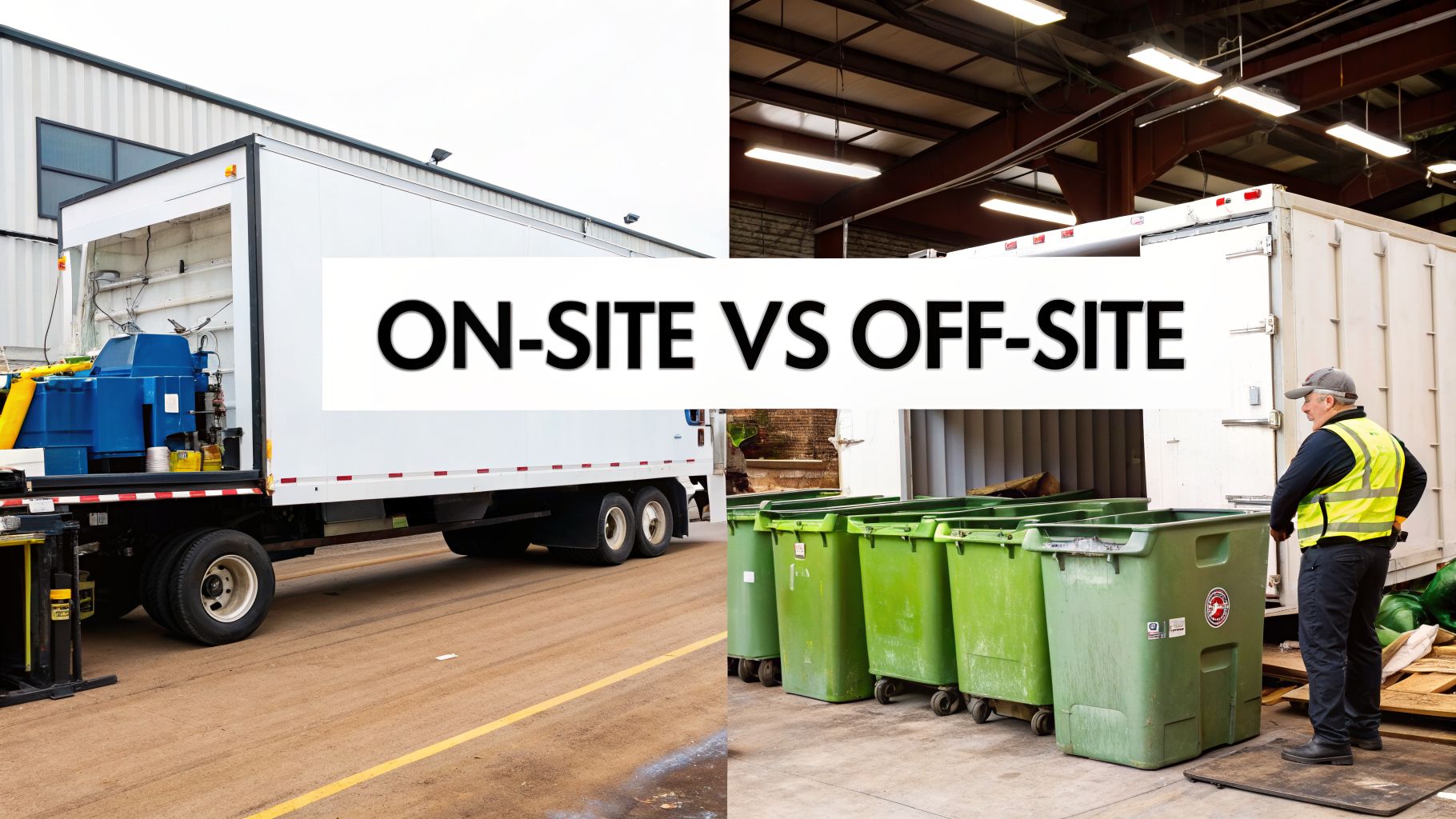
When it comes to destroying hard drives, one of the first questions you'll face is a simple one: should the shredder come to you, or should your drives go to the shredder? For businesses in Arlington, the answer really depends on your security needs, the size of your project, and your budget.
Both on-site (mobile) and off-site (plant-based) shredding provide secure destruction, but they are built for different priorities. Think of it like deciding between a catered event at your office versus hosting it at a restaurant—one offers maximum control and convenience, while the other delivers efficiency at a larger scale. Let's look at which option is the right fit for your organization.
On-Site Shredding: The Ultimate in Security and Peace of Mind
On-site shredding is exactly what it sounds like. A specialized truck equipped with an industrial-grade shredder arrives directly at your business location. Your team can physically witness every hard drive being scanned, logged, and destroyed right there in your parking lot.
This method delivers the highest level of security and is the go-to choice for organizations with strict compliance or confidentiality rules.
- Unbroken Chain of Custody: Your data never leaves your property until it's physically destroyed. This completely eliminates the risks associated with transporting data-bearing drives.
- Immediate Verification: You and your team can watch the destruction happen in real-time. This visual proof is powerful for internal stakeholders and undeniable evidence for any audit.
- Instant Documentation: A Certificate of Destruction, complete with scanned serial numbers, is issued on the spot before the truck ever leaves.
This is the preferred service for healthcare facilities under HIPAA, government contractors, and financial institutions where there is zero tolerance for risk. To see how this process works, you can learn more about our on-site shredding services near you.
Off-Site Shredding: Efficiency for Large-Scale Projects
Off-site shredding is the more traditional, plant-based approach. Your IT assets are collected, inventoried, and secured in a locked, GPS-tracked vehicle for transport to a dedicated destruction facility. At the high-security plant, drives are destroyed under constant camera surveillance, with the entire process documented from start to finish.
While on-site shredding offers peace of mind through witnessing, off-site destruction provides operational efficiency. It's the go-to solution for large-volume projects where watching every single drive get shredded would be impractical.
This service is a perfect match for:
- Large-Scale Disposals: It's ideal for data center decommissioning or company-wide hardware refreshes involving hundreds or thousands of drives.
- Cost-Effectiveness: Off-site services are often more budget-friendly because the provider can process materials from multiple clients efficiently at their centralized plant.
- Comprehensive Services: These facilities can typically handle a wider variety of e-waste along with hard drives, which streamlines your entire asset disposition project.
A certified off-site provider maintains a strict, documented chain of custody from the moment your assets are collected. This model provides fully compliant security with maximum efficiency, making it a reliable and cost-effective choice for many businesses.
To help you decide, here’s a quick comparison of the two service models.
On-Site vs Off-Site Shredding: Which Is Right for You?
Choosing between on-site and off-site shredding depends on what your Arlington business values most: direct oversight or operational scale. This table breaks down the key differences to help you make an informed decision.
| Feature | On-Site Shredding | Off-Site Shredding |
|---|---|---|
| Location | Destruction occurs at your business location on a mobile shred truck. | Drives are securely transported to a dedicated shredding facility. |
| Security | Highest level. You witness the destruction, ensuring a "zero-risk" chain of custody. | High level. Secure transport and plant-based video surveillance. |
| Verification | Immediate, visual confirmation that your drives have been destroyed. | Documented via a Certificate of Destruction and video records. |
| Cost | Typically higher due to dedicated truck and personnel time at your site. | More cost-effective, especially for large volumes. |
| Ideal Use Case | Highly sensitive data (HIPAA, legal, financial) or for maximum peace of mind. | Large-scale projects, data center cleanouts, and budget-conscious disposals. |
| Logistics | Requires scheduling a specific time slot and having space for the truck. | Flexible pickup scheduling; less on-site disruption. |
Ultimately, both on-site and off-site shredding offer secure, compliant solutions. The best choice is the one that aligns with your organization's specific security policies, project scope, and budget.
How to Choose a Hard Drive Shredding Partner in DFW
Selecting a vendor for hard drive shredding in Arlington is one of the most important decisions in your entire IT asset disposition strategy. The right partner acts as a final, critical firewall, protecting your company from data breaches and compliance failures. The wrong one can expose you to catastrophic risk.
Making the right choice means looking past the price tag to evaluate a vendor's security protocols, certifications, and reliability. This isn't just about destroying old equipment; it's about finding a partner you can trust to handle your most sensitive information with absolute integrity. A cheap service that cuts corners on security is no bargain.
Look for NAID AAA Certification
The first and most critical credential to look for is NAID AAA Certification. This isn't just a membership badge; it's a rigorous, ongoing audit of a vendor's entire security process. Certified companies are subject to unannounced inspections covering everything from employee screening and facility security to their vehicles and destruction methods.
Choosing a NAID AAA Certified provider guarantees they adhere to the highest industry standards for secure information destruction. It’s your single best assurance that a vendor’s practices are verified by an independent third party, which is essential for audit trails and proving compliance.
Verify Employee Screening and Training
The people handling your hard drives are a crucial link in the security chain. A reputable partner will conduct thorough, recurring background checks on all employees with access to your sensitive media. This should always include criminal history checks and drug screening.
On top of that, these employees must be formally trained in secure data handling procedures, chain-of-custody protocols, and privacy law requirements. When vetting a vendor, ask them to detail their screening and training programs. A hesitant or vague answer is a major red flag.
Choosing a vendor is like hiring an extension of your own security team. You need to be confident that every person who touches your assets is trustworthy, well-trained, and accountable for following strict security protocols.
Confirm Downstream Liability Insurance
Even with the best procedures in place, you need a plan for the unexpected. That's why specialized liability insurance is non-negotiable. Your shredding partner must carry downstream data liability insurance, which specifically covers them—and you—in the unlikely event of a data breach resulting from their services.
This is completely different from a general business liability policy. Be sure to confirm that the policy covers the full scope of their data destruction work and ask for proof of coverage. This insurance is your financial safety net, providing another essential layer of protection for your Arlington organization.
Review Their Chain of Custody Documentation
A secure process is a documented process. A professional hard drive shredding partner should provide a clear, unbroken chain of custody from the moment your assets leave your facility. This includes:
- Secure Collection: Assets are collected and transported in locked, sealed containers.
- Detailed Inventory: Every single drive is scanned by serial number before destruction.
- Secure Transport: Vehicles are GPS-tracked and operated by fully screened employees.
- Verified Destruction: The final Certificate of Destruction lists every scanned serial number, proving the job was completed.
This meticulous documentation creates an auditable trail, giving you concrete proof of exactly when and how your data was destroyed. It’s your ultimate proof of due diligence.
Ask About Responsible E-Waste Recycling
After your hard drives are shredded into tiny, unreadable fragments, what happens to the leftover material? A responsible partner doesn't just send it to a landfill. The shredded aluminum, steel, and circuit boards should be securely transported to a certified recycling facility for proper processing.
Ask potential vendors about their downstream recycling partners. They should be working with an R2 (Responsible Recycling) or e-Stewards certified facility. This ensures the materials are handled in an environmentally sound manner, protecting your brand's reputation and helping you meet corporate sustainability goals. To understand more about this, you can read our explanation of what it means to be an R2 Certified electronics recycler. This commitment to eco-friendly practices is a true hallmark of a top-tier provider.
Partner With An Expert for Your Arlington Shredding Needs
When your company’s reputation and compliance are on the line, selecting a vendor for hard drive shredding in Arlington is a critical business decision. The right partner provides more than a service; they deliver documented proof of security and a process you can trust. For businesses across the DFW area, Dallas Fortworth Computer Recycling is that partner.
With over 13 years of experience serving North Texas, we have a proven track record working with corporations, data centers, and healthcare organizations. We understand the high stakes involved when a single data breach can lead to significant financial and legal consequences. Our entire operation is built to eliminate that risk.
Our Commitment to Certified Security
We are a security company first. Our processes are designed around the industry’s most demanding standards to ensure your data destruction is auditable, compliant, and absolute.
- NAID AAA Certified Processes: We operate under the strict protocols required for NAID AAA Certification, which means every aspect of our service—from employee background checks to the final destruction—is subject to unannounced, independent audits.
- End-to-End Service: Our expertise goes beyond hard drives. We manage the secure retirement of all your IT assets, providing a single, accountable partner for your organization’s complete IT asset disposition needs.
- A Focus on Regulated Industries: We specialize in serving clients in regulated fields like healthcare who must meet strict HIPAA requirements. Our procedures are built to exceed these compliance standards, providing the documentation needed to pass any audit.
Choosing a partner for data destruction is a decision about risk management. With Dallas Fortworth Computer Recycling, you are investing in a proven, certified process that protects your business, your clients, and your reputation.
A Simple and Transparent Process
We believe securing your data shouldn't be a complicated or stressful process. Our workflow is designed for business efficiency, providing clear communication and full transparency from start to finish. The process begins with a straightforward quote and a scheduled, secure pickup from your Arlington location.
Our professional team handles every detail, whether you opt for on-site or off-site shredding. We meticulously track your assets, perform the certified destruction, and provide you with a detailed Certificate of Destruction. This legally recognized document is your official proof that your data has been permanently destroyed, closing the loop on your compliance obligations. Let our expertise provide the security your organization deserves.
Frequently Asked Questions About Hard Drive Shredding
When you're ready to dispose of old IT assets, you'll naturally have some practical questions. We've put together some straightforward answers to the most common things Arlington businesses ask about hard drive shredding.
How Is Hard Drive Shredding Priced in The Arlington Area?
The cost of hard drive shredding in Arlington usually comes down to a few specifics: how many drives you have, whether you want on-site or off-site service, and the type of media. Most certified shredding providers will charge by the drive or by total weight.
For larger jobs, like decommissioning an entire data center, you'll almost always get a custom quote. The best way to get a solid number is to reach out to a provider with your inventory list for an exact estimate.
Do We Have To Remove Hard Drives From The Computers Ourselves?
No, you don't have to. A full-service IT asset disposition (ITAD) partner can manage the entire process for you. Our professional teams are equipped to come to your location and handle the de-installation of hard drives from desktops, laptops, and servers before they are shredded.
This service frees up your internal IT staff from a time-consuming and tedious task. More importantly, it ensures the chain of custody remains secure and unbroken, with trained technicians handling the assets from start to finish.
A common misconception is that a company’s own IT team needs to pull every drive before the shredding vendor arrives. A true ITAD partner does that heavy lifting for you, integrating into your workflow to ensure the secure and seamless retirement of your equipment.
What Happens To The Shredded Material?
Once your hard drives are turned into tiny fragments and the data is gone for good, the job still isn't done. The shredded mix of aluminum, steel, plastic, and circuit board components is securely transported to a certified e-waste recycling facility.
At the recycling facility, these raw materials are carefully sorted and processed. From there, they are put back into the manufacturing supply chain. This means your data destruction process is not only 100% secure but also environmentally responsible—a key commitment of any reputable shredding partner.
Is Shredding Better Than Degaussing?
While degaussing—using a powerful magnet to wipe data—is an approved method for older magnetic hard disk drives (HDDs), it comes with major drawbacks in a modern IT environment.
- Ineffective on SSDs: Degaussing has zero effect on Solid-State Drives (SSDs), which store data on flash memory chips, not magnetic surfaces.
- No Visual Proof: It leaves the drive physically intact, so you have no visual confirmation that the data has actually been destroyed.
Physical shredding, on the other hand, works on everything. It's completely effective on HDDs, SSDs, backup tapes, and mobile devices. It provides irreversible, physical proof that your data has been destroyed, making it the clear winner for audits, compliance, and total peace of mind.
When you need to be absolutely certain your data is gone forever, work with a certified expert. Dallas Fortworth Computer Recycling provides NAID AAA Certified hard drive shredding services built for the security and compliance needs of businesses across Arlington. Contact us today for a secure, transparent quote.